University of East London Institutional Repository: http://roar.uel.ac.uk
This paper is made available online in accordance with publisher policies. Please scroll down to view the document itself. Please refer to the repository record for this item and our policy information available from the repository home page for further information.
To see the final version of this paper please visit the publisher’s website. Access to the published version may require a subscription.
Author(s):
Mouratidis, Haralambos., Giorgini, Paolo., Manson, Gordon.Article Title:
When Security meets Software Engineering: A case of modelling secure information systemsYear of publication:
2005Citation:
Mouratidis, H., Giorgini, P., Manson, G. (2005) ‘When Security meets Software Engineering: A case of modelling secure information systems’ Information Systems 30(8) 609-629Link to published version:
http://dx.doi.org/10.1016/j.is.2004.06.002
DOI:
10.1016/j.is.2004.06.002When security meets software engineering: A case of modelling
secure information systems
♦♦♦♦Haralambos Mouratidis1∗, Paolo Giorgini2, Gordon Manson1
1Department of Computer Science, University of Sheffield, England#
[email protected], [email protected] 2Department of Information and Communication Technology,
University of Trento, Italy
Abstract. Although security is a crucial issue for information systems,
traditionally, it is considered after the definition of the system. This approach often
leads to problems, which most of the times translate into security vulnerabilities.
From the viewpoint of the traditional security paradigm, it should be possible to
eliminate such problems through better integration of security and software
engineering. This paper firstly argues for the need to develop a methodology that
considers security as an integral part of the whole system development process, and
secondly it contributes to the current state of the art by proposing an approach that
considers security concerns as an integral part of the entire system development
process and by relating this approach with existing work. The different stages of
the approach are described with the aid of a real-life case study; a health and social
care information system.
Keywords: Information system design, requirements analysis, security
engineering.
♦This is an extended and revised version of the “Integrating Security and Systems Engineering: towards the Modeling of Secure Information Systems” paper presented at the 15th International Conference on Advanced
Information systems Engineering (CaiSE 2003) and published in Advanced Information Systems Engineering, J. Eder and M. Missikiff (Eds.), Springer LNCS 2681, 2003.
∗ Corresponding Author
# First author’s present address: School of Computing and Technology, University of East London, Barking Campus,
1 Introduction
As information systems (IS) become more and more critical in every aspect of the
human society, from the health sector to military, so does the demand to secure these
systems. This is mainly because private information is stored in computer systems and
without security, organisations (and individuals) are not willing to share information or
even use the technology.
Consider, for example,a health and social care information system containing health
data of different individuals. Security in such a system, as in any health and social care
information system, is very important since security breaches might result in medical
history to be revealed, and revealing a medical history could have serious consequences
for particular individuals.
Software Engineers consider security as a non-functional requirement, but unlike
other non-functional requirements, such as reliability and performance, security has not
been fully integrated within the development lifecycle and it is still mainly considered
after the design of the system. However, security introduces not only quality
characteristics but also constraints under which the system must operate. Ignoring such
constraints during the development process could lead to serious problems [1], since
security mechanisms would have to be fitted into a pre-existing design, therefore
leading to design challenges that usually translate into software vulnerabilities [33].
We believe that security should be considered during the whole development process
and it should be defined together with the requirements specification. By considering
security only in certain stages of the development process, more likely, security needs
will conflict with functional requirements of the system. Taking security into account
the cases of conflict, by identifying them very early in the system development, and find
ways to overcome them. On the other hand, adding security as an afterthought not only
increases the chances of such a conflict to exist, but it requires huge amount of money
and valuable time to overcome it, once they have been identified (usually a major
rebuild of the system is needed).
However, current methodologies for IS development do not meet the needs for
resolving the security related IS problems [34], and fail to provide evidence of
integrating successfully security concerns throughout the whole range of the
development process.
There are at least two reasons for the lack of support for security engineering [20]:
1. Security requirements are generally difficult to analyse and model. A major
problem in analysing non-functional requirements is that there is a need to
separate functional and non-functional requirements yet, at the same time,
individual non-functional requirements may relate to one or more functional
requirements. If the non-functional requirements are stated separately from the
functional requirements, it is sometimes difficult to see the correspondence
between them. If stated with the functional requirements, it may be difficult to
separate functional and non-functional considerations.
2. Developers lack expertise for secure software development. Many developers,
who are not security specialists, must develop systems that require security
features. Without an appropriate methodology to guide those developers on the
development processes, it is likely that they will fail to produce effective
In this paper we present an approach that integrates security and systems engineering,
using the same concepts and notations, throughout the entire system development
process. This work falls within the context of the Tropos methodology [6, 8] in which
security requirements are considered as an integral part of the whole development
process.
The paper is structured as follows. Section 2 provides an introduction to the Tropos
methodology describing briefly the methodology stages and its concepts. Section 3
describes the security extensions to the Tropos methodology to enable it to model
security issues, whereas section 4 describes a health and social care information system
that is used as a case study throughout the paper. Section 5 illustrates how our approach
integrates security and systems engineering within the Tropos development process and
Section 6 relates our work to the literature by providing an overview of related work.
Finally, section 7 provides directions for future work and it concludes the paper.
2 Tropos methodology
Tropos is a development methodology tailored to describe both the organisational
environment of a system and the system itself. Tropos is characterised by three key
aspects [6, 28]. Firstly, it deals with all the phases of system requirements analysis and
system design and implementation2 adopting a uniform and homogeneous way.
Secondly, Tropos pays great deal of attention to the early requirements analysis that
precedes the specification of the perspective requirements, emphasising the need to
understand the how and why the intended system would meet the organisational goals.
This allows for a more refined analysis of the system dependencies, leading to a better
treatment not only of the system functional requirements but also of its non-functional
requirements, such as security, reliability, and performance [28]. Thirdly, Tropos is
based on the idea of building a model of the system that is incrementally refined and
extended from a conceptual level to executable artefacts, by means of a sequence of
transformational steps [5].
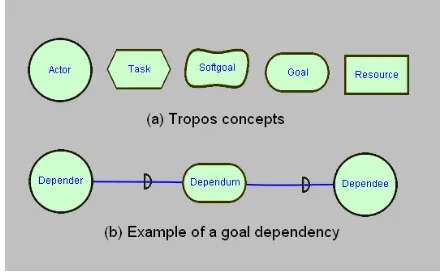
Tropos adopts the i* modelling framework [35], which uses the concepts of actors,
goals, tasks, resources and social dependencies for defining the obligations of actors
(dependees) to other actors (dependers). Actors have strategic goals and intentions
within the system or the organisation and represent (social) agents (organisational,
human or software), roles or positions (represent a set of roles). A goal represents the
strategic interests of an actor. In Tropos we differentiate between hard (only goals
hereafter) and soft goals. The latter having no clear definition or criteria for deciding
whether they are satisfied or not [35]. A task represents a way of doing something.
Thus, for example, a task can be executed in order to satisfy a goal. A resource
represents a physical or an informational entity while a dependency between two actors
indicates that one actor depends on another to accomplish a goal, execute a task, or
deliver a resource. Figure 1a shows the graphical representation of the
[image:6.612.203.426.547.684.2]above-mentioned concepts.
Because of these concepts, in Tropos, the system (as well as its environment) is seen
as a set of actors, who depend on other actors to help them fulfil their goals. The type of
the dependency describes the nature of an agreement (called dependum) between
dependee and depender. Goal dependencies represent delegation of responsibility for
fulfilling a goal; softgoal dependencies are similar to goal dependencies, but their
fulfilment cannot be defined precisely; task dependencies are used in situations where
the dependee is required to perform a given activity; and resource dependencies require
the dependee to provide a resource to the depender. Figure 1b illustrates a graphical
representation of a goal dependency.
Tropos covers four main software development phases:
Early Requirements analysis, concerned with the understanding of a problem by
studying an existing organisational setting. The output of this phase is an organisational
model, which includes relevant actors, their respective dependencies and the security
constraints imposed to those actors.
Late requirements analysis, where the system-to-be is described within its
operational environment, along with relevant functions and security requirements; this
description models the system as a (small) number of actors, which have a number of
dependencies and security constraints. These dependencies define the system’s
functional requirements, while the security constraints define the system’s security
requirements.
Architectural design, where the system’s global architecture is defined in terms of
subsystems, interconnected through data and control flows. Within the framework,
subsystems are represented as actors and data/control interconnections are represented
styles are analysed taking into account security and other non-functional requirements
of the system and secure capabilities are identified and assigned to the different actors
of the system to satisfy the secure entities.
Detailed design, where each architectural component is further defined in terms of
inputs, outputs, control, and the security aspects analysed in the previous stages. For this
stage, Tropos is using elements of AgentUnified Modelling Language (AUML) [3] to
complement the features of i*.
3 The security extensions
Although Tropos was not conceived with security on mind, a set of security concepts,
such as security constraint, secure entities and secure dependencies have been proposed
[25] to enable it to consider security aspects throughout the whole development process.
To enable developers to adequately capture security requirements the concept of
constraint [25] is introduced and it is extended it with respect to security. In addition,
the Tropos concepts of dependency, goal, task, resource, and capabilityare also
extended with security in mind. All these concepts are defined within the Tropos project
as secure entities.
In the context of our work, a security constraint is defined as a restriction related to
security issues, such as privacy, integrity and availability, of an information system that
it can influence the analysis and design of the system under development by restricting
some alternative design solutions, by conflicting with some of the requirements of the
A security constraint contributes to a higher level of abstraction, meaning that security
constraints do not represent specific security protocol restrictions3, which restrict the
design with the use of a particular implementation language. This higher level of
abstraction allows for a generalised design free of models biased to particular
implementation languages.
Moreover, the term secure entityis used within the context of our work to describe
goals, tasks, and resources related to the security of the system. In other words, a secure
entity represents a secure goal, a secure task or a secure resource.
Secure goals are introduced to the system to help in the achievement of a security
constraint. A secure goal does not particularly define how the security constraint can be
achieved, since (as in the definition of goal, see [35]) alternatives can be considered.
However, this is possible through a secure task, since a task specifies a way of doing
something [35]. Thus, a secure task represents a particular way for satisfying a secure
goal. For example, for the secure goalAuthorise Access, we might have secure tasks
such as Check Password or Check Digital Signatures. A resource that is related to a
secure entity or a security constraintis considered a secure resource. For example, an
actor depends on another actor to receive some information and this dependency
(resource dependency) is restricted by a constraint Only Encrypted Info. All these
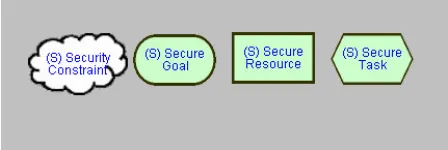
[image:9.612.199.423.573.648.2]security-related concepts are graphically represented as illustrated in Figure 2.
Figure 2: Graphical representation of security-related concepts
The only difference in the representation of non-secure Tropos concepts and secure
concepts is an S (Security) within brackets that appears in the beginning of the security
concept description to indicate that the concept is related to the security of the
information system.
A secure dependency [25] introduces security constraint(s), proposed either by the
depender or the dependee in order to successfully satisfy the dependency. Both the
depender and the dependee must agree for the fulfilment of the security constraint in
order for the secure dependency to be valid. That means the depender expects from the
dependee to satisfy the security constraint(s) and also that the dependee will make an
effort to deliver the dependum by satisfying the security constraint(s).
Secure Tropos differentiates three different types of secure dependency:
• A Dependee Secure Dependency, in which the depender depends on the
dependee and the dependee introduces security constraint(s) for the
dependency.
• A Depender Secure Dependency, in which the depender depends on the
dependee and the depender introduces security constraint(s) for the
dependency.
• A Double Secure Dependency, in which the depender depends on the
dependee and both the depender and the dependee introduce security
constraints for the dependency.
To better understand the concept of secure dependency, consider a dependee secure
dependency where a Doctor (depender) depends on a Patient (dependee) to obtain
Health Information (dependum), and that the Patient imposes to the Doctor the
depender and the dependee must agree in this constraint (or constraints) for the secure
dependency to be valid. That means, the Doctor must satisfy the share health
information only if consent is obtained security constraint introduced by the Patient
in order to help in the achievement of the Obtain Health information secure
[image:11.612.153.471.235.449.2]dependency. The different types of secure dependency are graphically illustrated in
Figure 3.
Figure 3: Secure Dependencies
4 Case Study
This section introduces the case study that will be used in the rest of this paper to
describe the security analysis process throughout the different stages of the Tropos
methodology.
We consider the electronic Single Assessment Process (eSAP) system [27], an
integrated health and social care information system for the effective care of older
people. Security is a very important factor in the development of the electronic single
(a) Dependee Secure Dependency
(b) Depender Secure Dependency
assessment process, since security of personal health information is considered a
priority by many health care unions in different countries of the world including
England. This is due to the fact that in cases where patients (in the case of the eSAP
older people) do not trust the security of the system, they will refuse to provide
complete information about their health and social care needs, and this could lead to
many problems such as wrong assessment of needs, which could lead to wrong care
plans.
Therefore privacy of health and social care information, such as the health and social
care plans used in the electronic single assessment process, is the number one security
concern in such a system. According to Good Medical Practice, patients have a right to
expect that you will not pass on any personal information, which you learn in the course
of your professional duties unless they agree. In addition to that, the English
government and health and social care unions have agreed that electronic health care
records should be at least as well protected as the paper ones.
Other important concerns are integrity and availability. Integrity assures that
information is not corrupted and availability ensures the information is always available
to authorised health and social care professionals. If assessment information is
corrupted or it is not available the care provided to the older people (in the case of the
eSAP) by the health and social care professionals will not be efficient or accurate.
Therefore, it is necessary to find ways to help towards the privacy, the integrity and the
availability of personal health and social care information.
It must be noticed that, in our example, many functionalities of the system are
omitted, since our aim is not to explore the complexity of the system, but rather to
Throughout our case study, the security policy principles identified in [1] are used. In
addition, some more principles are added: (1) System Authorisation, only authorised
professionals and patients can access the system; (2) Access Control, each Care Plan
shall be marked with an access control list naming the people or groups who may read it
and append data to it. The system should prevent anyone not on the list from accessing
the record in any way; (3) Care Plan Opening, a professional may open a care plan with
themselves and the older person on the access control list. When an older person has
been referred, the professional might open a record with themselves, the older person,
and the referring professional on the access control list; (4) Control, only one of the
professionals (most likely the professional responsible for the older person) may alter
the control list, and add other professionals; (5) Information Flow, information derived
from care plan A may be appended to care plan B if and only if B’s Access control list
is contained in A’s; (6) Availability, the information must be available whenever a
person included in the access control list requires any information.
5 The Development Process
5.1 Early Requirements
During the early requirements stage, the goals, dependencies and the security
constraints between the stakeholders (actors) are modelled with the aid of an actors’
diagram [28].
In such a diagram, actors (graphically represented as circles) are modelled together
dependencies (represented as links between the actors indicating the dependum4) and
their security constraints (modelled as clouds).
In the actor’s diagram, imposed security constraints are expressed in high-level
statements.
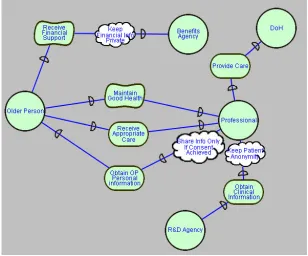
For the eSAP case study, we consider the following actors (see Figure 4)
Professional: the health and/or social care professional;
Older Person: the Older Person (patient) that wishes to receive appropriate
health and social care;
DoH: the English Department of Health;
R&D Agency: a Research and Development Agency interested in obtaining
medical information;
[image:14.612.157.465.397.653.2]Benefits Agency: an agency that helps the older person financially.
Figure 4: Actors Diagram
The main goal for the Older Person actor is to Maintain Good Health5 and a
secondary goal is to Receive Appropriate Care. Since the Older Person cannot
guarantee either of those goals alone, they depend on the Professional to help them
satisfy them. In addition, the Older Person depends on the Benefits Agency to
Receive Financial Support. However, the Older Person worries about the privacy of
their finances so they impose a constraint to the Benefits Agency actor, to keep their
financial information private. The Professional depends on the Older Person to
Obtain OP (Older Person) Information. However one of the most important and
delicate matters for the Older Person is the privacy of their personal medical
information, and the sharing of it. Therefore, most of the times, the Professional is
imposed a constraint to share this information if and only if consent is obtained. On
the other hand, one of the main goals of the R&D Agency is to Obtain Clinical
Information in order to perform tests and research. To get this information the R&D
Agency depends on the Professional. However, the Professional is imposed a
constraint (by the Department of Health) to Keep Patient Anonymity.
When the stakeholders, their goals, the dependencies between them, and the security
constraints have been identified, the next step of this phase is to analyse in more depth
each actor’s goals and the security constraints imposed to them. In addition, secure
entities are introduced to help towards the satisfaction of the imposed security
constraints. In this example, since the paper is focused on the secure Tropos and not in
Tropos in general, we focus only in the analysis of the security constraints, and not in
the goal or task analysis of each individual actor.
To model this, goal diagrams are used. In a goal diagram, each actor is represented as
The nodes of the diagram represent goals, soft-goals, and/or tasks whereas the links
identify the different kinds of relationships between those nodes. Moreover, these links
can be connected with external dependencies (identified in the actor diagram) when the
reasoning of the analysis goes beyond the actor’s boundary [35].
The analysis of the security constraints starts by identifying which goals of the actor
they restrict. This case is known as security constraint assignment. The assignment
of a security constraint to a goal is indicated using a constraint link (a link that has the
“restricts” tag). In addition, different alternatives can be considered for achieving the
goals and the security goals of the stakeholders. For example, during the early
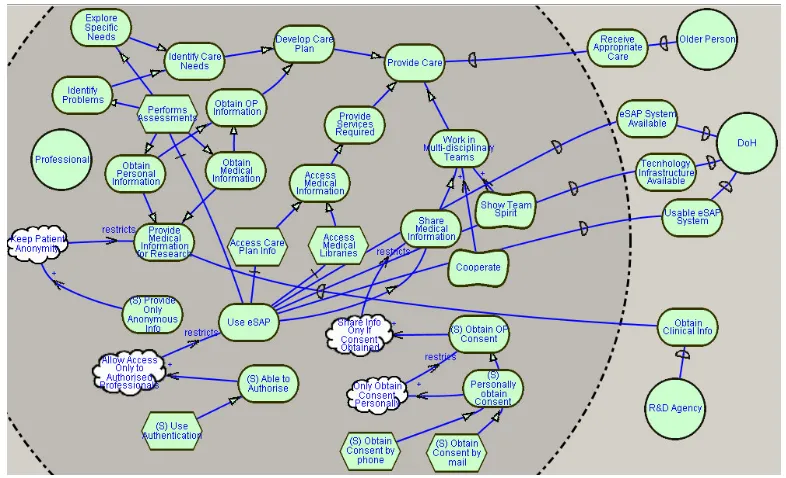
requirements analysis (shown in Figure 4), the Professional actor has been imposed
two security constraints (Share Info Only If Consent Achieved and Keep Patient
Anonymity). By analyzing the Professional actor (as shown in Figure 5) we have
identified the Share Medical Infogoal. However, this goal is restricted by the Share
Info Only If Consent Obtainedconstraint imposed to the Professionalby the Older
Person. For the Professional to satisfy the constraint, a secure goal is introduced
Obtain Older Person Consent. However, this goal can be achieved with many
different ways, for example a Professional can Obtain the Consent Personally or
can Ask a Nurse to obtain the consent on their behalf. Thus a sub-constraint is
introduced, Only Obtain Consent Personally. This sub constraint introduces another
secure goal Personally Obtain Consent. This goal is divided into two sub-tasks
Obtain Consent by Mail or Obtain Consent by Phone. The Professional has also a
goal to Provide Medical Information for Research. However, the constraint Keep
Medical Information for Research goal. As a result of this constraint a secure goal
[image:17.612.109.502.130.369.2]is introduced to the Professional, Provide Only Anonymous Info.
Figure 5: Partial Analysis of the Professional Actor
5.2 Late Requirements
In the late requirements stage, the functional, security, and other non-functional
requirements for the system-to-be are described. The system-to-be is introduced as one
or more actors who have a number of dependencies with the other actors of the
organization (defined during the early requirements stage) and it (the system)
contributes to the goals of the stakeholders.
More specifically, from the security point of view, during the late requirements analysis
stage, security constraints are imposed to the system-to-be. These constraints are further
analysed and security goals and entities necessary for the system to guarantee the
In the presented case study, one of the main aims of the Department of Health is to
allow older people to get more involved in their care and also help professionals provide
more efficient care. For this reason, the Department of Health depends on the
electronic Single Assessment Process (eSAP) system to automate care.
Therefore, the eSAP system has been introduced as another actor that receives the
responsibility for the fulfilment of some of the goals identified during the early
requirements analysis for the actors of the system. In other words, some goals that the
actors of the system cannot fulfil or are better fulfilled by the eSAP system are
delegated to the eSAP System.
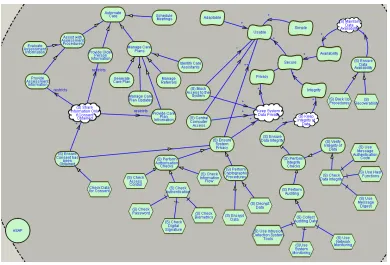
To satisfy all the delegated dependencies, the main goal of the eSAP system has been
identified as to Automate Care. By performing a means-end analysis, presented in
Figure 6, it was identified that for the eSAP System to fulfil the Automate Care goal,
the following sub-goals must be accomplished: Assist with Assessment Procedures,
Provide Older PersonInformation, Manage Care Plans and Schedule Meetings.
Each of those sub-goals can be furthered analysed employing means-end analysis.
For example, the Manage Care Plans goal can be accomplished with the fulfilment of
the Generate Care Plan, Manage Care Plan Updates, Provide Care Plan
Information, Manage Referrals and Identify Care Assistants sub-goals.
From the security point of view, and taking into consideration the security policy
(presented in the previous section) there are three main security constraints imposed, by
the desired security features of the system Privacy, Integrity and Availability, to the
Figure 6: eSAP analysis
These are Keep System Data Private, Keep Integrity of the Data and Maintain
Data Availability. In addition, the eSAP system must satisfy the Share Information
Only if Consent Obtained security constraint imposed to the eSAP by the secure
dependencies delegated by the other actors.
Each of these secure constraints can be satisfied with the aid of one or more secure
goals. For example, the Keep System Data Private security constraint can be fulfilled
by blocking access to the system, by allowing access only from a central computer, or
by ensuring system privacy. However, the two first contribute negatively to the
usability of the system, i.e. the system will be secure but it will not be used. On the
other hand, the Ensure System Privacy secure goal is considered the best solution
since it provides security to the system and it doesn’t affect (dramatically) its usability.
Thus, for the eSAP to satisfy its security constraints the following secure goals have
Ensure Data Availabilityand Ensure Consent has been Obtained. These can be
furthered analysed. For example, the Ensure System Privacy goal is further analysed
into the Perform Authorisation Checks and Perform Cryptographic Procedures
secure goals. Both of those goals must be fulfilled for the Ensure System Privacy
goal to be satisfied.
Each of those tasks can be achieved by considering different alternatives. For
example, in order to check authorisation different alternatives can be considered such
as check passwords, check biometrics or check digital signatures. An approach to
evaluate the different alternatives could be to use the measures of complexity and
criticality [13]. Complexity represents the effort required from an actor for achieving a
(security) task, while criticality represents how the (security) goals of the actor will be
affected if a (security) task is not achieved. Thus, by knowing how complex and how
critical the different alternatives are, we can decide which alternative is the best
solution.
5.3 Architectural Design
The architectural design phase defines the system’s global architecture. During
architectural design the first step is to identify the overall architectural organization by
selecting among alternative architectural styles6 using as criteria the non-functional
requirements of the system identified in the previous stage.
However, quality characteristics (non-functional requirements) are difficult to
measure since it is difficult to get empirical evidence during the design stages.
6 To avoid confusion we must note that architectural styles differ from architectures in that “ a style can be thought of
Nevertheless, a technique is required to allow developers to reason about alternative
design solutions according to the security requirements of their system.
For this reason, we have developed an analysis technique to enable developers to
select among alternative architectural styles using as criteria the non-functional
requirements of the multiagent system under development.
Our analysis process is based on an independent probabilistic model, which uses the
measure of satisfiability proposed by Giorgini et al. [14]. In our example, satisfiability
represents the probability that the non-functional requirement will be satisfied. Thus, the
evaluation results in contribution relationships from the architectural styles to the
probability of satisfying the non- functional requirements of the system identified in the
late requirements stage.
To express the contribution of each style to the satisfiability of each non-functional
requirement of the system, a weight is assigned. Weights take a value between 0 and 1.
For example, 0.1 means the probability that the architectural style will satisfy the
non-functional requirement is very low (the style is not suitable for satisfying the
requirement). On the other hand, a weight of 0.9 means the probability that the
architectural style will satisfy the non-functional requirement is very high (the style is
suitable for satisfying the requirement).
The analysis involves the identification of more specific non-functional requirements,
by refining the ones identified during the late requirements stage, and the evaluation of
different architectural styles against those requirements. It must be noticed that the
refinement of the security requirements took place during the late requirements analysis
with the identification of secure tasks, so from the security point of view, the alternative
In the eSAP system, the security of the system is one of the most important factors
and it is the criterion that will guide the selection process, in this example, for the
appropriate architectural style. As derived from the analysis of the eSAP, security is
decomposed to privacy, integrity and availability.
We consider two architectural styles for our analysis, a hierarchical style –
client/server- and a mobile code style -mobile agents. We decided to consider those
two since client/server is the most frequently encountered of the architectural styles for
network-based applications [11], while mobile agents form a growing and quite
different architectural style. In client/serverstyle, a node is acting as a server that
represents a process that provides services to other nodes, which act as clients. The
server listens for requests upon the offered services. The basic form of client/server does
not constrain how application state is partitioned between client and server components
[11]. Client/serverarchitectural style is also referred to by the mechanisms used for the
connector implementation such as Remote Procedure Call (RPC) [11]. RPC is
appropriate for client/server architectural styles since the client can issue a request and
wait for the server's response before continuing its own processing. On the other side, in
mobile agents style, mobility is used in order to dynamically change the distance
between the processing and source of data or destination of results. The computational
component is moved to the remote site, along with its state, the code it needs and
possibly some data required to perform the task [11].
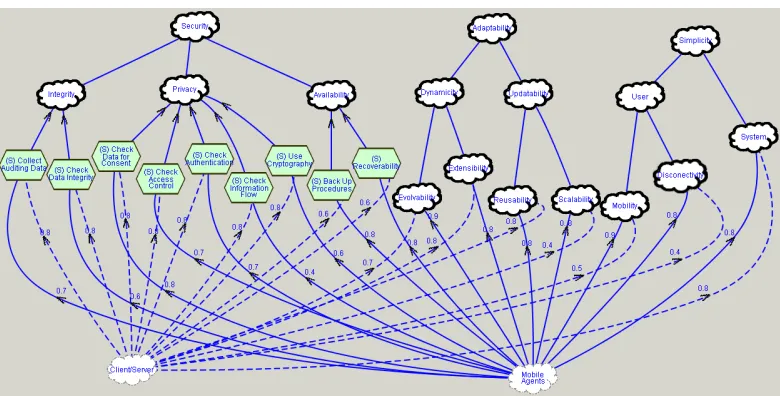
As shown in Figure 7, each of the two styles satisfies differently each of the
Figure 7: Selecting amongst different architectural styles
For instance, the mobile agents style allows more scalable applications (weight 0.8),
because of the dynamic deployment of the mobile code. For example, a doctor wishes to
access a large number of medical information, filtered according to the content. In the
(pure) client/server architectural style (weight 0.4), the doctor would access the server
data (medical information) and all the retrieved information would be transferred to the
client. Then the filtering would be performed at the doctor site. In the mobile agents
architectural style, such a filtering can be performed in the server site, where redundant
information can be identified early and thus does not have to be transferred to the client.
The latter approach is more scalable since the required filtering is distributed and can be
performed close to the information sources.
As concluded from our analysis (illustrated in Figure 7), the client/server style
satisfies more the privacy requirements of the system than the mobile agents style. This
is mainly because mobility is involved in the mobile agents style. Therefore, although
protection of a server from mobile agents, or generally mobile code, is an evolution of
far, prevent malicious behaviour from occurring but may be able to detect it [15].
Consider for example, the Check Information Flowsecure task of the eSAP. The
information flow property is more easily damaged by employing mobile agents (weight
0.4) since possible platforms that a mobile agent could visit might expose sensitive
information from the agent [15, 16]. In the case of the client/server style (weight 0.8)
sensitive information is stored in the server and existing well-proven security measures
could be taken to satisfy the information flow attribute.
On the other hand, the mobile agents style satisfies more, than the client/server style,
the availability requirements of the system. Consider for example the recoverability
secure task of the eSAP. The mobile agents style contributes with a weight of 0.8. This
is due to the fact that mobile agents adapt dynamically. Mobile agents can react to
changes in their environment and maintain an optimal configuration for solving a
particular problem [21].
From the integrity point of view, the client/server style contributes better than the
mobile agents style. In the mobile agents style mobility is involved and therefore
checking the integrity of the data becomes a more difficult task. This is because mobile
agents cannot prevent a malicious agent platform from tampering with their code, state
or data, but they can only take measures to detect this tampering [15, 16]. Moreover, in
the mobile agent style, the integrity of both the local and remote agent platforms must
be checked.
From the above, it can be concluded that the client/server styles contributes more
towards the privacy and integrity of the eSAP, whereas the mobile agents style
It is worth mentioning that the weights of the contribution links reported in figure 7,
of each architectural style to the different non-functional requirements of the system,
have been assigned after reviewing different studies [2,4], evaluations [11], and
comparisons [29] involving the architectural styles. We must also note that figure 7
represents a partial illustration of the comparison process. For example, we have
omitted, in order to keep the figure simple and easy to understand, the contributions and
the conflicts amongst the different non-functional requirements. For example, although
privacy contributes negative to the mobility requirement, this is not shown in the figure.
When the contribution weights for each architectural style to the different
non-functional requirements of the system have been assigned, the best-suited architectural
style is decided. This decision involves the categorization of the non-functional
requirements according to the importance to the system and the identification of the
architectural style that best satisfies the most important non-functional requirement
using a propagation algorithm, such as the one presented by Giorgini et al. [14].
In our example, privacy and integrity are more important (in the case of the eSAP)
than availability (most of the times, not real-time information is needed). As a result,
the client/server style has been chosen as the architectural style of the system
In the case that two or more non-functional requirements are of the same importance,
the presented approach can be integrated with other analysis techniques, such as the
SAAM [18], to indicate which architectural style is best suited for the system-to-be.
As mentioned by Castro et al. [8], an interesting decision that comes up during the
architectural design is whether fulfilment of an actor’s obligations will be accomplished
through assistance from other actors, through delegation, or through decomposition of
evaluated, and one has been chosen, the next step of the architectural design stage
involves the introduction of new actors and their dependencies, as well as the
decomposition of existing actors into sub-actors and the delegation of some (security)
responsibilities from the existing actors to the introduced sub-actors.
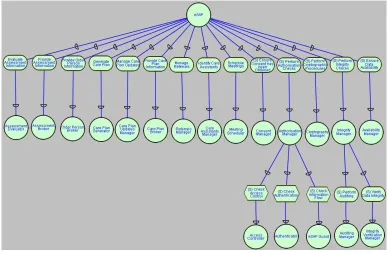
In the presented example, the eSAP actor is decomposed, as shown in figure 8, to
internal actors and the responsibility for the fulfilment of the eSAP’s goals is delegated
[image:26.612.112.500.261.515.2]to these actors.
Figure 8: eSAP decomposition
For instance, the Evaluate Assessment Information goal is delegated to the
Assessment Evaluator, whereas the Provide Assessment Information goal is
delegated to the Assessment Broker. In addition, the Older Person Broker and the
Consent Manager actors have been introduced to the eSAP system to fulfil the
eSAP system to satisfy the secure dependency Obtain Older Person Information
together with the Share Information Only if Consent Obtained security constraint.
Moreover, the eSAP delegates responsibility (see figure 8) for the fulfilment of the
Perform Authorisation Checks security goal to three new actors, the eSAP Guard
(delegated the Check Information Flow secure task),the Authenticator (delegated the
Check Authentication secure task), and the Access Controller (delegated the Check
Access Control secure task)as shown infigure 8.
In addition, the Tropos methodology introduces extended actor diagrams, in which
the new actors and their dependencies with the other actors are presented. Consider for
instance, the extended diagram with respect to the Assessment Evaluator actor, as
depicted in figure 9. The Assessment Evaluator has been delegated the responsibility
to satisfy the goal Evaluate Assessment Information. To fulfil this goal, the
Assessment Evaluator depends on two internal actors, the Assessment Analyser
and the Evaluation Synthesiser. The first is responsible for obtaining the
Assessment Information secure resource, identify the problems of the Older Person
according to the Assessment Information and provide the Problems to the
Evaluation Synthesiser. The latter is responsible for obtaining the Evaluation
Request, and the Problems and providing the Assessment Evaluation secure
resource to the actor requesting the information (in the presented analysis to the Social
Worker) after considering the Problems, the Available Professionals, the Required
Figure 9: An example of an extended diagram
Each of those actors can be furthered decomposed to model more precisely the actor’s
goals and how the actor will achieve these goals. For instance, the Assessment
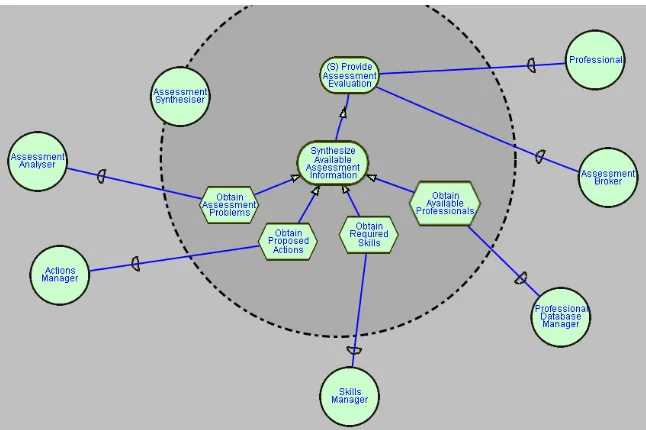
Synthesiser sub-actor of the Assessment Evaluator, can be furthered analysed as
shown in Figure 10. The main goal of the Assessment Synthesiser is to Provide an
Assessment Evaluation.
[image:28.612.150.473.448.663.2]To satisfy this goal, the Assessment Evaluator has to synthesise any information
related to the assessment. To achieve this, the Assessment Evaluator must obtain the
problems associated with the assessment, the proposed actions required to deal with the
identified problems, the skills required to carry out these actions, and the available
professionals that demonstrate the required skills. However, the Assessment
Evaluator cannot achieve these tasks without help. Therefore, the Assessment
Evaluator depends on the Assessment Analyser, the Actions Manager, the Skills
Manager and the Professional Database Manager respectively to satisfy the above
mentioned tasks.
The last step of the architectural design aims to identify capabilities for each of the
actors by taking into account dependency relationships of the actors. A capability
represents the ability of an actor of defining, choosing and executing a plan for the
fulfilment of a goal, given certain world conditions and in presence of a specific event
[28]. For example, the Assessment Evaluator should have capabilities such as get
assessment information, get proposed actions, and provide assessment evaluation.
However, the process of identifying capabilities for each actor has been extensively
described in the literature [6, 26, 28] and thus it is not described here.
From the security point of view, secure capabilities are introduced to the actors to
guarantee the satisfaction of the security constraints. A secure capability represents the
ability of an actor/agent to achieve a secure goal, carry out a secure task and/or deliver a
secure resource.
For example, as identified in the early requirements analysis, for the eSAP system to
satisfy the Ensure System Privacy secure goal, only encrypted data transfers across
from the Professional to the Assessment Analyser (as illustrated in figure 9) must be
encrypted. Because of this, the Professional actor should be provided with capabilities
to encrypt and decrypt data. Later in the detailed design, each agent’s capabilities are
further specified and then coded during the implementation phase
5.4 Detailed Design
During the detailed design each component of the system, identified in the previous
stages, is further specified. In Tropos the detailed design stage is based on the
specifications resulted from the architectural design stage, and the reasons for a given
component can be traced back to the early requirements analysis. In particular, from the
security point of view, during the detailed design the developers specify in detail the
actors’ capabilities and interactions taking into account the security aspects derived
from the previous steps of the analysis.
For the detailed design stage, Tropos adapts a subset of the AUML diagrams
proposed in [3]. These are:
• Capability Diagrams. We use AUML activity diagrams to model a (secure)
capability or a set of capabilities for a specific actor. In each capability diagram,
the starting state is represented by external events, activity nodes model plans,
transition arcs model events, and beliefs are modelled as objects. For instance, in
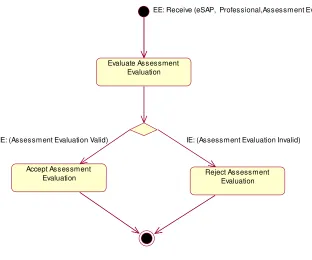
our case study, the Receive Assessment Evaluation capability (see figure 9)
of the Professional actor is illustrated in figure 11. The Professional receives
(external event – EE) the Assessment Evaluation from the eSAP System.
She/he then evaluates the Assessment Evaluation and either accepts it or
Evaluate Assessment Evaluation
Accept Assessment
Evaluation Reject Assessment Evaluation
IE: (Assessment Evaluation Valid) IE: (Assessment Evaluation Invalid)
[image:31.612.136.448.98.358.2]EE: Receive (eSAP, Professional,Assessment Evaluation)
Figure 11: Capability diagram for the Receive Assessment Evaluation Capability
• Plan Diagrams. Plan Diagrams are used to further specify each plan node of a
capability diagram. Figure 12 illustrates the plan diagram for the Evaluate
Assessment Evaluation plan belonging to the capability depicted in the
diagram of figure 11. The plan is activated with the receipt of the Assessment
Evaluation from the Professional and it ends by deciding if the Assessment
Evaluation is valid or invalid (In addition the plan can be terminated if
Assessment Evaluation is not readable). The integrity of the Assessment
Evaluation is checked. If the check is successful the Assessment Evaluation
is received as Valid, else the Assessment Evaluation is considered Invalid
EE: Receive (eSAP, Professional,Assessment Evaluation)
Decrypt Assessment Evaluation
Check Integrity
Not Valid Assessment Evaluation
Valid Assessment Evaluation Read Assessment
Evaluation
Not Encrypted
Integrity Check Failed
[image:32.612.137.510.105.353.2]Assessment Evaluation not Readable
Figure 12: Plan diagram example
• Agent Interaction Diagrams. We apply in our case sequence diagrams
modelling agent Interaction Protocols as proposed by [2]. An example of an
Agent Interaction Diagram is shown in figure 13. This diagram illustrates
interactions (illustrated as arrow-lines) between the Professional, the eSAP
Guard, the Cryptography Manager and the Authenticator agents (graphically
illustrated as rectangles at the top of the diagram). The Professional sends a
system access request to the eSAP Guard. The eSAP Guard decrypts the
incoming request (with the aid of the Cryptography Manager) and checks if
the Professional has authentication clearance (with the aid of the
Authenticator).
However, it would be useful to denote under what constraints authentication
authentication clearance if the details of the Professional are valid, and the eSAP
Guard provides access to the eSAP system if authentication clearance is provided. To
indicate these constraints, we introduce security rules. These are similar to the business
rules that UML has for defining constraints on the diagrams. Graphically, security rules
are placed on Notes and attached to the related structure as shown in figure 13.
Professional eSAP Guard Cryptography
Manager
Authenticator
eSAP Access Request
Send Encrypted Request
Plain Text Request
Send Authentication Request
Ask for Authentication Details
Provide Authentication Details
Authentication Clearance
eSAP Access Reply
[image:33.612.128.569.221.500.2]IF authentication Details Valid then Provide Clearance ELSE Reject Authentication Clearance IF Authentication Clearance is Provided then Accept System Access Request ELSE Reject System Access Request
Figure 13: An example of an agent interaction diagram including security rule notation
6 Related Work
Literature provides only few approaches in considering security requirements as an
integral part of the whole software development process.
Chung applies a process-oriented approach [9] to represent security requirements as
software systems. The proposed framework, which is called the NFR (Non-Functional
Requirements) framework, represents and uses security requirements as a class of
non-functional requirements and it allows developers to consider design decisions and relate
these decisions to the represented non-functional requirements.
Rohrig [30] proposes an approach to re-use existing business process descriptions for
the analysis of security requirements and the derivation of necessary security measures.
The proposed approach consists of four main steps. During the first step, the general
security objectives of the business process are defined, whereas during the second step
the security objectives of all the constructs, such as actors and artefacts, are examined.
The third step examines whether these specifications are consistent and during the
fourth step a list of necessary security measures for each process component is
generated.
In addition, Jurgens proposes UMLsec [17], an extension of the Unified Modelling
Language (UML), to include modelling of security related features, such as
confidentiality and access control. In his work, Jurgens uses four different UML
diagrams; class diagrams to ensure that exchange of data obeys security levels,
state-chart diagrams to prevent indirect information flow from high to low values within an
object, interaction diagrams to ensure correctness of security critical interactions
between objects and deployment diagrams to ensure that security requirements on
communication are met by the physical layer.
Lodderstedt et al. [22] also extend UML to model security. In their work, they present
a security modelling language called SecureUML [22]. They describe how UML can be
application and how this information can be used to automatically generate complete
access control infrastructures.
McDermott and Fox adapt use cases [23] to capture and analyse security
requirements, and they call the adaption an abuse case model [23]. An abuse case is
defined as a specification of a type of complete interaction between a system and one or
more actors, where the results of the interaction are harmful to the system, one of the
actors, or one of the stakeholders of the system [23].
Sindre and Opdahl [32] define the concept of a misuse case, the inverse of a use case,
which describes a function that the system should not allow. They also define the
concept of a mis-actor as someone who intentionally or accidentally initiates a misuse
case and whom the system should not support in doing so. In their approach security is
considered by analysing security related misuse cases.
The concept of obstacle is used in the KAOS framework [10] to capture undesired
properties of the system, and define and relate security requirements to other system
requirements. In this work, two set of techniques, based on a temporal logic
formalisation, are employed to reason about obstacles to the satisfaction of goals,
requirements, and assumptions elaborated in the requirements engineering process.
These (above-mentioned) approaches provide a first step towards the integration of
security and software engineering and have been found helpful in modelling security
requirements. However, they only guide the way security can be handled within a
certain stage of the software development process. For example, McDermott and Fox’s
approach is used only during the requirements analysis, whereas Jurgen’s analysis take
place in a fairly low level and it is suited to a more operational analysis. In other words,
Differently than them, this paper proposes an approach that covers the whole
development process using the same concepts and notations. As mentioned in the
Introduction, considering security issues throughout the development process helps to
limit the cases of conflict, by identifying them very early in the system development,
and find ways to overcome them.
Moreover, some of the above mentioned approaches only deal with specific security
issues. For example, UMLSec is focused more in access control policies and how these
policies can be integrated into a model-driven software development process. Although
such an analysis is important, it is very specific and it is applicable only on the design
stage of the modelling process. In contrast, the approach presented in this paper
considers the whole range of security issues, from access control to authentication and
integrity.
In addition to the above approaches, existing formal methods [7, 31] support the
verification of a security protocol, which has already been specified [24]. However,
such approaches are only applicable by security specialists and cannot be easily applied
by software developers. On the other hand, the approach presented in this paper uses
concepts and notations derived mainly from the requirements engineering area and as a
result can be applied by software developers with minimum knowledge of security
engineering.
It is worth mentioning that the technique presented for the evaluation of the different
architectural styles, is similar to the evaluation process for organisational styles
proposed by Kolp et al. [19]. The main difference is that Kolp’s process is based on a
independent probabilistic model, which uses the measure of satisfiability proposed by
Giorgini et al. [14].
7 Conclusions and future work
Although Security is an important issue in the development of information systems,
currently the common approach towards the inclusion of security within a system is to
identify security requirements after the definition of a system. However, as pointed
earlier, this approach leads many times to problems and systems full of security
vulnerabilities. It should be possible to eliminate such problems through the integration
of security concerns at every phase of the system development. To achieve this goal,
methodologies must provide developers (even those not expert on security) guidance
through a systematic process, which will integrate security and systems engineering at
every phase of the system development cycle.
The main contribution of this paper is the introduction of a process that integrates
security and systems engineering, using the same concepts and notations, in the entire
system development process. The integrated, in Tropos, security process is one of
analysing the security needs of the stakeholders and the system in terms of security
constraints imposed to the system and the stakeholders, identify secure entities that
guarantee the satisfaction of the security constraints and assign capabilities to the
system to help towards the satisfaction of the secure entities. The presented approach is
characterised by five key ideas. Firstly by considering the overall software development
process it is easy to identify security requirements at the early requirements stage and
propagate them until the implementation stage. This introduces a security-oriented
approach towards security. Security is defined in different levels of complexity, which
allows the software engineer a better understanding while advancing through the
process. Thirdly, iteration allows the re-definition of security requirements in different
levels therefore providing a better integration with system functionality. Fourthly,
consideration of the organisational environment facilitates the understanding of the
security needs in terms of the security policy. In addition, functional and non-functional
requirements are defined together however a clear distinction is provided.
However, this work is by no means complete. Future work includes providing a
process to verify the security of the developed information systems during the design
stage and also applying our process to different case studies to refine it. We also aim to
integrate our extensions to the Formal Tropos [12] specification language to enable us
to formally evaluate it. The formal part of the work will also allow us to prove and
check the properties of the system.
References
1. Anderson R., “Security Engineering: A Guide to Building Dependable Distributed Systems”, Wiley
Computer Publishing, 2001
2. Bass L, Clements P., Kazman R., “Software Architecture in Practice”, SEI Series in Software
Engineering, Addison – Wesley, 1998.
3. Bauer B., Müller J., Odell J., “Agent UML: A Formalism for Specifying Multiagent Interaction”. In
Agent-Oriented Software Engineering, Paolo Ciancarini and Michael Wooldridge (eds), Springer,
Berlin, pp. 91-103, 2001.
4. Bosch J., “Design and Use of Software Architectures: adopting and evolving a product-line approach”,
ACM Press, Addison – Wesley, 2000.
5. Bresciani P., Giorgini P., “The Tropos Analysis Process as Graph Transformation System”. In
Proceedings of the Workshop on Agent-oriented methodologies, at OOPSLA 2002, Seattle, WA,
6. Bresciani P., Giorgini P., Giunchiglia F., Mylopoulos J., Perini A., “TROPOS: An Agent-Oriented
Software Development Methodology”. In the Journal of Autonomous Agents and Multi-Agent
Systems. 2003. Kluwer Academic Publishers. In press.
7. Burrows M., Abadi M., Needham R., “A logic of authentication. In Proceedings of the Royal Society
of London A, 426, pp 233-271, 1989”.
8. Castro J., Kolp M., Mylopoulos J., “A Requirements-Driven Development Methodology,” In Proc. of
the 13th Int. Conf. On Advanced Information Systems Engineering (CAiSE’01), Interlaken,
Switzerland, June 2001.
9. Chung L., Nixon, B., “Dealing with Non-Functional Requirements: Three Experimental Studies of a
Process-Oriented Approach”, Proceedings of the 17th International Conference on Software
Engineering, Seattle- USA, 1995
10. Dardenne A., Van Lamsweerde A., Fickas S., “Goal-directed Requirements Acquisition. Science of
Computer Programming”, Special issue on 6th Int. Workshop of Software Specification and Design,
1991.
11. Fielding R.T., “Architectural Styles and the Design of Network-based Software Architectures”,
Doctoral dissertation, University of California, Irvine, 2000
12. Fuxman A, Pistore M, Mylopoulos J., Traverso P., “Model Checking Early Requirements
Specification in Tropos”, Proceedings of the 5th Int. Symposium on Requirements Engineering, RE’
01, Toronto, Canada, August 2001
13. Garzetti M., Giorgini P., Mylopoulos J., Sannicolo F., “Applying Tropos Methodology to a real case
study: Complexity and Criticality Analysis”, in the Proceedings of the Second Italian workshop on
“WOA 2002 dagli oggetti agli agenti dall’informazione alla conoscenza”, Milano, 18-19 November
2002
14. Giorgini P., Mylopoulos J., Nicchiarelli E., Sebastiani R., “Reasoning with Goal Models”, in the
Proceedings of the 21st International Conference on Conceptual Modeling (ER2002), Tampere,
Finland, October 2002.
15. Jansen W., Countermeasures for Mobile Agent Security, Computer Communications, Special Issue on
Advanced Security Techniques for Network Protection, Elsevier Science BV, November 2000.
16. Jansen W., Karygiannis T., Mobile Agent Security, National Institute of Standards and Technology,
Special Publication 800-19, August 1999.
17. Jürjens J., “Towards Secure Systems Development with UMLsec”, Fundamental Approaches to
18. Kazman R., Abowd G., Bass L., Webb M., “SAAM: A Method for Analyzing the Properties of
Software Architectures”, Proceedings of ICSE-16, Sorrento –Italy, May, 1994.
19. Kolp M., Giorgini P., Mylopoulos J., “A Goal-Based Organizational Perspective on Multi-Agent
Architectures”, in the Proceedings of the 8th International Workshop on Agent Theories, architectures,
and languages (ATAL-2001), Seattle-USA, August 2001.
20. Lampson B., “Computer Security in the real world”, Annual Computer Security Applications
Conference 2000.
21. Lange D.B., Oshima M., “Seven Good Reasons for Mobile Agents”, Communications of the ACM,
Vol. 42, No 3, March 1999
22. Lodderstedt T., Basin D., Doser J., “SecureUML: A UML-Based Modelling Language for
Model-Driven Security”, in the Proceedings of the 5th International Conference on the Unified Modeling
Language, 2002.
23. McDermott J., Fox C., “Using Abuse Care Models for Security Requirements Analysis”, Proceedings
of the 15th Annual Computer Security Applications Conference, December 1999.
24. Meadows C., “A Model of Computation for the NRL protocol analyser”, Proceedings of the 1994
Computer Security Foundations Workshop, 1994.
25. Mouratidis H., Giorgini P., Manson G., Philp I., “A Natural Extension of Tropos Methodology for
Modelling Security”, In the Proceedings of the Agent Oriented Methodologies Workshop (OOPSLA
2002), Seattle-USA, November 2002.
26. Mouratidis H., Giorgini P., Manson G., Philp I., “Using Tropos Methodology to Model an Integrated
Health Assessment System”, Proceedings of the 4th International Bi-Conference Workshop on
Agent-Oriented Information Systems (AOIS-2002), Toronto-Ontario, May 2002
27. Mouratidis H., Philp I., Manson G., “Analysis and Design of eSAP: An Integrated Health and Social
Care Information System”, in the Proceedings of the 7th International Symposium on Health
Information Managements Research (ISHIMR2002), Sheffield, June 2002
28. Perini A., Bresciani P., Giorgini P., Giunchiglia F., Mylopoulos J., “Towards an Agent Oriented
Approach to Software Engineering. In A. Omicini and M.Viroli, editors, WOA 2001 – Dagli oggetti
agli agenti: tendenze evolutive dei sistemi software, Modena-Italy, September 2001.
29. Puliafito A., Riccobene S., Scarpa M., ``Which paradigm should I use?: An analytical comparison of
the client-server, remote evaluation and mobile agents paradigms'', IEEE Concurrency and
30. Rohrig S., “Using Process Models to Analyze Health Care Security Requirements”,
International Conference Advances in Infrastructure for Business, Education, Science, and
e-Medicine on the Internet, January 2002, L'Aquila, Italy
31. Ryan P., Schneider S., Analysis and Design of Security Protocols, Pearson Professional Education,
2000
32. Sindre G., Opdahl A. L, “Eliciting Security Requirements by Misuse Cases”, Proceedings of TOOLS
Pacific 2000, November 2000.
33. Stallings W., “Cryptography and Network Security: Principles and Practice”, Second Edition,
Prentice-Hall 1999.
34. Tryfonas T., Kiountouzis E., Poulymenakou A. “Embedding security practices in contemporary
information systems development approaches”, Information Management & Computer Security, Vol 9
Issue 4, 2001, pp 183-197
35. Yu E., “Modelling Strategic Relationships for Process Reengineering”, PhD thesis, Department of
Computer Science, University of Toronto, Canada, 1995.