Georgia State University Georgia State University
ScholarWorks @ Georgia State University
ScholarWorks @ Georgia State University
Anthropology Theses Department of Anthropology
Summer 8-2011
Strategic Neighboring and "Beloved Community" Development in
Strategic Neighboring and "Beloved Community" Development in
West Atlanta Neighborhoods
West Atlanta Neighborhoods
Cheryl L. Case
Georgia State University
Follow this and additional works at: https://scholarworks.gsu.edu/anthro_theses
Part of the Anthropology Commons
Recommended Citation Recommended Citation
Case, Cheryl L., "Strategic Neighboring and "Beloved Community" Development in West Atlanta Neighborhoods." Thesis, Georgia State University, 2011.
https://scholarworks.gsu.edu/anthro_theses/55
STRATEGIC NEIGHBORING AND “BELOVED COMMUNITY” DEVELOPMENT
IN WEST ATLANTA NEIGHBORHOODS
by
CHERYL CASE
Under the Direction of Dr. Katherine B. Hankins and Dr. Kathryn Kozaitis
ABSTRACT
This study investigates the phenomenon of faith-motivated actors in blighted inner-city
neighborhoods on the west side of Atlanta, Georgia. In merging community development
litera-ture with a framework of place, this research explores the role of faith in neighborhood
transfor-mation efforts. In particular, it examines the motivations and values of these actors that shape
how they conceptualize their neighborhoods and in turn how these values are then inscribed into
place. Fewer than 40 strategic neighbors are known to be active in Atlanta’s west side; of these
32 participated in the research through in-depth interviews, surveys, diaries and other qualitative
research methods. Through this extensive qualitative investigation, this thesis explores the
mid-dle-class identity struggles experienced by participants as they reconfigure the social and
materi-al spaces of their neighborhoods as they live out their faith.
STRATEGIC NEIGHBORING AND “BELOVED COMMUNITY” DEVELOPMENT
IN WEST ATLANTA NEIGHBORHOODS
by
CHERYL CASE
A Thesis submitted in Partial Fulfillment of the Requirements for the Degree of
Masters of Arts
In the College of Arts and Sciences
Georgia State University
Copyright by
Cheryl Case
STRATEGIC NEIGHBORING AND “BELOVED COMMUNITY” DEVELOPMENT
IN WEST ATLANTA NEIGHBORHOODS
by
CHERYL CASE
Committee Co-Chair: Dr. Kathryn A. Kozaitis
Dr. Katherine B. Hankins
Committee: Dr. Jennifer Patico
Electronic Version Approved:
Office of Graduate Studies
College of Arts and Sciences
Georgia State University
DEDICATION
ACKNOWLEDGEMENTS
First and foremost to my advisors, faculty, and staff at the Georgia State University
De-partment of Anthropology, in particular Dr. Kathryn Kozaitis, who has guided me along in
learn-ing praxis anthropology and how to put anthropology to work for humanity, and Dr. Jennifer
Pa-tico who has graciously served on my committee, I have deep gratitude. In addition, I owe this to
my mentor Dr. Katherine Hankins, without whom this research would not have begun, as well as
Dr. Andy Walter who together with Dr. Hankins served to sculpt my intellectual journey and
comprise the Urban Spatial Justice: Faith in the neighborhood research team.
I would also like to thank my neighbors, friends, and family who have been encouraging
me along the way. My parents Harry and Barbara Case, my sister and brother-in-law Rachael
and Jay Auyer, my nephews Levi and Sam, and a special thanks to my late brother Michael Case,
with whom I greatly miss sharing in this achievement, thank you. Although I would like to
in-clude all the people who have moved me forward in this adventure, I would like to point out my
loving boyfriend Eric and closest friends Jamie, Victoria, Ryan, Beverly, Drew, Diane, and
Ash-lee, as well as countless others.
I want to thank all my participants, who are living out their faith as “Christ’s hands and
feet” as they work toward restoration in their neighborhoods. For every pancake breakfast, late
night game night, bike ride, and the joy of living the last three years of life together, thank you.
Then lastly, I would like to thank Miss Annie Jewel Moore and Miss Jean Reese, you have
wel-comed me into your homes and into your families, supported and prayed for me, called at just the
right times to encourage me when I wanted to quit. Thank you to you all, without you I would
TABLE OF CONTENTS
ACKNOWLEDGEMENTS v
LIST OF TABLES ix
LIST OF FIGURES x
INTRODUCTION 1
1 LITERATURE REVIEW: “BELOVED COMMUNITY” DEVELOPMENT 4 1.0 INTRODUCTION 4
1.1 THE HISTORY OF FAITH AND DEVELOPMENT 10
2 A THEORETICAL FRAMEWORK: THE PLACE ETHIC 20
2.0 INTRODUCTION 20
2.1 OPERATIONALIZING PLACE 23 2.2 SPATIAL JUSTICE AND THE POTENTIAL OF PLACE POLITICS 25 3 METHODOLOGY: PRAXIS IN QUALITATIVE RESEARCH 29
3.0 INTRODUCTION 29
3.1 DATA SOURCES AND TECHNIQUES 32 3.2 POSITIONALITY 42 4 ARE YOU A STRATEGIC NEIGHBOR? 45
4.0 INTRODUCTION 45
4.1 WHO ARE STRATEGIC NEIGHBORS 47 5 FAITH IN CLASS 54
5.0 INTRODUCTION 54
5.2 THE NEIGHBORHOOD ASSOCIATIONS 66
5.3 FAITH IN THE NEIGHBORHOOD 72
6 PLACE AND CLASS 79
6.0 INTRODUCTION 79
6.1 CHOOSING TO STAY 81
6.2 CHALLENGING CLASS THROUGH PLACE 85
7 CLASS IN DAILY ACTIONS 94
7.0 INTRODUCTION 94
7.1 SMALL BUT STRATEGIC 96
7.2 WHY DON’T THEY USE A MATERIAL/PHYSICAL APPROACH? 102
8 THE CONCLUSION 109
8.0 INTRODUCTION 109
8.1 THE BURNOUT 110
8.2 HOPE AND THE BELOVED COMMUNITY 119
REFERENCES 124
APPENDICES 130
APPENDIX A: GLOSSARY 130
APPENDIX B: FIGURES AND TABLES 133
APPENDIX C: SEMI-STRUCTURED INTERVIEW QUESTIONS 136
APPENDIX D: CODE BOOK AND CONCEPTUAL DIAGRAMS 139
LIST OF TABLES
3.0. Table: Participant Strategic Neighbors west Atlanta Neighborhoods
133
4.0 Table: Common traits identified by participants when defining strategic neighboring 47
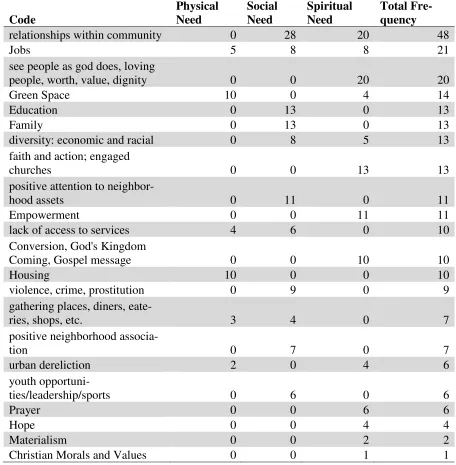
D.1.0 Table: Frequency of Neighborhood Needs with Participant Categorization 139
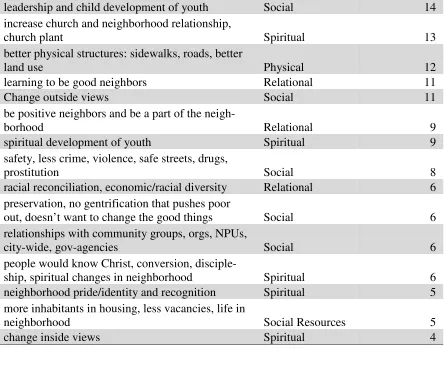
D.2.0 Table: Frequency of Visions with Participant Categorization 139
LIST OF FIGURES
3.1 Figure: Map of Strategic neighbors west Atlanta, Georgia neighborhoods 134
3.2 Figure: Participant Diaries 38
D.1.1. Figure: (Diagram of Table D.1.0) Visualization of Neighborhood Needs 140
D.2.1. Figure: (Diagram of Table D.2.0) Visualization of Participants’ Visions 141
D.2.2. Figure: (Diagram of Tables D.1.0 and D.2.0) Visualization of Needs/Visions 141
INTRODUCTION
The End is my Beginning—T.S. Eliot1
At the beginning of this research process, I was not a strategic neighbor. Instead, through
this process I became one. In this sense, the finish of this research is truly a start. I now begin as
a sinner, a Christian, a social scientist, a white, twenty-four year old female, and as a neighbor
seeking to live out the implications of my faith in the context of my neighborhood in the city of
Atlanta, Georgia.
In 2008, inspired by my Christian faith to love God, love my neighbor, and confront the
injustice and inequalities within the City of Atlanta I relocated to an under-resourced inner-city
neighborhood in Atlanta2. It was not before long that I discovered I was one among many
faith-motivated actors in my neighborhood. Through other faith-faith-motivated neighbors, I discovered
that this phenomenon is part of a much larger movement beyond my neighborhood and beyond
Atlanta; it is a movement going on across the United States referred to as Christian community
development (CCD). My personal experiences in my neighborhood then led me a year later to
the Georgia State University Applied Anthropology program in an effort to utilize ethnographic
methods to address the injustices and blight that I saw in my neighborhood. As I searched for the
“perfect research study” on community development practices, my path serendipitously crossed
with Dr. Katherine Hankins, an urban geography faculty member in the Department of
Geos-ciences at Georgia State.
1
Eliot, T.S. 1944. Four Quartets (East Coker) 2
I intended to ask about her research on Atlanta neighborhoods but forgot my questions
when I realized she was studying “gentrification with justice” and CCD. I shared that it was
“funny” that I was “doing” what she was researching and she asked me, “Are you a strategic
neighbor?” a term she found in the process of her research. Awe-struck and confused by the
fa-miliar concept with an unfafa-miliar name, I replied “I guess I am.” Unknowingly, this marked the
beginning of a research study and team, in which I found myself as a research subject and a
re-searcher.3
I accompanied Dr. Hankins and her research partner Dr. Walter to the Annual Conference
of the Christian Community Development Association (CCDA) held in Chicago October of 2010
to conduct research on urban ministries employing “gentrification with justice” strategies and on
strategic neighbors. During this study, we conducted surveys and interviews with urban
minis-tries and strategic neighbors across the United States. At the close of the on-line survey data
col-lection, 70 strategic neighbors and representatives from 35 urban ministries had responded. In
addition, I conducted multiple interviews with strategic neighbors, 32 of whom are located
spe-cifically within west Atlanta neighborhoods. As our study developed and through my
conversa-tions with Dr. Hankins, a new line of thought emerged on the role of faith in the urban process,
as we had come to call it--one which this thesis aims to explore.
Although there are many aspects to examine in excavating the role of faith in the urban
process, in this thesis I focus on identity struggles. More specifically, I examine the
class-identity struggles of key faith-motivated actors (strategic neighbors), because they reveal the
ten-sions of social inequalities present in contemporary urban life. I argue that community
develop-ment, when examined through a place-based lens, reveals embedded social class-identity
3
Re-gles and contours of faith that are presently sculpting the urban landscape and molding the
dy-namic twenty-first century city.
Chapter One surveys community development and the emergent sub field of faith-based
community development (FBCD). This review draws attention to place and a current shift within
community development literature towards an understanding of social capital that draws from
Bourdieu (1986) rather than Putnam (2001). This leads into Chapter Two, which concurs that
place is a critical framework in the exploration of community development and faith-based
community development (FBCD). This chapter discusses the complexities of neighborhood and
suggests that it is malleable and open for politics. In doing this, it develops a framework that
in-serts a “place ethic” into understandings of politics. Then, Chapter Three discusses the
impor-tance of the study and provides a detailed summary of triangulated qualitative methods employed
in this research and my complex positionality as a practitioner of Christian community
develop-ment and as a researcher.
Chapter Four begins the empirical section of this study. It discusses what it means to be
a strategic neighbor in west Atlanta and reveals an embedded conflict between social class and
faith. This conflict is referred to as class-identity struggle and is explored by the next three
chapters. In order to examine these struggles and tensions, each chapter focuses on one of three
key traits shared by strategic neighbors: (Chapter Five) Faith, (Chapter Six) Place, and (Chapter
Seven) everyday life, which encompasses the daily-actions and practices of strategic neighbors.
Then finally, Chapter Eight marks the conclusion and summarizes the class-identity struggle of
strategic neighbors. It reveals how participants’ identities are transformed and how these
1 LITERATURE REVIEW: EXAMINING “BELOVED COMMUNITY” DEVELOPMENT
“The public mood has detached…There are structural problems…As these problems have gone
unaddressed, Americans have lost faith in the credibility of their political system. This loss of
faith has contributed to a complex but dark national mood. The country is anxious, pessimistic,
ashamed, helpless, and defensive”— April 26, 2011 David Brooks, New York Times4
“…the end is reconciliation; the end is redemption; the end is the creation of the beloved com-munity…This is the love that may well be the salvation of our civilization.”—Dr. Martin Luther King Jr, 19575
Introduction (1.0)
Globalization and neoliberalism have been credited with marginalizing and
disenfran-chising local communities (Harvey 1996; Kemper and Adkins 2005; Massey; Creswell 2004;
Bennett and Hyland 2005). Some suggest that the restructuring of the global political economy
has caused “time-space compression” which has produced anxiety, disjunctures, and has
“annihi-lated space” (Harvey 1996). For many, this new phenomenon has caused an onslaught of
unin-tended consequences, rendering space irrelevant, inciting placelessness and ultimately
perpetuat-ing social inequalities(Harvey 1996; Harvey 2000; Massey 2005; Creswell 2004). However
de-spite a current discourse, that globalization and neoliberalism are “inevitable,” many actors
con-tinue to resist (Massey 2005).
4
Current resistance efforts have sought place-based initiatives and local action in the form
of community-based development (Hyland and Bennett 2005; Creswell 2004; Massey 2005). In
this way, one could argue that efforts such as faith-based community development (FBCD) are a
product of what scholars and theorists deem the “spatial turn” (Soja 2010; Massey 2005). This
turn suggests that space plays a critical role in shaping social practices, beliefs, and values; and
that space is engaged in molding both social theory and social justice in the twenty-first century
(Massey, 2005; Soja, 2010). Through the spatial turn, scholars suggest “beliefs, values, internal
thought-life, imaginaries, and ethics are what underpin and transform communities and places”
(Gerhardt 2008: 912, 913, 926). In other words, these underpinnings are internalized and become
identities which are then inscribed in place and are also shaped by place itself. In this way, the
spatial turn reveals how critical space/place is for the twenty-first century (Creswell 2004;
Mas-sey 2005).
This perspective sheds light on the current struggles occurring for and within place and
requires that we interrogate whom urban places and politics serve. In particular, it demands that
we examine the growing (or, one might argue, renewed) interest in (place-based) community
de-velopment within larger urban dede-velopment efforts. Therefore, it is imperative for emerging
fields like community development to draw from a critical engagement with space and place as
community developers enact their vision of “social justice.”
Community Development in the Twenty-First Century
Community development is a growing field that has attracted the attention of business
developers, churches, politicians, neighborhood residents and activists, as well as social
contemporary community development, has recently been drawn into question. According to
Putnam, in Bowling Alone (2001), social capital refers to “ideas that resource skills, like
know-ledge, reciprocity, norms, values facilitate community members working together to make
sub-stantial improvement in the entire community’s living conditions” (Putnam 2000, cited by
Ben-nett and Hyland 2005:7). Furthermore, he suggests that the loss of civic engagement in U.S.
ci-ties and neighborhoods is due to lack of “social capital.” Although scholars do find that the
re-sources identified by Putnam’s social capital are relevant and constitute community (Hyland and
Bennett 2005), many argue that his ideas fail to explore the real value and meaning of social
cap-ital. Furthermore, scholars suggest it is unempirical, lacks rigor, and relies too heavily on
mi-drange theory and experiences (Van Willigen 2005:27; Hyland and Bennett 2005; DeFillipis
2001). As such, scholars are now (re)turning to an understanding of social capital that draws
from Bourdieu (1986).
As DeFillipis (2001) argues, Bourdieu’s focus on relationships, values, beliefs, and social
class offers a critical new lens for community development studies and practices. Contrary to
Putnam, Bourdieu’s social capital points to social structures, networks, and identities. More
spe-cifically, he explains that there is a relationship between macro social structures and micro
net-works, which ultimately create social class categories and social class identities (Bourdieu 1986).
In this way, Bourdieu’s social capital is not describing relationships and networks as resources,
which they are, but an overarching social order and its social class categorizations.
Bourdieu (1986) identifies three distinct “fields” of capital with different relationships
toward class: economic, cultural, and social capital. These “capitals” are then internalized and
reproduced through class networks and relationships, through what Bourdieu calls “symbolic
but also determine to whom one is (or is not) linked, which forges class-stratified networks.
These identities are what is then acted out as “habitus” which then perpetuates and reproduces
class categories (Bourdieu 2002).
For the purpose of this research, I focus only on social capital as it stands in contrast to
Putnam’s (2001) conceptualization, because Bourdieu’s social capital emphasizes conflicts and
the power function of these social class positions and the divisions they create across not only
class, but race/ethnicity, gender, socio-economics, or etc. As such, he would not agree with
Put-nam that there is a “lack of social capital.” Instead, Bourdieu suggests that it is impossible to be
lacking social capital because we are entrenched in it. Hence, he would argue that social capital
creates inequalities and disparities across class-lines by creating internalized class identities.
This insight then shifts studies of class away from examining one’s relationship to
pro-duction to “class identities.” In this lens, class-identities are more than socioeconomic; they are
“psychosocial,” moral, and emotional experiences (Dowling 2009:1; Patico 2008; Hankins et al.
2010). For this reason, Bourdieu focuses on underpinning beliefs, values, and relationships
which forge networks and social class categories and identities that perpetuate and reproduce
class, unequal power relationships, and the overarching economic forces of capitalism.
Within community development studies, there are debates on the role of these social
net-works in constituting community. At the moment, scholars debate the importance of internal
and/or external networks and how they operate in developing “strong” or “weak” ties
(Granovet-ter 1973). Key concepts of community development focus on “community building” and
“com-munity strengthening.” Com“com-munity building is best understood as internal com“com-munity
relation-ships within development (Van Willigen 2005). Meanwhile community strengthening is best
(Schensul 2005). The focus on lateral partnerships in community strengthening suggest that
in-ternal and exin-ternal networks forge new networks and new possibilities which are pivotal to
con-stituting communities (Hyland and Bennett 2005; Schensul 2005). But in the spirit of Bourdieu,
it is not only these relationships and networks which constitute community, it is the underpinning
beliefs, values, social class, race, ethnicity, religion, gender, and place that comprise these
net-works in the first place (Bourdieu 1985; Gerhardt 2008; Dowling 2009; Hyland and Bennett
2005). These contours within internal/ external networks are worthy of exploration, because the
underpinnings serve to constitute and shape communities and inform how actors engage in
community development.
Faith-based community development
In the exploration of these underpinnings of community development, scholars have
ex-plored the sub-field of faith-based community-development (FBCD) (Kemper and Adkins 2005;
Phillips 2010; Connolly and Brondo 2010; Kline 2010; Pentenko 2005; Kemper and Adkins
2006; Heffernan and Fogarty 2006; Hankins and Walter 2011; Occhinpinti 2005; Bornstein
2005; Occhinpinti, Adkins, Heffernan 2010). According to Heffernan and Fogarty (2010), 18%
of U.S. Non-government agencies are faith-based with over 135,000,000 members, over 350,000
congregations, and a large and growing collective annual budget (Heffernan and Fogarty
2010:1). 6 Although not all of these groups are involved in FBCD, there is a growing trend to
en-gage in community development work through formal religious congregations.
6
Since 2001, faith-based organizations (FBOs) have increasingly been given federal
sup-port and funding (Kemper and Adkins 2005; Kemper and Adkins 2006; Goode 2006). 7 In this
lens, the growth, budget, and increasing social-service delivery capacity of FBOs make them a
powerful entity in community development programs in the context of the neoliberal(izing) state
(Heffernan and Fogarty 2010).
Scholars have examined this relationship between FBOs and the government inside the
neoliberal state (Adkins, Occhinpinti, Heffernan 2010; Goode 2006; Occhinpinti 2005; Bornstein
2005). Generally, they examine the organizational structures and conclude that there are critical
problems with neoliberalism as an ideological framework for caring for marginalized groups. In
particular, they state that FBOs are insufficient and do not fill the gap of the receding state.
While this is a key finding among researchers, these studies have yet to explore other important
aspects of FBOs. More specifically, they leave unaddressed the ethical underpinning, such as
faith, that is embedded in these processes and operationalized in community development.
There remains little attention to how the values and beliefs within faith groups shape and
motivate their community development strategies and make FBCD unique. In addition, scholars
have yet to examine how practitioners operationalize FBCD and what it means for these actors
who negotiate market-forces and socio-political structures with their faith beliefs and values.
Moreover, although these values and class identities are often invisible, they are, and have been,
important dimensions of (faith-based or secular) community development. As a first step in
7
ploring the underpinnings of FBCD, this research will now review the historical legacy of faith
and development.
The History of Faith and Development (1.1)
In spite of the renewed interest in FBOs in the neoliberal(izing) state, FBOs have a long
history in the United States. According to Kemper and Adkins (2005), faith-based groups have
been involved in development and social justice since the nineteenth century social gospel
movement. However, at that time these groups focused on “transforming and reforming people…
instead of the structures that created and shaped poverty” (Kemper and Adkins 2005:78). This
shifted during the 1960s social justice movements and turned toward faith-based community
or-ganizing. These movements draw from Saul Alinsky’s (1949) Reville for Radicals, a manual that
operationalizedorganizing methods to unite Protestants and Catholics to work together on urban
issues and injustice in Chicago.
Faith-based organizing was instrumental in movements such as the Civil Rights
move-ment in the 1960s, the Watts urban riots (1967), Latin American liberation and reform, and
mul-tiple other protests (Kemper and Adkins 2005; Marsh 2005; Connolly and Brondo 2010).
Al-though these movements had various ethical underpinnings, they were all deeply theological and
faith oriented. In particular, the American Civil Rights movement was rooted in faith-oriented
principles which merged faith and social justice together (Kemper and Adkins 2005; Marsh
“Beloved Community” (King 1998; King 1967; Marsh 2005; Inwood 2009). 8 According to
Phillips (2010:17) during the1960s and 1970s, there was also a critical theological shift around
the idea of “mission.” As Phillips (2010: 17) suggests, “mission” changed meaning for many
people and institutions of faith and began to focus on “promot[ing] physical and cultural
well-being of people, especially the “community,” by emphasizing the community and social nature
of faith. Furthermore, he suggests this social shift transitioned from “colonial theology” to
libera-tion theology and “incarnalibera-tional faith” (Phillips 2010). In his view, colonial theology focuses on
the soul, devalues material betterment, relies on universal and/or abstract principles, supports
creation and hierarchy as a moral order, and emphasizes charity toward the poor. In contrast,
incarnational faith is defined by “daily lived experiences and social conditions of ordinary people
and communities as the context for living out one’s faith” (Phillips 2010:17). Incarnational faith
focuses on the whole person and human experience as social, material, physical, and spiritual.
Informed by social science, rather than philosophy alone, it exchanges charity for justice and
“takes on” structural forces which require innovation, networks, and place-based focuses
(Phil-lips 2010:28).
Theologies of Development and Networks of Faith
Current faith-based development studies suggest that the Christian theological doctrine of
“incarnation” is deeply linked to development (Phillips 2010; Connolly and Brondo 2010). In a
study of faith-based community development on “El Paraja,” a Christian community in
Nicara-gua, Phillips (2010) suggests that the theological doctrine of incarnation is what links “faith” to
development. In particular, he finds that incarnational faith fuses faith and action together and
8
makes the practice of religious faith and development synonymous. According to Phillips
(Phil-lips 2010:18), in El Paraja, incarnational faith is oriented towards practical and daily living of
faith-based values rather than faith-rituals:
…faith is expressed in relations to others and concerns their community and
world…[T]he community’s sense of faith is so integrated into its development as
a community that it is hard to separate one from the other” (Phillips 2010:27).
Based on these findings, he suggests incarnational faith is a certain kind of faith expression that
ignites social action and community transformation in the form of development. Ultimately, this
not only links “incarnational faith” to development but marks it a pivotal force.
Similarly, Connolly and Brondo (2010) suggest incarnational faith is critical to
faith-based development models. However, they suggest that it is rooted in theology, specifically the
“Christian doctrine that Jesus is truly God and truly human” (Connolly and Brondo 2010). They
suggest this theological doctrine is traditionally linked to Anglican/Episcopal church
denomina-tions which (1) make the sacred and the secular inseparable, (2) are traditional in the Southeast,
and (3) treat practices of faith (service, care and mission) as evangelism (or sharing one’s
reli-gious beliefs and views). In fact, they suggest that incarnational theology and faith-based
devel-opment are implemented through acts of evangelism (Connolly and Brondo 2010).
In their study of the “Mississippi Model,” a FBCD model involving a Mississippi
Epi-scopal church and a Panamanian village, they found incarnational theology was the “clear” link
between “provision of social, medical and economic support services and evangelism” (Connolly
and Brondo 2010:42). Incarnational theology shifts the goal of Christian evangelism and the
“mission” away from conversion and towards “forming relationships and spiritual community as
theol-ogy includes faith-based development efforts, as they call it “doing” Christianity, which
primari-ly involves “community” and “relationship building” (Connolprimari-ly and Brondo 2010:46).
Ultimate-ly, the transition to incarnational theology shifts faith-motivated actors’ mission and overall
goals towards community, partnership, cultural exchange, sustainability, local empowerment,
and determination to build capacity within communities served (Connolly and Brondo 2010:46).
Incarnational faith and theology is also an intriguing underpinning of FBCD, particularly
because FBCD is operationalized through the creation of networks and through building
relation-ships across lines of class, gender, race/ethnicity, economics, etc. According to Kline
(2010:140), these networks and relationships are one of the biggest assets that FBOs offer to
communities. In his research, he focuses on the social networks and partnerships between an
FBO, the Light of Central Florida (LCF) and the Apopka, an under-resourced and marginalized
farming population in Southwest Florida. He finds that LCF has the ability to help the
margina-lized farm-workers because of its “power of networks” (Kline 2010:134-5). In other words, the
organization is networked through faith, which includes an array of individuals, churches, and
FBOs. Then through these networks of faith, they are able to link the Apopka to medical doctors
and skilled healthcare practitioners to whom farm-workers previously did not have access (Kline
2010).9
Christian Community Development Association
FBOs continue to grow and become increasingly involved in FBCD. A key component of
faith-based community development is the work that is emerging explicitly from Christians.
Christian community development efforts are increasingly represented by the Christian
9
nity Development Association (CCDA). The CCDA was established in 1989 and is not a single
FBO, but an association of 3,000 individual members, 500 interdenominational churches and
FBOs in over 200 cities and forty states (CCDA 04/24/2011).
The CCDA philosophy of development first emerged as the “3Rs:” relocation,
reconcilia-tion, and redistribution (Perkins 1995). This philosophy serves to integrate faith and development
as one pursuit. These tenants, which he articulated in With Justice for All (1982), were first
de-veloped by Dr. John Perkins after his theology shifted from dispensational to incarnational
(Marsh 2005). On the front book flap, Perkins describes each tenant:
(1) Relocation: To be an effective community developer demands relocating to
the community in need. We must live among those we are serving. We must
become one of them. Their needs must become our needs.
(2) Reconciliation: …We cannot achieve Christ’s mission working alone; we
must work as a body with each person exercising his or her spiritual gifts as a
part of the whole. To do this the work of reconciliation, then, we must begin
by being a reconciled fellowship (speaking directly about segregation and
rac-ism in the church).
(3) Redistribution: The earth does not belong to us, but to God. We are only its
stewards. God provided the earth for all mankind. Economic injustice, then, is
simply depriving people of free access to God’s creation. Justice is achieved
by working with God to share His resources with the disenfranchised of the
earth (Perkins 1982).
In particular, he developed these tenants of CCD as a way to meet “three universal felt needs:”
amount of security” (Perkins 1995:20-21). According to Perkins, (1995:21) “The gospel rightly
understood is [sic] holistic” and, similarly, Christian community development (CCD) embodies
evangelism, social action, economic development, and justice.
A key tenant to Perkins and the CCDA strategy for CCD is relocation. In Restoring
At-Risk Communities Perkins (1995:21-22), explains that this tenant is theologically based in the
fact that “Jesus relocated. He became one of us. He didn’t commute back and forth to
hea-ven…the most effective [practitioners]…will live among the poor…have a personal stake in the
development of their neighborhoods;” and later he adds that relocation of faith-motivated actors
to under-resourced neighbors offer solutions unlike “programs” which he argues are ”poor
subs-titute(s) for what neighbors can do best” (pg. 86).
Perkins then breaks down the “first R” relocation into three sub-categories: Remainers,
Relocators, and Returners. These three sub-categories describe the different decisions made by
individuals who are participating in CCD: (1) “Relocators” are individuals, usually middle to
up-per middle class (gentry), who are not from an under resourced neighborhood but move-in as an
act of faith; (2) “Returners” are individuals who are native to an under-resourced neighborhood,
left to seek a better life, and have now returned to live out their faith in their indigenous
neigh-borhood; (3) “Remainers” are those who did not leave their neighborhoods, have endured the
problems, and have chose to stay and be a part of CCD (Perkins 1995). These persons then “live
out their faith” in an under-resourced neighborhood in a socially just way, and then implement
additional components of reconciliation and redistribution (Perkins 1995; Lupton 1997; Barber
2009). This process serves as an intentional spiritual and physical revitalization plan to create
Shalom and Beloved Community
According to Nicholas Wolterstoff (1983:69-72) in Until Justice and Peace Embrace,
Shalom is not the absence of conflict but “the presence of right and harmonious relationships
imbued with delight and flourishing before the Lord.” Additionally, Gornik (2002) adds Shalom
is not only what he calls all “faith-shaped urban activity” it is the “reconceptualiz[ation] of the
political and social order of the city; it reverses the everyday and localized effects of a global
market economy and a history of discrimination and exclusion…a radical alternative for the city”
(Gornik 2002:98-99). However, historian and theologian Charles Marsh (2005) suggests that
still a greater movement encompasses Shalom and goes beyond “strategic neighboring,” FBCD,
and CCDA.
According to Marsh, these efforts are deeply connected with Dr. Martin Luther King’s
concept of the “Beloved Community” (Marsh 2005). He suggests that the idea of Beloved
Com-munity is the tangible synthesis of the presence of the church and social justice movements
(in-cluding the movement embodied by strategic neighbors, CCDA, and FCBD) (Marsh 2005:207).
For King, Beloved Community was a social, theological and geographical method to bring about
justice and enact social change. More specifically, it operationalizes this change by cultivating
human agency, encouraging individuals and groups to stand up and oppose an unjust system of
oppressors and oppression, loving oppressors through divine Agape love, and converting one’s
enemy to a collaborator to build the Beloved Community (King 1967; Inwood 2009). Moreover,
in King’s own words it was the purpose and “end” of the entire Civil Rights movements:
“…reconciliation…redemption…the creation of the Beloved Community” (King [1954]1998;
What is a strategic neighbor?
Within the CCDA, the “3Rs” philosophy is a specific set of actors called “strategic
neighbors,” i.e. Relocators, a term coined by Robert Lupton, a founding member and long-time
practitioner of Christian community development (see Lupton 1997). According to Lupton
(2005: 172-173) “strategic neighbors” are “the best thing we can offer an urban neighborhood.”
He argues that strategic neighbors are different than “urban workers” and volunteers who enter
into the neighborhood to “help” and drive back home after their shift (Lupton 2005:172). In
par-ticular, he describes them as
…people who have a deep commitment to loving God and loving their
bor…they are the frontline troops who go into neighborhoods where good
neigh-bors are in short supply. They buy houses, join neighborhood associations, help
organize crime watches, build relationships with neighbor kids, offer support to
single moms, take seniors to the grocery store. In short, they are the embodiment
of good news…essential to the return of wholeness to an urban
communi-ty…[they are] committed neighbors who will make the neighborhood their own
(Lupton 1997:173).
Strategic neighbors are key actors in FBCD and specifically Lupton’s concept of
“gentri-fication with justice” (see Hankins and Walter 2011). 10 In particular, this concept places the
faith-based social justice components of the CCDAs “3Rs” alongside market forces. In other
words, Lupton suggests that it is both possible and critical to integrate social justice and faith
with market forces and urban processes of gentrification. In fact, he embraces market-forces,
ex-plaining “There is nothing [as] life-giving or self-sustaining as sanctified self-interest” (Lupton
10
2005:173). He argues that while there is a risk with the gentry returning to these neighborhoods,
but also there is a definite need and problem if they never do (Lupton 1997).
Lupton and his ministry FCS Urban Ministry Collective have operationalized the concept
of “gentrification with justice,” by recruiting and utilizing strategic neighbors in five Atlanta
neighborhoods.11 As of 2011, FCS is currently focusing on South Atlanta, a disinvested
neigh-borhood and has recruited numerous strategic neighbors to implement its FBCD strategy.12
However, our broader research study has revealed that strategic neighboring and FBCD are not
only happening across the United States, but also among individuals unconnected to Lupton,
FCS, or even CCDA (see Hankins et al. 2010).
Marsh (2005) argues that through Beloved Community and incarnational theology draws
a link between CCDA’s model of community transformation and the grass roots faith-based
ac-tivism of the Civil Rights movement. His claims are supported by Leroy Barber in New
Neigh-bor: Invitation to the Beloved Community (2009). Barber explicitly asserts that “strategic
neigh-bors” or what he terms “new neighneigh-bors” are living out the Beloved Community philosophy
(Bar-ber 2009) through CCD. Leroy Bar(Bar-ber is not only a strategic neighbor, but President of Mission
Year and a co-collaborator alongside Lupton’s FCS Urban Ministries Collective, both of which
are Atlanta-based Christian FBOs that recruit and utilize strategic neighbors in FBCD efforts
(Barber 2009). 13
11
South Atlanta,East Lake, Ormewood Park, Summerhill, and Grant Park (Lupton 1973; Lupton 1982; Lupton 1997; Lupton 2000; Lupton 2009; Lupton 2010)
12
It was suggested during participant interviews, from August 2010-January 2011, that there were over 30-34 strategic neighbors in South Atlanta.
13
For a definition of Mission Year, see glossary Appendix A.
17
Dr. Martin Luther King Jr. moved his family to Vine City in 1967 [other sources claim 1965] and his widow Coretta Scott King maintained their residence in the neighborhood until her death in 2006. Martin Luther King III continues to maintain the Vine City residence today
As this research study will explore, strategic neighboring is occurring in west Atlanta, an
important hub of the “The Beloved Community” and the Civil Rights movement. Throughout
west Atlanta are the homes of former Civil Rights leaders, historical buildings, and sites of
im-portant meetings and protests. In particular, the originator of “Beloved Community” himself,
Rev. Dr. Martin Luther King Jr, lived in Vine City (one of the studied neighborhoods) from 1965
until his death in 1968.
In close, current research has yet to make the connection or truly explore the
underpin-nings of faith-motivated actors and how they operationalize and experience FBCD. Although
studies have addressed several critical areas of analysis, they primarily focus on the structural
components of FBOs, while leaving out the individual actors who enact FBCD. It is my
conten-tion that research should explore FBCD in such a way to illuminate the underpinnings and
net-works of individuals and actors who are enacting FBCD in their daily lives and pursuing
Be-loved Community. And, importantly, it is critical to interrogate the meanings, experiences, and
2 A THEORETICAL FRAMEWORK: THE PLACE ETHIC
“Perhaps the extraordinary thing is actually the ordinary…and ordinary things are more
valua-ble than the extraordinary things; nay they are more extraordinary”—G.K. Chesterton14
“Politics is when you look out your window”—Adrienne Crawford, quoting Shane Claiborne15
Introduction (2.0)
Space
As mentioned in the previous chapter, social justice and social theory within community
development have taken a “spatial turn.” This turn can be traced to the work of Henri Lefebvre
(1991), who conceptualized space in The Production of Space (Lefebvre 1991). In his work, he
created a framework that explained space was not a “receptacle,” but an active agent shaping
so-cial action (Lefebvre 1991). Adding to Lefebvre’s work, Edward Soja (1980) suggests that space
is not only a causal agent but that social actions and space simultaneously shape each other in a
“socio-spatial dialectic” (Soja 1980). The formation of the socio-spatial dialectic is critical to
un-derstanding the interconnected relationship between space and social practices, is in particular,
how social life ranging from macro social structures to everyday, mundane actions shape and are
shaped by space.
14
Chesterton, G.K. 1995 [1908]. Orthodoxy. Ignatius Press: San Francisco, pg. 96
15
Wal-According to Soja (2010), the socio-spatial dialectic reveals that humans are inherently
spatial, temporal, and social and live in the socio-spatial dialectic (Soja 2010). Moreover, in
de-scribing the dialectic, Soja suggests there is a “porous” relationship of various external and
inter-nal structures and movements within spatial and social practices (Soja 2010:18). Furthermore, as
this dialectic engages with the socio-spatial dimension it not only reveals that humanity and
space-time are interconnected, but that social inequalities and disparities “disconnect” or disrupt
the spatial, temporal, and social interconnectedness of humanity (Foucault 1967).
According to Harvey, space and time are socially constructed, and they are shaped by
class and therefore, capitalist relations (Harvey 1996). In fact, this is why he argues that place is
problematic. Harvey (1996) explains that because place is a product of capitalism it is
intrinsical-ly reactionary and exclusionary. Therefore, he suggests that place reveals the class struggle is
inscribed on space and that any effort to resist which does not address “property” and “capital” is
a diversion (Harvey 1973; Harvey 1996; Harvey 2006). Although Harvey agrees that
globaliza-tion and neoliberalism have opened up progressive and universal politics, both addresses neither
capitalism, nor its inevitable production of social inequality (Harvey 1996; Harvey 2000; Harvey
2006). In short, for him the only hope for “social justice in the city” is spatial politics that tackle
capitalism and underlying class struggles (Harvey 1973; Harvey 1996; Harvey 2000).
However, in contrast Creswell (2004) argues that place is not a diversion but a necessary
part of the human experience. He suggests that place is the way humans know and experience the
world and that the fixity of place both serves to reveal social inequalities and get at “the center of
humanity” (Creswell 2004). Creswell explains that place is made up of location, locale, and the
and feelings (Creswell 2004). In this lens, place is not a diversion but is essential to being
hu-man and for exploring and understanding the class struggle of capitalism.
Place
In Global Sense of Place (1991)and For Space (2005), Massey suggests that place is not
necessarily a hegemonic product of capitalism or just a way to make social inequalities visible.
Although she does not refute these claims, she argues place is created by multiple forces, such
as, race, gender, ethnicity, and interconnected relationships which are open for politics (Massey
1991; Massey 2005). Massey understands place as a “bundle,” full of varying flows, fluxes, and
flexes in space. These various flows and fluxes are numerous interrelationships, which operate at
varying strengths and speeds and engender place with multiplicity and contemporanity.
Based on this understanding of space, Massey (2005) suggests that globalization is not
causing anxiety and placelessness nor is it “annihilating space” for those attached to place and
made vulnerable (as described in Chapter One) (Massey 2005). Instead, she argues that the idea
that globalization (global capitalism) and the neoliberal imaginary of globalization are inevitable
is false (Massey 2005). Moreover, she suggests that place is open to “multiplicity” and diverse
social relationships, which therefore opens place up for “cross-cutting politics,” with macro and
micro social and political implications (Massey 2005). In this way, place and politics thereby
link, through the socio-spatial dimension, the change materiality and social relations of place
Operationalizing Place (2.1)
In an effort to operationalize Massey-like place-politics, Susan Fainstein’s The Just City
(2010) focuses on urban planning policies. Like Massey (2005), she suggests that space and
ci-ties can be gradually reconfigured and reimagined through place-politics (Fainstein 2010).
Al-though other theorists like Harvey and Soja (2010) dismiss Fainstein’s contribution because of
her deviation from revolution to reform, she argues that it is also imperative to work to develop
capabilities within the capitalist city (Fainstein 2010). However, Fainstein only operationalizes
Massey-like place politics to form policy recommendations for politicians, urban planners, and
city developers. She does not explore the potential for extroverted place politics for individuals,
activists, citizens, and places like neighborhoods.
Neighborhoods: Place and Space
In order to explore place-politics for the twenty-first century, the potential for
neighbor-hood place-politics must too be explored (Martin, 2002, 2003). In Enacting Neighborhood
(2002), Deborah Martin explains that the “spatial identity” of neighborhoods is unclear and
sug-gests that it is both a space and a place (Martin 2002). This, she argues, is because
neighbor-hoods are “enacted by social and political actions,” but they are also “a product of larger spatial
organizations” (Martin 2002). To further understand this hybridity of neighborhoods, Martin
draws on Massey-like place-politics as “places of bundled spatiality” (Martin 2002). Expressed
another way, neighborhoods are complex places, constructed by both everyday routines and daily
politics and macro structural forces, i.e. individuals, neighborhood associations/community
Place Frames to Relational-Place Making
Martin (2003) develops “place-frames” as a framework through which to understand the
role of place in contentious politics. These frames highlight the role of external forces, as they
influence and shape everyday politics of neighborhoods. In particular, these place-frames
ex-amine collective action through moments of conflict and negotiations (Martin 2003). These
mo-ments, she suggests, are the only way through which everyday politics of neighborhood become
visible to those outside the neighborhood (Martin 2003).
More recently in Pierce et al. (2011) Relational place-making: The Networked Politics of
Place, Martin’s place-frames and efforts to operationalize neighborhood place-politics are
brought together. The goal of this work is to connect activism and place, and “draw attention to
people and events within the place.” They seek to bring to light both the internal daily politics of
neighborhood together with external politics and networks (Pierce et al 2011:3). To do so, they
utilize place-frames to analyze and dissect the “bundles of spatiality” which constitute
neighbor-hood. Through this lens, they suggest these bundles are made up of place, politics, and networks
and fold together multiple scales of place, i.e. individual, local, community, state, etc. (Pierce et
al. 2011).
Within network politics, they argue that place-identity remains essential and complex in
shaping networks of place and politics (Pierce et al. 2011:5). Therefore, to explore neighborhood
networks and politics, they consciously focus on networks instead of “powerful forces” of
struc-tural urban capital to pinpoint connections that create identity. These imaginaries of
place-identity are about two main ideas: (1) the “combination of people and institutions that agree upon
and recognize themselves as a part of a shared community,” and (2) the “bridging and
In other words, (and reiterating Hyland and Bennett 2005; Schensul 2005) internal and external
networks are both instrumental in shaping and forming each other. Therefore, in their view, the
bundling of place-making “reconceptualiz[es] place as both simultaneously experienced and
par-ticipated in” (Pierce et al. 2011:5) by a range of scaled, interlocking networks.
This concept of relational place-making is a process, one which utilizes both internal and
external networks, and is effective on multiple scales (individual, community, and urban place)
(Pierce et al. 2011:7). Within relational place-making it becomes possible for “the dynamic and
radical complexity of place-politics” to cultivate "politics of neighborhood" and achieve greater
spatial justice (Pierce et al. 2011).
Spatial Justice and the Potential of Place-Politics (2.2)
Neighborhood-based place-politics are multifaceted because of their ability to cut across
gender, class, race, ethnicity, and other issues of identity politics (Martin 2002; Pierce et al.
2011; Massey 2005; Massey 1994; Massey 200; Soja 2010). Neighborhood by nature lends itself
to place-politics because it “has the ability to mobilize identity for collective action and
neigh-borhood with the potential to enact place, but is also grounded” (Martin 2003). In this way,
neighborhood place-politics can be open and situated without being bound and exclusionary.
Therefore, neighborhood place-based politics demystify beliefs that globalization, urbanization
of injustice, and neoliberalism are inevitable (Massey 2005; Pierce et al. 2011). Hence, the
neighborhood, as a bundle of trajectories, I suggest, has the ability to move towards new spatial
regio-nalism (2010), King’s (1957) Beloved Community, Gornik’s (2002) Shalom, and Fainstein’s just
city (2010). Moreover, these radical place-based ideals forge “place-politics” and echo what
Massey (2005) suggests: that space is open and full of political potential to liberate individuals,
organizations, and institutions to create place, which is full of multiplicity.
The problem of place-frames
What remains unknown about the potential for neighborhood place-politics is how they
are actually constituted and operationalized. Although relational place-making connects the
agency of individual subjects to the daily politics that forge place-politics (Pierce et al. 2011), it
only reveals in part how place-politics are constructed and operationalized in neighborhoods. In
this lens, it appears place frames may be unnecessarily limiting the further exploration of
neigh-borhood place-politics.
Place-frames potentially become problematic for three key reasons. First, place-frames
focus on conflict and moments of negotiation. According to Hyland and Bennett (2005), conflict
and negotiation frames reinforce negative images of neighborhoods and perpetuate a problem
and deficiency focus that often frames neighborhood as a project and an object of charity
(Kretzmann and McKnight 1993, Hyland and Bennett 2005). This in turn fostersa hegemonic,
exclusionary, and reactionary treatment of neighborhood as place. Ultimately, this could lead to
privileging the role of the external forces over the daily politics of agentic actors, who do not
and/or are unable to utilize traditional conflict management and negotiation spaces.
Second, place frames ignore subject positions and the identities of actors. In particular,
they make class identities and tropes of race, ethnicity, gender, and sexuality and how they are
devalued by the larger social categories nor does it capture politics but rather only “consensus”
(Ranciere 2001). Third and finally, place frames are momentary and too temporal to understand
the connection between activism and place and the place-politics of neighborhoods. By looking
at small moments of conflict, it becomes impossible to view the multiplicity within everyday life.
This makes it also impossible to view the multiplicity within the socio-spatial dialectic and how
within the dialectic agentic actors enact place-politics and operationalize place (Massey 2005).
Therefore, place-frames never truly reveal the daily politics and relational place-making that
oc-cur nor the class constructions that are internalized within the construct of neighborhood.
Moving away from place frames could both further open up the potential for relational
place-making, as well as cultivate a better understanding of how agentic subjects and place-politics are
operationalized inside of neighborhoods. To engage and examine neighborhood place-politics in
a way that illuminates these underpinnings it may prove insightful to turn to a new framework.
The “place-ethic” (Hankins et al. 2010) enables a fuller view of daily politics and
over-comes this gap. This framework weaves together a synthesis of the socio-spatial dialectic
(Har-vey 1996; 2006; Soja 2010), politics (Massey 1991; 1996; 2005), and relational
place-making (Pierce et al. 2011). 16 In particular, it incorporates Ranciere’s (2001) “proper politics”
and situates itself in the context of daily politics of community development (van Willigen 2005;
Schensul 2005). Unlike place-frames, the lens of a place-ethic does not focus on momentary
con-flicts as sites of relational place-making. Instead, the focus is on how individual actors make
place through their notion of how things ‘ought’ to be and the socio-spatial consequences of their
daily lives.
This lens makes the identities, social class, and subject positions of agentic subjects
visi-ble by exploring how they operationalize, reimagine, and relationally “make neighborhood,”
through their interactions, internal relationships, and networks. Moreover, this makes agentic
subjects in silenced places/spaces and “proper politics” visible (Ranciere 2001). These silenced
places/spaces include individuals, communities, and groups marginalized by larger
socio-political structures. In particular, this place-ethic draws attention to them as they act to strengthen
current capabilities to reimagine and reconfigure space and to cultivate “socially just” places.
This is relevant to a theoretical framework of place for the twenty-first century, because it
re-veals how individuals are harnessing place to resist or engage socio-political structures.
Al-though the place-ethic is not intended to dispel the other frameworks surveyed, it does suggest
that to examine actors and agents within urban politics the study of everyday life as politics is
necessary.
Interestingly, this echoes yet again the “spatial turn.” Within this “spatial turn,”
geo-graphers and social theorists continue to peel back the layers of politics, revealing internalized
values and beliefs which are active forces in shaping political culture and actions. For this
rea-son, the theoretical development of “relational-place making” and the “place-ethic” serves to put
agentic subjects and the daily actions of individuals “back on the map.”
As described in Chapter One, values, beliefs, and relationships are lived and underpin
community development, specifically FBCD. In this lens, the following chapters will draw upon
an empirical research study on faith-motivated neighbors who seek to enact FBCD. Since place
as a framework provides a lens to both explore faith-motivated actors (strategic neighbors) and
how they operationalize neighborhood, it also reveals embedded class identities, through faith
values and daily actions which express FBCD. Ultimately, this not only opens up silent spaces
3 METHODOLOGY: PRAXIS IN QUALITATIVE RESEARCH
Introduction (3.0)
Since 2001’s Faith Based Initiative Executive Order, there has been increasing attention
to faith-based efforts, specifically in the field of community development (Kemper and Adkins
2005). 17 According to Kemper and Adkins (2005), faith-based community development (FBCD)
is distinct from other forms of traditional social capital and assets-based community development
(Kemper and Adkins 2005).
[Faith-based development] does not mean having more, but fundamentally being
more in terms of quality relationships of life that emerge from a community’s
own cultural traditions…the creation of new cultural, political and economic
pat-terns and conditions that enhance dignity, critical consciousness, and
interperson-al communication and cooperating based on the principles of participation and
community self-determination (Kemper and Adkins 2005:98).
Within scholarship, social scientists have been exploring community development as both a
study and a practice. In an effort to “put people first,” many have utilized applied and
participa-tory, action methods (Cernea 1985; Hyland and Bennett 2005; Schensul 2005; Van Willigen
2005; Lambert-Pennington 2010; Hale 2007; Kline 2010). My research is informed by such
ap-proaches and utilizes participatory methods and praxis principles to examine FBCD in inner city
Atlanta.
17
As I pointed out in Chapter two, most research on FBCD has primarily focused on the
understanding the role and organizational structure of FBOs (Kemper and Adkins 2005; Kemper
and Adkins 2006; Goode 2006; Adkins, Occhinpinti, Heffernan 2010). However, researchers are
now beginning to explore the theological and faith-motivation underpinnings of FBOs and
FBCD (Heffernan and Fogarty 2010; Brondo and Connolly 2010; Phillips 2010;
Lambert-Pennington 2010). To expand this line of inquiry, my research looks at the role of individuals
and how they enact faith-based community development. My research question asks, How do
strategic neighbors seek to transform neighborhoods through their faith-based community
devel-opment practices? In particular, it examines how faith-motivated actors conceptualize and enact
place politics through their vision for holistic community transformation, which, I suggest in my
empirical chapters, reveals underpinning social-class struggles.
Praxis Principles
In this research I utilize various praxis strategies and principles from Kozaitis (2000),
Hale (2007), Van Willigen (2005), and Schensul (2005). Anthropological praxis is defined by
Kozaitis (2000) in The Rise of Anthropological Praxis as the merger of anthropological methods
and practice that are informed under both grand and mid-range social theory (Kozaitis 2000). My
praxis principles are compassion, advocacy, and participation. The planning stages of my
re-search design featured Kozaitis’s compassion-centered and participatory approach, which
ulti-mately seeks to use anthropological theory and methods to yield positive social change and
reform (Kozaitis 2000). These took shape as “praxis strategies” that took into account “activist
anthropology.” In particular, activist anthropology removes objective distances by “align[ing]
com-mitment to produce knowledge in collaboration and dialogue with the members of that group”
(Hale 2007:104). This approach directly applied to my position in the research, as both a
re-searcher and a research participant.
Additionally, I was also informed by Van Willigen (2005) and Schensul (2005) in my
methods to utilize principles of social knowledge (Van Willigen 2005) and “bonding and
bridg-ing” (Schensul 2005). Together these principles focus on cultivating local knowledge that will
identify community needs and build community (Van Willigen 2005), as well as utilize
commu-nity strengthening principles which make research and knowledge accessible to participants
(Schensul 2002:191; cited by Lambert Pennington 2010:144).
In reference to the role of faith in shaping the city, social life, and motivating social
ac-tion, this study research design intentionally evoked nuances of praxis and participatory research
in three key ways: (1) to further “democratize knowledge” gained through research by informing
practitioners and organizations engaged in FBCD, (2) to serve the three main stakeholders:
faith-motivated actors, local neighborhoods, and participants being researched, and (3) to further the
role of anthropologists and social scientists in faith-related research. Moreover, these key praxis
Data Sources and Techniques (3.1)
Data Sources
This research brings a traditional research design together with these praxis principles.
These principles were implemented throughout the process of gathering, analyzing and reporting
data. I gathered data by engaging in four methods of qualitative research: active-participant
ob-servation, detailed ethnographic field notes, participant diaries and semi-structured interviews
with strategic neighbors.
My data sources included seven west Atlanta neighborhoods, including West End,
West-view, Booker T. Washington Community, Washington Park, Vine City, English Avenue, and
Grove Park. Although these neighborhoods are all poor neighborhoods, predominately African
American, and on the west side of Atlanta, they do have differences. Some have experienced
more or less (dis)investment, displacement of indigenous neighbors, drug and prostitution,
reli-gious and ethnic diversity, and they have experienced individually nuanced histories. But,
de-spite these differences, one key element they all have in common is the presence of
faith-motivated “strategic neighbors.”
Strategic neighbors are located in other neighborhoods throughout Atlanta; however these
particular places and participants were chosen based on rapport and networks. My focus on west
Atlanta neighborhoods evolved as I utilized my own networks in addition to the “snowball
me-thod” to recruit participants (Bernard 1997). Many of these networks and relationships were built
because I live in the Booker T. Washington Community.
Since 2008, I have been active as a strategic neighbor within west Atlanta. During this
Atlanta, and throughout the United States. For this research, I specifically chose west Atlanta
neighborhoods because of what appeared to be growing numbers of faith-motivated actors; in
addition, I find it compelling to explore FBCD in the historic hub of Atlanta’s Civil Rights
movement, as west Atlanta was home to some of the movement’s leaders. In fact, I was able to
interview and identify the first known strategic neighbor and Civil Rights activist in Vine City:
Hector Black.18 More general, this study also provides insight into claims that CCD is
historical-ly linked to American faith-based social justice movements (Marsh, 2005).
The Participants
Thirty-two strategic neighbors were interviewed from the seven west Atlanta
neighbor-hoods (see Appendix B, Table 3.0 for full list of participants). Twelve one-on-one and six group
semi-structured interviews were conducted. All participants interviewed self-identified as
Chris-tians, 31 of 32 said they regularly attend church, and all are motivated by their Christian faith. As
a group, research participants represented five denominations: “Presbyterian Church of
Ameri-ca,” “Presbyterian USA,” “Anglican Mission in AmeriAmeri-ca,” “Evangelical-Non-Denominational,”
and “Evangelical Covenant.”
As a collective, this sample represents individuals from the age of 19-70 years of age and
an average age of 31 years old. Of the 32 participants, they self-identified as such: 28 identified
themselves as white, 3 identified as mixed race (African American-White,
Black-Hispanic-White, and Lebanese-French), and 1 identified as ethnically Chilean. On average, they have
lived in their respective neighborhoods for 2.5 years, the greatest length of time being 10 years,
18
and the least being 3-4 months. Of this sample, 20 females and 12 males were interviewed,
in-cluding 17 who were married, 11 of whom had children (only 3 participants had children that
were of school age), as well as 15 who were single, without children, and/or not married.
Addi-tionally, all but three participants had gone to college, 25 participants had a Bachelor’s degree,
and 15 had received a Master’s Degrees or higher.
At the beginning of the study, 20 participants were homeowners and 12 participants were
renters. However, at the close of the study one of the homeowners moved out, as well as three of
the five Mission Year team members, who were renters. 1920 Additionally, 7 participants said
they “had been a strategic neighbor before” at a previous location and were now “trying” again.
The Neighborhoods
Three out of the six neighborhoods studied were targeted in 2008 Weed and Seed
anti-poverty initiatives. 21 Additionally, all the neighborhoods resided in zip codes 30318, 30314, and
30310 and were described by participants as “the inner-city” (see appendix B, Figure 3.1 for a
full map of west Atlanta neighborhood boundaries and the location of participants). These area
codes are 95% African American and have been home to countless poverty and revitalization
19
Sally Jeffrey moved out of Vine City at the beginning of 2011; she was interviewed as a stra-tegic neighbor during the research period of 2010.
20
Colyn Burbank, Joshua Brown-Culp, and Jannelle Fenton moved out at the end of March 2011 when they felt that Mission Year was “too structured” and they wanted to focus on being neigh-bors in their hometown communities.
21