ScholarWorks @ Georgia State University
ScholarWorks @ Georgia State University
Geosciences Theses Department of Geosciences
Spring 5-11-2012
Spatial Ontology for the Production Domain of Petroleum Geology
Spatial Ontology for the Production Domain of Petroleum Geology
Dickson M. Liadey
GEORGIA STATE UNIVERSITY
Follow this and additional works at: https://scholarworks.gsu.edu/geosciences_theses
Recommended Citation Recommended Citation
Liadey, Dickson M., "Spatial Ontology for the Production Domain of Petroleum Geology." Thesis, Georgia State University, 2012.
https://scholarworks.gsu.edu/geosciences_theses/46
by
DICKSON M. LIADEY
Under the Direction of Hassan A. Babaie
ABSTRACT
The availability of useful information for research strongly depends on well structured
relationships between consistently defined concepts (terms) in that domain. This can be
achieved through ontologies. Ontologies are models of the knowledge of specific domain such
as petroleum geology, in a computer understandable format. Knowledge is a collection of facts.
Facts are represented by RDF triples (subject-predicate-object). A domain ontology is therefore
a collection of many RDF triples, which represent facts of that domain. The SWEET ontologies
are upper or top-level ontologies (foundation ontologies) consisting of thousands of very general
concepts. These concepts are obtained from of Earth System science and include other related
concepts. The work in this thesis deals with scientific knowledge representation in which the
SWEET ontologies are extended to include wider, more specific and specialized concepts used in
Petroleum Geology. Thus Petroleum Geology knowledge modeling is presented in this thesis.
by
DICKSON M. LIADEY
A Thesis Submitted in Partial Fulfillment of the Requirements for the Degree of
Master of Science
in the College of Arts and Sciences
Georgia State University
Copyright by Dickson M. Liadey
by
DICKSON M. LIADEY
Committee Chair: Hassan A. Babaie
Committee: Crawford Elliott
Daniel Deocampo
Electronic Version Approved:
Office of Graduate Studies
College of Arts and Sciences
Georgia State University
DEDICATION
I dedicate this thesis to Jesus Christ my Lord and Righteous Savior: The WORD OF
GOD and One through whom all things were created (JOHN 1:1-5; ACTS 3:15). I am indeed
thankful to Christ my Lord for the Blessed gift of life, for His provision and protection.
I also dedicate this thesis to my lovely wife, Adeline Liadey for her unflinching support,
love and encouragement. Finally, I dedicate this thesis to our sweet and lovely daughter
ACKNOWLEDGEMENTS
My profound gratitude goes to Dr. Hassan A. Babaie, my thesis advisor and the chair of
my thesis committee for supervising this thesis. I deeply appreciate his weighty contribution to
the success of this piece of work. In the Fall of 2010, he introduced and taught a course in
Geoinformatics in the Department of Geosciences. The course content involved languages such
as XML, RDF, RDF(S) and OWL, and the general method of building ontologies. The lessons
from this class gave a lot of impetus to this thesis and I am indeed deeply grateful for
Dr. Babaie’s supports in making this work a great success.
I am also extremely thankful for the valuable contributions of Dr. W. Crawford Elliot,
and Dr. Daniel M. Deocampo, the other members on my thesis committee. Special thanks again
to Dr. Daniel M. Deocampo who directed my studies in Petroleum Geology.
My sincere gratitude also goes to Dr. Timothy La Tour and to the entire faculty of the
Geoscience Department of Georgia State University, whose impartation of knowledge has
greatly contributed to my academic success.
Finally, grateful thanks to my fellow students and staff of the Department of Geoscience,
TABLE OF CONTENTS
ACKNOWLEDGEMENTS………..v
LIST OF TABLES………....x
LIST OF FIGURES……….xi
CHAPTER 1 INTRODUCTION………1
1.1 General Method of Constructing a Scientific ontology………...2
2 THE PETROLEUM GEOLOGY DOMAIN...………..5
2.1 Oil and Natural Gas formation……….5
2.2 Petroleum reservoirs and types of reservoir porosity……….8
2.3 Petroleum traps………..9
2.4 Petroleum production and drive mechanisms………....10
3 THE SWEET ONTOLOGIES………...13
4 CONTROLLED VOCABULARY AND ONTOLOGY………..18
5 A BRIEF OVERVIEW OF THE WEB ONTOLOGY LANGUAGE…..………..21
5.1 Defining classes………22
5.1.2 Value Restrictions………22
5.1.3 Cardinality Restrictions………..25
5.1.4 Using Set Operators……….26
5.1.5 Disjoint Classes..………..29
5.2 OWL Properties………...32
5.2.1 Inverse Properties………..……….……….32
5.2.2 Property Characteristics………...33
5.2.2.1 Symmetric Properties……….………...………33
5.2.2.2 Asymmetric Properties……….……...………34
5.2.2.3 Transitive Properties……….…………..………34
5.2.2.4 Functional Properties……….………….………..……….…36
5.2.2.5 Inverse Functional Properties………...………….………36
5.2.3 Disjoint Properties………....38
5.2.4 Domain and Range of Property………...38
6 METHOD………...41
6.1 Re-engineering the SWEET ontologies……….……….…………41
6.2.1 The OWL Classes tab………..…44
6.2.2 The Properties tab………53
6.2.3 The OWL Viz tab……….59
6.2.4 Constructing OWL Class expressions………..……….61
6.2.5 Description Logic (DL) Reasoning………...………..62
7 RESULTS………....63
7.1 Extensions made to matrNaturalResource.owl………..…...……….63
7.1.1 The concept of Petroleum redefined and remodeled……….….….63
7.1.2 Multiple more specific concepts added to NaturalGas……….……….65
7.2 Extensions made to propFraction.owl……….….………71
7.2.1 Multiple concepts added to Porosity ……….……….71
7.3 Extensions made to matrRock.owl and reprSciComponent.owl……….….72
7.3.1 Multiple concepts added to SedimentaryRock……….……....72
7.3.2 PetroleumReservoir class and its subclasses………...………..………72
7.4 Extensions made to reprSciComponent.owl to create PetroleumTrap...81
7.4.1 Multiple concepts added to PetroleumTrap...81
7.5 Extensions made to humanCommerce.owl………..89
7.6 Extensions to phenFluidDynamics.owl……….….…93
7.6.1 Multiple new classes added to the class FluidPhenomena……….………93
8 CONCLUSIONS………..96
REFERENCES……….………..98
LIST OF TABLES
LIST OF FIGURES
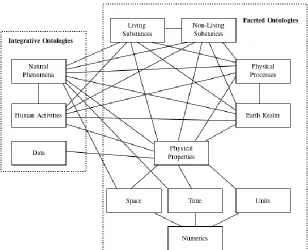
Figure 3.1 Primary ontologies in SWEET and their interrelationships…………...…………13
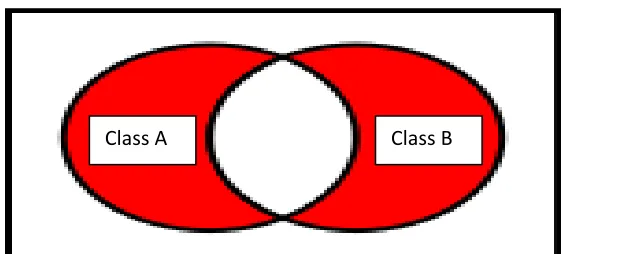
Figure 5.1 The disjoint union of two classes A and B ...………...30
Figure 5.2 Inverse Properties: hasDriveMechanism and driveMechanismOf……….…....33
Figure 5.3 Symmetric property: inContactWith ……….……...………..………..….33
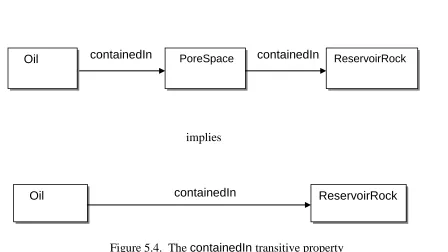
Figure 5.4 Transitive Property: containedIn………..……….…35
Figure 5.5 Functional Property: hasAge……….………...………….36
Figure 5.6 Inverse functional Property: hasAtomicNumber………...…37
Figure 6.1 Screen shot of the Protégé OWL Classes tab…...……….…...…44
Figure 6.2 Screen shot of pop up dialog for entering class name…………..………..……….45
Figure 6.3 Screen shot showing ‘add subclass’ button………..……….………….46
Figure 6.4 Screen shot showing relevant button for creating disjoint classes………..………47
Figure 6.5 Screen shot showing the selection of a class to make disjoint with others……....48
Figure 6.6 Screen shot showing the selection of multiple classes to make disjoint…………..49
Figure 6.7 Screen shot showing a selected class and its disjoint classes……..……….…49
Figure 6.8 Screen shot of the definition of a class from the intersection of two classes...50
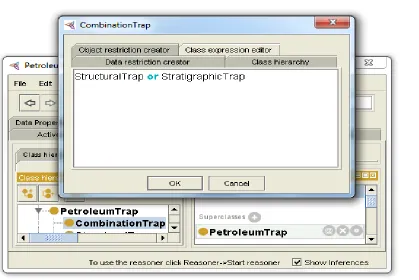
Figure 6.9 Screen shot of the definition of a class from the union of two classes ………51
Figure 6.11 Screen shot of the Protégé “Object Properties” tab…………...………53
Figure 6.12 Screen shot of pop up Object “Property Name Dialog”…………...…….……....54
Figure 6.13 Screen shot of an assigned property characteristic…….………...…………55
Figure 6.14 Screen shot of the Protégé “Data Properties” tab………..…56
Figure 6.15 Screen shot of pop up Datatype “Property Name Dialog”……….57
Figure 6.16 Screen shot showing the creation of a sub-property of a property…………..…...58
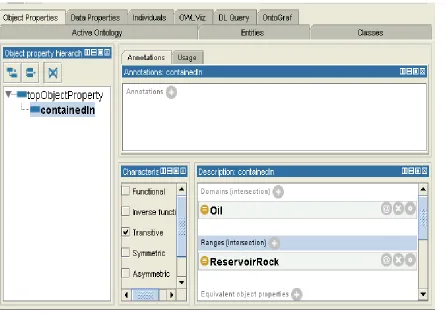
Figure 6.17 Screen shot showing the Domain and Range of the containedIn property……...59
Figure 6.18 Screen shot of the “OWL Viz” tab………..……...60
Figure 7.1 Screen shot showing subclasses and some superclasses of Petroleum.………….64
Figure 7.2 Screen shot showing subclasses and superclasses of NaturalGas…………..……66
Figure 7.3 Screen shot showing subclasses and superclasses of PetroleumReservoir ……..73
Figure 7.4 Screen shot showing superclasses and subclasses of SandstoneReservoir…….74
Figure 7.5 Screen shot showing the StructuralComponent of PetroleumTrap…...….82
Figure 7.6 Screen shot showing the RockComponent of PetroleumTrap .………...….83
Figure 7.7 Screen shot showing specializations of the StructuralTrap...…………...….84
Figure 7.8 Screen shot showing specializations of the StratigraphicTrap ………..……...….85
Figure 7.10 Screen shot of superclasses and subclasses of PetroleumExtraction...90
Figure 7.11 Screen shot showing specializations of TertiaryRecovery………...91
CHAPTER 1
INTRODUCTION
This thesis presents a cogent re-engineering of an aspect of the existing upper-level
Semantic Web for Earth and Environmental Terminology (SWEET) ontologies
(http://sweet.jpl.nasa.gov/2.3)to suit its efficient usage by domain experts in the field of
Petroleum Geology. An ontology is a representation of our knowledge of a domain in a machine
(computer) understandable format (Yu, 2010). It also consistently defines the terms used to
describe and represent the domain or area of knowledge (Heflin, 2009). The knowledge of a
domain is the statements of facts of that domain. For example, in Petroleum Geology, statements
of facts include: petroleum is composed of hydrocarbons and other elements; a petroleum trap
generally consists of a source rock, reservoir rock, and cap rock; oil is a kind of petroleum;
natural gas is a kind of petroleum; oil is the same as crude oil or simply crude. This knowledge
(statements of facts) can be encoded through established relationships (superclass-subclass
relationships) between concepts (classes), the properties describing these concepts, and the use of
certain reserved words (e.g., owl:class) in the form of a subject-predicate-object format, called
RDF triple.
Gruber (1993) defines ontology as an explicit formal specification of conceptualization.
Babaie (2011), explains that in the Gruber’s definition of ontology, “explicit” means that each
and every fact is explicitly (openly, clearly, plainly, unambiguously) translated into RDF triples
or class hierarchies (e.g., rdfs:subClassOf ). “Formal” means that ontology is machine
(computer) readable because ontology is written in standard machine readable languages of
the language constructs, for example when you say that SedimentaryRock is a Rock; you are
explicitly specifying that SedimentaryRock (a concept) is a Rock (another concept). The is-A
is the specific relation (specification). “Conceptualization” in this context means that the
relations between classes (concepts) are represented with OWL constructs.
The concepts in the ontology are structured in a hierarchical superclass-subclass
relationship (is-A relationship). The existing SWEET ontologies upon which the extensions are
made, are developed by NASA’s Jet Propulsion Lab for Earth System science. These publicly
available SWEET ontologies are written in OWL (Web Ontology Language) and include several
thousand terms, spanning the broad extent of Earth System science and related concepts (Raskin
and Pan, 2005).
In the model, presented in this thesis, top-level concepts from the SWEET ontologiesare
used and specialized (extended) for the first time to build an ontology for the Petroleum Geology
domain. The re-engineering of the SWEET ontologies is to provide an in-depth resource base of
relevant concepts in Petroleum Geology and thus enhance a more efficient usage among experts
in the Petroleum Geology domain. This ontology is about spatial objects, it does not deal with
processes.
1.1 General method of constructing a scientific ontology
Noy and McGuiness (2003) proposed a set of ordered steps as a general method in
building or constructing ontologies, which are given in a modified form in the following
The first step in the ontology building process is the determination of the domain and
scope of the ontology. The domain is the field of study or discipline under consideration in the
ontology, which in this thesis is the Petroleum Geology. The domain is usually very large, so
one would want to define a scope of the ontology, which is the specific part of the domain
knowledge of interest to capture and model (for example an aspect petroleum production). The
scope of the ontology is often determined through the use of competency questions (Gruninger
and Fox, 1995) which are the list of questions which a knowledge represented by the ontology
should be able to answer. The scope of this ontology is on the aspect of Petroleum Geology
which concern petroleum production (Petroleum Geology mainly involves petroleum exploration
and petroleum production). This stage strongly depends on the purpose of the ontology.
The second step is the acquisition of domain knowledge. This knowledge attainment
involves the extraction of relevant terms or concepts used in the domain of discourse. These
terms (concepts) are nouns and verbs used as vocabularies in the domain.
The third step is to consider the reuse of existing ontologies in the scoped domain of
interest. Some ontologies may be located at: www.ksl.stanford.edu/soft-ware/ontoligua and the
DAML ontology library at: www.daml.org/ontologies (Loh et al., 2008). In that case, the
available ontologies must be reused as much as possible.
The fourth step involves the identification of object (spatial) or processes classes,
superclasses, and subclasses (i.e., the identification of hierarchical structure among object and
process entities). Superclasses represent higher level concepts and subclasses are specializations
of these concepts. For example, in the Petroleum Geology domain, one could identify
StructuralTrap as subclasses (specializations). To further extend this, a StructuralTrap for
instance would have AnticlinalTrap and FaultTrap as subclasses (types). The approach adopted
in this thesis for the hierarchy of classes is the bottom-up method, which starts with defining
more specific, specialized concepts which are then combined or grouped to form more general
concepts higher in the hierarchy (Uschold and Gruninger, 1996).
The fifth step involves identifying properties which take non-object values (datatype
properties), which relate an instance of a class to the predefined XML data types or RDF literals,
such as string, date, integer etc. Porosity, permeability, and thickness of a reservoir rock are
all datatype properties. In addition to these datatype properties, object properties (e.g.,
containedIn, locatedIn, composedOf etc.) are identified. Object properties relate instances of
different classes to each other. For example, the containedIn property relates instances of Oil
and PetroleumReservoir classes. It is important at this stage to determine the characteristics
of the properties, i.e., whether they are functional, inverse functional, symmetric, reflexive,
transitive, etc. Also the cardinality (number of objects participating in a property) and value
restrictions for the properties may be identified (Babaie, 2011). Property characteristics and
restrictions are discussed in detail in Chapter 5.
The sixth and final step is to construct the scoped domain ontology using the identified
concepts and relationships. The ontology may become populated with instances (individuals) of
CHAPTER 2
THE PETROLEUM GEOLOGY DOMAIN
2.1 Oil and Natural Gas formation
Petroleum Geology is a branch of Geology which deals with the application of Geology
to the exploration for and production of oil and gas (Selley, 1998). Petroleum mainly forms from
buried organic matter in a steadily subsiding sedimentary basin (Selley, 1998). The major source
of organic matter from which petroleum forms is known as sapropel. Sapropel is predominantly
fine plant and animal organic matter from marine microorganisms: phytoplankton (microscopic
plants), zooplankton, and pores which accumulate in oxygen-deficient environments such as
lakes, lagoons, or marine basins (Boggs, 2006). Such oxygen-poor environments could come
about as a result of poor water circulation to replenish any oxygen used for instance in a decay
process or if so much organic matter is supplied that, it completely overwhelms any available
oxidants (Boggs, 2006). As the organic matter begins to decay by microbial activity any
available oxygen is used in the decay process. The remaining organic matter is therefore
preserved and buried under newer layers of marine sediments (Murck et al., 1996).
Tissot (1977) defines three major phases surface organic matter under goes during burial
resulting in the formation of oil and gas. These phases are diagenesis, catagenesis and
metagenesis. Diagenesis involves biogenic decay aided by bacteria, and reactions that are not
biogenic in nature. During this process, methane, carbon dioxide, and water are released
resulting in the formation of kerogen and a reduction in oxygen content. With increasing burial,
later gas (natural gas). Kerogen therefore matures into oil and natural gas. Oil is generated at 60
and 120 0C, and thermogenic gas is generated between 120 and 225 0C. The hydrogen:carbon
ratio of the kerogen declines in the process of generating oil and gas. This phase is known as
catagenesis. With still further burial resulting in increasing higher temperatures and pressures
methane is largely expelled and the hydrogen:carbon ratio further declines eventually resulting
the formation of carbon in the form of graphite. This phase is known as metagenesis.
Petroleum encompasses naturally occurring liquid and gaseous hydrocarbons (oil and
natural gas), and also semisolid hydrocarbons, commonly called tar (Murck et al., 1996). Oil and
natural gas are the two main forms of Petroleum (Murck et al., 1996). Selley (1998) mentions
that petroleum exploration is largely concerned with the search for oil and natural gas.
According to selley (1998), The American Petroleum Institute (API), the American
Association of Petroleum Geologist (AAPG) and the Society of Petroleum Engineers (SPE)
jointly define crude oil “as a mixture of hydrocarbons that existed in the liquid phase in natural
underground reservoirs and remains liquid at atmospheric pressure after passing through surface
separating facilities”. Liquid hydrocarbons are referred to as oil, crude oil, or simply crude
(Selley, 1998). Crude oils vary in appearance, sulfur content, surface viscosities, refractive
indices, density and specific gravity. These variations are sometimes due to temperature
variations and to the various hydrocarbons present in crude oil (Selley, 1998). The density of oil
is often expressed in the API gravity units (0API) defined by the American Petroleum Institute
(API). By this definition, light oils have API gravities of greater than 400 and heavy oils have
Also according to to Selley (1998), in the oil industry natural gas is defined as “a mixture
of hydrocarbons and varying quantities of nonhydrocarbons that exists either in the gaseous
phase or in solution with crude oil in natural underground reservoirs”. This is the adopted
definition by the American Petroleum Institute (API), the American Association of Petroleum
Geologist (AAPG) and the Society of Petroleum Engineers (SPE). The above authorities again
subclassify natural gas into dissolved, associated, and nonassociated gas. Dissolved gas is
natural gas that exists in solution in crude oil in the reservoir. Associated gas, also known as gas
cap gas is natural gas that overlies and is in contact with crude oil in the reservoir.
Nonassociated gas is natural gas that is not in contact with significant quantities of crude oil in
the reservoir (Selley, 1998). Such reservoirs containing nonassociated gas may contain some
crude oil but not in significant quantities (Hyne, 2001). Natural gas is also described as sweet or
sour. Sweet natural gas (sweet gas) is natural gas containing very little or no sulphur or sulphur
compounds (e.g., hydrogen sulfide). Sour natural gas (sour gas) is natural gas containing
significant quantities of sulphur or sulphur compounds (Hyne, 2001). Selley (1998) mentions
that gases are described as sweet or sour based on the absence or presence respectively of
hydrogen sulfide. Selley (1998) also mentioned that gases may be classified as dry gas if they
contain less than 0.10 gal/ 1000ft3 of condensate and as wet gas if they contain more than 0.30
gal/ 1000ft3 of condensate, and that chemically, dry gas is mainly methane and wet gas contains
ethane, propane, and butane.
After the formation of fluid hydrocarbons (oil and natural gas) in the source rock, they
migrate from the source rock. There are two types of migration associated with petroleum:
primary migration and secondary migration. Primary migration is the emigration of
usually sandstones or limestones. And secondary migration refers to the subsequent movement
of oil and gas within the permeable carrier beds and reservoirs through the interconnected pore
spaces of these rocks (Showalter, 1979; England, 1994). Primary migration may be partly due to
the fact that petroleum in the source rock is under tremendous lithostatic pressure as a result of
the weight of over-lying layers of rock and sediment. Secondary migration is by buoyancy as a
result of the different densities of the fluids involved and in response to differential pressures
(Selley, 1998).
2.2 Petroleum reservoirs and types of reservoir porosity
The most common types of reservoirs into which oil and gas migrates and are stored are
sandstone reservoirs and carbonate reservoirs. The two major types of carbonate reservoirs are
limestone reservoirs and dolostone (or dolomite) reservoirs. These reservoirs are porous and
permeable. Selley (1998) describes the following porosities associated with petroleum
reservoirs.
Primary porosity (depositional porosity) is the original porosity formed at the time of
deposition. Primary porosity can be subclassified as intergranular porosity and intragranular
porosity. Intergranular porosity occurs between grains and is initially present in all sediments at
the time of deposition but can be quickly lost during lithification. The preserved forms of
intergranular porosity are common in sandstone reservoirs. Intragranular porosity is found
within grains especially within grains of carbonate sands.
Secondary porosity (post depositional porosity) is formed in the rock at some later time
after deposition. Secondary porosity includes, intercrystaline porosity, fenestral porosity, vuggy
result of the selective dissolution of minerals, commonly carbonates, in which only the grains or
only the matrix has been leached out. Vuggy porosity is also the result of the dissolution of
minerals but cut across grains and matrix and is often larger than moldic pores. Larger forms of
vuggy porosity are known as cavernous porosity. Fenestral porosity is characteristic of
pelmicrite (carbonates) and is usually generated between buckled pelmicrite laminae.
Dehydration, lithification etc soon after deposition can cause laminae to buckle and generate
sub-horizontal fenestral pores between the laminae. Intercrystalline porosity is pores between the
crystal faces of crystalline rocks. Fracture porosity refers to interconnected pores generated as
fractures in brittle rocks.
Petroleum will migrate through the permeable reservoir rock until it encounters on its
way, a highly impermeable rock unit called a cap rock which are commonly shale, gypsum,
anhydrite, and salt (halite) which prevents further migration. When trapped, petroleum
accumulates overtime in the reservoir rock (Selley, 1998; Murck et al., 1996).
2.3 Petroleum traps
A geologic setting involving a source rock, a reservoir rock, and a cap rock is known as a
petroleum trap (Murck et al., 1996). There are different types of petroleum traps which can be
classified into structural traps, stratigraphic traps, hydrodynamic traps and combination traps.
Structural traps and stratigraphic traps are the major groups of traps agreed upon. Selley (1998)
provides the following definitions of the different types of traps. Structural traps are those traps
whose geometry was formed from tectonic processes after the deposition of the beds that formed
them, resulting in folding or faulting. Stratigraphic traps are those traps whose geometry formed
lithology (e.g., truncations and diagenetic changes). Hydrodynamic traps are those traps that
occur where the downward movement of water prevents the upward movement of oil. Such
traps are very uncommon. Combination traps are formed from a combination of any two or
more of the above mentioned processes but very commonly from structural and stratigraphic
processes. There are several specializations of the above mentioned traps such as fault trap and
fold (anticlinal) trap related to structural traps. Also somehow related to structural traps are
diapiric traps (salt diapirs and mud diapirs) which are caused by upward movement of
impermeable materials such as salt or clay that are less dense than those overlying them.
Unconformity traps, diagenetic traps, depositional traps such as pinchout traps, barrier bar traps
are different kinds of the stratigraphic trap.
According to Selley (1998), an anticlinal trap is the simplest kind of trap and further
provided the following definitions for its parameters. The productive reservoir within a
petroleum trap is also known as the pay, and the vertical distance from the top of the reservoir to
the petroleum/water contact is termed the gross pay, all of which may not necessarily consists of
productive reservoir. The net pay is the cumulative vertical thickness of the reservoir from
which petroleum may be produced.
2.4 Petroleum production and drive mechanisms
Production (or recovery) of oil and gas from the reservoir of a petroleum trap involves
both natural and artificial drive mechanisms. Production of hydrocarbons may occur in stages
identified as primary recovery, secondary recovery, and tertiary recovery (Enhanced Oil
of the reservoir in which oil and gas are produced using the reservoir’s natural or original energy
as a drive. Water drive, gas cap drive, dissolved gas (solution gas) drive, and gravity drive are
primary (natural) recovery drive mechanisms. In water drive, as oil and gas are produced, the
reservoir pressure drops and water occupying lower portions of the reservoir pushes the
overlying oil upwards through the reservoir pores. In this case the drive energy is from an
aquifer that in contact with the oil at the oil-water contact and displaces the oil during production
(Selley, 1998). In gas cap drive, the drive energy for moving the oil is provided by the less
dense natural gas which settles above the oil as a gas cap. As production continues resulting in
the reduction of the reservoir pressure, natural gas in the gas cap expands and pushes the oil into
production well. The drive energy in dissolved gas drive is provided by the dissolved gas in oil
which bubbles out of solution and expands as the reservoir pressure drops during production.
The expanded gas forces the oil through the reservoir pores towards the boreholes (Selley, 1998).
Gravity drive involves the gravitational force of the earth pulling downward on oil towards
production wells.
Secondary recovery and tertiary recovery involve artificial drive mechanisms. Artificial
drive mechanisms involve supplemental effort to improve oil recovery when the natural drive of
the reservoir becomes depleted. Secondary recovery techniques are water flooding (water
injection) and gas flooding (gas injection). Water flooding involves the injection of water in to
the reservoir to restore reservoir pressure and displace oil toward production wells. Gas flooding
involves the injection of a gas into the reservoir to displace oil towards production well and to
Tertiary recovery techniques include miscible gas injection, steam injection, detergent
injection and alkaline flooding. Miscible gas injection involves the injection of gases such as
carbon dioxide that are miscible with the oil to make oil more fluid and be drawn to production
wells. Steam injection as the name implies involves the injection of steam into oil and gas
reservoirs to make oil less viscous and be drawn into production wells. Some of the oil becomes
vaporized. The steam upon cooling turns into water which also aid in driving oil to the well
bore. The injection of detergents (micellar floods) is to emulsify heavy oil and move it to the
surface (Selley, 1998). Similarly, alkaline floods reduce the interfacial tension between oil and
CHAPTER 3
THE SWEET ONTOLOGIES
The Semantic Web for Earth and Environmental Terminology (SWEET) ontologies are
developed and maintained by NASA’s Jet Propulsion Lab. SWEET is a comprehensive
upper-level ontology which comprises several thousand terms and related concepts drawn from the
broad extent of Earth system science (Raskin and Pan, 2005). The ontologies are developed
using the Web Ontology Language (OWL) and are downloadable at:
http://sweet.jpl.nasa.gov/sweet(Raskin, 2005a). In the original SWEET ontologies, Figure 3.1,
each rectangular box represents a separate ontology, and the connecting lines show where major
properties relate these ontologies.
[image:28.612.122.430.398.648.2]
The guide to the original SWEET ontologies (Raskin, 2005b) downloadable at:
http://sweet.jpl.nasa.gov/guide.doc reveal that the primary ontologies in SWEET shown in
Figure 3.1 are of two categories: integrative ontologies and faceted ontologies.
The faceted ontologies are surrounded by the larger dotted rectangle in Figure 3.1. The
faceted ontologies represent orthogonal concepts commonly known as facets (faceted concepts).
Facets are single concepts such as fluid and pressure which may exist as descendants of the same
or different taxonomies (meaning they may be found as concepts in the same or different
ontologies). The structure of a faceted ontology is designed such that specialization and greater
details are added to more general concepts as one descends down the structure (or tree).
The integrative ontologies, surrounded by the smaller dotted rectangle in Figure 3.1, are
unifying ontologies which define holistic, synthesizing concepts using elements from the faceted
ontologies. The integrative ontologies contain integrative (unifying) concepts (Raskin, 2006).
They may therefore define compound concepts such as fluid pressure which are combinations of
orthogonal concepts.
Among the outstanding features of the SWEET ontologies are their scalability and
orthogonality. Scalability is the attribute of ontology to be easily extendable so that specialized
domain concepts can be developed from existing more general ontologies. Orthogonality of the
SWEET ontologies implies compound concepts are decomposed (or split) into their component
parts (facets) so that they can be recombined in diverse ways as desired. In orthogonal
ontologies, each term (concept) is defined only in one ontology and other ontologies that need to
use the term refer to its definition in the source ontology (Ghazvinian et al., 2010) to enhance
The current SWEET ontologies upon which the modifications presented in this thesis are
made are downloadable at: http://sweet.jpl.nasa.gov/2.3. This current version of SWEET
consists of nine top-level concepts/ontologies. These top-level ontologies consists of modules
for (or cover areas such as) Representation, Process (microscale), Phenomena (macroscale),
Matter, Realm, Human Activities, Property (observation), State (adjective, adverb) and Relation
(verb). Relating to each module, there are several ontologies. For example, more directly
related to the properties ontology are the propChemical.owl, propEnergy.owl, propMass.owl etc
files all of which contain ontologies.
Representation has ontologies relating to Math, Science, Data, Time and Space. Again,
several concepts are usually covered in the ontologies relating to each area. For example,
reprMath.owl, reprMathFunction.owl, reprMathOperation.owl, and reprMathStatistics.owl are
all files of representation relating to Math. They contain concepts such as Function,
ExponentialGrowth, and Subtraction.
Process (microscale) has ontologies relating to Physical Process, Chemical Process,
Biological Process and Mathematical Process. These ontologies consist of concepts including
Diffraction, Reflection, Flushing, Folding, Flaring, Combustion, Trapping, Migration,
Vaporization etc. Such processes affect, i.e, change the state of, both living and nonliving
substances.
Phenomena (macroscale) consist of ontologies relating Ecological Phonomena and
Physical Phenomena. It has related files such as phenGeolTechnology.owl, phenHydro.owl and
phenGeolFault.owl. Concepts covered in this ontology include StrikeSlip, Normal,
Matter consists ofLiving Thing, Chemical and Material Thing ontologies. Related files
in this ontology include matrNaturalResource.owl, matrCompound.owl, matrEnergy.owl. The
ontologies cover concepts such as FossilFuel, NaturalGas, Chlathrate, Biofuel, etc.
Realm consists of ontologies relatingthe layers of the Earth system (Earths’ spheres)
such as Atmosphere, Cryosphere, Geosphere, Heliosphere, Ocean, Terrestrial Hydrosphere, and
Land Surface. Files such as realmGeolOrogen.owl, realmGeolOceanic.owl,
realmGeolConstituent.owl are related to the realm ontology, and include concepts like Orogeny,
Lithosphere, Matrix, and Landform.
HumanActivities ontology represents activities humans are engaged in. This embrace
areas such as Human Decision, Commerce, Jurisdiction, Research and Environment and involves
concepts such as Exploration, Prospecting, ResourceeExtraction, Imaging, Mapping,
Drilling, Pumping, Miningetc.
Property (Observation) ontology relates Quantity (e.g., VectorQuantity), Binary
Property (e.g., Polarity), Categorical Property (e.g., Group, Community, Classification), and
Ordinal Property (e.g., Condition, Level, Color). Other concepts in the property ontology
include physical properties such as permeability, porosity, thickness, altitude, depth,
viscosity, density,and pressure. These properties are usually measured physical quantities or
qualities with units.
State ontology includes Role, Physical, Chemical, Space and Biological state. It
comprises files like stateRealm.owl, statePhysical.owl, and stateChemical.owl. These ontologies
Relation (verb) ontology covers areas such as Human, Physical, Time, Space, and
Chemical relations. It incorporates the files relaSci.owl, relaSpace.owl and relaTime.owl
Concepts such as DarcysLaw, Chronology, Provenance, Genesis etc are covered in these
ontologies.
The relationships between concepts in the ontologies are usually that of a
superclass-subclass relationship. Other relationships include disjointness and equivalence. Some classes or
CHAPTER 4
CONTROLLED VOCABULARY AND ONTOLOGY
Controlled vocabularies are the set of approved terms such as unconformity, diagenesis,
permeability, reservoir, orogeny, etc which are used in a domain of discourse as a means of
communication. These terms are defined and expected to be consistent in meaning in all
contexts (Hebeler et al., 2009). Vocabularies become controlled when they are managed,
meaning when they are consensually approved and defined in which case a team of experts
supervise (oversee) the addition (or creation) of new terms and revision of existing terms which
are done according to agreed-upon procedures (Neiswender,2009). Glossary of terms
(e.g., glossary of terms in Petroleum Geoscience), taxonomy, thesaurus etc are all examples of
types of controlled vocabularies. The accepted terms are to follow a consistent definition and
use. Within the framework of metadata (data which describes data), it is useful not to have
multiple terms represent the same concept or the same term carry multiple meanings ( i.e. the
same term representing different conceps) to make it easier for data to be understood
(Neiswender et. al, 2011).
Taxonomy is a kind of a controlled vocabulary in which terms are organized in the form
of a hierarchy (Neiswender, 2009). According to Hebeler et al., (2009), whereas vocabularies
(or controlled vocabularies) are a simple collection of well defined-terms, taxonomies extend
controlled vocabularies by adding hierarchical relationships to the terms. The relationships
between these terms are that of superclass-subclass relationship (Hebeler et al., 2009).
can greatly help to formally organize knowledge of a given domain thereby enhancing reuse of
the knowledge and also make possible or easy data (or metadata) interoperability (Yu, 2011).
Metadata interoperability is the ability of two or more computer systems to exchange (or
share) descriptive metadata with minimal loss of information (Neiswender and Montgomery,
2009). For greater data interoperability, sophisticated data comparison, and improved
knowledge discovery, controlled vocabularies alone are unable to meet these needs. This is
where their use in an ontology satisfies the need through the added capabilities of the ontology
(Alexander,2011). A controlled vocabulary is viewed as an ontology when its concepts are explicitly defined and at least some defined as classes (Graybeal and Alexander, 2011). Also, a
firm hierarchical subclass relationship must be present between the classes (Gruber, 1993). Graybeal and Alexander (2011), emphasized that to be adequately potent enough to be considered an ontology, a controlled vocabulary should possess classes, relations between
classes, and properties. In this way, ontologies enrich controlled vocabularies by establishing relations between them and defining properties for terms (Alexander, 2011). An ontology uses
predefined, reserved vocabulary of terms e.g., owl:class, owl:equivalentClass,
rdfs:subClassOf, owl: allValuesFrom, etc to define concepts and the relationships between
them (Hebeler et al., 2009). By this means, relationships between concepts will not only be human readable and understandable but machines (computers) will also be able to understand
and interpret the encoded relationships between concepts. In this way the knowledge of a
domain can be well encoded to be understood by a computer (Yu, 2011).
Further, though taxonomies and other Knowledge Organization Systems (KOSs) can be
whereas taxonomies and other examples of KOSs relationships between concepts are
semantically weak (Yu, 2011).
Ontologies can be very useful on the Semantic Web. The Semantic Web vision is to
extend the current web so that data can be related or linked to one another and shared very
efficiently based on meaning (semantics). On the Semantic Web information is represented as
statements in the form of subject-predicate-objects, called triples (Hebeler et al, 2009).
Information is encoded in triples using the Resource Description Frameworks (RDF) ontology
language. The subject of the statement refers to the element being described, and the predicate
describes the relationship between the subject and one or more object (Hebeler et al, 2009). For
example, the statement: petroleum is contained in a reservoir rock, can be simply written as an
RDF triple of the form, PetroleumcontainedInReservoirRock. The subject of this triple is
Petroleum, the predicate is containedIn, and the object is ReservoirRock. With the RDF
Schema, and to a large extent, the Web Ontology Language (OWL) semantics, or meanings, are
added to the RDF statements. All resources (subjects, predicates, or objects) on the Semantic
Web are identified using unique Uniform Resource Identifiers (URIs). A user with the
appropriate query language, such as SPARQL, can request a URI and all the RDF triples where
the URI dereferences to could be returned. In a more elaborate form, the request could be made
in such a way that all the triples where the requested URI is a subject, predicate, or object could
be returned. These resources can be referred to through namespaces or qualified names
(qnames), which are used to qualify resources (terms) by associating the namespaces with URI
CHAPTER 5
A BRIEF OVERVIEW OF THE WEB ONTOLOGY LANGUAGE (OWL)
The
Web Ontology Language (OWL) (
http://www.w3.org/TR/owl-features/) is aSemantic Web ( Berners-Lee et.al, 2001) language for knowledge representation, and is based on
Description Logic (DL) (Baader et.al, 2003), which allows a knowledge base, based on it, to
respond with certainty to different kinds of data, models and queries (Babaie, 2011).
Web Ontology Language (OWL) extends the RDF(S) language (Horrocks et. al., 2003)
by adding several constructs to those in RDF(S) language such, owl:unionOf,
owl:disjointUnionOf, owl:intersectionOf etc. The Web Ontology Language (OWL) has several
useful features. It has special features to make two classes, properties, and individuals
equivalent. For example classes such as A and B can be made equivalent to each other using the
owl:equivalentClass construct. Similarly two properties could be made equivalent using
owl:equivalentProperty. Again in OWL we can constrain cardinalities using owl:Restriction
to set a minimum cardinality as well as a maximum cardinality using owl:minCardinality and
owl:maxCardinality respectively. Complex classes could also be constructed in OWL by
restricting properties of existing classes. OWL defines two types of properties. OWL object
property declared using owl:objectPropertyand OWL datatype property, which is declared
using owl:datatypeProperty. Object properties may have corresponding inverse properties.
For example, an object property such as hasPart has the inverse, partOf. OWL Object
properties also have the added value of property characteristics such as functional, inverse
functional, transitive, symmetric, antisymmetric, reflexive, and irreflexive. Data properties may
5.1 Defining classes
5.1.1 Property Restrictions
A property restriction results in the creation of a new class that is defined by the
description of its members in terms of existing properties and classes (Allemang and Hendler,
2008). It describes the class of individuals that meet the condition or restriction placed on the
property (Hebeler et al, 2009). For example, considering the property containedIn, if a
restriction (or constraint) is placed on this property to have the value ReservoirRock as its
object or range, this will define the class of things contained in a reservoir rock. A property
restriction is therefore a special kind of class description. A property restriction is declared using
the construct owl:restriction and the property on which the restriction is placed ( i.e. the property
the restriction applies to) is identified using owl:onProperty. So that in the above example the
restriction defining the objects contained in a reservoir rock is owl:onPropertycontainedIn.
The two types of property restrictions, value restrictions and the cardinality restrictions are
discussed in the following sections.
5.1.2 Value Restrictions
A new class can be created or defined if the value of a property is restricted by specifying
or stating what its object must be (Allemang and Hendler, 2008). A value restriction or
constraint places constraints on the range of the property (Yu, 2011). For example considering
the property hasChemicalElement, by restricting (constraining) the value (object or range) of
this property to be HydroCarbon, we define a new class: the class of things that have chemical
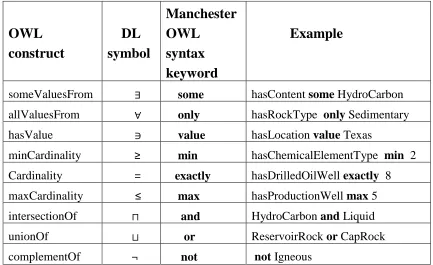
specifying the object or range of a property are owl:allValuesFrom, owl:someValuesFrom and
owl:hasValue.
The owl:allValuesFrom restriction is used to specify that the value of the restricted
property should all come from the specified class or data range (Yu, 2011). They are also known
as ‘only’ restrictions as they constrain the range for a given property to a specific class (Horridge
and Brandt, 2011) or data range. That means the value of the constraint property should be an
instance of the specified class or data range. For example, the density of oil as mentioned earlier
is often expressed in API gravity units (o API) defined by the American Petroleum Institute
(API). By the API definition, light oils have API gravities of more than 40o and heavy oils have
API gravities of less than 10 o (Selley, 1998). The above knowledge can be modeled using value
constraints. By placing restriction on the property hasAPIGravity, and constraining its values to
the specified range of GreaterThan40o, we can define the LightOil class. Similarly the value
(range) of the property hasAPIGravity can be constrained to LessThan10o to define the
HeavyOil class. Light oils have higher API gravities than heavy oils because oil viscosity and
API gravity are generally inversely related (Selley, 1998). When the owl:allValuesFrom is used
on a given property, the property does not need to have a value (no relationship for the property);
the owl:allValuesFrom property restriction simply indicates that if a relationship exists with the
given property, its values should all come from the specified class (Horridge and Brandt, 2011).
The owl:someValuesFrom restriction is used to define the class of individuals that have
at least one specific kind of relationship, along the restricted property to individuals of the
specified class (Horridge and Brandt, 2011). That means all instances (members or individuals)
of the newly defined class must have at least one relationship along the restricted property to the
elements. To express this knowledge, a Petroleum class is defined by placing a constraint (or
restriction) on the composedOf property to have owl:someValuesFrom the Hydrocarbon
class, the range of the property. This means every individual of the petroleum class is at least
composed of hydrocarbons. The owl:someValuesFrom restriction therefore provides some
value restriction for the range of the property, in this case the Hydrocarbon class. Individuals of
the defined class are not restricted to have values only from the specified range; they may
additionally have a relationship along the property to individuals of a different class. For
example, individuals of the defined Petroleum class apart from using range values from the
specified Hydrocarbon class may additionally use the composedOf property with range values
from a different class of elements. Petroleum may for instance be composed of other elements
like sulphur, nitrogen, and oxygen (Hunt, 1996), which may belong to different classes of
elements.
Similar to the earlier restrictions described, the owl:hasValue restriction acts on a
particular property specified by owl:onProperty (Allemang and Hendler, 2008) and defines the
class of individuals that are related to a specific individual (instance) along the specified
property (Horridge and Brandt, 2011). It is nearly the same as the owl:someValuesFrom
restriction except that the specified value or range of the particular property on which it acts is an
instance (individual) instead of a class (Horridge and Brandt, 2011). This means that all
instances of the defined class will have the particular property with the exact value specified.
For example, to directly model the knowledge that wet gas contains significant amounts of
condensate, the contains propertywhen used with the WetGas class will be assigned the value
SignificantCondensate as the range of the property. The class of oil fields located in Texas
specified value (owl:hasValue) of Texas. This provides a more direct approach to defining the
class.
The code shown below uses the owl:someValuesFrom restriction in which Petroleum
has been described to be composed of at least hydrocarbons. This is modelled using the
composedOf objectproperty, owl:someValuesFrom restriction,the Petroleum class, and the
Hydrocarbon class.
Code using owl:someValuesFrom restriction:
<owl:Class rdf:about="&petronto;Petroleum">
<rdfs:subClassOf>
<owl:Restriction>
<owl:onProperty rdf:resource="&petronto;composedOf"/>
<owl:someValuesFrom rdf:resource="&petronto;Hydrocarbons"/>
</owl:Restriction>
</rdfs:subClassOf>
</owl:Class>
5.1.3 Cardinality Restriction
Cardinality restriction is another way of defining a class by placing a constraint on the
number of values a property can take (Yu, 2011). It makes it possible to define a class based on
the number of distinct values a particular property of individuals of the class being defined can
take (Allemang and Hendler, 2008). The cardinality restriction therefore indicates the number of
times a property can be used to describe an instance of a class (Hebeler et al, 2009). Each
cardinality restrictions are: owl:cardinality, owl:minCardinality, and owl:maxCardinality.
Assuming x is the number of distinct values of the property, (x being a non-negative integer) an
owl:cardinality will have exactly x distinct values of the property. An owl:minCardinality will
have at least x distinct valuesof the property and an owl:maxCardinality will have at most x
distinct values of the property. The owl:minCardinality and the owl:maxCardinality can be
used simultaneously to specify a range of values.
5.1.4 Using Set Operators
The set operators owl:intersectionOf, owl:unionOf and owl:complementOf can be
used to define or construct more complex classes in terms of other existing simple classes.
For a class defined in terms of other classes using the owl:intersectionOf operator, the
newly defined class becomes a subclass of each of the classes involved in its definition. For
example if a SandstoneReservoir class is constructed from the owl:intersectionOf a
Sandstone class and the PetroleumReservoir class, the SandstoneReservoir class will be a
subclass of both the Sandstone class and the PetroleumReservoir class. Further, since a
subclass will inherit all the properties of its base class (Yu, 2011), the SandstoneReservoir
class will inherit all the properties associated with the base class Sandstone. Also, it will
inherit all the properties associated with its other base class, which in this case is the
PetroleumReservoir class.
A new class could also be defined by the union of earlier defined classes using the
owl:unionOf operator. The list of classes which form part of the union in defining the new class
will each become a subclass of the newly defined class (Yu, 2010). For example, a
and StratigraphicTrap will have both StructuralTrap and StratigraphicTrap become
subclasses of the CombinationTrap. Some subclasses of the new class are purely or solely one
of the participating components forming the union and other subclasses are intersections of any
two or more of the participating classes forming the union (Yu, 2010). For example, the
CombinationTrap mentioned earlier may have subclasses (sections) which are purely
StructuralTrap, orpurely StratigraphicTrap and a subclass which is actually an intersection of
StructuralTrap and StratigraphicTrap. This means a combination trap of the
structural-stratigraphic kind in an oil field may actually have sections which could be identified purely as a
stratigraphic trap or a structural trap, and a trap involving both structural and stratigraphic
processes (intersection). We construct the CombinationTrap from the union of its component
parts because oil and gas fields that are due to a CombinationTrap may also have sections that
are actually purely one of the component parts. However, strictly speaking, the
CombinationTrap is that part of the trap that is formed from the intersection of its component
parts. A Migmatite may also be similarly constructed from the union of the IgneousRock class
and the MetamorphicRock class. This is because an outcrop of a migmatite will have sections
which are purely metamorphic, and sections which are purely igneous, as well as sections which
are both igneous and metamorphic.
The next set operator is the owl:complementOf. The complement of an OWL class will
define another class whose members are things not in the complemented class (Allemang and
Hendler, 2008). Such complement of a class will include all classes of individuals whose
members are not in the complemented class. The owl:complementOf is often combined with
the owl:intersectionOf operator to make the definition of a class complete and correct. For
SweetGas class. This is because the complement of the SourGas class includes the class of
Rivers, Houses, Fruits, in fact the class of anything which is not SourGas. To indirectly
assert that the SweetGas class is the complement of the SourGas class, the complement of the
SourGas class (which could be the class of anything) is used in an intersection with the
NaturalGas class. This is to assert that SweetGas is a NaturalGas. In other words, we are
now considering a natural gas which is not sour, and therefore sweet. The definition is therefore
made complete only after combining the owl:complementOf operator with the
owl:intersectionOf operator. If a class, X is owl:complementOf of another class Y, then all the
subclasses of the class X will be owl:disjoint With class Y (Yu, 2011).
In the code below, the SweetGas class is constructed from the intersection of the
NaturalGas class and the complement of the SourGas class.
Code combining the owl:complementOf operatorwith the owl:intersectionOf operator:
<owl:Class rdf:about="&petronto;SweetGas">
<owl:intersectionOf rdf:parseType="Collection">
<rdf:Description rdf:about="&petronto;NaturalGas"/>
<owl:Class>
<owl:complementOf rdf:resource="&petronto;SourGas"/>
</owl:Class>
</owl:intersectionOf>
5.1.5 Disjoint Classes
Two classes can be asserted to be disjoint when they do not have any individuals in
common (Allemang and Hendler, 2008). In such a case, an instance of one class cannot at the
same time also be an instance of the other class. Disjoint classes can be asserted using
owl:disjointWith. The owl:disjointWith property is a symmetric property, that is if a class, X is
disjoint with another class,Y then Y is also disjoint with X. For example, if the Oil class is
disjoint with the NaturalGas class, it also implies the NaturalGas class is disjoint with the Oil
class.
In cases where there are more than two classes, the owl:AllDisjointClasses
OWL 2 operatorcan be used in a more concise way to specify that these classes are pair-wise
disjoint with each other. Alternatively, OWL 1’s owl:disjointWith has to be used on each pair of
classes(Yu, 2011). For example, we can succinctly assert that the DissolvedGas,
AssociatedGas, and NonAssociatedGas classes are pair-wise disjoint with each other using
the owl:AllDisjointClasses.
The code below describes the AssociatedGas, DissolvedGas, and the
NonAssociatedGas classes as all pair-wise disjointclasses:
<rdf:Description>
<rdf:type rdf:resource="&owl;AllDisjointClasses"/>
<owl:members rdf:parseType="Collection">
<rdf:Description rdf:about="&petronto;AssociatedGas"/>
<rdf:Description rdf:about="&petronto;DissolvedGas"/>
<rdf:Description rdf:about="&petronto;NonAssociatedGas"/>
</owl:members>
Also, OWL 2’s owl:disjointUnionOf, can be used in a concise manner to define a new
class as the union of several collection of classes which are mutually or pair-wise disjoint with
each other (Yu, 2011). For example, a petroleum trap in general consists of a source rock, a
reservoir rock and a cap rock which are pair-wise disjoint with each other, meaning no
component of the petroleum trap will for instance serve as a reservoir rock and a cap rock at the
same time. The PetroleumTrap class can therefore be modeled as the owl:disjointUnionOf the
SourceRock, ReservoirRock, and CapRock classes. Again, this implies there are no
intersections of the classes involved in the union (or no members in the intersections). The
classes are disjoint.
Figure 5.1. The disjoint union of class A and Class B shaded.
Code for constructing the PetroleumTrap class from the disjoint union of the
SourceRock, ReservoirRock, and CapRock is shown below:
[image:45.612.176.497.344.471.2]<owl:Class rdf:about="&petronto;PetroleumTrap">
<owl:disjointUnionOf rdf:parseType="Collection">
<rdf:Description rdf:about="&petronto;CapRock"/>
<rdf:Description rdf:about="&petronto;ReservoirRock"/>
<rdf:Description rdf:about="&petronto;SourceRock"/>
</owl:disjointUnionOf>
</owl:Class>
A similar construct can be used for modeling the Maturation process of organic matter as
the owl:disjointUnionOf of Diagenesis, Catagenesis, and Metagenesis. The code for this
modeling is provided below:
<owl:Class rdf:about="&petronto;Maturation">
<owl:disjointUnionOf rdf:parseType="Collection">
<rdf:Description rdf:about="&petronto;Catagenesis"/>
<rdf:Description rdf:about="&petronto;Diagenesis"/>
<rdf:Description rdf:about="&petronto;Metagenesis"/>
</owl:disjointUnionOf>
5.2 OWL Properties
In OWL, two major types of properties can be defined. They are declared using
owl:ObjectProperty and owl:DatatypeProperty. The owl:ObjectProperty is used to connect
a resource to another resource (Yu, 2011). As a binary property, the owl:ObjectProperty relates
the set of individuals of a class to the set of individuals of another class. The
owl:DatatypeProperty on the otherhand connects a resource to an rdfs:literal (untyped) or XSD
datatype (typed) value (Yu, 2011). Also as a binary relation, the owl:DatatypeProperty relates
the set of individuals (instances) of a class to the set of individuals of a datatype.
The definitions of properties can be enriched (enhance semantics) through the use of
features or property characteristics. The characteristics that object properties may have are
functional, inverse functional, transitive, symmetric, asymmetric, reflexive and irreflexive.
Some of these property characteristics are discussed in the following section.
5.2.1 Inverse Properties
A property may be asserted to be the inverse of another property using owl:inverseOf.
Inverse properties are associated with object properties. Each object property in one direction
may have a corresponding inverse property in the opposite direction so that if the property relates
individual x to individual y, then its inverse property will relate individual y to individual x
(Horridge and Brandt, 2011). For example, the property hasPart has inverse partOf. For
instance, if a PetroleumTraphasPartReservoirRock, then the ReservoirRock is partof the
PertoleumTrap. Similarly, if in petroleum production, PrimaryRecovery
hasDriveMechanismNaturalDrive, we can also say, NaturalDrive is the driveMechanismOf
properties. Datatype properties cannot have an inverse because their values, which are literals,
cannot be the subjects of statements (Hebeler et al., 2009).
hasDriveMechanism
driveMechanismOf
Figure 5.2. The hasDriveMechanism and driveMechanismOf inverse properties.
5.2.2 Property Characteristics
5.2.2.1 Symmetric Properties
A property P is declared symmetric using owl:SymmetricProperty if it describes a
situation where it connects (or relates) a resource x to a resource y, and it again (the same
property name) relates the resource y back to the resource x. The relationship is in both
directions. The inContactWith property is an example of a symmetric property. For example, if
a ReservoirRock is inContactWith a CapRock in a petroleum trap, the CapRock is also
inContactWith the ReservoirRock. The property inContactWith is therefore a symmetric
property.
inContactWith
inContactWith
The rdfs:range of a symmetric property is always a resource (can only be a resource) and never
a literal or datatype (Yu, 2011). This is because owl:SymmetricProperty is a subclass of
owl:objectProperty, which as mentioned earlier relates a resource to another resource.
5.2.2.2 Asymmetric Properties
A property is an asymmetric property if it relates an individual x to individual y but does
not relate individual y back to individual x. That means the relationship is not bidirectional. The
migratesFrom property is an example of an asymmetric property. For instance if Oil
migratesFromSourceRock, the reverse statement which reads: SourceRockmigratesFrom
Oil does not hold true. The asymmetric migratesFrom property is able to relate oil to source
rock in one direction but unable to relate source rock back to oil in the opposite direction. A
property is declared asymmetric using owl:AsymmetricProperty.
5.2.2.3 Transitive Properties.
For individuals x, y, and z and a transitive property P, declared using
owl:TransitiveProperty, (xPy) and (yPz) implies (xPz) (Hebeler et al, 2009). This means if a
property P is transitive, and the property P relates individual x to individual y (xPy), and also
relates individual y to individual z (yPz), then it can be inferred that individual x is related to
individual z by the property P (xPz) (Horridge and Brandt, 2011). For example, the containedIn
property can be declared transitive as explained below. Oil is contained in the pore spaces of a
reservoir rock. And since the pore spaces are themselves contained in the reservoir rock, it
may contain one or more pools. Each pool may also contain one or more pay zones. We may
therefore conclude that an oil or gas field may contain one or more pay zones.
The locatedIn property could be used in a similar sense. For example, if a particular Oil
field is located in a certain county and that county is located in a given State, it implies
transitively that this Oil field is located in the State under consideration. Transitive properties are
also associated with only object properties. Datatype properties can not be declared transitive.
containedIn containedIn
implies
containedIn
Figure 5.4. The containedIn transitive property
Like the symmetric property, owl:TransitiveProperty is a subclass of owl:objectProperty,
therefore its rdfs:range can only be a resource but not a literal or datatype. It can only connect a
resource to another resource (Yu, 2011).
Oil PoreSpace ReservoirRock
[image:50.612.93.541.273.525.2]5.2.2.4 Functional Properties
A functional property is one for which there is only one value for a given instance. It has
one unique rdfs:range value for each rdfs:domain instance. It is declared using
owl:FunctionalProperty, and it is a subproperty of the rdf:property. As a result, the
rdfs:range of a functional property can be a resource, a literal, or a datatype (Yu, 2011).
hasAge
Figure 5.5 The hasAge functional property
Again, both an owl:ObjectProperty and an owl:DatatypeProperty can be functional,
hence the rdfs:range values of the functional property can be any type of values that an
owl:ObjectProperty or an owl:DatatypeProperty can assume. Properties such as
hasLocation, hasArealExtent, hasSpecicificGravity, hasAge etc are properties which can
assume only one value for any instance and are therefore characterized as functional properties.
Further, if the property of a class is assigned an owl:cardinality equal to 1, it is the same as
declaring that the property is a functional property (Yu, 2011).
5.2.2.5 Inverse Functional Property
The object individual x of an owl:InverseFunctionalProperty, uniquely relates (or
identifies) a single subject individual y (Hebeler et al, 2009).
Oil