© Author(s) 2014. CC Attribution 3.0 License.
Technical Note: Reducing the spin-up time of integrated surface
water–groundwater models
H. Ajami1,2, J. P. Evans3,4, M. F. McCabe5, and S. Stisen6
1School of Civil and Environmental Engineering, University of New South Wales, Sydney, Australia 2Connected Waters Initiative Research Centre, University of New South Wales, Sydney, Australia 3Climate Change Research Centre, University of New South Wales, Sydney, Australia
4ARC Centre of Excellence for Climate System Science, University of New South Wales, Sydney, Australia 5Water Desalination and Reuse Center, King Abdullah University of Science and Technology, Thuwal, Saudi Arabia 6Geological Survey of Denmark and Greenland, Copenhagen, Denmark
Correspondence to: H. Ajami ([email protected])
Received: 30 April 2014 – Published in Hydrol. Earth Syst. Sci. Discuss.: 26 June 2014 Revised: 31 October 2014 – Accepted: 6 November 2014 – Published: 12 December 2014
Abstract. One of the main challenges in the application of coupled or integrated hydrologic models is specifying a catchment’s initial conditions in terms of soil moisture and depth-to-water table (DTWT) distributions. One approach to reducing uncertainty in model initialization is to run the model recursively using either a single year or multiple years of forcing data until the system equilibrates with respect to state and diagnostic variables. However, such “spin-up” ap-proaches often require many years of simulations, making them computationally intensive. In this study, a new hybrid approach was developed to reduce the computational burden of the spin-up procedure by using a combination of model simulations and an empirical DTWT function. The method-ology is examined across two distinct catchments located in a temperate region of Denmark and a semi-arid region of Aus-tralia. Our results illustrate that the hybrid approach reduced the spin-up period required for an integrated groundwater– surface water–land surface model (ParFlow.CLM) by up to 50 %. To generalize results to different climate and catch-ment conditions, we outline a methodology that is applicable to other coupled or integrated modeling frameworks when initialization from an equilibrium state is required.
1 Introduction
The issue of model initialization is important for hy-drologic simulation and prediction, as the initial state has a major impact on a catchment’s modeled response (Berthet et al., 2009). In coupled or integrated surface– subsurface models, uncertainty in a catchment antecedent condition is of particular importance, as both the soil mois-ture distribution and depth-to-water table (DTWT) need to be specified at the start of a simulation (Ivanov et al., 2004; Noto et al., 2008).
Since information on the spatial pattern of water table and soil moisture distributions is generally unavailable, vari-ous approaches have been developed to determine the initial DTWT variation. Sivapalan et al. (1987) used a topography– soil index to map the spatial distribution of initial DTWT. In another approach, Troch et al. (1993) used recession flow analysis to estimate the effective water table height of a catchment. Regardless of the choice of initial DTWT, the un-certainty involved is such that a period of spin-up is always required (Cloke et al., 2003), as the applied atmospheric forc-ing is often inconsistent with the hydrodynamic initialization of the catchment inferred from limited observations (Ajami et al., 2014).
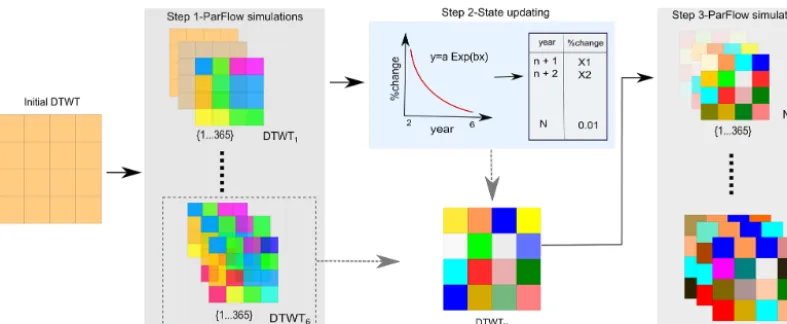
Figure 1. The hybrid spin-up approach consists of three main steps: (1) initial ParFlow.CLM spin-up simulations based on an arbitrary
DTWT distribution, (2) a state-updating step by developing a DTWT function based on percentage changes in mean annual DTWT in initial spin-up simulations, and (3) stage 2 of ParFlow.CLM spin-up simulations until the desired equilibration level is reached.
and Maxwell, 2008), and the impact of initialization is re-duced through recursive simulations over either a single year or multiple years of forcing data, until equilibrium condi-tions are reached, which are usually related to spin-up cri-teria based on changes in groundwater heads (Refsgaard, 1997) or changes in water and energy balances (Kollet and Maxwell, 2008); or (2) the model is initialized from a fully saturated condition, and simulations are continued until the modeled baseflow matches the observations (Jones et al., 2008). Equilibrium-based initializations have been utilized previously for exploring land surface–groundwater coupling (Kollet and Maxwell, 2008) and assessing the impact of cli-mate change on groundwater–land surface interactions us-ing an integrated hydrologic model (Ferguson and Maxwell, 2010).
Results of a ParFlow.CLM spin-up study for a catchment in Denmark showed that at least 20 years of recursive sim-ulations were required to reach equilibrium in subsurface storages, defined as occurring when percentage changes in monthly unsaturated and saturated zone storages were less than 0.1 % and 0.01 %, respectively (Ajami et al., 2014). For reference, 20 years of spin-up simulations required 20 000 service units (a service unit is equivalent to 1 h of time used by one processor) on a high-performance parallel computing cluster, equivalent to over 26 days of computation using 32 processors. The challenge lies in designing methodologies to reduce the spup period in computationally intensive in-tegrated hydrologic models such as ParFlow.CLM (Ashby and Falgout, 1996; Jones and Woodward, 2001; Kollet and Maxwell, 2006) when initialization from equilibrium states is required for transient simulations. In integrated hydrologic models like ParFlow, numerical solution of the Richards equation in 3-D increases computational time (Kim et al., 1997; Maxwell et al., 2014), in comparison to approaches that use a 1-D Richards equation for the vadose zone and a
2-D groundwater flow formulation for simulating subsurface flow.
The objective of the current study is to develop a hybrid spin-up approach that significantly reduces the number of years of spin-up required for model state equilibrium. The equilibrium-based initialization represents a correct initial state for catchments in which the land use does not change over time and the interannual variability of atmospheric forc-ing is very small, assumptions that are common to most sim-ulation frameworks. This technical note provides a method for improving the efficiency of this commonly used initializa-tion technique. The performance of the proposed approach in reducing the spin-up period for a catchment-scale application of the ParFlow.CLM model is evaluated against the standard continuous recursive simulation approach that is commonly applied for land surface model spin-up, and is referred to here as the baseline spin-up approach.
2 Data and methodology
Figure 2. Sub-catchment of the Skjern River basin located in western Denmark (reproduced from Ajami et al., 2014) (left), and the Baldry
sub-catchment in Australia (right). Modeling domains are extended beyond the catchment boundary to remove the impact of boundary conditions on catchment fluxes.
2.1 Overview of the ParFlow.CLM model
ParFlow is a 3-D variably saturated groundwater flow model that solves the mixed form of the 3-D Richards equation for the subsurface (Ashby and Falgout, 1996; Jones and Woodward, 2001; Maxwell et al., 2014). ParFlow has a fully integrated overland flow simulator (Kollet and Maxwell, 2006) and performs routing of the ponded water on the land surface via the kinematic wave equation. The Common Land Model (CLM 3.0) (Dai et al., 2003) is integrated into ParFlow to simulate water and energy fluxes at the land sur-face (Maxwell and Miller, 2005; Kollet and Maxwell, 2008). ParFlow.CLM versions 605 and 653 were used for the Skjern River and Baldry simulations, respectively, which are de-scribed below. The terrain-following grid of Maxwell (2013) is not implemented in these modeling setups.
2.1.1 Sub-catchment of the Skjern River basin, Denmark
The sub-catchment of the Skjern River basin in western Den-mark has an area of 208 km2(Fig. 2) and is characterized by mild topography and a temperate climate (Jensen and Illan-gasekare, 2011). Agricultural land is the dominant cover type (78 %), with the remainder of the catchment area covered by evergreen needle leaf forest.
To reduce the impact of boundary conditions on catchment-scale fluxes, the computational domain is ex-tended beyond the delineated catchment boundary. As such, the ParFlow.CLM model domain covered a 28 km by 20 km area that encompasses the Skjern River sub-catchment (Fig. 2). The modeling grid had a horizontal reso-lution of 500 m and a vertical discretization of 0.5 m. Catch-ment topography was determined via a 500 m digital eleva-tion model (DEM), and the bottom elevaeleva-tion of the domain was a uniform −75 m, resulting in a 56×40×406 dimen-sion grid.
At the land surface, the ParFlow free-surface overland flow boundary condition was assigned. A no-flow boundary con-dition was specified for the sides and the bottom boundary. Spatially uniform hourly atmospheric forcing (air tempera-ture, wind speed, specific humidity, air pressure, precipita-tion, and incoming shortwave and downward longwave ra-diation) for the year 2003 was used for spin-up. In 2003, an-nual precipitation was 801.6 mm, and the minimum and max-imum daily air temperatures were 261.2 K and 295.2 K, re-spectively. Initial DTWT was assigned uniformly at 3 m be-low the land surface. Ground surface temperature was set to the mean annual air temperature (281 K) at the start of a sim-ulation. Prescribed subsurface hydraulic parameters include the saturated hydraulic conductivity (0.3 m h−1), porosity (0.39), van Genuchten parameters (α=1.5 m−1andn=2), and relative residual saturation (0.1).
2.1.2 Baldry sub-catchment, Australia
The Baldry sub-catchment, located in central western New South Wales of Australia, has an area of 1.9 km2, with an elevation range from 443 m to 500 m inside the catchment boundary (Fig. 2). For the spin-up experiment, the catchment land cover was assumed to be evergreen broadleaf forest rep-resenting eucalyptus plantation.
The ParFlow.CLM model of the site was set up over a 2.9 km by 2.9 km area encompassing the Baldry sub-catchment (Fig. 2) in order to reduce the impact of boundary conditions on catchment-scale fluxes. Catchment topography was represented using a 60 m pre-processed DEM. The bot-tom elevation of the modeling grid was a uniform 400 m, re-sulting in a subsurface thickness of 43 to 101 m across the computational domain. The modeling grid had a 60 m reso-lution in thex andy directions and a vertical discretization of 0.5 m, resulting in a 48×48×203 dimension grid.
land surface. A no-flow boundary condition was specified for the lateral and bottom boundaries of the computational do-main (gray dodo-main in Fig. 2). Hourly forcing data for the year 2004 were obtained from a weather station at the site. For the hourly downward longwave radiation, the Modern Era Retrospective Analysis for Research and Applications (MERRA) reanalysis data interpolated to 0.25◦×0.25◦ res-olution were used (Decker et al., 2012). In 2004, annual pre-cipitation was 674.8 mm, and the minimum and maximum daily air temperatures were 277 K and 305.5 K, respectively. Prescribed subsurface hydraulic parameters include the sat-urated hydraulic conductivity (0.18 m h−1), porosity (0.25), van Genuchten parameters (α=1.5 m−1andn=2), and rel-ative residual saturation (0.1). The model was initialized with a uniform DTWT of 2 m below the land surface. Ground sur-face temperature was set to the mean annual air temperature of 288.1 (K).
2.2 Development of empirical DTWT functions for model re-initialization
Analysis of ParFlow.CLM spin-up behavior using the base-line spin-up approach for the sub-catchment of the Skjern River identified the fact that percentage changes in subsur-face storages and DTWT had the form of an exponential decay for a model initialized from a uniform 3 m DTWT (Ajami et al., 2014). Due to spatial adjustment of the water table during the spin-up, groundwater levels declined near the catchment divide and reached the land surface along the channel network, causing an overall decline in mean annual DTWT relative to the initial condition. Using the functional relationships between the number of simulation years and the percentage change of a variable, Ajami et al. (2014) pro-duced a series of spin-up functions based on 16 years of ini-tial ParFlow.CLM simulations. These spin-up functions were used to predict the number of years required until the model equilibrated, based on a predefined threshold, i.e., a 0.1 % or 0.01 % change for a given variable. Sensitivity of spin-up functions across multiple criteria and variables showed that the estimated spin-up period based on mean annual DTWT was more stable when compared to other spin-up criteria, such as changes in the mean DTWT for the last day of re-cursive simulations (Ajami et al., 2014).
The inverse of a spin-up function for DTWT predicts per-centage changes in DTWT as a function of simulation years, which hereinafter is referred to as the empirical DTWT func-tion. In this study, we examined the capabilities of empirical DTWT functions as a means of updating DTWT and hence groundwater storage after just a few initial ParFlow.CLM spin-up simulations. The expectation is that this state up-dating should reduce the total number of spin-up years of simulation, substantially reducing the computational burden. To do this, a series of spin-up simulations was performed based on an arbitrary initial state (DTWT of 3 m below the land surface for the Skjern River sub-catchment as in Ajami
et al. (2014)), in order to identify the minimum number of data points required to develop an empirical DTWT function (stage 1 of model simulation).
Due to the anticipated large changes in mean annual DTWT values between the first and second years of the spin-up simulation, the first year of data is removed from the analysis. As a minimum of four data points (i.e., six cycles of ParFlow.CLM simulations) is required to fit a double ex-ponential function, 6 years of spin-up simulations are per-formed using a single year of forcing data. To assess the sen-sitivity of DTWT functions to the number of ParFlow.CLM cycles, various exponential functions with single (Eq. 1) or double exponential (Eq. 2) terms are fit to ParFlow.CLM cy-cles 2 to 6:
y=aexp(bx) (1)
y=aexp(bx)+cexp(dx), (2)
wherey is the percentage change in DTWT,x is the num-ber of simulation years, anda,b,c, andd are the fitting pa-rameters. Coefficient of determination and root mean square error are used as goodness-of-fit measures. Furthermore, the performances of global- versus local-scale DTWT functions are evaluated. In this analysis, a domain-based global DTWT function is based on percentage changes in mean annual DTWT values from all the grid cells inside the computa-tional domain, while a catchment-based DTWT function is based on the grid cells inside the catchment boundary. Lo-cal DTWT functions are developed for every grid cell based on percentage changes in mean annual DTWT values in that grid cell.
The empirical DTWT functions calculated above estimate percentage changes in mean annual DTWT as a function of simulation year. To predict spatially distributed mean nual DTWT from a global DTWT function, the mean an-nual DTWT from the final cycle of the ParFlow.CLM spin-up simulation for every grid cell is used as the initial value to estimate successively DTWT distributions as a function of simulation year. These DTWT distributions are based on the predicted percentage change values from the global DTWT function. The sensitivity of DTWT functions to the number of ParFlow.CLM cycles was also examined by de-veloping a number of DTWT functions using data from two to six cycles of ParFlow.CLM. To assess the perfor-mance of these DTWT functions, estimated mean annual DTWT values from the DTWT functions were compared against mean annual DTWT from the ParFlow.CLM model of Ajami et al. (2014) that had been spun up for 20 years. Root mean square difference (RMSD), mean absolute error (MAE) and bias were computed to find the best-performing DTWT function. These objective functions are calculated as follows:
RMSD= v u u t 1
N N
X
i=1
MAE= 1 N
N
X
i=1
|Bi−Mi|, (4)
%bias= N
P
i=1
(Bi−Mi)
N
P
i=1 (Bi)
×100, (5)
where N is the number of grid cells in the domain, B is the mean annual DTWT from the baseline simulation of Ajami et al. (2014) for every grid cell, and M is the esti-mated mean annual DTWT in a grid cell obtained from a DTWT function.
In the state-updating stage, the best performing empiri-cal DTWT function (a double exponential DTWT function as discussed in Sect. 3.1) was used to estimate percentage changes in DTWT as a function of simulation years, until percentage changes reached the 0.01 % threshold. Using the percentage change values and the mean annual DTWT dis-tribution from the sixth cycle of the ParFlow.CLM spin-up simulation, spatially distributed DTWT was predicted for the entire computational domain.
In the second stage of model simulations, the ParFlow.CLM was re-initialized using newly estimated DTWT values from a double exponential DTWT function, and spin-up simulations were continued until equilibration based on subsurface storage spin-up criteria. The second stage of spin-up simulations was necessary to ensure equi-librium after re-initialization, especially for the unsaturated zone storage.
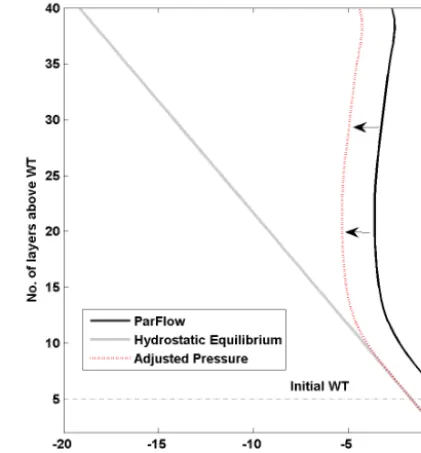
[image:5.612.322.533.68.295.2]One issue with the re-initialization of DTWT using the DTWT function is that the distribution of soil moisture above the water table cannot be estimated. Here, we considered two approaches to defining pressure head distribution above the water table: (1) implementing the commonly used hydro-static equilibrium assumption, where the pressure head at the water table was linearly decreased as a function of elevation head towards the land surface; and (2) adjusting the pressure head distribution of the unsaturated zone from the last day of the sixth cycle of ParFlow.CLM spin-up simulations based on new DTWT values from the DTWT function. In the ad-justed pressure head approach, the hydrostatic equilibrium assumption is used in regions between the new DTWT and the initial DTWT. The ParFlow.CLM pressure head distri-bution is adjusted to begin at the new pressure head from the initial WT such that the vertical profile is maintained (Fig. 3). This adjustment may represent a lack of consistency in the proposed approach, as the DTWT function estimates mean annual DTWT, while pressure head adjustments in the un-saturated zone are taken from the last day of the sixth cycle of ParFlow.CLM. While it is possible to use DTWT values
Figure 3. Adjusted pressure head distribution above the estimated
DTWT from the DTWT function. Pressure head distribution of the last day of ParFlow. CLM spin-up simulation 6 was adjusted in ev-ery grid cell based on the position of DTWT estimated from the DTWT function. In this approach, the hydrostatic equilibrium as-sumption is used in regions between the new DTWT and the initial DTWT. The ParFlow.CLM pressure head distribution is adjusted to begin at the new pressure head from the initial WT, such that the vertical profile is maintained. Hydrostatic pressure head distribu-tion is shown as a reference for the new DTWT, which is lower than the WT in simulation 6.
from the last day of simulations to develop a DTWT func-tion, estimated DTWT values from such a function exhibit larger variability and result in a larger bias. For the Skjern River sub-catchment, the percentage bias values between the estimated DTWT values from the DTWT functions and the baseline simulation of Ajami et al. (2014) for the equilibrium year (simulation 20) were−4 % and−1.6 % for the DTWT functions based on the last day and mean annual DTWT val-ues, respectively.
2.3 Evaluating the hybrid spin-up approach
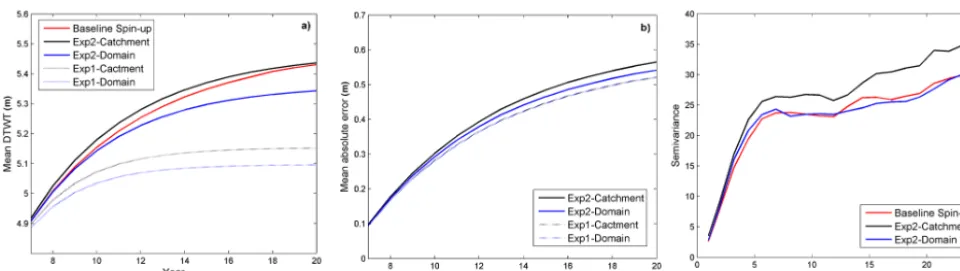
cy-Figure 4. (a) Comparison between the simulated mean annual DTWT obtained from the baseline spin-up approach of ParFlow.CLM of the
Skjern River sub-catchment and empirical DTWT functions. The single exponential model was formulated using the domain- and catchment-averaged data from spin-up simulations 2 to 6; (b) estimated mean absolute error based on simulated DTWT from the baseline spin-up together with both catchment- and domain-averaged single and double exponential functions; and (c) experimental semi-variograms of mean annual DTWT from the ParFlow.CLM equilibrium year (after 20 years of simulations) and DTWT from catchment- and domain-averaged double exponential functions, showing that catchment-based semi-variances are higher than the baseline simulation. Exp1 and Exp2 refer to single and double exponential functions, respectively.
cles (i.e., cycles 2 to 6) is explored and assessed against the baseline spin-up simulations of the Baldry sub-catchment. In the next step, the hybrid spin-up approach outlined in Sect. 2.2 was implemented to re-initialize ParFlow.CLM us-ing a domain-based double exponential DTWT function to estimate spatially distributed DTWT and the adjusted pres-sure head distribution approach above the water table. Recur-sive simulations after re-initialization continued until equi-librium condition was achieved.
3 Results
3.1 Performance of empirical DTWT functions in predicting DTWT–Skjern River sub-catchment Optimum parameter values for single and double exponen-tial DTWT functions were obtained using the nonlinear least squares method. Performance of the single and double ex-ponential DTWT functions in predicting 14 years of DTWT were compared against the ParFlow.CLM baseline spin-up simulations (years 7 through 20) of Ajami et al. (2014) to find the optimum empirical DTWT function for the Skjern River sub-catchment. Post-simulation analysis indicates that global DTWT functions based on domain- or catchment-averaged percentage change values are better predictors of DTWT response compared to local DTWT functions devel-oped for every grid cell. Instability of local DTWT functions occurs in grid cells where percentage changes in DTWT os-cillate between positive and negative values through initial spin-up simulations. Spatial distributions of these grid cells are shown in Supplement Fig. S1.
Calculated RMSD and percentage bias relative to the base-line spin-up simulations indicate that global double exponen-tial functions using ParFlow.CLM spin-up simulations 2 to
6 provide a better fit compared to various single exponential functions obtained from different spin-up simulation years (2 to 4, 2 to 5, etc.). Because the first six cycles of ParFlow.CLM simulations were the same between the baseline spin-up sim-ulations and DTWT distributions from the DTWT functions presented in Fig. 4, comparisons were made with simula-tions 7 to 20 of the baseline spin-up approach of Ajami et al. (2014).
[image:6.612.58.538.64.199.2]nential function.
To investigate this result further, three empirical semi-variograms were generated. As the impact of an east–west spatial trend on the mean annual DTWT values was evident in the semi-variograms, the trend should first be removed from the mean annual DTWT values. To remove the trend, a plane was fitted to the observed mean annual DTWT val-ues, with an equation of the form
z=ax+by+c, (6)
where a, b and c are fitted coefficients, x and y are the coordinates of every grid cell, and z is the mean annual DTWT. Residuals are computed by subtracting the estimated mean annual DTWT from Eq. (6) from the observed mean annual DTWT values. Finally, the semi-variogram of the residuals as a function of distance is calculated. The semi-variance is a measure of spatial semi-variance, and presents the average ()similarity between data pairs at a given dis-tance. Investigating the empirical semi-variograms of mean annual DTWT values (Fig. 4c) indicates that the domain-based double DTWT function is a better predictor of mean annual DTWT, because the spatial structure of DTWT is suf-ficiently reproduced by the domain-based function, and the catchment-based function has a higher variance compared to the baseline simulations. Therefore, it is recommended to use the domain-based DTWT function, as it contains data from high-elevation regions on the eastern side of the domain that contribute to topographically driven flow, and equilibrates more slowly than in other regions (Ajami et al., 2014). In summary, double exponential functions are chosen as they have less bias compared to single exponential functions, and there is very little difference in terms of MAE amongst pre-dictions. The choice is further supported by the RMSD and semi-variograms.
3.2 Impact of unsaturated zone re-initialization on ParFlow.CLM spin-up
Impacts of re-initializing the unsaturated zone using the hy-drostatic equilibrium versus adjusted vertical pressure dis-tribution on the spin-up period were also explored using the ParFlow.CLM simulations of the Skjern River sub-catchment. As can be seen from Fig. 3, the difference be-tween the two initialization methods is more pronounced in areas of the deep water table, where hydrostatic pressure head distribution results in a drier unsaturated zone com-pared to adjusted pressure head distribution. Results indicate that after re-initialization, the system equilibrated after 6 ad-ditional years of spin-up simulation when using the hydro-static equilibrium option. With the adjusted pressure head distribution option, only 4 additional years of spin-up sim-ulation were required. Therefore, depending on the pressure head distribution above the water table, either 10 or 12 years of ParFlow.CLM simulations were sufficient to ensure
sub-Figure 5. Comparison of (a) unsaturated and (b) groundwater
stor-ages of the ParFlow.CLM equilibrium year using the hybrid and baseline spin-up approaches (Ajami et al., 2014). The equilibrium year corresponds to simulation cycles of 10, 12 and 20 for the ad-justed pressure head, hydrostatic equilibrium, and baseline simula-tions, respectively. The dynamics of groundwater and unsaturated zone storages are closely reproduced by the adjusted pressure head distribution approach relative to the baseline spin-up approach for the Skjern River sub-catchment.
surface storage equilibrium, reducing the spin-up time by 40 or 50 %, compared to the baseline spin-up approach.
[image:7.612.311.546.66.223.2]ad-Figure 6. Differences in equilibrium DTWT between ParFlow.CLM simulations after re-initializations and ParFlow.CLM after 20 years of baseline spin-up simulations in meters, where
(a) is based on hydrostatic pressure head distribution above the
water table for the initial condition, while (b) is based on adjusted pressure head distribution above the water table for the Skjern River sub-catchment. White regions correspond to grid cells where the differences in equilibrium DTWT are less than 0.5.
justed pressure head re-initializations, indicating unsaturated zone equilibrium at different threshold levels.
Changes in annual water balance after re-initialization were also compared against the baseline spin-up approach of Ajami et al. (2014). While changes in annual evapotranspira-tion were approximately 1 mm between the two spin-up ap-proaches (annual baseline evapotranspiration of 447.3 mm), the percentage bias in annual discharge against observations decreased by about 2 % compared to the baseline approach (Table 1). In the hybrid approach, changes in groundwater storage were positive, because after re-initialization, DTWT decreased as simulations proceeded and the system reached equilibrium (Fig. 5). At equilibrium, differences in simu-lated DTWT from the last day of the ParFlow.CLM sim-ulations after re-initializations (hydrostatic equilibrium and adjusted pressure head distribution) and the baseline spin-up approach varied by up to 2 m inside the catchment boundary (Fig. 6), although most areas were within 0.5 m. Differences were more pronounced in areas of higher elevation in the catchment. Figure 6 shows that the hydrostatic equilibrium pressure head adjustment leads to a clear bias with consis-tent overestimation of the DTWT, while the adjusted vertical pressure distribution produces a distribution of pressure head errors centered on the expected value.
3.3 Evaluation of the hybrid spin-up approach over the Baldry sub-catchment
Similar to the Skjern River sub-catchment, percentage changes in monthly groundwater storages were used to as-sess the equilibrium condition. However, for the Baldry sub-catchment, a threshold level of 0.1 % was chosen as the con-vergence criterion. Results indicated that 28 years of recur-sive simulations were required until the model equilibrated, based on monthly groundwater storage changes. For refer-ence, 28 years of baseline spin-up simulations for Baldry re-quired 37 000 service units, which is equivalent to 24 days
Figure 7. Differences in equilibrium DTWT of Baldry ParFlow.CLM simulations after re-initialization with the adjusted pressure head distribution above the water table and ParFlow.CLM after 28 years of baseline spin-up simulations, in meters. The contours of DTWT overestimation are along the direction of flow lines from high-elevation areas towards the catchment outlet.
of computation using 64 processors of a high-performance computing cluster.
To obtain optimum parameter values for single and dou-ble exponential DTWT functions, the nonlinear least squares method is used. Similar to the Skjern River sub-catchment, a double exponential DTWT function using simulations 2 to 6 resulted in WT distributions with the smallest RMSD and percentage bias, relative to the baseline spin-up simulations. For Baldry, a domain-based double exponential function had the closest mean over the domain (Fig. S2a) and the small-est mean absolute error relative to the baseline simulation (Fig. S2b). However, DTWT semi-variograms showed higher variances in the domain-based double exponential function relative to the catchment-based function (Fig. S2c). Despite the slight differences in the predictive power of DTWT tions between the two catchments, a double exponential func-tion seems to perform best, based on most of the criteria.
To re-initialize the ParFlow.CLM model of the Baldry sub-catchment, the new DTWT distribution obtained from the domain-based double exponential function was used. After re-initialization with the adjusted pressure head distribution, only 8 additional simulation years were required until per-centage changes in monthly groundwater storages reached below the 0.1 % level. This result indicates a 50 % reduction in the spin-up period of a semi-arid catchment when the hy-brid spin-up approach is used.
approach using the hydrostatic equilibrium and adjusted pressure head distribution options above the water table. Annual precipitation is 801.6 mm.
Simulation name Number of % bias
1 ET dS2GW3 dSUZ4
simulations Q (mm yr−1) (mm) (mm)
ParFlow baseline
20 20.3 447.3 −3.3 −0.2
simulation
ParFlow+DTWT function
12 18.1 446.8 3.3 −0.7
(hydrostatic equilibrium)
ParFlow+DTWT function
10 18.5 446.3 3 −1.6
(adjusted pressure)
1Percentage bias is based on the observed discharge at the gauge shown in Fig. 2. 2Changes in storage.
[image:9.612.126.473.106.220.2]3Groundwater storage. 4Unsaturated zone storage.
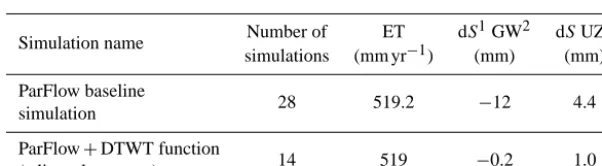
Table 2. Baldry sub-catchment annual water balance for the equilibrium year after the baseline spin-up approach and the hybrid approach,
with the adjusted pressure head distribution option above the water table. Annual precipitation is 674.8 mm.
Simulation name Number of ET dS
1GW2 dSUZ3
simulations (mm yr−1) (mm) (mm)
ParFlow baseline
28 519.2 −12 4.4
simulation
ParFlow+DTWT function
14 519 −0.2 1.0
(adjusted pressure)
1Changes in storage. 2Groundwater storage. 3Unsaturated zone storage.
observed in higher-elevation areas in the southern part of the catchment. Lower WT levels in the hybrid spin-up approach resulted in larger unsaturated zone storage compared to the baseline spin-up (Fig. S3). In this semi-arid catchment, no stream flow was generated at the catchment outlet for the equilibrium year. The difference in annual evapotranspiration was only 0.2 mm between the two equilibrium simulations (Table 2).
4 Summary
We present a hybrid approach for reducing the period of spup required to reach equilibrium with the ParFlow.CLM in-tegrated hydrological model. In the case of the Skjern River and Baldry sub-catchments, the simulation period decreased by 50 % compared to the baseline spin-up approach when an adjusted pressure head distribution was specified above the water table. Although ParFlow.CLM was used as a modeling platform, the developed methodology is applicable to other coupled or integrated hydrologic models.
A general approach to spin-up should include the follow-ing steps: (1) perform 6 years of hydrologic model
simula-tions with DTWT initialized via expert knowledge or an in-formed guess (here 2 m and 3 m below the land surface for the Baldry and Skjern River sub-catchments, respectively); (2) calculate a global double exponential DTWT function us-ing domain-wide data, and estimate the new DTWT for the desired equilibration level; (3) implement the adjusted pres-sure head approach for the unsaturated zone initialization; and (4) continue spin-up simulations until the desired equi-libration level is reached. Previous efforts in calibrating cou-pled or integrated hydrologic models required a spin-up pro-cess after every parameter update (Stisen et al., 2011; Weill et al., 2013). Development of a computationally efficient spin-up approach will enable this type of systematic calibration of integrated or coupled hydrologic models.
[image:9.612.148.449.309.392.2]for hydrological investigations and facilitate the use of these models in investigating both real-world and theoretical sys-tem behavior.
The Supplement related to this article is available online at doi:10.5194/hess-11-5169-2014-supplement.
Acknowledgements. This research was funded by the Australian Research Council and the National Water Commission through the support of the National Centre for Groundwater Research and Training (NCGRT). Jason Evans was supported by Australian Re-search Council Future Fellowship FT110100576. We acknowledge the support provided by the National Computational Infrastruc-ture at the Australian National University through the National Computational Merit Allocation Scheme, Intersect partner share and University of New South Wales LIEF grant LE120100181 for high-performance computing. The use of high-performance computing facilities at the University of New South Wales is also appreciated. We acknowledge the HOBE hydrological observatory and the New South Wales Department of Primary Industries for providing the Skjern River and Baldry data, respectively. We would also like to thank the two anonymous reviewers for their valuable and insightful comments.
Edited by: V. Andréassian
References
Ajami, H., McCabe, M. F., Evans, J. P., and Stisen, S.: Assessing the impact of model spup on surface water–groundwater in-teractions using an integrated hydrologic model, Water Resour. Res., 50, 2636–2656, doi:10.1002/2013WR014258, 2014. Ashby, S. F. and Falgout, R. D.: A parallel multigrid preconditioned
conjugate gradient algorithm for groundwater flow simulations, Nucl. Sci. Eng., 124, 145–159, 1996.
Berthet, L., Andréassian, V., Perrin, C., and Javelle, P.: How cru-cial is it to account for the antecedent moisture conditions in flood forecasting? Comparison of event-based and continuous approaches on 178 catchments, Hydrol. Earth Syst. Sci., 13, 819– 831, doi:10.5194/hess-13-819-2009, 2009.
Cloke, H. L., Renaud, J. P., Claxton, A. J., McDonnell, J. J., An-derson, M. G., Blake, J. R., and Bates, P. D.: The effect of model configuration on modelled hillslope–riparian interactions, J. Hydrol., 279, 167–181, doi:10.1016/S0022-1694(03)00177-X, 2003.
Dai, Y., Zeng, X., Dickinson, R. E., Baker, I., Bonan, G. B., Bosilovich, M. G., Denning, A. S., Dirmeyer, P. A., Houser, P. R., Niu, G., Oleson, K. W., Schlosser, C. A., and Yang, Z. L.: The Common Land Model, Bull. Am. Meteorol. Soc., 84, 1013– 1023, 2003.
Decker, M., Pitman, A. J., and Evans, J. P.: Groundwater constraints on simulated transpiration variability over south-eastern Australian forests, J. Hydrometeorol., 14, 543–559, doi:10.1175/JHM-D-12-058.1, 2012.
Ferguson, I. M. and Maxwell, R. M.: Role of groundwater in water-shed response and land surface feedbacks under climate change, Water Resour. Res., 46, W00F02, doi:10.1029/2009WR008616, 2010.
Ivanov, V. Y., Vivoni, E. R., Bras, R. L., and Entekhabi, D.: Catchment hydrologic response with a fully distributed triangu-lated irregular network model, Water Resour. Res., 40, W11102, doi:10.1029/2004wr003218, 2004.
Jensen, K. H. and Illangasekare, T. H.: HOBE: a hydrological ob-servatory, Vadose Zone J., 10, 1–7, doi:10.2136/vzj2011.0006, 2011.
Jones, J. E. and Woodward, C. S.: Newton–Krylov-multigrid solvers for large-scale, highly heterogeneous, variably sat-urated flow problems, Adv. Water Resour., 24, 763–774, doi:10.1016/s0309-1708(00)00075-0, 2001.
Jones, J. P., Sudicky, E. A., and McLaren, R. G.: Applica-tion of a fully-integrated surface–subsurface flow model at the watershed-scale: a case study, Water Resour. Res., 44, W03407, doi:10.1029/2006wr005603, 2008.
Kim, C. P., Stricker, J. N. M., and Feddes, R. A.: Impact of soil het-erogeneitoy on the water budget of the unsaturated zone, Water Resour. Res., 33, 991–999, doi:10.1029/97WR00364, 1997. Kollet, S. J. and Maxwell, R. M.: Integrated surface–groundwater
flow modeling: a free-surface overland flow boundary condition in a parallel groundwater flow model, Adv. Water Resour., 29, 945–958, doi:10.1016/j.advwatres.2005.08.006, 2006.
Kollet, S. J. and Maxwell, R. M.: Capturing the influence of ground-water dynamics on land surface processes using an integrated, distributed watershed model, Water Resour. Res., 44, W02402, doi:10.1029/2007wr006004, 2008.
Maxwell, R. M.: A terrain-following grid transform and preconditioner for parallel, large-scale, integrated hy-drologic modeling, Adv. Water Resour., 53, 109–117, doi:10.1016/j.advwatres.2012.10.001, 2013.
Maxwell, R. M. and Miller, N. L.: Development of a coupled land surface and groundwater model, J. Hydrometeorol., 6, 233–247, doi:10.1175/JHM422.1, 2005.
Maxwell, R. M., Putti, M., Meyerhoff, S., Delfs, J., Ferguson, I. M., Ivanov, V., Kim, J., Kolditz, O., Kollet, S. J., Kumar, M., Lopez, S., Niu, J., Paniconi, C., Park, Y., Phanikumar, M. S., Shen, C., Sudicky, E. A., and Sulis, M.: Surface-subsurface model intercomparison: A first set of benchmark results to di-agnose integrated hydrology and feedbacks, Water Resour. Res., 50, doi:10.1002/2013WR013725, 2014.
Noto, L. V., Ivanov, V. Y., Bras, R. L., and Vivoni, E. R.: Effects of initialization on response of a fully-distributed hydrologic model, J. Hydrol., 352, 107–125, doi:10.1016/j.jhydrol.2007.12.031, 2008.
Refsgaard, J. C.: Parameterisation, calibration and validation of distributed hydrological models, J. Hydrol., 198, 69–97, doi:10.1016/s0022-1694(96)03329-x, 1997.
Sivapalan, M., Beven, K., and Wood, E. F.: On hydrologic similar-ity: 2. A scaled model of storm runoff production, Water Resour. Res., 23, 2266–2278, doi:10.1029/WR023i012p02266, 1987. Stisen, S., Sonnenborg, T. O., Hojberg, A. L., Troldborg, L., and
tion of a distributed catchment scale water balance model, Water Resour. Res., 29, 1805–1817, doi:10.1029/93wr00398, 1993.