Price Range Effect on Extremeness Aversion and
Compromise Effect
Pei-Hsun Wu
1,*, Mei-Ching Huang
1, Yi-Shu Wang
21Department of International Business, National Taichung University of Science and Technology, Taiwan 2Department of Business Administration, Chien Hsin University of Science and Technology, Taiwan
Copyright © 2015 by authors, all rights reserved. Authors agree that this article remains permanently open access under the terms of the Creative Commons Attribution License 4.0 International License
Abstract
Recent decision research has discovered the presence of the extremeness aversion and compromise effect in choice. The extremeness aversion and compromise effect extend the principle of loss aversion. Based on the inference that a loss will not be possibly prominent when the price range for alternatives in a choice set was narrower, the present research pointed out that the prices difference for alternatives in the choice set, via different psychological mechanisms, loss aversion versus cost-effectiveness, affects a consumer’s choice. Two studies demonstrated that the level of extremeness aversion (Study 1) and compromise effect (Study 2) in the case of a wider price range will be higher than that in the case of a narrower price range. Theoretical and practical implications of the finding were discussed.Keywords
Price Range, Consumer Choice, Extremeness Aversion, Compromise Effect1. Introduction
One of the major issues for exploring factors affecting a consumer’s choices is the context effect, in other words, to explore how different structures for alternatives in a choice set influence a consumer’s decision making when a consumer faces a choice set. In this regard, this field has lots of stable theories developed such as the contrast effect, extremeness aversion [16], attraction effect [6,14], compromise effect [15], etc. The extremeness aversion and compromise effect are derived from the principle of loss aversion [8,16,17] to relative the advantages and disadvantages of other options in the choice set. The principle of loss aversion points out that more emphasis will be placed on disadvantages (losses) than on the corresponding advantages (gains). In this context, extremeness aversion refers that, all else being equal, an option with relatively more extreme values tends to be viewed as less attractive over an otherwise equivalent
option with moderate values. For example, in the xperiment of Simonson and Tversky’s research [16], a consumer who considers three cameras that differ in quality and price is likely to evaluate the advantages and disadvantages of these products in relation to each other. Suppose these cameras contain camera A, MINOLTA X-370, with the price of US$ 169.99, camera B, MINOLTA-MAXXUM 3000i, with the price of US$ 239.99, and camera C, MINOLTA-MAXXUM 7000i, with the price of US$ 469.99. A consumer might perceive losing more money while choosing camera C, perceiving losing more quality while choosing camera A, and the loss was perceived as minor in relation to the other options if the choice made by the consumer is camera B.
Simultaneously, another stable theory in choice, the compromise effect, demonstrated that the proportion of choosing the middle option will be increased significantly with an extreme option added into a choice set. For example, with regards to the same example described previously, the proportion of choosing camera B will be increased relatively with camera C added into the choice set (camera A and camera B) or camera A added into the choice set (camera B and camera C).
attractive ones for a choice set with a narrower price range.
2. Literature Review and Hypotheses
Formulation
2.1. Price Range for Alternatives in a Choice Set and Extremeness Aversion
Recent decision research has discovered the presence of extremeness aversion [16] in choice. Extremeness aversion extends the principle of loss aversion [8,16,17] to relative the advantages and disadvantages of other options in the choice set. The principle of loss aversion points out that more emphasis will be placed on disadvantages (losses) than on the corresponding advantages (gains). In this context, extremeness aversion refers that, all else being equal, an option with relatively more extreme values tends to be viewed as less attractive over an otherwise equivalent option with moderate values.
In the previous research, the effect of the price range for alternatives in a choice set on the extremeness aversion was neglected. However, the previous research demonstrated that the attribute range knowledge enables respondents to comprehend brand attribute information better and make meaningful attribute trade-offs [1]. Meller and Biagini [9] also reported that “small differences along one dimension result in greater weight of the other dimension”. The question of whether the range of attribute levels affects choice model has aroused interest in researchers [2,5,10,11,13,18].
In order to explore the effect of the price range for alternatives in a choice set on the extremeness aversion, consider a choice set (x, y, z) for three microwave ovens with a wider price range, e.g., microwave oven x, NN679, with a price of NT$5000 (US$161), microwave oven y, NN697, with a price of NT$10000 (US$323), and microwave oven z, NN796, with a price of NT$15000 (US$484). For this example, a consumer, while perceiving microwave oven x with more loss in quality and microwave oven z with more loss in money, may be inclined to choose y, the middle option, due to less loss in choosing y in relation to the other extreme options. Nevertheless, for another case of three microwave ovens with a narrower price range, e.g., microwave oven x, NN679, with a price of NT$9000 (US$290), microwave oven y, NN697, with a price of NT$10000 (US$323), and microwave oven z, NN796, with a price of NT$11000 (US$355), a consumer may incline to the most expensive one, microwave oven z, based on consideration to acquire higher quality while perceiving the insignificant difference in prices and less loss in money for the choice of the most expensive object. For, the previous research on the effect of attribute range on choice, it can be inferred that a consumer with the desire of acquiring better quality may choose a high priced object, because the weights of quality attributes will be augmented
for the case of insignificant difference in price attributes. Additionally, a consumer may be inclined toward an option with the lowest price in a choice set, microwave oven x in this example, based on the inference that the microwave oven with an insignificant difference in price has similar quality. In the case for the choice set with a narrower price range, the effect of extreme aversion cannot be observed since the middle option is expected to have a weak attraction. With the above inference, this argument can be explicitly described as follows:
H1: The extremeness aversion was a function of the price
range for alternatives in a choice set. In a choice set with three options of low price, middle price, and high price respectively, the degree of extremeness aversion for a wider price range will be greater than the degree for a narrower price range.
H1a: In the case of a wider price range, the proportion of
choosing the middle priced option will be higher than the proportion of choosing the low priced and high priced options.
H1b: In the case of a narrower price range, the proportion
of choosing the low priced and high priced options will be higher than the proportion of choosing the middle priced option.
2.2. Price Range for Alternatives in a Choice Set and Compromise Effect
The compromise effect [7,15] has been investigated in several other studies [3,4,12]. The compromise effect occurs if the choice of one option, b, relative to another alternative, c, is enhanced when a third option, a, is added to the choice set, making b a compromise (middle) option. In addition, the compromise effect can be derived from the principle of the loss aversion [8,16,17].
quality. Hence, the compromise effect is observable if the difference in prices for options is significant but unobservable for insignificant difference. With the above inference, this proposition can be explicitly described as follows:
H2: The compromise effect was a function of the price
range for alternatives in a choice set. The extent of compromise effect will be greater for the choice set with a wider price range than for the choice set with a narrower price range.
H2a: The proportion of choosing the middle priced option
will be increased relatively with a high priced option added into the choice set including low priced and the middle priced options for the choice set with a wider price range.
H2b: The proportion of choosing the middle priced option
will be decreased relatively with a high priced option added into the choice set including low priced and the middle priced options for the choice set with a narrower price range.
3. Experiments
3.1. Study 1The aim of this study was to examine whether the extent of extremeness aversion was a function of the price range for alternatives in a choice set.
Design: The study adopted a two-condition (price range for alternatives in a choice set: wider vs. narrower) between-subjects experimental design.
Participants: Four hundred and fifty-one undergraduates were recruited and paid for their participation in this study.
Stimuli: As the stimuli adopted in this study, two products, an air conditioner and microwave oven, have their brands concealed to prevent respondents’ decisions affected by personal preferences. The choice set for each product has three alternatives with information of models, prices, functions and pictures displayed.
Procedure: The study used the paper-and-pencil method. To effectively control the experiment and simulate realistic situations of respondents’ decision making, we adopted one-to-one interview in this study so that respondents were randomly assigned to two different experimental conditions: one with the wider price range and another with the narrower price range. The next step was to ask the respondents to choose one from three alternatives in the choice set. Finally, respondents had to answer one question about the manipulation check: “What opinion do you have on the difference of price ranges in the three options?” The participants responded on a five-point scale on which 1 indicated “very small” and 5 indicated “very large”.
Manipulation check: The result for the manipulation check indicated respondents classified into the condition with a wider price range (n=224) had a more significant perception regarding price difference for alternatives in the choice set than respondents classified into the group with a narrower price range (n=227) (M wide = 4.38, M narrow = 1.64, t=43.06, p<.001). Thus, the manipulation of the price ranges was successful.
Results: The results were shown in Table 1 and showed that respondents using different price range demonstrated significant differences in choices in the three-alternative choice set (air conditioner: χ2 (2)=23.156, p<.001; microwave oven: χ2(2)=33.530, p<.001). Hence, H
1, H1a
[image:3.595.63.547.509.607.2]and H1b were supported.
Table 1. Choice shares for different price range in Study 1
Product category Price range Choice shares χ2
Low priced option Middle priced option High priced option
Air conditioner Wide(n=111) 18.9% (n=21) 51.4%(n=57) 29.7%(n=33) 18.16*** 23.15***
Narrow(n=115) 34.8%(n=40) 20.9%(n=24) 44.3%(n=51) 9.617*
Microwave oven Wide(n=113) 21.2%(n=24) 54.9%(n=62) 23.9%(n=27) 23.69*** 33.53***
Narrow(n=112) 34.8%(n=39) 17.9%(n=20) 47.3%(n=53) 14.696**
*** p<.001, **p<.005, *p<.01.
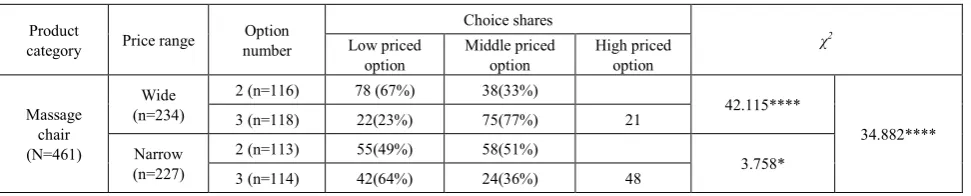
Table 2. Choice shares for different price range in Study 2
Product
category Price range number Option
Choice shares
χ2 Low priced
option Middle priced option High priced option
Massage chair (N=461)
Wide (n=234)
2 (n=116) 78 (67%) 38(33%)
42.115****
34.882****
3 (n=118) 22(23%) 75(77%) 21
Narrow (n=227)
2 (n=113) 55(49%) 58(51%)
3.758*
3 (n=114) 42(64%) 24(36%) 48
[image:3.595.64.550.639.737.2]3.2. Study 2
Study 2 aimed to examine whether the compromise effect was a function of the price range for alternatives in a choice set.
Design: This study adopted 2(the number of the option in a choice set: 2 options vs. 3 options) × 2(the price range of the options: wider vs. narrower) between-subjects experimental design.
Participants: Four hundred and sixty one citizens were recruited and paid for their participation in this study.
Stimuli and procedure: As a stimulus, the massage chair was adopted in this study. The information expressed for the price range for alternatives in a choice set was similar to Study 1, but the low priced and middle priced options occurred in the choice set for the two option case and the low priced, middle priced and high priced options for the three option case. Besides, the procedure and the question for the manipulation check in this study were identical to Study 1.
Manipulation check: The result for the manipulation check indicated respondents classified into the group with a wider price range (n=234) had a more significant perception regarding the price difference for alternatives in the choice set than respondents classified into the group with a narrower price range (n=227) (M wide = 3.97, M narrow = 2.08, t=19.192, p<. 001). Thus, the manipulation of the price range was successful.
Results: In this study, the hierarchical log linear model was employed to examine the influence of the price range for alternatives in a choice set on the compromise effect, in other words, to examine if there was any interaction effect among the price range (wider vs. narrower), the number of the option (two options vs. three options), and the relative proportion of choosing the low priced and middle priced options by respondents. The results were shown in Table 2. The results according to the hierarchical log linear model indicated significant interactions among three variables (χ2 (1)=34.882, p<.001). Hence, H2, H2a and H2b were
supported.
4. Discussion
4.1. Theoretical Implications
The results from the present research imply that the prices difference for alternatives in the choice set, via different psychological mechanisms, affects a consumer’s choice. With the price range for alternatives widened, a consumer, through the psychological mechanism of the loss aversion, tends to prefer the middle option with relatively less loss because of a perception that a high price implies more loss in money and a low price connecting to poor quality. With the price range for alternatives narrowed, a consumer employing the cost-effectiveness model to evaluate options in the choice set is inclined towards the
low priced or high priced option due to larger cost-effectiveness and the middle option is unfavorable instead owing to perception of the high price implying better quality available by spending a few money and the low price connecting to similar quality by spending less money.
4.2. Practical Implications
As it is useful for application by business operators, the theory of the extremeness aversion and the compromise effect can be applied to affect customers’ selections for the middle option. In this research, we realize another pragmatic application of affecting customers’ selections for the extreme options through manipulation of the price range for alternatives. With the theory provided in this research, enterprises are able to realize customers’ perception for the price range for alternatives in a choice set and customers’ selection behavior, completing the target of affecting customers’ selections for specified options via some adequate applications. For instance, as for the commodity display of retailing, enterprises employing this theory in this research are able to affect consumers’ selections for the middle option and extreme options by different distributions of a commodity’s price range. In addition, with the satisfaction level after purchase included into considerations, an enterprise, by reducing the price difference for alternative in a choice set rather than by increasing the difference, improves customers’ satisfaction level for purchased options.
REFERENCES
[1] Assar, A., & Chakravarti, D. (1984). Attribute range knowledge: Effects on consumers’ evaluation of brand-attribute information and search patterns in choice. In: R. W. Belk et al. (Eds.), Scientific methods in marketing (pp. 62-67). Chicago: American Marketing Association.
[2] Cooke, A. D. J., & Mellers, B. A. (1995). Attribute range and response range: Limits of compatibility in multiattribute judgement. Organizational Behavior & Human Decision Processes, 63(2), 187-194.
[3] Dhar, R., Nowlis, S. M., & Sherman, S. J. (2000). Trying hard or hardly trying: A analysis of context effects in choice.
Journal of Consumer Psychology, 9(4), 189-200.
[4] Drolet, A. (2002). Inherent rule variability in consumer choice: Changing rules for change’s sake. Journal of Consumer Research, 29(3), 293-305.
[5] Eagle, T. C. (1984). Parameter stability in disaggregate retail choice models: Experimental evidence. Journal of Retailing, 60(1), 101-123.
[7] Huber, J., & Puto, C. (1983). Market boundaries and product choice:Illustrating attraction and substitution effects.
Journal of Consumer Research, 10(1), 31-44.
[8] Kahneman, D., Knetsch, J. L., & Thaler, R. H. (1991). The endowment effect, loss aversion, and status quo bias.
Journal of Economic Perspectives, 5(1), 1325-1347. [9] Mellers, B. A., & Biagini, K. (1994). Similarity and choice.
Psychological Review, 101(3), 505-518.
[10] Mellers, B. A., & Cooke, A. D. J. (1994). Trade-offs depend on attribute range. Journal of Experimental Psychology:
Human Perception and Performance, 20(5), 1055-1067. [11] Meyer, R. J., & Eagle, T. C. (1982). Context-induced
parameter instability in a disaggregate-stochastic model of store choice.Journal of Marketing Research, 19(1),62-71. [12] Nowlis, S. M., & Simonson, I. (2000). Sales promotions and
the choice context as competing influences on consumer decision making. Journal of Consumer Psychology, 9(1), 1-16.
[13] Ohler, T., Le, A., Louviere, J., & Swait, J. (2000). Attribute range effects in binary response tasks. Marketing Letters, 11(3), 249-260.
[14] Ratneshwar, S. A., Shocker, D., & Stewart, D.W. (1987). Toward understanding the attraction effect: The implications of product stimulus meaningfulness and familiarity. Journal of Consumer Research, 13(4), 520-533.
[15] Simonson, I. (1989). Choice based on reasons:The case of attraction and compromise effects. Journal of Consumer Research, 16(2), 158-174.
[16] Simonson, I., & Tversky, A. (1992). Choice in context: Tradeoff contrast and extremeness aversion. Journal of Marketing Research, 29(3), 281-295.
[17] Tversky, A., & Kahneman, D. (1991). Loss aversion in riskless choice:A reference-dependent model. Quarterly Journal of Economics, 106(4), 1039-1061.