International Seminar on Application of Science Mathematics 2011 ISASM2011 IMAGE S EGMENTATION AND TEXT EXTRACTION:
APPLICATION TO THE EXTRACTION OF TEXTUAL INFORMATION IN SCEN E IMAGES
Danial Md Nor1, Rosli Oma r2 , M. Za rar M.Jenu3, and Jean-Marc Ogie r4
1,2,3
Faculty of Electrical and Electronics Engineering, Universit i Tun Hussein Onn Malaysia 86400 Parit Ra ja, Batu Pahat, Johor, MA LA YSIA.
4L3I University of La Rochelle, 17042 La Rochelle ced ix 1, FRANCE.
1[email protected], 2[email protected], 3[email protected],
This paper proposes a solution to the problem o f e xt raction of te xtua l informat ion in presentation scene images. The proble m has gained numerous of interest by document analysis and recognition (DAR) co mmunity. A s an extention in DAR, new research doma in, Ca me ra Based Document Analysis and Recognition (CBDA R) has been established which deals with the te xtual informat ion in scene images taken by lo w cost hand held devices like digital ca me ra, ce ll phones, etc. A lot of applications like te xt translation, read ing text for visually impaired and blind person, information retrieva l fro m media document, e-learning, etc., can be built using the techniques developed in CBDA R doma in. The proposed approach of e xtraction of textual informat ion is composed of three steps: image segmentation, text localization and extraction, and Optical Character Recognition. First of all, for pre-processing the resolution of each image is checked for re-sa mpling to a common resolution format (720 X 540). Then, the fina l image is converted to grayscale and binarized using Otsu
segmentation method for further processing. In addition, looking at the mean horizontal run length of both black and white pixe ls , the proper segmentation of foreground objects is checked. In the post-processing step, the text localizer validates the candidate text regions proposed by text detector. We have employed a connected component approach for text localization. The extracted te xt is then has been successfully recognized using ABBYY Fine Reader for OCR.
Ke ywor ds: Image Seg mentation, Scene te xt, Te xtual Informat ion,Te xt Extract ion, OCR
Scope : Science Engineering.
1. Intr oduc tion
2. Relate d Work
Develop ment and progress of various approaches to the extraction of te xt information fro m the image and video have been proposed for specific application, including page segmentation [2], text co lor e xt raction [3], v ideo fra me te xt detection [4] and content-based image or video inde xing[5, 6] . Ho wever, e xtensive research, it is not easy to design series general-purpose systems. This is because there many possible sources of variation when extract ing text . Shaded fro m the te xtured bac kground or, fro m the low-contrast or co mple x images, or images with variations in font size , style, color, orientation, and align ment. Th is variation ma kes the problem very difficu lt to draw automatically. Genera lly te xt-detection methods can be classified into three categories. The first one consists of connected component-based methods, which assume that the text regions have uniform colors and satisfy certain size, shape, and spatial a lign ment constraints. However, these methods are not effective when the text have similar colo rs with background. The second one consists of the texture based methods, which assume that the text regions have special te xture. Though these methods are comparatively less sensitive to background colors, they may not differentiate the texts from the text-like backgrounds. The third one consists of the edge-based methods [7]. The te xt regions are detected under the assumption that the edge of the background and the object regions are sparser than those of the text reg ions. However, this kind of approaches is not very effective to detect texts with large font size. Chen et al. [4] co mpared the Support Vector Machines (SVM) based method with the mu ltilayer perceptrons (MLP) based one for text verification over four independent features, name ly, the distance map feature, the grayscale spatial derivative feature, the constant gradient variance feature and the DCT coeffic ients feature. They found that better detection results are obtained by SVM rather than by MLP. Mu lti-resolution-based text detection methods are often adopted to detect texts in different scales [8]. Te xts with different scales will have different features in the each sub-band. Integrating the detected text in d iffe rent sub-bands achieves better performance. Furthermore, the availab le redundant temporal information of videos is often used in candidate text region verificat ion and falsely detected text region elimination. Multi-resolution text regions can be detected from the edge maps down-sampled fro m that of the original images. Moreover, they also made full use of the temporal redundancy to eliminate the falsely detected text regions [9]. The ma in contribution of this paper lies in the following three aspects: (1) it is a fast OCR method as in Fig.1, (2) it is proposed for feature extraction of textual info rmation, and (3) it is enhancing textual information for its feature e xt raction.
Figure 1. Flowchart of Te xt Extraction
3. Text Extr acti on
The aim o f Opt ical Character Recognition (OCR) is to classify optical patterns (often contained in a dig ital image) corresponding to alphanumeric or other characters. The process of OCR involves several steps including segmentation, feature e xtraction, and c lassification. In principle , any standard OCR software can now be used to recognize the text in the segmented fra mes. However, a hard look at the properties of the candidate character regions in the segmented fra mes or image revea ls that most OCR softwa re packages will have significant difficulty to
MPEG Video
Fra me Extraction
n
Image Classsification Image
Segmentation MPEG
Video
Fra me Extraction
n
Image Segmentation
Te xt
Extraction OCR Image
Classsification MPEG
Video
Fra me Extraction
n
[image:2.596.123.518.546.591.2]International Seminar on Application of Science Mathematics 2011 ISASM2011
Black and white (binarization)
recognize the text.Docu ment images are different fro m natural images because they contain ma inly te xt with a few graphics and images. Due to the very low-resolution of images of those captured using handheld devices, it is hard to extract the complete layout structure (logical or physical) of the documents and even worse to apply standard OCR systems. For this reason, a shallow representation of the low-resolution captured document images is proposed. In case of original electronic documents in the repository, the extraction of the same signature is straightforward; the PDF o r Powe rPo int form o f the origina l e lectronic documents is converted into a re latively h igh-resolution image (TIFF, JPEG, etc.) on which the signature is co mputed. Finally, the captured document’s signature is compared to with all the orig inal electronic documents’ signatures in order to find a match.
4. Experi mental Results
4.1 Image segmentation
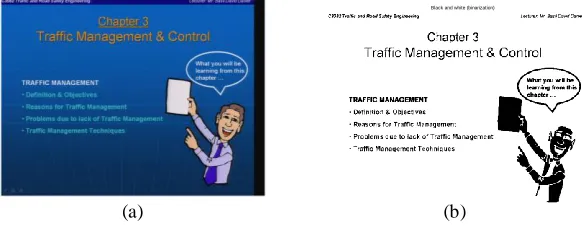
First of all, the resolution of each document i.e. both the image version of the origina l e lectronic documents and the pre-processed captured documents is checked for re-samp ling to a co mmon resolution format (720 X 540). If the perce ived document image is resolution -wise different than the common resolution, then the re-sa mpling is required to bring the image up to the co mmon resolution. This is necessary as in this scenario, the geo metrical p roperties of the various visual features are considered during the matching for the identification of the captured document images. Due to poor resolution, it is not feasible to go up to the character level as long as the adjacent characters are overlapped in the captured documents. First, the captured document images are pre-processed for the perspective correction and noise removal Then, the final image is converted to grayscale and binarized using Otsu segmentation method for further processing [Otsu, 1979]. Fu rthermore, looking at the mean horizontal run length of both black and white pixe ls the proper segmentation of foreground objects is checked. For exa mp le, for the document images having dark background and light foreground, the output of t he binarizat ion is reversed
i.e. blac k background (represented as 0’s) and white foreground (represented as 1’s) (Fig.4.1(a)).
(a) (b)
Figure 4.1: Otsu segmentation: (a) o rig inal slide document, (b ) output of Otsu segmentation
[image:3.596.158.449.478.591.2]4.2 Text l ocalization and extrac tion
4.2.1 Run-Length S moothing Algorithm
The method RLSA is applied row-by-row and column-by-co lu mn to the above mentioned binary document images representing white pixels by 1’s and black pixels by 0’s. The RLSA transforms a binary sequence x into an output sequence y according to the rules described by Behera as follows [10]:
i) 1’s in x are changed to 0’s in y if the nu mber of ad jacent 1’s is less than a pre-defined limit ,
T.
ii) 0’s in x are unchanged in y.
[image:4.596.142.498.564.684.2]For e xa mp le, with T = 5 the sequence x is mapped into y , which is illustrated in Fig. 4.2.
Figure 4.2: RLSA a lgorith m (adapted from [10])
The basic idea of the RLSA is to connect the neighboring black a reas when they are separated by less than T pixels. The degree of connectivity depends on T, the distribution of white and black pixels in the document and the ‘dpi’ (dots per inch) resolution of the document. The two
distinct bit-maps are generated using the RLSA in both horizontal and vertical directions. Often, the spacing between the components in the document image tends to differ horizontally and vertically. Therefo re, two d ifferent thresholds Th and Tv are used for the RLSA in respective horizontal and vertical direction. For the slide documents, these thresholds are tuned as Th = 80 and Tv = 100. The two bit-maps of respective RLSA output in horizontal and vertical directions are comb ined using a logical AND operator to detect various components in the document images. Additional horizontal smoothing using the RLSA (Ts = 15) produces the final segmentation result. Fig. 4.3 illustrates the RLSA algorithm in horizontal, vert ical and comb ining output of the image in Fig. 4.3 (c). The values of these thresholds have been evaluated and tuned using about a hundred slide images.
RLSA horizontally RLSA vertically Intersected Image
(a) (b) (c )
International Seminar on Application of Science Mathematics 2011 ISASM2011
Show text only
combin ing both the directions, of the binary image in Fig. 4.1 (b )
4.3 Optic al Char acter Rec ognition
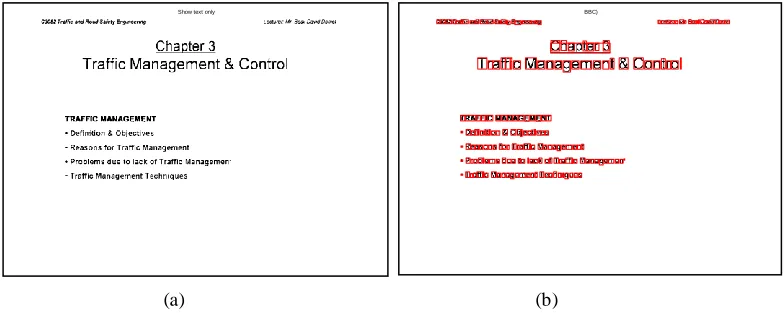
Binarization is achieved with a gray threshold value derived from Otsu’s [38] method. Additional steps are done for a better binary image. Firstly, a horizontal projection profile analysis is done to detect white te xt on black background. If the te xt co lor is deemed to be white, the OT-region is inverted. This is necessary as most OCR software works best with black text on white background. An e xa mp le of Otsu segmentation is depicted in Fig. 4.4.
RLSA additional horizontally
2117 2673
2885 3150
2558 3488
3346 4800
4208 6384
3307 4720
10373 16071
16161717
3272 4437
3232
34581 85680
1496 1629
524756
3536
Final Text
(a) (b)
Figure 4.4: Otsu segmentation: (a) o rig inal slide document, (b ) output of Otsu segmentation
Finally, a vertica l project ion profile analysis is done to discard unwanted pixel regions that are less than a calculated threshold. The final binar ized image is shown in Fig. 4.5 (a ) and its connected components is illustrated in Fig. 4.5 (b) . Connected components will be e xp lained later. We used ABBYY FineReader 8.0 (http://fine reader.abbyy.com) for OCR. We found that it was sufficient for our purpose.
[image:5.596.153.479.255.401.2]
(a) (b)
[image:5.596.129.521.521.678.2]ABBYY FineReader is a good OCR software but not for low resolution document. After e xtracting the individual characters in a document and determin ing their properties, we compare them to the original set. Letters like "g", "j" & "y", which extend below the baseline are in one group, tall letters, such as "l" and "T" are in another, short characters, like "a" and "c" another, and floating characters, such as "'" and "^" are in the last. Once classified, an extracted character is compared to learned characters which are in the same group. If no good match is found, the e xtracted character is then compared to the other original characters, regardless of group. Because we found that some characters made it past the original character recognition algorith m, we deemed it necessary to perform additional operations on poorly recognized chara cters. The ma inly observable cause of misrecognition in our original progra m was lin ked characters as wide character. An "r" would just barely touch an "i", and the character would be recognized as an "n". To alleviate this problem, we split the character at its most narrow point. This algorithm could possibly cause problems with something like "mi" -- with a poorly scanned "m", the joined character could be broken in the middle of the "m", find an "n", and do something unpredictable with the re mnants of the "m" and the "i". Another common cause of misrecognition were sp lit characters. An "r" might be split down the middle, leav ing an "l" -like figure on the left, and something incomprehensible on the right.
5. Enhancing Te xtual Infor mati on
In addition to OCR which was obtained fro m the binarized fra me , we propose several other unique features that can be used to represent low resolution images. The layout shape signature can be used as a feature vector to measure the distance between two images in a query by e xa mple searching system. He re we briefly discuss the connection of two features derived fro m the results of the extraction of te xtual info rmation Length of Sentences and the Minimu m Spanning Tree of Sentences (MST).
5.1 Length of Sentences
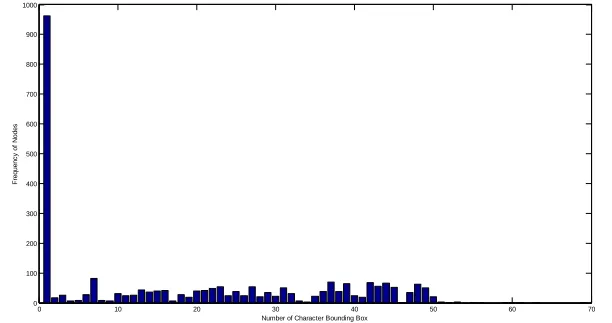
[image:6.596.152.458.534.696.2]Using te xt as a feature vector will result in dissimila rity between the orig inal te xt and the generated ones. Hence an algorithm is proposed to classify horizontal words into three categories namely short, mediu m and long sentences. The sentences are determined fro m a number of connected components as in Fig 5.1. A connected component is by a set of character.
Figure 5.1: The histogram of classified connected components .
0 10 20 30 40 50 60 70
0 100 200 300 400 500 600 700 800 900 1000
Number of Character Bounding Box
F
re
q
u
e
n
c
y
o
f
N
o
d
e
International Seminar on Application of Science Mathematics 2011 ISASM2011
5.2 Mi ni mum s panning trees
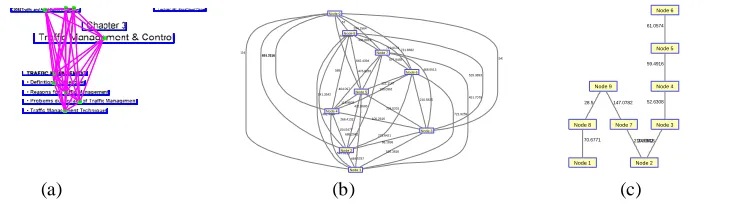
Basically a min imu m spanning tree is a subset of the edges of the graph, so that there’s a path form any node to any other node and that the sum of the weights of the edges is minimu m. We consider each sentence as a node. Here’s the min imu m spanning tree of the exa mp le (Fig.5.2) of Prim’s Algorith m by Robert C. Prim.The algorith m (greedily) builds the minimal spanning tree by iteratively adding nodes into a working tree:
1. Start with a tree which contains only one node.
2. Identify a node (outside the tree) which is closest to the tree and add the min imu m weight edge from that node to some node in the tree and incorporate the additional node as a part of the tree.
3. If there a re less then n – 1 edges in the tree, go to 2
For the exa mple graph, here’s how it would run. The resulting graph will have 8 MST as in Fig. 5.1 (c ).
449.5787 516.3816 68.1836 595.9211 154.5477 105.2616 688.2042 266.4132 224.0201 118.9832 721.9259 273.6421 210.5825 130.0961 122.1147 451.7079 421.8685 468.6513 464.097 476.8281 577.9455 141.3542 461.4694 529.3893 589 662.4394 719.0174 336.8813 198.2524 474.3216 541.1562 591.7516 656.3452 721.6682 294.1564 57 Node 1 Node 2 Node 3 Node 4 Node 5 Node 6 Node 7 Node 8 Node 9 34.0918 52.6308 59.4916 61.0574 210.9342 70.6771 147.0782 28.5
Node 1 Node 2
Node 3 Node 4 Node 5 Node 6 Node 7 Node 8 Node 9
[image:7.596.137.508.336.446.2](a) (b) (c)
Figure 5.1: Prim’s Algorith m; (a) Nodes, (b) Edges,(c) MST
6.0 Conclusions
Image Segmentation is an important task and requires careful scrutiny. We have presented an innovative and novel frame work for the separation of information in an image. This research, which aims to obtain te xt information inc luding OCR and layout signature, has focused on the captured images fro m slide show videos . While OCR enables us to search words in the document, layout signature will be used in indexing. The good indexing scheme of an image or fra me will be able to produce fast and accurate retrieval. However, the results are very dependent on the quality of OCR images or documents.
1. Jung, C., Q. Liu, and J. Kim, A new approach for text segmentation using a strok e filter.
Signal Processing, 2008. 88(7): p. 1907-1916.
2.
Drivas, D. and A. Amin,
Page segmentation and classification utilizing bottom-up
approach
. InProc. of ICDAR
, August 1995: p. 610-614.3. Saidane, Z. and C. Ga rcia , An Automatic Method for Video Character Segmentation. 2008: p. 557– 566.
4. Chen, D., J.-M . Odobez, and H. Bourlard, Text detection and recognition in images and
video frames. Pattern Recognition, 2004. 37(3): p. 595-608.
5. Al-Tayeche, R. and A. Khalil, CBIR: Content Based Image Retrieval. 2003. 6. Ameen, M.A., Content-Based Image Search Engine. 2004: p. 255 - 263.
7. Jung, K., K. In Kim, and A. K. Jain, Text information extraction in images and video: a
survey. Pattern Recognition, 2004. 37(5): p. 977-997.
8. Basu, S., et al., Text line extraction from multi-sk ewed handwritten documents. Pattern Recognition, 2007. 40(6): p. 1825-1839.
9. Lee, S. and J. Kim, Complementary combination of holistic and component analysis for
recognition of low-resolution video character images. Pattern Recognition Letters, 2008.
29(4): p. 383-391.
10. Behera, A., D. Lalanne, and R. Ingold. Enhancement of layout-based identification of
low-resolution documents using geometrical color distribution. in Document Analysis and

![Figure 4.2: RLSA algorithm (adapted from [10])](https://thumb-us.123doks.com/thumbv2/123dok_us/8778842.903016/4.596.142.498.564.684/figure-rlsa-algorithm-adapted-from.webp)