Tracking Student Movement using Active RFID
HERDAWATIE ABDUL KADIR
1, MOHD HELMY ABD WAHAB
2, ZARINA TUKIRAN
3,
ARIFFIN ABDUL MUTALIB
41,2,3
Faculty of Electrical and Electronic Engineering
Universiti Tun Hussein Onn Malaysia
P.O. Box 101, Pt. Raja, Batu Pahat, Johor
MALAYSIA
{watie, helmy,
zarin}@uthm.edu.my
College of Art and Science
Universiti Utara Malaysia
06010 Sintok, Kedah, MALAYSIA
[email protected]
Abstract: - Monitoring students of Universiti Tun Hussein Onn Malaysia (UTHM) movement around the campus is difficult especially for lecturer hall and laboratory access control. By using RFID technology, it is easy to track the student thus enhances the security and safety in selected zone. The application of active RFID in a student monitoring system is to improve faculty and UTHM management system to monitor particular group of students’ whereabouts. This paper describes about an ongoing research which is currently in the stage of data collection to measure its’ implementation in terms of effectiveness. The focus of the paper is to discuss about the development of the system which is called Student Monitoring System Using Active RFID (SMOSA)
Key-Words: - RFID, student monitoring, active RFID, tracking, security, movement
1 Introduction
Currently, low-cost Radio Frequency Identification (RFID) has been implemented widely in both industry and academic institutes as discussed by [1, 2, 3, 4] where the technology was focused more efficient in terms of processing time. It saves time and money [5]. A contactless transfer of data between the data-carrying device and its reader is far more flexible than smart card and RFID technology provides this contactless ID system solution.
In the Malaysia RFID 2006-2010 Forecast and Analysis by Bizedge (2006), it is stated that the RFID spending in Malaysia is estimated to grow at a compound annual growth rate (CAGR) of 45.84% (nearly US$20.94 million (RM77 million)) in 2010 from US$2.45 million (RM9 million) in 2005. Based on the study, hardware comprises largest portion of the total commercial RFID spending in 2005 (which was 60%), driven primarily by the purchases of readers and tags, followed by software and services (40%).
Knowing this, the SMOSA was developed to ease the university management team to monitor the presence of each student in the interest zone. SMOSA system contains two monitoring tasks; attendance system and tracking system using active
RFID. The aim of this paper is to improve attendance data management, reduce administrative error and internal theft.
This section describes briefly about the background of this study. SMOSA architecture is described in the following section. Next, analysis of SMOSA follows. Finally this paper is concluded with an outline of a future work to be carried out
2
SMOSA
architecture
and
technologies
This section explains the high-level design of SMOSA, from the RFID tag to the display data on computer screen.
Fig. 1: The operation of the SMOSA.
[image:2.595.63.254.317.545.2]The criteria of SMOSA are selected based on range, frequency, and technical aspects which are suitable for this project environment and availability of the component. Table 1 lists the property of SMOSA including RFID reader and RFID tag. Meanwhile Figure 2 shows the images of the RFID components.
Table 1 The property of SMOSA
Criteria Solution Type of
RFID
Active
Reader 2.4GHz ISM Band (High
Frequency)
Range 70 meters
Size of RFID tag
(31 x 21.5 x 7)mm – without enclosure
(40 x 40 x 15)mm
Life Unlimited
Source of power supply
- 8-28 V DC/400mA(RFID reader)
- Lithium battery CR2032(RFID tag)
Type of software
- Microsoft Visual Basic 2008 - SQL
- Macromedia Dreamweaver 8 Others
Typical application
Access control, item level tracking, smart card,
Networking LAN
Fig. 2 Active RFID component
To design and develop the SMOSA, a list of software and hardware were involved and described in the followings:
2.1
RFID Tag
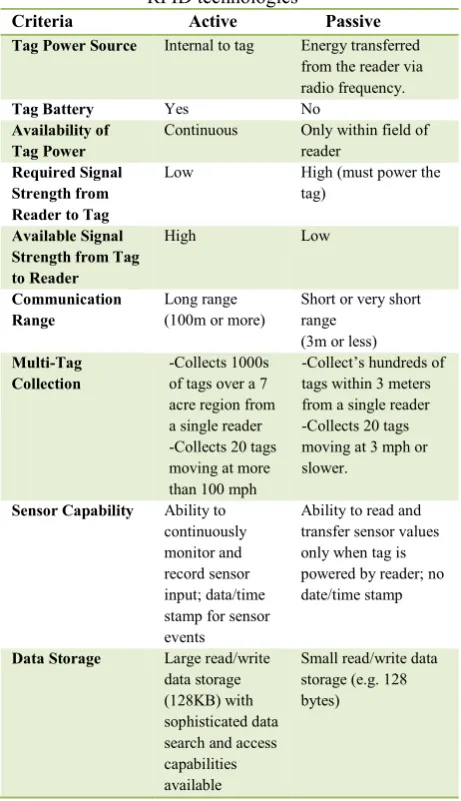
[image:2.595.62.253.321.633.2]RFID tag is a small object that can be attached to or incorporated into a product [6]. It contains antennas to enable them to receive and transmit radio-frequencies to and from transceivers. There are two basic types of RFID tags: passive, and active. Passive tags require no internal power source, and are commonly used with issues relating to security. In contrast, active tags require a power source, and are more expensive. In addition, there is another type of tag which is called Semi-passive RFID which is similar to passive tags except for the addition ofa very small battery allowing it to have a small amount of constant power. Table 2 addresses the differences between passive and active RFID technologies
Table 2 The differences between passive and active RFID technologies
Criteria Active Passive
Tag Power Source Internal to tag Energy transferred from the reader via radio frequency.
Tag Battery Yes No
Availability of Tag Power
Continuous Only within field of reader
Required Signal Strength from Reader to Tag
Low High (must power the tag)
Available Signal Strength from Tag to Reader
High Low
Communication Range
Long range (100m or more)
Short or very short range
(3m or less) Multi-Tag
Collection
-Collects 1000s of tags over a 7 acre region from a single reader -Collects 20 tags moving at more than 100 mph
-Collect’s hundreds of tags within 3 meters from a single reader -Collects 20 tags moving at 3 mph or slower.
Sensor Capability Ability to continuously monitor and record sensor input; data/time stamp for sensor events
Ability to read and transfer sensor values only when tag is powered by reader; no date/time stamp
Data Storage Large read/write
data storage (128KB) with sophisticated data search and access capabilities available
[image:2.595.314.545.367.768.2]Area Monitoring (e.g. warehouse, terminal, yard)
Yes No
High-Speed, Multi-Tag Portal
Yes Limited
Savi Technologies [6] discusses about the RFID technology processes, which starts with a tag that is made up of a microchip with an antenna, and a reader with an antenna. Active RFID uses an internal power source (battery) to continuously power the tag and its radio frequency (RF) communication circuitry. Active RFID allows very low-level signals to be received by the tag (because the reader does not need to power the tag), and the tag can generate high-level signals back to the reader, driven from its internal power source. Additionally, the Active RFID tag is continuously powered, whether in the reader field or not. As discussed in the next section, these differences impact communication range, multi-tag collection capability, and ability to add sensors and data logging, and many other functional parameters.
2.2
RFID Reader
RFID reader is a device that is used to interrogate an RFID tag [8]. The reader has an antenna that emits radio waves; the tag responds by sending back its data. A number of factors can affect the distance at which a tag can be read (the read range). The frequency used for identification, the antenna gain, the orientation and polarization of the reader antenna and the transponder antenna, as well as the placement of the tag on the object to be identified will all have an impact on the RFID system’s read range
3 SMOSA Design
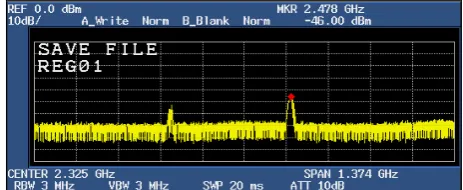
An experiment has been conducted to test the functionality and performances of SMOSA; a spectrum analyzer was used to capture the output for the RFID tag. The RFID reader utilized 12V batteries and 2.4 GHz frequency. Figure 3 shows the detail of hardware analysis obtained from the experiment. An experiment was conducted in order to test the functionality and performances of the SMOSA with minimum disturbance of people and electronic appliances; such as mobile phone, television and radio.
Fig. 3 Output signal of RFID reader within 3.5 meter radius
It can be noticed that the operating maximum power was 46 dBm with frequency of 2.35 GHz; affected
by minimum environment producing the
electromagnetic (EM) noise and normal moisture levels within the air. The pattern of power decreases as distance gets larger due to the effected of the environment interferences.
For the interfacing part, SMOSA were divided into two part : (1) stand alone system (2) online system. The stand alone system comprises of four modules: attendance, login, register, and search. The database was developed to store data using SQL. A web server was utilized to assist the management system to monitor the students’ movement in preferred places. The function of the web server is to register the students’ information and monitor the students’ attendance lists using networking via either Local Area network (LAN) or Wireless.
3.1
Database Design
[image:3.595.306.538.72.167.2]The database has three tables that are attendance, registration and users. The detailed information in every table is shown in Table 3.
[image:3.595.61.287.72.128.2]3.2
Interface Design
Figure 4 shows the flow chart of SMOSA. First, the RFID tag should be assigned to user (student). Then RFID tag is turned ON and the tag must be placed in a reading range. The antenna will generate the radio frequency field to the tag. Then, RFID will be detected after the reader receives signals from the tag and uses to record attendance and saves it in the database or to search student’s details in the database. Although these steps sound simple but the most important key is to register the tag first. Secondly if problems still occur, some maintenance work would be required to identify the status of the tag and the reader. This process will repeat if a student with a tag enters the antenna reader region.
Fig. 4: SMOSA system flow chart
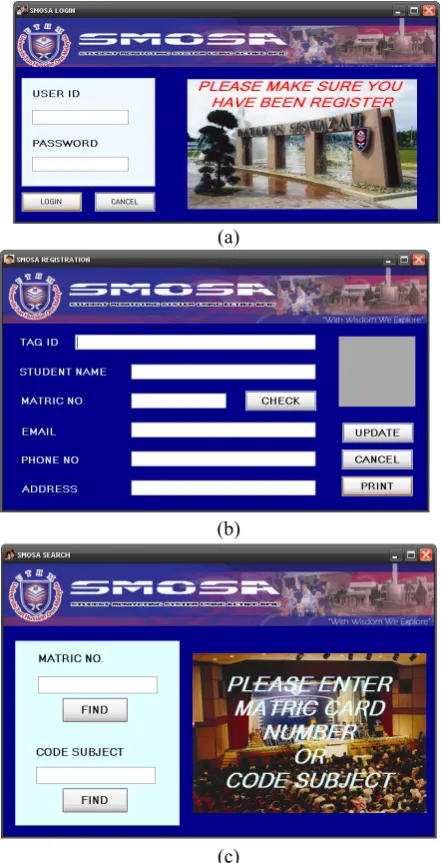
Figure 5 depicts three snapshots of SMOSA. The Figure 5(a) displays the main page of SMOSA, where it asks for user id and password. This is to ensure that only authorized persons can enter into
the system. Figure 5(b) displays a form to register a new tag. Each student is assigned to a specific RFID tag, and the tag will always keep his/her information, including tag id, student’s name, metric number, email address, phone number, and address. This information can always be updated. The management staffs can also find where a specific student located at any current time as indicated by Figure 5(c). They can search using either matric number or subject code
(a)
(b)
(c)
Fig. 5: SMOSA snapshots (a) Main page (b) Attendance module (c) Tracking module
4 Conclusion
[image:4.595.311.532.204.636.2] [image:4.595.54.280.320.672.2]communication. In our next research we will consider the security issue of the system to enabling the system to be immune from any attack and also combining RFID systems with biometric technology
References:
[1] Qaiser, A.; Khan, S.A., Automation of Time
and Attendance using RFID Systems,
International Conference on Emerging Technologies, ICET '06, 2006, pp.60-63.
[2]Chung-Chih Lin; Ping-Yeh Lin; Po-Kuan Lu; Guan-Yu Hsieh; Wei-Lun Lee; Ren-Guey Lee,A Healthcare Integration System for Disease Assessment and Safety Monitoring of Dementia Patients, IEEE Transactions on Information Technology in Biomedicine,Vol.12, No.5, 2008, pp.579-586.
[3] Ting, J.S.L.; Kwok, S.K.; Lee, W.B.; Tsang, A.H.C.; Cheung, B.C.F.,A Dynamic RFID-Based Mobile Monitoring System in Animal Care Management Over a Wireless Network,
International Conference on Wireless Communications, Networking and Mobile Computing, 2007,pp.2085-2088
[4]Sangyoon Chin, M.ASCE, Suwon Yoon, Cheolho Choi, and Changyon Cho , RFID+4D CAD for Progress Management of Structural Steel Works in High-Rise Buildings, Journal Comp in Civil Engineering,Vol 22,No 2,2008 ,pp. 74-89
[5] Bizedge,RFID 2006-2010 Forecast and Analysis byhttp://www.theedgedaily.com/cms/content.jsp ?id=com.tms.cms.article.Article_d2cc4b9-cb73c03a-29d65b00-cd5c3a50, 2006.
[6] Balachandran, G.K.; Barnett, R.E., A 110 nA Voltage Regulator System With Dynamic Bandwidth Boosting for RFID Systems, IEEE Journal of Solid-State Circuits, , Vol.41, No.9, 2006, pp.2019-2028.
[7] Savi Technologies, Savi Technologies: Active and Passive RFID and Selecting the Right Active Frequency Q.E.D System. 2005.
[8] E. Ergen, B. Akinci, B. East & J. Kirby, Tracking Components and Maintenance History within a Facility Utilizing Radio Frequency Identification Technology. Journal of Computing in Civil Engineering, Vol.21, No.1, 2007, pp. 11-20.
[9] J.W. Satzinger & T.U. Orvik, “The
Object-Oriented Approach Concepts, System
Development and Modeling with UML. 2nd. ed. Boston: Course Technology Thomson Learning, 2001.