Journal of Chemical and Pharmaceutical Research
__________________________________________________
ISSN No: 0975-7384 CODEN(USA): JCPRC5
J. Chem. Pharm. Res., 2011, 3(2):684-690
684
Formulation and Characterisation of Clarithromycin controlled
released Bioadhesive Tablets
*Kiran Kumar Alladi1, Ramesh Suram2, Manohar Bela3, Sannaila Kiran3 Ramaesh V4 andNarendra Y5
1
Department of Pharmaceutics, Dr Samuel George Institute of Pharmaceutical Sciences, Markapur, A.P, India
2
Department of Pharmaceutics, Shri Shivani College of Pharmacy, Warangal, A.P, India
3
Department of Pharmaceutics, Talla Padmavathi College of Pharmacy, Warangal, A.P, India
4
Department of Pharmaceutics, Trinity College of Pharmacy, Pedapally, A.P, India
5
Department of Pharmaceutics, Pullareddy College of Pharmacy, Hyderabad, A.P, India
______________________________________________________________________________
ABSTRACT
The present investigation concerns the development of bioadhesive tablets of Clarithromycin which were designed to prolong the gastric residence time after oral administration. Matrix tablets of Clarithromycin were formulated using four bioadhesive polymers namely Carbopol 974P, HPMC K15M and HPMC K4M carried out studies for weight variation, thickness, hardness, content uniformity, swelling index, bioadhesive force and in vitro drug release. Formulation of F9 and F12 which were formulated by using polymers, HPMC K14M, HPMC K15M and Carbopol 974P provided controlled release of Clarithromycin over the period of 12 hrs. The cumulative % of drug release of formulation F9 and F12 were 93.16 and 96.82 respectively. Invitro releases of F1 to F12 were found to be diffusion controlled and followed zero order kinetics. Formulation of F9 and F12 which were formulated by using polymers HPMC. K4M, HPMC K15M and Carbopol 974P were established to be the optimum formulation with optimum bioadhesive force, swelling index & desired invitro drug release. Further investigations are needed to confirm the in vivo efficiency, long term stability studies are needed to stabilize the controlled released (F9 and F12) formulations.
Key words: bioadhesive tablets, swelling index, Clarithromycin, bioadhesive force.
______________________________________________________________________________
INTRODUCTION
685
systems leading to a significantly prolonged residence time of sustained release delivery systems on these mucosal membranes. In addition, the development of oral bioadhesive delivery systems was always of great interest as delivery systems capable of adhering to certain gastrointestinal (GI) segments would offer various advantages. However, bioadhesive drug delivery systems have so far not reached their full potential in oral drug delivery, because the adhesion of drug delivery systems in the GI tract is insufficient to provide a prolonged residence time of delivery systems in the stomach or small intestine. The conventional dosage forms stays in the stomach for 0.5-3 hours and passes to small intestines from where it gets absorbed within 3-6 hours. It is therefore difficult to adjust release retardation and stomach retention for longer period of time. Some antibiotics produce effect depending on concentration at the site of bacterial infection. The bioavailability of active ingredients which are not completely absorbed decreases because part of the dose is lost, so frequent administration of dosage form is required. Clarithromycin is a macrolide antibiotic, It prevents bacteria from growing by interfering with their protein synthesis. Clarithromycin binds to the subunit 50S of the bacterial ribosome and thus inhibits the translation of peptides. Clarithromycin has similar antimicrobial spectrum as erythromycin but is more effective against certain gram-negative bacteria. Clarithromycin is used to treat certain infections caused by bacteria, such as pneumonia (a lung infection), bronchitis (infection of the tubes leading to the lungs), and infections of the ears, sinuses, skin, and throat. It also is used to treat and prevent disseminated Mycobacterium avium complex (MAC) infection [a type of lung infection that often affects people with human immunodeficiency virus (HIV)]. It is used in combination with other medications to eliminate H. pylori, a bacteria that causes ulcers. Clarithromycin is in a class of medications called macrolide antibiotics. It works by stopping the growth of bacteria. Antibiotics will not work for colds, flu, or other viral infections. Clarithromycin (CL) has a short half life 2.5-3 hours. The usual oral dosage regimen is 250-500 mg every 4-6 hours and Gastric residence time of the conventional Clarithromycin dosage form is 0.5-2 hours. CL is having suitable properties stability in stomach pH and soluble in acidic pH. By considering above facts, the present study was undertaken with the following objective. To design the controlled release bioadhesive oral tablet to increase the residence time of the drug in the stomach and release for extended period of time in order to; Increase bioavailability of the drug, Reduce the dosing frequency, Improve patient compliance.
EXPERIMENTAL SECTION
Clarithromycin was procured by (Sun Pharmaceuticals Mumbai), HPMC K4M, HPMC K15M was gifted by (Himedia Laboratories Pvt. Ltd Mumbai); Carbopol-974P gifted by Noveon, Mumbai, India, Lactose, Mg-stearate was gifted by Loba Chemie Pvt Ltd, Mumbai, India. All other chemicals, reagents and solvents were used are of Analytical grade.
Preparation of bioadhesive tablets
686
Table. 1 Formulations composition of CL tablet of F 1 to F 12
Formulation No. * HPMC K4M (mg) HPMC K15M (mg) Carbopol - 974P (mg) Mg- Stearate (mg) Talc (mg) Lactose (mg)
F1 110 -- -- 4.5 4.5 81
F2 125 -- -- 4.5 4.5 66
F3 140 -- -- 4.5 4.5 51
F4 -- 110 -- 4.5 4.5 81
F5 -- 125 -- 4.5 4.5 66
F6 -- 140 -- 4.5 4.5 51
F7 100 -- 10 4.5 4.5 81
F8 105 -- 15 4.5 4.5 71
F9 80 -- 20 4.5 4.5 91
F10 -- 90 10 4.5 4.5 91
F11 -- 80 20 4.5 4.5 91
F12 -- 70 30 4.5 4.5 91
* All formulation contains 250 mg of CL, * Total weight of tablet – 450 mg.
RESULTS AND DISCUSSION
Evaluation of Bioadhesive Tablets
Tablet dimensions:- The dimensions determined for formulated tablets were tabulated in Table
No 2 Tablets mean thickness (n=3) were uniform in F1 to F12 formulations and were found to be in the range of 0.32 cm to 0.345 cm.
Hardness:- The hardness of tablets of each batch ranged between 6.2 to 7.3 kg/cm2 (Table No
2). This ensures good handling characteristics for all batches.
Friability Test: - The values of friability test were tabulated in Table No 2. The Percentage
[image:3.595.69.531.523.717.2]friability was less than 1% in all the formulations (Except formulation F 6) ensuring that the tablets were mechanically stable.
Table: 2 Physical properties of tablets
Formulation No.
Hardness* (kg/cm2)
Thickness* (cm) % Friability Weight Variation*(mg) % Drug content
F1 6.6±0.152 0.325±.00110 0.52 453±2.08 100.41
F2 6.8±0.289 0.341±0.0012 0.64 449±1.52 100.94
F3 6.3±0.462 0.343±0.0010 0.68 454±4.93 99.52
F4 7.3±0.354 0.328±0.0006 0.85 452±5.29 100.94
F5 6.9±0.145 0.321±0.0010 0.76 448±3.21 99.11
F6 6.8±0.587 0.323±0.0010 1.09 449±4.00 99.52
F7 6.7±0.345 0.331±0.0006 0.60 454±2.64 101.82
F8 6.8±0.306 0.331±0.0115 0.81 449±4.04 99.05
F9 7.3±0.328 0.345±0.0006 0.89 448±1.52 101.41
F10 6.3±0.133 0.337±0.0029 0.82 451±1.52 99.75
F11 6.2±0.218 0.332±0,0012 0.83 451±1.32 99.65
F12 6.5±0.314 0.332±0.0009 0.86 453±2.14 99.48
* (n=3, ±S.D.)
Weight Variation Test:- The percentage weight variations for all formulations were tabulated in
687
variation was within the standard pharmacopoeial limits of 7.5% of the weight. The weights of all the tablets were found to be uniform with low standard deviation values.
Drug Content Uniformity:- The percentage of drug content for F1 to F12 was found to be
between 99.05% and 100.94 % of Clarithromycin, it complies with official specifications. The results were shown in Table No 2.
Bioadhesive Force Measurement of Tablet
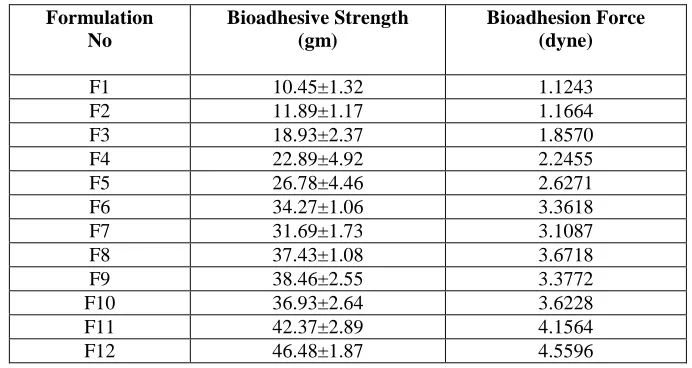
[image:4.595.132.478.493.677.2]Adhesion was reported to be effected by hydration. Hydration of the bioadhesive polymer is essential to initiate the bioadhesive bonding process. In case of tablets applied in the dehydrated state, which is most convenient, it is essential that sufficient water is available so that rapid hydration takes place, and a flexible rubbery state occurs. The capillary force arises when water from the space between the mucosa and the polymer was taken up by a dry system. Once the bond is formed, reduction in the rate of swelling due to water uptake from the tissue surface may only prolong the association of the tablet with the mucosa. Removal of water from the underlying mucosa layer by the hydrating polymer may increase the cohesive forces of mucus; this plays a vital role in the establishment of an effective bioadhesive bond. Modified balance method was used for the measurement of bioadhesive force. During measurement of bioadhesive force 15 min contact time was kept constant. Bioadhesive force depends on the viscosity and concentration of the polymer. Formulation F1 was having lowest bioadhesive force because the HPMC K4M having lower viscosity. While formulation (F 12) containing HPMC K15M and carbopol 971 shows higher bioadhesion force due to higher viscosity .In order to increase the bioadhesive strength of low viscosity polymer containing HPMC K4M was combined with carbopol 974P having good bioadhesive property. This combination results in good bioadhesive properties as shown in Table no. 3. From the above results it was found that polymers having high molecular weight and high viscosity exhibited higher adhesion. HPMC K15M and Carbopol 974P were found to be having good bioadhesive strength. HPMC and carbopol possesses hydroxyl and carboxy groups respectively required for bioadhesion.
Table. 3 Bioadhesive strength and force of formulation F 1 to F 12
Formulation No
Bioadhesive Strength (gm)
Bioadhesion Force (dyne)
F1 10.45±1.32 1.1243
F2 11.89±1.17 1.1664
F3 18.93±2.37 1.8570
F4 22.89±4.92 2.2455
F5 26.78±4.46 2.6271
F6 34.27±1.06 3.3618
F7 31.69±1.73 3.1087
F8 37.43±1.08 3.6718
F9 38.46±2.55 3.3772
F10 36.93±2.64 3.6228
F11 42.37±2.89 4.1564
F12 46.48±1.87 4.5596
Swelling Study of Tablets
688
Table. 4 Percentage swelling of formulation F 1 to F 12
Form. no.
Time (hrs)
1 2 3 4 5 6 7 8 10
[image:5.595.157.459.297.489.2]F1 133.8 136.56 137.4 139.25 140.12 142.23 143.36 143.89 144.87 F2 98.95 134.32 135.6 136.85 137.64 139.74 140.61 143.58 144.34 F3 100.2 130.67 132.2 134.69 136.67 137.83 138.97 139.21 140.73 F4 63.36 96.83 100.9 105.36 111.86 119.34 125.87 130.94 134.99 F5 73.31 115.46 118.4 120.81 121.36 125.36 129.35 131.23 132.21 F6 79.66 113.57 115.6 116.25 117.49 119.39 125.75 128.37 129.99 F7 85.28 129.45 131.9 132.12 132.68 133.25 133.24 133.92 134.17 F8 98.28 129.15 30.57 132.69 133.24 134.53 135.45 136.57 137.51 F9 98.27 126.93 128.7 129.98 130.24 132.48 132.25 134.36 135.03 F10 52.36 83.45 87.36 95.36 102.23 106.35 115.23 118.63 122.48 F11 68.58 109.67 111.6 113.65 115.34 118.39 11934 123.35 125.68 F12 73.59 111.34 112.3 112.98 115.34 116.37 117.68 118.45 119.36
Fig.1 Percentage swelling Vs time of formulation F 1 to F 12
Formulations containing HPMC K 4 M i.e. F1, F2 and F3 had higher % Swelling than formulations containing HPMC K 15 M i.e. F4, F5 and F6. Polymers HPMC K4M and Carbopol 974P have higher cross linking indicate that polymers having cross linking constrain and therefore the polymer did not open up easily. Fabergas and Gareia have reported a correlation between % Swelling and bioadhesive strength. Initial swelling due to hydration aided bioadhesion but further swelling induced over-extension of hydrogen bonds and other forces. This resulted in lower bioadhesion. % Swelling decreased with polymer concentration because high concentration of the polymer restricts its movement.
Comparison of In vitro release profile of optimized formulation F 9 and F 12 with market CR tablet (Biaxin)
689
Table: 5 Cumulative drug release of formulation F 9 and F 12
Time % Cumulative Drug Release*
(Hour) F 9 F 12 Biaxin Tablet
1 15.25±1.16 14.64+1.96 8.59+0.36
2 31.70+3.48 32.97+3.56 15.58+0.63
3 40.95±2.99 42.56+1.34 27.94+1.89
4 51.80+1.17 53.30+2.36 33.18+2.92
5 59.88+6.95 61.26+4.96 46.51+1.61
6 70.07+8.37 72.57+4.78 53.26+0.85
7 78.97+6.99 79.64+5.26 61.52+1.44
8 85.56+3.28 86.97+4.29 65.74+0.31
10 91.81+4.65 90.71+3.67 78.83+2.68
12 95.78+0.95 96.38+1.21 85.32+1.30
CONCLUSION
Hence in present investigation, an attempt was made to deliver Clarithromycin via oral bioadhesive drug delivery system to the vicinity of absorption site by prolonging the gastric residence time of the dosage form. For the formulation of oral bioadhesive tablet various polymer used like Hydroxypropyl methylcellulose K15M, Hydroxypropyl methylcellulose K4M, Carbopol 974P, used as hydrophilic matrix forming and bioadhesive polymer in varying concentration along with Magnesium stearate, talc and Lactose as filler. Tablets were subjected to various evaluation parameters such as drug content, hardness, weight variation, friability, bioadhesive strength, swelling index, and in vitro drug release study. It was revealed that the tablets of all batches had acceptable physical parameters. Tablets of batch F9 and F12 had good Bioadhesion along with good swelling behaviours and in vitro drug release. A result of the study of individual polymers shows that the, HPMC K15M, HPMC K4M and Carbopl 974P, alone was also able to control the release in 12 hour. Release of Clarithromycin, from combination of HPMC K15M with Carbopl 974P, combination HPMC K4M with Carbopl 974P gave the good results compared to employing individual polymers. Tablets of Batch F9 and F12 were selected as an optimum batch and evaluated for further parameters like accelerated stability study and characterization using IR spectroscopy. The stability study revealed that there was no significant change in dissolution profile and bioadhesive strength for a period of one month.
Acknowledgement
The authors are thankful to the Management, Dr.samuel George institute of pharmaceutical sciences, for providing necessary facilities to carry out this work. And we are grateful to my parents to their encouragement.
REFERENCES
[1] S. B. Patil, R. S. R. Murthy, H. S. Mahajan, R. D. Wagh, S. G. Gattani, Pharm Times, 2006, 38(4), 25-28.
[2] J Swarbrick, JC. Boylon, “Encyclopedia of Pharmaceutical Technology” Marcel Dekker, Volume-10, 458-460.
[3]A Semalty, M Semalty. Pharmainfonet, 2006. [4] K.P.R.Chowdary and L.Srinivas, Indian
drugs, 2000, 37, (9), 400-405.
[5] N. Vivien, R. Gaurl, Parshoen, M. Madan, Euro J Pharm Biopharm, 2002, 50, 109-115. [6] B Jasti, X Li, Pharmatech, 2003, 53-58.
690
[9] AK. Shingla, M Chawla, A Singh.Drug Devel Indust Pharm, 2000, 9, 913-914.
[10] R.B. Satoskar, S.D.Bhandarkar, Phamacology and Phamacotherapeutics, (18th Edn), Popular Prakashan, (2003) 410.
[11] D Tivari, R Sause and PL. Madan; AAPS Pharmscitech, 1999, 1(3), 13. [12] K Morimoto, J Wang , Y Tabata , D Bi, J Contr. Rel. 73, 2001, 223–231.
[13] MD. Chavanpatil, P Jain, S Chaudhari, PR Vavia, Inter J Pharm, 316, 2006, 86–92.
[14] NA Naffee, FA Ismail, NA. Boraje, Drug Devel. Indust. Pharmacy, 2004, Vol. 30 (9), P 995-1004.
[15] R.Bala Rane sha Chary and Y. Madhusudan Rao, Drug Dev and Ind Pharm, 26 (8), 2000, 901-906.
[16] K.P.R. Chowdary and G.Balatripura Sundari, Indian J. pharm. Sci, 65 (6), 2003, pp-591-594.