2018 International Conference on Computer, Communication and Network Technology (CCNT 2018) ISBN: 978-1-60595-561-2
Comprehensive Integrated Platform for Garbage Classification in
Reduction, Innocuity, and Resource
Ben WANG
*and Wen-li ZHOU
Hangzhou Normal University, Hangzhou City, Zhejiang Province, China
*
Corresponding author
Keywords: Garbage classification, Internet of things, Intelligent environmental protection.
Abstract. Urban garbage collection in three steps and environmental monitoring have become an indispensable link in the green recycling economy of the country. In the process of explosive growth of cities and towns in China, the amount of waste is also expanded in the exponent growth, causing huge environmental and social problems. The current urban area commonly applies the strategy of "mixed collection, centralized transportation, centralized processing", commonly known as the three segment management to recycle and dispose of refuse, which can not effectively solve massive waste issues. This paper is based on the intelligent environmental protection and garbage classification technology to solve the inevitable problems of "sanitation digital management", "solid waste classification & recycling station real-time feedback", and "surrounding environment monitoring", so as to recycle of garbage efficiently and harmlessly. Our initial research results have been applied in the environmental protection projects in many demonstration cities and beautiful villages throughout the country, and good results have been achieved. Based on the research and rich engineering experience, we have proposed and optimized digital dynamic sanitation management, grid large-scale real-time monitoring of solid waste recycling stations feedback, the surrounding water and air quality on-line monitoring subsystems. To overcome difficulties and provide theoretical basis or technical methods, it will strongly support the extensive deployment of garbage recycling in China, and greatly improve the recycling rate of urban and rural waste.
Introduction
Garbage collection (GC) in three steps is an important part of the green circular economy. Under the guidance of "Scientific outlook on development 2018", China will vigorously develop low carbon cycle economy, advocate green development, recycle the environmental resources, and reduce energy or material consumption. It has become the internal requirement of Chinese sustained economic development [1,2,3]. "To put the ecological civilization in a prominent position and integrate into the economic construction, political construction, cultural construction and social construction in all aspects and the whole process, we build a beautiful China and realize the sustainable development of the Chinese nation. "
This paper is based on Internet of things, big data, and the scientific research of environmental protection. In the process of construction, the optimization of algorithm is the key to efficient and stable operation [5]. The development of intelligent environmental protection and garbage classification is highly consistent with the strategic direction of green economy and circular economy in our country [6]. The regeneration of resources, and intelligent environmental protection and garbage classification are the starting point of resource regeneration [7]. Therefore, the research conforms to the national economic development plan, and has broad industrial prospects. Therefore, the research on the key issues of the Internet of things in the field of intelligent environmental protection and garbage classification is very important and necessary [8].
Research Contents
Digital Grid Management for Environmental Sanitation
The data in the intelligent environmental protection and garbage classification project have the multidimensional characteristics of space-time. The grid data based on the map has different spatial span in space, and also has time series related changes [9,10]. The data also presents the characteristics of multi-granularity and multi-scale [11,12]. The grid framework algorithm and dynamic grid management algorithm are implemented and optimized to reduce the dependency among different layers of the framework. The framework will include perception layer, transport layer, activation layer, foundation support layer and application layer.
Hierarchical Structure Prototype of Intelligent Environmental Protection and Garbage
Classification. The system framework of intelligent environmental protection and garbage
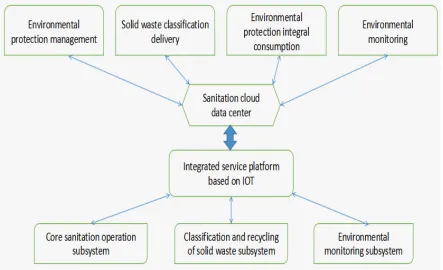
[image:2.612.85.528.317.587.2]classification includes three subsystems: Core sanitation operation subsystem, classification and recycling of solid waste subsystem, and environmental monitoring subsystem. The massive data produced by three subsystems will be stored into the sanitation cloud data center, through integrated service platform based on IOT, to realize intelligent decision support and intelligent management. The structure can greatly improve the management efficiency, and reduce daily operation cost. The prototype of intelligent environmental protection and garbage classification is shown in Figure 1.
Figure 1. Hierarchical structure prototype of intelligent environmental protection and garbage classification.
Dynamic Grid Optimization of High Load Application Cloud Architecture. Dynamic grid
management is a large distributed real-time system based on cloud architecture. It needs to solve problems of intensive business logic[13]. Data extraction, cleaning, and integration of heterogeneous unstructured dynamic data are the precondition [14,15]. By optimizing intelligent decision management system and customer behavior analysis system, it can handle, store, and query big data efficiently [16].
data, security, data driven services, data separation, and complex query [18,19]. Furthermore, the relational database that traditionally supports SQL has an extension problem. Relatively, Hadoop's data tools are suitable for deeper analysis and query, and NOSQL is suitable for the rapid processing of unstructured data [21].
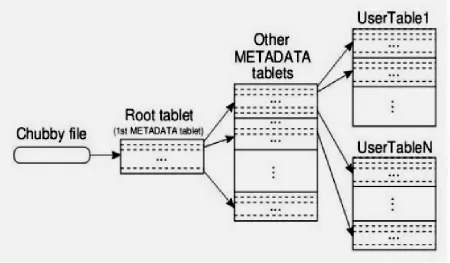
[image:3.612.82.532.286.549.2]At present, we propose an index and query structure, JHTable, which carries the PB level monitoring data, as well as the stability operation for hundreds of thousands of monitoring terminals and mobile devices. The JHTable cluster consists of three parts: a library for the client, a main server (Master Server), and a number of Tablet Servers. The JHTable splits the table (tablet), and then the size of the tablet is maintained in 100-200MB range. Once it goes beyond the range, it will be splitted into smaller pieces, or merge into larger pieces.The positioning strategy of tablet is designed in three layers. The first layer is Chubby file, which preserves the location of root tablet. This Chubby file belongs to a part of the Chubby service. The second layer is root tablet, which is the first fragment of the METADATA table. It preserves the location of other meta-data tables. Root tablet is very special. In order to keep the depth of the tree unchanged, root tablet never splits. The third layer is constructed by other meta-data tablets, which contains location information of many user segments. Above structure is shown in Figure 2.
Figure 2. JHTable, an index and query structure.
Real-time Monitoring Feedback for Large Scale Solid Waste Recycling Stations.
In each district, the waste recycling stations, recycling vehicles, and regional roads are all dynamic, so the core algorithm involves the detection and analysis of the dynamic characteristics of the environmental protection area. The detection and analysis algorithm of dynamic characteristics is proposed to achieve the early detection of the "traffic abnormal mode" of the recycling vehicle and the recycling station. At the same time, it should predict abnormal events, and make prospective preventive scheduling, and greatly improve the recovery efficiency [22].
appliances and solid waste. In order to encourage the residents and tourists to participate in the solid waste recovery, the part value generated by the transaction is provided to the participants.
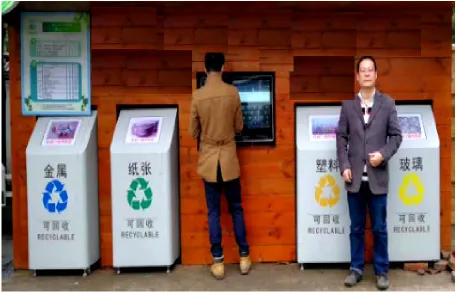
Based on intelligent information management platform, intelligent terminals are connected by GPRS, 3G/4G, WiFi, wireless Bluetooth, and so on [26]. It can realize the functions of high efficiency recovery of enterprise access, periodic reclaim task dispatch, intelligent settlement. The platform also provides service for solid waste recovery and monitoring. The solid waste recycling intelligent terminal prototype is shown in Figure 3.
[image:4.612.78.536.232.526.2]The SC-Tree is implemented in subsystem to efficiently handle, store and query heterogeneous mass data [20]. The real-time job dispatch is carried out with the optimal path. In order to achieve the above information processing and feedback, the subsystem integrates sensor technology, embedded technology, distributed information processing, wireless communication, and network security technology.
Figure 3. Solid waste recycling intelligent terminal prototype.
Environmental Monitoring Subsystem
In monitoring big area, air and water quality data among stations are often very different [25,26]. The adaptive dynamic environment monitoring algorithm are suggested. And the machine learning technology is implemented to measure the influence of dynamic factors of air and water in different areas, so as to further improve the accuracy of air and water quality monitoring.
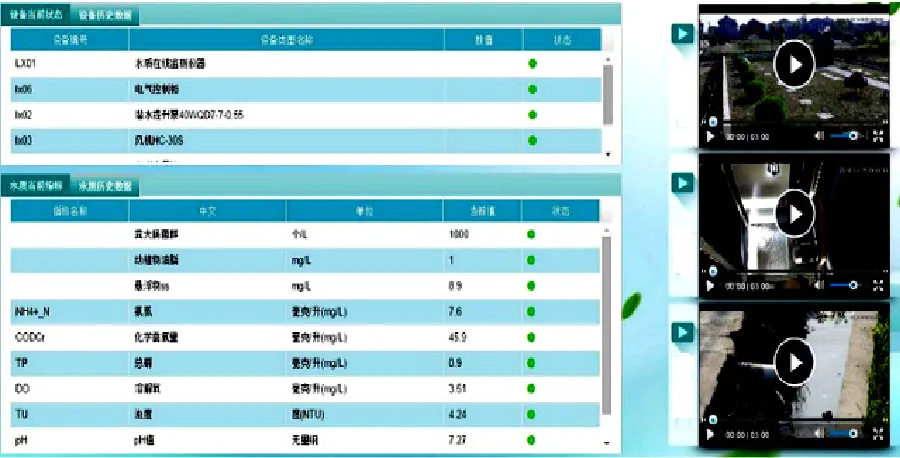
The water quality testing equipments are integrated according to the surface water quality standard (GB3838-2002). The biochemical oxygen demand (BOD), chemical oxygen demand (COD), total organic carbon (TOC), and total oxygen demand (TOD) are detected. The water quality can be evaluated in real time. The equipment and indicators real-time monitoring prototype is shown in Figure 4.
Figure 4. Equipment and indicators real-time monitoring prototype.
Summary
In the paper, we have proposed three subsystems: digital dynamic sanitation management, grid large-scale real-time monitoring of solid waste recycling stations feedback, the surrounding water and air quality on-line monitoring. Our system adopts the innovative architecture, and applies the Internet of things and big data technology into the urban garbage collection industry. The research and technologies have been implemented in several cities in China. Great social and economic benefits have been achieved in the past two years.
Acknowledgement
This research was financially supported by the scientific research funds of Hangzhou Normal University.
References
[1] X.G. Wang, Technical policy of municipal solid waste disposal and pollution prevention and control in environmental management of municipal solid waste in the process of classified collection and centralized disposal, Sun Yat-sen University. 5:5-9 (2000)
[2] Y.F. Lu, X.J. Sun, Discussion on the Countermeasures for classification and collection of municipal solid waste in China, Environmental Sanitation Engineering. 22(3):4-6 (2002)
[3] X.Y. Yi, Discussion on the treatment of urban garbage, Environmental management in China. 12(1):3-5 (2010)
[5] W. Hao, The classification and collection of municipal solid waste is imperative, Journal of Tianjin Institute of Urban Construction. 6:114-117 (2010)
[6] J. Yu, Legal Research on classification of municipal solid waste in China, Environmental Science and management. 4:13-15 (2009)
[7] F. Lu, How to fight domestic garbage, Tsinghua University. 3:15-22 (2000).
[8] Y.G. Jiang, Standardizing the privatization of public affairs management by legal system, Contemporary administration. 1:4-5 (2004)
[9] S.Q. Cai, On the legislation of circular economy, Journal of Nanyang Teachers College. 4:3-4 (2005)
[10] Department of pollution control of the State Environmental Protection Administration, Status quo of management and disposal of municipal solid waste, Sinopec press. 34-36 (2002).
[11] Y. Jiang, Y.T. Liu, Municipal solid waste management: Advance the frontiers of circular economy, China Environmental Science Press. 56-57 (2004).
[12] Y. Zhang, Urban domestic waste reduction management economics, Chemical Industry Press, 2004:34-35.
[13] W. Tang, A legal study on the prevention and control of domestic waste pollution, Hunan University. 4:45-46 (2015)
[14] D.D. Ma, Study on the legal problems of municipal solid waste pollution prevention and control, Shanxi University of Finance and Economics. 2:12-13(2008)
[15] T. Q. Liu, Introduction to Environmental Protection, Higher Education Press. 211-212 (1999)
[16] S.C. Dong, The potential of municipal solid waste resources and the Countermeasures of industrialization, Resource Science. 23 (2001).
[17] G. Gao, Y.W. Dong, H. Bo. Jin, Research on urban garbage disposal and Management Countermeasures, Urban environment and urban ecology. 56-58 (2000)
[18] L.Z. Gao, Construction of intelligent logistics management system based on Internet of things technology, Logistics technology. 12:124-126 (2012)
[19] Y. Zheng, Urban computing and large data, Communication of Chinese Computer Society. 9:8–18 (2013)
[20] B. Wang, J. Q. Gan, SC-Tree: An Efficient Structure for High-Dimensional Data Indexing, Lecture Notes in Computer Science. 4042: 164-176 (2005).
[21] S. Liu, Y. Liu, L.M. Ni, J. Fan, and M. Li, Towards mobility-based clustering, Knowledge Discovery and Data Mining. ACM, 919–928 (2010)
[22] P. Gang, Q. Guande, W.S. Zhang, Li Shijian, Z.H. Wu, and L. T. Y. Laurence. Trace analysis and mining for smart cities:Issues, methods, and applications, Communications Magazine 51:120–126 (2013)
[23] Q. Guande, L. Xiaolong, Li Shijian, G. Pan, Z.H. Wang, and D. Zhang, Measuring social functions of city regions from large-scale taxi behaviors, Pervasive Computing and Communications. 384–388 (2011)
[24] V. Marco, S. Phithakkitnukoon, and B. Carlos, Urban mobility study using taxi traces, Trajectory data mining and analysis. 23–30 (2011).
[25] Y. Jing, Z. Yu, and X. Xing, Discovering regions of different functions in a city using human mobility and pois, Knowledge Discovery and Data Mining. ACM. 186–194 (2012).