A Monthly Double-Blind Peer Reviewed (Refereed/Juried) Open Access International e-Journal - Included in the International Serial Directories Indexed & Listed at:
VOLUME NO.2(2012),ISSUE NO.10(OCTOBER) ISSN2231-5756
CONTENTS
CONTENTS
CONTENTS
CONTENTS
Sr.No.
TITLE & NAME OF THE AUTHOR (S)
Page No.
1. EFFICIENCY AND PERFORMANCE OF e-LEARNING PROJECTS IN INDIA
SANGITA RAWAL, DR. SEEMA SHARMA & DR. U. S. PANDEY
1
2. AN ADAPTIVE DECISION SUPPORT SYSTEM FOR PRODUCTION PLANNING: A CASE OF CD REPLICATOR
SIMA SEDIGHADELI & REZA KACHOUIE
5
3. CONSTRUCT THE TOURISM INTENTION MODEL OF CHINA TRAVELERS IN TAIWAN
WEN-GOANG, YANG, CHIN-HSIANG, TSAI, JUI-YING HUNG, SU-SHIANG, LEE & HUI-HUI, LEE
9
4. FINANCIAL PLANNING CHALLENGES AFFECTING IMPLEMENTATION OF THE ECONOMIC STIMULUS PROGRAMME IN EMBU COUNTY, KENYA
PAUL NJOROGE THIGA, JUSTO MASINDE SIMIYU, ADOLPHUS WAGALA, NEBAT GALO MUGENDA & LEWIS KINYUA KATHUNI
15
5. IMPACT OF ELECTRONIC COMMERCE PRACTICES ON CUSTOMER E-LOYALTY: A CASE STUDY OF PAKISTAN
TAUSIF M. & RIAZ AHMAD
22
6. SOCIAL NETWORKING IN VIRTUAL COMMUNITY CENTRES: USES AND PERCEPTION AMONG SELECTED NIGERIAN STUDENTS
DR. SULEIMAN SALAU & NATHANIEL OGUCHE EMMANUEL
26
7. EXPOSURE TO CLIMATE CHANGE RISKS: CROP INSURANCE
DR. VENKATESH. J, DR. SEKAR. S, AARTHY.C & BALASUBRAMANIAN. M
32
8. SCENARIO OF ENTERPRISE RESOURCE PLANNING IMPLEMENTATION IN SMALL AND MEDIUM SCALE ENTERPRISES
DR. G. PANDURANGAN, R. MAGENDIRAN, L.S. SRIDHAR & R. RAJKOKILA
35
9. BRAIN TUMOR SEGMENTATION USING ALGORITHMIC AND NON ALGORITHMIC APPROACH
K.SELVANAYAKI & DR. P. KALUGASALAM
39
10. EMERGING TRENDS AND OPPORTUNITIES OF GREEN MARKETING AMONG THE CORPORATE WORLD
DR. MOHAN KUMAR. R, INITHA RINA.R & PREETHA LEENA .R
45
11. DIFFUSION OF INNOVATIONS IN THE COLOUR TELEVISION INDUSTRY: A CASE STUDY OF LG INDIA
DR. R. SATISH KUMAR, MIHIR DAS & DR. SAMIK SOME
51
12. TOOLS OF CUSTOMER RELATIONSHIP MANAGEMENT – A GENERAL IDEA
T. JOGA CHARY & CH. KARUNAKER
56
13. LOGISTIC REGRESSION MODEL FOR PREDICTION OF BANKRUPTCY
ISMAIL B & ASHWINI KUMARI
58
14. INCLUSIVE GROWTH: REALTY OR MYTH IN INDIA
DR. KALE RACHNA RAMESH
65
15. A PRACTICAL TOKENIZER FOR PART-OF SPEECH TAGGING OF ENGLISH TEXT
BHAIRAB SARMA & BIPUL SHYAM PURKAYASTHA
69
16. KEY ANTECEDENTS OF FEMALE CONSUMER BUYING BEHAVIOR WITH SPECIAL REFERENCE TO COSMETICS PRODUCT
DR. RAJAN
72
17. MANAGING HUMAN ENCOUNTERS AT CLASSROOMS - A STUDY WITH SPECIAL REFERENCE TO ENGINEERING PROGRAMME, CHENNAI
DR. B. PERCY BOSE
77
18. THE IMPACT OF E-BANKING ON PERFORMANCE – A STUDY OF INDIAN NATIONALISED BANKS
MOHD. SALEEM & MINAKSHI GARG
80
19. UTILIZING FRACTAL STRUCTURES FOR THE INFORMATION ENCRYPTING PROCESS
UDAI BHAN TRIVEDI & R C BHARTI
85
20. IMPACT OF LIBERALISATION ON PRACTICES OF PUBLIC SECTOR BANKS IN INDIA
DR. R. K. MOTWANI & SAURABH JAIN
89
21. THE EFFECTIVENESS OF PERFORMANCE APPRAISAL ON ITES INDUSTRY AND ITS OUTCOME
DR. V. SHANTHI & V. AGALYA
92
22. CUSTOMERS ARE THE KING OF THE MARKET: A PRICING APPROACH BASED ON THEIR OPINION - TARGET COSTING
SUSANTA KANRAR & DR. ASHISH KUMAR SANA
97
23. WHAT DRIVE BSE AND NSE?
MOCHI PANKAJKUMAR KANTILAL & DILIP R. VAHONIYA
101
24. A CASE APPROACH TOWARDS VERTICAL INTEGRATION: DEVELOPING BUYER-SELLER RELATIONSHIPS
SWATI GOYAL, SONU DUA & GURPREET KAUR
108
25. ANALYSIS OF SOURCES OF FRUIT WASTAGES IN COLD STORAGE UNITS IN TAMILNADU
ARIVAZHAGAN.R & GEETHA.P
113
26. A NOVEL CONTRAST ENHANCEMENT METHOD BY ARBITRARILY SHAPED WAVELET TRANSFORM THROUGH HISTOGRAM EQUALIZATION
SIBIMOL J
119
27. SCOURGE OF THE INNOCENTS
A. LINDA PRIMLYN
124
28. BUILDING & TESTING MODEL IN MEASUREMENT OF INTERNAL SERVICE QUALITY IN TANCEM – A GAP ANALYSIS APPROACH
DR. S. RAJARAM, V. P. SRIRAM & SHENBAGASURIYAN.R
128
29. ORGANIZATIONAL CREATIVITY FOR COMPETITIVE EXCELLENCE
REKHA K.A
133
30. A STUDY OF STUDENT’S PERCEPTION FOR SELECTION OF ENGINEERING COLLEGE: A FACTOR ANALYSIS APPROACH
SHWETA PANDIT & ASHIMA JOSHI
138
CHIEF PATRON
CHIEF PATRON
CHIEF PATRON
CHIEF PATRON
PROF. K. K. AGGARWAL
Chancellor, Lingaya’s University, Delhi
Founder Vice-Chancellor, Guru Gobind Singh Indraprastha University, Delhi
Ex. Pro Vice-Chancellor, Guru Jambheshwar University, Hisar
FOUNDER
FOUNDER
FOUNDER
FOUNDER PATRON
PATRON
PATRON
PATRON
LATE SH. RAM BHAJAN AGGARWAL
Former State Minister for Home & Tourism, Government of Haryana
Former Vice-President, Dadri Education Society, Charkhi Dadri
Former President, Chinar Syntex Ltd. (Textile Mills), Bhiwani
CO
CO
CO
CO----ORDINATOR
ORDINATOR
ORDINATOR
ORDINATOR
AMITA
Faculty, Government M. S., Mohali
ADVISORS
ADVISORS
ADVISORS
ADVISORS
DR. PRIYA RANJAN TRIVEDI
Chancellor, The Global Open University, Nagaland
PROF. M. S. SENAM RAJU
Director A. C. D., School of Management Studies, I.G.N.O.U., New Delhi
PROF. M. N. SHARMA
Chairman, M.B.A., Haryana College of Technology & Management, Kaithal
PROF. S. L. MAHANDRU
Principal (Retd.), Maharaja Agrasen College, Jagadhri
EDITOR
EDITOR
EDITOR
EDITOR
PROF. R. K. SHARMA
Professor, Bharti Vidyapeeth University Institute of Management & Research, New Delhi
CO
CO
CO
CO----EDITOR
EDITOR
EDITOR
EDITOR
DR. BHAVET
Faculty, M. M. Institute of Management, Maharishi Markandeshwar University, Mullana, Ambala, Haryana
EDITORIAL ADVISORY BOARD
EDITORIAL ADVISORY BOARD
EDITORIAL ADVISORY BOARD
EDITORIAL ADVISORY BOARD
DR. RAJESH MODI
Faculty, Yanbu Industrial College, Kingdom of Saudi Arabia
PROF. SANJIV MITTAL
University School of Management Studies, Guru Gobind Singh I. P. University, Delhi
PROF. ANIL K. SAINI
Chairperson (CRC), Guru Gobind Singh I. P. University, Delhi
DR. SAMBHAVNA
Faculty, I.I.T.M., Delhi
DR. MOHENDER KUMAR GUPTA
VOLUME NO.2(2012),ISSUE NO.10(OCTOBER) ISSN2231-5756
DR. SHIVAKUMAR DEENE
Asst. Professor, Dept. of Commerce, School of Business Studies, Central University of Karnataka, Gulbarga
DR. MOHITA
Faculty, Yamuna Institute of Engineering & Technology, Village Gadholi, P. O. Gadhola, Yamunanagar
ASSOCIATE EDITORS
ASSOCIATE EDITORS
ASSOCIATE EDITORS
ASSOCIATE EDITORS
PROF. NAWAB ALI KHAN
Department of Commerce, Aligarh Muslim University, Aligarh, U.P.
PROF. ABHAY BANSAL
Head, Department of Information Technology, Amity School of Engineering & Technology, Amity University, Noida
PROF. A. SURYANARAYANA
Department of Business Management, Osmania University, Hyderabad
DR. SAMBHAV GARG
Faculty, M. M. Institute of Management, Maharishi Markandeshwar University, Mullana, Ambala, Haryana
PROF. V. SELVAM
SSL, VIT University, Vellore
DR. PARDEEP AHLAWAT
Associate Professor, Institute of Management Studies & Research, Maharshi Dayanand University, Rohtak
DR. S. TABASSUM SULTANA
Associate Professor, Department of Business Management, Matrusri Institute of P.G. Studies, Hyderabad
SURJEET SINGH
Asst. Professor, Department of Computer Science, G. M. N. (P.G.) College, Ambala Cantt.
TECHNICAL ADVISOR
TECHNICAL ADVISOR
TECHNICAL ADVISOR
TECHNICAL ADVISOR
AMITA
Faculty, Government H. S., Mohali
DR. MOHITA
Faculty, Yamuna Institute of Engineering & Technology, Village Gadholi, P. O. Gadhola, Yamunanagar
FINANCIAL ADVISORS
FINANCIAL ADVISORS
FINANCIAL ADVISORS
FINANCIAL ADVISORS
DICKIN GOYAL
Advocate & Tax Adviser, Panchkula
NEENA
Investment Consultant, Chambaghat, Solan, Himachal Pradesh
LEGAL ADVISORS
LEGAL ADVISORS
LEGAL ADVISORS
LEGAL ADVISORS
JITENDER S. CHAHAL
Advocate, Punjab & Haryana High Court, Chandigarh U.T.
CHANDER BHUSHAN SHARMA
Advocate & Consultant, District Courts, Yamunanagar at Jagadhri
SUPERINTENDENT
SUPERINTENDENT
SUPERINTENDENT
SUPERINTENDENT
SURENDER KUMAR POONIA
CALL FOR MANUSCRIPTS
CALL FOR MANUSCRIPTS
CALL FOR MANUSCRIPTS
CALL FOR MANUSCRIPTS
Weinvite unpublished novel, original, empirical and high quality research work pertaining to recent developments & practices in the area of Computer, Business, Finance, Marketing, Human Resource Management, General Management, Banking, Insurance, Corporate Governance and emerging paradigms in allied subjects like Accounting Education; Accounting Information Systems; Accounting Theory & Practice; Auditing; Behavioral Accounting; Behavioral Economics; Corporate Finance; Cost Accounting; Econometrics; Economic Development; Economic History; Financial Institutions & Markets; Financial Services; Fiscal Policy; Government & Non Profit Accounting; Industrial Organization; International Economics & Trade; International Finance; Macro Economics; Micro Economics; Monetary Policy; Portfolio & Security Analysis; Public Policy Economics; Real Estate; Regional Economics; Tax Accounting; Advertising & Promotion Management; Business Education; Management Information Systems (MIS); Business Law, Public Responsibility & Ethics; Communication; Direct Marketing; E-Commerce; Global Business; Health Care Administration; Labor Relations & Human Resource Management; Marketing Research; Marketing Theory & Applications; Non-Profit Organizations; Office Administration/Management; Operations Research/Statistics; Organizational Behavior & Theory; Organizational Development; Production/Operations; Public Administration; Purchasing/Materials Management; Retailing; Sales/Selling; Services; Small Business Entrepreneurship; Strategic Management Policy; Technology/Innovation; Tourism, Hospitality & Leisure; Transportation/Physical Distribution; Algorithms; Artificial Intelligence; Compilers & Translation; Computer Aided Design (CAD); Computer Aided Manufacturing; Computer Graphics; Computer Organization & Architecture; Database Structures & Systems; Digital Logic; Discrete Structures; Internet; Management Information Systems; Modeling & Simulation; Multimedia; Neural Systems/Neural Networks; Numerical Analysis/Scientific Computing; Object Oriented Programming; Operating Systems; Programming Languages; Robotics; Symbolic & Formal Logic and Web Design. The above mentioned tracks are only indicative, and not exhaustive.
Anybody can submit the soft copy of his/her manuscript anytime in M.S. Word format after preparing the same as per our submission guidelines duly available on our website under the heading guidelines for submission, at the email address: [email protected].
GUIDELINES FOR SUBM
GUIDELINES FOR SUBM
GUIDELINES FOR SUBM
GUIDELINES FOR SUBMISSION OF MANUSCRIPT
ISSION OF MANUSCRIPT
ISSION OF MANUSCRIPT
ISSION OF MANUSCRIPT
1. COVERING LETTER FOR SUBMISSION:
DATED: _____________ THE EDITOR
IJRCM
Subject: SUBMISSION OF MANUSCRIPT IN THE AREA OF .
(e.g. Finance/Marketing/HRM/General Management/Economics/Psychology/Law/Computer/IT/Engineering/Mathematics/other, please specify)
DEAR SIR/MADAM
Please find my submission of manuscript entitled ‘___________________________________________’ for possible publication in your journals.
I hereby affirm that the contents of this manuscript are original. Furthermore, it has neither been published elsewhere in any language fully or partly, nor is it under review for publication elsewhere.
I affirm that all the author (s) have seen and agreed to the submitted version of the manuscript and their inclusion of name (s) as co-author (s).
Also, if my/our manuscript is accepted, I/We agree to comply with the formalities as given on the website of the journal & you are free to publish our contribution in any of your journals.
NAME OF CORRESPONDING AUTHOR:
Designation:
Affiliation with full address, contact numbers & Pin Code: Residential address with Pin Code:
Mobile Number (s): Landline Number (s): E-mail Address: Alternate E-mail Address:
NOTES:
a) The whole manuscript is required to be in ONE MS WORD FILE only (pdf. version is liable to be rejected without any consideration), which will start from the covering letter, inside the manuscript.
b) The sender is required to mention the following in the SUBJECT COLUMN of the mail:
New Manuscript for Review in the area of (Finance/Marketing/HRM/General Management/Economics/Psychology/Law/Computer/IT/
Engineering/Mathematics/other, please specify)
c) There is no need to give any text in the body of mail, except the cases where the author wishes to give any specific message w.r.t. to the manuscript. d) The total size of the file containing the manuscript is required to be below 500 KB.
e) Abstract alone will not be considered for review, and the author is required to submit the complete manuscript in the first instance.
f) The journal gives acknowledgement w.r.t. the receipt of every email and in case of non-receipt of acknowledgment from the journal, w.r.t. the submission of manuscript, within two days of submission, the corresponding author is required to demand for the same by sending separate mail to the journal.
2. MANUSCRIPT TITLE: The title of the paper should be in a 12 point Calibri Font. It should be bold typed, centered and fully capitalised.
3. AUTHOR NAME (S) & AFFILIATIONS: The author (s) full name, designation, affiliation (s), address, mobile/landline numbers, and email/alternate email address should be in italic & 11-point Calibri Font. It must be centered underneath the title.
4. ABSTRACT: Abstract should be in fully italicized text, not exceeding 250 words. The abstract must be informative and explain the background, aims, methods,
VOLUME NO.2(2012),ISSUE NO.10(OCTOBER) ISSN2231-5756
5. KEYWORDS: Abstract must be followed by a list of keywords, subject to the maximum of five. These should be arranged in alphabetic order separated by commas and full stops at the end.
6. MANUSCRIPT: Manuscript must be in BRITISH ENGLISH prepared on a standard A4 size PORTRAIT SETTING PAPER. It must be prepared on a single space and
single column with 1” margin set for top, bottom, left and right. It should be typed in 8 point Calibri Font with page numbers at the bottom and centre of every page. It should be free from grammatical, spelling and punctuation errors and must be thoroughly edited.
7. HEADINGS: All the headings should be in a 10 point Calibri Font. These must be bold-faced, aligned left and fully capitalised. Leave a blank line before each
heading.
8. SUB-HEADINGS: All the sub-headings should be in a 8 point Calibri Font. These must be bold-faced, aligned left and fully capitalised.
9. MAIN TEXT: The main text should follow the following sequence:
INTRODUCTION
REVIEW OF LITERATURE
NEED/IMPORTANCE OF THE STUDY
STATEMENT OF THE PROBLEM
OBJECTIVES
HYPOTHESES
RESEARCH METHODOLOGY
RESULTS & DISCUSSION
FINDINGS
RECOMMENDATIONS/SUGGESTIONS
CONCLUSIONS
SCOPE FOR FURTHER RESEARCH
ACKNOWLEDGMENTS
REFERENCES
APPENDIX/ANNEXURE
It should be in a 8 point Calibri Font, single spaced and justified. The manuscript should preferably not exceed 5000 WORDS.
10. FIGURES & TABLES: These should be simple, crystal clear, centered, separately numbered & self explained, and titles must be above the table/figure. Sources of data should be mentioned below the table/figure. It should be ensured that the tables/figures are referred to from the main text.
11. EQUATIONS: These should be consecutively numbered in parentheses, horizontally centered with equation number placed at the right.
12. REFERENCES: The list of all references should be alphabetically arranged. The author (s) should mention only the actually utilised references in the preparation
of manuscript and they are supposed to follow Harvard Style of Referencing. The author (s) are supposed to follow the references as per the following:
•
All works cited in the text (including sources for tables and figures) should be listed alphabetically.•
Use (ed.) for one editor, and (ed.s) for multiple editors.•
When listing two or more works by one author, use --- (20xx), such as after Kohl (1997), use --- (2001), etc, in chronologically ascending order.•
Indicate (opening and closing) page numbers for articles in journals and for chapters in books.•
The title of books and journals should be in italics. Double quotation marks are used for titles of journal articles, book chapters, dissertations, reports, working papers, unpublished material, etc.•
For titles in a language other than English, provide an English translation in parentheses.•
The location of endnotes within the text should be indicated by superscript numbers.PLEASE USE THE FOLLOWING FOR STYLE AND PUNCTUATION IN REFERENCES: BOOKS
•
Bowersox, Donald J., Closs, David J., (1996), "Logistical Management." Tata McGraw, Hill, New Delhi.•
Hunker, H.L. and A.J. Wright (1963), "Factors of Industrial Location in Ohio" Ohio State University, Nigeria. CONTRIBUTIONS TO BOOKS•
Sharma T., Kwatra, G. (2008) Effectiveness of Social Advertising: A Study of Selected Campaigns, Corporate Social Responsibility, Edited by David Crowther & Nicholas Capaldi, Ashgate Research Companion to Corporate Social Responsibility, Chapter 15, pp 287-303.JOURNAL AND OTHER ARTICLES
•
Schemenner, R.W., Huber, J.C. and Cook, R.L. (1987), "Geographic Differences and the Location of New Manufacturing Facilities," Journal of Urban Economics, Vol. 21, No. 1, pp. 83-104.CONFERENCE PAPERS
•
Garg, Sambhav (2011): "Business Ethics" Paper presented at the Annual International Conference for the All India Management Association, New Delhi, India, 19–22 June.UNPUBLISHED DISSERTATIONS AND THESES
•
Kumar S. (2011): "Customer Value: A Comparative Study of Rural and Urban Customers," Thesis, Kurukshetra University, Kurukshetra. ONLINE RESOURCES•
Always indicate the date that the source was accessed, as online resources are frequently updated or removed. WEBSITESAN ADAPTIVE DECISION SUPPORT SYSTEM FOR PRODUCTION PLANNING: A CASE OF CD REPLICATOR
SIMA SEDIGHADELI
RESEARCH ASST.
RESEARCH CENTRE FOR COMPUTERS
COMMUNICATION AND SOCIAL INNOVATION (RECCSI)
LA TROBE BUSINESS SCHOOL
LA TROBE UNIVERSITY
MELBOURNE, AUSTRALIA
REZA KACHOUIE
RESEARCH SCHOLAR
RESEARCH CENTRE FOR COMPUTERS COMMUNICATION & SOCIAL INNOVATION (RECCSI)
LA TROBE BUSINESS SCHOOL
LA TROBE UNIVERSITY
MELBOURNE, AUSTRALIA
ABSTRACT
Latest advances in information and computer technology and production planning methods as well as improvements in development of user-friendly interfaces have led to considerable growth in the development and application of Decision Support Systems (DSS) for production planning. This study provides an example of the development and implementation of an adaptive DSS for management of production planning for a manufacturing company -ShimaFilm. The system provides an optimized real-time production plan based on new and existing orders, priorities, availability of production lines and available raw material. The system includes Customer Prioritizing (CP), Human Resource Management (HRM), Inventory Replenishment (IR), and Preventive Maintenance (PM) subsystems.
KEYWORDS
Adaptive decision support system, Information systems, Procurement planning, Production planning.
INTRODUCTION
owadays, organizations are facing globalization of markets, the ever-changing vigorous customer preferences and dynamic spirit of markets; which forces Top Management Team (TMT) of organizations make decisions besides managing the resources, (Clark et al., 1991, Davila et al., 2006). One of the most critical decisions that an industrial unit manager should make relates to production planning. However, always there are some uncertainties beyond the production process, in particular, uncertainties in demand and supply. Many researches strive for formalizing the uncertainty in production systems (Yano and Lee, 1995, Sethi et al., 2002).
Production planning in manufacturing firms includes several aspects, at different organizational levels, for example decisions on production and inventory quantities, resource acquisition, and sequencing the products. As a result, different and often contrasting objectives can be pursued; also, several limitations may need to be considered. In this complex context, TMT should make not only accurate but also swift decisions; which is not a straightforward task. In order to address this looming problem, a decision maker needs a system that can support him in different problem situations (Chuang and Yadav, 1998). Massive development in information and communication technology intensifies the approach to using computer systems to support decision-making.
Decision Support Systems (DSS) are computer-based systems designed to enhance the effectiveness of decision makers in performing semi-structured problems; tasks that the decision maker is uncertain about the nature of the problem or opportunity, the alternative solutions and the criteria or value for making a choice. Hence, the primary role of a DSS is to aid the judgment processes as the decision maker challenges inadequately defined problems (Alavi and Napier, 1984). The nature of the production planning process is closely related to the type of manufacturing (Gelders and Van Wassenhove, 1981). In this research, we addressed tactical production planning and scheduling issues in a manufacturing company, which produces, replicated CDs and DVDs as well as developed DSS specifically for their use.
Section 2 summarizes the related literature and section 3 synthetically describes the addressed problem including product type and demand structure, production facility and planning the production lines. Section 4 describes the proposed approach. Section 5 is about developed ADSS. Final remarks and possible future developments are mentioned in Section 6.
BACKGROUND
This section reviews related literature to the subject of design and development decision support systems based on previous researches.
Gorry and Morton coined the phrase ‘DSS’ in 1971(Gorry and Morton, 1971). As a general definition, DSS is a system providing both problem-solving and communications capabilities for semi-structured problems (McLeod Jr and Schell, 2001). But while speaking in a precise and professional world, DSS is a system that supports a single manager or a relatively small group of managers working as a problem-solving team in the solution of a semi-structured problem by providing information or making suggestions concerning specific decisions (McLeod Jr and Schell, 2001). Based on studies of Keen and Morton (1978) a DSS may have three different objectives: (1) assist in solving semi-structured problems, (2) support, not replace, the manager, and (3) contribute to decision effectiveness, rather than efficiency. Power (2008) defined DSS as an interactive computer-based system intended to help managers make decisions; a DSS helps a manager to retrieve, summarize and analyze decisions relevant data.
DSS is a software package based on mathematical programming models defined and solved within a user customizable decision framework (Caricato and Grieco, 2009). According to Finlay (1994), a DSS is simply a computer-based system that aids the process of decision making. Turban presented another definition; an interactive, flexible and adaptable computer-based information system, especially developed for supporting the solution of a non-structured management problem for improved decision-making. It utilizes data, provides an easy-to-use interface and allows for the decision-makers’ own insights (Turban, 1993). A general notion about a DSS is that it is an interactive computerized system consisting of three major components: a dialog subsystem, a database subsystem, and a model base subsystem (Watson and Sprague Jr, 1993); or, an interface subsystem, a knowledge subsystem, and a problem processing subsystem (Bonczek et al., 1981, Holsapple et al., 1996). With the knowledge and other capabilities embodied in these components, a DSS is intended to help a decision maker interactively solve managerial decision problems (Chuang and Yadav, 1998). The three-component architecture is capable of managing data; fitting data into models; and providing methods to reach decisions (Angehrn and Jelassi, 1994). By manipulating models and data, the decision maker is able to examine various scenarios and their consequences. The user interface component, which may be individually tailored to the user’s preferences and expertise, lends itself to being
VOLUME NO.2(2012),ISSUE NO.10(OCTOBER) ISSN2231-5756
a friendly and effective communication facility. The three components, as a whole, contribute to the quality of decisions that are taken by a decision maker (Chuang and Yadav, 1998).
With the advent of Artificial Intelligence (AI) and expert system (ES) techniques, it has been broadly recognized that it is possible to empower a DSS by incorporating these techniques into the system (Angehrn and Jelassi, 1994, Chuang and Yadav, 1998, Finlay and Martin, 1989, Henderson, 1987, Holsapple and Whinston, 1985, Holsapple et al., 1996, Keen, 1987, Liang, 1993, Radermacher, 1994, Turban and Watkins, 1986). Such techniques can be incorporated into each component of the DSS (Holsapple et al., 1993, Turban and Watkins, 1986), and, accordingly, the performance of that strengthened component can be improved (Chuang and Yadav, 1998).
To deal with the ever-growing need of ventures for managing worldwide spread activities, various decision support techniques have been developed over last decade (Caricato and Grieco, 2009). Mathematical programming techniques in general and linear programming in particular have been widely used for production planning issues since the 1960s (e.g. van de Panne, 1965). However, since those early years, researchers suggest that managing the whole production as a huge single problem is not an efficient solution to realize effective decision support systems; and some more complex models such as the ones described in (Pochet and Wolsey, 2006) created. For instance, in (Anthony and Administration, 1965), the problem was already divided into three different levels: strategic planning, management control and operations control. A thorough analysis of planning and scheduling applications as applied in both manufacturing and services industries can be found in (Pinedo, 2009).
The term Adaptive Decision Support System (ADSS) was coined by Holsapple et al. (1993) to represent a category of decision support systems capable of self-teaching, which is accomplished by equipping systems with unsupervised inductive learning methods. One distinguishing feature of the systems in this category is that they are able to generate a better solution to a problem by gradually refining an initial solution (Holsapple et al., 1993). One distinguishing feature of the systems in this category is that they are able to generate a better explanation to a problem by gradually refining an initial solution (Holsapple et al., 1993). Also adaptiveness must be understood from the user's point of view: an adaptive DSS enables the user to build an information environment based on his needs (Deutsch and Metelka, 2008).
THE PROBLEM
ShimaFilm Company was established in 1994 in Iran, which is known as the first Iranian VHS cassette producer. Then the company was expanded and started to produce replicated Compact Discs (CD) by the end of 1999 and Digital Video Discs (DVD) in 2003. Today, by initiating an audio and video recording studio, photography and designing atelier, and distribution channel, the company is one of the largest digital media producers in the region.
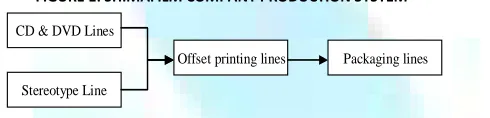
The production of CD and DVD takes place in four different stages with dissimilar production speeds (Figure 1). Orders differ by number and some orders should deliver at precise time (for example at least one day before first day of an exhibition). When a potential order comes, the marketing manager does not know exactly what time it can be delivered. In addition, the production manager does not know which production line should product, which order to do not delay the customer order. We present a decision support system (DSS) being developed to provide managers with an effective tool for this task.
FIGURE 1: SHIMAFILM COMPANY PRODUCTION SYSTEM
Product type and demand structure
The company offers two main kinds of productions, CDs and DVDs. Demand is specified in terms of kind (CD or DVD), quantity, printing (four or 5-color printing) and packaging (bulk, wallet and frame). In addition, the company has a costumer ranking system, so the priorities of orders differ. The customers are classified according to four criteria, which include loyalty, agreed price they can pay, their order size and their limitation in time. This classification leads to different priorities in production orders (normal, high and top priority), so the system changes its parameters and adapts itself related to background of each costumer. The nature of products of this company is that it cannot be produced before finalizing the order and it cannot be stored. Because of the considerable variation in demand, the company management faces different decision-making problems.
Production facility
The production facility consists of six CD lines, seven DVD lines, one stereotype line, four offset printing and three packaging lines, each with its own capacity and production rate. Each line can be run on 1, 2 or 3 shifts operating mode depending on demand and raw material availability levels. The production rate will vary based on the operating mode.
The production is made of one primary type of raw material supplied by three major vendors. As it happens to raw material, the more expensive the quicker it can be supplied.
Planning the production lines
In producing these products, the company faces several decisions in order to take the advantage of the various planning trade-offs. Such decision involves: (1) prioritizing the orders, (2) timing and amount of production of each line in every stage, (3) raw material availability versus cost and (4) the best time for preventive maintenance.
On the other hand, the most important question each customer needs to know is that "what time, exactly, the order is ready?" The delay in delivery of orders leads to customer dissatisfaction so delivering the orders on time is the critical success factor and their core competency of ShimaFilm Company.
THE PROPOSED APPROACH
The proposed approach in this research consists of two main streams. First, one is designing the conceptual model and the second is developing the system.
Conceptual model
The basic problem from a user perspective is the production order. Actually, each production order can usually be decomposed into the production phases that can be individually assigned to different departments inside the firm.
Without considering any other aspect, orders could be in any array. If we denote the production order with i, the production line with j, the production phase
with k, the production type with l and the priority of order with m. So the decision variable xijklm can be introduced. Being M the number of orders to be assigned,
N the number of lines, O the number phases, P the type of product and Q the different priorities the solution space before considering any constraints has the cardinality of M*N* O*P*Q.
Possible choices for j, k, l and m are summarized in table 1, table 2, table 3 and table 4 respectively.
TABLE 1: PRODUCT LINE
j 1 2 … 20 21
meaning 1st CD line 2nd CD line … 2nd packaging 3rd packaging
TABLE 2: PRODUCT PHASE
k 1 2 3 4
meaning Production Sterotyping Printing Packaging
CD & DVD Lines
Stereotype Line
TABLE 3: PRODUCT TYPE
l 1 2
meaning CD DVD
TABLE 4: ORDER PRIORITY
m 1 2 3
meaning Normal priority High priority Top priority
Without considering any priority, orders arrange chronologically. Suppose there is a new order. Depending on previous orders and the priority of the new order, the system should plan the lines so the orders serve in optimum time. Depending on priorities previous production planning may change.
The orders, depending on their types and the stage, should go to correct empty lines. If there is not any empty line, the order should wait in queue. The program should check every order in the queue and find first order with lower priority. Then it should change the sequence of orders according to do the higher priority before lower priority orders. Start and finish time of all the orders should be calculated and renewed. If the new finish day shows a delay more than 10 days of agreed deliver day, then the priority of that order should change to a higher priority. Also by adding new data of each customer to database, the system should adapt itself and learn of current operations. According to production, planning the system should recommend an optimum time for raw material inventory replenishment. In addition, it should plan the preventive maintenance program.
DEVELOPING THE SYSTEM
The way of designing a DSS is different from that of a transaction processing system. A fundamental assumption in the traditional “life cycle” approach is that the requirements can be determined prior to the start of the design and development process (Alavi and Napier, 1984). However, Sprague (Sprague Jr, 1980) stated that DSS designers literally “cannot get to first base” because the decision maker or user cannot define the functional requirements of the DSS in advance. The proposed approach in this article is adaptive design process based on previous researches e.g. (Alavi and Napier, 1984, Keen, 1980) but it has been revised. In an adaptive design approach, the four traditional system development activities (requirements analysis, design, development, and implementation) are combined into a single phase, which is iteratively repeated in a relatively short time (Sprague Jr, 1980). We used a five phase system life cycle based on (McLeod Jr and Schell, 2001) which includes planning, analyzing, designing, implementing and use for each subsystem. In the planning phase, a general description of potential system described. In the next phase, analyzing, a detailed analysis of subsystem defined. Design phase included defining data needs of proposed subsystem. In implementation phase, the proposed subsystem based on data needs gathered in previous phase developed and link between the subsystem and total system made. The last phase was auditing, using and improving each subsystem.
The ADSS
The developed ADSS includes several modules and procedures, each of them allocated to a specific task. Each module is written so that its behavior is entirely specified through its interface. The main modules and subsystems are introduced below:
The graphical user interface module, which is the connection between system and users. The database module that updates the database and knowledgebase.
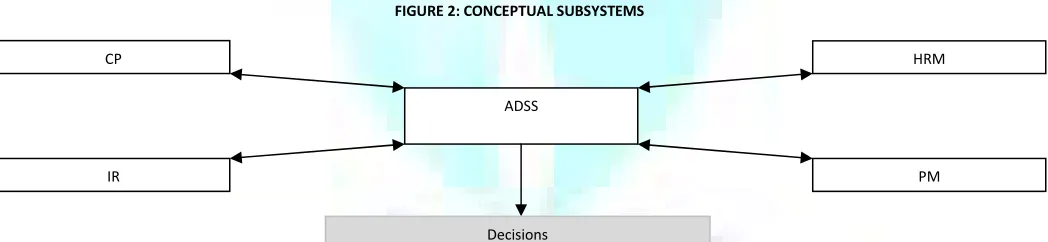
Queuing module, which is a simulation module that calculate the start and finish time of each order (This module is the decision module). Customer Prioritizing (CP) subsystem, which prioritize the customers (and subsequently the orders).
Human Resource Management (HRM) subsystem that plans the overtime work of operators. Inventory Replenishment (IR) subsystem, which suggests optimum time for ordering raw material. Preventive Maintenance (PM) subsystem that seeks for potential idle time of production lines.
The connection of subsystems is shown conceptually in figure 2, in which arrows show that the flow of data and information.
FIGURE 2: CONCEPTUAL SUBSYSTEMS
In the industry of producing CDs and DVDS, each customer should know the time that company can deliver his or her order. Many costumers tolerate an extra pay for taking their order sooner. On the other hand, some of them leave the company and go to competitor firms as the company cannot deliver the order on-time or he may claim against the company for delay.
While a potential customer negotiate with marketing manager, gives some data about the order and its properties. This is the time that marketing manager loads this data to the system, and system can provide different scenarios. The most generic scenario is that the order waits in the queue for its turn. Another one is the cheapest and often the slowest choice. If the customer be in a hurry he can select a top priority order but should pay an extra charge for human resource overtime work and sometimes the delay in other orders. The customer can select between scenarios. After the agreement about the conditions, this is the time for recording the order.
Now the DSS checks for inventory and if needed it can alert the inventory replenishment staffs. In addition, if the orders cannot be done in agreed time, the system plans the overtime of operators.
Before and after implementing this ADSS the satisfaction of two main interest groups, the marketing staffs and costumers, were measured. Statistics showed an 18 percent increase in staff satisfaction but about 40 percent in customer satisfaction.
CONCLUSION
This paper proposed and implemented adaptive design process in combination with traditional system life cycle to develop an ADSS to solve the problem of production planning in a manufacturing firm. It is assumed that under the condition of diversity in the orders, marketing manager does not know when the customer order can be delivered, inventory replenishment staffs do not know when, and how much they should order raw materials. In this occasion an ADSS, which mainly can plan the product lines, was developed.
One extension of the present study is implementing fuzzy logic in prioritizing the orders. Also by global use of internet, it is recommended that such systems designed for using in different production areas worldwide.
ADSS
PM HRM CP
IR
VOLUME NO.2(2012),ISSUE NO.10(OCTOBER) ISSN2231-5756
ACKNOWLEDGMENT
It is a pleasure to thank Mr. Norouzi, managing director of SHIMAFILM Company, who provided company information for our research.
REFERENCES
1. ALAVI, M. & NAPIER, A. H. 1984. An experiment in applying the adaptive design approach to DSS development. Information and Management, 7, 21-28.
2. ANGEHRN, A. A. & JELASSI, T. 1994. DSS research and practice in perspective. Decision support systems, 12, 267-275.
3. ANTHONY, R. N. & ADMINISTRATION, H. U. G. S. O. B. 1965. Planning and control systems: a framework for analysis, Division of Research, Graduate School
of Business Administration, Harvard University.
4. BONCZEK, R. H., HOLSAPPLE, C. W. & WHINSTON, A. B. 1981. Foundations of decision support systems, Academic Press New York.
5. CARICATO, P. & GRIECO, A. 2009. A DSS for production planning focused on customer service and technological aspects. Robotics and Computer-Integrated
Manufacturing, 25, 871-878.
6. CHUANG, T. T. & YADAV, S. B. 1998. The development of an adaptive decision support system1. Decision support systems, 24, 73-87.
7. CLARK, K. B., FUJIMOTO, T. & COOK, A. 1991. Product development performance: Strategy, organization, and management in the world auto industry.
8. DAVILA, T., EPSTEIN, M. J. & SHELTON, R. D. 2006. Making innovation work: How to manage it, measure it, and profit from it, Wharton School Pub.
9. DEUTSCH, J. C. & METELKA, T. 2008. Adaptive DSS–a new kind of DSS. Daywater: An Adaptive Decision Support System for Urban Stormwater
Management, 15.
10. FINLAY, P. & MARTIN, C. 1989. The state of decision support systems: a review. Omega, 17, 525-531.
11. FINLAY, P. N. 1994. Introducing decision support systems, NCC Blackwell.
12. GELDERS, L. F. & VAN WASSENHOVE, L. N. 1981. Production planning: a review. European Journal of Operational Research, 7, 101-110.
13. GORRY, G. A. & MORTON, M. S. S. 1971. A framework for management information systems, Massachusetts Institute of Technology.
14. HENDERSON, J. C. 1987. Finding synergy between decision support systems and expert systems research. Decision Sciences, 18, 333-349.
15. HOLSAPPLE, C. W., PAKATH, R., JACOB, V. S. & ZAVERI, J. S. 1993. Learning by problem processors:: Adaptive decision support systems. Decision support
systems, 10, 85-108.
16. HOLSAPPLE, C. W. & WHINSTON, A. B. 1985. Management support through artificial intelligence, Institute for Research in the Behavioral, Economic, and
Management Sciences.
17. HOLSAPPLE, C. W., WHINSTON, A. B., BENAMATI, J. H. & KEARNS, G. S. 1996. Decision support systems: A knowledge-based approach, West Pub. Co.
18. KEEN, P. G. W. 1980. Adaptive design for DSS. Database, 12, 15-25.
19. KEEN, P. G. W. 1987. Decision support systems: The next decade. DECISION SUPPORT SYST., 3, 253.
20. KEEN, P. G. W. & MORTON, M. S. S. 1978. Decision support systems: an organizational perspective, Addison-Wesley Reading, Mass.
21. LIANG, T. P. 1993. Special section: research in integrating learning capabilities into information systems. Journal of Management Information Systems, 9,
5-15.
22. MCLEOD JR, R. & SCHELL, G. 2001. MANAGEMENT INFORMATION SYSTEMS 8/E.
23. PINEDO, M. L. 2009. Planning and scheduling in manufacturing and services, Springer.
24. POCHET, Y. & WOLSEY, L. A. 2006. Production planning by mixed integer programming, Springer Verlag.
25. POWER, D. J. 2008. Decision support systems: A historical overview. Handbook on Decision Support Systems 1, 121-140.
26. RADERMACHER, F. 1994. Decision support systems: Scope and potential. Decision support systems, 12, 257-265.
27. SETHI, S. P., YAN, H., ZHANG, H. & ZHANG, Q. 2002. Optimal and hierarchical controls in dynamic stochastic manufacturing systems: A survey.
Manufacturing and Service Operations Management, 4, 133-170.
28. SPRAGUE JR, R. H. 1980. A framework for the development of decision support systems. MIS quarterly, 1-26.
29. TURBAN, E. 1993. Decision support and expert systems: management support systems, Prentice Hall PTR Upper Saddle River, NJ, USA.
30. TURBAN, E. & WATKINS, P. R. 1986. Integrating expert systems and decision support systems. MIS quarterly, 121-136.
31. VAN DE PANNE, C. 1965. Linear programming for production planning. The Journal of Industrial Economics, 14, 55-71.
32. WATSON, H. J. & SPRAGUE JR, R. H. The Components of an Architecture for DSS. 1993. Prentice-Hall, Inc., 99-110.
REQUEST FOR FEEDBACK
Dear Readers
At the very outset, International Journal of Research in Commerce, IT and Management (IJRCM)
acknowledges & appreciates your efforts in showing interest in our present issue under your kind perusal.
I would like to request you to supply your critical comments and suggestions about the material published
in this issue as well as on the journal as a whole, on our E-mail i.e.
for further
improvements in the interest of research.
If you have any queries please feel free to contact us on our E-mail
.
I am sure that your feedback and deliberations would make future issues better – a result of our joint
effort.
Looking forward an appropriate consideration.
With sincere regards
Thanking you profoundly
Academically yours
Sd/-