Open Access
Research article
Effect of urbanization on bone mineral density: A Thai
epidemiological study
Chatlert Pongchaiyakul
1,2, Tuan V Nguyen*
2, Vongsvat Kosulwat
3,
Nipa Rojroongwasinkul
3, Somsri Charoenkiatkul
3and Rajata Rajatanavin
4Address: 1Division of Endocrinology, Department of Medicine, Faculty of Medicine, Khon Kaen University, Thailand, 2Bone and Mineral Research Program, Garvan Institute of Medical Research, Sydney, Australia, 3Institute of Nutrition, Salaya Campus, Mahidol University, Thailand and 4Division of Endocrinology, Department of Medicine, Ramathibodi Hospital, Mahidol University, Thailand
Email: Chatlert Pongchaiyakul - [email protected]; Tuan V Nguyen* - [email protected]; Vongsvat Kosulwat - [email protected]; Nipa Rojroongwasinkul - [email protected]; Somsri Charoenkiatkul - [email protected]; Rajata Rajatanavin - [email protected] * Corresponding author
Abstract
Background: The incidence of fractures in rural populations is lower than in urban populations, although the reason for this difference is unclear. This cross-sectional study was designed to examine the difference in bone mineral density (BMD), a primary predictor of fracture risk, between urban and rural Thai populations.
Methods: Femoral neck and lumbar spine BMD was measured by dual-energy X-ray
absorptiometry (GE Lunar, Madison, WI) in 411 urban and 436 rural subjects (340 men and 507 women), aged between 20 and 84 years. Body mass index (BMI) was calculated from weight and height.
Results: After adjusting for age and body weight in an analysis of covariance model, femoral neck BMD in rural men and women was significantly higher than those in urban men and women (P < 0.001), but the difference was not observed at the lumbar spine. After stratifying by sex, age group, and BMI category, the urban-rural difference in femoral neck BMD became more pronounced in men and women aged <50 years and with BMI ≥ 25 kg/m2.
Conclusions: These data suggest that femoral neck BMD in rural men and women was higher than their counterparts in urban areas. This difference could potentially explain part of the urban-rural difference in fracture incidence.
Background
Osteoporosis and its ultimate consequence of low trau-matic fracture pose a major public health problem, because it incurs significant costs and increased risk of mortality [1-3]. Osteoporosis is sometimes considered a "consequence" of modernization, because the incidence of fractures in urban regions is often higher than in rural
regions [4-10], although the underlying reason for this trend is largely unknown.
Measurement of bone mineral density (BMD) is consid-ered the primary predictor of fracture risk [11]. Therefore, it could be hypothesized that the urban-rural difference in fracture incidence is partly explained by the urban-rural
Published: 04 February 2005
BMC Musculoskeletal Disorders 2005, 6:5 doi:10.1186/1471-2474-6-5
Received: 06 July 2004 Accepted: 04 February 2005
This article is available from: http://www.biomedcentral.com/1471-2474/6/5 © 2005 Pongchaiyakul et al; licensee BioMed Central Ltd.
difference in BMD. However, such a difference has not been well documented due to limited data available [12-14]. Some previous studies reported that rural subjects had higher BMD or bone mineral content (BMC) than those urban subjects [12,13], but another study found no such difference [14].
The pace of urbanization in developing countries is more pronounced than in developed countries. Therefore, developing countries are ideal settings for studying the urban-rural difference in BMD. The aim of this study was to examine the difference in BMD between an urban pop-ulation and a rural poppop-ulation in Thailand.
Methods
Setting and subjects
The present study was designed as a cross-sectional, pop-ulation-based investigation. The setting was Bangkok city and Khon Kaen province in Thailand. Bangkok is the cap-ital city with a population of 5.7 million and Khon Kaen is a rural province, located 445 km northeast of Bangkok with a population of 1.8 million and is largely an agricul-tural community. Further details of this study have been described elsewhere [15]
The study included 872 Thai men and women, aged between 20 and 84 years, of whom 422 subjects were from Bangkok and 450 subjects from Khon Kaen. In Khon Kaen, subjects were recruited from 2 villages in the Muang district. There were 14 hamlets in the two villages. In each hamlet, a full list of subjects was obtained, from which 40 subjects were randomly selected by the village's
adminis-trator. The selected subjects were then sent a letter of invi-tation to participating in the study. The response rate was 80.3%. In Bangkok, subjects were recruited via a media campaign, and the sampling technique was similar to the scheme used in Khon Kaen, where subjects were ran-domly selected from 5 districts within the city of Bangkok.
All Khon Kaen subjects were farmers, while Bangkok sub-jects were office workers, factory workers or house work-ers. Twenty-one subjects were excluded from analysis because of bone disorders, chronic diseases, history of tak-ing medications that are deemed to affect calcium and bone metabolism, such as the use of steroids or thyroid hormone; and 4 women were excluded on the basis of pregnancy, lactation, delivery or abortion within the pre-vious 3 months, prepre-vious history of oophorectomy and premature menopause. The study was conducted in accordance with the Helsinski Declaration in 1975 and as revised in 1983 and was approved by the Ethics Commit-tee of Faculty of Medicine Ramathibodi Hospital Mahidol University (Bangkok) and Khon Kaen University (Khon Kaen), and written informed consent was obtained from all subjects.
Measurements
BMD at the femoral neck and lumbar spine (L2-4) in g/
cm2, was measured by dual-energy X-ray absorptiometry
with a Lunar DXP-IQ densitometer (GE Lunar Radiation Corp, Madison, WI, USA). The two study sites (Bangkok and Khon Kaen) used the same model of the DXA machine and the same protocol of measurements. The
radiation dose with this method is < 0.1 µGy. The
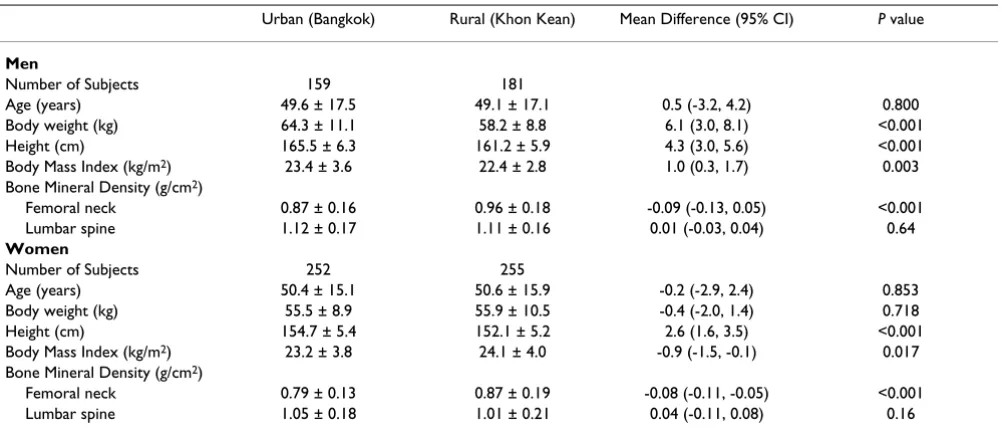
coeffi-Table 1: Characteristics of study subjects
Urban (Bangkok) Rural (Khon Kean) Mean Difference (95% CI) P value
Men
Number of Subjects 159 181
Age (years) 49.6 ± 17.5 49.1 ± 17.1 0.5 (-3.2, 4.2) 0.800
Body weight (kg) 64.3 ± 11.1 58.2 ± 8.8 6.1 (3.0, 8.1) <0.001
Height (cm) 165.5 ± 6.3 161.2 ± 5.9 4.3 (3.0, 5.6) <0.001
Body Mass Index (kg/m2) 23.4 ± 3.6 22.4 ± 2.8 1.0 (0.3, 1.7) 0.003
Bone Mineral Density (g/cm2)
Femoral neck 0.87 ± 0.16 0.96 ± 0.18 -0.09 (-0.13, 0.05) <0.001
Lumbar spine 1.12 ± 0.17 1.11 ± 0.16 0.01 (-0.03, 0.04) 0.64
Women
Number of Subjects 252 255
Age (years) 50.4 ± 15.1 50.6 ± 15.9 -0.2 (-2.9, 2.4) 0.853
Body weight (kg) 55.5 ± 8.9 55.9 ± 10.5 -0.4 (-2.0, 1.4) 0.718
Height (cm) 154.7 ± 5.4 152.1 ± 5.2 2.6 (1.6, 3.5) <0.001
Body Mass Index (kg/m2) 23.2 ± 3.8 24.1 ± 4.0 -0.9 (-1.5, -0.1) 0.017
Bone Mineral Density (g/cm2)
Femoral neck 0.79 ± 0.13 0.87 ± 0.19 -0.08 (-0.11, -0.05) <0.001
Lumbar spine 1.05 ± 0.18 1.01 ± 0.21 0.04 (-0.11, 0.08) 0.16
[image:2.612.56.557.99.316.2]cient of variation of BMD for normal subjects is 0.96 and 0.98 at proximal femur and lumbar spine, respectively.
Body weight (including light indoor clothing) was meas-ured using an electronic balance (accuracy 0.1 kg) and standing height (without shoes) with a standiometer (nearest 0.1 cm). Body mass index (BMI) was calculated as ratio of weight (in kg) over height (in meter squared).
Statistical analyses
Descriptive statistics were computed for each residential region and sex separately. In order to test for difference between urban and rural regions, an analysis of covari-ance (ANCOVA) model was performed. In this model, BMD was treated as outcome variables; age and weight (or
BMI) were treated as covariates; and residence (urban or rural) was the factor. Interactions between age and BMI or age and residence variable were also considered in the model. Estimates of the model parameters were based on the least square method via the SPSS version 9.0 (SPSS, Inc, Chicago).
Results
Demographic characteristics
After excluding 25 subjects, data from 847 subjects (340 men and 507 women) were analysed. There was no signif-icant difference between urban and rural subjects with respect to age or sex distribution. The mean age was 49 and 50 years old in men and women, respectively. How-ever, urban men had higher weight and greater height
Interaction effects of age and residence variable on bone mineral density at the femoral neck in men (A) and women (C), and at the lumbar spine in men (B) and women (D)
Figure 1
Interaction effects of age and residence variable on bone mineral density at the femoral neck in men (A) and women (C), and at the lumbar spine in men (B) and women (D).
F E M O RA L NE CK B M D (g/ cm 2)
- - -, Rural
, Urban
LU M BAR SPIN E BM D ( g/c m 2) F E M R A L NE CK B M D (g/ cm 2)
- - - , Rural
, Urban
- - - , Rural
, Urban
LU M BAR SPIN E BM D ( g/c m 2)
- - - , Rural
, Urban FEMORAL NECK BMD IN MEN
AGE (YEARS) 90 80 70 60 50 40 30 20 10
LUMBAR SPINE BMD IN MEN
AGE (YEARS) 90 80 70 60 50 40 30 20 10
FEMORAL NECK BMD IN WOMEN
AGE (YEARS) 90 80 70 60 50 40 30 20 10
LUMBAR SPINE BMD IN WOMEN
than rural men (P < 0.001), whereas urban women had a
greater height (P < 0.001) but equivalent weight (P =
0.72) compared with rural women (Table 1).
In the entire sample, higher weight was associated with
higher BMD in men (r = 0.13, P = 0.017 for femoral neck,
and r = 0.37, P < 0.001 for lumbar spine) and in women
(r = 0.33, P < 0.001 for femoral neck, and r = 0.33, P <
0.001 for lumbar spine). On the other hand, advancing age was associated with a significant reduced BMD in men
(r = -0.53, P < 0.001 for femoral neck, and r = -0.15, P =
0.007 for lumbar spine) and women (r = -0.63, P < 0.001
for femoral neck, and r = -0.60, P < 0.001 for lumbar
spine).
However, the strength of relationship between age and BMD in urban subjects was less pronounced than in rural subjects, such that rural women had a higher cross-sec-tional "rate of bone loss" than urban women, particularly at the femoral neck. For example, in women, each 5-year increase in age was estimated to associate with a 2.1% and 1.2% decrease in femoral neck BMD for rural and urban group, respectively; in men, the respective rate of decrease
was 1.3% and 0.8%. As a result, among those aged 50+
years, BMD in rural subjects tended to be lower than (or converged to) BMD in urban subjects (Figure).
Urban-rural difference in BMD
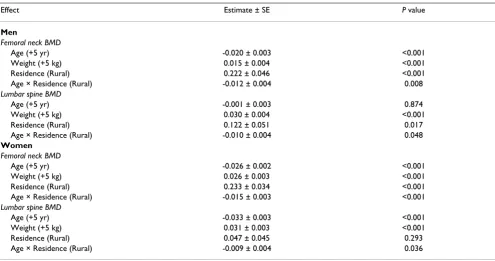
In both sexes, after adjusting for age and weight, BMD in rural individuals was significantly higher than in urban individuals. For instance, femoral neck BMD in rural men
and women was 0.22 and 0.23 g/cm2 significantly higher
(P < 0.001) than in urban men and women, respectively;
but the difference was lower for the lumbar spine BMD
(0.12 g/cm2 in men, P = 0.017 and 0.05 g/cm2 in women,
P = 0.293). The statistical significance of the
age-by-resi-dence interaction term in the ANCOVA model suggested that the urban-rural difference in BMD decreased with advancing age (Table 2).
Further analyses stratified by sex, age group, and BMI cat-egory indicated that the urban-rural difference in femoral neck BMD was more pronounced in the younger age
group (< 50 years old) and higher BMI (≥ 25 kg/m2). This
trend was consistent for men and women. However, for lumbar spine BMD, no significant urban-rural difference was observed in most subgroups, with the exception of
[image:4.612.58.553.108.369.2]women aged ≥ 50 years and BMI < 25 kg/m2 in whom
Table 2: Effects of age, weight and residence on bone mineral density: estimates of parameters of the analysis of covariance stratified by sex and BMD site
Effect Estimate ± SE P value
Men
Femoral neck BMD
Age (+5 yr) -0.020 ± 0.003 <0.001
Weight (+5 kg) 0.015 ± 0.004 <0.001
Residence (Rural) 0.222 ± 0.046 <0.001
Age × Residence (Rural) -0.012 ± 0.004 0.008
Lumbar spine BMD
Age (+5 yr) -0.001 ± 0.003 0.874
Weight (+5 kg) 0.030 ± 0.004 <0.001
Residence (Rural) 0.122 ± 0.051 0.017
Age × Residence (Rural) -0.010 ± 0.004 0.048
Women
Femoral neck BMD
Age (+5 yr) -0.026 ± 0.002 <0.001
Weight (+5 kg) 0.026 ± 0.003 <0.001
Residence (Rural) 0.233 ± 0.034 <0.001
Age × Residence (Rural) -0.015 ± 0.003 <0.001
Lumbar spine BMD
Age (+5 yr) -0.033 ± 0.003 <0.001
Weight (+5 kg) 0.031 ± 0.003 <0.001
Residence (Rural) 0.047 ± 0.045 0.293
Age × Residence (Rural) -0.009 ± 0.004 0.036
SE, Standard Error.
BMD was lower in the rural group compared to the urban group (Table 3).
Discussion
Osteoporosis has emerged as one of the most common diseases in the aged population, and represents one of the most significant public health problems in Asia [2,16,17]. A consistent trend in osteoporosis is that the incidence of fracture is higher in developed countries than in develop-ing countries; and in any country, the incidence is higher in urban than in rural communities [5-11]. While many factors are hypothesized to be responsible for this trend, BMD is thought to be a primary determinant, because it is the most consistent and robust predictor of fracture risk [1,11].
In the present population-based study, we have shown that BMD in a rural Thai population was significantly higher than in urban population, particularly at femoral
[image:5.612.55.558.99.462.2]neck. The magnitude of difference was more than 1 stand-ard deviation which is clinically relevant. It is difficult to compare the present study's results to previous studies' due to differences in methodology and study design. For instance, Sundberg et al [12] reported that lumbar spine BMD (measured by DXA) in rural adolescents was signif-icantly higher than that in urban adolescents, but there was no significant difference in femoral neck BMD. Furthermore, a study from Southern Sweden suggested that bone mass at the forearm (measured by single-pho-ton absorptiomety) in rural population was significantly higher than in urban population and the difference was more pronounced when comparing a true urban popula-tion who had lived their entire life in a city with a true rural population who had never lived in a city [13]. A study from Eastern Poland found that the mean lumbar spine BMD values in every age range were higher in rural population than in urban population, but the difference was not statistically significant [14]. Taken together, these
Table 3: Bone mineral density in urban and rural men and women by age group and body mass index
(a) Lumbar spine BMD
Sex Age (years) BMI (kg/m2) Bone mineral density (g/cm2)
Urban Rural Mean difference and
95% CI
Men < 50 < 25 0.94 ± 0.16 1.05 ± 0.16 -0.11a (-0.16, -0.06)
≥ 25 0.89 ± 0.12 1.04 ± 0.17 -0.15b (-0.26, -0.03)
≥ 50 <25 0.80 ± 0.15 0.86 ± 0.15 -0.06b (-0.12, -0.01)
≥ 25 0.83 ± 0.11 0.92 ± 0.15 -0.09b (-0.17, -0.01)
Women < 50 < 25 0.85 ± 0.11 0.97 ± 0.13 -0.12a (-0.16, -0.09)
≥ 25 0.92 ± 0.11 1.04 ± 0.13 -0.12b (-0.20, -0.05)
≥ 50 <25 0.70 ± 0.11 0.71 ± 0.15 -0.01 (-0.05, 0.03)
≥ 25 0.76 ± 0.11 0.82 ± 0.15 -0.06b (-0.11, -0.01)
(b) Femoral neck BMD
Sex Age (years) BMI (kg/m2) Bone mineral density (g/cm2)
Urban Rural Mean difference and
95% CI
Men < 50 < 25 1.12 ± 0.14 1.13 ± 0.15 -0.01 (-0.06, 0.04)
≥ 25 1.11 ± 0.09 1.14 ± 0.16 -0.03 (-0.13, 0.08)
≥ 50 < 25 1.05 ± 0.18 1.06 ± 0.16 -0.01 (-0.07, 0.05)
≥ 25 1.21 ± 0.19 1.19 ± 0.20 0.02 (-0.11, 0.14)
Women < 50 < 25 1.14 ± 0.13 1.13 ± 0.14 0.01 (-0.04, 0.04)
≥ 25 1.21 ± 0.15 1.15 ± 0.13 0.06 (-0.02, 0.15)
≥ 50 < 25 0.92 ± 0.14 0.83 ± 0.19 0.09b (0.03, 0.14)
≥ 25 1.02 ± 0.17 0.97 ± 0.21 0.05 (-0.01, 0.13)
results including ours, suggest that rural subjects tend to have higher BMD than in urban subjects.
The present study's data and design can not elucidate any underlying factors that are responsible for the difference but some propositions could be put forward. The urban-rural difference in femoral neck BMD could be due to the difference in the peak of bone mass levels. In this study, both rural men and women aged between 20 and 30 years had significantly higher BMD than urban counterparts. For example, young rural men and women had
signifi-cantly higher than urban subjects (1.17 vs. 1.03 g/cm2,
[95% CI: 0.07–0.22] in men and 1.02 vs. 0.86 g/cm2,
[95% CI: 0.10–0.22] in women). This finding was par-tially consistent with a previous study [12] and could be explain the fact that the urban-rural difference was mainly found in younger age groups.
This study also found that the urban-rural difference in femoral neck BMD decreased with advancing age. The dif-ference may be attributed to the difdif-ference in physical activity between the two populations. Rural populations were generally more physically active than urban popula-tions [18,19]. The rural population in this study was mainly farmers who spend most of their time in rice field long hours of physical activity.
However, the difference was sex- and site- dependent. The difference in femoral neck BMD was much more pro-nounced than that in lumbar spine and this was more transparent before the age of 50 in men and before the menopause in women. After this age the difference was no longer significant. The data suggested that the rate of bone loss in rural population may be more rapid than in urban population. However, this finding was not consistent with a previous study which demonstrated that the rate of bone loss was higher in urban population compared with rural population [13]. The reason(s) for the higher rate of bone loss in rural population in this study is unknown, but low dietary calcium intake could be a contributory factor [20-22].
The present findings must be interpreted in the context of a number of potential strengths and weaknesses. The data
were obtained from a large and well-defined rural vs.
urban area, which allowed the rural and urban difference to be reliably delineated. The study subjects were Thai, among whom, cultural backgrounds and environmental living conditions are different from Western populations. Thus care should be taken when extrapolating these results to other populations.
Conclusions
These data have demonstrated that femoral neck BMD in rural men and women was higher than their counterparts
in urban areas. This difference could potentially explain part of the urban-rural difference in fracture incidence.
List of abbreviations
All abbreviations are defined in the text.
Competing interests
The author(s) declare that they have no competing interests.
Authors' contributions
Chatlert Pongchaiyakul had an active role in the conduct of this study, obtained and analysed data, and drafted the manuscript. Tuan V Nguyen was involved in the concep-tual discussion of this study, and had an active role in data analysis, drafting of the manuscript. Vongsvat Kosulwat, Nipa Rojroongwasinkul, and Somsri Charoenkiatkul had an active role in the study design, and was involved in the conceptual discussion. Rajata Rajatanavin conducted and established this study. All authors contributed to the last version of the manuscript.
Acknowledgments
The study was supported by Thailand Research Fund. The first author would like to acknowledge the Faculty of Medicine, Khon Kaen University for grant to Garvan Institute of Medical Research. We also thank Mrs. Ratchanee Chotmongkol, RN and Mrs. Choowong Pongchaiyakul, RN for data collection. TVN is supported by a Australian National Health and Med-ical Research Council grant.
References
1. Cummings SR, Melton LJ: Epidemiology and outcomes of oste-oporotic fractures.Lancet 2002, 359:1761-1767.
2. Cooper C, Campion G, Melton LJ 3rd: Hip fractures in the eld-erly: a world-wide projection.Osteoporos Int 1992, 2:285-289. 3. Center JR, Nguyen TV, Schneider D, Sambrook PN, Eisman JA:
Mor-tality after all major types of osteoporotic fracture in men and women: an observational study.Lancet 1999, 353:878-882. 4. Sanders KM, Nicholson GC, Ugoni AM, Seeman E, Pasco JA, Kotow-icz MA: Fracture rates lower in rural than urban communi-ties: the Geelong Osteoporosis Study.J Epidemiol Community Health 2002, 56:466-470.
5. Kaastad TS, Meyer HE, Falch JA: Incidence of hip fracture in Oslo, Norway: differences within the city.Bone 1998, 22:175-178. 6. Madhok R, Melton LJ 3rd, Atkinson EJ, O'Fallon WM, Lewallen DG:
Urban vs. rural increase in hip fracture incidence. Age and sex of 901 cases 1980–89 in Olmsted County, U.S.A.Acta Orthop Scand 1993, 64:543-548.
7. Falch JA, Kaastad TS, Bohler G, Espeland J, Sundsvold OJ: Secular increase and geographical differences in hip fracture inci-dence in Norway.Bone 1993, 14:643-645.
8. Norton R, Yee T, Rodgers A, Gray H, MacMahon S: Regional vari-ation in the incidence of hip fracture in New Zealand.N Z Med J 1997, 110:78-80.
9. Jonsson B, Gardsell P, Johnell O, Redlund-Johnell I, Sernbo I: Differ-ences in fracture pattern between an urban and a rural pop-ulation: a comparative population-based study in Southern Sweden.Osteoporos Int 1992, 2:269-73.
10. Mannius S, Mellstrom D, Oden A, Rundgren A, Zetterberg C: Inci-dence of hip fracture in Western Sweden 1974–1982. Com-parison of rural and urban populations.Acta Orthop Scand 1987,
58:38-42.
11. Kanis JA: Diagnosis of osteoporosis and assessment of frac-ture risk.Lancet 2002, 359:1929-1936.
12. Sundberg M, Duppe H, Gardsell P, Johnell O, Ornstein E, Sernbo I:
Publish with BioMed Central and every scientist can read your work free of charge
"BioMed Central will be the most significant development for disseminating the results of biomedical researc h in our lifetime."
Sir Paul Nurse, Cancer Research UK
Your research papers will be:
available free of charge to the entire biomedical community
peer reviewed and published immediately upon acceptance
cited in PubMed and archived on PubMed Central
yours — you keep the copyright
Submit your manuscript here:
http://www.biomedcentral.com/info/publishing_adv.asp
BioMedcentral
area – a population-based study of 246 subjects in southern Sweden.Acta Orthop Scand 1997, 68:456-460.
13. Gärdsell P, Johnell O, Nilsson BE, Sernbo I: Bone mass in an urban and a rural population: a comparative, population-based study in Southern Sweden.J Bone Miner Res 1991, 6:67-75. 14. Filip RS, Zagorski J: Bone mineral density and osteoporosis in
rural and urban women. Epidemiological study of the Lublin region (Eastern Poland).Ann Agric Environ Med 2001, 8:221-226. 15. Pongchaiyakul C, Nguyen TV, Kosulwat V, Rojroongwasinkul N,
Cha-roenkiatkul S, Eisman JA, Rajatanavin R: Effects of physical activity and dietary calcium intake on bone mineral density and oste-oporosis risk in a rural Thai population.Osteoporos Int in press. 2004 Jun 3
16. Lau EM, Lee JK, Suriwongpaisal P, Saw SM, Das De S, Khir A, Torralba T, Sham A, Sambrook P: The incidence of hip fracture in four Asian countries: the Asian Osteoporosis Study (AOS). Oste-oporos Int 2001, 12:239-243.
17. Lau EM: Epidemiology of osteoporosis. Best Pract Res Clin Rheumatol 2001, 15:335-344.
18. Jonsson B, Gardsell P, Johnell O, Sernbo I, Gullberg B: Life-style and different fracture prevalence: a cross-sectional comparative population-based study.Calcif Tissue Int 1993, 52:425-433. 19. Ringsberg KA, Gardsell P, Johnell O, Josefsson PO, Obrant KJ: The
impact of long-term moderate physical activity on functional performance, bone mineral density and fracture incidence in elderly women.Gerontology 2001, 47:15-20.
20. Marshall TA, Stumbo PJ, Warren JJ, Xie XJ: Inadequate nutrient intakes are common and are associated with low diet variety in rural, community-dwelling elderly. J Nutr 2001,
131:2192-2196.
21. Gaddi A, Cicero AF, Wani FO, Dormi A, Pasquarelli V, D'Addato S:
The realization of a project aimed at reducing the plasmatic lipid level in a large Italian population improves the mean calcium daily intake: the Brisighella Study.Eur J Clin Nutr 2001,
55:97-106.
22. Pettifor JM, Moodley GP: Appendicular bone mass in children with a high prevalence of low dietary calcium intakes.J Bone Miner Res 1997, 12:1824-1832.
Pre-publication history
The pre-publication history for this paper can be accessed here: