Education Corruption, Reform, and
Growth: Case of Post-Soviet Russia
Osipian, Ararat
Vanderbilt University
21 September 2009
Online at
https://mpra.ub.uni-muenchen.de/17447/
Vanderbilt University
Education Corruption, Reform, and Growth:
Case of Post-Soviet Russia
Ararat L. Osipian
[email protected] [email protected]
Department of Leadership, Policy, and Organizations Peabody College of Education
Vanderbilt University Peabody GPC #414 230 Appleton Place Nashville, TN 37203-5721
Ph: (615)322-8000 Fax: (615)3432391
Nashville, TN - 2009
Education Corruption, Reform, and Growth:
Case of Post-Soviet Russia
This paper investigates a possible impact of education corruption on economic growth in Russia. It argues that high levels of education corruption may harm total factor productivity in the long run, primarily through lowering the level of human capital and slowing down the pace of its accumulation. Ethical standards learned in the process of training in universities can also affect the standards of practice in different professions. The growing level of productivity is not likely to reduce education corruption in the short run, but can eventually lead to implementation of higher ethical standards in the education sector.
Key words: corruption, education, growth, reform, Russia, transition
Introduction
The impact of education corruption on economic growth remains in the realm of
speculations and some theorizing. There is a lot of research done on human capital, education,
economic development, and growth. There is also a substantial bloc of literature on corruption
and economic development and growth. This bloc of scholarly literature, however, is represented
mostly by theoretical works. Few empirical works are produced so far, primarily due to the lack
of data. Reliability and validity of the existing scarce data on governance and corruption also
remains an issue. We target education corruption, human capital, and growth in Russia and offer
examples from other New Independent States (NIS). More specifically, we look at corruption in
education and at its possible implications for economic growth in Russia. We consider specific
aspects of education corruption and its probable impact on growth. These aspects include
interactions between education corruption and total factor productivity and interactions between
corruption and structure of the national economy. Education corruption may be harmful for
productivity while higher productivity may reduce education corruption. Education corruption
may to a certain extent define or influence the structure of the national economy. Corruption in
the education sector may be reduced through the changes in the economic structure. All of these
are rather mere speculations or hypotheses to be researched than definitive statements. The areas
to be touched upon are the education sector, labor market, level of concentration of property
rights, and distribution of property rights on the means of production.
Corruption and economic growth
Corruption is a growing problem in Russia and receives more attention now than ever
in terms of corruption. The surveys conducted by Transparency International and by the World
Bank picture Russia as a very corrupt country. According to the Corruption perceptions index
(CPI), developed and calculated annually by Transparency International, Russia was 79rd out of
91 countries surveyed in 2001. In 2008, Russia was in 147th place with the score of 2.1, out of
180 countries, sharing the neighborhood with such countries, as Kenya and Syria (Transparency
International, 2008). CPI score relates to perceptions of the degree of corruption as seen by
business people and country analysts, and ranges between 10 (highly clean) and 0 (highly
corrupt). The lower the numerical value of the country’s score, the higher is the level of
corruption in the country.
All-Russian Center for Research of Public Opinion (VCIOM) conducted a study of
corruption perceptions among Russians at the end of 2008. 30 percent of the respondents marked
the level of corruption as very high, while another 44 percent as high. 19 percent considered it as
average and only 1 percent as low. The most corrupt in people’s minds are traffic police (33
percent), local authorities (28 percent), police (26 percent), healthcare (16 percent), and
education (15 percent). 52 percent of the respondents had experiences of giving money or gifts to
medical professionals while 36 percent made informal payments to educators (Leonidov, 2009).
According to the data, presented by the Attorney General, major corruptioners in Russia are
college faculty, school teachers, policemen, and doctors, but not state bureaucrats. The number
of corrupt civil servants does not correlate directly with their total number or the level of region’s
economic development. The number of reported cases of corruption in Russia continues to grow.
There were 12.5 thousand cases of bribery reported in 2008. It is a 7.7 percent increase as
compared to 2007. The number of recorded abuses of public office in 2008 has reached 43.5
has declined 23.8 percent, down to 1712 cases. Police investigators turned to courts 27.4 percent
less cases of corruption in 2008, than they did in 2007. For investigators of the prosecutor’s
department this decline is equal to 4.5 percent (Newsru.com, May 5, 2009). Despite all the claims
of the authorities about the uncompromising fight against corruption, the real numbers show
opposite trends.
Over 80 percent of all of those sentenced for bribery received less than $1000 in illicit
payments. There are only 189 court sentences handed in 2008 to bureaucrats of all levels,
including federal, regional, and municipal level bureaucrats. The categories are prosecuted for
bribe receiving. The majority of those prosecuted for bribe giving consists of drivers. They
rutinely pay bribes to the traffic police officers. However, when the police officers are on watch
by their own controllers, they may arrest a driver for the offer of a bribe and send him/her to
court. Such a statistics is very surprising since one would expect businessmen constitute the bulk
of those who pay pribes and, under the effective anti-corruption campaign, prosecuted for bribe
giving. Apparently, it is not the case. Chair of the non-governmental organization against
corruption, Kirill Kabanov, says that the government only catches thsoe corruptioners who are
easy to catch. He also believes that more than half of all the court cases against corruptioners are
a result of mere provocation. Street level civil servants are a major target for anti-corruption
campaigns, not even street level bureaucrats (Kornya, Holmogorova, and Nikol’skij, 2009).
Rose-Ackerman (1978) considers corruption as an “allocative mechanism” for scarce
resources. The state monopolizes certain allocative functions, be it permissions and licenses, or
access to public services. State officials’ profiteering is based on abuse of their discretionary
powers and monopolistic positions. Referring to Klitgaard (1988, p. 23) Gong states that
or when the client corrupts the agent “if he or she (client) perceives that the likely net benefits
from doing so outweigh the likely net costs” (Gong, 2002, p. 88) According to the
“grease-the-wheels” concept of corruption, it helps overcome bureaucratic obstacles that remain from the
previous regime. This may be especially true for Russia during the transition period of 1990s.
There are some methodologies that allow approaching the issue of corruption and measuring it
(see, for instance, Bellver and Kaufmann, 2005; Besançon, 2003; Kaufmann and Kraay, 2003;
Osipian, 2007a), including legalistic (Kaufmann and Vicente, 2005; Osipian, 2009e; Zimring and
Johnson, 2005) and economic ones (Kaufmann et.al., 2000; Rose-Ackerman, 1978, 1999).
Lancaster and Montinola (1997) suggest that studies of corruption should assess rival
explanations.
Svensson (2005) notes that it might be true higher wages for bureaucrats reduce
corruption, but there is not enough evidence to support it (pp. 32-33). According to the data
analysis, presented by Shleifer and Treisman (2003, pp. 27-28), administrative corruption is very
high in poor countries of the former Soviet Union, such as Uzbekistan, Armenia, and Azerbaijan,
lower in the Russian Federation, Bulgaria, and Lithuania, and even lower in relatively wealthy
Hungary and Slovenia. Individuals’ perceptions about corruption put Russia lower than
Argentina, Brazil, Romania, or Lithuania. Svensson (2005) notes that “All of the countries with
the highest levels of corruption are developing or transition countries. Strikingly, many are
governed, or have recently been governed, by socialist governments.” (p. 24) Referring to the
works of Lipset (1960), Demsetz (1967), and Glaeser, La Porta, Lopez-de-Silanes and Schleifer
(2004), the author points out that higher per capita income and higher level of human capital
The Ministry of Justice is composing a list of most “corruptible” public offices, first of all
those with high discretionary authorities over big funds and projects. These offices will be taken
under special control. The Minister of Justice, Aleksandr Konovalov, emphasises transparency
and accountability. He also suggests new organizational technologies and electronic
decision-making (Savel’eva, 2008). Russian Prime Minister, Vladimir Putin, signed the order About the
methodology of conducting an expert examination of the projects of laws and other legal
documents with the goal of identifying sections and regulations that have a potential to facilitate
corruption (Putin, 2009). Despite governmental efforts, 58 percent of Russians think that it is
impossible to annihilate corruption. The major causes of corruption are greediness and low moral
standards (44 percent of the respondents) and ineffective government and legislation (34 percent
of the respondents). Only 18 percent of Russians see themselves as the cause of corruption due to
their low legal culture and legal nihilism (Newsru.com, April 28, 2009).
The Minister of The Interior, Rashid Nurgaliev, uses some very vague estimates, based
on surveys and other small scale sociological studies, to report the annual damage from
corruption on a scale of 40 billion rubles, or around $1.5 billion. This sum is not that large for a
country with the annual GDP of around $2 trillion, as measured in the nominal USD. Over 56
percent of businessmen reported paying bribes to state bureaucrats. According to the
representative survey, conducted by the New Russia Barometer in 2007, 86 percent of Russians
believe that the police itself are all corrupt from top to down, even though only 5 percent of the
respondents acknowledged facing corruption in police (Samofalova, 2008).
The National Anticorruption Committee estimates the total corruption market at $300
billion. 40 to 60 percent of this total consists of kickbacks paid by businesses to public
2009). The numbers are impressive, but the sources and credibility of such estimates are not
clear. Russian President Dmitry Medvedev took on corruption seriously: bureaucrats who hide
their incomes should be fired immediately (Newsru.com, March 10, 2009). However, Russians
are not very interested in their public officials’ incomes, 52 percent of the respondents
(Newsru.com, April 14, 2009). People are not interested in the income declarations of particular
bureaucrats, but 50 percent approve the idea of their publication. 26 percent think that
bureaucrats will be able to get around the reporting of their income while 15 percent consider
such measures as a political populism on the side of the government (Nikol’skij, 2009).
Russians are not very eager to report cases of corruption: 15 percent of the respondents
did not know who to report, 29 percent would not do this, 22 percent would report to the police,
7 percent – to the local authorities, 7 percent – to nongovernmental organizations, 10 percent
would turn to the media, and 11 percent would tell it to the president personally. In an unlikely
hypothetical case of the disappearance of corruption, 49 percent of Russians expect to solve their
problems easier, while 12 percent expect more difficulties. 29 percent will not expect any
changes while 10 percent could not imagine a life without corruption (Mironova, 2009).
Quantitatively, corruption is a black box. No one knows what share of all the corrupt activities
are covered in the official statistics. An increase in the number of prosecuted corruptioners may
indicate a success in the anti-corruption campaign or an increase of the total number of
corruptioners involved in illicit activities. The same is true with the decrease in these numbers.
The level of sentenced corruptioners is not a good indicator for any measure of corruption or
anti-corruption. Police itself found 25 percent less corrupt officers among its people in 2008,
standards of integrity in the police. Rather, it is a result of the less active work of the Internal
Security Department (Newsru.com, May 5, 2009).
One of the arguments used to support the idea of sharp and significant output decline in
the countries of the former Soviet Bloc is that the high level of corruption in transition
economies has a negative impact on production and productivity. We will turn to statistical data
to test such a statement. The level of business-related corruption in the Commonwealth of
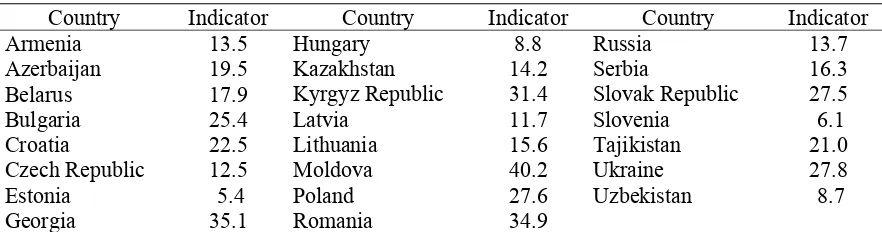
Independent States and Central and Eastern Europe in 2002 is presented in Table 1. The percent
of managers who consider corruption the major obstacle for the business and entrepreneurial
activities is considered an indicator of the negative impact of corruption on production. The data
[image:10.612.75.516.444.560.2]is obtained during the survey conducted in the NIS and CEE in 2003.
Table 1
Business-related corruption in NIS and CEE, 2002*
Country Indicator Country Indicator Country Indicator Armenia Azerbaijan Belarus Bulgaria Croatia Czech Republic Estonia Georgia 13.5 19.5 17.9 25.4 22.5 12.5 5.4 35.1 Hungary Kazakhstan Kyrgyz Republic Latvia Lithuania Moldova Poland Romania 8.8 14.2 31.4 11.7 15.6 40.2 27.6 34.9 Russia Serbia Slovak Republic Slovenia Tajikistan Ukraine Uzbekistan 13.7 16.3 27.5 6.1 21.0 27.8 8.7
Source: World Development Indicators. Retrieved from the database in August 10, 2006. Cited from Osipian (2009j, p. 112).
* Data for Kyrgyz Republic, Moldova, Poland, Tajikistan, and Uzbekistan are for 2003.
According to the data presented in Table 1, the level of corruption in business and the
relationship between business and state in Russia is at the lower end of the scale for the region
corruption is relatively low as compared to the region’s average. Needless to say, data on
corruption are always to a large extent subjective, partial, and biased. Nevertheless, they should
be taken into consideration when there is a lack of better sources of information.
The issue of slowing down economic growth due to an increase in corruption is still open.
While a positive correlation between the high level of corruption and output decline has been
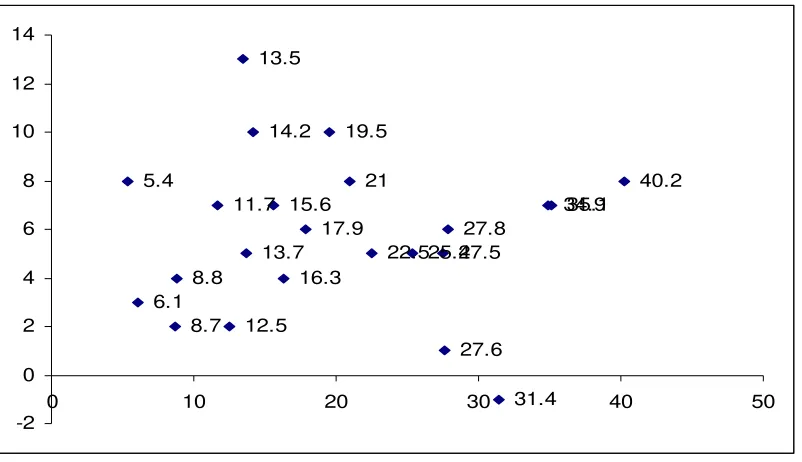
proven theoretically, strong systematic empirical evidence has yet to be shown. Correlation of
the GDP per capita growth and estimates of corruption made by the businessmen in the NIS and
CEE countries of the former socialist bloc in 2002 is presented as a diagram in Figure 1.
13.5 19.5 17.9 25.4 22.5 12.5 5.4 35.1 8.8 14.2 31.4 11.7 15.6 40.2 27.6 34.9 13.7 16.3 27.5 6.1 21 27.8 8.7 -2 0 2 4 6 8 10 12 14
[image:11.612.81.482.336.567.2]0 10 20 30 40 50
Figure 1. Correlation of the GDP per capita growth and estimates of corruption made by
the businessmen in the NIS and CEE countries of the former Socialist Bloc, 2002.
The diagram shows that there is no clear evidence of a positive correlation between the
growth of 8 percent in 2002 was possible with the level of corruption marked at 40.2. In Slovenia
during the same year GDP per capita growth was only 3 percent, with the level of corruption at
6.1. In Russia, GDP per capita growth of around 5 percent in 2002 coexisted with the level of
corruption of 13.7, while in Ukraine the same level of GDP per capita growth related to the level
of corruption of 27.5 on the offered scale.
Education corruption in Russia
Definition of education corruption includes the abuse of authority for material gain
(Anechiarico & Jacobs, 1995a, 1995b). Sayed and Bruce (1998) and Waite and Allen (2003)
present a broad social approach to define corruption. Petrov and Temple (2004) apply a narrow
definition of corruption that regards corruption as such only if it implies illegality. Corruption in
higher education may be defined as a system of informal relations established to regulate
unsanctioned access to material and nonmaterial assets through abuse of the office of public or
corporate trust (Osipian, 2007a, p. 315). Contrary to the common belief, transparency in the area
of education corruption in Russia is of a high level and cases of corruption are reported in the
media (Osipian, 2007e, 2008f).
Russian secondary and higher education suffers of corruption, as do national educational
sectors of other former Soviet republics (Osipian, 2007d, 2008c, 2009i; Round and Rodgers,
2009). The Department of Economic Security of the Ministry of the Interior conducted the
annual operation “Education 2008” with the following results: almost 200 university faculty and
administrators are charged with embezzlement and bribery. There are 217 criminal investigations
launched out of 3.5 thousand crimes registered. Of those 3.5 thousand crimes almost 600 are
members are prosecuted and sentenced for bribery, but often they receive terms on parole. They
are considered as no threat to the society, since their crimes are non-violent. A faculty member in
Perm State Agricultural Academy was sentenced to three years and six month on parole for
bribery. He set a price of $100 for the examination and managed to collect $2500 in bribes from
25 students in July of 2008. The court also banned the faculty from teaching for three years
(Ivanova, 2009). Two faculty members were arrested for bribery in Oil and Gas University in
Tyumen, a large city in Siberia that stands on oil. In first case it was an extortion of only $40 in
exchange for a positve examination grade. In the second case it was a sum of $1000 collected
from several students (Leonidov, 2009).
In the Russian system of higher education, the corrupt relations in the education sector
are quite complex, because the government comes into play as the major financier and regulator
of secondary and higher education. The system is highly centralized with both public and private
colleges being regulated by the government. This means that a case of embezzlement or misuse
of college property by the college administrator constitutes an act of corruption by way of
abusing public trust. The public through the government entrusts the college administration with
proper management and financial operations. In case of a corrupt faculty, the abuse of public
trust occurs not only in terms of assigning a higher grade with no academic merit, but in terms of
misusing governmental financing, since half of college students are funded with Russian
taxpayers’ money. At this stage, there is no need for the leading role of the government in higher
education. There are enough places in universities to accommodate all those who want to receive
higher education and to meet the demand of business for qualified workforce. It is assumed that
private colleges can provide higher education services more effectively and efficiently. This
system operate more effectively and efficiently than do public ones. There is no need to collect
and redistribute values through the tax system, governmental budget, and access regulations.
Nevertheless, the government continues to own and regulate public universities and regulate
[image:14.612.71.545.275.626.2]private colleges.
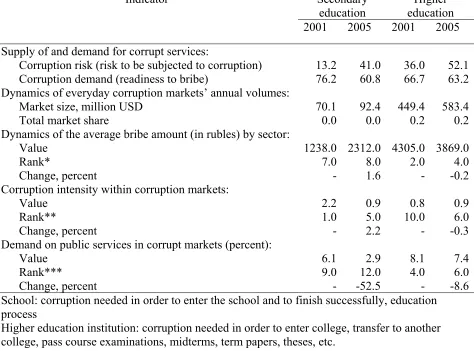
Table 2
Everyday corruption market characteristics in the Russian education sector, 2001 and 2005
Indicator Secondary education
Higher education 2001 2005 2001 2005
Supply of and demand for corrupt services:
Corruption risk (risk to be subjected to corruption) 13.2 41.0 36.0 52.1 Corruption demand (readiness to bribe) 76.2 60.8 66.7 63.2 Dynamics of everyday corruption markets’ annual volumes:
Market size, million USD 70.1 92.4 449.4 583.4
Total market share 0.0 0.0 0.2 0.2
Dynamics of the average bribe amount (in rubles) by sector:
Value 1238.0 2312.0 4305.0 3869.0
Rank* 7.0 8.0 2.0 4.0
Change, percent - 1.6 - -0.2
Corruption intensity within corruption markets:
Value 2.2 0.9 0.8 0.9
Rank** 1.0 5.0 10.0 6.0
Change, percent - 2.2 - -0.3
Demand on public services in corrupt markets (percent):
Value 6.1 2.9 8.1 7.4
Rank*** 9.0 12.0 4.0 6.0
Change, percent - -52.5 - -8.6
School: corruption needed in order to enter the school and to finish successfully, education process
Higher education institution: corruption needed in order to enter college, transfer to another college, pass course examinations, midterms, term papers, theses, etc.
* The rank 1 is assigned to the sector based on the largest average bribe
** The rank 1 is assigned to the market with the most intensified corruption activities
*** The rank 1 is assigned to the segment of the public services market with the highest demand Source: Composed from: Corruption Process in Russia: Level, Structure, Trends. In G. Satarov (Ed.). Diagnostics of Corruption in Russia: 2001-2005. INDEM
Table 2 presents data on everyday corruption market characteristics in the Russian education
sector in 2001 and 2005. According to the data, the demand on bribes from the side of educators is
growing, as does average size of a bribe. According to the survey, conducted by the Center for
Public Opinion Research in 2004, diminished accessibility to free education and medical help is
pointed out by 23 percent of Russians as the greatest problem, 55 percent consider bureaucracy
and corruption among the present political and economic elite as the major contributing factor
that prevents Russia from getting out of socio-economic crisis and achieving economic
prosperity (Kofanova & Petukhov, 2006, p. 24).
The increasing gap between pay rates in private and public sectors of the economy urges
public employees to seek other sources of income (Gorodnichenko and Sabirianova, 2006).
Along with the health services industry, higher education in Russia has become one of the
industries, most affected by corruption. Surprisingly, 54 percent of Russians believe that harsher
punishment for bribery may stop faculty members from accepting or extorting bribes
(Agranovich, 2008). A rapid development of higher education, its partial privatization and
increasing flow of financial resources have created a base for corruption. University faculty
accept bribes and numerous other illicit benefits and utilizing their privileged position and
control over the access to higher education.
The higher education sector cannot stay outside the mainstream of development and has
to operate in changing socio-economic conditions. Accordingly, corruption becomes part of the
education sector, as it is of other sectors of the economy and the government. The hypothetical
evolution of corrupt hierarchies in universities points to changing internal structures shaped by
external influences of the market and the government (Osipian, 2007b, 2008b). The ruling
(Darden, 2008; Osipian, 2008e). The nexus of political graft and education corruption that may
be observed in the former Soviet republics includes collusion, compliance, and control (Osipian,
2008a). Underpaid educators are more susceptible to corruption. The regime uses educators’
need for illicit benefits to create the “feed from the service” scheme and to control the agenda in
universities (Osipian, 2007d, 2009a). The regime might be interested in maintaining corruption
in education and preserving its functions of financier and regulator of access.
Corruption in education is more detrimental than typical bureaucratic corruption.
Corruption in higher education is detrimental to the society for at least three major reasons. First,
it has a negative impact on the economy and society due to lowering the system’s efficiency, as
does bureaucratic corruption. Second, as distinct from ordinary bureaucratic corruption,
corruption in higher education reduces total social welfare of the society because of its negative
effect on the quality of educational programs and qualifications of college graduates. Finally,
corruption in education eats away social cohesion, because students learn not only their subject
matter, but also pervasive ways and practices of corruption. Corruption in higher education
negatively affects access, quality, and equity. Contrary to expectations, development of a
substantial private sector in higher education in Russia leads to an increase in corruption. Private
universities are as corrupt as their public counterparts, which proves that not only public officials
are susceptible to corruption.
There are around two million licensed places for freshmen in around 1500 colleges and
universities in Russia, of which there are 80 percent in public colleges and 20 percent in private
ones. In addition, there are numerous public community colleges and vocational schools. The
projections point out that the number of places in universities in Russia, licensed and accredited
degrees, including distance learning, correspondence programs, re-training, etc. Almost half of
all the students in public colleges and universities are funded by the government. The admissions
to governmentally funded places are corrupt. Course grades can also be bought from faculty
members. Presence of such problems in the nation’s educational system follows from the
numerous media reports (Osipian, 2008a, 2008f). Doctoral education is also not free of
corruption, and doctoral dissertations and degrees are available for sale (Osipian, 2009f, 2010).
Corruption in admissions to governmentally funded places in public universities and
bribery in academic process may be most explicit, but certainly not the only forms of corruption
in academia. Forms of corruption, typical for just about any industry, are characteristic of
education industry as well. Embezzlement of public funds is committed up the hierarchical
ladder, from student dormitory administrators to heads of colleges and universities (Novaya
gazeta, May 14, 2009). Facts of embezzlement, fraud, gross waste, misallocation of resources,
and other corrupt activities are found in colleges and universities throughout the country.
Bribery, embezzlement, and fraud are not the only dominating forms of corruption in
higher education. Logrolling in academia is a typical form of latent corruption. Logrolling, as a
form of corruption, may be widespread in Russian universities. A faculty member in the school
of journalism can guarantee the admission of a protégé from the school of foreign languages, and
faculty member in the school of journalism can admit his/her protégé in exchange. This
exchange of favors can be split in time. Placement in a university may be swapped for a job
placement. Such an illicit practice in education can be defined as a corrupt education swap.
Corrupt education swap is a form of education corruption that may be more prevalent than
monetary transactions, and more preferred too, for the safety reasons. Corrupt education swap
in universities and even if identified, they are still difficult to prove and argue their illegality. In
economic sense, however, corrupt education and placement swaps are not less harmful to the
economy and society than education corruption where bribes are paid in cash.
Impact of education corruption on economic growth
There is no direct evidence for Russia that corruption in higher education has a
significant negative impact on the national economy or the rate of growth. According to
Klitgaard (1986), elitism and lack of meritocracy in access to higher education and leadership
positions in some developing countries lead to a decrease in GNP. New empirical studies are
needed to reflect the modern day realities. Only theory and some comparisons on general
developmental trends may point to disadvantages that a national economy experiences due to a
high level corruption in its educational sector. The discussion presented above offers a prediction
of possible negative impact in the long run, when those with relatively low level of human
capital will occupy places of more capable individuals. But this may be compensated with the
years of working experience.
Corruption is often perceived as a form of rent-seeking behavior. Rent in this case is
extracted from the monopolistic position, be it a bureaucratic office or a university professorship.
The rent-seeking behavior in the Russian society is perceived as a norm. Public officials,
bureaucrats, and public servants attempt to transform their access to material and non-material
assets into personal benefits. Educators act in a similar manner. Rectors of public universities
rent out public property, including academic and non-academic facilities and land, to businesses
in which they often have a share. University faculty sell academic degrees by abusing their
amny other societies, the rent-seeking behavior in Russia extends far beyond state bureaucracy,
bublic healthcare and education sectors. Public sector is not the only area of rent extraction by
the bureaucrats and civil servants. The etire national economy suffers of heavy dependency on
rent extraction from the rich antural resources. With a significant and continuing increase in
prices on oil, gas and other resourses, Russians consider rent-seeking not only as a form of
bureaucratic behavior, by the way the economy works.
The process of massification of higher education is driven by two fundamentals:
development of production and social development (Dye, 1966; Lindeen and Willis, 1975;
Volkwein and Malik, 1997). The national economy presents demand on the skilled labor, i.e.
human capital, produced in universities (Marshall and Tucker, 1992). Russian government
represents interests of producers and so its function is to supply skilled labor to businesses by
maintaining the system of public education. The economy requires the productive resource
“human capital” at the minimum cost. Hence, the task of the government is to maximize the
effectiveness and efficiency of public higher education. It may be done on the basis of market
reforms, dismantling of the vertical axis of subordination, and balancing university autonomy
with its accountability to the government.
Discussions of the nature and function of Russian education point to such priorities as
upbringing (Nikandrov, 2007) and development of civic values and patriotism (Gavriliuk and
Malenkov, 2004). Value orientations of contemporary youth include friends, health, interesting
work, and money (Semenov, 2007). According to the results of the survey of students conducted
in four universities in St. Petersburg in 2005, “when it comes to prestige, the leading professions
are economist (37 percent) and lawyer (36 percent), with the lowest rankings going to
social significance of occupations, the ratings are different, with medical specialist (45 percent)
and schoolteacher (36 percent) at the top.” (Semenov, 2008) This points out to a certain
differential between the personal and societal orientations on social capital and human capital.
Our suggestion is to introduce more market relations and lessen governmental control in
the higher education sector. This new balance can only be achieved through further restructuring,
privatization, plurality of forms of property and economic activities. Unfortunately, all of these
changes can be made primarily by the government. The government, however, may not be
interested in such changes (Osipian, 2008a, 2008e). The leading role of the government in the
education reform should be supplemented by the popular support. If explained clearly and
without bias to the population, the reform is likely to be supported by the majority of the
population. One may suggest more participatory strategies, more public control, more political
activism, broader initiatives on transparency and accountability, civil society, participatory
decision making in regard of taxes, etc. Taxes should be reduced if higher education becomes for
a fee. Such a change in the pattern of redistribution may be appealing to the public.
Little can be done to reduce education corruption in the short run. The measures that
target corruption on the functional level, such as transparency and code of conduct, are not
enough. Structural changes, organizational changes, and institutional changes are needed to resist
corruption in education. These are, however, unlikely to be implemented from the top. Structural
and institutional changes can only evolve naturally, based on technological changes and demands
of societal production. Organizational changes may be made voluntarily, but only in the short run.
In the long run, if proven irrelevant, they will disappear or transform to a mere formality.
Organizational and structural changes are possible as secondary measures to reduce
Graduation requires a set of passes and grades on the sequence of courses, taken over five years.
Thus, the bureaucratic system that exists in Russian universities can be defined as a sequential
model. Certain rules apply for maximization of illicit profits in such systems and certain patterns
of behavior among dishonest faculty members may be observed. According to Rose-Ackerman
(1978), “The sequential model is identical to the fragmented except that applicants must have the
portions of their petition approved in a particular order. No bureaucrat in the sequence, however,
ever reviews the choices made by officials who have already acted. These two models, then, best
describe procedures in which each functionary behaves like an independent, specialized expert.”
(p. 169) The real structure of corrupt relations in academia is much more complex and often
involves rigid hierarchical structures (Osipian, 2009d). Rose-Ackerman (1978) addresses the
hierarchy as one of the forms of bureaucratic structure, but in Osipian (2009h), hierarchical
structures are presented as ones of corruption. Vertical hierarchies, thus, are not one step further,
but a different, parallel line of investigation.
Agranovich (2008) reports that in 2008 49 percent of Russians believed that in order to
enter a college one has to pay a bribe. According to the data from VCIOM, in 2006 61 percent of
Russians believed in the necessity to bribe for the access to higher education. Provost of the New
School of Economics, Grigory Kantorovich, says that a certain role in such a decline played the
introduction of the standardized test as the major tool for the college admissions process. This
test presumably eliminated the direct connection between the professor and the candidate in the
admissions process. Kantorovich’s ideas about the elimination of corruption in the admissions
process in the New School of Economics stay within the limits of simple technical and
procedural innovations. He suggests that two thirds of all the graft is collected not in admissions,
well-prepared students from other universities. Such impersonations are illegal, but there are ways of
avoiding prosecution for such misconduct. The standardized test reduced significantly
impersonations on entry examinations, but the system of academic Olympiads developed and
widened significantly as an alternative to the test now becomes rotten with impersonators.
Osipian (2007c, 2009b) reports that the standardized test experiences numerous problems and is
unlikely to solve the problem of corruption in higher education even at the entrance stage.
Following the universities, secondary schools also become riddled with petty corruption. For
instance, in Tomilino, a town near Moscow, a school principal was caught red-handed for
bribery. A 65 year old principal extorted $350 from the parent of a prospective student in
exchange for enrollment to school (Vesti, February 11, 2009). In appears that the entrance to
secondary education also becomes corrupt despite a well-developed universal and compulsory
system of secondary education.
Test based admissions are admissions to universities on competitive basis, based on the
results of independently administered computer graded examinations or standardized tests. These
are anticipated to become a major tool in fighting corruption in admissions. The introduction of
standardized tests, even if proven successful in reducing corruption in access to higher education,
does not represent fundamental changes. The test-based admissions and vouchers as replacement
for the university-based entry examinations and direct governmental funding means preservation
of the same system when the government retains the distribution function. Under such a system,
corruption is unlikely to decline, even in the long run. In order to remove the government as an
intermediary and the distributor, direct governmental funding should be replaced almost entirely
with the consumer payments. Income-based inequality should be compensated for with
bank credits. The reform of education financing alone will not result in the change of the system.
The reform should include privatization or at least a long term lease of universities. Privatization
of public universities should include privatization of land. This will allow universities to raise
funds for investment in university facilities, equipment, libraries, faculty salaries, scholarships
for most promising students with low income, and research. While the issue of property rights
delineation is fundamental, the tests are crucially important for successful reforms (Osipian,
2008d, p. 101). Decentralized educational systems with a large private sector, such as the one in
the US, are also not free of corruption (Osipian, 2009c, 2009g), but they may better fit modern
Russia.
Property distribution through vouchers, and auction based sale of public enterprises
focused on creation of open joint-stock companies did not bring expected results; property
distribution is characterized by high inequalities, not to mention social injustice and the
accompanying tensions. The idea of making individuals stock-holders has yet to come to life.
Privatization did not work socially, but the development of the stock market may help. The stock
market may involve additional resources, currently held by the population, into production.
Economic reforms were initiated by the government, but the bureaucrats seek to strengthen their
positions and gain more control and more property rights. Accordingly, the two fundamentals
that still need further development are democracy and private property.
Education corruption and growth may be linked through human capital, and placing value
on human capital under different conditions. Transition from the Soviet to post-Soviet reality
touches on the higher education sector. During the Soviet times, the major stake for individuals
was gaining higher education. Jobs were available for everyone, and higher education was not a
people were not allowed to be unemployed. There was criminal persecution of idle people
predetermined in the laws. There were some disincentives embedded in the system of education
and employment that worked as regulators or stabilizers: low salaries for educated people kept
many away from universities and lowered the demand on higher education. State monopoly on
all the sectors of the economy led to the fact that wages were set by the government. As a result
of low wages for educated professionals, many engineers worked as skilled workers and earned
twice as much plus had better benefits, including faster housing and cars. There was no labor
market in the country in its classical understanding.
In the post-transition economy, massive renovation of production capacities requires
investment in principal capital and human capital that would be able to invent and use new
technologies, operate the machines, and manage complex technological processes. It is
misleading to assume that since the Soviet times, there was plenty of human capital starting
1970s. But this assumption is still being made as a result of high unemployment, especially
among technical cadres, during the 1990s. As a consequence, the major focus now is on the
future investment in principal capital. However, human capital can soon become a limited
resource, with qualified specialists being in short supply. Market economies are socially complex
systems. Socially complex societies are naturally low productive. In order to realize their
potential advantage over the more simple planned economies, complex societies need a sufficient
quantity of human capital not only of technical, but of social expertise as well. This will include
economists, lawyers, managers, accountants, and such.
In micro-perspective, the major stake in contemporary Russia is not higher education, but
the job. More and more often, education becomes a necessary formality, such as a diploma to
circumventing formal requirements for gaining a degree. This situation may change only in one
case: if a growing competition between producers will make the need for higher effectiveness
stronger, and employers will start seeking human capital. In the current situation, the existing
level of nepotism, cronyism, preferential treatment, and sometimes outright bribery dictate, in
part, employment decisions. Such practices result in an undeveloped labor market. In many
instances, high level human capital is undervalued and its bearers, i.e. highly skilled and
motivated professionals, are underpriced or artificially made low-competitive. Meritocracy and
talent suffer, while low professionalism gains way.
Massive education offers plenty of high quality, affordable, and accessible education. But
in addition to honest ways, one can obtain diplomas in exchange for bribes. With broader
introduction of for tuition programs, when payments for education are made legally, corruption
in admissions will inevitably decline. Corruption, however, is not limited to admissions to
governmentally funded places, but continues in the academic process through the program of
study. One of the real solutions to academic corruption will be further development of the labor
market, when knowledge obtained in universities, whether paid for by the government or by
tuition, will be valued higher than personal connections, bribes, and other illicit benefits. A weak
undeveloped labor market pools back the nation’s otherwise dynamically developing economy.
The process of economic transformation from planned to market economy is
characterized by the transition from full employment to unemployment. In the Soviet times,
planned economy employed the entire available workforce. The predominantly extensive nature
of economic growth explained full employment at that period. In the market economies, full
employment is rather a continuing goal to be achieved than a reality. Accordingly, market
The illicit ways to receive jobs include nepotism, cronyism, personal connections, and
bribes. They are similar to the illicit forms of gaining access to publicly funded higher education.
There are two consequences of such realities: a significant portion of human capital is of unclear
value; the high quality human capital is often undervalued and not utilized in societal production
at full capacity. Distribution of property rights on production capacities, including plants and
mines is skewed and concentrated in the hands of few. This is a result of corrupt privatization of
public enterprises of 1990s. This is especially important since Ukrainian economy remains
industry oriented, rather than predominantly service oriented, and rightly so. We argued earlier
that this is a better structure for the national economy. Low competition between the producers
means no need for the best and brightest. Unequal distribution of property rights on production
capacities eventually results in undervalued human capital.
Even competition between the employers does not place the real value and the accent on
human capital. Employers need a diploma holder who can do the job for the lowest possible
wage. The diploma is needed as a part of the risk aversion strategy, typical for the job market, or
in order to satisfy some formal requirements. The result is that employees cannot do the job
properly. They are ineffective. Employers no longer rely on diplomas; in addition to degree
certificates, they prefer working experience as a guaranty of qualifications. Preferential treatment
in higher education and employment may correlate positively. Those with means to buy places in
prestigious public universities are likely to obtain better job placements by the same way of
bribing and using kinship and personal connection. At this stage, these are no longer speculations
but rather hypotheses that will have to be tested in the future research.
The property rights on the principal capital are in the hands of few. These few are rich
level of productivity. They do not run for the highest effectiveness and efficiency possible. They
accumulate large profits thanks to their size, not to the effectiveness of their work. They can
afford lavish lifestyle now. Initial monopolistic structure of the economy inherited from the
Soviet times, emphasis on machine building and heavy industry, and poorly designed and
implemented de-nationalization and privatization resulted in the high degree of monopolization,
oligopolies, and low competition. A weak need for being competitive, as well as the strong
tradition of non-economic solutions for economic problems, including through mafia, collusions,
and illicit business-government relations, lead to low effectiveness and efficiency.
Conclusion
As can be seen from the discussion, high levels of education corruption may harm total
factor productivity in the long run, primarily through lowering the level of human capital and
slowing down the pace of its accumulation. Ethical standards learned in the process of training in
universities can also affect the standards of practice in different professions. The growing level
of productivity is not likely to reduce education corruption in the short run, but can eventually
lead to implementation of higher ethical standards in the education sector. This may happen
through the chain of incentives emerging at every stage of the process of creation and utilization
of human capital. To simplify, the growing complexity of technological processes will demand
higher amount of human capital, including human capital per capita. This will change the
characteristics of the labor force in demand. The labor market will send the signal to the
education sector and to the future employees. As a result, both producers of educational services
and those investing in their human capital will demand high quality education rather than bribe
It is unlikely that education corruption defines or influences the structure of the Russian
economy. Such explicit manifestations of corruption in the higher education sector as diploma
mills are presented in the form of distant branches of colleges and universities. Their total
revenue is insignificant as are their enrollments and they do not occupy a significant niche in the
sector. Changes in the structure of the national economy can reduce corruption in higher
education due to the demand on qualified work force and competitiveness of firms. An increase
in competition due to the decreasing concentration of property rights and more even distribution
of property rights on principal capital will eventually accentuate human capital over
governmentally supported educational certificates. Decentralization and restructuring of the
Russian higher education sector diminishes the role of the government. University autonomy
may be needed to replace weakening governmental control. Meritocracy and high social prestige
of academic profession and university degrees slowly weakens. This indicates the process of
erosion of values, common for the transition society overall. Forgeries will eventually be
annihilated by their overwhelming number. If the situation will develop in an unregulated,
unorganized way, the university degree will become absurdist. Reputation of each degree and
degree holder will be based on his/her academic merits and reputation of the granting university.
Competitive labor market will place accents on values of academic degrees and human capital.
References
Agranovich, M. (2008). Podstava na ekzamene: kazhdyj vtoroj rossiyanin ubezhden, chto
postupit’ v vuz mozhno tol’ko s pomoshch’yu vzyatki [Impersonators on the test: every
Rossiyskaya gazeta, №4736, August 26, 2008. Retrieved July 5, 2009, from
http://www.rg.ru/2008/08/26/kantorovich.html
Anechiarico, F. & Jacobs, J. (1995a). The Pursuit of Absolute Integrity: How Corruption Control
Makes Government Ineffective. Chicago, IL: University of Chicago Press.
Anechiarico, F., & Jacobs, J. (1995b). Panopticism and Financial Controls: The Anticorruption
Project in Public Administration. Crime, Law and Social Change, 22, pp. 361-379.
Bellver, A., & Kaufmann, D. (2005). Transparenting Transparency: Initial Empirics and Policy
Applications. World Bank Policy Research Working Paper. Washington, DC.
Besançon, M. (2003). Good Governance Rankings: The Art of Measurement. World Peace
Foundation Report 36, Washington, D.C. Retrieved October 1, 2008, from
doi: http://siteresources.worldbank.org/EXTWBIGOVANTCOR/Resources/wpf36govern
ance.
Bol’shinstvo rossiyan ravnodushno otneslis’ k deklaratsiyam chinovnikov: ih ne interesuyut
chuzhie dohody [The majority of Russians ignored income declarations of public
bureaucrats: They are not interested in others’ incomes]. Newsru.com, April 14, 2009.
Retrieved July 5, 2009, from http://www.newsru.com/russia/14apr2009/opros.html
Darden, K. (2008). The Integrity of Corrupt States: Graft as an Informal State Institution, Politics
& Society, 36(1), pp. 35-59.
Dye, T. (1966). Politics, Economics, and the Public. Chicago: Rand McNally.
Gavriliuk, V., & Malenkov, V. (2004). Grazhdanstvennost’, patriotism i vospitanie molodezhi
[Civic-mindedness, patriotism, and upbringing of young people]. Sotsiologicheskie
tml
tml
Genprokuror nashel glavnyh vzyatochnikov v Rossii: eto uchetelya, militsionery i vrachi [The
Attorney General found major corruptioners in Russia: these are teachers, policemen, and
doctors]. Newsru.com, May 5, 2009. Retrieved July 5, 2009,
from http://www.newsru.com/russia/05may2009/chaikacorrupt.h
Glaeser, E., La Porta, R., Lopez-de-Silanes, F., & Schleifer, A. (2004). Do Institutions Cause
Growth? Journal of Economic Growth, 9(3), pp. 271-303.
Gong, T. (1997). Forms and characteristics of China’s corruption in the 1990s: with continuity.
Communist and Post-Communist Studies, 30(3), pp. 277-288.
Gong, T. (2002). Dangerous collusion: corruption as a collective venture in contemporary China.
Communist and Post-Communist Studies, 35(1), pp. 85-103.
Gorodnichenko, Y., & Sabirianova, K. (2006). Public Sector Pay and Corruption: Measuring
Bribery from Micro Data. Paper submitted to the NEUDC annual conference, Ithaca, NY.
Ivanova, O. (2009). Permskij prepodavatel’-vzyatochnik poluchil 3 goda i 6 mesyatsev uslovno
[A faculty member in Perm’ was sentenced to three years and six month on parole for
bribery]. Novy Region, March 6, 2009. Retrieved July 5, 2009,
from http://www.nr2.ru/perm/223301.h
Kaufmann, D. (2005). Myths and Realities of Governance and Corruption. Social Science
Research Network SSRN, doi: http://ssrn.com/abstract=829244. Accessed October 1,
2008.
Kaufmann, D., Hellman, J., Jones, G., & Schankerman, M., (2000). Measuring Governance,
Corruption, and State Capture: How Firms and Bureaucrats Shape the Business
197
tml
2312. Social Science Research Network SSRN, doi: http://ssrn.com/abstract=236214.
Accessed October 1, 2008.
Kaufmann, D., & Kraay, A. (2003). Governance Matters III: New Indicators for 1996-2002 and
Addressing Methodological Challenges. The World Bank Institute Working Papers,
Washington, D.C.: The World Bank.
Kaufmann, D., & Vicente, P. (2005). Legal Corruption. Social Science Research Network SSRN.
doi: http://papers.ssrn.com/sol3/papers.cfm?abstract_id=829844&rec=1&srcabs=829244.
Accessed October 1, 2008.
Klitgaard, R. (1986). Elitism and Meritocracy in Developing Countries. Baltimore: John
Hopkins University Press.
Klitgaard, R. (1988) Controlling Corruption. Berkeley and Los Angeles: University of California
Press.
Kofanova, E., & Petukhov, V. (2006). Public Opinion of Corruption in Russia. Russian Social
Science Review, 47(6), pp. 23-45.
Kornya, A., Holmogorova, V., & Nikol’skij, A. (2009). Nezavisimo ot ekonomiki [Independent
of the economy]. Vedomosti, 80(2350), May 5, 2009. Retrieved July 5, 2009,
from http://www.vedomosti.ru/newspaper/article.shtml?2009/05/05/194
Lancaster, T., & Montinola, G. (1997). Toward a Methodology for the Comparative Study of
Political Corruption. Crime, Law & Social Change, 27(3-4), pp. 185-206.
Leonidov, A. (2009). Vzyatki v vuzah: den’gi, podarki i intim [Bribes in HEIs: money, gifts and
sex]. 72.ru, February 11, 2009. Retrieved July 5, 2009,
tml
Lindeen, J., & Willis, G. (1975). Political, Socio-economic, and Demographic Patterns of
Support for Public Higher Education. Western Political Quarterly, 28, pp. 528-541.
Lipset, S. (1960). Political Man: The Social Basis of Modern Politics. New York: Doubleday.
Marshall, R., & Tucker, M. (1992). Thinking for a Living: Education and the Wealth of Nations.
New York: Basic Books.
Medvedev vser’ez vzyalsya za korruptsiyu: skryvayushchih dohody chinovnikov budut
bezzhalostno uvol’nyat’ [Medvedev took on corruption seriously: bureaucrats who hide
their incomes will be fired immediately]. Newsru.com, March 10, 2009. Retrieved July 5,
2009, from http://www.newsru.com/russia/10mar2009/corrupt_gos.html
Mironova, Y. (2009). Vorovat’ ne nado zabyvat’: Rossiyane vidyat horoshie storony korruptsii
[Do not forget to steal: Russians see benefits of corruption]. Vremya, April 28, 2009.
Retrieved July 5, 2009, from http://vremya.ru/2009/73/4/228116.html
Nachal’nik Baltijskogo voenno-morskogo institute lishilsya dolzhnosti [Head of Baltic Naval
Institute lost his office]. Novaya gazeta, May 14, 2009. Retrieved July 4, 2009,
from http://www.novayagazeta.ru/news/537424.h
Nazarets, Y. (2008). Korruptsiya v vuzah: berut mnogo, no po chut’-chut’ [Corruption in HEIs:
take a lot, but little by little]. Radio Svoboda, December 12, 2008. Retrieved July 5, 2009,
from http://www.svobodanews.ru/content/article/476731.html
Nikandrov, N. (2007). Vospitanie i sotsializatsiya v sovremennoj Rossii: riski i vozmozhnosti
[Upbringing and socialization in contemporary Russia: risks and opportunities].
Pedagogika, 1, pp. 3-14.
Nikol’skij, A. (2009). Interesen Putin i Zhirinonskij: grazhdanam malointeresny deklaratsii
08.
008.
and Zhirinonskij: people are not interested in the income declarations of particular
bureaucrats, but they approve the idea of their publication]. Vedomosti, №66 (2336),
April 14, 2009. Retrieved July 5, 2009, from
http://www.vedomosti.ru/newspaper/article.shtml?2009/04/14/191074
Osipian, A. (2007a). Corruption in Higher Education: Conceptual Approaches and Measurement
Techniques. Research in Comparative and International Education, 2(4), pp. 313-332.
Osipian, A. (2007b). Corruption Hierarchies in Education in Developing and Transition
Societies. In D. Thompson and F. Crampton (Eds.), UCEA Conference Proceedings for
Convention 2007, doi: http://coe.ksu.edu/ucea/2007/Osipian1_UCEA2007.pdf Accessed
October 1, 2008.
Osipian, A. (2007c). Replacing University Entry Examinations with Standardized Tests in
Russia: Will It Reduce Corruption? In D. Thompson and F. Crampton (Eds.), UCEA
Conference Proceedings for Convention 2007,
doi: http://coe.ksu.edu/ucea/2007/Osipian2_UCEA2007.pdf Accessed October 1, 20
Osipian, A. (2007d). “Feed from the Service”: Corruption and Coercion in the State—University
Relations. Annual Conference of the Central Eurasian Studies Society (CESS, Harvard),
University of Washington, Seattle, WA, 17 October, 2007. The Education Resources
Information Center (ERIC), US Department of Education,
doi: http://www.eric.ed.gov/ERICDocs/data/ericdocs2sql/content_storage_01/0000019b/
80/3f/98/a8.pdf Accessed October 1, 2
Osipian, A. (2007e). Higher Education Corruption in Ukraine: Opinions and Estimates.
008.
8.
Osipian, A. (2008a). Political Graft and Education Corruption in Ukraine: Compliance,
Collusion, and Control. Demokratizatsiya: The Journal of Post-Soviet Democratization,
16(4), pp. 323-344.
Osipian, A. (2008b). Corruption in Higher Education: Does it Differ Across the Nations and
Why? Research in Comparative and International Education, 3(4), pp. 345-365.
Osipian, A. (2008c). Book Review of Corrupt Schools, Corrupt Universities: What Can Be
Done? Paris: Institute for International Educational Planning by Jacques Hallak and
Muriel Poisson. Canadian and International Education Journal, 37(2), pp. 99-101.
Osipian, A. (2008d). Corruption and Coercion: University Autonomy versus State Control.
European Education: Issues and Studies, 40(3), pp. 27-48.
Osipian, A. (2008e). Misdeeds in the US Higher Education: Illegality versus Corruption. The
Education Resources Information Center (ERIC), US Department of Education.
doi: http://www.eric.ed.gov/ERICDocs/data/ericdocs2sql/content_storage_01/0000019b/
80/3c/85/2f.pdf Accessed December 31, 2
Osipian, A. (2008f). Corruption in Russian Higher Education as Reflected in the Media. Social
Science Research Network (SSRN),
doi: http://papers.ssrn.com/sol3/papers.cfm?abstract_id=1087612 Accessed December
31, 200
Osipian, A. (2009a). “Feed from the Service”: Corruption and Coercion in the State—University
Relations in Central Eurasia. Research in Comparative and International Education, 4(2),
Osipian, A. (2009b). Vouchers, Tests, Loans, Privatization: Will They Help Tackle Corruption in
Russian Higher Education? Prospects: Quarterly Review of Comparative Education,
39(1), forthcoming.
Osipian, A. (2009c). Investigating Corruption in American Higher Education: The Methodology.
FedUni Journal of Higher Education, May, 4(2), pp. 49-81.
Osipian, A. (2009d). Corruption Hierarchies in Higher Education in the Former Soviet Bloc.
International Journal of Educational Development, 29(3), pp. 321-330.
Osipian, A. (2009e). Corruption in the Higher Education Industry: Legal Cases in the Context of
Change. Annual Conference of the University Council for Education Administration,
Anaheim, CA, November 2009.
Osipian, A. (2009f). Le Bourgeois Gentilhomme: Political Corruption of Russian Doctorates.
Annual Meeting of the American Sociological Association, San Francisco, CA, August
2009.
Osipian, A. (2009g). Grey Areas in the Higher Education Sector Finance: Illegality versus
Corruption. Annual Meeting of the American Education Finance Association, Nashville,
TN, March, 2009.
Osipian, A. (2009h). Corrupt Organizational Hierarchies in the Former Soviet Bloc. Transition
Studies Review, 16(3), forthcoming.
Osipian, A. (2009i). Corruption and Reform in Higher Education in Ukraine. Canadian and
International Education Journal, 38(2), forthcoming.
Osipian, A. (2009j). The Impact of Human Capital on Economic Growth: A Case Study in
Osipian, A. (2010). Dissertations for Sale: Corruption in Russia’s Doctoral Education. Annual
Meeting of the American Economic Association, Atlanta, GA, January 2010.
Petrov, G., & Temple, P. (2004). Corruption in Higher Education: Some Findings from the States
of the Former Soviet Union. Higher Education Management and Policy, 16(1), pp. 83-99.
Putin, V. (2009). Postanovlenie ot 5 marta 2009 g. #196 Ob utverzhdenii metodiki provedeniya
ekspertizy proektov normativnyh pravovyh aktov i inyh dokumentov v tselyah
vyyavleniya v nih polozhenij, sposobstvuyushchih sozdaniyu uslovij dlya proyavleniya
korruptsii [The Order # 196 of March 5, 2009, About the methodology of conducting an
expert examination of the projects of laws and other legal documents with the goal of
identifying sections and regulations that have a potential to facilitate corruption]. The
Government of the Russian Federation, March 5, 2009. Retrieved July 5, 2009, from
http://www.government.ru/content/governmentactivity/insiderfgovernment/archive/2009/
03/10/d2c7c346-6577-499f-b3eb-905d724fec4a.htm
Round, J. & Rodgers, P. (2009). The Problems of Corruption in Post-Soviet Ukraine's Higher
Education Sector. International Journal of Sociology, 39(2), pp. 80-95.
Rose-Ackerman, S. (1978). Corruption: A Study in Political Economy. New York: Academic
Press.
Rose-Ackerman, S. (1999). Corruption and Government: Causes, Consequences and Reform.
Cambridge: Cambridge University Press.
Rossijskie chinovniki voruyut kak v poslednij den’: ob’emy korruptsii dostigayut $300 mlrd v
god [Russian bureaucrats steal as if there is the last day coming: the volume of corruption
reaches $300 billion a year]. Newsru.com, March 17, 2009. Retrieved July 5, 2009, from
tml
tion.
tml
Samofalova, O. (2008). Uroven’ korruptsii v Rossii samyj vysokij za poslednie vosem’ let [Level
of corruption in Russia is highest in the last eight years]. RB.ru, October 23, 2008.
Retrieved July 5, 2009,
from http://www.rb.ru/topstory/economics/2008/10/23/184618.h
Satarov, G. (2006). Corruption Process in Russia: Level, Structure, Trends. In G. Satarov
(Ed.). Diagnostics of Corruption in Russia: 2001-2005. Moscow: INDEM Founda
Retrieved May 12, 2006, from http://www.indem.ru/en/publicat/2005diag_engV.htm
Savel’eva, D. (2008). Minyust sostavliaet spisok samyh “vzyatkoemkih” dolzhnostej [The
Ministry of Justice composes a list of most “corruptible” public offices]. RB.ru,
December 3, 2008. Retrieved July 5, 2009, from
http://www.rb.ru/topstory/economics/2008/12/03/102547.html
Sayed, T., & Bruce, D. (1998). Police Corruption: Towards a Working Definition. African
Security Review, 7(1), pp. 1. Retrieved May 20, 2002,
from http://www.iss.co.za/ASR/7No1/SayedBruce.h
Semenov, V. (2007). Tsennostnye orientatsii sovremennoj molodezhi [Value orientations of
contemporary youth]. Sotsiologicheskie issledovaniya, 4, pp. 37-43.
Semenov, V. (2008). The Value Orientations of Today’s Young People. Russian Social Science
Review, 4, pp. 38-52.
Shleifer, A., & Treisman, D. (2003). A Normal Country. NBER Working Paper 10057.
Retrieved January 4, 2004, from www.nber.org/papers/w10057
Solomon, P., & Foglesong, T. (2000). The Two Faces of Crime in Post-Soviet Ukraine. East
429
Svensson, J. (2005). Eight Questions about Corruption. Journal of Economic Perspectives, 19(3),
pp. 19-42.
Transparency International (2008), Corruption Perceptions Index. Retrieved October 1, 2008,
from http://www.transparency.org/policy_research/surveys_indices/cpi
V Tomiline direktor shkoly popalas’ na vzyatke [In Tomilino, a school principal was caught
red-handed for bribery]. Vesti, February 11, 2009. Retrieved July 5, 2009,
from http://www.vesti.ru/doc.html?id=257
VCIOM: rossiyane tak i ne poverili v gryadushchuyu pobedu nad korruptsiej [VCIOM: Russians
do not believe in the coming victory over corruption]. Newsru.com, April 28, 2009.
Retrieved July 5, 2009, from http://www.newsru.com/russia/28apr2009/neveryat.html
Volkwein, J., & Malik, S. (1997). State Regulation and Administrative Flexibility at Public
Universities. Research in Higher Education, 38(1), pp. 17-43.
Waite, D., & Allen, D. (2003). Corruption and Abuse of Power in Educational Administration.
The Urban Review, 35(4), pp. 281-296.
Zimring, F., & Johnson, D. (2005). On the Comparative Study of Corruption. British Journal of