Frequent Itemset Mining with
Incremental Multiple Hashes
Kasho Yamamoto, Masayuki Ikebe, Tetsuya Asai, Masato Motomura
Graduate School of IST, Hokkaido University, Sapporo, Japan
Received 26 April 2016; accepted 10 May 2016; published 25 August 2016
Copyright © 2016 by authors and Scientific Research Publishing Inc.
This work is licensed under the Creative Commons Attribution International License (CC BY). http://creativecommons.org/licenses/by/4.0/
Abstract
With the advent of the IoT era, the amount of real-time data that is processed in data centers has increased explosively. As a result, stream mining, extracting useful knowledge from a huge amount of data in real time, is attracting more and more attention. It is said, however, that real- time stream processing will become more difficult in the near future, because the performance of processing applications continues to increase at a rate of 10% - 15% each year, while the amount of data to be processed is increasing exponentially. In this study, we focused on identifying a promising stream mining algorithm, specifically a Frequent Itemset Mining (FIsM) algorithm, then we improved its performance using an FPGA. FIsM algorithms are important and are basic data- mining techniques used to discover association rules from transactional databases. We improved on an approximate FIsM algorithm proposed recently so that it would fit onto hardware architec-ture efficiently. We then ran experiments on an FPGA. As a result, we have been able to achieve a speed 400% faster than the original algorithm implemented on a CPU. Moreover, our FPGA proto-type showed a 20 times speed improvement compared to the CPU version.
Keywords
Data Mining, Frequent Itemset Mining, FPGA, Stream Processing
1. Introduction
gained from this technique is widely used in data analytics, such as in the analysis of sensor networks, network traffic, stock markets, and fraud detection.
There is a similar process, Frequent Item Mining (FIM), which is used to discover frequently appearing items in a database. Though the processes sound similar, FIsM is a much more difficult problem compared to FIM because of combinatorial itemset explosion.
In 1994, Agrawal proposed the first Apriori algorithm [1] for FIsM, based on a breadth-first search. Later, a depth-first algorithm called FP-Growth [2] was proposed by Han in 2000. Studies following these works have mainly focused on obtaining higher speeds and reducing memory usage. However, because of the explosive in-crease in data, a method is needed that can process huge amounts data in real time. Therefore, algorithms that find frequent itemsets in stream data in real time, i.e., stream mining, have been studied extensively.
Since stream data refers to large amounts of data coming in continuously, it is unrealistic to keep all data in main memory. Therefore, the algorithm is not allowed to scan the database multiple times, this memory capacity limitation prevents the method from accurately counting the number of occurrences of all itemsets. For this rea-son, a single-scan approximation algorithm has been proposed. For example, lossy counting [3] separates trans-actions into batches and eliminates infrequent itemsets at the end of each batch. The drawback of this algorithm is that a sudden burst of stream data can produce a memory overflow. In contrast, the space saving [4] and Skip LC-SS algorithms [5] address this memory overflow problem by fixing the number of stored itemsets. Unfortu-nately, this process requires substantial memory access and tends to produce memory access bottlenecks during CPU processing. To address this problem, there has been a substantial amount of research using FPGAs.
In the FPGA implementation of the FIM item-processing algorithm, Teubner proposed the use of a space saving algorithm [6]. Because there is no need to consider the exponential increase in possible combinations, the proposed implementation was able to take advantage of parallelism by using registers. In the implementation of the off-line FIsM algorithm, Baker et al. [7] proposed the first Apriori architecture. Since then, substantial re-search has been done. However, when implementing FIsM, which handles stream data using an FPGA, it is dif-ficult to handle the exponentially increasing amount of itemsets. There are multiple methods, both based on the proposed algorithm of Liu et al. and a method using a tree proposed by Lazaro. However, they avoid combina-torial explosion by limiting the types of items, as such their application range is limited. Furthermore, HW stu-dies evaluating their accuracy have not yet been presented. In this study, we propose a new hardware-friendly algorithm, based on the Skip LC-SS algorithm. We also consider hardware architecture capable of processing various kinds of data.
Our contributions in this paper are as follows:
We propose a faster and memory-efficient algorithm for hardware based on Skip LC-SS.
We explain a method to store itemset on small BRAMs without tree structure.
We verify the improvement of performance with standard evaluation tool that is capable of evaluating vari-ous FIsM.
This paper is organized as follows. The algorithm, which is the base of our algorithm, is described in Section 2. The discussion in Section 3 gives the hardware that is designed to work with our proposed algorithm. Expe-rimental and evaluation results are described in Section 4. We then summarize our research in Section 5.
2. Skip LC-SS Algorithm
2.1. Background
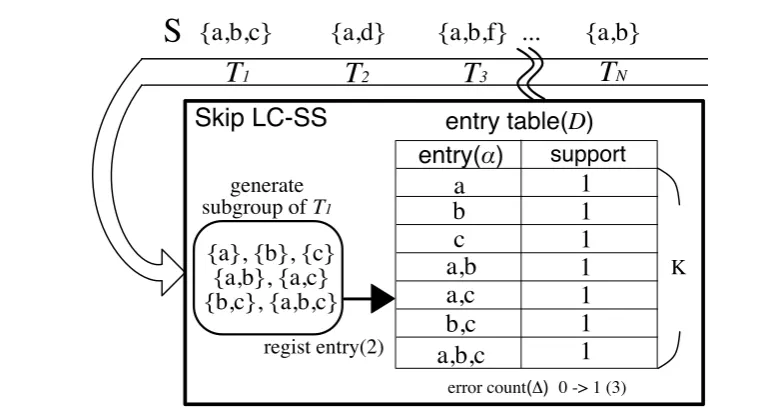
In Figure 1, we explain the notation and terminology used in this paper. Let I = a, b, c,... be a set of items. An itemset is composed of a subset of I, excluding the empty set. S, a transactional data stream, is continuous data containing transactions T1, T2 ...Tn, where Ti is the transaction that arrives at time I and N is any huge number. Let e be an entry, and the support of e, shown by sup(e), is the number of transactions that include e in the stream S.
Given a minimal support threshold, σ satisfying ∈ (0, 1). If sup(e) ≥ σN, e is frequent itemset. In this algo-rithm, the counter called frequent counter for each mining target is held.
Figure 1. Processing example of T1.
2.2. Skip LC-SS Algorithm
The Skip LC-SS algorithm was proposed by Yamamoto et al. in 2014. It can be extended to be used with the FIsM algorithm that corresponds to stream data by integrating it with Lossy Counting algorithm and space sav-ing algorithm. It used the features of the Space Savsav-ing Algorithm to fix the number of entries to be saved. The processing unit in the transaction was the Lossy Counting Algorithm (LC-SS), in order to speed up the algo-rithm, some approximation process (skip) was added. As described above, this algorithm fixes the number of stored entries. Given a constant k, entry table D, and data stream containing plural transactions, the LC- SS Al-gorithm operates in the following manner in accordance with the state of the entry table. In this case, c(ei) is the number of occurrences of the i-th itemset ei and m is an entry with the minimum number of occurrences in the entry table.
• Case 1: |D| < K
1) if < ei, c(ei) > ∈D, increment c(ei) by one. 2) else, store the new itemset <ei, 1 > in D. 3) if |D| < K, set error count(∆) to one.
4) after cheking all itemset, process next transaction.
We show the method used to process T1 in Figure 1(Case 1). At this time, since |D| = 0 and K = 7, the process shown in Case 1 is followed. In the initial state, Delta = 0. First, enumerate itemsets that could be con-tained in T1. Then, confirm whether each itemset appears in the entry table. Because T1 is the first transaction, the entry table is empty. Therefore, all itemset are stored. However, if the number of itemsets exceeds K, the method shown in Case 2 is used. In this case, after all itemsets are checked, error count (∆) is incremented by one because the entry table has been filled. At this point the next transaction is processed.
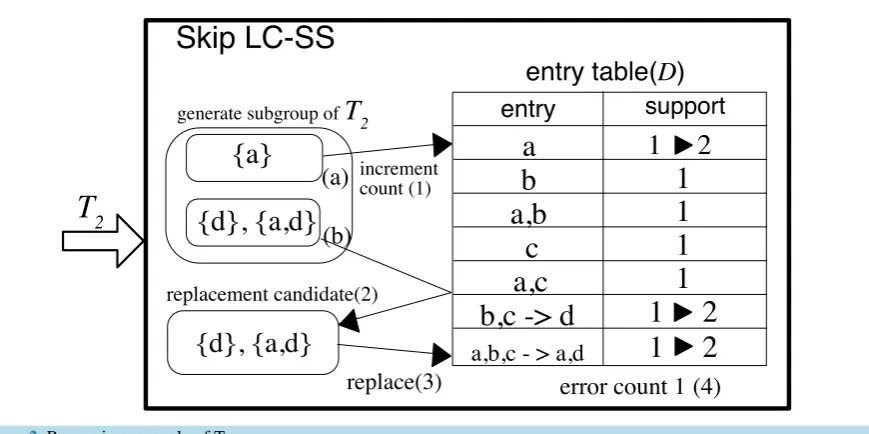
• Case 2 : |D| = K
1) if<ei, c(ei) >∈D, increment c(ei) by one. 2) else store ei as a candidate.
3) after checking all itemset, replace the minimal entry <m,c(m) > with the candidate set <ei, ∆ + 1>.
4) update error count (∆) to c(m). 5) process next transaction.
Figure 2. Processing example of T2.
In this algorithm, memory consumption is kept constant. However due to the use of the minimum value search and replacement, processing time is negatively affected. Thus, Yamamoto et al. introduced an approxi-mation process to simplify (skip) the processing of replacement and large transactions, which cause a reduction in processing speed. The methods were termed the t2-skip and r-skip. If 2|Ti|−1 > k, the entry table frequency and error counts are incremented by one. Afterwards, the transaction is completed (t2-skip). Thus, it is possible to efficiently process a huge amount of transactions without causing significant performance degradation.
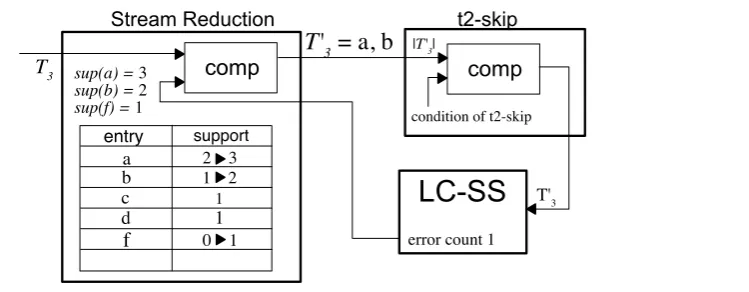
r-skip is an approximation process, but it is omitted because it is not used, as will be described later. Finally, in order to prevent the accuracy degradation due to r-skip and t2 skip, Yamamoto et al. proposed stream reduc-tion. Stream reduction is a pre-processing method performed on the input transactions. The method executes FIM on transactions, and compares the frequency of items included in the incoming transaction with ∆. Items whose frequency is lower than ∆ are then removed from the transaction as an infrequent itemset. This enables the method to perform frequent itemset mining from relatively frequent items. Therefore, Skip LC-SS retains accuracy even when used with r-skip and t2-skip techniques to accelerate the processing.
Figure 3 shows an example of stream reduction, we apply stream reduction from this example. When the in-put transaction T3 = a, b, f is counted, occurrences of each item is (3, 2, 1). However, after processing transac-tion t2, ∆ = 1. Because the frequency of item f is less than delta, transaction T3’ is to be processed at a later stage than a and b. Afterwards, for this transaction, it is determined whether to execute the t2-skip. Because 22-1 < 7 (the condition of the t2-skip), this transaction is processed in LC-SS part of the algorithm (details omitted).
3. Hardware Design
The maximum point of FIsM on hardware is considered configuring the entry table. In this study, we used a hash table to confirm whether itemsets were registered in the entry table for a small number of memory accesses. We list the following three issues when considering the hardware used to implement this algorithm.
1) Limitation of the amount of BRAM. (3.1)
Because the size of the BRAM is much smaller than the amount of memory that could be used by the server, the number of itemsets in the entry table is limited. This limitation lowered practicality for a huge data set. In custom chips, area is an issue.
2) Searching the minimal frequent count of the entry table is not suitable for hardware. (3.2)
The process of replacement requires that the minimal frequent count is found. However, sorting is not a prob-lem well suited for FPGAs.
3) The lack of parallelism of the original algorithm. (3.3)
Figure 3. Stream reduction and its example.
3.1. Incremental Hash
In the Skip LC-SS algorithm, it is necessary to perform many processes, such as registering an itemset, con-firming a registered itemset, counting up, and conducting sorting and replacement in the entry table for each transaction. Furthermore, these processes change depending on the state of the table. Therefore, frequent mem-ory access becomes a bottleneck when DRAM is used instead of BRAM because of its latency. Considering the latency of reference itemsets, our approach is to configure the hash table using BRAM. This allows us to con-firm the existence of itemsets at high speed with low latency. However, the size of BRAM is too small as men-tioned above. Therefore, the itemset cannot be stored as string as in other software implementation. It is neces-sary to use a compact data structure for an efficient implementation with the hardware.
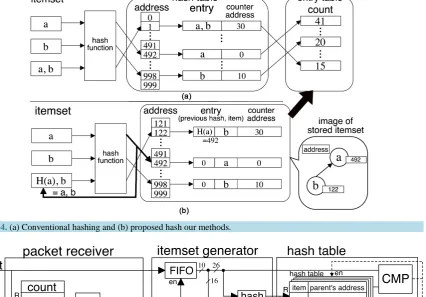
Figure 4 shows the solution we propose. In the conventional hashing method (a), itemsets are stored and searched according to the value output from a hash function after an itemset (key) string was inserted. However, it is necessary to save the original itemset to confirm whether the hashed itemset and stored itemset are the same because hash function sometimes output the same value for different itemsets (collision). However, itemset scan not directly be stored in BRAM due to capacity limitations.
Therefore, to obtain a more efficient data structure, we considered that not only can the bit string indicatean itemset, its address is stored in accordance with the hash value obtained by hashing the itemset and is an unique value. Specifically, the itemset key contains n + 1 items (length n + 1), which consists of the new item (length 1) and the initial itemset address containing n items. Based on this idea, we propose a hash table to enable efficient searching and memory saving.
Our proposed method is shown in Figure 4(b). For an itemset of length 1, the method is the same as conven-tional methods. However, for an itemset of length greater than two (in our example itemset <a, b>) the key used to search for itemset <a, b> is not string <a, b> but a combination of the address of itemset <a> and new item b. This allows the length of the stored itemset to be fixed because the address of the item bit string is a fixed length.
There are two major methods used to search an itemset efficiently, breadth-first search and depth-first search. In recent research, depth-first search has been used with less memory consumption. However, in our method, knowledge of the itemsetkey with length n + 1 requires the address of the itemset with length n. Therefore, we use a breadth-first search due to the smaller increase in memory consumption of breadth-first search compared with a hashtable.
Figure 5 shows a simplified block diagram of the stream reduction, itemset generator and hashtable. The process is as follows.
Figure 4. (a) Conventional hashing and (b) proposed hash our methods.
Figure 5. Hardware architecture of itemset generator and hash table.
3.2. Sort Function
The Skip LC-SS Algorithm uses sorting to replace infrequent itemsets in the entry table with new itemsets. However, sorting in the skip LC-SS Algorithm is different from ordinary sorting because the value in the entry table changes by one at most. In our research, we propose a sorting method based on stream summary [3], which manages itemsets using a common counter for frequency of appearance.
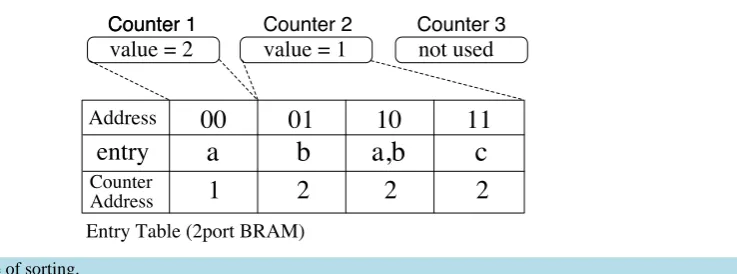
Figure 6 shows image of our sort. If itemset <a, b> hit in hash table, the address and hit flag are transferred to sort function. Then, we obtain its counter address (2) from entry table and get frequency (value 1) and top ad-dress among group, which has same frequency (adad-dress 01). Afterwards, we swap entry <a, b> and <b>. Fre-quency of <a, b> is incremented by one, and check whether there is counter which has the same value. If we have already had the same counter, the counter address of itemset <a, b> is changed to 1. Otherwise, we create new counter.
3.3. Batch Replace
[image:6.595.92.540.337.504.2]Figure 6. The image of sorting.
gorithm, we assume that the hardware allows us to count and sort at the same time. However, these two pro- cesses cannot be executed simultaneously with the replacement process. Therefore, it is necessary to stop these processes and switch processing actions for each transaction.
Instead of processing replacements during each transaction, we propose a method for batch processing a plu-rality of transactions. We then explore frequent itemsets among the replacement candidates generated from each transaction using counting. Possible replacements for the frequent itemset groups and the current entry table are combined at the end of the batch. Here, the problem is the proportion of itemsets that are not hit and the itemsets that hit the entry table. If the number of itemsets that do not hit is large, a bottleneck appears replacement can-didates for the frequent itemsets are still being found. Therefore, replacement cancan-didates generated through this process are generally itemsets whose length is the same as the frequent itemset in the entry table plus one, be-cause they are likely to be frequent. That is, we will explore the frequent itemsets from the itemsets that were not found in the hash table. A search of the itemset that contains an itemset that was not hit in the hash table is terminated.
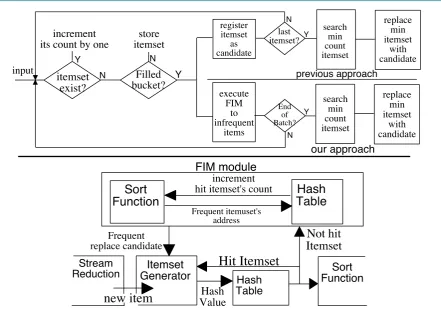
Figure 7 (upper) shows the original Skip LC-SS chart and our algorithm chart. Then the lower side of Figure 7 shows our proposed hardware architecture. Hash table and sorting is mentioned above. Itemsets that were not hits in the hash table are sent to the FIM module, and then found through frequent itemset mining. After all transactions of process in batch are processed and combined in the entry table and replacement candidates are found, we process the next batch. Almost all processes in this algorithm can be processed in parallel, except the process of coupling the hash table. Therefore, we expect further speed improvements.
4. Evaluation
4.1. Dataset & Environment
In order to obtain reliable data, we created evaluation data using a Synthetic Data Generator widely used to eva-luate the performance of FIsM by the IBM Almaden Quest research group. This dataset is generated using the following parameters: “T” is the average number of items included in the transactions, “I” is the average length of the frequent itemset, “D” is the number of transactions included in the database, and “N” is the number of types of items included in the database. We use a label “TxIyDz (T = x, I = y, D = z)” to denote the characteris-tics of a dataset. Thereafter, in order to reveal the various characterischaracteris-tics of our algorithm, we conducted expe-riments by incrementally changing each parameter. Finally, to evaluate the algorithm more realistically, we evaluated it using a dataset that contained retail market basket data created by Tom Brijs. Most experimental re-sults were obtained using an Intel Xeon E5-1620. Experiment 5-3 was evaluated using a Mac Pro with Mac OS 10.6, 3.33 GHz, 16 GB. Hardware (HW) results were evaluated based on the RTL simulation with 156 MHz. Target device is ZC706 and the resource usage is shown in Table 1 and Table 2.
4.2. Basic Properties of the Improved Algorithm
“Precision” is a metric indicating how often the frequent itemsets identified by the algorithm are truly frequent itemsets. ‘Recall’ is a metric indicating how often the algorithm identifies the real frequent itemsets.
Figure 7. (upper) flow of original and improved algorithm; (lower) hardware architecture of batch replacement.
Table 1. Parameter summary.
Parameter
T Average number of items included in the transaction
I Average length of frequent itemset
D Number of transactions included in the database
N Kind of items included in the database
L Maximum number of frequent itemset
Table 2. FPGA chip resource consumption and clock freq.
FF LUT BRAM Clock freq.
1,0370/106,400 8098/53,200 135/140 156 MHZ
(a)
[image:9.595.148.536.81.444.2](b) (c)
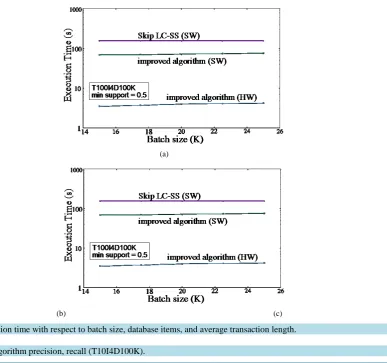
[image:9.595.87.540.436.502.2]Figure 8. Execution time with respect to batch size, database items, and average transaction length.
Table 3. HW Algorithm precision, recall (T10I4D100K).
Min support 0.5 0.1 0.005
Precision recall 1.00 1.00 1.00
Recall 1.00 1.00 1.00
Figure 8(b) and Figure 8(c), shows the experimental results after varying the parameters of the aforemen-tioned datasets. Figure 8(c), is the result of varying the average number of items in transactions included in the data set (T) based on the TxI4D10K parameter. As transaction length increases, processing time also increases because the number of generated itemsets increases as O(2L). In addition, in SW and HW, processing speed re-mains at a realistic value, while itemsets increase explosively due to the exponential increase in combinations. This is because an increase in T does not lead to an increase in the processing target due to the stream summary and efficient search methods.
Figure 8(b) gives the experimental results while changing the type of items included in the data set (N). It can be seen that as more types of items are included in the dataset, the execution time decreases. Increases in the types of item leads to the increase in infrequent items because the other parameters do not change. Thus, in-creasing the number of infrequent items results in a higher number of items removed from the transactions. Therefore, the processing speed of both SW and HW increased in the same way. Since the processing time is independent of the types of items, the more items the Stream Reduction prunes, the shorter the execution time.
4.3. Real Data
(a)
[image:10.595.118.500.80.409.2](b)
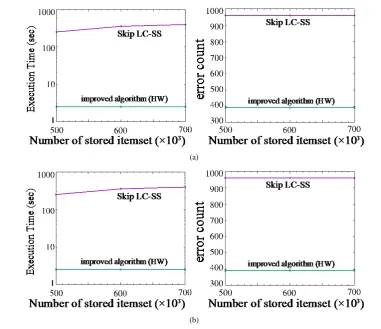
Figure 9. Execution time and error count of retail and web log items in set e such that sup(e) ≥ σN (no false negative), where ∆ is a lower limit such that the recall is guaranteed to be 1. (a) dataset: retail; (b) dataset: web_log.
information and a web click stream. The retail data consists of 88,162 transactions and 16,470 items; the web- log data stream consists of 19,466 transactions and 9961 items. As mentioned above, SW evaluation data is ob-tained from the original skip LC-SS paper by Yamamoto using the same dataset. The limit of the stored itemsets is 500 K, 600 K, and 700 K respectively. The configuration of the HW was the same as in the previous section (bucket size 10 K). As a result, despite the much smaller bucket size compared to the original algorithm, processing speed was 100 times faster and the error count necessary to guarantee minimum support was 100 times smaller. By introducing a batch process, we achieved a more efficient algorithm. Since the original algo-rithm executes the approximation process repeatedly on huge transactions, memory efficiency was reduced. However, the proposed algorithm uses memory more efficiently because it selects potential frequent itemsets and replaces them with frequent replacement candidates. Even in realistic datasets, this algorithm works well.
5. Conclusion
398-412. http://dx.doi.org/10.1007/978-3-540-30570-5_27
[4] Manku, G.S. and Motwani, R. (2002) Approximate Frequent Counts over Data Streams. Proceedings of the 28th In-ternational Conference on Very Large Data Bases (VLDB’02), Hong Kong, 20-23 August 2002, 346-357.
[5] Yamamoto, Y., Iwanuma, K. and Fukuda, S. (2014) Resource-Oriented Approximation for Frequent Itemset Mining from Bursty Data Streams. Proceedings of the 2014 ACM SIGMOD International Conference on Management of Data (SIGMOD’14), Snowbird, 22-27 June 2014, 205-216. http://dx.doi.org/10.1145/2588555.2612171
[6] Teubner, J., Mueller, R. and Alonso, G. (2010) FPGA Acceleration for the Frequent Item Problem. Proceedings of the IEEE 26th International Conference on Data Engineering (ICDE), Long Beach, 1-6 March 2010, 669-680.
http://dx.doi.org/10.1109/icde.2010.5447856
[7] Baker, Z. and Prasanna, V. (2005) Efficient Hardware Data Mining with the Apriori Algorithm on FPGAs. Proceed-ings of the 13th Annual IEEE Symposium on Field Programmable Custom Computing Machines (FCCM’05), 18-20 April 2005, 3-12. http://dx.doi.org/10.1109/fccm.2005.31
Submit or recommend next manuscript to SCIRP and we will provide best service for you:
Accepting pre-submission inquiries through Email, Facebook, LinkedIn, Twitter, etc. A wide selection of journals (inclusive of 9 subjects, more than 200 journals) Providing 24-hour high-quality service
User-friendly online submission system Fair and swift peer-review system
Efficient typesetting and proofreading procedure
Display of the result of downloads and visits, as well as the number of cited articles Maximum dissemination of your research work