www.hydrol-earth-syst-sci.net/16/1709/2012/ doi:10.5194/hess-16-1709-2012
© Author(s) 2012. CC Attribution 3.0 License.
Earth System
Sciences
Improving runoff estimates from regional climate models:
a performance analysis in Spain
D. Gonz´alez-Zeas1, L. Garrote1, A. Iglesias2, and A. Sordo-Ward1
1Department of Hydraulic and Energy Engineering, Technical University of Madrid, Spain
2Department of Agricultural Economics and Social Sciences, Technical University of Madrid, Spain Correspondence to: D. Gonz´alez-Zeas ([email protected])
Received: 14 November 2011 – Published in Hydrol. Earth Syst. Sci. Discuss.: 5 January 2012 Revised: 25 May 2012 – Accepted: 29 May 2012 – Published: 25 June 2012
Abstract. An important step to assess water availability is to have monthly time series representative of the current situa-tion. In this context, a simple methodology is presented for application in large-scale studies in regions where a properly calibrated hydrologic model is not available, using the out-put variables simulated by regional climate models (RCMs) of the European project PRUDENCE under current climate conditions (period 1961–1990). The methodology compares different interpolation methods and alternatives to generate annual times series that minimise the bias with respect to observed values. The objective is to identify the best alter-native to obtain bias-corrected, monthly runoff time series from the output of RCM simulations. This study uses infor-mation from 338 basins in Spain that cover the entire main-land territory and whose observed values of natural runoff have been estimated by the distributed hydrological model SIMPA. Four interpolation methods for downscaling runoff to the basin scale from 10 RCMs are compared with empha-sis on the ability of each method to reproduce the observed behaviour of this variable. The alternatives consider the use of the direct runoff of the RCMs and the mean annual runoff calculated using five functional forms of the aridity index, defined as the ratio between potential evapotranspiration and precipitation. In addition, the comparison with respect to the global runoff reference of the UNH/GRDC dataset is evalu-ated, as a contrast of the “best estimator” of current runoff on a large scale. Results show that the bias is minimised using the direct original interpolation method and the best alter-native for bias correction of the monthly direct runoff time series of RCMs is the UNH/GRDC dataset, although the for-mula proposed by Schreiber (1904) also gives good results.
1 Introduction
of surface runoff over great extensions of land (Fekete et al., 1999), and it can be used to correct bias from RCMs.
In light of this situation, it is essential to analyse several alternatives that will enable us to obtain simulated stream flow series and can be introduced in water resources mod-els to estimate climate change impacts. In the present study, we consider the use of direct surface runoff series simulated using RCMs or obtained applying climate formulas (such as those based on the aridity index; Arora, 2002), which give surface runoff variables on an annual time scale. In this re-gard, it is noteworthy that numerous studies have highlighted the calculation of the mean annual surface runoff using a non-parametric focus that does not depend on a hydrologic model (i.e. Sankarasubramanian and Vogel, 2003), using cli-mate formulas based on the aridity index to evaluate the sen-sitivity of surface runoff to climate changes (in 1337 basins in the United States).
In hydrologic applications, the spatial resolution of a given climate model plays a significant role in determining its im-pact on hydrologic systems. For this reason, in recent years, the use of RCMs has improved the spatial details of cli-mate change projections obtained with global clicli-mate mod-els (D´equ´e et al., 2005). The European PRUDENCE project (Christensen et al., 2007) provides high-resolution climate change scenarios with results that include the simulations of several RCMs for the projection of climate variables in cur-rent and future climate situations. However, despite the rel-atively high resolution of RCMs, hydrologic modelling gen-erally requires information on a smaller scale than that pro-vided by the typical RCM grid size (Hagemann and Gates, 2003). Thus, one of the limiting factors regarding the use of information projected by RCMs (in hydrologic predictions) is the scale misalignment between the output of the climate models and the scale used by the hydrologic models (the river basin) (e.g. Lettenmaier et al., 1999; Bergstr¨om et al., 2001; Wood et al., 2002). Several studies have designed different downscaling techniques to overcome this deficiency, focus-ing their attention on temperature and precipitation variables because they are the key variables by which hydrologic mod-els calculate surface runoff (e.g. Leung et al., 2003; Dibike and Coulibaly, 2005; Terink et al., 2010).
A broad range of downscaling techniques has been devel-oped, including methods involving artificial neural networks (Hewitson and Crane, 1992), empirical regression methods (Von Storch et al., 1993) and methods based on linear inter-polation, spatial disaggregation and bias correction (Wood et al., 2004; Chen et al., 2011). For all of these, the general lim-itations are well documented in the existing literature (Wilby et al., 2004). However, many of these reports only evaluate the advantages and disadvantages associated with a specific use of the method and do not give accurate information re-garding the best method for evaluating the effects of climate change on hydrologic systems (Fowler et al., 2007). There-fore, using several methodological alternatives to downscale runoff output from RCMs in current climate conditions and
comparing their results with respect to observed data may reveal the procedure that gives the best fit.
Another factor that limits the use of RCM output is its bias, which has to be eliminated before it can be used for other purposes (Christensen et al., 2008). In general, the be-haviour of climate models shows less bias for precipitation and temperature than for surface runoff (Girorgi et al., 1994; Gonz´alez-Zeas, 2010). Bias-correction techniques have been developed for precipitation and temperature variables used in hydrologic models (Piani et al., 2010a, b). Changes in spe-cific statistical aspects, generally mean and variance values, of the simulated fields are used in the bias correction for-mulations, which are directly applied to current observations that are subsequently used to force the hydrologic models (Haerter et al., 2011). Many hydrologic models have been used to determine current surface runoff values from precipi-tation and temperature variables simulated by climate models (e.g. Leavesley et al., 2002; D¨oll et al., 2003). However, due to the limited availability of data and the lack of a correctly calibrated hydrologic model that allows surface runoff deter-mination from basic climate variables (i.e. precipitation and temperature) when working on a large regional or continen-tal scale, it is often difficult to generate surface runoff series that accurately represent the current conditions and, thus, can be successfully employed with water resources management models (Strzepek and Yates, 1997; Yates, 1997; Hagemann et al., 2004; Kirchner, 2006; Silberstein, 2006; D¨oll et al., 2008). For this reason it is important to evaluate which of the alternatives considered in this study minimises bias with respect to observed values.
Our study focuses on providing estimates for runoff con-ditions in current situation using the RCM outputs. Nonethe-less, if the RCM runoff is to be used in climate change impact analysis, the first step is to analyze how the RCM simulations reproduce the current situation, and therefore our methodol-ogy focuses on the control scenario as a first step before link-ing to climate change impact analysis.
(4) to generate a monthly series that is representative of cur-rent conditions using a simple bias correction methodology based on the alternative that best reproduces the observed values.
2 Data
2.1 Area of study
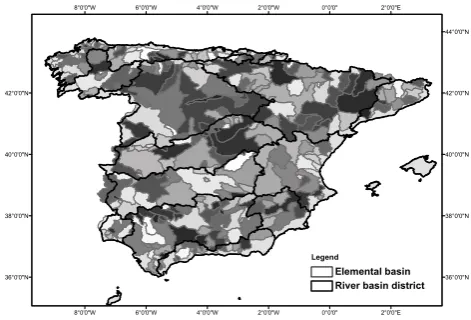
The area of study is the mainland territory of Spain, which has an area of 504 782 km2. The study considers 338 sub-basins, which are defined from points in the river network that are relevant to the management of water resources (MARM, 1998). Figure 1 shows the 338 elemental sub-basins. The basins on which this study has been performed were obtained by accumulating all the elemental sub-basins located upstream of the point being considered. Table 1 sum-marises the characteristics of the accumulated basins and classifies them by river basin districts (RBDs).
The basins studied are broadly variable in their size, with the largest being 84 923.85 km2(the basin of the Ebro RBD) and the smallest being 15.89 km2(in the North I RBD). The mean size of the basins is 4358.13 km2, with a coefficient of variation of 1.89.
2.2 Observed surface runoff series
The hydrologic regimes of most rivers in Spain are strongly affected by water abstractions and flow regulations. Thus, data measured in the gauging stations cannot be directly compared to surface runoff in natural regimes. Natural regime surface runoff data were obtained from the results of the Precipitation Runoff Integrated Model (SIMPA, by its Spanish acronym) (Estrela and Quintas, 1996). This model is calibrated over 100 control points of the entire territory of Spain, using stations where stream flows are measured in nat-ural regimes (MARM, 2000; Alvarez et al., 2004), enabling the monthly series of runoff in natural regimes to be obtained in a grid with a 1 km2resolution. Evaluation/comparisons of the results of the climate models employed the monthly sur-face runoff series generated by the SIMPA model (labelled as observed data in this study) in each of the 338 elemental study basins for the period from 1961–1990.
2.3 Regional climate models
The present study uses projections made by eight regional climate models presented in the European PRUDENCE project (Christensen et al., 2007) nested in a single global model, referred to as HadAM3H. The regional models give information relative to a large number of variables (temper-ature, precipitation, runoff, evaporation and solar radiation, among others) with daily, monthly and seasonal resolution for the periods from 1961–1990 (control period) and 2071– 2100 (climate change scenario). The PRUDENCE project
2°0'0"E 2°0'0"E
0°0'0" 0°0'0"
2°0'0"W 2°0'0"W
4°0'0"W 4°0'0"W
6°0'0"W 6°0'0"W
8°0'0"W 8°0'0"W
44°0'0"N
42°0'0"N 42°0'0"N
40°0'0"N 40°0'0"N
38°0'0"N 38°0'0"N
36°0'0"N 36°0'0"N
Legend
[image:3.595.309.545.63.223.2]Elemental basin River basin district
Fig. 1. Elemental basins of study. The methods used in this study
were applied to the accumulated basins below, including all the sub-basins upstream of the point being considered.
gives the values of the simulated climate variables, using the grid of the original coordinates (O) of each model, with a spatial resolution that varies between 25–50 km depending on the model, and in the unified coordinates CRU (Climate Research Unit) with a spatial resolution of 0.5×0.5◦(cells of approximately 50 km sides). The DMI model has 3 differ-ent simulations; thus, in total, this study has used data gen-erated by 10 climate simulations of the PRUDENCE project (Table 2).
3 Methodology
The methodology used herein consists of comparing the observed surface runoff series with the series downscaled from the results of the RCMs via different alternatives and analysing the results to select the most accurate procedure. Given that the SIMPA model has been specifically conceived and calibrated to generate monthly runoff series with high spatial resolution, its results should be more accurate than those produced by RCMs. The surface runoff layers gen-erated by the UNH/GRDC, an additional global reference, are also considered because they specifically pertain to sur-face runoff with the same spatial resolution as generated by RCMs.
Table 1. Characteristics of the basins used in this study by river basin district.
River Basin
Code Number of Maximum Minimum Mean area Coefficient of
District basins area (km2) area (km2) (km2) variation
North I NorI 15 16 320.85 15.89 2295.24 1.86
North II NorII 20 13 888.75 31.36 1468.41 2.04
North III NorIII 13 4463.18 31.31 737.24 1.57
Galician Coast Gal 20 8599.34 31.09 786.69 2.38
Ebro Ebr 48 84 923.85 31.42 6186.81 2.56
Catalunya Cat 16 12 458.64 32.32 1931.93 1.53
South Sou 20 9973.39 68.70 980.90 2.22
Segura Seg 9 15 752.37 738.34 5494.19 1.09
Jucar Juc 17 35 912.64 50.25 7586.91 1.28
Duero Due 33 75 544.62 63.08 8693.35 2.37
Tagus Taj 39 55 758.17 16.25 6587.23 2.18
Guadiana I GnaI 23 54 395.58 99.70 9806.86 1.68
Guadiana II GnaII 9 6303.90 101.81 1253.73 1.61
Guadalquivir Gqv 56 60 939.80 34.19 7204.32 2.11
Total 338 84 923.85 15.89 4358.13 1.89
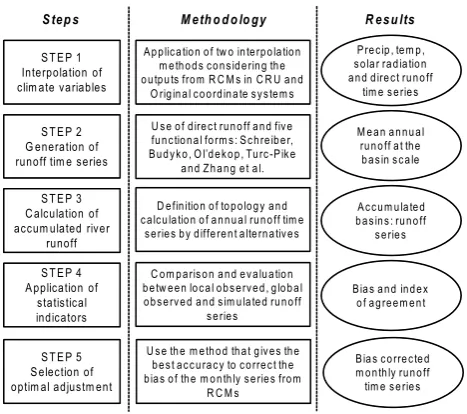
procedures were used in each case: (1) direct method (D) and (2) interpolated method (I). Topological analyses were performed on the elemental basins, and surface runoff values were obtained for the accumulated basins. The goodness of fit between the observed and generated annual runoff time se-ries was evaluated using statistical indicators. Next, we deter-mined and evaluated the alternative that best reproduced the observed values and that was, therefore, used to correct the bias and to generate the monthly surface runoff series at the hydrologic basin scale (which can be introduced in the water resources management models). As summarised in Fig. 2, the analysis process had the following steps: (1) interpolation of climate variables, (2) generation of surface runoff series for the basins studied, (3) generation of surface runoff series for the accumulated basins, (4) determination of the goodness of fit of the generated surface runoff series and (5) determi-nation of the method and alternative that provided the best agreement with observed values and, thus, that was used to correct the bias of the monthly series simulated by the RCMs. 3.1 Interpolation methods
Many interpolation methods have been developed to span the gap from climate models to basin scale. Some of these statis-tical approaches used a truncated Gaussian weighting filter (Thornton et al., 1997), PRISM method (Daly et al., 2002), the thin-plate smoothing splines procedure (Hijmans et al., 2005), among others.
We have used four procedures to generate the basic series for the basins studied. The base was determined by the out-puts of the 10 RCM simulations in the O coordinates of each model and in the common CRU coordinate system with a resolution of 0.5×0.5◦. The behaviours of the two coordi-nate systems were evaluated, because, although it is easier to
Steps Methodology R esults
Precip, tem p, solar radiation and direct runoff
tim e series M ean annual
runoff at the basin scale
Accum ulated basins: runoff
series
Bias and index of agreem ent Application of tw o interpolation
m ethods considering the outputs from R C M s in C R U and
O riginal coordinate system s
STEP 1 Interpolation of clim ate variables
STEP 2 G eneration of runoff tim e series
STEP 3 Calculation of accum ulated river
runoff
STEP 4 Application of
statistical indicators
U se of direct runoff and five functional form s: Schreiber, Budyko, O l’dekop, Turc-Pike
and Zhang et al. D efinition of topology and calculation of annual runoff tim e
series by different alternatives C om parison and evaluation betw een local observed, global observed and sim ulated runoff
series
Bias corrected m onthly runoff tim e series
STEP 5 Selection of optim al adjustm ent
U se the m ethod that gives the best accuracy to correct the bias of the m onthly series from
R C M s
Fig. 2. Scheme of the analysis methodology.
work in the common system, the interpolation process that enables transition to the unified CRU domain can alter the values of some variables, particularly in the coastal regions. In addition, errors introduced by the existence of different landscapes at specific points between the original grid and the regular 0.5◦grid can be overlooked (Hagemann and Ja-cob, 2007).
[image:4.595.311.545.311.518.2]Table 2. Summary of the regional climate model simulations used in this study and produced by the European PRUDENCE Project
(Chris-tensen et al., 2007).
Driving Global ∗Centre or Regional Simulations
Climate Model Institute Climate Models Control Scenario Acronym
(RCMs) (1961–1990)
HadAM3H
HC1 DMI.1
DMI HIRHAM HC2 DMI.2
HC3 DMI.3
ETH CHRM HC CTL ETH
GKSS CLM CTL GKSS
ICTP RegCM ref ICTP
KNMI RACMO HC1 KNMI
MPI REMO 3003 MPI
SMHI RCAO HCCTL SMHI
UCM PROMES control UCM
∗DMI: Danish Meteorological Institute; ETH: Swiss Federal Institute of Technology; GKSS: Institute of
Coastal Research; ICTP: Physics of Weather and Climate Section; KNMI: The Royal Netherlands Meteorological Institute; MPI: Max-Planck-Institute for Meteorology; SMHI: Swedish Meteorological and Hydrological Institute; UCM: Universidad Complutense de Madrid.
(a)
(b)
(c)
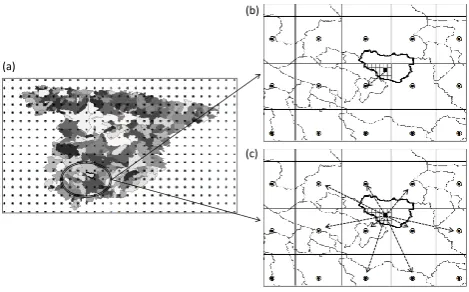
Fig. 3. Interpolation methods: (a) CRU domain of the RCMs, (b)
di-rect method (D) and (c) interpolated method (I). A similar procedure was used with the RCM outputs in original coordinates.
working scale. The outputs of the RCMs were translated into this grid with two interpolation methods: the D method and the I method. Figure 3 shows the scheme used; Fig. 3a shows the CRU grid superimposed on the elemental sub-basins of the analysis; Fig. 3b shows the application of the D method, in which the assumed value of the variable on the work grid is the nearest element of the grid RCM; Fig. 3c shows the application of the I method, in which the assumed value on the work grid is obtained from the values for the nine nearest points in the RCM grid through a weighted mean, in which the weighting coefficient of each value is the inverse of the distance squared. A similar procedure is used with the output in O coordinates. Therefore, four interpolation methods are compared in this study: CRU-D, CRU-I, O-D and O-I.
3.2 Generated temporal surface runoff series
Using the four interpolation methods, mean annual surface runoff series were generated for the basins studied, consid-ering the following alternatives: (1) the direct runoff of the 10 RCM simulations and (2) the mean annual surface runoff obtained via application of five functional forms based on the aridity index (Arora, 2002). In addition, the D and I pro-cedures were applied to the surface runoff datasets of the UNH/GRDC, a reference of the current global surface runoff (Fekete et al., 1999).
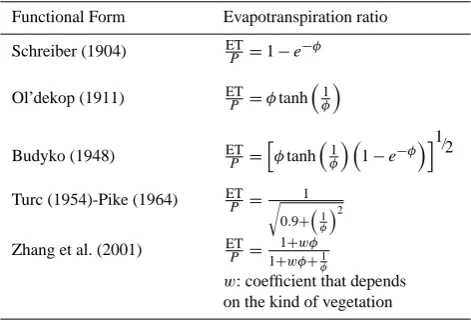
Arora (2002) showed that the use of functional forms based on the aridity index (φ), defined as the ratio be-tween the potential evapotranspiration (PET) and precipi-tation (P), is a reasonable first-order approximation of the actual evapotranspiration (ET). Functional forms based on this index consist of formulas proposed by different au-thors (Schreiber, 1904; Ol’dekop, 1911; Budyko, 1948; Turc, 1954-Pike, 1964; Zhang et al., 2001; Table 3) that allow cal-culation of the mean annual surface runoff values. These for-mulas determine the ratio between the actual evapotranspi-ration (ET) and the precipitation (P) through the balance of water and energy.
The mean value of annual surface runoff (R) is obtained by the balance of water as follows:
R=P−ET−1S. (1)
Assuming that1S(the change in moisture storage in soil) is very small over an annual time scale, the actual evapotranspi-ration (ET) can be calculated in each of the functional forms of Table 3 and substituted in Eq. (1), thereby yielding the value of the mean annual surface runoff as a function of the aridity index:
[image:5.595.50.285.309.455.2]Table 3. Functional formsF (φ)used to calculate the evapotranspi-ration ratio.
Functional Form Evapotranspiration ratio
Schreiber (1904) ETP =1−e−φ
Ol’dekop (1911) ETP =φtanh1φ
Budyko (1948) ETP =hφtanh1φ 1−e−φi1/2
Turc (1954)-Pike (1964) ETP =r 1
0.9+
1
φ
2
Zhang et al. (2001) ETP = 1+wφ
1+wφ+1
φ
w: coefficient that depends
on the kind of vegetation
whereF (φ)corresponds to each of the five functional forms used.
For calculation of the PET, the Hargreaves method is used (Hargreaves and Samani, 1982) as follows:
PET=0.0023·(Tmean+17.8)·(Tmax−Tmin)0.5RA, (3)
where PET is the potential evapotranspiration in mm,RAis
the solar radiation in the upper part of the atmosphere in W m−2, Tmean is the mean temperature in ◦C,Tmax is the
maximum temperature in◦C andTminis the minimum
tem-perature in◦C.
Information regarding precipitation, temperature and so-lar radiation used for the calculation of the PET and the mean annual surface runoff is obtained from the outputs of the PRUDENCE RCM simulations. As a consequence, for each functional form of Table 3, 10 mean annual surface runoff values are generated, 1 for each simulation of the PRUDENCE project.
The UNH/GRDC dataset provides monthly climatologi-cal runoff fields, which are runoff outputs from a water bal-ance model that is driven by observed meteorological data and then corrected with the runoff fields that are disaggre-gated from the observed river discharges at the main gauging stations in the world. The UNH/GRDC dataset preserves the accuracy of the observed discharge measurements and main-tains the spatial and temporal distributions of the simulated surface runoff. Thus, because it provides the “best estimate” of surface runoff on a large scale (Fekete et al., 2002), the UNH/GRDC dataset has been used as a reference in the cali-bration and validation of different surface runoff models (e.g. SIMTOP, SIMGM) that use global and regional climate mod-els (Wei et al., 2002; Niu et al., 2005; Sperna Weiland et al., 2012; Wisser et al., 2010). This study used the annual surface runoff layer of the UNH/GRDC dataset as a reference for the “best results” that can be obtained at the working scale of each RCM. The surface runoff layer of the UNH/GRDC dataset has the same resolution as the CRU grid.
A total of 60 mean annual surface runoff values for each interpolation method are generated as follows: 10 corre-sponding to the RCM simulations of the European PRU-DENCE project and 50 corresponding to the 5 climate for-mulas (10 for each functional form). In addition, two annual runoff series (D and I) are generated using the UNH/GRDC runoff fields. In total, 40 series of direct runoff are obtained, considering that four methods of interpolation are used. Sim-ilarly, 200 series are obtained for the five climatic formulas and 2 series for the UNH/GRDC dataset, since in this case only a single simulation is available and the outputs are only in CRU coordinate systems.
3.3 Criteria for comparison(s) of results
It is appropriate to evaluate/compare models, such as those used in this study, using quantitative indicators of goodness of fit (Legates and McCabe, 1999). Along these lines, anal-yses of the discrepancies between the output of the models and the observed values have been reported by several au-thors (Adam and Lettenmaier, 2003; Fekete and V¨or¨osmarty, 2004). Thus, quantitative measurements were used to deter-mine the agreement (goodness of fit) between the mean an-nual surface runoff observed and the simulated surface runoff determined by different interpolation methods, and the bias and the index of agreement proposed by Willmott (1981) were evaluated.
The bias reveals the model’s tendency to overestimate or underestimate one variable and quantifies the systematic er-ror of the model (Janssen and Heuberger, 1995). The bias can be determined from the mean error, which is normalised by the mean of the values observed for the group of 338 accu-mulated basins and for the different alternatives analysed as follows:
Bias=S−O
O , (4)
whereSandOrepresent the mean annual simulated and ob-served runoff for the group of basins studied, respectively.
d=1−
n P
i=1
(Si−Oi)2
n P
i=1
(Si−O
+
Oi−O
)2
, (5)
whereSi represents the simulated surface runoff in basini,
Oiis the surface runoff observed in the basini,Ois the mean
observed surface runoff,n is the number of basins studied anddis the index of agreement (which varies between 0, not a good adjustment, and 1, perfect adjustment).
3.4 Correction of the bias
Considering the lack of a correctly calibrated hydrologic model in large-scale studies, monthly surface runoff series are built from RCM simulations, using the alternative that best reproduces the observed values. The results are validated with information obtained from the UNH/GRDC dataset. It is well known that the output of the RCMs cannot be used di-rectly if there is no procedure that eliminates the existing bias (Sharma et al., 2007). Studies conducted by Murphy (1999), Kidson and Thompson (1998) and Wilby et al. (2000) sug-gest the need to correct the bias in the outputs of the climate models to ensure accurate results in hydrology and water re-sources management applications. Different methodologies have been used to correct the bias. The simplest methodology uses changes in one specific statistical aspect, often the mean or the variance. This method is equivalent to correcting the observed series with a constant multiplying factor (e.g. Klein et al., 2005). More advanced bias-correcting methodologies, such as those developed by Schmidli et al. (2006) and Le-ander and Buishand (2007), correct the bias using more than one specific statistical aspect. Improvements in the simpler methods of bias correction have been obtained by fitting the probability density function to the histograms of the observed data (Piani et al., 2010a; Maraun et al., 2010), the application of the quantile mapping method (Wilby et al., 2000; D´equ´e, 2007; Bardossy and Pegram, 2011). This study proposes a simple bias-correction methodology based on the determina-tion of an annual correcdetermina-tion factor, which is obtained using the alternative that minimises the bias and gives the surface runoff series that most closely agrees with observed values. Using the mean of the annual series as a representative statis-tical parameter, constant multiplying factors are determined that are then used to correct the monthly runoff time series directly simulated via RCMs. The corresponding corrected monthly runoff series are obtained as follows:
Rcontrol.cor,i=Rcontrol,i·
R
alt Rcontrol
, (6)
where Rcontrol,cor,i are the corrected monthly runoff series
of the RCMs,Rcontrol,i are the monthly runoff series of the
RCMs,Ralt is the mean annual runoff of the alternative that
best approximates the observed values and Rcontrol is the
mean annual runoff value of the RCMs.
In order to evaluate the performance of the results ob-tained for the corrected monthly surface runoff series, the Kolmogorov-Smirnov (K-S) non-parametric test (Conover, 1980) is used to compare monthly cumulative distribution function (cdf) with the observed runoff.
The K-S test can be described as follows. SupposeF1(x)
andF2(x)are two cdfs of two sample data of a variablex.
The null hypothesis and the alternative hypothesis concern-ing their cdfs are
H0:F1(x)=F2(x)for allx
HA:F1 (x)6=F2(x)for at least one value ofx and the test
statistics,T is defined as
T =supx|F1(x)−F2(x)|, (7)
which is the maximum vertical distance between the distri-butionsF1(x)andF2(x). If the test statistics is greater than
the critical value, the null hypothesis is rejected. 3.5 Regime curves
To represent the annual hydrological cycle once the annual bias of the series has been corrected, we calculated the hy-drological regime curve which consists of the 30-yr average mean monthly runoff, obtained for all 12 months individu-ally from observed and simulated runoff in Spain. Regime curves have been calculated from observed runoff, direct runoff obtained by each RCM and bias corrected runoff by UNH/GRDC and Schreiber (1904) formula for the 10 RCM simulations. Additionally to plot the regime curves of Spain, the Nash-Sutcliffe (NS) coefficient of efficiency is used to compare the 30-yr average monthly values displayed in the regime curves (e.g. Wolock and McCabe, 1999; Sperna Wei-land et al., 2010). Besides, we have taken into account the performance spatially, calculating the NS in the 14 river basin districts of Spain.
NS is a dimensionless indicator widely used to evaluate the goodness of fit of the data (Nash and Sutcliffe, 1970). This coefficient represents the relative improvement of the simulated values with respect to the mean of the observed values and is expressed in the following manner:
NS=1−
n P
i=1
(Si−Oi)2
n P
i=1
(Oi−O)2
, (8)
whereSiandOirepresent the simulated and observed values
−10 −0.8 −0.6 −0.4 −0.2 0 0.2 0.2
0.4 0.6 0.8 1
Bias
Cumulative Probability
CRU−D CRU−I O−D O−I
0.4 0.5 0.6 0.7 0.8 0.9 1 0
0.2 0.4 0.6 0.8 1
d CRU−D
CRU−I O−D O−I
[image:8.595.116.483.66.171.2](a) (b)
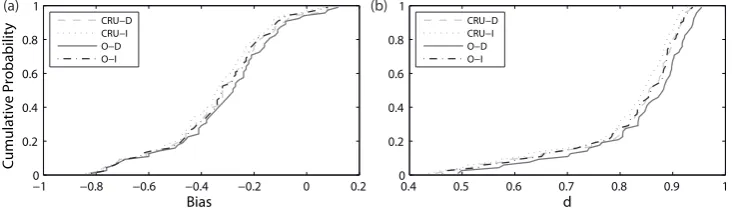
[image:8.595.104.491.249.391.2]Fig. 4. Cumulative probability of the 60 values that correspond to all of the alternatives analysed for each interpolation method: (a) bias and (b) index of agreement.
Table 4. Mean values of the bias and the index of agreement of the annual mean surface runoff obtained with the 10 RCMs for each
interpolation method and for the different alternatives considered. Bold numbers are used to remark the best results.
Alternatives
Bias (%) Index of Agreement (d)
CRU-D CRU-I O-D O-I CRU-D CRU-I O-D O-I
Direct Runoff −36 −38 −35 −37 0.761 0.746 0.779 0.762
Schreiber (1904) −23 −25 −20 −23 0.867 0.855 0.883 0.867
Ol’dekop (1911) −47 −49 −44 −47 0.775 0.756 0.804 0.775
Budyko (1948) −34 −37 −32 −35 0.830 0.815 0.852 0.830
Turc (1954)-Pike (1964) −36 −38 −33 −36 0.823 0.808 0.846 0.823
Zhang et al. (2001) −25 −27 −22 −25 0.857 0.845 0.874 0.857
Mean −33 −36 −31 −34 0.819 0.804 0.840 0.819
UNH/GRDC −3 −4 0.959 0.957
4 Results
4.1 Comparison of the interpolation methods
In this section, the interpolation method that generates a sur-face runoff series that most closely approximates the ob-served values is determined. Using the bias and the index of agreement, the relative errors of the mean annual runoff ob-tained by the different alternatives were calculated for each interpolation procedure. The values of the indicators repre-sent the behaviour of the group of the 338 basins of the study. Figure 4 shows the cumulative probability of the bias and index of agreement of the CRU-D, CRU-I, O-D and O-I methods for 10 simulations of direct surface runoff and 5 climate formulas. In total, 60 values are presented for each interpolation method. The cumulative probability of the bias curve (Fig. 4a) shows that the bias of the O-D method is less than those of all other methods, indicating that the O-D method tends to minimise errors with respect to observed values. Similarly, the results shown in Fig. 4b indicate that the cumulative probability ofd, the index of agreement, ob-tained with the O-D method is greater than that obob-tained by any other method, indicating a better adjustment.
Table 4 summarises the values of the indicators for the mean of the 10 RCM obtained for each alternative using each
interpolation method. Once again, the best results are ob-tained with the O-D method, which outputs mean bias and d-values of−31 % and 0.840, respectively. However, the dif-ference between the O-D method and other methods is not very marked; comparing the O-D method to the CRU-D, O-I and CRU-I methods, the error in the results decreases by only 2 %, 3 % and 5 %, respectively.
Similar comparisons were made with the mean annual sur-face runoff values given by the UNH/GRDC dataset. For methods D and I, the results show an existing bias with re-spect to the observed values of−3 % and−4 % and d-values of 0.959 and 0.957, respectively, indicating that method D gives the best results.
4.2 Evaluation of the annual surface runoff obtained by direct runoff from RCMs and climate formulas
In this section, the direct runoff values determined by the RCMs and the mean annual runoff obtained from five climate formulas are compared to determine if they can adequately represent the observed values of mean annual surface runoff. The results are also compared to the reference surface runoff values obtained from the UNH/GRDC dataset.
DMI1 DMI2 DMI3 ETH GKSS ICTP KNMI MPI SMHI UCM −1
−0.8 −0.6 −0.4 −0.2 0 0.2
Bias
Direct Runoff Schreiber Ol−dekop Budyko Turc−Pike Zhang et al UNH/GRDC
DMI1 DMI2 DMI3 ETH GKSS ICTP KNMI MPI SMHI UCM 0.4
0.5 0.6 0.7 0.8 0.9 1
d
Direct Runoff Schreiber Ol−dekop Budyko Turc−Pike Zhang et al UNH/GRDC
[image:9.595.117.478.65.195.2](a) (b)
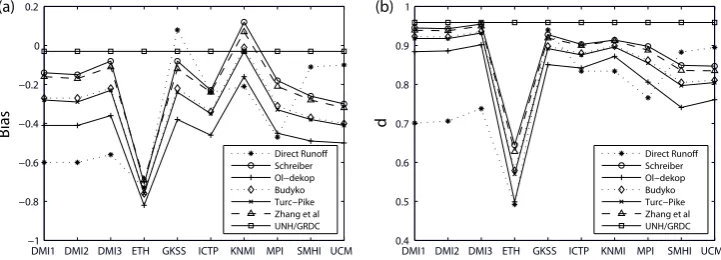
Fig. 5. Goodness of fit indicators obtained for the direct surface runoff, the five functional forms (Schreiber, 1904; Ol’dekop, 1911; Budyko,
1948; Turc, 1954-Pike, 1964; Zhang et al., 2001) for the 10 RCM simulations and for the UNH/GRDC dataset: (a) bias and (b)t-index of agreement. The acronyms of the RCM simulations are defined in Table 2.
values. Therefore, from this point on, we use the mean an-nual surface runoff results calculated with this procedure. Figure 5a and b show the fitting indicators of the direct sur-face runoff from RCMs, the runoff from the climate formu-las of Schreiber (1904), Ol’dekop (1911), Budyko (1948), Turc (1954)-Pike (1964), Zhang et al. (2001) and the mean annual runoff in the UNH/GRDC dataset. Results are shown for all 10 RCM simulations. The fitting indicators show best behaviour for the UNH/GRDC dataset, because the associ-ated bias is minimum with a value of−3 % and the d-value is 0.959, which is greater than the d-values obtained with alter-native approaches. The climate formulas behave better with regard to the direct runoff of the RCMs. Compared to the rest of the functional forms, Schreiber’s formula performs better with regard to all RCMs simulations studied. The for-mula from Zhang et al. (2001) shows similar results, although they are slightly less accurate than the ones obtained with Schreiber’s formula. Using the formulas of Budyko (1948) and Turc (1954)-Pike (1964), similar results are generated, and results using Ol’dekop’s formula show the poorest agree-ment of all the functional forms. Despite demonstrating the least favourable overall results, comparisons with direct sur-face runoff demonstrate better agreements than Schreiber’s formula for the GKSS, SMHI and UCM models. The bias obtained for the direct surface runoff is−35 % for the mean of the 10 RCMs, while that obtained for Schreiber’s formula is−20 %.
Some of the 10 RCMs obviously provide better results than others. With regard to Schreiber’s formula, the best per-forming model is DMI.3, which has a bias of−8 % and a d-value of 0.955. Regarding direct surface runoff, the GKSS model performs best with bias and d-values of 8 % and 0.940, respectively. With all alternatives investigated, the ETH model had the greatest errors when compared to the observed surface runoff in the basins of Spain.
Therefore, Schreiber’s formula and the DMI.3 model pro-duce the best fit with observed values. Compared to the UNH/GRDC dataset, the error in the results is on the order of−5 %.
4.3 Corrected monthly series
Considering that the monthly series determined via direct runoff from RCMs cannot be directly introduced into the management models of water resources due to their observed bias and that Schreiber’s formula gives only annual values of surface runoff in the basins studied, this section generates corrected monthly time series from simulations obtained us-ing RCMs. These series are generated usus-ing annual correc-tion factors calculated based on the methodology that most accurately approximates the observed values. The results are compared with the monthly time series that are corrected with the annual values given by the global runoff reference of the UNH/GRDC dataset.
Table 5. Test results (p-values) of the K-S test for the difference between observed and (a) direct runoff, (b) runoff bias corrected by
UNH/GRDC and (c) runoff bias corrected by Schreiber’s formula in Spain at 95 % confidence level, for the 10 RCM simulations. Bold characters are used to remark the passed test. The acronyms of the RCM simulations are defined in Table 2.
Alternatives DMI1 DMI2 DMI3 ETH GKSS ICTP KNMI MPI SMHI UCM Mean
Direct Runoff 1.9×10⁻²⁶ 1.5×10⁻²⁷ 6.0×10⁻²¹ 8.1×10−48 0.04 1.0×10⁻⁴ 2.3×10⁻³ 1.0×10⁻¹⁴ 3.4×10⁻¹¹ 9.0×10⁻⁹ 1.4×10⁻⁷
UNH/GRDC 0.03 0.07 0.01 5.6×10⁻⁹ 0.48 3.1×10⁻³ 3.7×10⁻⁵ 0.10 3.4×10⁻¹¹ 3.4×10⁻⁹ 0.12
Schreiber (1904) 1.8×10⁻³ 0.02 1.8×10⁻³ 2.3×10⁻⁸ 0.20 2.3×10⁻³ 5.3×10⁻⁴ 0.10 2.0×10⁻¹¹ 9.0×10⁻⁹ 0.06
(a)
0 1 2 3 4 5 6
x 104
0 0.2 0.4 0.6 0.8 1
Monthly runoff (hm3)
Cumulative Probability Observed Direct−Mean Direct
(b)
0 1 2 3 4 5 6
x 104
0 0.2 0.4 0.6 0.8 1
Monthly runoff (hm3)
Cumulative Probability Observed
Corrected UNH/GRDC−Mean Corrected UNH/GRDC
(c)
0 1 2 3 4 5 6
x 104 0
0.2 0.4 0.6 0.8 1
Monthly runoff (hm3)
Cumulative Probability Observed Corrected Schreiber−Mean Corrected Schreiber
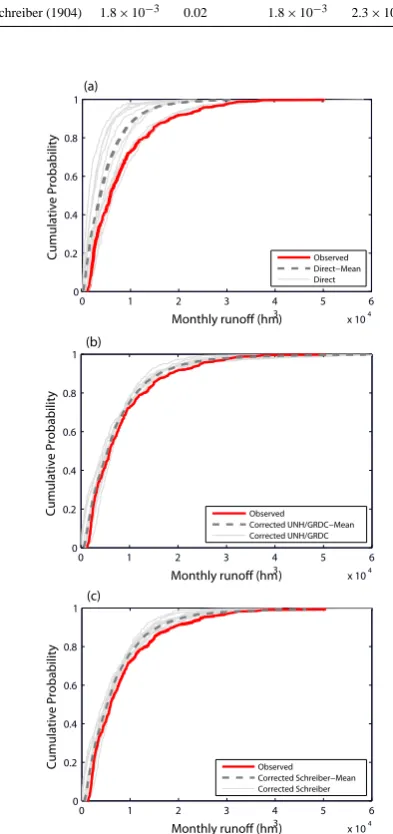
Fig. 6. Monthly distribution of runoff in Spain. The figures show
the cumulative probability of the mean runoff of every month of the entire period of analysis (1961–1990). The comparison is made between the observed data and (a) direct runoff, (b) bias cor-rected runoff by UNH/GRDC dataset and (c) bias corcor-rected runoff by Schreiber (1904). Red line is observed monthly distribution of runoff; grey lines are monthly distributions of runoff simulated by the 10 RCMs, and dotted line is the mean of the simulations.
4.4 Regime curves
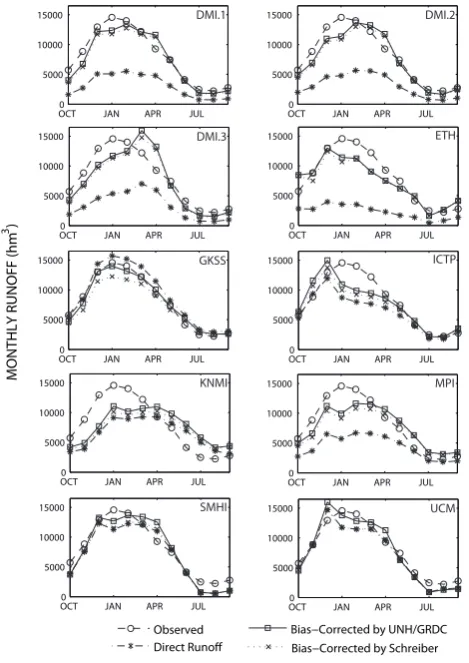
Figure 7 shows the mean monthly surface runoff values in Spain for each of the 10 RCM simulations utilised in this study. The observed runoff values are compared to runoff corrected by Schreiber’s formula for the DMI.3 RCM simu-lation, the runoff corrected by UNH/GRDC dataset and di-rect runoff from RCMs. The monthly values in the figure represent the 30-yr mean behaviour (1961–1990). Generally, the regime curves of the corrected RCM series show a re-duction of the differences between the regimes derived from the direct runoff and adequately represent the predominant seasonal cycle of the observed regime. Nonetheless, there are certain seasonal discrepancies that vary from one model to another. The GKSS, SMHI and UCM models more ade-quately represent the observed seasonal cycle. The DMI.1, DMI.2, DMI.3, KNMI and MPI models tend to underesti-mate the observed values during autumn and winter, and the ICTP and ETH models underestimate the values in winter and spring.
[image:10.595.62.259.135.553.2]OCT0 JAN APR JUL 5000
10000 15000
OCT JAN APR JUL
0 5000 10000 15000
OCT0 JAN APR JUL
5000 10000 15000
OCT0 JAN APR JUL
5000 10000 15000
OCT JAN APR JUL
0 5000 10000 15000
OCT0 JAN APR JUL
5000 10000 15000
OCT JAN APR JUL
0 5000 10000 15000
OCT JAN APR JUL
0 5000 10000 15000
OCT JAN APR JUL
0 5000 10000 15000
OCT0 JAN APR JUL
5000 10000 15000
Observed Direct Runoff
Bias−Corrected by UNH/GRDC Bias−Corrected by Schreiber
MONTHLY RUNOFF (hm
3 )
DMI.1 DMI.2
DMI.3 ETH
GKSS ICTP
KNMI MPI
[image:11.595.310.544.61.275.2]SMHI UCM
Fig. 7. Comparison of mean monthly runoff in mainland Spain
for the 10 RCM simulations obtained from observed values, direct runoff, bias corrected by UNH/GRD dataset and bias corrected by Schreiber’s formula (mean of period 1961–1990). The acronyms of the RCM simulations are defined in Table 2.
5 Discussion and conclusions
This study explores different alternatives that utilise RCM simulations to generate surface runoff time series that ap-proximate observed values and that comprise the basis for generating a design series that, when introduced into man-agement models, will allow us to evaluate the impacts on water availability under future scenarios of climate change. Considering the absence of a correctly calibrated hydrologic model when working on a large scale, this study analysed four interpolation procedures for downscaling surface runoff at the river basin scale. Different alternatives were also con-sidered, particularly with regard to the measure to which each of them approximates the observed values.
Using fit capability indicators, the behaviour of the group of Spanish basins was evaluated using four interpolation pro-cedures: CRU-D, CRU-I, O-D and O-I. The cumulative prob-ability curves (for the bias and the index of agreement values) show that the O-D method minimises deviation with respect to the observed values. This result indicates that the O-D
−2 −1 0 1
Direct UNH/GRDC
Schreiber NorI
−2 −1 0 1
NorII
−2 −1 0 1
NorIII
−2 −1 0 1
Direct UNH/GRDC
Schreiber Gal
−2 −1 0 1
Ebr
−2 −1 0 1
Cat
Sou Seg
−2 −1 0 1
Direct UNH/GRDC
Schreiber
Juc
−2 −1 0 1 −2 −1 0 1
Due Taj GnaI
−2 −1 0 1
Direct UNH/GRDC
Schreiber
−2 −1 0 1 −2 −1 0 1
GnaII Gqv Spain
−2 −1 0 1
Direct UNH/GRDC
Schreiber
−2 −1 0 1 −2 −1 0 1
[image:11.595.51.286.62.394.2]NS
Fig. 8. Nash-Sutcliffe (NS) efficiency coefficients of the 30-yr
aver-age monthly mean of direct and corrected surface runoff for Spain and its 14 river basin districts. The boxplots show the NS obtained by the 10 RCM simulations. The lines extend up to 1.5 times the interquartile range to the right and left of the box. The box extends from the 25th percentile to the 75th percentile. The line within the box indicates the median of the simulations. The black point shows the mean of the simulations, and red crosses outside the box indicate the outliers. The river basin district code is defined in Table 1.
method is the best procedure to determine the runoff series for a given river basin using RCM outputs. It is easiest to de-termine the values of the variables in each basin based on the influence of the nearest point in the grid that corresponds to the climate model simulation. Similar results were obtained for the runoff series generated by the climate formulas and the UNH/GRDC dataset. Others studies (for example, Wood et al., 2004) have also used spatial disaggregation techniques on RCM outputs.
surface runoff. Other studies (e.g. Sankarasubramanian and Vogel, 2002; Arora, 2002; Potter and Zhang, 2009; McMa-hon et al., 2011) have also satisfactorily evaluated surface runoff using the formulas proposed by Schreiber (1904), Ol’dekop (1911), Budyko (1948), Turc (1954)-Pike (1964) and Zhang et al. (2001).
Of the five functional forms of the aridity index, Schreiber’s formula generates mean annual surface runoff values that minimise error compared to observed data. The least favourable results were obtained with the direct surface runoff method, with the exception of the GKSS, SMHI and UCM models, whose goodness-of-fit indicators show supe-rior behaviour compared to results obtained with Schreiber’s formula. In addition, the UNH/GRDC values show better agreement with observed values compared to results obtained with climate formulas and direct runoff. This result confirms that, as established by Fekete et al. (2002), the combina-tion of a water balance model and contribucombina-tions of the main hydrologic stations of the world can generate mean annual runoff fields that are consistent with observed values, pre-serving the spatial accuracy for large-scale domains. Com-parison of climate formulas and direct runoff reveals that, de-spite the fact that they were not based on a model specifically conceived for the study of surface runoff, Schreiber’s for-mula applied to the DMI.3 model presents results similar to those obtained with the UNH/GRDC dataset. Similarly, Vo-gel et al. (1999) and Sankarasubramanian and VoVo-gel (2003) determined that, on a large scale and without requiring the assumption of a model or a calibration strategy, the use of non-parametric estimators, such as those based on the aridity index to determine surface runoff, give results that are com-parable to those obtained with a basin model.
The findings reported in this study show that the corrected runoff improves the direct runoff simulated by the RCMs. However, the K-S test of the corrected monthly distribution of runoff indicates that only some of the RCMs and the aver-age of them are capable to reproduce the observed behaviour. The application of the bias-correction method to the di-rect runoff of the RCMs decreases the deviation to the 30-yr average observed values. Evaluation of the regime curves of direct runoff simulated by the RCMs and corrected with the UNH/GRDC dataset and Schreiber’s formula applied to the DMI.3 model in Spain has demonstrated a greater accu-racy in matching the observations using the annual correc-tion factor based on UNH/GRDC dataset. Thus, for the con-trol scenario, the best alternative for correcting the monthly runoff series simulated by RCMs is to use the global sur-face runoff information given by the UNH/GRDC dataset. However, it is also worth mentioning that the series corrected with Schreiber’s formula give good values for the NS coef-ficient and do not differ significantly from the UNH/GRDC results obtained for mainland Spain. In some cases, the for-mer alternative actually shows improved performance when the behaviour is evaluated at the RBD level. It is noteworthy that, when working with accumulated basins, some errors of
upstream basins can be compensated for downstream basins. The NS efficiency coefficients in Fig. 8 show different haviours for the different RBDs. Thus, the RBDs that be-long to the Cantabrian, Pyrenees and Mediterranean slopes (North II, Galicia, Ebro, Internal Basins of Catalunya, Se-gura and Jucar) show more accurate results when the bias is corrected with Schreiber’s formula. However, the RBDs that belong to the Atlantic slope (Duero, Tagus, Guadiana and Guadalquivir) show more satisfactory results when the bias is corrected with the UNH/GRDC dataset. The different ca-pability of performance obtained by the two alternatives may be caused by the following: (1) the deficiency of the RCMs to simulate the climatic variables in arid and semi-arid re-gions, (2) the UNH/GRDC dataset has been calibrated in the Spanish gauging stations that belong to the RBDs that give the better performance results with this alternative, (3) the in-ability of the climate formulas to capture the impact of rapid precipitation events over arid and semi-arid regions and (4) the basin’s size. However, both the UNH/GRDC dataset and Schreiber’s formula improve the performance of the RCMs and can be used to correct the bias of the direct surface runoff simulations. The existing literature contains several studies that focus on bias correction of the temperature and precip-itation variables, the results of which are then used in the hydrologic models to determine surface runoff values (e.g. Fujihara et al., 2008; Piani et al., 2010b). However, this study underscores the importance of correcting the bias of the di-rect surface runoff simulated by RCMs, suggesting that the accuracy of the results of the corrected monthly series may be comparable to those obtained by other studies (e.g. Hay et al., 2002; Hay and Clark, 2003).
A shortcoming of annual models, such as the formulas based on the aridity index described here, is the inability to track changes in soil moisture and the loss of important sea-sonal variability which exists in many regions. Because the corrected monthly surface runoff series are obtained from di-rect runoff in RCM simulations, the monthly, seasonal and year-to-year variability in the current climate situation will depend on the characteristics of each RCM. The results de-picted in Fig. 7 show a general trend toward accurate repsentation of the observed seasonal cycles. However, the re-sults differ from one climate model to another. The GKSS model best represents the observed seasonal cycles for main-land Spain.
Despite the fact that RCM-generation of surface runoff uses simple simulation methods and is not necessarily de-signed to calculate the stream flow values with the accuracy of a hydrologic model, results obtained by this method reflect the general trends of water balance. In addition, the errors that can exist can be directly linked to errors within the vari-ables related to the hydrologic cycle, which are errors that cannot be eliminated even by the most sophisticated hydro-logic models.
In general, the findings of this study conclude that, for using direct surface runoff outputs from RCMs, the O-D interpolation method at basin scale and the bias-correction with annual factors given by the UNH/GRDC dataset or Schreiber’s climate formula alternatives are necessary in or-der to obtain simulated monthly runoff that most closely ap-proximates the observed values.
Acknowledgements. This research has been supported by MAEC
– AECID (Ministry of Foreign Affairs and Cooperation – Spanish Agency for International Cooperation) through its scholarships for foreigners to doctoral studies, European Commission CIRCE project (contract no. 036961), ARCO project (200800050084350) of the Spanish Ministry of Environment, Rural and Marin Affairs (MARM) and CYTED Action VIAGUA (410AC0399). Data have been provided through the PRUDENCE data archive, funded by the European Union through contract EVK2-CT2001-00132.
Edited by: M. Vanclooster
References
Adam, J. C. and Lettenmaier, D. P.: Adjustment of global gridded precipitation for systematic bias, J. Geophys. Res., 108, 42–57, 2003.
´
Alvarez, J., S´anchez, A., and Quinta, L.: SIMPA, a GRASS based tool for Hydrological Studies, Proceedings of the FOSS/GRASS users Conference, Bangkok, Thailand, 12–14 September, 2004. Arnell, N. W.: Climate change and water resources, Global Environ.
Change, 9, S31–S49, 1999.
Arora, V. K.: The use of the aridity index to assess climate change effect on annual runoff, J. Hydrol. 265, 164–177, 2002. B´ardossy, A. and Pegram, G.: Downscaling precipitation
using regional climate models and circulation patterns towards hydrology, Water Resour. Res., 47, W04505, doi:10.1029/2010WR009689, 2011.
Bergstr¨om, S., Carlsson, B., Gardelin, M., Lindstr¨om, G., Petters-son, A., and Rummukainen, M.: Climate change impacts on runoff in Sweeden-assessments by global climate models, dy-namical downscaling and hydrological modeling, Clim. Res., 16, 101–112, 2001.
Budyko, M. I.: Evaporation under natural conditions, Gidrom-eteorizdat, Leningrad, USSR, English translation by IPST, Jerusalem, 1948.
Buytaert, W., C´elleri, R., and Timbe, L.: Predicting climate change impacts on water resources in the tropical Andes: the ef-fects of GCM uncertainty, Geophys. Res. Lett., 36, L07406, doi:10.1029/2008GL037048, 2009.
Chen, J., Brissette, F. P., and Leconte, R.: Uncertainty of downscal-ing method in quantifydownscal-ing the impact of climate change on hy-drology, J. Hydrol., 401, 190–202, 2011.
Christensen, J. H., Carter, T. R., Rummukainen, M., and Amana-tidis, G.: Evaluating the performance and utility of regional cli-mate models: the PRUDENCE Project, Clicli-mate Change, 81, 1–6, 2007.
Christensen, J. H., Boberg, F., Christensen, O. B., and Lucas-Picher, P.: On the need for bias correction of regional climate change projections of temperature and precipitation, Geophys. Res. Lett., 35, L20709, doi:10.1029/2008GL035694, 2008. Conover, W. J.: Practical Nonparametric Statistics, 2nd Edn. Wiley,
New York, 1980.
Daly, C., Gibson, W. P., Taylor, G. H., Johnson, G. L., and Pasteris, P.: A knowledge-based approach to the statistical mapping of cli-mate, Clim. Res., 22, 99–113, 2002.
D´equ´e, M.: Frequency of precipitation and temperature extremes over France in an anthropogenica scenario: Model results and statistical correction according to observed values, Global Planet. Change, 57, 16–26, 2007.
D´equ´e, M., Jones, R. G., Wild, M., Giorgi, F., Christensen J. H., Hassell, D. C., Vidale, P. L., Rockel, B., Jacob, D., Kjellstr¨om, E., Castro, M., Kucharski, F., and van den Hurk, B.: Global high resolution versus limited area model climate change projections over Europe: quantifying confidence level from PRUDENCE re-sults, Clim. Dynam., 25, 653–670, 2005.
Dibike, Y. B. and Coulibaly, P.: Hydrologic impact of climate change in the Saguenay watershed: comparison of downscaling methods and hydrologic models, J. Hydrol., 307, 145–163, 2005. D¨oll, P., Kaspar, F., and Lehner, B.: A global hydrological model for deriving water availability indicators: model tuning and vali-dation, J. Hydrol., 270, 105–134, 2003.
D¨oll, P., Berkhoff, K., Bormann, H., Fohrer, N., Gerten, D., Hage-mann, S., and Krol, M.: Advances and visions in large-scale hydrological modelling: findings from the 11th Workshop on Large-Scale Hydrological Modelling, Adv. Geosci., 18, 51–61, doi:10.5194/adgeo-18-51-2008, 2008.
Elsner, M. M., Cuo, L., Voisin, N., Deems, J. S., Hamlet, A. F., Vano, J. A., Mickelson, K. E., Lee, S., and Lettenmaier, D. P.: Implications of 21st century climate change for the hydrology of Washington State, Climate Change, 102, 225–260, 2010. Estrela, T. and Quintas, L.: El sistema integrado de modelizaci´on
precipitaci´on aportaci´on (SIMPA), Revista de Ingenier´ıa Civil, 104, 43–52, 1996.
Fekete, B. M. and V¨or¨osmarty, C. J.: Uncertainties in precipitation and their impacts on runoff estimates, J. Climate, 17, 294–304, 2004.
Fekete, B. M., V¨or¨osmarty, C. J., and Grabs, W.: Global, Composite Runoff Fields Based on Observed River Discharge and Simulated Water Balances, Rep. 22, Global Runoff data Cent., Koblenz, Germany, available at: http://www.grdc.sr.unh.edu/html/paper/ ReportUS.pdf (last access: 20 June 2011), 1999.
Fekete, B. M., V¨or¨osmarty, C. J., and Grabs, W.: High-resolution fields of global runoff combining river discharge and sim-ulated water balances, Global Biogeochem. Cy., 16, 1042, doi:10.1029/1999GB001254, 2002.
27, 1547–1578, 2007.
Fujihara, Y., Tanaka, K., Watanabe, T., Nagano, T., and Kojiri, T.: Assessing the impacts of climate change of the Seyhan River Basin in Turkey: Use of dynamically downscaled data for hy-drologic simulations, J. Hydrol., 353, 33–48, 2008.
Graham, L. P., Hageman, S., Jaun, S., and Beniston, M.: On inter-preting hydrological change from regional climate models, Cli-mate Change, 81, 97–122, 2007.
Giorgi, F., Hostetler, S. W., and Brodeur, C. S.: Analysis of the sur-face runoff hydrology in a regional climate model, Quart. J. Roy. Meteor. Soc., 120, 161–183, 1994.
Gonz´alez-Zeas, D.: An´alisis hidrol´ogico de los escenarios de cam-bio clim´atico en Espa˜na. Unpublished DEA from Ph.D. Thesis, Technical Universtiy of Madrid, Spain, 2010.
Haerter, J. O., Hagemann, S., Moseley, C., and Piani, C.: Cli-mate model bias correction and the role of timescales, Hy-drol. Earth Syst. Sci., 15, 1065–1079, doi:10.5194/hess-15-1065-2011, 2011.
Hagemann, S. and Gates, D.: Improving a subgrid runoff parameter-ization scheme for climate models by the use of high resolution data derived from satellite observations, Clim. Dynam., 21, 349– 359, 2003.
Hagemann, S. and Jacob, D.: Gradient in the climate change sig-nal of European discharge predicted by a multi-model ensemble, Climate Change, 81, 309–327, 2007.
Hagemann, S., Machenhauer, B., Jones, R., Christensen, O. B., D´equ´e, M., Jacob, D., and Vidale, P. L.: Evaluation of water and energy budgets in regional climate models applied over Europe, Clim. Dynam., 23, 547–567, 2004.
Hall, M. J.: How well does you model fit the data?, J. Hydroinform., 3, 49–55, 2001.
Hargreaves, G. H. and Samani, Z. A.: Estimating potential evapo-transpiration, J. Irrig. Drain. E.-ASCE, 108, 225–230, 1982. Hay, L. E. and Clark, M. P.: Use of statistically and dynamically
downscaled atmospheric model output for hydrologic simula-tions in three mountainous basins in the western United States, J. Hydrol., 282, 56–75, 2003.
Hay, L. E., Clark, M. P., Wilby, R. L., Gutowski Jr., W. J., Leaves-ley, G. H., Pan, Z., Arritt, R. W., and Takle, E. S.: Use of regional climate model output for hydrologic simulations, J. Hydromete-orol., 3, 571–590, 2002.
Hewitson, B. C. and Crane, R. G.: Large-scale atmospheric controls on local precipitation in tropical Mexico, Geophys. Res. Lett., 19, 1835–1838, 1992.
Hijmas, R. J., Cameron, S. E., Parra, J. L., Jones, P. G. and Jarvis, A.: Very high resolution interpolated climate surfaces for global land areas, Int. J. Climatol., 25, 1965–1978, 2005.
Hurk, B., Hirschi, M., Sch¨ar, C., Lenderink, G., Meijgaard, E., Ulden, A., Rockel, B., Hagemann, S., Grahan, P., Kjellstr¨om, E., and Jones, R.: Soil control on runoff response to climate change in regional climate model simulations, J. Climate, 18, 3536–3551, 2004.
Janssen, P. H. M. and Heuberger, P. S. C.: Calibration of process-oriented models, Ecol. Model., 83, 55–66, 1995.
Krause, P., Boyle, D. P., and B¨ase, F.: Comparison of different effi-ciency criteria for hydrological model assessment, Adv. Geosci., 5, 89–97, doi:10.5194/adgeo-5-89-2005, 2005.
Kidson, J. W. and Thompson, C. S.: A comparison of statistical and model-based downscaling techniques for estimating local
climate variations, J. Climate, 11, 735–753, 1998.
Kirchner, J. W.: Getting the right answers for the right rea-sons: Linking measurements analysis and models to advance the science of hydrology, Water Resour. Res., 42, W03S04, doi:10.1029/2005WR004362, 2006.
Klein, J., Frei, C., Gurtz, J., L¨uthi, D., Vidale, P. L., and Sch¨ar, C.: Hydrologic simulations in the Rhine basin driven by a regional climate model, J. Geophys. Res., 110, D04102, doi:10.1029/2004JD005143, 2005.
Leander, R. and Buishand, T. A.: Re-sampling of regional climate model output for the simulation of extreme river flows, J. Hy-drol., 332, 487–496, 2007.
Leavesley, G. H., Markstrom, S. L., Restrepo, P. J., and Viger, R. J.: A modular approach to addressing model design, scale, and pa-rameter estimation issues in distributed hydrological modelling, Hydrol. Process., 16, 173–187, 2002.
Legates, D. R. and McCabe Jr., G. J.: Evaluating the use of “good-ness of fit” measures in hydrologic and hydroclimatic model val-idation, Water Resour. Res., 35, 233–241, 1999.
Leung, L. R., Mearns, L. O., Giorgi, F., and Wilby, R. L.: Regional climate research, B. Amer. Meteorol. Soc., 84, 89–95, 2003. Lettenmaier, D. P., Wood, A. W., Palmer, R. N., Wood, E. F., and
Stakhiv, E. Z.: Water resources implications of global warm-ing: A U.S. regional perspective, Climatic Change, 43, 537–579, 1999.
MacMahon, T., Peel, M. C., Pegram, G. G. G., and Smith, I. N.: A simple methodology for estimating mean and variability of an-nual runoff and reservoir yield under present and future climates, J. Hydrometeorol., 12, 135–146, 2011.
MARM: Metodolog´ıas de Evaluaci´on de los Sistemas de Ex-plotaci´on de Recursos H´ıdricos, Centro de Estudios y Exper-imentaci´on de Obras P´ublicas (CEDEX), Ministerio de Medio Ambiente y Medio Rural y Marino, Spain, 1998.
MARM, Ministry of Environment, Ministerio de Medio Ambi-ente: White Paper Book of Water in Spain. Libro Blanco del Agua en Espa˜na. Secretar´ıa de Estado de Aguas y Costas, avail-able at: http://www.mma.es/rechid/librob/index.htm (last access: 10 July 2011), 2000.
Maraun, D., Wetterhall, F., Ireson, A. M., Chandler, R. E., Kendon, E. J., Widmann, M., Brienen, S., Rust, H. W., Sauter, T., Themessl, M., Venema, V. K. C., Chun, K. P., Goodess, C. M., Jones, R. G., Onof, C., Vrac, M., and Thiele-Eich, I.: Precipita-tion downscaling under climate change: Recent developments to bridge the gap between dynamical models and the end user, Rev. Geophys., 48, RG3003, doi:10.1029/2009RG000314, 2010. Moriasi, D. N., Arnold, J. G., Van Liew, M. W., Bingner, R. L.,
Harmel, R. D., and Velth, T.: Model evaluation guidelines for systematic quantification of accuracy in watershed simulations, T. ASABE, 50, 885–900, 2007.
Murphy, J.: An evaluation of statistical and dynamical techniques for downscaling local climate, J. Climate, 12, 2256–2284, 1999. Nash, J. E. and Sutcliffe, J. V.: River flow forecasting through con-ceptual models, Part I – A discussion of principles, J. Hydrol., 10, 282–290, 1970.
Ol’dekop, E. M.: On evaporation from de surface of river basins, Trans.Met.Obs. lur-evskogo, Univ. Tartu 4, 1911 (in Russian). Piani, C., Haerter, J. O., and Coppola, E.: Statistical bias correction
for daily precipitation in regional climate models over Europe, Theor. Appl. Climatol., 99, 7866–7873, doi:10.1007/S00704-009-0134-9, 2010a.
Piani, C., Weedon, G. P., Best, M., Gomes, S. M., Viterbo, P., Hage-mann, S., and Haerter, J. O.: Statistical bias correction of global simulated daily precipitation and temperature for the application of hydrological models, J. Hydrol., 395, 199–215, 2010b. Pike, J. G.: The estimation of annual runoff from meteorological
data in a tropical climate, J. Hydrol., 2, 116–123, 1964. Potter, N. J. and Zhang, L.: Interannual variability of catchment
wa-ter balance in Asutralia, J. Hydrol., 369, 120–129, 2009. Schmidli, J., Frei, C., and Vidale, P.: Downscaling from GCM
pre-cipitation: a benchmark for dynamical and statistical downscal-ing methods, Int. J. Climatol., 26, 679–689, 2006.
Schreiber, P.: ¨Uber die Beziehungen zwischen dem Niederschlag und der Wasserf¨uhrung der Fl¨ube in Mitteleuropa, Meteorol. Z., 21, 441–452, 1904.
Sankarasubramanian, A. and Vogel, R. M.: Annual hydroclima-tology in the United States, Water Resour. Res., 38, 1083, doi:10.1029/2001WR000619, 2002.
Sankarasubramanian, A. and Vogel, R. M.: Hydroclimatology of the continental United States, Geophys. Res. Lett., 30, 1363, doi:10.1029/2002GL015937, 2003.
Sharma, D., Das Gupta, A., and Babel, M. S.: Spatial disaggrega-tion of bias-corrected GCM precipitadisaggrega-tion for improved hydro-logic simulation: Ping River Basin, Thailand, Hydrol. Earth Syst. Sci., 11, 1373–1390, doi:10.5194/hess-11-1373-2007, 2007. Silberstein, R. P.: Hydrological models are so good, do we still need
data?, Environ. Modell. Softw., 21, 1340–1352, 2006.
Sperna Weiland, F. C., van Beek, L. P. H., Kwadijk, J. C. J., and Bierkens, M. F. P.: The ability of a GCM-forced hydro-logical model to reproduce global discharge variability, Hy-drol. Earth Syst. Sci., 14, 1595–1621, doi:10.5194/hess-14-1595-2010, 2010.
Sperna Weiland, F. C., van Beek, L. P. H., Weerts, A. H., and Bierkens, M. F. P.: Extracting information from ensemble of GCMs to reliably assess future global runoff change, J. Hydrol., 412–413, 66–75, 2012.
Strzepek, K. M. and Yates, D. N.: Climate change impacts on the hydrologic resources of Europe: a simplified continental scale analysis, Climatic Change, 36, 79–92, 1997.
Terink, W., Hurkmans, R. T. W. L., Torfs, P. J. J. F., and Uijlenhoet, R.: Evaluation of a bias correction method applied to downscaled precipitation and temperature reanalysis data for the Rhine basin, Hydrol. Earth Syst. Sci., 14, 687–703, doi:10.5194/hess-14-687-2010, 2010.
Thornton, P. E., Running, S. W., and White, M. A.: Generating sur-faces of daily meteorology variables over large regions of com-plex terrain, J. Hydrol., 190, 214–251, 1997.
Turc, L.: Le bilan d’eau des sols. Relation entre la pr´ecipitation, l’´evaporation et l’´ecoulement, Ann. Agron. 5, 491–569, 1954.
Varis, O., Kajander, T., and Lemmel¨a, R.: Climate and water: from climate models to water resources management and vice versa, Climatic Change, 66, 321–344, 2004.
Vicuna, S. and Dracup, J. A.: The evolution of climate change im-pact studies on hydrology and water resources in California, Cli-matic Change, 82, 327–350, 2007.
Vogel, R. M., Wilson, I., and Daly, C.: Regional regression models of annual streamflow for the United States, J. Irrig. Drain. E.-ASCE, 125, 148–157, 1999.
Von Storch, H., Zorita E., and Cubasch, U.: Downscaling of global climate change to regional scales: an aplication to iberian rainfall in wintertime, J. Climate, 6, 1161–1171, 1993.
Wei, H., Gutowski, W. J., Vorosmarty, C. J., and Fekete, B. M.: Calibration and validation of a regional climate model for pan-Artic hydrologic simulation, J. Climate, 15, 3222–3236, 2002. Wilby, R. L., Hay, L. E., Gutowski Jr., W. J., Arritt, R. W., Takle,
E. S., Pan, Z., Leavesley, G. H., and Clark, M. P.: Hydrologi-cal responses to dynamiHydrologi-cally and statistiHydrologi-cally downsHydrologi-caled climate model output, Geophys. Res. Lett., 27, 1199–1202, 2000. Wilby, R. L., Charles, S. P., Zorita, E., Timbal, B., Whetton, P., and
Mearns, L. O.: Guidelines for use of climate scenarios developed from statistical downscaling methods, IPCC task group on data and scenario support for impacts and climate analysis, 2004. Willmott, C. J.: On the validation of models, Phys. Geogr., 2, 184–
194, 1981.
Willmott, C. J.: Some comments on the evaluation of model perfor-mance, B. Am. Meteorol. Soc., 63, 1309–1369, 1982.
Willmott, C. J., Ackleson, S. G., Davis, R. E., Feddema, J. J., Klink, K. M., Legates, D. R., O’Donnell, J., and Rowe, C. M.: Statistics for the Evaluation and Comparison of Models, J. Geophys. Res., 90, 8995–9005, 1985.
Wisser, D., Fekete, B. M., V¨or¨osmarty, C. J., and Schumann, A. H.: Reconstructing 20th century global hydrography: a contribution to the Global Terrestrial Network- Hydrology (GTN-H), Hydrol. Earth Syst. Sci., 14, 1–24, doi:10.5194/hess-14-1-2010, 2010. Wolock, D. M. and McCabe, G. J.: Explaining spatial variability
in mean annual runoff in the conterminous United States, Clim. Res., 11, 149–159, 1999.
Wood, A. W., Maurer, E. P., Kumar, A., and Lettenmaier, D. P.: Long range experimental hydrologic forecasting for the eastern U.S., J. Geophys. Res., 107, 4429, doi:10.1029/2001JD000659, 2002.
Wood, A. W., Leung, L. R., Sridhar, V., and Lettermaier, D. P.: Hy-drological implications of dynamical and statistical approaches to downscaling climate model outputs, Climatic Change, 62, 189–216, 2004.
Yates, D. N.: Approaches to continental scale runoff for integrated assessment models, J. Hydrol., 201, 289–310, 1997.