Impact of Preparation Process on the Protein Structure
and on the Volatile Compounds in Eisenia foetida Protein
Powders
Elias Bou-Maroun1, Camille Loupiac1, Aurélie Loison1, Bernadette Rollin1, Philippe Cayot1, Nathalie Cayot1*, Elil Marquez2, Ana Luisa Medina2
1Unité Procédés Alimentaires et Microbiologiques, UMR A 02.102, AgroSup Dijon, Université de Bourgogne, Dijon, France; 2Dpto Ciencia de Alimentos, Grupo Ecología y Nutrición, Facultad de Farmacia y Bioanalisis, Universidad de los Andes, Merida, Vene-zuela.
Email: *[email protected]
Received August 22nd, 2013; revised September 22nd, 2013; accepted September 29th, 2013
Copyright © 2013 Elias Bou-Maroun et al. This is an open access article distributed under the Creative Commons Attribution Li-cense, which permits unrestricted use, distribution, and reproduction in any medium, provided the original work is properly cited.
ABSTRACT
Protein powders from Eisenia foetida were prepared using different drying processes and fractionation. Differential scanning calorimetry was used to show that heat denaturation occurred during the drying process above 42˚C. Protein solubility was also studied. The addition of dissociating reagents allowed concluding that solubility was decreased dur-ing oven drydur-ing due to thermo denaturation includdur-ing hydrogen bonds. The volatile compounds of the different powders were extracted by solid phase micro-extraction and identified by mass spectrometry. Volatile compounds were related to lipid oxidation and Maillard reactions occurring during the preparation of the powders. High drying temperatures led to more volatile compounds resulting from Maillard reactions. In the protein powder preparation process, a fractionation step led to a “pulp fraction” and a “juice fraction” of earthworms. The “pulp fraction” contained less odorant volatile compounds resulting from Maillard reactions than the “juice fraction” did.
Keywords:Eisenia foetida Protein Powder; Drying Process; Protein Structure; Volatile Compounds;
HS-SPME/GC-MS
1. Introduction
Some authors have pointed out the great potential of Eisenia foetida as a non-conventional protein source [1]. They determined that earthworms had a high protein content of about 62% dry weight [2] and that the content of essential amino acids, except for tyrosine [1], was higher than that recommended by the FAO. Earthworms could then have many different nutritional applications as animal feed and as an ingredient in food products for humans. They have already been used in an experimental diet for rainbow trout [3] and as chicken feed [4].
For practical reasons, earthworms were often dried and used as a powder in the different applications. We con-ducted former studies on oven-dried powders. Two main problems were encountered when these earthworm protein powders were used in food products. One was related to the odor properties, and the other to protein denaturation.
Concerning the odor properties, off-flavors can make the powder unacceptable to humans. In fact, the Sol-vent-Assisted-Flavor-Evaporation (SAFE) method was used in a previous study [5] to obtain the volatile fraction from the oven-dried protein powder. Gas chromatogra-phy coupled with mass spectrometry (GC-MS) was then used to analyze this volatile fraction and allow the identi-fication of more than 70 volatile compounds. Among these volatile compounds, some might come from the raw material (i.e. the earthworm itself, its feed and its environment such as earth, water…); others might be due to microbiological modifications or to lipid peroxidation. Additionally, in the case of protein powder, drying is a crucial step because it may concentrate off-flavors and/or create new odorant compounds. The most abundant chemical groups found in the volatile fraction of the earthworm powder were ketones (29%) including unde-can-2-one, alcohols (21%) including pentan-1-ol, and
aldehydes (15%) including hexanal. Pyrazines (10%) were also a major chemical group and could be consid-ered a product generated during drying as a result of thermally induced reactions. In fact, Maillard reactions are known to give alkylpyrazines, or benzene acetalde-hyde among many other volatile compounds [6]. Some of the aldehydes and acids found in the volatile fraction may come from the degradation of lipids. In fact, the first step of lipid oxidation generates hydroperoxides, the de-composition of which leads to the formation of aldehydes, acids, esters and hydrocarbons. For example, model ex-periments of the autoxidation of oleic, linoleic and lino-lenic acids gave pentanal, hexanal, heptanal, E hex-2- enal [7]. This mixture of volatile compounds extracted from the earthworm powder gave it a strong animal odor, which was described by Cayot et al. [5] as “dried fish”. This odor may limit the use of this protein powder in food products.
Nevertheless, dehydrated proteins offer a longer shelf life, and lower storage and transports costs. The tradi-tional methods used to transform protein suspensions into dry powders are spray drying, solar drying, convective hot air drying and freeze drying. A number of effects are observed during the heat-drying (spray, solar and con-vective hot air drying) of protein-containing product, the main effect being the thermal denaturation of protein. Heat causes rapid thermal motion of the atoms leading to rupture of the hydrogen bonds that link them together. Under suitable conditions, thermal denaturation leads to coagulation. During the process, peptide chains are pro- pagated and form agglomerates. The denatured protein is insoluble [8]. As a low temperature process, freeze-dry- ing is a known method to ensure the long-term stability of high-value or therapeutic proteins that are not stable enough in aqueous solutions and that are very sensitive to heat. However, some proteins are also sensitive to the stresses imposed by freeze drying and can be degraded or decomposed during the process [9]. The low temperature of freeze drying does not guarantee protein stability be- cause some proteins also experience cold denaturation. Moreover, freeze drying is costly in terms of both time and energy, and can therefore only be used to dry high value proteins.
For these reasons, different processes to kill the earthworms, to crush them and to dry the different frac-tions obtained were tested in the present study. Two main types of drying process were used, oven drying (60˚C during 4 h) and, for reference in terms of protein struc-ture preservation, freeze drying. The volatile compounds were extracted from the protein powder by Headspace Solid Phase Micro Extraction HS-SPME, and were fur-ther analyzed by GC-MS. Protein denaturation was checked by Differential Scanning Calorimetry (DSC) and
solubility measurements.
The aim of the study was to understand the impact of preparation process on volatile composition and on pro-tein denaturation, in order to obtain fractions as odor-free as possible and with proteins as little denatured as possi-ble.
2. Materials and Methods
2.1. Preparation of Protein Powder: From the Compost to the Dried Earthworm Powder
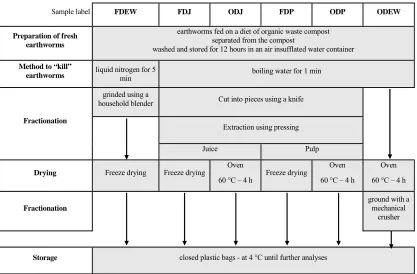
Samples were obtained from the species Eisenia foetida at the adult stage of development (3 months), with aver-age length and weight of 8.5 cm and 0.45 g respectively (earthworm cultures from “Luis Ruiz Terán” Herbarium at the Faculty of Pharmacy, University of the Andes, Merida-Venezuela). The earthworms were fed on a diet of organic waste compost, obtained from a university canteen in the region. In order to guarantee optimum growth conditions, the temperature, moisture and pH of the compost were kept under control. A single batch of earthworm powder was prepared as follows and used throughout the study. Different preparation processes were then applied as summarized in Figure 1 and the
dried protein-rich powders obtained were stored until further analyses. The data we referred to in the introduc-tion part were corresponding to ODEW sample of the present study.
2.2. Composition of the Eisenia foetida Powders
2.2.1. Water Content
The moisture content of each powder was determined in triplicate using volumetric Karl Fisher titrimetry. This chemical method allowed the determination of the water content with a reproducibility of 0.5%. The titration was checked with a water standard at 1% (Epura, Merk). A Karl Fisher titration apparatus from Mettler Toledo (DL38, Inc., Columbus, OH, USA) was used.
2.2.2. Protein Content
Sample label FDEW FDJ ODJ FDP ODP ODEW
Preparation of fresh earthworms
earthworms fed on a diet of organic waste compost separated from the compost
washed and stored for 12 hours in an air insufflated water container
Method to “kill”
earthworms liquid nitrogen for 5 min boiling water for 1 min
Fractionation
grinded using a
household blender Cut into pieces using a knife
Extraction using pressing
Juice Pulp
Drying Freeze drying Freeze drying
Oven
60 °C – 4 h Freeze drying
Oven
60 °C – 4 h
Oven
60 °C – 4 h
Fractionation
ground with a mechanical
crusher
[image:3.595.91.508.94.368.2]Storage closed plastic bags - at 4 °C until further analyses
Figure 1. Process for the preparation of earthworm protein powders.
the initial boric acid pH (pH 4.6). The conversion factor from nitrogen content to protein content was 6.25.
2.3. Evaluation of Protein Denaturation
2.3.1. Protein Solubility
To determine protein solubility, protein powders were suspended in water at 40 g·L−1 and stirred overnight at 4˚C. The pH of the suspension was adjusted to pH 6 at the end of the stirring step. The suspensions were centri-fuged at 700 g for 30 minutes and the Kjeldahl procedure was used to analyze the protein content as previously described. Some samples of ODEW were suspended at 40 g·L−1 but in the presence of different reagents: 1% w/v of sodium dodecyl sulfate (SDS), 1 mol·L−1 of dithiot-reitol (DTT), or 6 mol·L−1 of urea were added before centrifugation. Biochemical grade urea, SDS and DTT were purchased from Sigma.
2.3.2. Differential Scanning Calorimetry
A microcalorimeter DSC III (Setaram Instrumentation, France) was used to determine the denaturation tempera-ture of the protein suspension. The range of temperatempera-ture chosen for this study was 30˚C to 110˚C, with a tem-perature gradient of 0.5˚C·min−1, and a sample weight of approximately 600 mg (exact weighting) placed in a hermetically closed cell “batch”. Water was used as the reference. The temperature profile of the thermogram
was done using the software of the apparatus (Setsoft, Setaram Instrumentation, France).
2.4. Extraction of Volatile Compounds by Headspace Solid Phase Micro-Extraction (HS-SPME)
For the HS-SPME analysis, 1 g of each protein powder was transferred into a 10 mL vial, which was immedi-ately sealed with a Teflon-lined septum and a screw cap. The equilibration time was 24 h at room temperature. The powder was incubated at 30˚C for 90 min with an agitation of 250 rpm at intervals of 20 s using an auto sampler (Gerstel MPS2). After incubation, the headspace volatiles were extracted using an SPME fiber (2 cm- 50/30 µm DVB/Carboxen/PDMS/StableFlex, Supelco, USA) for 60 min at 30˚C. Finally, for the injection, the fiber was inserted into the GC injection port and de-sorbed for 3 min in splitless mode. The fiber was cleaned at 240˚C for 12 min after each injection. The relative standard deviation of this method was calculated by ana-lyzing the ODEW sample five times and was equal to 2.17%. The other samples were analyzed twice.
2.5. Gas Chromatography Mass Spectrometry Analysis (GC-MS)
equipped with a fused-silica capillary column (30 m × 0.32 mm ID, 0.5 m film thickness) coated with a DB-Wax stationary phase (J & W Scientific, USA). The instrument was equipped with an injection port operating at 240˚C. Helium was used as the carrier gas and the chromatographic temperature was programmed from 40˚C to 240˚C at a rate of 4˚C/min, with a final isotherm of 10 min. Mass spectrometry was taken in the electron ionization mode at 70 eV and the scan range between 29 and 350 amu. The ion source was set at 230˚C and the transfer line at 240˚C. Compounds were identified by comparison with mass spectra libraries (WILLEY138, NIST, and INRA database) and by calculating and com-paring the GC retention index of a series of alkanes (C8 to C30) with the retention index from published data calculated under the same conditions.
2.6. Statistical Data Analysis
The absolute area values of the four compounds chosen as related with heating process (hexanal, 2-pentyl furan, 2,6-dimethylpyrazine and benzaldehyde) were first cen-tred and reduced in order to attribute the same impor-tance to the four variables (four compounds). Standard-ized data were submitted to a hierarchical clustering analysis using Euclidean distances and Ward’s aggrega-tion method in order to identify homogeneous subgroups of powders. Then, the subgroups were verified by k-means clustering, calculated on the standardized data and using the un-scaled squared Euclidean distances. In fact, three k-means algorithms were made in parallel in order to verify the stability of the subgroups. Data analy-sis was done using the Statistica software (version 10).
3. Results and Discussion
3.1. Impact of the Preparation Process on the Protein Structure and Solubility
Differential scanning calorimetry was used to determine the impact of the preparation process on protein structure for the traditional powder (ODEW) and for a powder prepared without any heating step, neither during “kill-ing” of earthworms, nor during drying (FDEW). Figure 2 presents typical thermograms obtained by DSC on
suspensions of freeze dried (FDEW) and oven dried (ODEW) protein powders. It was not possible to observe any endothermic peak on samples that had been dried in the oven at 60˚C as ODEW. The thermogram obtained for samples which had been freeze dried (FDEW) exhib-ited an endothermic peak at 42˚C, indicating that a dena-turation process of non-denatured proteins had occurred during DSC at this temperature. As a consequence, FDEW can be considered a reference for earthworm powder as non-denatured protein and the powders that
30 40 50 60 70 80 90 100 110
1,2 1,4 1,6 1,8 2,0
He
at fl
ow
(
m
W)
Temperature (? )
40g/L, pH6 42?
oven
temperature FDEW
42˚C
ODEW
[image:4.595.312.534.95.259.2]˚C
Figure 2. Thermograms obtained by differential scanning calorimetry of oven dried earthworm powder (ODEW, black line) and freeze dried earthworm powder (FDEW, bold line) (exo up).
had been prepared at temperatures above 42˚C thus pre-sented flat thermograms.
Preliminary studies on solubility were done from pH 2 to pH 8 on FDEW and on ODEW, and showed that maximum solubility was obtained for pH 6 and above (data not shown). As a pH value compatible with food products, pH 6 was selected to continue the study. Solu-bility at this pH value was 43% ± 22% for ODEW and 117% ± 27% for FDEW (value above 100% was due to the precision of the method). FDEW was thus less dena-tured than ODEW but also far more soluble.
It is well established that the functionality of proteins is strongly influenced by the processing conditions. The lack of solubility can be due to protein aggregation via covalent or non-covalent bonding. For example, heating whey proteins leads to denaturation of the whey proteins and beta-lactoglobulin, which modifies the availability of some free thiol groups. These free thiol groups can react with disulphide bonds, or can react with another thiol group to form a disulphide bond [11]. Non-covalent bonding can include the modification of dipole-dipole interactions, hydrogen bonds, or hydrophobic interactions.
between cysteine residues [15].
In our experiments, the addition of DTT did not change the solubility of ODEW (36% ± 14%). In the presence of SDS, the solubility increased to 64% ± 19%, and finally, the addition of urea led to 100% ± 19% solubility. It can then be concluded that the loss of solubility of earthworm protein due to heat denaturation involved hydrogen bonds and probably also hydrophobic interactions.
From these experiments on protein structure and
solu-bility, FDEW rather than ODEW should be considered the reference for the preparation of earthworm powder. It was thus important to check the impact of the preparation process also on the volatile composition of these two powders.
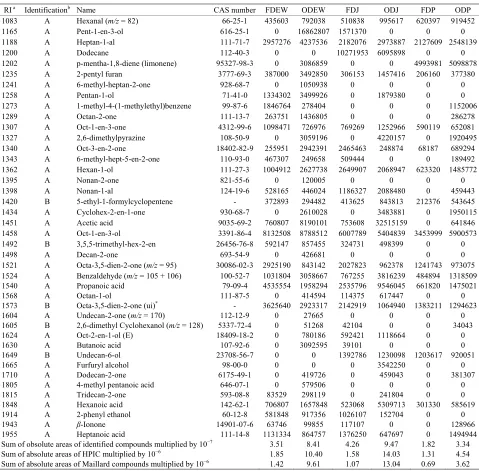
The volatile compounds were identified for the whole powders, for two fractions of earthworms and for the two drying processes and were reported in Table 1. Among
[image:5.595.59.538.238.709.2]the identified compounds, some compounds are strongly
Table 1. Volatile compounds identified by GC-MS in an HS-SPME extract from protein powders and their corresponding peak area.
RI a Identificationb Name CAS number FDEW ODEW FDJ ODJ FDP ODP
1083 A Hexanal (m/z = 82) 66-25-1 435603 792038 510838 995617 620397 919452
1165 A Pent-1-en-3-ol 616-25-1 0 16862807 1571370 0 0 0
1188 A Heptan-1-al 111-71-7 2957276 4237536 2182076 2973887 2127609 2548139
1200 A Dodecane 112-40-3 0 0 10271953 6095898 0 0
1202 A p-mentha-1,8-diene (limonene) 95327-98-3 0 3086859 0 0 4993981 5098878
1235 A 2-pentyl furan 3777-69-3 387000 3492850 306153 1457416 206160 377380
1241 A 6-methyl-heptan-2-one 928-68-7 0 1050938 0 0 0 0
1258 A Pentan-1-ol 71-41-0 1334302 3499926 0 1879380 0 0
1273 A 1-methyl-4-(1-methylethyl)benzene 99-87-6 1846764 278404 0 0 0 1152006
1289 A Octan-2-one 111-13-7 263751 1436805 0 0 0 286278
1307 A Oct-1-en-3-one 4312-99-6 1098471 726976 769269 1252966 590119 652081
1327 A 2,6-dimethylpyrazine 108-50-9 0 3059196 0 4220157 0 1920495
1340 A Oct-3-en-2-one 18402-82-9 255951 2942391 2465463 248874 68187 689294
1343 A 6-methyl-hept-5-en-2-one 110-93-0 467307 249658 509444 0 0 189492
1362 A Hexan-1-ol 111-27-3 1004912 2627738 2649907 2068947 623320 1485772
1395 A Nonan-2-one 821-55-6 0 120005 0 0 0 0
1398 A Nonan-1-al 124-19-6 528165 446024 1186327 2088480 0 459443
1420 B 5-ethyl-1-formylcyclopentene - 372893 294482 413625 843813 212376 543645
1434 A Cyclohex-2-en-1-one 930-68-7 0 2610028 0 3483881 0 1950115
1451 A Acetic acid 9035-69-2 760807 8190101 753608 32515159 0 641846
1458 A Oct-1-en-3-ol 3391-86-4 8132508 8788512 6007789 5404839 3453999 5900573
1492 B 3,5,5-trimethyl-hex-2-en 26456-76-8 592147 857455 324731 498399 0 0
1498 A Decan-2-one 693-54-9 0 426681 0 0 0 0
1521 A Octa-3,5-dien-2-one (m/z = 95) 30086-02-3 2925190 843142 2027823 962378 1241743 973075 1524 A Benzaldehyde (m/z = 105 + 106) 100-52-7 1031804 3058667 767255 3816239 484894 1318509
1540 A Propanoic acid 79-09-4 4535554 1958294 2535796 9546045 661820 1475021
1568 A Octan-1-ol 111-87-5 0 414594 114375 617447 0 0
1573 B Octa-3,5-dien-2-one (ui)* - 3625640 2923317 2142919 1064940 1383211 1294623
1604 A Undecan-2-one (m/z = 170) 112-12-9 0 27665 0 0 0 0
1605 B 2,6-dimethyl Cyclohexanol (m/z = 128) 5337-72-4 0 51268 42104 0 0 34043
1624 A Oct-2-en-1-ol (E) 18409-18-2 0 780186 592421 1118664 0 0
1630 A Butanoic acid 107-92-6 0 3092595 39101 0 0 0
1649 B Undecan-6-ol 23708-56-7 0 0 1392786 1230098 1203617 920051
1665 A Furfuryl alcohol 98-00-0 0 0 0 3542250 0 0
1710 A Dodecan-2-one 6175-49-1 0 419726 0 459043 0 381307
1805 A 4-methyl pentanoic acid 646-07-1 0 579506 0 0 0 0
1815 A Tridecan-2-one 593-08-8 83529 298119 0 241804 0 0
1848 A Hexanoic acid 142-62-1 706807 1657848 523068 5309713 301330 585619
1914 A 2-phenyl ethanol 60-12-8 581848 917356 1026107 152704 0 0
1943 A β-Ionone 14901-07-6 63746 99855 117107 0 0 128966
1955 A Heptanoic acid 111-14-8 1131334 864757 1376250 647697 0 1494944
Sum of obsolute areas of identified compounds multiplied by 10−7 3.51 8.41 4.26 9.47 1.82 3.34
Sum of absolute areas of HPIC multiplied by 10−6 1.85 10.40 1.58 14.03 1.31 4.54
Sum of absolute areas of Maillard compounds multiplied by 10−6 1.42 9.61 1.07 13.04 0.69 3.62 *ui = Unidentified isomer. aRetention index calculated with a DB-Wax stationary phase using a series of alkanes between C8 and C30. bA, compounds
dependent on thermal treatments: 1) Benzaldehyde comes from Strecker degradation and is known to be a Maillard reaction product [19,20]. 2) Alkylpyrazines generates from two accepted mechanisms: the Strecker degradation and the ammonia/acyloin reaction. In both mechanisms, the temperature is a determinant factor. 2,6-dimethylpy- razine may come from the thermal degradation of serine or threonine [21]. 3) 2-pentyl furan comes from the ther- mal degradation of linoleic acid [22]. Strecker degrada- tion produced by some lipid oxidation products such as 4,5(E)-epoxy-2(E)-decenal yields 2-pentyl furan [23]. 4) Hexanal is often found to be a major compound in the volatile profile of meat products and is often chosen as an indicator of oxidation in meats, especially during the early oxidative changes [24].
These four compounds were further used to compare the different powders. The term “heat process implicated compounds” (HPIC) will be used here to name these compounds.
3.2. Impact of the Preparation Process on the Volatile Composition of ODEW and FDEW
A global comparison of ODEW and FDEW volatile com- position was done by comparing the sum of identified compounds areas. This comparison shows that ODEW contains 2.4 times more volatiles compounds than FDEW (Table 1). Compounds from various chemical
classes such as aldehydes, alcohols, benzene derivatives, or acids were encountered in both powders. As previ-
ously reported [25], volatile compounds are originated from lipid oxidation, Maillard reactions, and animal feed. Amino acid catabolism, environmental pollutants and the growth of microorganisms have also been reported as possible origins of volatile compounds detected in earth- worm powders [7].
The amount of Maillard reactions products and HPIC was higher in ODEW than in FDEW. 2,6-dimethy- lpyrazine was found in ODEW but not in FDEW. Killing earthworms in boiling water and drying them in a tradi-tional oven favor Maillard reactions due to the higher temperature during the process and, consequently, lead to the production of Maillard compounds in larger quantities.
As many parameters were different in the preparation processes of these two powders, a deeper study of the impact of the drying step and the fractionation step on volatile compounds production was necessary.
3.3. Impact of the Drying Step on the Volatile Composition of the Powders
Each protein fraction was dried using either a traditional oven (ODJ and ODP) or using freeze drying (FDJ and FDP). In order to study the impact of the drying on the volatile composition of the powders, we compared the powders that differ only by the drying step, i.e. the two couples FDJ/ODJ and FDP/ODP.
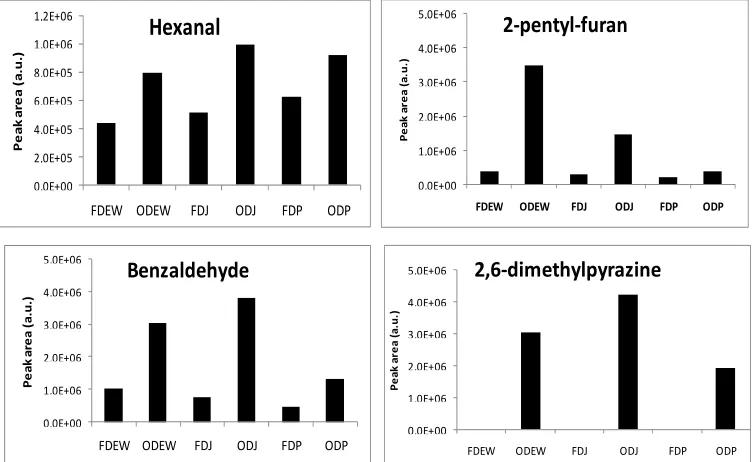
Benzaldehyde, 2,6-dimethylpyrazine and 2-pentyl-fu- ran were chosen as indicators of Maillard reactions and their relative quantities were reported in Figure 3.
0,0E+00 2,0E+05 4,0E+05 6,0E+05 8,0E+05 1,0E+06 1,2E+06
FDEW ODEW FDJ ODJ FDP ODP
Pe a k ar e a (a .u.)
Hexanal
0,0E+00 1,0E+06 2,0E+06 3,0E+06 4,0E+06 5,0E+06FDEW ODEW FDJ ODJ FDP ODP
Pe a k ar e a (a .u .)
2
‐
pentyl
‐
furan
0,0E+00 1,0E+06 2,0E+06 3,0E+06 4,0E+06 5,0E+06
FDEW ODEW FDJ ODJ FDP ODP
Pe a k ar e a (a .u .)
Benzaldehyde
0,0E+00 1,0E+06 2,0E+06 3,0E+06 4,0E+06 5,0E+06FDEW ODEW FDJ ODJ FDP ODP
Pe ak ar e a (a .u .)
2,6
‐
dimethylpyrazine
Figure 3. Absolute peak areas in the different powders obtained by HS-SPME-GC-MS. For 2-pentyl-furan and 2,6 dimethylpyrazine, areas were calculated from the TIC (Total Ion Chromatogram). For hexanal, areas were calculated from
ingle ion m/z = 82 and for benzaldehyde, areas were calculated from single ions m/z = 105 + 106. s
[image:6.595.110.486.464.695.2]Oven dried juice contained 12.2 more Maillard com- pounds than freeze dried one and oven dried pulp con- tained 5.2 more Maillard compounds than the freeze dried one. This is clearly linked with the temperature of the drying process, which is higher in the oven than in the freeze dryer. It is noticeable that 2,6-dimethylpy- razine was found in all oven dried powders but not in freeze dried powders.
Hexanal was chosen as an indicator for lipid oxidation. It occurred in all the powders and its relative quantities found in the different powders were reported in Figure 3.
Here again, oven dried powders contained higher quanti-ties of hexanal than the corresponding freeze dried pow-ders, which is consistent with the fact that lipid oxidation was accelerated by temperature increase. The larger amount of hexanal in oven dried powders in comparison with the freeze dried powders can be related to protein denaturation. Indeed, the oven dried proteins were more denatured than the freeze dried ones. This increases the availability of heme groups which are more efficient catalysts for lipid peroxidation than metal ions are. Belitz et al. [7] have already suggested that the activity of a heme protein towards hydroperoxides is influenced by its steric accessibility to fatty acid hydroperoxides.
Water content was higher in FDJ than in ODJ and it was higher in FDP than in ODP (Table 2). The Maillard
compounds were higher in ODJ than in FDJ and higher in ODP than in FDP. The water content was therefore inversely proportional to the amount of Maillard com-pounds in these powders. Lu et al. [26] have already shown that volatile compounds generated from Maillard reactions increases as water content decreases.
3.4. Impact of the Fractionation Step on the Volatile Composition of the Powders
As detailed in Figure 1, different earthworm powders
were prepared. ODEW was obtained using traditional drying in an oven. FDEW was our reference for less de- natured protein and was done using freeze drying. The soluble fraction (juice) of earthworms was separated from the solid fraction (pulp). Protein content was higher in the pulp fraction than in the juice fraction (Table 2).
Conversely, sugars are supposed to be mainly contained in the soluble fraction. As a consequence, Maillard reac- tions should be reduced in the pulp fraction.
In order to study the impact of the fractionation on the volatile composition of the powders, we compared the powders that differed only by the fractionation step, i.e. the two couples FDJ/FDP and ODJ/ODP. Even though the separation of the two fractions (juice and pulp) was not perfect, and some reducing sugar might remain in the pulp fraction, the quantity of Maillard reactions com- pounds (Table 1) (Benzaldehyde, 2,6-dimethylpyrazine
and 2-pentyl-furan) was found to be 1.6 times lower in the pulp than in the juice for freeze dried powders and 3.6 times lower in the pulp than in the juice for the oven dried powders. This confirmed that reducing sugar was mainly in the juice. Additionally, as the proteins that were oven dried were denatured, NH2 groups of amino acids might have been more available for reactions with reduce- ing sugar, leading to more Maillard volatile compounds.
Juice and pulp fractions both contained larger quanti- ties of hexanal than did the whole fractions. Fraction separation might favor oxygen contact with the intracel- lular medium and membranes and thus might have in- creased lipid oxidation. Oxygen contact could also have an impact on Maillard products. In fact, Fong Lam [27] showed that molecular oxygen can influence bond clea- vage, which may lead to greater amounts of benzalde- hyde. This can explain the high amount of benzalde- hyde found in ODJ powder.
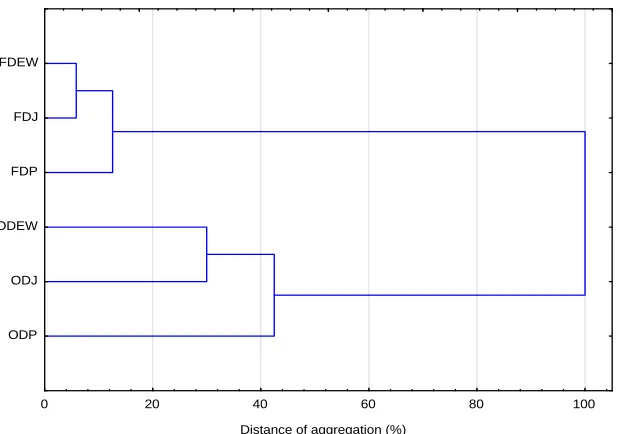
A hierarchical clustering analysis and k-means clus- terings were done on the standardized areas of the “heat process implicated compounds” (HPIC) extracted from the different powders. The resulting dendrogram (Figure 4) shows three subgroups, which were verified by k-
[image:7.595.55.541.676.736.2]means clusterings: a first subgroup containing FDEW, FDJ and FDP, a second subgroup containing ODEW and ODJ and a final subgroup containing ODP alone. This dendrogram indicates that the three freeze-dried powders FDEW, FDJ and FDP are close together with a distance of aggregation below 13% and far from the oven dried powders. This result shows, as cited above, the impor- tance of reducing the temperature in the preparation process of the powders in order to obtain earthworm powders containing low amounts of HPIC. On the den- drogram, the FDJ powder is closer to FDEW than FDP and ODJ is closer to ODEW than ODP. It clearly appears that the pulp fractions are different from the other pow- ders. In agreement with this observation, the pulp frac- tions contain, for each thermal treatment, less volatile
Table 2. Water and protein content of the earthworm powders.
Sample ODEW FDEW FDJ ODJ FDP ODP
0 20 40 60 80 1 Distance of aggregation (%)
00 ODP
[image:8.595.145.455.92.309.2]ODJ ODEW FDP FDJ FDEW
Figure 4. Dendrogram obtained from the hierarchical cluster analysis of the “heat process implicated compounds” HPIC analysed by HS-SPME-GC-MS in earthworm powder samples.
compounds than the other powders (Table 1). The dif-
ference between the pulp fractions and the other powders is mainly due to the volatile compounds from Maillard reactions than those from lipid oxidation (Figure 3).
In this work, differential scanning calorimetry showed that a drying process using temperature above 42˚C led to protein denaturation. This thermo-denaturation led to a drastic decrease in solubility. This loss of solubility could be due to protein denaturation involving changes in hy-drogen bonding and hydrophobic interactions. Finally, the FDEW powder was 3 times more soluble than the ODEW powder. Moreover, the odor properties were also modified by the drying process, and these were assessed through the analysis of volatile compounds. The amount of Maillard reactions compounds and lipid oxidation compounds was higher in powders that were obtained using oven drying rather than freeze drying. Fractiona-tion was a determinant step in the preparaFractiona-tion process of the earthworm powders. For the same heat treatment, the pulp fraction contained less volatile compounds resulting from Maillard reactions than the juice fraction did. It was possible to produce a more neutral protein by using frac-tionation and freeze drying: freeze dried pulp (FDP).
4. Acknowledgements
We are grateful to the Conseil Régional de Bourgogne for funding this research program.
REFERENCES
[1] R. Vielma, D. J. F. Ovalles, L. A. Leon and A. L. Medina,
“Valor Nutritivo de la Harina de Lombriz (Eisenia foetida) Como Fuente de Aminoacidos y su Estimacion Cuantita- tiva Mediante Cromatografia en Fase Reversa (HPLC) y Derivatizacion Precolumna con o-Ftalaldehido (OPA),”
ARS Pharmaceutica, Vol. 44, 2003, pp. 43-58.
[2] A. L. Medina, J. A. Cova, R. A. Vielma, P. Pujic, M. P. Carlos and J. V. Torres, “Immunological and Chemical Analysis of Proteins from Eisenia foetida Earthworm,”
Food and Agricultural Immunology, Vol. 15, No. 3-4, 2003, pp. 255-263.
http://dx.doi.org/10.1080/09540100400010084
[3] H. Bastardo, A. L. Medina and S. Sofia, “Sustitución Total de Harina de Pescado por Harina de Lombriz en Dietas para Iniciador de Trucha Arcoíris,” Agroalimen- tación y Desarrollo Sustentable, Vol. 17, 2005, pp. 1-6. [4] L. Taboga, “The Nutritional Value of Earthworms for
Chickens,” British Poultry Science, Vol. 21, No. 5, 1980, pp. 405-410.
http://dx.doi.org/10.1080/00071668008416688
[5] N. Cayot, P. Cayot, E. Bou-Maroun, H. Laboure, B. Abad-Romero, K. Pernin, N. Seller-Alvarez, A. V. Her- nández, E. Marquez and A. L. Medina, “Physico-Chemi- cal Characterisation of a Non-Conventional Food Protein Source from Earthworms and Sensory Impact in Arepas,”
International Journal of Food Science and Technology, Vol. 44, No. 11, 2009, pp. 2303-2313.
http://dx.doi.org/10.1111/j.1365-2621.2009.02074.x [6] D. S. Mottram, “The Effect of Cooking Conditions on the
Formation of Volatile Heterocyclic Compounds in Pork,”
Journal of the Science of Food and Agriculture, Vol. 36, No. 5, 1985, pp. 377-382.
http://dx.doi.org/10.1002/jsfa.2740360510
[7] H. D. Belitz, W. Grosch and P. Schieberle, “Food Chem- istry,” Springer, Berlin, 2004.
[8] C. Strumillo, W. Kaminski and I. Zbicinski, “Some As-pects of the Drying of Protein Products,” The Chemical Engineering Journal, Vol. 58, No. 2, 1995, pp. 197-204. [9] T. Arakawa, S. J. Prestrelski, W. C. Kenney and J. F.
Carpenter, “Factors Affecting Short-Term and Long- Term Stabilities of Proteins,” Advanced Drug Delivery Reviews, Vol. 46, No. 1-3, 2001, pp. 307-326.
http://dx.doi.org/10.1016/S0169-409X(00)00144-7 [10] Association of Official Analytical Chemists, “Crude
Pro-tein in Meat: Block Digestion Method. (981.10),” Official Methods of Analysis, 1990.
[11] R. Floris, I. Bodnar, F. Weinbreck and A. C. Alting, “Dy- namic Rearrangement of Disulfide Bridges Influences Solubility of Whey Protein Coatings,” International Dairy Journal, Vol. 18, No. 5, 2008, pp. 566-573.
http://dx.doi.org/10.1016/j.idairyj.2007.10.013
[12] J. A. Gordon and W. P. Jencks, “The Relationship of Structure to the Effectiveness of Denaturing Agents for Proteins,” Biochemistry, Vol. 2, No. 1, 1963, pp. 47-57. http://dx.doi.org/10.1021/bi00901a011
[13] A. Wallqvist, D. G. Covell and D. Thirumalai, “Hydro- phobic Interactions in Aqueous Urea Solutions with Im- plications for the Mechanism of Protein Denaturation,”
Journal of American Chemist Society, Vol. 120, No. 2, 1998, pp. 427-428. http://dx.doi.org/10.1021/ja972053v [14] A. V. Moroni, S. Ametti, F. Bonomi, E. K. Arendt and F.
Dal Bello, “Efficient Buffers for the Extraction of Total Protein in Gluten Free Cereals,” Food Chemistry, Vol. 121, No. 4, 2010, pp. 1225-1230.
http://dx.doi.org/10.1016/j.foodchem.2010.02.009 [15] U. T. Rüegg, J. Rudinger, C. H. W. Hirs and S. N. Tima-
sheff, “Reductive Cleavage of Cystine Disulfides with Tributylphosphine,” In: C. H. W. Hirs and S. N. Tima- sheff, Eds., Methods inEnzymology, Vol. 47, Academic Press, New York, 1977, pp. 111-116.
[16] P. Farkas, J. L. Le Quéré, H. Maarse and M. Kovác, “The Standard GC Retention Index Library of Flavour Com- pounds,” In: H. Maarse and D. G. Van Der Heij, Eds.,
TrendsinFlavourResearch, Elsevier Science B.V., Am- sterdam, 1994, pp. 145-149.
[17] F. Bianchi, M. Careri, A. Mangia and M. Musci, “Reten- tion Indices in the Analysis of Food Aroma Volatile Compounds in Temperature-Programmed Gas Chroma- tography: Database Creation and Evaluation of Precision and Robustness,” Journal of Separation Science, Vol. 30, No. 4, 2007, pp. 563-572.
http://dx.doi.org/10.1002/jssc.200600393
[18] A. M. El-Sayed, “The Pherobase: Database of Phero- mones and Semiochemicals,” 2008.
http://www.pherobase.com
[19] J. adamiec, J. Rössner, J. Velíšek, K. Cejpek and J. Šavel, “Minor Strecker Degradation Products of Phenylalanine and Phenylglycine,” European Food Research and Tech- nology, Vol. 212, No. 2, 2001, pp. 135-140.
http://dx.doi.org/10.1007/s002170000234
[20] N. A. Mancilla-Margalli and M. G. López, “Generation of Maillard Compounds from Inulin during the Thermal Processing of Agave tequilana Weber Var. azul,” Journal of Agricultural and Food Chemistry, Vol. 50, No. 4, 2002, pp. 806-812. http://dx.doi.org/10.1021/jf0110295
[21] C.-K. Shu, “Pyrazine Formation from Serine and Threo- nine,” Journal of Agricultural and Food Chemistry, Vol. 47, No. 10, 1999, pp. 4332-4335.
http://dx.doi.org/10.1021/jf9813687
[22] O. Mandin, S. C. Duckham and J. M. Ames, “Volatile Compounds from Potato-Like Model Systems,” Journal of Agricultural and Food Chemistry, Vol. 47, No. 6, 1999, pp. 2355-2359. http://dx.doi.org/10.1021/jf981277+ [23] F. J. Hidalgo and R. Zamora, “Strecker-Type Degradation
Produced by the Lipid Oxidation Products 4,5-Epoxy-2- Alkenals,” Journal of Agricultural and Food Chemistry, Vol. 52, No. 23, 2004, pp. 7126-7131.
http://dx.doi.org/10.1021/jf048883r
[24] F. Shahidi, “Assessment of Lipid Oxidation and Off- Flavour Development in Meat and Meat Products,” In: F. Shahidi, Ed., FlavourofMeatandMeatProducts, Chap- man and Hall, Glasgow, 1994, pp. 247-266.
http://dx.doi.org/10.1007/978-1-4615-2177-8_14
[25] E. Bou-Maroun and N. Cayot, “Odour-Active Com- pounds of an Eisenia foetida Protein Powder. Identifica- tion and Effect of Delipidation on the Odour Profile,”
Food Chemistry, Vol. 124, No. 3, 2011, pp. 889-894. http://dx.doi.org/10.1016/j.foodchem.2010.07.014 [26] C.-Y. Lu, Z. Hao, R. Payne and C.-T. Ho, “Effects of
Water Content on Volatile Generation and Peptide Deg- radation in the Maillard Reaction of Glycine, Diglycine, and Triglycine,” Journal of Agricultural and Food Chem- istry, Vol. 53, No. 16, 2005, pp. 6443-6447.
http://dx.doi.org/10.1021/jf050534p