ISSN 2286-4822
www.euacademic.org DRJI Value: 5.9 (B+)
Evaluation of Different Insecticides against
Sucking Insect Pest on Sunflower Crop
BABAR HUSSAIN CHANG1
ABDUL GHANI LANJAR
Department of Entomology, Sindh Agriculture University Tandojam Sindh, Pakistan
ABDUL WAHEED SOLANGI
Institute of Plant Protection Chinese Academy of Agricultural Sciences, Beijing, China
AMMARA RAJPUT
Department of Entomology, Sindh Agriculture University Tandojam Sindh, Pakistan
MEHAR UL NISSA RAIS
Department of Agriculture Economics Sindh Agriculture University, Tandojam, Pakistan
NAZIA RAIS
Department of Soil Science Sindh Agriculture University, Tandojam, Pakistan
Abstract:
In order to examine the efficacy of different insecticides against sucking insect pests of sunflower, the study was carried out during kharif 2015 at experimental field of Agronomy department, Sindh Agriculture University Tandojam. Treatments were based on different insecticides (Curacran 500 EC, Delegate 25% WG and Novastar 56 EC); while the efficacy of these insecticides was compared with untreated control. The crop was sprayed twice during the whole crop season; first when insect pest buildup was noticed to be increasing unusually; while the second spray was carried out a month later. The
whitefly, jassid and thrips population was monitored before and after each spray.
The results showed that Curacran 500 EC had significantly (P<0.05) reduced maximum population of all sucking pests during both sprays. It reduced whitefly population up to (84.00%), while Novastar and Delegate reduced (80.00%) and (69.00%), respectively. The population of jassid was reduced up to (93.00%), (78.00%) and (60.00%), by Curacron, Novastar and Delegate, respectively. Similarly, thrip population up to (94.00%), (85.00%) and (58.00%) Curacron, Novastar and Delegate, respectively. In untreated control, the insect pests infestation remained stabilized throughout the cropping season. It was observed that the highest yield of sunflower crop was achieved from the plots sprayed with Curacran 500 EC followed by Novastar 56 EC and Delegate 25% WG; the lowest yield was recorded in untreated plot (control plots). It is concluded that all the insecticides had effectively controlled the population of sucking insect pests on sunflower crop; however, Curacron was found the most effective insecticide. It is suggested that Curacran 500 EC should be applied against sucking insect pests of sunflower for better yield.
Key words: Sunflower, Insecticides, Sucking insect pest.
INTRODUCTION
In Pakistan, almost 70 percent edible oil is imported for meeting the domestic consumption; as the local edible oil production hardly meets 30 percent of the domestic demand. Sunflower has the potential to bridge up the gap between demand and supply of edible oil and it is well adapted to agro-ecological conditions of Pakistan. The net yield level has been considerably low, due to its poor cultivation and management practices. Among these, insect pests are the major limiting factors for high yield in sunflower crop for many years. Many of these insect pests ultimately result in a huge yield reduction in sunflower production throughout the world (Carl, 1990). Jassid, whitefly, thrips are the major insect pests of many crops and an important vector of gemini viral pathogens worldwide. Jassid, whitefly, thrips have been considered as a species complex containing several genetic and biological variants undergoing continuous evolutionary changes (Brown, 2000; Perring, 2001). Presently, jassid, whitefly and thrips have emerged as the new serious sucking insect pest complex on sunflower. These insects also serve as vector of leaf curl virus on sunflower and many other oil seed crops. Presence of these insect pests affected the productivity of sunflower crop. This has attracted a lot of attention of the entomologists and pathologists (Katti, 2007). The chemical control is the one of the rapid methods and is an integral part and tool of integrated pest management (IPM) program to reduce the losses caused by sucking insect pests to the sunflower crop (Gogi, et al., 2006). Various researchers have conducted the research regarding the effectiveness of different insecticides against sucking insect pests of sunflower crop (Saleem et al., 2001; Aslam et al., 2004; Khattak et al., 2006; Shah et al., 2007). Some new insecticides with new chemistry are being including to protect crops from the alternate of different insect pest.
sunflower crop under field conditions with aims to the following objectives.
MATERIALS AND METHODS
This study was undertaken to determine the efficacy of different insecticides against sucking insect pests of sunflower crop. Sunflower (HO-1 variety) crop was cultivated on experimental field of Agronomy department, Sindh Agriculture University Tandojam in winter season 2014-15.
Experimental Design
The experiment was laid out in a randomized complete block design with four treatments and four replicates on an area of ½ acre. The experimental area was divided into sixteen sub plots, each plot size was 3×4 meter. Plant to plant and row to row distance was maintained as 9 and 30 inches. All the agronomical practices were uniformly applied for all treatment plots.
Insecticides and their Application
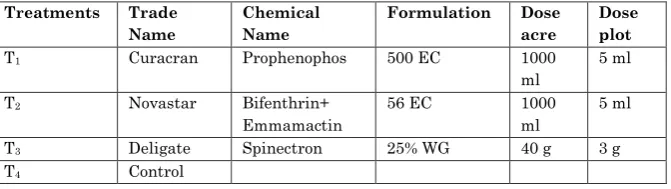
Three insecticides were evaluated against population of sucking insect pests. The application of insecticides was made after 35 days of sowing, the spraying were done early in the morning. The insecticides and their solution used are given in Table 1.
Table 1. Insecticides their formulation, dose and group used against sucking insect pests of sunflower crop
Treatments Trade
Name
Chemical Name
Formulation Dose
acre
Dose plot
T1 Curacran Prophenophos 500 EC 1000
ml
5 ml
T2 Novastar Bifenthrin+
Emmamactin
56 EC 1000
ml
5 ml
T3 Deligate Spinectron 25% WG 40 g 3 g
A knapsack sprayer was used for this purpose, after spraying of each insecticide. The tank of the spray was thoroughly cleaned and rinsed with fresh water and re-rinsed with the spraying solution of the next insecticide to be sprayed.
Sampling techniques
Before application of the pesticides, pre-treatment count of the sucking insect pests was made one day before spraying and post-treatment count was made at the interval of 1st, 3rd, 7th and 10th days after spray. The pest population was recorded on five plants randomly selected from each plot. Five leaves were randomly examined from each plant one from top, two from middle and two from bottom portion. The under side of each leaf was keenly examined for pest count.
The reduction percentage of pest population was calculated by using Flemings and Ratnakaron (1985) equation.
The data thus collected were subjected to statistical analysis using analysis of variance to know the significance differences in population reduction of whitefly, jassid and thrips. LSD (Least Significance Difference) test was also employed to compare different treatments for their efficacies against whitefly, jassid and thrips.
RESULTS
7 showing efficacy of the products applied and the yield per plot was calculated and presented in Figure-1.
Whitefly (1st spray)
Data in table 2 revealed the pre-treatment population of whitefly as (7.66) per leaf and post-treatment population after application of Curacran was as 5.36 (27.79%), 3.81 (48.16%), 2.32 (67.46%) and 1.04 (85.11%) on 1st, 3rd, 7th, and 10th days, respectively. Likewise, pre-treatment count of whitefly was noted as 7.80/ leaf in the plots treated with Delegate that was reduced to 6.16 (18.50%), 4.81 (35.73%), 3.32 (54.27%) and 1.96 (72.44%) after 1, 3, 7 and 10 days interval. Moreover, pre-treatment count of (7.86/ leaf) of whitefly was observed for Novastar, after spay the population of whitefly was recorded as 5.66 (25.68%), 4.13 (45.23%), 2.60 (64.46%) and 1.30 (81.86%) on day 1, 3, 7 and 10, respectively.
Comparative efficacy Test of the insecticides revealed that Curacran 500 EC brought maximum reduction (85.11%) in whitefly population followed by Novastar 56 EC (81.86%) and Delegate 25% WG (72.44%). Analysis of variance showed significant difference (P<0.05) in the efficacy of insecticides, however, LSD showed non-significant difference in the efficacy of Curacran 500 EC Novastar 56 EC.
Table-2. Efficacy of different insecticides against whitefly (1st spray)
Treatments
Pre-treat
Post-treatment reduction (%) in population
Maximum reduction (%) 1-Day 3-Days 7-Days 10 Days
Curacran 500 EC 7.66 5.36 (27.79)
3.81 (48.16)
2.32 (67.46)
1.04 (85.11)
85.11a
Delegate 25% WG 7.80 6.16 (18.50)
4.81 (35.73)
3.32 (54.27)
1.96 (72.44)
72.44b
Novastar 56 EC 7.86 5.66 (25.68)
4.13 (45.23)
2.60 (64.46)
1.30 (81.86)
81.86a
Untreated control
2nd spray
During 2nd spray Curacran 500 EC behaved similarly as it performed during 1st spray. It reduced the population of whitefly from 5.44/ leaf to 4.35 (20.95%), 3.52 (35.41%), 2.85 (47.40%) and 0.96 (82.38%) on day 1, 3, 7 and 10, respectively after spray. Delegate 25% WG stood 2nd in efficacy and reduced whitefly population to 4.22 (13.99%), 3.76 (22.62%), 3.34 (30.86%) and 1.64 (66.25%) on day 1, 3, 7 and 10, respectively as compared to pre-treatment population ,which was recorded as 4.85per leaf one day before spray. The pre-treatment population (5.65/ leaf) of whitefly was reduced to 4.63 (18.99%), 3.84 (32.16%), 3.19 (43.31%) and 1.24 (78.95%) after 1, 3, 7 and 10 days of spray in the plots treated with Novastar 56 EC (Table 3).
Again Curacran stood 1st in reducing whitefly population followed by Novastar 56 EC, and Delegate 25% WG. The results also indicated significant difference (P<0.05) in efficacy of insecticides during 2nd spray.
Table-3: Efficacy of different insecticides against whitefly (2nd spray)
Treatment
Pre-treat
Post-treatment reduction (%) in population
Maximum reduction (%) 1-Day 3-Days 7-Days 10 Days
Curacran 500 EC
5.44 4.35 (20.95) 3.52 (35.41) 2.85 (47.40) 0.96 (82.38) 82.38a
Delegate 25% WG
4.85 4.22 (13.99) 3.76 (22.62) 3.34 (30.86) 1.64 (66.25) 66.25c
Novastar 56 EC
5.65 4.63 (18.99) 3.84 (32.16) 3.19 (43.31) 1.24 (78.95) 78.95b Untreated control
5.15 5.21 5.16 5.13 5.14
Jassid 1st spray
population as 28.47 (33.32%), 20.21 (52.18%), 10.31 (75.01%) and 1.75 (96.07%) on day 1, 3, 7, and 10 after spray. Delegate 25% WG reduced 27.64 (26.14%), 20.73 (44.04%), 20.31 (43.83%) and 11.99 (69.31%) in the same intervals after spay. Whereas of Novastar 56 EC showed more or less the same performance. It reduced the population of jassid as 26.91 (29.20%), 19.64 (47.79%), 18.27 (50.27%) and 3.84 (90.32%), on day 1, 3, 7, and 10, respectively after spray.
The maximum reduction (96.07%) in the population of jassid was observed in the plots treated with Curacran 500 EC followed by Novastar 56 EC (90.32%) and Delegate 25% WG (69.31%). Analysis of variance showed significant difference (P<0.05) in the efficacy of the treatments. The results further indicated that Curacran and Novastar 56 EC behaved almost similarly against jassid on sunflower as indicated by LSD test (P<0.05).
Table-4: Efficacy of different insecticides against jassid (1st spray)
Treatment
Pre-treat
Post-treatment reduction (%) in population
Maximum reduction (%) 1-Day 3-Days 7-Days 10
Days Curacran 500
EC
43.80 28.47 (33.32) 20.21 (52.18) 10.31 (75.01) 1.75 (96.07) 96.07a
Delegate 25% WG
38.39 27.64 (26.14) 20.73 (44.04) 20.31 (43.83) 11.99 (69.31) 69.31b
Novastar 56 EC
38.99 26.91 (29.20) 19.64 (47.79) 18.27 (50.27) 3.84 (90.32) 90.32a Untreated control
42.26 41.20 40.78 39.82 43.01
Second spray
population and reduction percentages were recorded as 13.27 (40.61%), 12.61 (43.00%), 12.35 (43.59%) and 11.00 (51.65%) at day 1, 3, 7 and 10, respectively. Moreover, pre-treatment count of jassid population was recorded as (23.28/ leaf) in the plots of Novastar 56 EC that was reduced to 13.03 (41.68%), 11.21 (49.33%), 10.76 (50.76%) and 7.64 (66.42%) at the intervals of 1, 3, 7 and 10 days after spray. The data in Table 5 revealed that the jassid population in check plots remained more or less similar during post-treatment intervals as compared to pre-treatment population. The maximum reduction (90.18%) was recorded in the population of jassid on sunflower treated with Curacran 500 EC insecticide during 2nd spray followed by Novastar 56 EC (66.06%) and Delegate 25% WG (51.65%). Analysis of variance showed significant difference (P<0.05) in the effectiveness of insecticides against jassid on sunflower crop. The results further indicated that Curacran showed its best performance during 2nd spray. It is endorsed through LSD test at (P<0.05).
Table-5: Efficacy of different insecticides against jassid (2nd spray)
Treatment
Pre-treat
Post-treatment reduction (%) in population
Maximum reduction (%) 1-Day 3-Days 7-Days 10
Days Curacran 500
EC
24.82 11.17 (53.11) 10.16 (56.92) 7.22 (69.07) 2.38 (90.18) 90.18a
Delegate 25% WG
23.28 13.27 (40.61) 12.61 (43.00) 12.35 (43.59) 11.00 (51.65) 51.65c
Novastar 56 EC
23.28 13.03 (41.68) 11.21 (49.33) 10.76 (50.76) 7.64 (66.42) 66.06b Untreated control
24.39 23.41 23.18 22.94 23.84
Thrips 1st spray
showed that Curacran 500 EC reduced per leaf population of thrip to 9.26 (47.94%), 5.65 (67.91%), 3.44 (80.26%) and 0.45 (97.30%) at day 1, 3, 7 and 10 after application as compared to pre-treatment count (18.15 thrips/ leaf). Similarly, Delegate 25% WG reduced thrip population to 9.08 (52.02%), 8.62 (53.98%), 8.45 (54.42%) and 7.52 (57.73%) after 1, 3, 7 and 10 days post-treatment intervals as compared to pre-treatment count of 19.31 thrips/ leaf. Moreover, Novastar 56 EC suppressed pre-treatment population (18.79 thrips/ leaf) to 11.08 (39.83%), 7.32 (59.84%), 4.83 (73.23%) and 3.43 (80.19%) during the same post-treatment intervals.
During 1st spray, the overall maximum reduction in the population of thrip due to Curacran 500 EC was recorded as (97.30%), Novastar 56 EC and Delegate 25% WG brought maximum reduction (80.19%) and (57.73%), respectively in the population of thrip on sunflower. Analysis of variance showed significant difference in the efficacy of the insecticides against thrip at (P>0.05). LSD confirmed the same difference at (P>0.05). The results further indicated that thrips population was considerably decreased when insecticides ‘Curacran 500 EC’ was sprayed on the crop.
Table-6: Efficacy of different insecticides against thrips (1st spray)
Treatment
Pre-treat
Post-treatment reduction (%) in population
Maximum reduction (%) 1-Day 3-Days 7-Days 10
Days Curacran 500
EC
18.15 9.26 (47.94) 5.65 (67.91) 3.44 (80.26) 0.45 (97.30) 97.30a
Delegate 25% WG
19.31 9.08 (52.02) 8.62 (53.98) 8.45 (54.42) 7.52 (57.73) 57.73c
Novastar 56 EC
18.79 11.08 (39.83) 7.32 (59.84) 4.83 (73.23) 3.43 (80.19) 80.19b Untreated control
Second spray
The pre-treatment population before 2nd spray and post-treatment reduction % in the population of thrips at 1, 3, 7 and 10 days after spray are presented in Table 7. One day after spray maximum reduction in the population of thrip in the plots treated with Delegate 25% WG was recorded as 10.51 (52.63) followed Novastar 56 EC 16.67 (29.59) and Curacran 500 EC 22.82 (7.11%). Three days after spray Novastar 56 EC decreased maximum the population 7.67 (67.27%) of thrip as compared to Delegate 25% WG 9.98 (53.98%) and Curacran 500 EC 18.48 (24.27%). On 7 days Novastar 56 EC decreased more population and reduction % was recorded as 4.29 (81.50%) followed by Delegate 25% WG 9.78 (54.44%) and Novastar 56 EC 13.12 (45.48). It showed that after 7 day Delegate 25% WG could reduce 0.46 % more population than the previous post- treatment interval. Ten days after spray the highest reduction percentage in thrip population was recorded as (92.59) in the plots treated with Curacran 500 EC followed by Novastar 56 EC (90.16%) and Delegate 25% WG (57.73%).
The results indicated that Curacran 500 EC and
Novastar 56 EC performed non-significantly against thrip population on sunflower crop. Both the insecticides suppressed thrip population more than 90%. In response of these insecticides Delegate 25% could suppress thrip population up to 58%. Analysis of variance showed significant difference (P<0.05) in effectiveness of insecticides, however, LSD showed non-significant difference in effectiveness of Curacran 500 EC and Novastar 56 EC at (P>0.05).
Table-7: Efficacy of different insecticides against thrips (2nd spray)
Treatment
Pre-treat
Post-treatment reduction (%) in population
Maximum reduction (%)
1-Day 3-Days 7-Days 10 Days Curacran 500
EC
25.07 22.82 (7.11)
18.48 (24.27)
13.12 (45.48)
1.71 (92.59)
Delegate 25% WG
22.36 10.51 (52.63)
9.98 (53.98)
9.78 (54.44)
8.71 (57.73)
57.73b
Novastar 56 EC
24.16 16.67 (29.59)
7.67 (67.27)
4.29 (81.50)
2.19 (90.16)
90.16a
Untreated control
25.02 24.52 24.27 24.02 23.06
Crop yield
The data in Fig. 1 reveals that the average yield 34, 29, 22.33 kg per plot in the plots treated with Curacran 500 EC, Delegate 25% WG, Novastar 56 EC, respectively as compared to check plot, which yielded not more than 17 kg per plot. It was observed that highest yield of sunflower crop was achieved when the crop sprayed with Curacran 500 EC followed by Novastar 56 EC and Delegate 25% WG. Lowest yield of sunflower crop was determined in plot kept as untreated (control plots).
Figure-1. Yield (kg) of sunflower treated with different treatments.
DISCUSSION
and Novastar 56 EC; while the efficacy of these insecticides was compared with untreated control.
mortality of whitefly: Lie et al. (2000) also investigated the increased susceptibility of whitefly to confidor. The finding of the present studies disagree the results of Latif et al. (2001) who underestimated the efficacy of Confider than Asmido. Mohan and Katiray, (2000) stated that confidor was the most effective in suppressing the whitefly population and its continuous use resulted in increased whitefly population. The present findings are more or less agreed with Khattak et al.
(2004) reported that insecticides Tamaron, 60SL, Confidor 200 SL, Polo 500 EC and Mospilan 20 SP significantly reduced the mean percent population of jassid. Tufail et al. (1995), Mustafa, (1996), and Hameed et al. (1997) investigated that Confidor significantly controlled jassid. This supports the results obtained in the present studies. Tamaron was not considered much effective insecticide against jassid by Ahmad and Khan, (1995) and Tufail et al. (1995). Mohan and Katiyar, (2000) and Yazdani et al. (2000) also showed better control of jassid by Confidor 200 SL. In contrast to present results, Mustafa (1996) investigated that Polo 500 EC caused more than 94.40% motility of jassids.
CONCLUSIONS
All the insecticides effectively controlled the whitefly infestation when compared with control. The insecticides lost their efficacy after 10 days interval of first spray against whitefly. On the basis of efficacy, the Curacran 500 EC stood 1st in effectiveness against sucking insect pests of sunflower crop followed Novastar. It was observed that highest yield of sunflower crop was achieved when the crop sprayed with Curacran 500 EC followed by Novastar 56 EC and Delegate 25% WG. Lowest yield of sunflower crop was determined in plot kept as untreated control.
LITERATURE CITED:
Afzal, M., S.M. Rana, M. H. Babar, I. L. Haq, Z. Iqbal and H.M. Saleem. 2014. Comparative efficacy of new insecticides against whitefly, Bemisia tabaci (Genn.) and jassid,
Amrasca devastans (Dist.) on Cotton, Bt-121. J. Pakistan, 60 (1) : 117-121.
Ahmad, F. and F. R. khan. 1995. Comparative efficacy of some traditional and non-traditional insecticides against sucking pests of cotton. Sarhad J. Agric, 11(6): 733-739. Ahmad. R, C. P. Yadava and S. Lal. 2001. Evaluation of spray
schedule for the control of insects pests of mungbean. Indian J. Pulses Res., 11(2): 146-148.
Ahmed, S., M.S. Nisar, M. M. Shakir, M. Imran and K. Iqbal. 2014. Comparative efficacy of some neonicotinoids and traditional insecticides on sucking insect pests and their natural enemies on bt-121 cotton crop. The Journal of Animal & Plant Sciences, 24 (2) : 660-663.
Uroleucon compositae (Theobald) infesting safflower,
Carthamus tinctorius Linnaeus. J. Entomol. 31 (8) : 300-310.
Asha, V.K. 2011. Effect of imidacloprid and thiamethoxam seed treatment on storability and sucking pests in sunflower. M. Sc. (Agri.) Thesis, Univ. Agric. Sci. Dharwad, India. Asi, M.R., M. Afzal, S.A. Anwar1 and M.H. Bashir. 2008.
Comparative efficacy of insecticides against sucking insect pests of cotton. Pak. J. Life Soc. Sci. 6 (2) : 140-142.
Aslam, M., M. Razaq, S.A. Shah and F. Ahmad. 2004. Comparative efficacy of different insecticides against sucking pests of cotton. Journal of Research (Science), 15 (1): 53-58.
Bashir, M.H, A. Muhammad, M. Afzal and M.A. Khan. 2009. Efficacy of some insecticides against whitefly (Bemisia tabaci Genn.) infesting cotton under field conditions. Pak. J. Life Soc. Sci. 7 (2) : 140-143.
Brown, J.K. 2000. Molecular markers for the identification and
global tracking of whitefly vector-Begomovirus
complexes. Virus Res.,71: 233-260.
Carl, D.P. 1990. Managing insect pests of Taxas Sunflower. Taxas Agricultural Extension.
Fazal, S. and M. Inayatullah. 2015. Efficacy of different botanicals and a new chemistry insecticide against
Bemisia tabaci (Hemiptera: aleyrodidae) on sunflower
(Helianthus annuus L.). Pak. J. Weed Sci. Res., 21(1): 25-36.
Gogi, M. D., R. M. Sarfraz, L.M. Dosdall, M.J. Arif, A. B. Keddie
& M. Ashfaq. 2006. Effectiveness of two insect growth
regulators against Bemisia tabaci and Helicoverpa
armigera and their impact on population densities of
arthropod predators in cotton in Pakistan. Pest
Management, Sci., 62: 982-990.
GOP, 2014. Economic Survey of Pakistan, 2012-2013. Government of Pakistan, Ministry of Food, Agriculture and Livestock, Agriculture & Livestock Division (Economic Wing), Islamabad.
Hussain, M. K., E. Rasul and S. K. Ali. 2000. Growth analysis of sunflower under drought conditions. Int. J. Agri. Biol., 2 : 136-140.
Iqbal, J., M. Nadeem, M.S. Assi1, M.M. Fiaz and M.W. Hassan. 2015. Comparative efficacy of some insecticides against sucking insect pests on mungbean, Vigna radiata (L.) Wilczek. Journal of Arid Zone Research. 32 (7) : 555-568. Jehan, B.E.N., N. El-Hoda and A. Zidan. 2013. Field evaluation
of imidacloprid and thiamethoxam against sucking insects and their side effects on soil fauna. Journal of Plant Protection Research. 53 (4) : 55-57.
Katti, P. 2007. Sucking pests of sunflower with special reference to Thrips palmi Karny, its relation with necrosis virus and management. Ph.D. Thesis, Univ. Agric. Sci. Dharwad, India. 108-112.
Khattak, M.K., M. Rashid, S.A.S. Hussain and T. Islam. 2004. Comparative effect of neem (Azadirachta indica) oil, neem seed water extract and Baythroid against whitefly, Jassids and Thrips on cotton. Pak. Entomol. 28 (1) : 31-37.
Muhammad, R.A., M. Afzal, S.A. Anwar and M.H. Bashir. 2008. Comparative efficacy of insecticides against sucking insect pests of cotton. Pak. J. Life Soc. Sci. 6 (2) : 140-142.
Munir, A., M. Rafiq, M.I. Arifand A.H. Sayyed. 2011.Toxicity of some commonly used insecticides against Coccinella undecimpunctata (Coleoptera: Coccinellidae). Pakistan J. Zool., 43 (6) : 1161-1165.
Perring, T.M. 2001. The Bemisia tabaci species complex. Crop Protec. 20: 725-737.
Razi, H. and M. T. Asad. 1998. Evaluation of variation of agronomic traits and water stress tolerant in sunflower conditions. Agricultural and Natural Resources Sciences, 2:31-43.
Rohit, N., S.S. Dashad and S.P. Singh. 2013. Bio-efficacy of newer insecticides against head borer, Helicoverpa armigera (Hubner) infesting sunflower. Crop Res. 46 (1, 2 & 3) : 130-132.
Said, F. and M. Inayatullah. 2015. Efficacy of different botanicals and a new chemistry insecticide against
Bemisia tabaci (Hemiptera: aleyrodidae) on sunflower
(Helianthus annuus L.). Pak. J. Weed Sci. Res., 21(1): 25-36.
Saleem, M.A., Mustafa, K. & Hussain, R. 2001. Relative efficacy of some insecticides against some sucking insect pests of CIM-443 cotton. Pak. Entomol., 23(1-2):91-92.
Shah, M.J., Ahmad, A., Hussain, M., Yousaf, M.M. andAhmad,
B. 2007. Efficacy of different insecticides against sucking insect pest complex on the growth and yield of mungbean (Vigna radiata L.) Pak. Entomol., 29(2) 83-85. Shamshad, A. and S. Ahmed. 2009. Chemical control of sucking
Singh, P. 2014. Management of insect pests of sunflower using
green lacewing, Chrysoperla carnea (Stephens) and
Neem Seed Kernel Extract. Karnataka J. Agric. Sci., 21 (1) : 130-133. 2008.