doi:10.4236/epe.2013.54B003 Published Online July 2013 (http://www.scirp.org/journal/epe)
Short-term Distributed Energy Resource Scheduling for a
DC Microgrid
G. W. Chang, H. J. Lu, H. J. Su
Department of Electrical Engineering, National Chung Cheng University Email: [email protected]
Received September, 2012
ABSTRACT
A microgrid is associated with a low voltage distribution power network and inherits small modular generation systems and loads that have certain coordinated functions to provide the solution to supply premium power to remote or specific areas. Similar to conventional power systems, the energy management of distributed generation resources (DERs) is carried out to minimize the operation cost and maximize benefit of installation of DERS in a microgrid. This paper pre-sents the process of implementing the short-term DER scheduling function for a dc microgrid. The optimal scheduling results for two operation modes are then reported.
Keywords: Microgrid; Distributed Generation Resources; PV; Battery
1. Introduction
The microgrid is a group of traditional and/or distributed generation resources, energy storages, and loads that is normally connected to a low-voltage power network. The point of common coupling (PCC) with the connected power network can be disconnected and the microgrid is then functioned in islanding mode. The microgrid can provide the platform for integration of different renew-able resources with communications [1].
Due to characteristics of distributed energy resources, modern power systems have functions of changing its power flow either in one direction or bi-directions. Since it is a trend that active distributed systems have flexible and smart control systems to obtain clean energy from renewable sources, distribution systems have trans-formed into larger-scale of smarter grids or a smaller scale of localized microgrids. Microgrids can reduce cost of investment for installations of renewable sources and they also provide reactive power compensation and fre-quency regulation, increase capacity of spinning reserve, and improve power quality and reliability of customer’s power system.
Unlike the conventional power system, a microgrid may include energy-storage devices such as batteries and becomes a strong coupling system in the time domain [2-4]. Furthermore, due to uncontrollable characteristics of DERs, certain operation function such as islanding mode of the grid and have to be further studied. In this paper, the short-term DER scheduling that considers the photovoltaic cell, wind generation, fuel cell, and energy-
storage device (i.e. battery) of a dc microgrid supplying
local loads is presented.
The optimization model is developed for the consid-ered short-term DER scheduling problem. The objective is to minimize operational costs while satisfying the mi-crogrid load demand. All the DER and energy-storage units must be operated within their lower and upper out-put limits. The outout-put of the power optimization model considers the operation limits of the supply options, load demand, sell/purchase power costs from the connected grid, and the operating costs of the DERs. Therefore, the objective function becomes minimizing operational costs represented by the difference between the profit and the cost. In the scheduling model, the problem is formulated as a nonlinear programming problem is solved by an op-timization toolbox provided by Matlab. To solve the mi-crogrid DER scheduling problem, a solution algorithm is proposed and implemented under MATLAB Graphical User Interface Development Environment (GUIDE). Results are then presented to show the usefulness of the proposed algorithm.
2. Problem Formulation
Figure 1 shows the network configuration of the dc
grid. Interconnection between the DC microgrid and the AC grid is through a bi-directional inverter. To ensure a stable operation, the power generation and consumption must be balanced to keep the DC bus voltage within an acceptable range. The inverter and battery are responsi-ble for DC voltage regulation in the grid-connected and islanding modes, respectively. In the grid-connected mode, the battery acts like a constant current source and can be in charge, discharge, or non-operated mode. In the islanding mode, the inverter is mainly responsible for maintaining a stable voltage to the AC loads.
2.1. Photovoltaic Array Model
The single-diode equivalent PV model shown in Figure
2 describes the v-i characteristic of PV arrays. In this
model, the series resistance (RS) and the parallel resis-tance (RP) represent the effect PV conversion efficiency [5]. The equation describing the v-i characteristic is
0
( )
exp( s ) 1 s
PH
P
q v iR v iR
i i i
kTA R
(1)
where i is the output current of the PV, iPH is the current
generated by the incident light, i0 is the reverse saturation
or the leakage current of diodes, q is the electron charge,
[image:2.595.311.536.380.717.2]v is the output voltage of the PV, k is Boltzmann constant,
Figure 1. A typical configuration of DC microgrid.
Figure 2. Equivalent single-diode PV mode.
T is the temperature in Kelvin, A is the ideal factor of the
PV (A = 1~1.5), RP is the series resistance, and RS is the
parallel resistance. The parameters needed in the equiva-lent PV model are iPH, i0, RP, RS, and A; they can be
ob-tained from the datasheets and the procedure for calcu-lating both series and parallel resistances [6, 7].
2.2. Wind Turbine Model
To model the permanent magnet synchronous generator (PMSG) of the wind turbine, the parameters of the PMSG are required to establish the detailed wind turbine models, which include the numbers of poles, dq-axis inductances, rotor resistance, etc. However, these pa-rameters are usually not provided by manufactories, the measurement-based wind turbine models can be obtained by establishing a look-up table of wind speed versus output power characteristic curve to represent wind tur-bine power characteristic [8].
2.3. Models of Fuel Cell and Battery
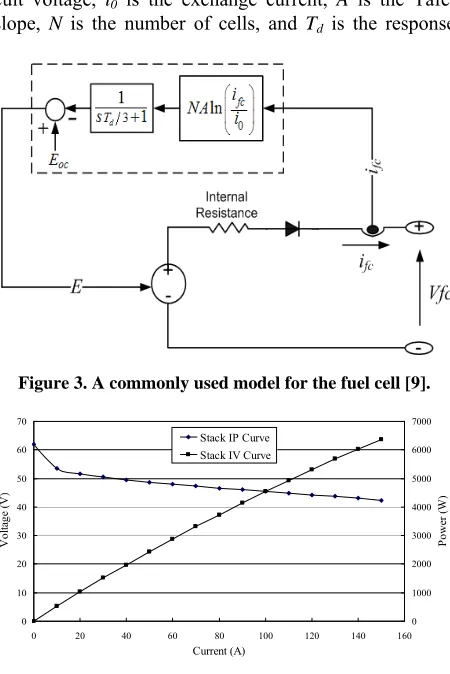
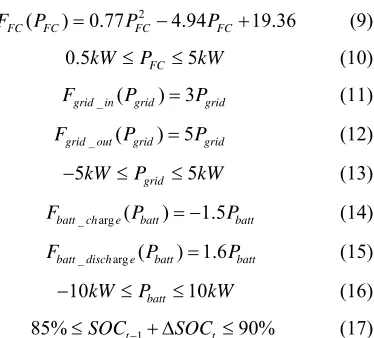
The fuel cell stack model shown in Figure 3 [9] is
com-monly used and the parameters can be obtained from the
datasheet shown in Figure 4, where Eoc is the open
cir-cuit voltage, i0 is the exchange current, A is the Tafel
[image:2.595.63.283.407.579.2]slope, N is the number of cells, and Td is the response
Figure 3. A commonly used model for the fuel cell [9].
0 10 20 30 40 50 60 70
0 20 40 60 80 100 120 140 160 Current (A)
V
oltag
e (V
)
0 1000 2000 3000 4000 5000 6000 7000
P
ow
er (W
)
[image:2.595.310.536.411.556.2]Stack IP Curve Stack IV Curve
[image:2.595.63.283.611.722.2]17
time. The simplified model is based on the equivalent circuit of a fuel cell stack and represents a particular fuel cell stack operating at nominal conditions of temperature and pressure. Battery models in SPS include four prede-fined types: lead-acid, lithium ion, nickel metal hydride and nickel cadmium. Parameters of models are battery types, nominal voltage, rated capacity and initial charge state.
3. Short-term DER Scheduling of the DC
Microgrid
3.1. Objective Function and Constraints
The short-term DER scheduling of the dc microgrid is to achieve its minimum operation cost. If the microgrid
includes N controllable DERs over a study period of T
time steps, the objective function to be minimized under grid-connected and islanding modes can be expressed by (2) and (3), respectively.
, ,
1 1
[( ( )) ( ) ( )]
T N
n n t grid grid t batt batt t
t n
C F P F P F P
, , , (2) , 1 1 [( ( )) ( )] T Nn n t batt batt t
t n
C F P F P
(3)where Pn,tis the output power of the nth DER in the t-th time step. Pgrid,t and Pbatt,t are the output power of the connected grid (i.e. electric utility) and the energy-stor- age device, respectively. Fn, Fgrid, and Fbatt are cost
func-tions associated with the nth DER, power sell or purchase
of the electric utility, and energy-storage device, respec-tively. The constraints must be met at each time step are listed in (4)-(8).
, , , ,
1
N
n t grid t batt t load t unctrl t
n
P P P P P
(4)min max
,
n n t n
P P P (5)
min max
,
grid grid t grid
P P P (6)
min max
arg , arg
ch e batt t disch e
P P P
(7)
min t1 t max
SOC SOC SOC SOC (8)
In (4)-(8), (4) is the power balance requirement during
the t-th time step, which ensures a stable operation.
Punctrl,t is output power of uncontrollable DERs (i.e., wind
generation and PV arrays) during the t-th time step, and
Pload,t is total active power of dc and ac loads; (5) is
gen-eration limits for the n-th DER, where and
are minimum and maximum generation, respectively. Equation (6) is inequality constrain of power from utility, and
min
n
P Pnmax
min grid
P and Pgridmax are minimum and maximum power
limitation. Equation (7) is associated with the charging and discharging power limits of the battery. In (8), the
state-of-charge (SOC) of the battery must meet its
nor-mal operation constraints, where SOCmin and SOCmax are
the lower and upper energy storage limits for the battery.
ΔSOCt is the change of SOC during the t-th time step.
3.2. Proposed Solution Procedure for the DER Scheduling Problem
To solve the described short-term DER scheduling prob-lem for the micro grid in both islanding and grid-con- nected modes, it is assumed that, at each time step, the forecasts of power generation from uncontrollable DERs (i.e. PV and wind generator), the utility electricity price, the load consumption, the initial value of battery SOC and the microgrid operation mode are provided. In the grid-connected mode, the scheduling problem of (2)-(7) will be solved and the battery output and the power pur-chase from the connected utility grid at each time step will be determined at the minimum microgrid operation cost. In the islanding mode, the microgrid is discon-nected form the utility grid. Consequently, the problem is
without considering the Pgird terms in the objective
func-tion and constraints and is then solved. For both opera-tion modes, the scheduling problems are solved by the Matlab Optimization toolbox (quadratic programming
solver) implemented with MATLAB GUIDE. Figure 5
illustrates the flowchart of the proposed solution proce-dure for both microgrid operation modes.
4. Case Study
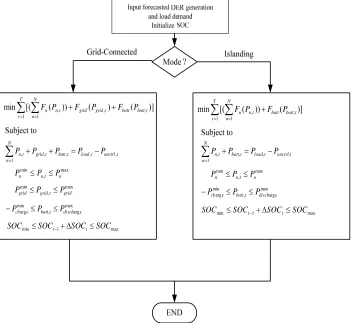
In this study, the simulations for an actual dc microgrid with grid-connected and islanding modes for 48 time steps (each time step spans over 15 minutes) are per-formed to show the scheduling results. The associated cost functions and constraints are listed in (9)-(17).
2
( ) 0.77 4.94 19.36
FC FC FC FC
F P P P (9)
0.5kWPFC 5kW (10)
_ ( ) 3
grid in grid grid
F P P (11)
_ ( ) 5
grid out grid grid
F P P (12)
5kW Pgrid 5kW
(13)
_ arg ( ) 1.5
batt ch e batt batt
F P P (14)
_ arg ( ) 1.6
batt disch e batt batt
F P P (15)
10kW Pbatt 10kW
(16)
1
85%SOCt SOCt90% (17)
where (9) and (10) are the fuel cell cost function and as-sociated generation limits. In (11)-(16), positive value of
Pgrid and Pbatt implies that the electric power flows into
[image:3.595.352.539.511.680.2]4.1. Case 1: Grid-Connected Mode 4.2. Case 2: Islanding Mode
Figure 6 shows the forecasting curves of load demands
and uncontrollable DERs for input to the problem.
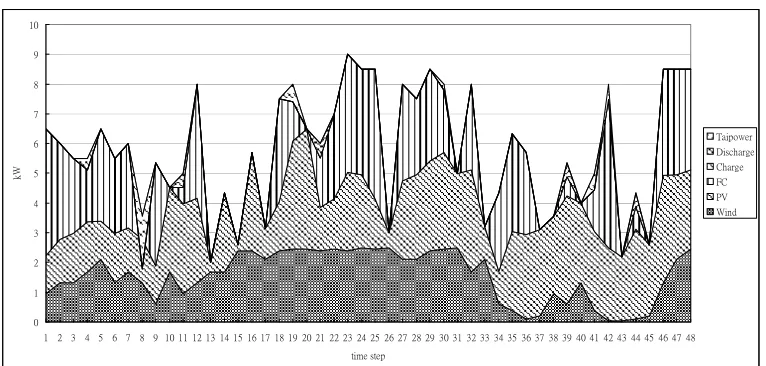
Figures 7 and 8 show the connected utility grid power
purchase/sell (indicated by Taipower), DER generation and battery output with and without optimization,
respec-tively. Table 1 indicates that optimal operation cost can
be achieved by selling and purchasing power to/from the connected utility at different time steps based on the fo-recasted input. The cost saving without optimization is about 13% more than that with optimization.
In this case, the load forecasting curve is shown in
Fig-ure 9 and the generation forecasts of uncontrollable
DERs are the same those of Case 1. Figures 10 and 11
show the connected utility grid power purchase/sell (in-dicated by Taipower), DER generation and battery output with and without optimization, respectively. By
observ-ing Table 2, the cost saving with optimization is much
less than that of Case 1. This is because that the islanding operation is without power purchase and sold to the util-ity grid.
N n t batt batt t grid grid t n n T t P F P F P F 1 , , , 1 )] ( ) ( )) ( ( [ min
N n t unctrl t load t batt t grid tn P P P P
P 1 , , , , , max , min n t n
n P P
P
max , min grid t grid
grid P P
P
max arg , min
arge battt disch e
ch P P
P
max 1
min SOC SOC SOC
SOC t t
N n t batt batt t n n T t P F P F1 , ,
1 )] ( )) ( ( [ min
N n t unctrl t load t batt tn P P P
P 1 , , , , max , min n t n
n P P
P
max arg , min
arge battt disch e
ch P P
P
max 1
min SOC SOC SOC
SOC t t
Figure 5. Flowchart of scheduling optimization program for grid-connected and islanding operations of the dc microgrid.
0 2 4 6 8 10
1 5 9 13 17 21 25 29 33 37 41 45 Time Step kW 0 2 4 6
1 5 9 13 17 21 25 29 33 37 41 45
Time Step
kW
WT PV
(a) (b)
19
0 1 2 3 4 5 6 7 8 9 10
1 2 3 4 5 6 7 8 9 10 11 12 13 14 15 16 17 18 19 20 21 22 23 24 25 26 27 28 29 30 31 32 33 34 35 36 37 38 39 40 41 42 43 44 45 46 47 48 time step
kW
[image:5.595.107.490.82.265.2]Taipower Discharge Charge FC PV Wind
Figure 7. Power purchase/sell (Taipower), DER generations and battery output with optimization (Case 1).
0 1 2 3 4 5 6 7 8 9 10
1 2 3 4 5 6 7 8 9 10 11 12 13 14 15 16 17 18 19 20 21 22 23 24 25 26 27 28 29 30 31 32 33 34 35 36 37 38 39 40 41 42 43 44 45 46 47 48
time step
kW
[image:5.595.107.487.297.490.2]Battery FC PV Wind
[image:5.595.108.486.531.719.2]Figure 8. DER generations and battery output without optimization (Case 1).
Table 1. Comparison of operation cost ($) w/o and with optimization.
Fuel Cell Battery Sell Purchase Cost w/o optimization 706.50 30.94 0.00 0.00 737.43
With optimization 694.00 8.33 60.33 1.55 642.00
0 2 4 6 8 10
1 5 9 13 17 21 25 29 33 37 41 45
Time Step
kW
0 1 2 3 4 5 6 7 8 9 10
1 2 3 4 5 6 7 8 9 10 11 12 13 14 15 16 17 18 19 20 21 22 23 24 25 26 27 28 29 30 31 32 33 34 35 36 37 38 39 40 41 42 43 44 45 46 47 48
time step
kW
Discharge Charge
FC PV
[image:6.595.153.443.83.223.2]Wind
Figure 10. DER generations and battery output with optimization (Case 2).
0 1 2 3 4 5 6 7 8 9 10
1 2 3 4 5 6 7 8 9 10 11 12 13 14 15 16 17 18 19 20 21 22 23 24 25 26 27 28 29 30 31 32 33 34 35 36 37 38 39 40 41 42 43 44 45 46 47 48
time step
kW
[image:6.595.152.444.247.391.2]Battery FC PV Wind
Figure 11. DER generations and battery output without optimization (Case 2).
Table 2. Comparison of operation Cost ($) with and w/o Optimization
Fuel Cell Battery Cost w/o optimization 663.88 10.96 674.84
With optimization 641.43 24.41 665.84
5. Conclusions
This paper has presented the aspect of short-term sched-uling of DERs for an actual dc microgrid operated in both grid-connected and islanding modes. Results of two study cases were illustrated the usefulness of the pro-posed solution procedure to minimize the microgrid op-eration costs while satisfying all opop-eration constraints. The schedules results were then input the time-domain simulation model to ensure a stable operation of micro-grid with maintaining near fixed dc bus voltage under both grid-connected and islanding operations.
REFERENCES
[1] A. Niinistö, “Simulation of the Management of a Micro-Grid with Wind, Solar and Gas Generators,” Master’s Thesis, Aalto University School of Science and Technol-ogy Faculty of Electronics, Finland, 2009.
[2] X. Liu, M. Ding, J. Han, P. Han and Y. Peng, “Dynamic
Economic Dispatch for Microgrids Including Battery En-ergy Storage,” 2nd IEEE International Symposium on Power Electronics for Distributed Generation Systems
(PEDG), 2010.
[3] F. Carastro, M. Sumner and P. Zanchetta, “An En-hancedshunt Active Filter with Energy Storage for Mi-crogrids,” Proceedings of IEEE Industry Applications
So-ciety Annual Meeting, Edmonton, October 2008.
[4] Y. Q. Zhu, Z. D. Yin and J. Tian, “Microgrids Based on DC Energy Pool,” Proceedings of IEEE Energy 2030
Conference, Atlanta, November 2008.
doi:10.1109/ENERGY.2008.4781004
[5] P. P. Dash and A. Yazdami,“A Mathematical Model and Performance Evaluation for a Single-stage Grid-connected Photovoltaic (PV) System,” International
Journal of Emerging Electric Power Systems, Vol. 9, No.
6, article 5, 2008.
[image:6.595.150.445.435.486.2]21
of Three-Phase Grid-Connected Photovoltaic Systems,” Master’s Thesis, Department Electric Engineering, Na-tional Taiwan University, Taipei, Taiwan, 2010.
[7] M. G. Villalva, J. R. Gazoli and R. Filho, “Comprehen-sive Approach to Modeling and Simulation of Photo-voltaic Arrays,” IEEE Transactions on Power Electronics,
Vol. 24, No. 5, 2009, pp. 1198-1208.
doi:10.1109/TPEL.2009.2013862
[8] F. A Mohamed, “Microgrid Modeling and Online Man-agement, Ph.D. Dissertation, Department of Automation and Systems Technology,” Helsinki University of Tech-nology Espoo, Finland, 2008.