m
m
tm
EUR
mvWW»
m
te*
mM
EUROPEAN ATOMIC ENERGY COMMUNITY - EURATOM
N«
Β
KftfttjgHj
ATTERN DISPLAY CONSIDERATIONS
FOR A PROGRAMMING AID MACHINE ¡ | Œ | Î p S i i
G A DIGITAL AND AN ANALOGUE COMPUTER
IS
jjH
\hmiiw
I
W. BECKER and I. DE LOTTO
» I
t
I
ÜH
k
i
ünD
iføflg
Ι 1 * ?,· Ί » < ' ' > "
MîVi*<
lir:
Joint Nuclear Research Cente
m
jjÉ Ispra Establishment -
l t > h ^ B i ^ y H n Í
Electronics Department
IliiillflliaÉ
m
¡Bi
•r
■mmm
» '
mmm.
«^tföiyMfftejI'.W
LEGAL NOTICE
mi
T h i s d o c u m e n t w a s p r e p a r e d u n d e r t h e s p o n s o r s h i p of t h e C o m m i s s i o n of t h e
E u r o p e a n A t o m i c E n e r g y C o m m u n i t y ( E U R A T O M ) .
»ι fill!«
til.
N e i t h e r t h e E U R A T O M C o m m i s s i o n , its c o n t r a c t o r s n o r a n y p e r s o n a c t i n g o n t h e i r b e h a l f :
Eini
Io — M a k e a n y w a r r a n t y o r r e p r e s e n t a t i o n , e x p r e s s o r i m p l i e d , w i t h r e s p e c t t o t h e
a c c u r a c y , c o m p l e t e n e s s , o r u s e f u l n e s s of t h e i n f o r m a t i o n c o n t a i n e d i n t h i s d o c u
Í
m e n t , o r t h a t t h e u s e of a n y i n f o r m a t i o n , a p p a r a t u s , m e t h o d , o r p r o c e s s d i s c l o s e d ΐ η + l i i n #l^i.ni-tOTifiYi4- m n i r . i / \ t ί η Γ κ ί η ι τ α n r ! ir -i t o l Λi n t h i s d o c u m e n t m a y n o t i n f r i n g e p r i v a t e l y o w n e d r i g h t s ; o r J m t ' i i p r l T » w r l i t c · ftr gilJtilÍS
A s s u m e a n y l i a b i l i t y w i t h r e s p e c t t o t h e u s e of, o r f o r d a m a g e s r e s u l t i n g f r o m t h e u s e of a n y i n f o r m a t i o n , a p p a r a t u s , m e t h o d o r p r o c e s s d i s c l o s e d i n t h i s d o c u m e n t .
T h e a u t h o r s ' n a m e s a r e l i s t e d i n a l p h a b e t i c a l o r d e r .
This report can be obtained, at the price of Belgian Francs 40,—, from : PRESSES ACADEMIQUES EURO PEENNES 9β, Chaussée de Charleroi, Bruseels 6.
Please remit payments:
— to BANQUE DE LA SOCIETE GENERALE (Agi Ma Campagne) Brussels account No 964.558, — to BELGIAN AMERICAN BANK AND TRUST C
PANY New York account No 121.86,
• í°ondL°F:DCS2,BANIC ( F O r e Í g n ) L t d· ■ 10 M O O r g a t e
t
London E.C.2,giving the reference: "EUR 410.e Pattern display consi derations for a programming aid machine linking a digital and an analogue computer".
Printed by SnoeckDucaju & Son, Ghent Brussels, December 1963.
i ι^^KiiFmMlf Idilli
EUR 410.e
P A T T E R N DISPLAY CONSIDERATIONS FOR A P R O G R A M M I N G AID M A C H I N E L I N K I N G A D I G I T A L A N D AN A N A L O G U E C O M P U T E R by W. B E C K E R and I. DE L O T T O
European Atomic Energy Community - EURATOM Joint Nuclear Research Center
Ispra Establishment - Italy Electronics Department
Brussels, December 1963 - pages 24 - figures 10
A short introduction to the question of auxiliary means, linking the output of a digital computer to the patch panel of an analogue computer in order to assist in setting u p the connections on the patch panel, is given. These connections, being a transformation of a set of addresses delivered by the digital computer, represent the program for the analogue computer.
E U R 410.e
P A T T E R N DISPLAY CONSIDERATIONS FOR A P R O G R A M M I N G AID M A C H I N E L I N K I N G A D I G I T A L AND AN A N A L O G U E COMPUTER by W. B E C K E R and I. DE L O T T O
European Atomic Energy Community - E U R A T O M Joint Nuclear Research Center
Ispra Establishment - Italy Electronics Department
Brussels, December 1963 - pages 24 ■ figures 10
A short introduction to the question of auxiliary means, linking the output of a digital computer to the patch panel of an analogue computer in order to assist in setting u p the connections on the patch panel, is given. These connections, being a transformation of a set of addresses delivered by the digital computer, represent the program for the analogue computer.
EUR 410.e
P A T T E R N DISPLAY CONSIDERATIONS FOR A P R O G R A M M I N G AID M A C H I N E L I N K I N G A D I G I T A L AND AN ANALOGUE COMPUTER by W. B E C K E R and I. DE LOTTO
European Atomic Energy Community - EURATOM Joint Nuclear Research Center
Ispra Establishment - Italy Electronics Department
Brussels, December 1963 - pages 24 ■ figures 10
After that a general survey of different existing or proposed solutions for the problem of panel display is presented concerning evacuated arrangements, solid state, gaseous and liquid display types, mechanical and optical systems, neon- and bulb matrices. Closer consideration is given to a tungsten-bulb matrix which has been finally chosen for the instrument.
A method for the calculation of crosstalk in such a bulb matrix is shown and a consideration of the summing up of reverse currents in the matrix is added. The problem of using a minimum number of components in a decoder is discussed as well as the question of eventual overloading of some driving transistors for the decoder, caused by an unsuitable distribution of component tolerances. Finally, a short explanation of the instruments block-diagram is given.
After that a general survey of different existing or proposed solutions for the problem of panel display is presented concerning evacuated arrangements, solid state, gaseous and liquid display types, mechanical and optical systems, neon- and bulb matrices. Closer consideration is given to a tungsten-bulb matrix which has been finally chosen for the instrument.
A method for the calculation of crosstalk in such a bulb matrix is shown and a consideration of the summing up of reverse currents in the matrix is added. The problem of using a minimum number of components in a decoder is discussed as well as the question of eventual overloading of some driving transistors for the decoder, caused by an unsuitable distribution of component tolerances. Finally, a short explanation of the instruments block-diagram is given.
After that a general survey of different existing or proposed solutions for the problem of panel display is presented concerning evacuated arrangements, solid state, gaseous and liquid display types, mechanical and optical systems, neon- and bulb matrices. Closer consideration is given to a tungsten-bulb matrix which has been finally chosen for the instrument.
EUR 410.e
EUROPEAN ATOMIC ENERGY COMMUNITY - EURATOM
PATTERN DISPLAY CONSIDERATIONS
FOR A PROGRAMMING AID MACHINE
LINKING A DIGITAL AND AN ANALOGUE COMPUTER
by
W. BECKER and I. DE LOTTO
1 9 6 3
Joint Nuclear Research Center
Ispra Establishment - Italy
C O N T E N T S
Page
1. I N T R O D U C T I O N 5
2. D I F F E R E N T SOLUTIONS F O R T H E P A N E L DISPLAY P R O B L E M . . 7
2.1 T h e evacuated-type panel displays 7
2.2 Displays using solid-state materials 7
2.3 Gaseous displays 8
2.4 Displays using liquids 9
2.5 Mechanical and optical solutions 9
2.6 Tungsten or neon gas bulb displays 10
3. SOLUTIONS T A K E N F I N A L L Y I N T O CLOSER C O N S I D E R A T I O N FOR
T H E ACTUAL P R O B L E M 11
3.1 Matrix of neon bulbs 11
3.2 Adopted solution using tungsten bulbs 12
3.2.1 Method for calculating crosstalk in a bulb matrix 12
3.2.2 Life-measurements of the bulbs 13
3.2.3 Influence of summed up reserve currents in the matrix . . . 14
4. T H E A U X I L I A R Y AND LOGIC CIRCUITS O F T H E I N S T R U M E N T . . 14
4.1 T h e decoder for the matrix addresses 14
4.2 T h e driving system for the decoder 16
4.3 T h e general block-diagram of the instrument 17
K E Y T O T H E F I G U R E S
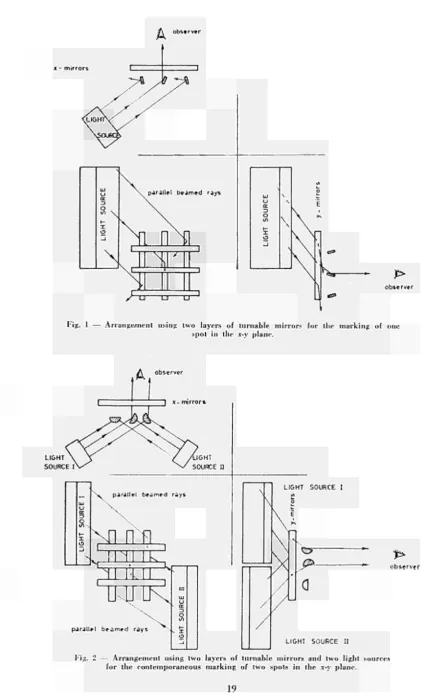
Page Fig. 1 Arrangement using two layers of turnable mirrors for the marking
of one spot in the x-y-plane 19 Fig. 2 Arrangement using two layers of turnable mirrors and two light
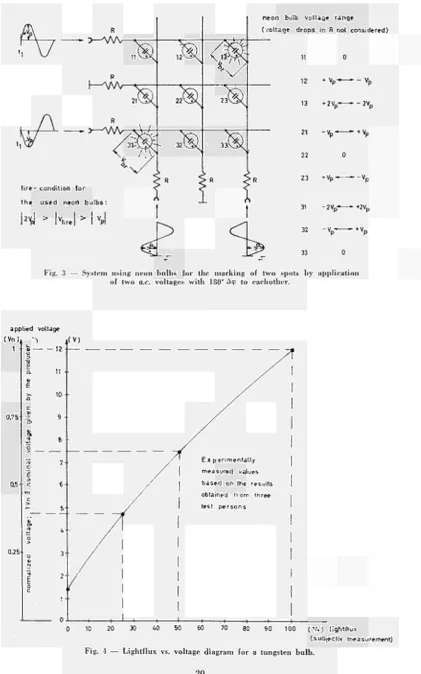
sources for the contemporaneous m a r k i n g of two spots in the Λ-y-plane 19 Fig. 3 System using bulbs for the m a r k i n g of two spots by application of
two a.c. voltages with 180° Αφ to eachother 20
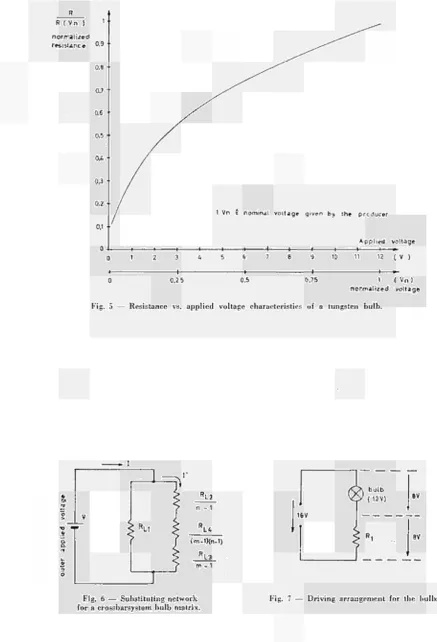
Fig. 4 Lightflux vs. voltage diagram for a tungsten bulb 20 Fig. 5 Resistance vs. applied voltage characteristics of a tungsten bulb . . 21
Fig. 6 Substituting network for a crossbarsystem bulb matrix 21
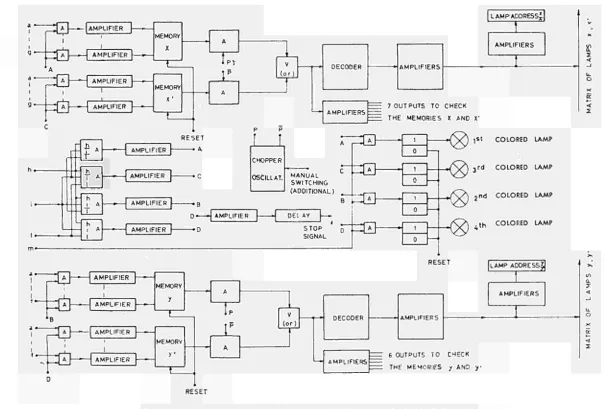
Fig. 7 Driving arrangement for the bulbs 21 Fig. 8a Complete plotting of bulb matrix section 22 Fig. 8b Exact substitute for the circuit in Fig. 8a 22 Fig. 9 Block-diagram of the driving system and all logic circuits for the
bulb matrix 23 Fig. 10 View of the total instrument housed in a provisorial case . . . . 24
PATTERN DISPLAY CONSIDERATIONS FOR A PROGRAMMING AID MACHINE LINKING A DIGITAL AND AN ANALOGUE COMPUTER
SUMMARY
A short introduction to the question of auxiliary means, linking the output of a digital computer to the patch panel of an analogue computer in order to assist in setting up the connections on the patch panel, is given. These connections, being a transformation of a set of addresses delivered by the digital computer, represent the program for the analogue computer.
After that a general survey of different existing or proposed solutions for the problem of panel display is presented concerning evacuated arrangements, solid state, gaseous and liquid display types, mechanical and optical systems, neon- and tungsten-bulb matrices. Closer consideration is given to a tungsten-bulb matrix which has been finally chosen for the instrument.
A method for the calculation of crosstalk in such a bulb matrix is shown and a consideration of the summing up of reverse currents in the matrix is added. The problem of using a minimum number of components in a decoder is discussed as well as die question of eventual overloading of some driving transistors for the decoder, caused by an unsuitable distribution of component tolerances. Finally, a short explanation of the instruments block-diagram is given.
1. INTRODUCTION
In the past many attempts have been made in developing a code to carry out automatically on the digital computer the great amount of preliminary operations which are the precondition for the study of a problem on an analogue computer.
In the mathematics-group of the Euratom-Center of Ispra the so called APACHE (Analog-Programming And CHEcking) code has been developed to be a symbolic language near to the original mathematical statements serving as the means of intro-duction of the physical problem data into the digital computer, which controls all the preparation for the study of the analogue problem. The output of this digital computer is then a complete list of patch panel (*) addresses written into one or more punched cards.
Up to now these addresses had to be read by an operator who then carried out manually the related patch panel connections. This process of reading and finding the right connection holes according to the address naturally contained the possibility of making many errors. Therefore it was felt that an instrument should he developed which serves at least as an aim to facilitate this work, since a complete automatization of doing the connections by itself seamed to be too difficult to achieve in the first step. This difficulty is due to quantitative problems. Assuming that there are for instance 50 lines and 100 columns of jacks which shall be connectable without limita-tions among eachother, this requires for the stated amount of 5000 jacks a crossbarfield with ca. 12,5 . 10° independently controllable coupling devices. Fortunately there will he never in praxis a program which uses all jacks, that means in our example a maximum of 2500 cables (if it is programmed in a manual way). However assuming that on a
patch panel of this size half of the jacks are serving only as outputs and the other half only as inputs there will be a remaining requirement of (5 . 103 : 2)2 = 6,25 . 10°
such coupling devices like switches of an electromechanical or purely electronic manner. From these figures it can be easily seen that a solution of this kind will be in every case too expensive. These considerations are based on the condition that it shall be possible for every output to reach every input. Like in the planning of telephone exchanges there can be reached however a remarkable reduction in coupling elements if certain internal blocking effects are granted, that means if it is agreed that a certain pattern of inter connections may hinder a certain output to reach a certain input, or if some inputs are never in correspondence to some outputs. Studying the programming requirements in a general way it should be possible to form groups of outputs and groups of inputs where there is a certain blocking effect between the outputs or between the inputs of the same group allowed, or where are some interconnection possibilities not at all provided. In this way it may be possible to find a solution for completely automatically handled interconnecting of the patchboard-jacks even for a reasonable price. Therefore the capability of the developed instrument is only as follows: The punched card addresses are electronically processed and converted into χ and y values for fixing one position in the patchboard by the two rectangular coordinates. These coordinates are then sent into a crossbararrangement in such a way that in the crosspoint of the coordinate values a light signal appears which can be seen through the related hole of the patchboard if this is properly fixed in front of the crossbar device. In this way two holes on the patch board can be lightened up simultaneously for the eye of the observer and all what he has to do is to take the connection-lead and put its two ends into the two illuminated holes. By these provisions the errors made by the operator would be more or less avoidable since also after having made each connection there is an additional check by the very fact that no one hole should be lightened up anymore since the marked ones are now closed with the inserted plugs.
Furthermore there are four types of connections to be made: 1) Connection of one output to one input by a single lead.
2) Connection of one output to one adjacent input by a single connection plug. 3) Connections of three outputs to each adjacent inputs by a special three con nection plug.
4) Connection of one output to one input by a single lead via a fan-out piece in the case that also other inputs shall in the sequence of the work be connected to the same output or have already been connected before.
For indicating, what type of connection shall be used, another four addresses must be available to be read from the punched card. The indication what address of these has been read can for instance be accomplished by relating four different colored lamps, which are mounted aside the patchboard, to the four addresses by means of an address storage device in order to keep this information visible during the whole time the operator works on doing the related connection. Such a storage device must also be provided for the addresses of the crossbar field coordinates since it is unconvenient to use the card itself as a short time memory during operation.
Concerning all the functions of the instrument one may call it in a general way to be an "intelligence l i n k " between program and patch panel.
2. D I F F E R E N T SOLUTIONS F O R T H E P A N E L DISPLAY P R O B L E M
T h e r e are many solutions to the problem of indicating in a panel a position individualized by the two m a t r i x variables χ and y. These solutions can be grouped according to the n a t u r e of the addresses (digital, analog, analog with feedback which takes the reference signal from the analog-digital converters*) and according to the type of t h e display: evacuated, solid, gas, liquid and mechanical [ 1 ] , [ 2 ] , [ 3 ] , [4J. In any case the panel-type display acts as a transducer to convert an optical or electrical in p u t into an optical o u t p u t primarily adapted for h u m a n observation.
2.1 T h e evacuated-type panel displays
are split into two groups :
a) Conventional CRT's redesigned to give the desired geometry (CRT of flat design) : T h e addresses are normally of t h e analog or digital and analog type according to the system used to deflect the electron beam. A feedback system is used when a good precision is required.
b) Image intensifier type tubes, where the problem of the stresses on the plates caused by atmospheric pressure is avoided and so the area of the tube is not limited : — An electromagnetic radiation forms an image on a photocathode that can be sensitive to that portion of the electromagnetic spectrum which is of interest. T h e image is then intensified through a group of secondary-emission dynode surfaces and presented on the phosphor of the anode.
2.2 Displays using solid-state materials
T h e most i m p o r t a n t group of this type is the .ry-matrix one where an electro luminescent phosphor (usually zinc sulphide crystals suspended in a transparent plastic or ceramic dielectric) is placed between an «y-array of grids. An alternating electric field (up to 10r'V/cm) between 100 and 20000 cycles/s allows the crystals to emit light
when they are properly activated. T h e brightness increases with both frequency and voltage: the o p t i m u m of efficiency, on the contrary, has been achieved at intermediate voltages. Moreover it must be pointed out that the highest brightness obtained at high voltages and frequencies may result in lifetimes of a few minutes. Now, if a voltage
* For instance, in the memories which use the flying-spot tubes the position of the spot is converted into a number by an optical digitizer and the comparison of this digital signal with the input address brings the spot in the exact position; in display panels where the χ and y displacements are obtained mechanically, mechanical digitizing gives directly the χ and y in digital form to control the χ
is applied to one line of the χ and one line of the y grids, the voltage drop across the area where these gridlines overlap will be twice as great as across every inactivated gridline crossing with the fed one. With the total voltage drop of the proper magnitude, the EL phosphor will be lighted at that area.
There are some difficulties owing to the crosstalk, stability and brightness. Two ways exist to overcome the difficulty of the crosstalk:
a) an EL material with a suitable threshold in its brightness-voltage characteristic; b) a phosphor in series with a nonlinear element, so that the voltages across the EL phosphor can be easily modified.—The second approach has led to many solutions: one of these is to use a ferroelectric nonlinear capacitor in series with each cell of phosphor considered as to be a lossy capacitor. The capacity of the ferroelectric element is controlled by a low power dc voltage source.—Another system which employs this approach uses nonlinear resistors in series with each cell of phosphor: in this way the brightness-voltage characteristic has a well defined threshold and a very steep slope so that the brightness discrimination ratio between full voltage and half voltage becomes more than 10,000 to 1, which is more than enough to eliminate the cross-image effect. Elements of this type operated at a 10 kc/s and 250 volts supply with a spot brightness of 7 to 10 foot-lamberts and a resolution of 8 lines/inch. There are no informations given about the size and the shape of the spot.
There has been reported in the literature about another solid state display device which looks interesting for the fact that the display (in one dimension) is due to timing of the pulses starting from the opposite ends of one line [5]. This device consists of a thin, flat panel of piezoelectric material supporting an electroluminescent layer. Voltage pulses, applied to the electrodes on the periphery of the panel, generate elastic waves into the piezoelectric material. Electric fields which accompany the waves interact with the electroluminescent layer and produce a localized spot of light. The position of the spot is controlled as already said, by varying the relative timing of the pulses. The light intensity can be modulated. The contrast ratio is improved by a nonlinear resistance layer in series with the electroluminescent phosphor layer. Actually the spot size is approximately 2 mm, and the input capacitance is_20pF/cm2.
The electroluminescent displays are solid-state devices and do not require an evacuated envelope: thus a lightweight flat panel with a high density of display elements can be obtained. Large dimensions of the panel and high resolutions however result in a remarkable response time for the device, because this is limited by the involved capacitance and by the internal impedance of the driving source, that is by the power dissipation in the address decoders. A wide and interesting discussion of many problems of the electroluminescent screens is presented by S.L. Linder and C.W. Hoover in [6].
2.3 Gaseous displays
The gaseous display may be obtained by substituting the EL layer of the electro luminescent display with a gas; it may be thought as a large array of tiny closely stacked gas discharge or fluorescent bulbs connected by a crossed wire matrix. The constant voltage characteristic of the gas discharge may be altered by using a proper geometry of the electrodes, gas pressure etc. In the gas discharge the value of the firing voltage is critical and so the crosstalk difficulty can be overcome quite easily. All these display panels are at present experimental.
2.4 Displays using liquids
Many physical and chemical phenomena may be used for this purpose. For instance, in an electrofluorescent liquid a continuous voltage causes a reaction which produces an electrochemical change that can be located in a fairly well defined zone with a particular geometry of the electric field. The phenomenon may be observed as a fluorescence source in the presence of ultraviolet radiation or by the selective absorp tion out of white light. This phenomenon is very slow.
A form of light valve is the Kerrcell. The transmission of light through this cell is controlled by the electrical potential change across it, which normally varies the polarization of the molecules of the fluid. This phenomenon may he very fast (up to a speed of 10~s sec).
2.5 Mechanical and optical solutions
Many mechanical displays may be designed where the addresses are obtained with mechanical displacement along the axis χ and y. This is a slow system and it is not practical when more than one light spot must be contemporarily present from the ¡joint of view of human observation.
However it is possible for instance to construct a system for mechanical display, which is not based on mechanical slow movements along the coordinates but on optical and mechanical principles together by columns and lines of narrow mirrors, which are turnable by electromagnets in one of two fixed angular positions around their long axis. The light source must be constructed and mounted in such a way, that the first layer of mirrors (columns or lines) must in its full size be hit by the parallel light rays. Preferably the light should pass a certain device after leaving the source to guide its rays all into one direction. Such device could be for example a grid composed of tubes or channels of a sufficient length and mounted in front of the lamp. The overall function in principle is this (see Fig. 1), that in the normal position of the mirrors which are first reached by the light, the light is absorbed or reflected in a direction where it can not hit anyone of the mirrors of the second layer which is nearest to the observer (lines or columns). Only if one mirror of the first layer is electromagnetically turned into its "on"position, it reflects the light in a way, that every mirror of the second layer (which has of course crosswise oriented mirroraxis in respect to the ones of the first layer) is hit by a lightspot in the area of the turned mirror of the first layer. In the normal position now all mirror devices of the second layer absorb or reflect the light into a direction where it can not reach the observers eye. Only the mirror electro magnetically turned into its "on"position reflects the light into a direction that provides visibility for the observer. By these means it is possible to mark every point of the
x-y plane. Since the response of such an electromagnetically turned mirror can be made fairly fast, in the order of 10 to 50 ms, by limiting the massmoment, it is possible to establish a sequence of two spots alternatively with a frequency higher than the one correspondent to the eyes resolution time, in order to simulate two marked spots at the same time. However since the device works electromechanical, there will be some steady noise unavoidable.
both layers that two lightspots at the same time can be ligthened up continuously without shopping (see Fig. 2). Although these three-position-movements could be easily achieved by using two different electromagnets which turn each the mirror from the restposition into the opposite angular direction, this method suffers a severe limitation: There can never be illuminated in the same manner two lightspots which have one coordinate in common since by moving a mirror, the light of the ray from the other lamp is blocked in respect to this mirror. To overcome this handicap, if complete independence of the choice of the two lightspots from eachother is necessary, one must set up an additional logic, which gives in such a case the command, that for the mirror related to the common coordinate only one of the two control signals is applied and that the two other mirrors which are related to the other two remaining coordinates (and are of course mounted in the other layer) turn both into the same direction. Such a logic is not at all very complicated. By these means both lightspots would in these special cases originate from the same light source and the intended function is executed for the observers eye as perfect as if there would not have been the above mentioned limitation.
In order to save electronic material it should be worth-while in all mechanical systems, where two simultaneously ligthened spots without chopping are used, to chopp only the decoding logic in a rather fast manner. If the indication units are sufficiently slow in response their mass-inertia can be used as short time memory over half a period of the fast shopping frequency for the logic units.
One statement should have been made which offers even more possibilities for solving the general problem of marking two lightspots in an :r-y-plane. It is not necessary to lighten up only the two spots, moreover it can be helpful for speeding up location finding of the spots to illuminate the whole coordinates and to mark the spot by the crosspoint. If this kind of operation is used it is however necessary to mark the two points in a sufficiently slow sequence one after the other or control the changeover from one spot to the other by the operator himself after he finished inserting one plug of the leads into the proper hole. A realization of such a system could be imagined by using two sets of optical light-guides for the two coordinates which are casting out some stray light to one side over there full length. The (e.g. plexigum) lightguides could be fed by lamps at their ends. This would be more an optical than a mechanical solution, however also corresponding mechanical solutions could be easily found. Such a help for finding more easy the lighted hole in a big matrix can be also arranged in all other systems by lighting up in addition to the wanted hole one hole out of a vertical and one out of a horizontal line mounted at the sides of the matrix indicating the coordinates of the wonted hole.
It is assumed that those mechanical systems as described in this chapter will be economical especially for big matrix arrangements since the more expensive electro-mechanical driving units are only necessary in the amount of the sum of lines and columns.
2.6 Tungsten or neon gas bulb displays
It is near at hand to use tungsten or neon gas bulbs in a flat display. There are however three difficulties in an .ry-arrangement : the resolution is limited by the bulb dimensions, the crosstalk is a difficult problem, particularly for the tungsten bulbs owing to the slow slope of the brightness-voltage characteristic, and the relativ cost is high for
displays with a large number of bulbs. The problem of the crosstalk is easier in the case of neon gas bulbs, but the tolerance in the firing voltage value makes difficult and critical the choice of the threshold. A suitable nonlinear impedance in series with each bulb may solve the problem.
SOLUTIONS TAKEN FINALLY INTO CLOSER CONSIDERATION FOR THE ACTUAL PROBLEM
The fairly small number of light-spots in our actual problem for patch-panel distribution of a size of 46 lines and 75 columns did not justify a deep study and long development work for solutions mentioned above in 1) to 5) and not available on the market till now. Therefore it was selected to use a matrix with individual bulbs.
3.1 Matrix of neon bulbs
A rather simple system using ac for energizing the columns and lines at the
cross-points of which the neon bulbs are mounted is shown in Fig. 3. In order to be able to light up two different neon bulbs of from eachother independent locations in the
crossbarfield, ac, for instance of line frequency, is applied in such a way to the columnes
and lines that two phases of 180° difference are in use for the two involved ordinates and abscisses. The voltages with those two phases can be easily taken from a
trans-former. In this case only the lamp whose crossing wires are attached to ac supplys of
opposite phases can periodically fire. Since there are only two phases in use there are also only two crosspoints for opposite phases possible, hence two lamps are ligthened up contemporarily. There is no crosstalk over other lamps, as far as firing is concerned, if the ignition voltage meets under all conditions as there are temperature changes or radiation influences the requirement
| ± Vpeak| < | ± Vignitionl < [ i ^ V p e a i t j
From the Fig. 3 this statement can be easily proved since for all not selected
lamps 11, 12, 21, 22, 23, 32 and 33 the electrode voltage remains below Vpe!l!l and for the
selected lamps 31 and 13 every half periode the voltage would rise, if not clamped by
the fired lamps, to 2Vpeak· These two lamps are therefore fired twice every period and
burn for a time less than half a period every time. The switching of the ac could
happen at the primary side of transformers for each column or line if semiconductor components, not capable of handling the high operation voltage for the neon bulbs, shall be used. Two transistors for instance would then serve as a s.p.d.t. switch for each column or line to connect it (respectively its transformer primary) with one or the other end of the centertapped output coil of the central supply transformer.
The decodifying logic driving the line and column-transistors could be constructed
in a fast tic-pulsed chopping mode using for instance capacitors at the bases of those
transistors as short time memories. In this way the decodifying logic needs not to be doubled for the two pairs of lightspot addresses.
The normal neon gas bulbs have a firing threshold of 70 to 100 volts, with a ratio between the minimum and the maximum value of this threshold quite less than one to two, and a very low power consumption. But the higher price of the neon bulbs, the high firing voltage which requires a more complicated logic of the driving system, the necessary brightness and dimensions of the available bulbs compelled us to decide for the use of a matrix of tungsten bulbs.
3.2 Adopted solution using tungsten bulbs
The brightnessvoltagecharacteristic of a tungsten bulb is given in Fig. 4. Fig. 5 gives the characteristic of the resistance of the bulb plotted against the applied voltage. Fig. 5 shows that there is not only a problem of crosstalk for the brightness, but also a problem of crosstalk for the power consumption.
3.2.1 Method for calculating crosstalk in a bulb matrix
For every matrix m ■ n bulbs, where only one bulb is lit up by applying a voltage between one line out of m and one column out of n and where all the other πι —1 and
n — 1 inputs are floating with an infinite impedance there will be four and only four groups of differently lit bulbs. The first group contains only one bulb (Lj) which is the one exposed to be lit up and its brightness is according to the above mentioned applied external voltage. The second group contains all bulbs (L2) which are at their one side
connected to the one line out of m where the voltage is applied to, except the bulb of the first group. Thus the second group contains re — 1 bulbs. The third group contains all bulbs (L3) which are at their one side connected to the one column out of η where
the voltage (the other terminal) is applied to, except the bulb of the first group. Thus the third group contains m — 1 bulbs. To the fourth group there belong all bulbs (L4)
whose leads are neither connected to the one mentioned line nor to the one mentioned column. Thus there are belonging (m — \) (re —1) bulbs to the fourth group. It can be shown (in a similar case this problem was handled concerning crosstalk in telephone exchange crossbarfields [7] ) that the current driven through the bulbs belonging to the same group is equal for all bulbs.
If for instance RL2 is the resistance of one bulb of group 2 in operation, the
whole matrix of bulbs may by substituted by a network of resistances of the four different values RIA, Rlj2, RLS a nd Rn- Since the RL2, RLA and RLi are paralleled to the amount
stated above, the complete and exact substituting network for the whole bulb matrix has the shown lay out (Fig. 6) with the marked values for the resistors.
The total current I will then be:
1 ( / r e l ) ( r e l )
R/,1 RL2(m-l)+RLa(n-l)+RLi
and the losscurrent /', that means the sum of the bypassing currents not passing the one desired bulb :
« « ( m l J + Ä u t n l J + Ä M
For easier discussion of the last equation we will assume, that for a certain matrix it may be n = m = N. With this we get:
z'=v.
{N-
iy-(N-l){RL2 + RL3)+RLi
and for N sufficiently large :
V I'=N
RL. + RLS+^RH
If we further roughly approximate, in spite of the fact we are using tungsten bulbs in different workingpoints of their characteristic, that all bulbs have about the
same internal resistance which we call Rh2 ~ RllA ~ R,A ~ R, the last equation simplifies
to
V
I' = N
2R,
It can be easily seen from the last equation that the power consumption becomes
prohibitive for greater values of N that means greater number of lines and columns.
For exact calculation of the loss-current / ' one must use the first stated equation
for I' and take into account, that
I'
RL2=f{h2):. RL» = HILB) and RlA=f(IL4), where IL2=—-;
re —1
I' I'
ha= r- andrei-1 ( n i - l ) ( r e - l )
In=-For a worked-out calculation it appeared that a linear function for R¡, of the type
RL ~ o/i+fe substitutes sufficiently good the bulb characteristics in the regarded region.
One could diminish the crosstalk for brightness and power consumption by installing nonlinear series resistors to each bulb but such resistors of a suitable charac-teristic have not been available. Therefore we used a diode in series with each bulb. Since the diode is an unidirectional current conductor in its first approximation, it opens all the crosstalk paths. This can be easily demonstrated at a drawing of the matrix of bulbs, looking at the crosstalk paths and taking into account the direction of currents. It might be good to note that diodes do not introduce higher thresholds or deeper slopes in the brightness-voltage characteristics of the bulbs, because their nonlinear characteristic parts are effective only around the zero point. Therefore they act on the lamps practically only as rectifiers.
Helping us in the decision to use tungsten bulbs and diodes has been the fact that the price of one bulb plus a diode is less that of one neon bulb.
3.2.2 Life measurements of the bulbs
Some life-measurements of the bulbs have been undertaken, using a precedent experience in this field. With a driving system of Fig. 7 there was not a single bulb
burnt out in 200 hours with a driving frequency of about lc/s. The voltage drop across
the bulb is equal to the voltage drop across the series-resistor Rr of the driving system
and is 8 volts where the nominal voltage of the bulb is 12 volts.
3.2.3 Influence of summed up reverse currents in the matrix
T h e value of Rx h a s b e e n o b t a i n e d from t h e d i a g r a m of Fig. 5 by t a k i n g a c c o u n t of t h e s u m of t h e reverse c u r r e n t s of t h e diodes in t h e crosstalk p a t h s . T h e calculation of t h e crosstalk c u r r e n t again follows t h e basic ideas developed i n [ 7 ] . F o r t h e special case in a p p l i c a t i o n Fig. 8a shows a c o m p l e t e p l o t t i n g of all i n p r i n c i p l e involved com ponents in a m a t r i x section a n d t h e i r d r i v i n g system. Ra or Rb are t h e resistors to ground if a line or c o l u m n is n o t activated. F o r t h e activated case t h e y c h a n g e to Ria
or Rib.
Fig. 8b corresponds w i t h o u t any neglections to Fig. 8a if all Ra, all Rb, all diodes a n d all b u l b s are u n d e r t h e m s e l v e s e q u a l . Two conclusions for satisfactory w o r k can be d r a w n i m m e d i a t e l y :
Ra
1) Ra s h o u l d be so great t h a t r e m a i n s ^> Rib.
?re —1
Rb
2) Rb s h o u l d b e so great t h a t r e m a i n s ^> Ria.
re —1
T h e s e conditions are necessary to observe in o r d e r to avoid big losscurrents passing t h r o u g h t h e b u l b s L2 a n d L3 and big voltage drops in t h e resistors Ria a n d Rib w h i c h
would result in decreasing t h e available voltage for b u l b L1. F u r t h e r m o r e it can b e i m m e d i a t e l y seen t h a t u n d e r observation of t h e j u s t m e n t i o n e d points t h e l e a k a g e c u r r e n t sum t h r o u g h all t h e reversed biased diodes in t h e m a t r i x is given b y t h e e q u a t i o n :
Vr e v
Irev.= ρ ' (ret —l)(re —1) or just /r e v. = (rei — 1) (re — 1) /D r e v.,
w h e r e RDrev. is t h e diode resistance w i t h an a p p l i e d reverse voltage Vl e v.. ( I n this cal
culation t h e r e is neglected t h e i n t e r i o r resistance of t h e b u l b s since i t is very small c o m p a r e d w i t h RDrev. a n d f u r t h e r m o r e t h e r e are neglected t h e voltage d r o p s i n t h e for
w a r d biased diodes since w i t h g e r m a n i u m diodes its sum (VDL2 + VD L3 ) will b e m u c h less
t h a n 1 volt because t h e c u r r e n t t h r o u g h a single diode r e m a i n s very small.)
I n t h e set u p practically constructed t h e r e are 46 lines (rei = 46) a n d 75 columns (re = 75). T h e reverse c u r r e n t /D r e v. w i t h 8 volts a p p l i e d at 25°C is in t h e average a b o u t
2 /¿A. H e n c e t h e s u m of l e a k a g e currents i n t h e b u l b m a t r i x at 25°C will b e ca. 6,7 m A . F o r 35°C it becomes t h e r e f o r e already ca. 15 m A . Still t h e total l e a k a g e c u r r e n t s u m r e m a i n s well below t h e c u r r e n t c o n s u m p t i o n of t h e one lit u p b u l b .
4. T H E A U X I L I A R Y A N D L O G I C C I R C U I T S O F T H E I N S T R U M E N T
A brief h a n d l i n g of some specific p r o b l e m s shall b e given in t h i s c h a p t e r besides a short e x p l a n a t i o n of t h e overall blockdiagram.
4 . 1 T h e d e c o d e r f o r t h e m a t r i x a d d r e s s e s
T h e decoding for delivering t h e 2" possible addresses (of each one of t h e two m a t r i x coordinates) o u t of t h e r e l a t e d re b i n a r y variables, w h i c h are r e a d from t h e p u n c h e d cards i n o u r e x a m p l e , can be realized by executing t h e 2" B o o l e a n functions in a decoder composed of diode conjunction gates. T h e simplest m e t h o d is to use 2"
c o n j u n c t i o n gates w i t h each re i n p u t s for all re variables or respectively t h e i r negations. T h i s can be excessively m u c h for greater values of re. T h e r e is h o w e v e r t h e possibility to divide t h e re variables into groups, to establish a decodifying for each g r o u p , a n d in cascade w i t h t h e results to use f u r t h e r sets of conjunction gates. I t is h o w e v e r possible if re is sufficiently large to choose t h e n u m b e r of parallel groups in t h e cascaded stages (or steps) in w h i c h t h e decoding is executed. F u r t h e r m o r e it is a m a t t e r to choose w h e t h e r t h e selected groups s h o u l d h a v e a m o n g themselves nearly t h e same n u m b e r of i n p u t variables or q u i t e differing n u m b e r I n a study of E u r a t o m , I s p r a (*), it is
shown t h a t p a r t i t i o n i n g of t h e re variables in two parts, such t h a t rei, = i r e , = — if re is
re + 1 re1 . 2
even, a n d reii=——, rei2=—— if re is odd, leads to realizations with less diodes t h a n any
— —
o t h e r p a r t i t i o n i n g in two p a r t s a n d t h a t t h e p a r t i t i o n i n g in two e q u a l (if re is even) or almost e q u a l (if re is odd) p a r t s yields a scheme using less diodes t h a n a scheme with p a r t i t i o n i n g i n m o r e t h a n two p a r t s . F u r t h e r m o r e it has b e e n shown t h a t w h a t e v e r f u r t h e r subdivision is used in realizing t h e sets of t h e rei¡ variables always m o r e diodes are involved t h a n in case t h e p a r t i t i o n i n g is in two e q u a l or almost e q u a l sets, t h a t m e a n s also in case of f u r t h e r subdivision this last m e t h o d leads to t h e use of t h e least n u m b e r of diodes. After these results a f u r t h e r conclusion of t h e investigations is stated in t h e m e n t i o n e d p a p e r as follows: T h e r e a l i z a t i o n of t h e 2" B o o l e a n functions of re variables w h i c h are given t o g e t h e r w i t h t h e i r negations, by m e a n s of diode conjunction m a t r i c e s , involves t h e least n u m b e r of diodes if t h e re variables are p a r t i t i o n e d i n two
n ι ™ · ι ι r , re + 1 . f i 1 . . . .
sets c o n t a i n i n g — a n d — variables if re is even, and a n d variables if re is odd,
¿t ¿* — —
a n d each of these sets likewise is p a r t i t i o n e d in two sets, a n d so on, u n t i l t h e n u m b e r of variables in each set is smaller t h a n four.
M e n t i o n i n g an e x a m p l e this would m e a n t h a t for t h e decoder in case of re = 8 variables four groups of each 2 variables (less t h a n four) a n d t h e i r negations would be formed. T h e first decoding stage would t h e n c o n t a i n four groups of each 4 conjunction gates w i t h each two i n p u t s . T h e second decoding stage w h i c h follows in cascade to t h e first would c o n t a i n two groups of each 16 conjunction gates w i t h each two i n p u t s a n d serves to c o m b i n a t e in each of t h e two groups t h e results of two groups of t h e first decoding stage. T h e t h i r d decoding stage combines t h e results of t h e two groups of t h e second decoding stage i n one g r o u p of 256 conjunction gates w i t h two i n p u t s each. I n this way t h e total n u m b e r of involved diodes is 2 . 2 5 6 + 2 . 1 6 + 2 . 16 + 2 . 4 + 2 . 4 + 2 . 4 + 2 . 4 = 608. If t h e decoding would h a v e been d o n e only in two cascaded stages t h e total n u m b e r of diodes involved would h a v e b e e n 2 . 2 5 6 + 4 . 1 6 + 4 . 1 6 = 6 4 0 or 4 . 2 5 6 + 2 . 4 + 2 . 4 + 2 . 4 + 2 . 4 = 1056 d e p e n d i n g on w h e t h e r gates with four i n p u t s are used in t h e first stage (640 diodes) or i n t h e second stage (1056 diodes). If however no p a r t i t i o n i n g is used t h e total n u m b e r of involved diodes is 8.256 = 2048. O n e can see t h a t t h e i m p r o v a l in saving diodes is very great for doing p a r t i t i o n i n g at all. T h e m o r e stages of decoding can b e established t h e less is t h e d r a w b a c k in a u g m e n t a t i o n of diodes if one decoding stage less t h a n t h e m a x i m a l n u m b e r of possible stages is used. So it can be sometimes technically justified n o t to use t h e m a x i m a l n u m b e r of decoding stages if t h e voltage d r o p in t h e cascaded diodes will cause troubles a n d would r e q u i r e for instance a m p l i f i c a t i o n w h i c h costs m o r e t h a n t h e saved diodes by increasing t h e n u m b e r of decoding stages.
To express in a t e c h n i c a l way t h e w e l l k n o w n overall results of t h e considerations for t h e i n t e r n a l g r o u p i n g of t h e decoding m a t r i x it can be said t h a t one involves t h e
(*) Investigation by P. Camion and L. Verbeek, Ispra, January 1963.
least number of diodes for decoding if he obeys the following rules: The last group (out-put-group) is naturally one group only with 2" conjunction gates (for the case of full use of all possible combinations). re = 2 yields 4 gates with 2 inputs each and re = 3 yields 8 gates with 3 inputs each. The inputs regard all combinations of the re variables. If re > 3 the output-group is always assembled by 2" gates with 2 inputs each but there will be also preceding groups. E.g. for re = 4 the 16 output-gates are preceded by two groups of 4 gates with 2 inputs each, and for re = 5 the 32 output-gates by 1 group of 4 gates with 2 inputs each and 1 group of 8 gates with 3 inputs each. Always the following group regards with their gates of 2 inputs each all possible output combi-nations of the two preceding groups. The mode of splitting always observes the rule that the log. dual, of the number of gates of the following group is divided into 2 equal parts if Id is even, or into 2 almost equal parts if Id is odd. These parts are then the Id of the number of gates of each of the two preceding groups. The splitting of each branch is continued till the groups contain only 8 gates (3 inputs each) or 4 gates (2 inputs each).
4.2 The driving system for the decoder
For the driving system of the decodifier there may arise some difficulties if saturated transistors are used for the driving, due to the fact of accidental summation of load currents to one transistor because of the spreading of saturation voltages of the transistors and voltage drops across the diodes of the matrix. It is however in many cases possible to avoid saturation and to provide selfbalancing of the system like the following remarks will show.
If re is the number of the .r-inputs and also of the x-inputs of the decoder there
are naturally 2" outputs in a full decodifier. If I is the current of one output of the
decodifier, the total output current of all outputs of the decoder will be (2n —1) / since
only one output is activated, that means only for one output the current is not delivered through the resistor of the last diode conjunction gate but from the inputs of this gate or this cascade of gates. It shall be supposed that the leakage current between the sets in which the variables are partitioned is negligible.
Now, as mentioned before, owing to the different saturation voltages of the transistors of the driving system and to the different voltage drops across the diodes of the matrices,
2"
one transistor can be forced to drive accidently — outputs, that means it must deliver an
2"-1 I
output current of 2"~' . / amperes. But if its base current is limited to only . =/&,
re ßmin
where the collector current is Ic = h, the transistor goes out of saturation, that means its
collector-emitter voltage grows. In this way also the other related transistors (up to one half of all the driving transistors, that is up to re transistors) must also deliver an output current. By this fact it is possible to obtain a good distribution of the load on all the involved driving transistors. The power dissipation will be always low, because the differences beUveen the different saturation voltages and between the different voltage drops across the diodes are normally lower than 1 volt.
It is possible to design the circuit in this mentioned way, if the claimed accuracy
of the output levels is not too high. Finally it may be mentioned, that these
tions are independent from the fact whether the decodification happens in a single stage or in a multiple stage decoder if in the latter case only the last stage of the decoder contains the normal working resistors for the diode conjunction gates.
4.3 The general block-diagram of the instrument
A short explanation of the general function of the instrument shall be given regarding Fig. 9.
The words delivered to the inputs are each containing the information of one coordinate value for the bulb matrix (6 or 7 bits), the identification of the coordinate
(x or y for one bulb and x' or y' for the other bulb) (2 bits) plus one bit information
whether a word is at all fed to the inputs and one bit to command via a set of 4 con-junction gates for this bit and the 4 coordinate identification outputs 1 out of 4 colored lamps for the indication of the type of connection to be used by the operator. This gives a total of 11 bits for one word. Since on a normal IBM punched card there are 12 bits per column available, all except one are used. 4 words together form one group of input information for establishing one connection on the patchboard. After the start for reading is given by the operator the 4 words are read automatically and after arrival of the last coordinate identification (D) the reader is stopped. By means of conjunction gates the coordinate identification signals open the path for either one of the bulb addresses to the related one of the 4 memories. A central chopper causes the time-multi-plexed offer of the 2 paires of stored addresses to the 2 decoders. The chopper frequency is sufficiently high to give to the operator the imagination of 2 continuously lit up bulbs.
(It may be noticed that with this operation mode the pulse current for the bulbs must be higher than obtained from the brightness vs. current diagram in order to give the wanted effective current.) Special outputs are provided in order to enable for a check of the stored addresses before they enter the decoder. Before entering the bulb matrix the addresses after being already amplified behind the decoder are fed also to another set of outputs for driving bulbs of one line and one row mounted above and aside the matrix in order to aid the operator in fast finding of the lit up matrix-bulbs and as a further steady mean for checking the correct function of the bulb matrix. The general reset for the memories of the addresses and of the information for the colored lamp is done automatically if a new set of 4 words shall be read. A manual setting of the chopper is also provided for checking purposes. For this it is advisable to leave the chopper oscillator run and use only one output in order not to overload the bulbs because of continuous current supply.
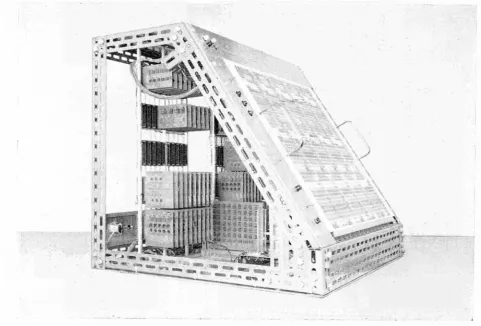
A view of the total instrument housed in provisorial case is shown in Fig. 10.
Although the constructed instrument deals with the task to mark only two points of a matrix in a slow sequence according to a given information, it was felt that per-haps some of the investigations and considerations made can be usefull also for other purposes where a pattern display is used. This has been the reason to handle a part of the problem in a more general way.
REFERENCES
[IJ J J . JOSEPHS: "A review of panel-type display devices" - Proc. IRE, August '60; pp. 1380-1395.
[2] R.T. LOEWE, R.L. SISSON, P. HOROWITS: "Computer generated displays" -Proc. IRE, January '61, pp. 185-195.
[ 3 | I. GREENBERG: "Electroluminescent display and logic devices" - Electronics, March '61, p. 31.
[4] H.G. BLANK, J.A. O'CONNELL, M.S. WASSERMANN: "Nonlinear resistors enhance display panel contrast" - Electronics, August '62, p. 33.
[5] S. YANDO: "A solid-state display device" - Proc. IRE, December '62, pp. 2445-2451. [6] S.L. LINDER, C.W. HOOVER: "Improved performance from matric
electro-luminescent screens in optical readout applications" - Proc. of the Symposium on Large-Capacity Memory Techniques for Computing Systems, May 23-25, 1961. [7] W. BECKER: "Die Planung einer elektronischen Fernsprechvermittlungsanlage
unter besonderer Berücksichtigung möglicher Störeinflüsse; Teil I I : Theoretische Betrachtung des Nebensprechens im Koppelfeld" - Frequenz. April '62 Bd. 16 Nr. 4, pp. 138-148.
« - mirrors
parallel beamed rays
o
ΙΛ
t
-I O
'W-observer
Fig 1 — Arrangement using two layers of turnable mirrors for the marking of one
spot in the x-y plane. observer
1 x-mirrors
o
parallel beamed rays
ΧΠ CLB
> c
χ ^
π ^ ^ .
parallel beamed rays
o
\
LIGHT SOURCE I
) <
JßL
observer >LIGHT SOURCE II
Fig. 2 — Arrangement using two layers of turnable mirrors and two light sources for the contemporaneous marking of two spots in the x-y plane.
[image:23.595.39.465.44.743.2] [image:23.595.74.465.59.438.2]- 3 - W W
h-ΛΛ/V
f i r e - c o n d i t i o n t o r
t h e u s e d n e o n b u l b s
J2vJ > k „ | > | V, ' t i r e
^ 3 3 ^ ,
n e o n b u l b v o i l a g e r a n g e
( v o l t a g e d r o p s i n R not c o n s i d e r e d )
12
13 21 22 23
♦ 2 Vp— - 2 Vp
- V p — +Vp
0
.V p ~ - Vp
31 - 2 V p — +2Vp
32 - Vp- ~ + Vp
33
Fig. 3 — System using neon bulbs for the marking of two spots by application of two a.c. voltages with 180" Δφ to eachothcr.
applied voltage ( V n ) .
0.75
0,25
E x p e r i m e n t a l l y
m e a s u r e d values
b a s e d on lhe r e s u l t s
obtained f r o m three
test p e r s o n s
10 20 30 40 50 60 70 80 90 100 ( V . ) l i g h t t l u x
(subjecliv measurement)
Fig. 4 — Lightflux vs. voltage diagram for a tungsten bulb.
[image:24.595.122.544.58.733.2] [image:24.595.122.552.59.343.2]R ( V n )
normalized resistance ° ·9 "
1 Vn = nominal voltage given by the p r e d u c e r
Applied voltage
10 11 12 ( V )
0,2 5 0.5 0,75 1 ( V r . )
[image:25.595.35.458.58.390.2]normalized voltage
Fig. 5 — Resistance vs. applied voltage characteristics of a tungsten bulb.
*L1
" L 2 n - 1
RL A ( m - D ( n - l )
RL 3
[image:25.595.33.471.61.704.2]1
Fig. 6 — Substituting network
for a crossbarsystem bulb matrix. Fig. 7 — Driving arrangement for the bulbs.
[image:25.595.71.494.321.760.2]R i
I—ΛΛ/V
Ria 2
\ . ^
]\ "y \
A L4 L3 L4 L4
*■ Ì ^ V v V
Ra 3
1ΛΛΛ
Ra 4
|—ΛΛΛ
\
^V
^ \ \ \ \
>^
S y
> >
•Rb < R b < R i b <>Rb
\ \ \
L-, L- L,
1*
Fig. 8a — Complete plotting of bulb matrix section.
| - > M ^
>M^
Rb n - 1 Ria1 L ,
n - 1 ( m - 1 ) ( n - 1 )
I f I | t l 1 : 1 I I I
m - 1
1 Í ' I Ι ι
I 1-3
_Ra_ m - 1
Rib
"1
Γ
Fig. 8b — Exact substitute for the circuit in Fig. 8a.
ts5 CU
T ^ Æ J —
AMPLIFIERq* ~ ~ ^ A ~ ) — — ) AMPLIFIER
MEMORY
X
ir;
AMPLIFIER
=t¿r
AMPLIFIER _LMEMORY Χ '
V ( o r )
DECODER AMPLIFIERS
LAMP ADDRESS^, Î
AMPLIFIERS
AMPLIFIERS 7 OUTPUTS TO CHECK THE MEMORIES X AND X'
AMPLIFIER
RESET · A
AMPLIFIER
Ρ Ρ
1
L
CHOPPER
OSCILLAT.
Æl·
NUAL ^ '
MA SWITCHING (ADDITIONAL) AMPLIFIER - • Β
AMPLIFIER DEL AY
AMPLIFIER ' D STOP
SIGNAL
1
fco-' r=&
i s t COLORED LAMP
COLORED LAMP
-*{\Ä 2n d COLORED LAMP i t h COLORED LAMP
RESET
<
a · >
1 1
1 t · —
A AMPLIFIER
1
ï
,lB
7.
I
-\
•r—
1AMPLIFIER
1 U
A AMPLIFIER
D MEMORY y t MEMORY y t RESET A 1P 1 Ρ
ι
A V( o r ) DECODER
AMPLIFIERS
AMPLIFIERS
LAMP ADDRESS*.
AMPLIFIERS
t
= e OUTPUTS το CHECK Z Z = THE MEMORIES y AND y
.
„ o
[image:27.842.167.773.57.466.2], ΓΤ_"-- **> « β BH
Ψ
φ
J
[image:28.595.89.571.214.540.2]> «L^» - J * * * < * * , ; Λ
Fig. 10 — View of the total instrument housed in a provisorial cai