© 2016, IRJET | Impact Factor value: 4.45 | ISO 9001:2008 Certified Journal
| Page 1951
ADSORPTION FOR THE REMOVAL OF CHROMIUM USING NATURAL
ADSORBENTS
V.B.Mane
1, M.A.Suryawanshi
2,G.B.Kumbhar
3,Prashant.L.Sahu
4,Pratiksha.S.Gajbhiye
5Department of Chemical Engineering, Bharati Vidyapeeth College of Engineering, Kharghar, Navi Mumbai, India.
ABSTRACT-
The removal of hexavalent chromium from aqueous solutions using low cost adsorbents like sawdust,sugarcane bagasse and orange peels is studied. Batch mode experiments were conducted at room temperature to study the effect of agitation time, initial metal ion concentration, and adsorbent dose. Equilibrium adsorption isotherms were investigated. The Freundlich and Langmuir isotherm was studied. The Langmuir isotherm is more favourable to adsorption as compare to freundlich. On the basis of present studies, it can be concluded that sawdust, has a higher chromium removal capacity as compared to other adsorbents.
Key Words
: Adsorbents; Sugarcane bagasse; Sawdust; Orange peels; Chromium, Adsorption isotherms.INTRODUCTION
Water pollution is cause due to toxic heavy metals that has become a major cause of concern for environmental engineers. The damages caused to the environment is due to industrial and domestic waste water and it adversely affect the human health. [1] Contamination of
heavy metal is one of the most noteworthy environmental problems of this century chromium is the seventh most abundant element on earth.[2]Chromium
was discovered by the French chemist Louis Vauquelin in 1797. It was named chromium (Greek chroma,“color”) because in its compound many different colors are found. [3] Chromium are present in two oxidation states
as Cr (III) and Cr (VI). The hexavalent form is 500 times more toxic than the trivalent. [4] Chromium found
abundant in nature and has a huge presence in most of the effluent streams as compared to other heavy metal ions. [5]
Now a days disposal of heavy metals in ground by human activity is increased due to urbanization, combustion byproducts,
automobile emissions, mining activities. [6]
Aqueous waste consists of contamination of heavy metals of many industries, such as metal plating, mining operations, tanneries, radiator manufacturing, smelting, alloy industries and storage batteries industries, etc. [7]
The discharge limit for chromium from industries is less than 1 mg/L. Chromium is hazardous to health when its limit in potable water exceeds 0.5 mg/L. [8] The
Chromium toxicity is depends on its chemical form. Hexavalent Chromium is much more toxic than trivalent Chromium. [9] Chromium (VI) has many adverse effects
on humans, aquatic life and soil. Some of the effects are as follows; Humans: Nausea,vomiting, epiesgestric pain, severe diarrhoea, haemorrhage, dermatitis by skin contact, nasal mucous membrane, ulcer, lung cancer and
tissue necrosis. [10] The removal of heavy metals from
aqueous
solutions is of huge importance. The United States Environmental Protection Agency (USEPA) has set up the maximum contamination levels (MCLs) of heavy metals for surface or groundwater to be used in the drinking supply. [11] Chromium is used in explosive,
ceramics and photography. [12] There are number of
treatment methods for the removal of metal ions from aqueous solutions mainly reduction, ion exchange, electrodialysis, electrochemical precipitation ,evaporation, solvent extraction, reverse osmosis, chemical precipitation and adsorption.[13]
Adsorption using activated carbon is most effective because it has a high capacity for adsorption, but its use is limited because of its high cost. [14] In recent years the
low-cost materials is used as an adsorbent has been encouraged. [15]In this study, the low cost materials used
are sugarcane bagasse, sawdust and orange peels. The aim is to do a comparative study of this adsorbent for removal of Chromium (VI). % removal was investigated by batch experiment such as varying adsorbent dosage, varying concentration and varying contact time. It also involve the Langmuir and Freundlich isotherm. The use of Langmuir isotherm model fit in the data. [16]
MATERIALS AND METHODS
Adsorbate
© 2016, IRJET | Impact Factor value: 4.45 | ISO 9001:2008 Certified Journal
| Page 1952
Preparation
A)Sugarcane bagasse :Raw sugarcane bagasse was collected, cutted into small pieces, washed several times with distilled water and kept in an oven maintained at 100°C for a period of 24 hours. Then the material was ground and sieved to get desired particle size of 30 mesh screen. [12,13,6]
B) Orange peels :
Orange peels were collected from various fruit juice centers where it was treated as waste. Collected skin of these fruits was kept for drying for more than 3 weeks by checking the moisture content of the all skins alternate days. Skin covered with a plastic paper to prevent its contamination. When all the skins get dry grinding took place. After grinding, screening is done by 30 mesh screen. [12,4,9]
C) Saw dust :
It was collected from local sawmill. It was mostly of teakwood origin. After collection it .was washed thoroughly with double distilled water to remove muddy materials and then with 0.1N NaOH to remove lignin based color materials followed by 0.1N H2SO4 .Finally it was again washed with double distilled water several times and dried in an oven at 100°C for a period of 6 hours and sieved to get desired particle size of 30 mesh screen. No other chemicals or physical treatments were used prior to the adsorption experiments. [12,5]
Adsorption Studies
For the adsorption experiment, the effect of adsorbent dose on the adsorption of the ions was investigated. 0.5-2.5g of the adsorbent was weighed respectively into conical flasks. 250 ml of 300mg/L solution of each of the metal ion solution was added and the mixture shaken with a shaker for 180 min. [16,12,17] The % adsorption was
determined by:
Where Co= Initial concentration of solution, Ca = Concentration of the solution after adsorption. [12,13,18] In
order to investigate the effect of concentration on the adsorption of metal ions, 1g of the adsorbent was added to 50 ml each of varying concentrations (between 100 - 500 mg/L) of the metal ion solutions. The mixtures were shaken and the concentration of the metal ions adsorbed was determined. The effect of contact time was also investigated by adding 2.5g of the adsorbent to 250 ml of 300 mg/L and agitated using varying contact times (between 30 – 180 min) and the percentage of adsorbed ions determined. The amount of adsorption at equilibrium, qe (mg/g) was calculated by equation. [12,6]
( )
Where, C0 and Ce (mg/L) are the liquid-phase
concentrations of hexavalent chromium at initial and equilibrium respectively. V is the volume of the solution (L) and W is the mass of dry adsorbent used.
RESULTS AND DISCUSSION
Effect of Adsorbent doses on Adsorption of
Chromium(VI)
To study the effect of change in adsorbent dosage, each experiment was done with 250ml solution of 300ppm Cr(VI) concentration; adsorbent dose was varied from 0.5-2.5g.The effect of the adsorbent dosage on the adsorption of Cr(VI) is shown in figure.The percentage removal increases from 16.6% to 39.95% for orange peels,29.95% to 59.98% for sugarcane bagasse and 33.3% to 76.65% for sawdust by increasing the adsorbent amount from 0.5g to 2.5g respectively.
Fig 1: Effect of Adsorbent Dosage on Adsorption of Cr (VI).
Effect of concentration on adsorption of the metal ions
Adsorption efficiency of orange peels has been studied by varying the initial Cr(VI) concentration from 100-500ppm with dosage of 1g with freshly prepared sample and with 250ml sample solution.Fig. predicts the effect of initial Cr(VI) concentration on the percentage removal of Cr(VI) by orange peels, sugarcane bagasse and sawdust.The % removal decreases from 44.44% to 9.52% for orange peels, 23.089% to 55.5% for sugarcane bagasse and 14.28% to 61.66% for sawdust.The highest % removal is obtained at 100ppm and lowest is 500ppm .For our further experimentation 300ppm solution was chosen as standard concentration of Cr(VI).
0 20 40 60 80 100
0 1 2 3
%
REM
O
V
A
L
ADSORBENT DOSAGE
% R E M O V A L V S D O S A G E
orange peels
sawdust
[image:2.595.313.521.317.509.2]© 2016, IRJET | Impact Factor value: 4.45 | ISO 9001:2008 Certified Journal
| Page 1953
Fig 2: Effect of concentration on the adsorption of themetal ions
Effect of contact time on the adsorption of
metal ion
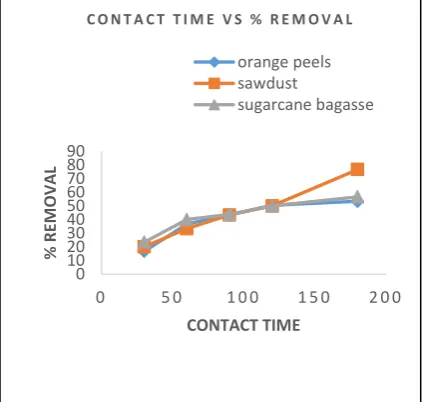
The effect of contact time on adsorption was studied at initial concentrations of 300ppm with adsorbent dosage of 2.5g. It is obvious that increase in contact time from 30min to 150min enhance significantly the percentage removal of Cr (VI). The Cr(VI) adsorption increase with increase in contact time.
Fig 3: Effect of contact time on the adsorption of metal ion.
Adsorption Isotherms
To examine the relationship between adsorbed (qe) and the aqueous concentration Ce at equilibrium sorption isotherm models are widely employed. The isotherm results were analyzed using the Langmuir, Freundlich isotherms. The Langmuir adsorption model is based on the assumption that maximum adsorption corresponds to a saturated monolayer of solute molecules on the adsorbent surface, with no lateral interaction between the adsorbed molecules. The Langmuir adsorption isotherm has been successfully used to explain the adsorption of hexavalent chromium from aqueous solutions. The expression of the Langmuir model is given [5] by Eq.
Where qe is the maximum amount of adsorbed per unit mass of adsorbent at equilibrium, qa is the maximum capacity of the adsorbent, Ce is the equilibrium concentration of Cr (VI), KL is the Langmuir constant, with qa and KL calculated from the slope and the intercept of the plot.
The essential characteristics of the Langmuir isotherm can be expressed in terms of a dimensionless constant separation factor RL [5] that is given by the following Eq.
( )
Where is the highest initial concentration of hexavalent chromium (mg/L) and k (L/mg) is Langmuir constant. The RL value indicates the shape of the isotherm to be either unfavorable (RL > 1), linear (RL = 1), favorable (0 < RL < 1), or irreversible (RL = 0). The RL values between 0 and 1 indicate favorable adsorption. The value of RL in the present investigation was found to be favorable.
Freundlich Isotherm: For adsorption from solution, the Freundlich isotherm is expressed as given by Eq.
where, Kf ( ) is the Freundlich constant,
which indicates the relative adsorption capacity of the adsorbent related to the bonding energy, and nF is the heterogeneity factor representing the deviation from linearity of adsorption and is also known as Freundlich coefficient. The Freundlich coefficients can be determined from the plot of log qe versus log Ce on the basis of the linear form of equation as given [12] by Eq. logqe=logKf+nFlogCe
0 20 40 60 80
0 1 0 0 2 0 0 3 0 0 4 0 0 5 0 0 6 0 0
%
REM
O
V
A
L
INITIAL CONC.
% R E M O V A L V S I N I T I A L C O N C .
orange peels
sawdust
sugarcane bagasse
0 10 20 30 40 50 60 70 80 90
0 5 0 1 0 0 1 5 0 2 0 0
%
REM
O
V
A
L
CONTACT TIME
C O N T A C T T I M E V S % R E M O V A L
orange peels sawdust
[image:3.595.36.249.464.665.2]© 2016, IRJET | Impact Factor value: 4.45 | ISO 9001:2008 Certified Journal
| Page 1954
Fig4:Freundlich isotherm for adsorption of chromium using Sugarcane bagasse
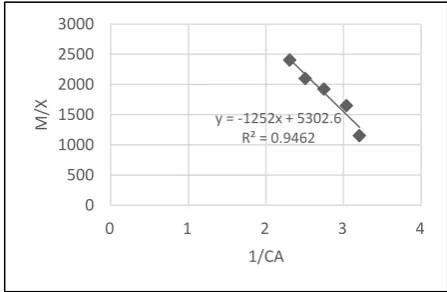
Fig 5:Langmuir isotherm for adsorption of chromium using Sugarcane bagasse
Fig 6: Freundlich isotherm for adsorption of chromium using Sawdust
Fig 7:Langmuir isotherm for adsorption of chromium using Sawdust
Fig 8: Freundlich isotherm for adsorption of chromium using Orange peels
Fig 9:Langmuir isotherm for adsorption of chromium using Orange peels
Conclusion
From the present study, it can be concluded that the sawdust has high potential to remove chromium than the sugarcane bagasse and orange peels. The percentage removal of chromium depend on adsorbent dose, initial concentration and contact time. At 180mins contact time and initial Cr concentration of 300mg/L, % of Cr removal was observed. The Freundlich and Langmuir biosorption models used for the mathematical description of the biosorption equilibrium of Cr ions to biosorbents. The biosorption equilibrium data fitted well to the Langmuir isotherm.
The maximum removal efficiency was observed up to 76.66% for biosorbent prepared from sawdust at the optimum value of parameters. The maximum removal efficiency was observed up to 59.98% for biosorbent prepared from sugarcane bagasse at the optimum value of parameter. The maximum removal efficiency was observed up to 39.95% for biosorbent prepared from orange peels at optimum values of parameters.
y = -1.5376x - 3.9089 R² = 0.9199
-3.3 -3.2 -3.1 -3 -2.9 -2.8 -2.7 - 0 . 8 - 0 . 6 - 0 . 4 - 0 . 2 0
LO
G
X
/M
LOGCA
y = -448.41x + 2839.7 R² = 0.961
0 500 1000 1500 2000
0 2 4 6
M/X
1/CA
y = -0.7874x - 3.5004 R² = 0.962
-3.2 -3.1 -3 -2.9 -2.8 -2.7 - 1 - 0 . 8 - 0 . 6 - 0 . 4 - 0 . 2 0
LO
G
(X/M)
LOGCA
y = -135.1x + 1679.1 R² = 0.9742
0 1000 2000
0 2 4 6 8 1 0
M/X
1/CA
y = -1.9507x - 4.107 R² = 0.8751
-3.45 -3.4 -3.35 -3.3 -3.25 -3.2 -3.15 -3.1 -3.05 -3
- 0 . 6 - 0 . 4 - 0 . 2 0
LO
G
(X?
M)
LOGCA
y = -1252x + 5302.6 R² = 0.9462
0 500 1000 1500 2000 2500 3000
0 1 2 3 4
M/X
[image:4.595.310.525.93.255.2] [image:4.595.313.537.331.477.2] [image:4.595.34.250.443.578.2] [image:4.595.35.247.613.701.2]© 2016, IRJET | Impact Factor value: 4.45 | ISO 9001:2008 Certified Journal
| Page 1955
References1. Upendra Kumar. Agricultural products and by-products as a low cost adsorbent for heavy metal removal from water andwastewater: A review.Scientific Research and Essay Vol. 1 (2). November 2006.
2. Bidyut Sahaa, Chris Orvigb,. Biosorbents for hexavalent chromium elimination from industrial and municipal effluents.Coordination Chemistry Reviews 254; (2010); 2959–2972. 3. Dinesh Mohana, Charles U. Pittman Jr. Activated
carbons and low cost adsorbents for remediation of tri- and hexavalent chromium from water. Journal of Hazardous Materials B137; (2006); 762–811.
4. V. Vinodhini and Nilanjana Das. Biowaste Materials As Sorbents To Remove Chromium(Vi) From Aqueous Environment-A comparative Study. ARPN Journal of Agricultural and Biological Science Vol. 4, No. 6, November 2009. 5. Suresh Gupta, 1B. V. Babu. Removal of Toxic
Metal Cr(VI) from Industrial Wastewater Using Sawdust as Adsorbent: Equilibrium, Kinetics and RegenerationStudies.
6. Saritha.B1, Abhishek Singh2, Amson3, Dhiraj Jha4, Khriezo Kiso5. Adsorption Of Chromium (Vi) From Aqueous Solution Using Sugarcane Bagasse As Adsorbent. International Journal of Engineering Trends and Technology (IJETT) – Volume2 issue3Number 2–Dec2011.
7. Nasim Ahmad Khan*, Shaliza Ibrahim and Piarapakaran Subramaniam. Elimination of Heavy Metals from Wastewater Using Agricultural Wastes as Adsorbents. Malaysian Journal of Science 23 : (2004); 43 - 51.
8. P. Venkateswarlu1, M. Venkata Ratnam1, D. Subba Rao1 and M. Venkateswara Rao2.Removal of chromium from an aqueous solution using Azadirachta indica (neem) leaf powder as an adsorbent. International Journal of Physical Sciences Vol. 2 (8); , August 2007;pp. 188-195. 9. Nitin M Rane and R S Sapkal. Chromium(Vi)
Removal By Using Orange Peel Powder In Batch Adsorption. International Journal of Chemical Sciences and Applications Vol 5, Issue 2;2014; pp 22-29.
10. Nasim Ahmed Khan, Syed Iqbal Ali and Sohail Ayub. Effect of pH on the Removal of Chromium (Cr) (VI) by Sugar Cane Bagasse. Science and Technology, 6; (2001); 13-19.
11. T.A.H. Nguyen a, H.H. Ngo a,⇑, W.S. Guo a, J. Zhang b, S. Liang b, Q.Y. Yue b, Q. Li b, T.V. Nguyen. Applicability of agricultural waste and by-products for adsorptive removal of heavy metals from wastewater. Bioresource Technology 148; (2013); 574–585.
12. Apeksha Gupta, S. R. Mote. A Comparative Study And Kinetics For The Removal Of Hexavalent Chromium From Aqueous Solution By Agricultural, Timber And Fruit Wastes. International Journal of Advances in Engineering & Technology;Mar. 2014.
13. Prashant Kumar Shrivastava* and S. K. Gupta. Removal of Chromium from Waste Water by Adsorption Method Using Agricultural Waste Materials. International Journal of Chemical Sciences and Applications Vol 6, Issue1;2015; pp 1-5.
14. Gurusamy Annadurai , Ruey-Shin Juang b, Duu-Jong Lee. Use of cellulose-based wastes for adsorption of dyes from aqueous solutions. Journal of Hazardous Materials B92;(2002); 263–274.
15. G. Annadurai, R.S. Juang and D.J. Lee. Adsorption of heavy metals from water using banana and orange peels. Water Science and Technology Vol 47 No 1;(2002); pp 185–190.
16. O. Olayinka Kehinde*, T. Adetunde Oluwatoyin, and O. Oyeyiola Aderonke. Comparative analysis of the efficiencies of two low cost adsorbents in the removal of Cr(VI) and Ni(II) from
aqueous solution. African Journal of Environmental Science and Technology Vol. 3(11);November 2009 ;pp. 360-369.
17. Suresh Guptaa, B V Babua. Adsorption of Cr(VI) by a Low-Cost Adsorbent Prepared from Neem LeavesNational Conference on Environmental Conservation-2006.