© 2016, IRJET | Impact Factor value: 4.45 | ISO 9001:2008 Certified Journal
| Page 1356
HadoopWeb: MapReduce Platform for Big Data Analysis
Saloni Minocha
1, Jitender Kumar
2,s Hari Singh
3, Seema Bawa
41
Student, Computer Science Department, N.C. College of Engineering, Israna, Panipat, Haryana
2
Associate Professor, CSE Department, N.C. College of Engineering, Israna, Panipat, Haryana
3
Associate Professor, CSE Department, N.C. College of Engineering, Israna, Panipat, Haryana
4
Professor, CSE Department, Thapar University, Patiala, Punjab
Abstract
:
MapReduce is one of the most popular programming model for Big Data Analysis in distributed and parallel computing environment. The Apache Hadoop project offers an open source MapReduce enabled parallel data processing ecosystem. In recent times, there has been a lot going of research going on in the area of Hadoop in Virtual Environment. This paper focuses on Hadoop in Virtual environment and presents the implementation and evaluation of HadoopWEB, a web service middleware platform between the user and Google Cloud based Virtual Hadoop Cluster. This can be used by users to perform their own MapReduce jobs. Experiments are conducted for different applications of MapReduce programs on real time data set of Chicago Crimes using HadoopWeb. Test results shows that HadoopWEB can be used to execute MapReduce jobs by users.Keywords: MapReduce, Virtual Hadoop, Web Service, Middleware, Cloud computing, Virtualization, Big Data.
1.
INTRODUCTION
Every year due to the advent of new technologies, devices and communication means, the amount of data produced by mankind is growing rapidly. The amount of data generated is still increasing enormously. All this information produced is meaningful and can be useful when processed. This data is termed as “Big Data.” Big data is a collection of large datasets that can’t be processed using traditional database techniques. It includes huge volume, high velocity and extensible variety of data that can be structured, semi-structured and unsemi-structured type. There are a lot of challenges associated with Big Data like capturing data, storage, searching, sharing, analysis, transfer and presentation. Google solved this problem using a parallel algorithm known as MapReduce. This algorithm divides the task into small tasks and assigns these small tasks to computers connected over the network and collects the results from computers to generate a final result dataset. However, in 2005 an open source project called Apache Hadoop was introduced by Doug Cutting and Mike Cafarella. Hadoop runs applications using MapReduce algorithms on clusters of computers and can perform statistical analysis for a huge amount of data. The four main components of Hadoop are as follow:
1) Hadoop Common: This includes java libraries and utilities required by Hadoop applications.
2) Hadoop Yarn: Framework for job scheduling and cluster resource management.
3) HDFS: Hadoop Distributed File System that supports high throughput access to application data.
4) Hadoop MapReduce: Yarn based system for parallel analysis and processing of large datasets.
Hadoop for a computation and storage uses a single server to thousands of machines. It provides a good performance in physical cluster but the huge amount of data launch in the system with less managing and deploying work is necessary. Efficient resource utilization and power saving is also necessary. Hence, in recent times the focus has been shifted to virtualization of Hadoop or Hadoop on cloud. Cloud Computing is a kind of internet based computing which enables on- demand access to a shared pool of configurable computing resources. There are three service models in cloud: Infrastructure as a Service (IaaS), Platform as a service (PaaS) and Software as a service (SaaS). Hadoop on cloud server allows less physical hardware requirements, less disscipation of heat; hence reduced electricity consumption and cost saving. There are also added advantages like easier maintenance, the effect of one virtual computer will not affect the other virtual computer, effective use of hardware, backups are made easier and also faster disaster recovery.
Amazon Elastic Compute Cloud, Microsoft Azure, IBM Smart Cloud or Google Cloud platform are few Cloud Computing Platforms that can be used to configure a Virtual Hadoop Cluster. Apart from these there are open source software solutions that can be used to make various cloud environments: Public, Private or Hybrid Clouds and can be further used to configure Hadoop in Virtual Environment. These are Eucalyptus, OpenNebula, OpenStack and CloudStack.
© 2016, IRJET | Impact Factor value: 4.45 | ISO 9001:2008 Certified Journal
| Page 1357
2.
LITERATURE SURVEY AND RECENT
WORKS
Pratiksha D. Mandal et al, 2016[1] in their paper proposed a system with the goal of adding the features of Elasric MapReduce to open source private cloud. They also stated limitations of Amazon EMR that it works on private cloud and does not allow to use Amazon EMR service on the private cloud, as a result user is not able to use their own infrastructure for task execution. Another limitation is the client needs for the service. They concluded in their paper that current Hadoop environments are manually deployed on physical servers and lack flexibility. They are presenting a framework capable of supporting a cluster to be dynamically elastic and also providing the same functionality as as Amazon EMR but on the top of private cloud build on OpenStack platform. This will enable users having access to private cloud to run their MapReduce computation tasks without having to worry about cloud resources management, failure handling that too free of cost. Hiren Parmar and Tuskar Champaneria, 2014[2] in their paper compared and analyzed OpenNebula, Eucalyptus, OpenStack and CloudStack platforms. These all are Cloud management platforms providing Infrastructure as a service. They concluded in their paper that OpenNebula and CloudStack are more towards the datacenter virtualization whereas Eucalyptus and OpenStack more towards the infrastructure provisioning. Among all the four, OpenNebula is more flexible they concluded. Arun S. Devadiga et al, 2014[3] in their paper integrated cloudstack, Hadoop and KVM. This integration resulted in Virtual Hadoop which will allow user to process huge amounts of data concurrently in virtual environment with efficient use of resources. In their paper they concluded that the virtual hadoop has slightly higher but almost similar execution time to execute the MapReduce program than the physical Hadoop and the advantages of virtual hadoop are that the management is easier, full utilization of computing resources, making Hadoop more reliable and save power. Parth Gohil et al, 2014[4] in their paper observed and analyzed the results of various MapReduce Applications on Big Data in cloud based Hadoop cluster and concluded that the results of MapReduce Applications are dependent on the size of Hadoop Cluster. Dweepna Garg and Bahul Panchal, 2014[5] in their paper discussed various MapReduce Applications like Word Count, Pi, Terasort and Grep in cloud based Hadoop using Amazon EMR. They concluded that as the number of nodes increases the execution time decreases and performance increases. Jobby P. Jacob and Akirban Basu, 2013[6] in their paper analyzed the performance of K-means clustering algorithm using Hadoop Mapreduce on Eucalyptus. They concluded that increase in the number of nodes boosted performance significantly. Also creating and running an OS is much faster as prebuild images which can be launched very easily and customized according to the
user requirements. Cloud also gives the user the ability to supply more machines when needed as long as it is not reaching the physical upper limits of the underlying host machines. Anca Iordache et al, 2013[7] in their paper presented the design, implementation and evaluation of RESLIN, a novel EMR-API compatible system to perform distributed MapReduce Computations. RESLIN goes one step beyond Amazon EMR solution and allows users to leverage resources from one or multiple public/private clouds. In future, they plan to extend the system by adding features allowing to automatically scaling the execution platform based on MapReduce job profiles and high level objectives. They will also conduct more experiments with different cloud managers, applications and parameters. Ruchi Mittal and Ruhi Bagga, 2013[8] in their paper evaluated and analyzed the performance of word count MapReduce application using Hadoop on Amazon EC2 using different Ubuntu instances and concluded that a threshold exists below which adding more nodes does not result in performance enhancement in the cluster but after that value with increasing number of data nodes, the Hadoop Cluster performance can be enhanced. Javier Conejaro et al, 2013[9] in their paper present the COSMOS platform supporting sentimental and tension analysis on Twitter data and demonstrate how this platform can be scaled using OpenNebula cloud environment with MapReduce based analysis using Hadoop. They concluded in their paper that the performance benefits can be achieved by using multiple virtual nodes, compared to running a sequential version of the application. However, the greater the worker nodes deployed, the better the performance achieved, but they are limited by the amount of VMs that can run simultaneously without affecting another. Hence, there is a limit on the number of VMs that can be hosted per physical machine to ensure consistent and reliable performance. Samira Daneshyar and Majid Razmjoo, 2012[10] proposed a framework where MapReduce application can be processed on Amazon cloud environment and validated the proposed framework by running experiments of MapReduce applications in cloud environment. From their analysis they concluded that using Cloud computing and MapReduce together improves the speed of processing and decreases the response time and cost of processing of large datasets.
3.
PROPOSED SYSTEM
© 2016, IRJET | Impact Factor value: 4.45 | ISO 9001:2008 Certified Journal
| Page 1358
3.1
Experimental Setup
The backend framework of Virtual Hadoop Cluster of 8 nodes was set up using Google Cloud Platform. For our series of experiments one instance of n1-standard-1-GNU/Linux8 (jessie) 1vCPU 3.75GB memory, 500GB SSD persistent Disk was used as Master Node and other 7 instances of n1-standard-1-GNU/Linux8 (jessie) 1vCPU, 3.75GB memory and 10GB SSD persistent Disks were used as Data Nodes. Hadoop-2.6.4 and 64 bit Java jdk 1.8.0_91 were installed in all the instances.
The frontend of HadoopWeb service was developed in HTML, CSS and PHP5.6 and configured in Master Node.
4.
RESULTS AND OBSERVATIONS
In this section we have analyzed the data set picked from City of Chicago data portal known as Crimes-2001 to present, using MapReduce and HadoopWeb. This dataset reflects reported incidents of crimes that occurred in the City of Chicago from 2001-2008. The row count of this dataset was 6084910. It had 21 columns in total and was of 1.33 GB in size.
The results are observed in two parts:
a) The execution time, Number of splits, Launched Map Tasks and CPU Time is observed by varying the size of dataset. The MapReduce program which is applied on the dataset was to list out unique crime types and their location description. The following graphs depict the results:
Chart-1: Execution Elapsed Time: Data Set Size vs Elapsed
Time
Job duration is the elapsed time for the job. It is observed that as the Data Set size increases, the Elapsed Time increases.
Chart-2: Number of Splits: Data Set Size vs Number of
Splits
When you input data into Hadoop Distributed File System (HDFS), Hadoop splits your data depending on the block size (default 64/128 MB) and distributes the blocks across the cluster. It is observed that as the Data Size increases the number of splits increases accordingly.
Chart-3: Launched Map Tasks: Data Set size vs Launched
Map Tasks.
© 2016, IRJET | Impact Factor value: 4.45 | ISO 9001:2008 Certified Journal
| Page 1359
Chart-4: CPU Time: Data Set size vs CPU time
CPU time is the total of CPU cycles spent for the job across the cluster. So, if a job is run for 1h, it could comprise of thousands of map tasks. As a result it might be possible that the cumulative CPU time will amount to CPU time higher than the elapsed time for the job. In our experiment we observed that as the Data Set Size increases the CPU time spent increases, but is less than the total elapsed time.
[image:4.595.68.530.37.783.2]b) HadoopWeb is tested with 9 MapReduce programs on the same dataset and the following counter tables were observed:
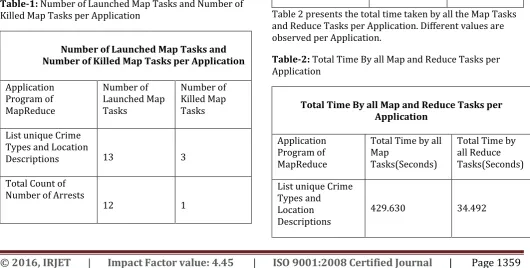
[image:4.595.295.562.62.525.2]Table 1 presents the Number of launched Map Tasks and Killed Map Tasks per Application. Different values are observed for every application. The dataset size and the cluster size are same throughout.
Table-1: Number of Launched Map Tasks and Number of
Killed Map Tasks per Application
Number of Launched Map Tasks and Number of Killed Map Tasks per Application
Application Program of MapReduce
Number of Launched Map Tasks
Number of Killed Map Tasks
List unique Crime Types and Location
Descriptions 13 3
Total Count of Number of Arrests
12 1
Total Count of Number of Domestic Crimes
13 2
List unique Domestic Crimes
14 4
List unique Crimes where arrests was
made 14 4
List unique Crimes where arrest was
not made 14 3
List unique Domestic Crimes where arrest was made
12 1
List unique Domestic Crimes where arrest was not made
14 3
Join query Crime Primary Type, Location Description and Arrest Status
14 4
Table 2 presents the total time taken by all the Map Tasks and Reduce Tasks per Application. Different values are observed per Application.
Table-2: Total Time By all Map and Reduce Tasks per
Application
Total Time By all Map and Reduce Tasks per Application
Application Program of MapReduce
Total Time by all Map
Tasks(Seconds)
Total Time by all Reduce Tasks(Seconds)
List unique Crime Types and Location Descriptions
[image:4.595.36.567.512.780.2]© 2016, IRJET | Impact Factor value: 4.45 | ISO 9001:2008 Certified Journal
| Page 1360
Total Count ofNumber of Arrests
565.564 9.083
Total count of Number of
Domestic Crimes 567.398 25.763
List of unique Domestic Crimes
474.001 50.696
List of unique Crimes where
Arrest was made 538.855 54.772
List of unique Crimes where Arrest was not made
585.874 42.754
List of unique Domestic Crimes where Arrest was made
509.871 14.313
List of unique Domestic Crimes where Arrest was not made
563.702 42.346
Join query on Crime Primary Type, Location Description and
Arrest Status 531.566 58.392
Table 3 presents the Garbage Collection Time and CPU Time per Application. Garbage Collection Time is a JVM counter which is observed during MapReduce job. Different values are observed per Application.
Table-3: Garbage Collection Time and CPU Time per
application
Garbage Collection Time and CPU Time per application
Application
Program of GC Time CPU Time
MapReduce (Seconds) (Seconds)
List unique Crimes and Location
Descriptions 6.012 46.770
Total Count of Number of Arrests
7.749 46.030
Total Count of Number of Domestic
Arrests 7.871 40.580
List unique Domestic Crimes
6.138 37.520
List unique Crimes where Arrest was
made 7.246 43.930
List unique Crimes where Arrest was
not made 7.893 45.870
List unique Domestic Crimes where Arrest was made
7.275 40.710
List unique Domestic Crimes where Arrest was not made
7.041 40.750
Join query on Crime Primary Type, Location Description and
Arrest Status 5.705 48.530
5.
CONCLUSION AND FUTURE SCOPE
© 2016, IRJET | Impact Factor value: 4.45 | ISO 9001:2008 Certified Journal
| Page 1361
factor for the data they upload unlike other Web Serviceslike Amazon EMR. In future, the direction will be to tune the number of Map and Reduce tasks appropriately according to the input data. It can be done in one of the three ways: Reducing the number of tasks if each task completes in less than 30-40 seconds, can increase the block size of data or can increase the mapper tasks to some multiple number of the mapper slots in the cluster. Furthermore, the backend of Hadoop Cluster can be made using CloudStack, which is an open source software designed to deploy and manage large networks of VM’s, as an available and scalable Infrastructure as a Service cloud platform.
ACKOWLEDGEMENT
This paper is a part of the study and experimental work accomplished towards the sponsored project. We thank All India Council for Technical Education (AICTE)-India for sponsoring the project titled “Developing a Grid-GIS Framework for Spatial Data” with file no.: 20/AICTE/RIFD/RPS (POLICY-1)6/2013-14 for duration of three years under the Research Promotion Scheme (RPS).
REFERENCES
[1] Mandal D. Pratiksha, “ Study of Elastic Hadoop On Private Cloud.” International Journal of Scientific and Research Publications, Volume 6, Issue 1, January 2016 321 ISSN 2250-3153.
[2] Parmar, Hiren, and Tushar Champaneria. "Comparative Study of Open Nebula, Eucalyptus, Open Stack and Cloud Stack." International Journal of Advanced Research
in Computer Science and Software Engineering 4.2 (2014).
[3] Devadiga, Arun S., P. R. Shalini, and Aditya Kumar Sinha. "Virtual Hadoop: The Study and Implementation of Hadoop in Virtual Environment using CloudStack KVM." International Journal of Engineering Development and Research. Vol. 2. No. 2 (June 2014). IJEDR, 2014.
[4] Gohil, Parth, Dweepna Garg, and Bakul Panchal. "A performance analysis of MapReduce applications on big data in cloud based Hadoop." Information Communication and Embedded Systems (ICICES), 2014 International Conference on. IEEE, 2014.
[5] Garg,Dweepna and Bakul Panchal. "A performance analysis of MapReduce applications on big data in cloud based Hadoop." Information Communication and Embedded Systems (ICICES), 2014 International Conference on. IEEE, 2014.
[6] Jacob, Jobby P., and Anirban Basu. "Performance Analysis of Hadoop Map Reduce on Eucalyptus Private
Cloud." International Journal of Computer Applications 79.17 (2013).
[7] Iordache, Anca, et al. "Resilin: Elastic MapReduce over multiple clouds." Cluster, Cloud and Grid Computing
(CCGrid), 2013 13th IEEE/ACM International Symposium on.
IEEE, 2013.
[8] Mittal, Ruchi, and Ruhi Bagga. "Performance Analysis of Multi-Node Hadoop Clusters using Amazon EC2 Instances." International Journal of Science and Research (IJSR) ISSN (Online): 2319-7064 Index Copernicus Value (2013).
[9] Conejero, Javier, et al. "Scaling archived social media data analysis using a hadoop cloud." IEEE 6th International
Conference on Cloud Computing (CLOUD). IEEE, 2013.