© 2016, IRJET | Impact Factor value: 4.45 | ISO 9001:2008 Certified Journal
| Page 140
Demand Driven Cloud Computing in IaaS using International Code
Sharing Principle
*1
Mrs. Kavitha S.K., *
2Ms. Siva Sankari A., *
3Mrs. Sangeetha Lakshmi G.,
*1
M.Phil Research Scholar, Department of Computer Science DKM College for Women (Autonomous),
Vellore, TamilNadu, India.
*2
HOD, Department of Computer Science DKM College for Women (Autonomous),
Vellore, TamilNadu, India.
*3
Assistant Professor, Department of Computer Science DKM College for Women (Autonomous),
Vellore, TamilNadu, India.
---***---Abstract
- Cloud computing is a very recent termwhich is mainly based on distributed computing, Virtualization, utility computing, networking and web and software services. This kind of service oriented Architecture reduces information technology overhead for end user, total cost of ownership, supports Flexibility and on-demand services. Conventionally cloud computing resources in IaaS is not shared internationally as a common resource. Also it is not a demand driven system. This paper discusses about using the IaaS resources internationally using code sharing principle which is driven by actual demand. In this way the resources used in this will be reduced to very optimal and customer gets the service at very low cost.
Key Words: Cloud Computing, Grid Computing, IaaS, PaaS, SaaS, DDCC
1. INTRODUCTION
The basic principle behind cloud computing is that it assigns the computing resources to many number of distributed computers rather than local computers or remote servers. This is more advantageous as it provides secure, quick, convenient data storage and the net computing service is centered by internet. So, the deployment, allocation, reallocation and monitoring of computing resources are all dynamically handled. The user needs not to care about how to buy software, servers, solutions etc. All the things are available through internet and are on-demand.
The main advantage of this kind of computing is pay-per-use model, i.e. pay-per-users have to pay only for what they have used. Hence it’s becoming cost effective. They elaborate the scenario regarding market-oriented cloud architecture and resource management strategies for market-oriented Clouds. Here the following figure logically describes the
[image:1.595.329.536.323.688.2]basic cloud computing scenario. Figure 1. Cloud Computing Logical Diagram [10]
© 2016, IRJET | Impact Factor value: 4.45 | ISO 9001:2008 Certified Journal
| Page 141
2. RELATED WORK
2.1 cloud computing
R. Buyya et al. [3] defines Cloud Computing according to its utility to end users. They put it like that the cloud computing is a market oriented distributed computing which consists of collection of interconnected and virtualized machines that can be dynamically presented as one or more unified computing resources depending Poulami Dalapati et.al / International Journal on Computer Science and Engineering (IJCSE)ISSN: 0975-3397 Vol. 5 No. 06 Jun 2013 435upon Service Level Agreement (SLA) established between provider and consumer through some negotiation.
According to National Institute of Standards and Technology (NIST) [3] cloud computing is the new kind of computing model which can enable convenient, on-demand access to the shared resources like network, server, storage, application, service form the resources pool which can be rapidly released and deserves minimal management effort or service provider interaction. Shuai Zhang, Shufen Zhang, Xuebin Chen and Xiuzhen Huo [4] in their paper told that Cloud Computing is a new kind of computing model which enables outsourcing of all IT needs like storage, computation, and software’s which are geographically distributed through internet. The various use of cloud computing made this popular and accordingly different agreements have been reached depending upon some basic style of this computing. Its style is as follows:
2.2 IaaS (Infrastructure as a Service):
It is a way of delivering cloud computing infrastructure- servers, storage, network and operating system, as an on demand service. Rather than purchasing servers, software’s, data center space or network equipment, clients can instead buy those resources as a fully outsourced service on demand. The service provider owns the equipment and is responsible for housing, running and maintaining it. IaaS allows a business to get rid of its locally installed servers and instead use so called virtual machine in other’s computer. The end result is the same that the users get the service they require but the organization does not need the space, power or hardware investment.
2.3 SaaS (Software as a Service):
SaaS is a software distribution model in which application are hosted by vendoror service provider and made available to customers over a network, typically the internet. With SaaS, a provider licenses an application to customer either as a service on demand, through a subscription, in a “pay-asyou-go” model, or at no charge
when there is opportunity to generate revenue from streams other than user, such as from advertisement.
2.4 PaaS (Platform as a Service):
[image:2.595.310.543.356.714.2]It is the way to rent hardware, operating system, network capacity over the internet. The service delivery model allows the customer to rent virtualized servers and associated services for running existing application or developing and testing new ones. PaaS builds on IaaS providing a pre-defined operating system, storage and development tools to allow a customer to develop new application to run on the provider’s infrastructure. It can be defined as a computer platform that allows the creation of web applications quickly and easily and without the complexity of building and maintaining the software infrastructure underneath it. PaaS is analogous to SaaS except that, rather than being software delivered over the web, it is the platform for creation of software, delivered over the web.
© 2016, IRJET | Impact Factor value: 4.45 | ISO 9001:2008 Certified Journal
| Page 142
3 .PROPOSED MODEL
Demand driven cloud computing in IaaS is driven by actual demand by using all the cloud partners’ resources. This approach takes the code sharing policy in assigning the resources for the end cloud user.
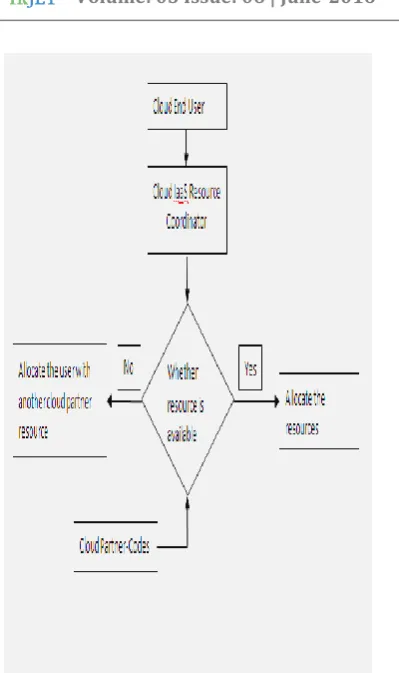
The above given flow chart will explain about the sequence of activities which will be followed in this new approach. This approach mostly applies to public cloud and can be extended to private cloud which has many sub divisions within an organization across the world. This paper mainly focuses on using demand driven cloud computing in IaaS for the public cloud. It is a centralized approach which focuses on meeting the cloud user demand by using minimum number or resources in a cost effective way. In this way the user will get the service quickly.
The cloud user will raise the request for using cloud infrastructure to the IaaS resource coordinator. The resource coordinator will check the user credentials and upon verification, he will check the availability of resources. If resource is available then he will allocate to the cloud user. In case if the resource is not available with the cloud partner-1, then he will check the resource availability with other cloud partner. This activity will continue until he gets the resource which will be allocated to the cloud user. The cloud partners will share the code to the IaaS resource coordinator to check the availability of resource and accordingly it will be allocated. Depending upon the usage, the cloud partner will charge the cloud user based on tariff for various TOD usage.
This demand driven cloud sharing concept by using coding sharing method allows the flexible use of resources with low capital investment and very low cost for the cloud user. This method also follows the principle of meeting the demand by using chase principle. In this way the return on investment for the infrastructure investment will be very quick .
Together with an explosive growth of the mobile applications and emerging of cloud computing concept, mobile cloud computing (MCC) has been introduced to be a potential technology for mobile services. MCC integrates the cloud computing into the mobile environment and overcomes obstacles related to the performance (e.g., battery life, storage, and bandwidth), environment (e.g., heterogeneity, scalability, and availability), and security (e.g., reliability and privacy) discussed in mobile computing. This paper gives a survey of MCC, which helps general readers have an overview of the MCC including the definition, architecture, and applications. The issues, existing solutions, and approaches are presented. In
addition, the future research directions of MCC are discussed.
Cloud computing is changing the way industries and enterprises do their businesses in that dynamically scalable and virtualized resources are provided as a service over the Internet. This model creates a brand new opportunity for enterprises. In this paper, some of the essential features of cloud computing are briefly discussed with regard to the end-users, enterprises that use the cloud as a platform, and cloud providers themselves. Cloud computing is emerging as one of the major enablers for the manufacturing industry; it can transform the traditional manufacturing business model, help it to align product innovation with business strategy, and create intelligent factory networks that encourage effective collaboration. Two types of cloud computing adoptions in the manufacturing sector have been suggested, manufacturing with direct adoption of cloud computing technologies and cloud manufacturing—the manufacturing version of cloud computing. Cloud computing has been in some of key areas of manufacturing such as IT, pay-as-you-go business models, production scaling up and down per demand, and flexibility in deploying and customizing solutions. In cloud manufacturing, distributed resources are encapsulated into cloud services and managed in a centralized way. Clients can use cloud services according to their requirements. Cloud users can request services ranging from product design, manufacturing, testing, management, and all other stages of a product life cycle.
4. CLOUD COMPUTINGINFRASTRUCTURE
Shubhasis Sengupta, Vikrant Kaulgud and Vibhu Saujanya Sharma [5] in their paper and Jayant Baliga, RobertW.A. Ayre, Kerry Hinton and Rodney S. Tucker [6] in their paper emphasizes on the cloud computinginfrastructure. They sub-divided to into Public, Private and Hybrid Cloud.
4.1 Public Cloud
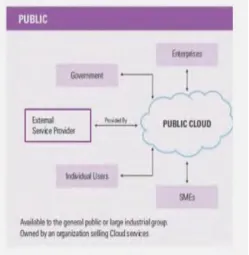
Public cloud is made available to general public by a service provider who hosts the cloud
© 2016, IRJET | Impact Factor value: 4.45 | ISO 9001:2008 Certified Journal
| Page 143
customers benefit from economy of scale, because [image:4.595.36.286.198.454.2]infrastructure costs are spread across all users, allowing each individual client to operate on low cost, “pay-as-you-go” model. Another advantage is that they are typically larger than an in-house enterprise cloud, which provides clients with seamless, on-demand scalability. This kind of cloud offers the greatest level of efficiency in shared resources, though they are more vulnerable.
FIG 3: PUBLIC CLOUD COMPUTING DELIVERY MODEL
4.2 PRIVATE CLOUD
This cloud infrastructure is defined to a particular organization. Private clouds allow business to host application in the cloud, while addressing concerns regarding data security and control. It is not shared with other organization, whether managed internally or by third-party and can be hosted internally or externally. There are two variations of private cloud:
(i) On-Premise Private Cloud: This type of cloud is hosted
within an organization’s own facility. A business IT department would incur the capital and operational costs for the physical resources with this model. It is best used for application that requires complete control and configurability of the infrastructure and security.
(ii) Externally Hosted Private Cloud: This type of clouds are also exclusively used by one organization, but are hosted by a third party specializing in cloud infrastructure. The service provider facilitates an exclusive cloud environment with full guarantee of privacy. This format is recommended for organizations that prefer not to use
[image:4.595.311.552.529.736.2]public cloud infrastructure.
FIG 4: PRIVATE CLOUD COMPUTING DELIVERY MODEL
4.3 HYBRID CLOUD
These kinds of clouds are composition of two or more clouds (private and/or public), that remain unique entities but are bound together offering the advantages of multiple deployment models. In a hybrid cloud, an organization can leverage third party cloud providers in either a full or partial manner ,Poulami Dalapati et.al / International Journal on Computer Science and Engineering (IJCSE)ISSN: 0975-3397 Vol. 5 No. 06 Jun 2013 437increasing the flexibility of computing. This kind of architecture requires both on-premise resources and off-site server based cloud infrastructure. But an organization has to keep track of multiple cloud security platforms and ensure that all aspects of business can communicate with each other.
© 2016, IRJET | Impact Factor value: 4.45 | ISO 9001:2008 Certified Journal
| Page 144
6. EVALUATION
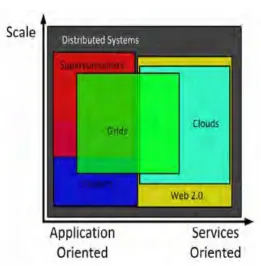
Shuai Zhang, Shufen Zhang, Xuebin Chen and Xiuzhen Huo [7] in their paper highlight the differences betweenCloud Computing and Grid Computing. Cloud computing evolves from grid computing and provides on demand resource provisioning. Grid computing may or may not be in the cloud depending on what type of users are using it. If the users are systems administrators and integrators, they care how things are maintained in the cloud. They upgrade, install, and virtualize servers and applications. If the users are consumers, they do not care how things are run in the system. Grid computing requires the use of software that can divide and farm out pieces of a program as one large system image to several thousand computers. One concern about grid is that if one piece of the software on a node fails, other pieces of the software on other nodes may fail.
This is alleviated if that component has a failover component on another node, but problems can still arise if components rely on other pieces of software to accomplish one or more grid computing tasks. Large system images and associated hardware to operate and maintain them can contribute to large capital and operating expenses. Whereas with cloud computing, companies can scale up to massive capacities in an instant without having to invest in new infrastructure, train new personnel, or license new software. Cloud computing is of particular benefit to small and medium-sized businesses who wish to completely outsource their data-center infrastructure, or large companies who wish to get peak load capacity without incurring the higher cost of building larger data center internally.
[image:5.595.308.570.92.359.2]In both instances, service consumers use what they need on the Internet and pay only for what they use. The service consumer no longer has to be at a PC, use an application from the PC, or purchase a specific version that's configured for smart phones, and other devices. The consumer does not own the infrastructure, software, or platform in the cloud. He has lower upfront costs, capital expenses, and operating expenses. He does not care about how servers and networks are maintained in the cloud. The consumer can access multiple servers anywhere on the globe without knowing which ones and where they are located.
FIG 6: GRID AND CLOUD OVERVIEW
Ian Foster, Yong Zhao, Ioan Raicu and Shiyong Lu [8] also in their paper elaborates the basic differences
Between cloud and grid computing. According to them, advanced virtualization and grid computing operations Poulami Dalapati et.al / International Journal on Computer Science and Engineering (IJCSE)
ISSN: 0975-3397 Vol. 5 No. 06 Jun 2013 438are essential elements of Cloud Computing environment. PaaS, which is commonly associated with cloud computing is a service offered within the scope of grid computing. Computing as a service, Storage as a service ,Network as a service are also grid services. Cloud computing should not focus on underlying middleware, hardware, storage or network resources.
© 2016, IRJET | Impact Factor value: 4.45 | ISO 9001:2008 Certified Journal
| Page 145
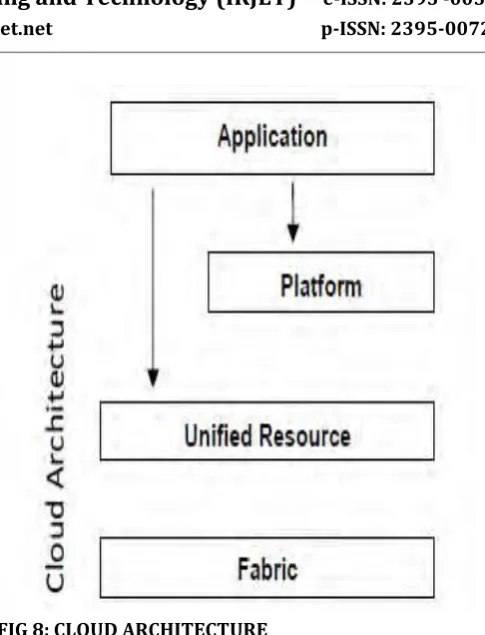
FIGURE 7. GRID PROTOCOL ARCHITECTURENaidila Sadashiv and S.M Dilip Kumar [9] in their paper gave a detail comparison between cluster, grid andcloud computing. According to their view, all three systems are
distributed and share similar characteristics.
[image:6.595.310.553.57.375.2]Thesimilarities relate to resource pooling and broad network access – two criteria that are fulfilled by all systems.Network access to cluster and grid computing systems usually takes place within a corporate network, while theservices of a cloud computing system can also be accessed through public network, i.e. the Internet. Thedifferences between cloud computing systems on the one hand and grid and cluster computing systems on theother are attributable to the system dynamics. Resources in grid and cluster environments are generally preserved,while cloud computing systems are demand driven, i.e. operation of these systems is geared toconsumers’ actual needs. Another difference concerns the rapid elasticity criterion, which forms an integral partof cloud computing systems but is not normally supported by cluster or grid systems. Service usage only tendsto be accurately measured in grid and cloud computing systems, whereas the majority of cluster environmentssimply provision rudimentary metering functions.
FIG 8: CLOUD ARCHITECTURE
The above given topics talks about various types of cloud services which is available and difference between various types to understand. This paper will discuss about using the public cloud as a base for implementing demand driven cloud computing for IaaS through international code sharing concept. At present all the cloud networks are using fixed resources from a specific cloud partner/supplier who offers services. Whenever additional user needs a service for short time from specific cloud partner/supplier then if the cloud partner doesn’t have a capacity to accommodate a new customer then it is a loss to the cloud partner and this is called as fixed capacity. Similarly whenever the number customers are low then the cloud resources will be underutilized. So the best way to manage the load on cloud network is to chase the load by using resources from various cloud partners and treat all the resources as a common resource. In this way the load levelling is achieved for all the cloud partners without underutilizing their resources. In this paper we will focus about how to achieve this using DDCC in IaaS.
The following flow chart explains about the demand driven cloud computing in IaaS.
© 2016, IRJET | Impact Factor value: 4.45 | ISO 9001:2008 Certified Journal
| Page 146
FIG 9:DRIVEN CLOUD COMPUTING IN IAAS.V. CONCLUSION
Here we have mainly discussed about the existing methodology which is used to manage the load in IaaS of sharing the resources from the cloud service providers and its drawbacks in addressing the user requirement and various types of cloud computing, difference between grid computing and cloud computing. Demand driven cloud computing in IaaS using international code sharing principle ensures the availability of resources to the user without any delay. This concept uses the demand chasing method by sharing the code of all the international cloud service providers and treat all the resources as a common resources for allocating to the cloud user. In this way the resources will be used effectively and pay back on investment is very quick.
REFERENCES
[1] Michael Miller, Cloud computing: web based applications that change the way you work and collaborate online (Pearson Education).
[2] R. Buyya, C.S. Yeo, S. Venugopal, J. Broberg and I. Brandic, “Cloud Computing and Emerging IT Platforms: Vision, Hype, and
reality for delivering computing as the 5th utility”, Future Generation Computer System, 25(6), pp. 599-616, 2009.
[3] Saurabh Kumar Garg and Rajkumar Buyya, “Green Cloud computing and Environmental Sustainability”.
[4] Shuai Zhang, Shufen Zhang, Xuebin Chen and Xiuzhen Huo, “ Cloud Computing Research and Development Trend”, 2010, Second
International Conference on Future Networks, pp. 93-97.
[5] Subhashis Sengupta, Vikrant Kaulgud and Vibhu Saujanya Sharma, “Cloud Computing Security- Trends and Research Directions”,
2011, IEEE World Congress on Services, pp. 524-525.
[6] Jayant Baliga, Robert W. A. Ayre, Kerry Hinton, and Rodney S. Tucker, Fellow IEEE, “Green Cloud Computing: Balancing Energy in
Processing, Storage, and Transport”.
[7] Shuai Zhang, Shufen Zhang, Xuebin Chen and Xiuzhen Huo, “The Comparison between Cloud Computing and Grid Computing”,
International Conference on Computer Application and System Modeling (ICCASM), IEEE 2010, pp. 72-75.
[8] Ian Foster, Yong Zhao, Ioan Raicu and Shiyong Lu, “Cloud Computing and Grid Computing 360-Degree Compared”.
[9] Naidila Sadashiv and S.M Dilip Kumar, “Cluster, Grid and Cloud Computing: A Detailed Comparison”, 6th International Conference
on Computer Science & Education (ICCSE), 2011, IEEE, pp. 477-482.
[10] www.wikipedia.com
[11] www.ibm.com
[12] Master planning of resources-CPIM Course material
[image:7.595.34.234.73.410.2]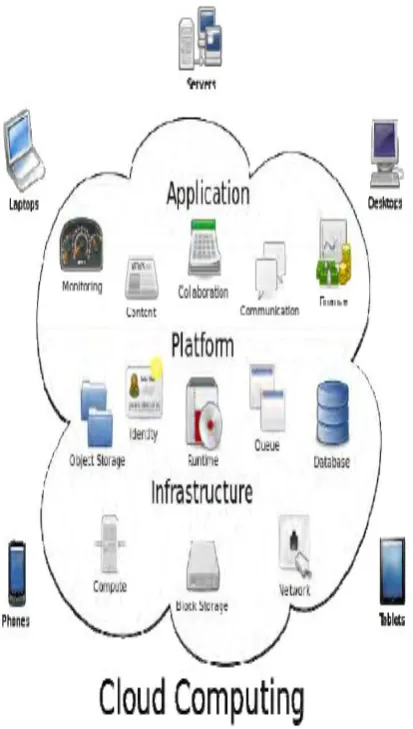
![Fig 2: Service Models of Cloud Computing [10]](https://thumb-us.123doks.com/thumbv2/123dok_us/8191008.813302/2.595.310.543.356.714/fig-service-models-cloud-computing.webp)