EFTEKHARI, FARZANEH. Design Thinking Beyond Design Discipline (Under the direction of Prof. Tsai Lu Liu).
Many disciplines in higher education in the United States have developed a growing interest in design thinking (DT) throughout the past decade. Countries outside the U.S., such as Singapore, China, Korea, and India, are also investing in design programs in their educational systems, or embedding innovative thinking throughout the curriculum (Beckman & Barry, 2007).
Multiple studies of DT have explored the values that the DT approach might bring to different disciplines. For instance, DT introduces a different pedagogy that is capable of moving students beyond the acquisition of pure knowledge toward actual application of knowledge (Plattner, Meinell & Leifer, 2012). DT is also a form of constructivist teaching with “project- and problem-based pedagogic frameworks” (Dym et al., 2005). Learning through DT is supported by experimentation, iteration and collaboration (Resnick & Rosenbaum, 2013); thus, students explore new possibilities and paths for solving problems. (Dym et al., 2005).
Other studies have criticized the growth of DT in non-design and STEM disciplines, due to the fact that these DT practices are distanced from their origins, housed in non-design
programs, and mostly taught by non-design faculty. (Ogilvie & Liedtka, 2011).
However, after more than a decade of DT practice in academia, relatively little has been written about how DT has been adapted and perhaps transformed to meet the specific needs of the various non-design disciplines. Could these adaptations be beneficial for designers as well? The first paper that emerged from this study explored the answer to that question.
the absorptive capacity, in the process of design thinking knowledge transfer. We explored, what is the meaning of prototyping in DT courses? What are the relationships between the core
by
Farzaneh Eftekhari
A dissertation submitted to the Graduate Faculty of North Carolina State University
in partial fulfillment of the requirements for the degree of
Doctor of Philosophy
Design
Raleigh, North Carolina 2019
APPROVED BY:
_______________________________ _______________________________ Professor Tsai Lu Liu Dr. Carolina Gill
Committee Chair
_______________________________ _______________________________ Dr. Soolyeon Cho Dr. Kelly Umstead
_______________________________ Dr. Rosanna Garcia
DEDICATION
I owe thanks to a very special person, my husband, Mohammad Mehdi Jahanbakht for his continued support, understanding, and patience during my Ph.D. journey
My heartfelt regard goes to my parents, Mohammad Reza Eftekhari and Zahra Moghaddasi. Both high school teachers, they instilled in me the special value of education, and provided
continued motivation and support for my academic achievements.
ACKNOWLEDGMENTS
I would like to express my deepest gratitude to my advisor, Professor Tsai Lu Liu, who provided critical support during my Ph.D. studies. His patience, punctuality and motivation deserve many thanks. I am honored to name him the best professor in my academic experience.
My sincere thanks also goes to Professor Carolina Gill, who provided guidance in my research with her immense knowledge and informative insights. Without her support it would have been impossible to conduct and publish my research.
I am thankful to Professor Barry Bayus who provided very deep insight and constructive recommendations in my PhD Journey.
I am thankful and acknowledge the support provided by Professor Soolyeon Cho for this wonderful opportunity of pursuing a Ph.D. in Design, especially for allowing flexibility during my Ph.D. journey.
I extend thanks to Professor Rosanna Garcia, who agreed to join my committee from Daniels College of Business - University of Denver. My Ph.D. research was only possible with the diverse cross-disciplinary scope and insights that I received from her.
My earnest thanks goes to Professor Kelly Umstead, who kindly supported my dissertation.
TABLE OF CONTENTS
LIST OF TABLES ... vii
LIST OF FIGURES ... viii
Chapter 1: motivation and research questions ... 1
New challenges in the market ... 1
More than a decade of teaching design thinking in non-design disciplines ... 2
Design thinking knowledge transfer: the possible stickiness in the process ... 2
Design thinking and prototyping ... 3
Thesis in the Context of Broad Literature Review ... 4
Literature review outline ... 4
The History and Emergence of Design Thinking ... 6
The emergence of design thinking in the design discipline ... 6
The emergence of new theories in the field of design ... 7
The change in the status of designers ... 8
Human-centered approach ... 9
A new paradigm in academic education: discipline-based education vs. interdisciplinary education ... 10
Design thinking pedagogy vs. non-design discipline pedagogy ... 11
Design thinking and engineering ... 13
Business interest in design thinking ... 14
The impact of IDEO ... 16
Conceptual models of design thinking process ... 17
The potential of design thinking for cross-disciplinary education ... 21
Summary of the literature review ... 24
Chapter 2: design of the study ... 27
Paper topic 1: What designers can learn from the non-designers that teach it? ... 27
Paper topic 2: design thinking: the process of knowledge transfer. ... 27
Paper topic 3: what it means prototyping in design thinking? ... 27
Conceptual Framework ... 28
Methodology plan: grounded theory ... 30
Tentative theoretical category ... 31
Data collection ... 32
Theoretical sampling ... 32
Coding ... 33
Focused coding ... 35
Theoretical coding ... 35
Memo writing ... 36
Final stage: emergence of theory ... 36
External criteria for judging the quality of the grounded theory ... 37
Chapter 3: design thinking, what designers can learn from the non-designers
that teach it ... 38
Abstract ... 38
Methods... 40
Design Thinking as a Platform for Knowledge Transfer ... 42
Design Thinking and New Perception Towards Design ... 44
Welcoming another discipline’s priorities in the product design process ... 44
Teaching DT and the Importance of the Mentors ... 46
Case Based Learning and Transdisciplinary Skills ... 47
Conclusion ... 50
References (paper 1) ... 52
Chapter 4: design thinking beyond design discipline: the process of knowledge transfer ... 54
The Emergence of the Second Paper ... 54
Abstract ... 56
Introduction ... 56
Szulanski Model of Knowledge Transfer ... 58
Method ... 60
Initial Stage in DT Transfer ... 65
Causal Ambiguity ... 65
Implementation Stage in DT Transfer ... 68
Causal Ambiguity ... 68
Source lack of motivation ... 68
Lack of perceived reliability of knowledge source ... 70
Arduous relationship ... 71
Recipient lack of absorptive capacity ... 71
Ramp-Up Stage ... 72
Barren context ... 73
Recipient absorptive capacity ... 75
Recipient lack of motivation and recipient lack of retentive capacity: unexpected or counterintuitive results ... 75
Integration stage ... 76
Summary ... 77
Conclusion ... 78
References (paper 2) ... 83
Chapter 5: prototyping & design thinking process ... 85
The Emergence of the Third Paper ... 85
Abstract ... 86
Introduction ... 87
Method ... 89
Secondary Data: Content Analysis of the Students’ Project ... 91
Stratified sampling strategy ... 92
Prototyping, Making and Visual Representation ... 92
What type of stickiness DT non-design instructors may experience in teaching
prototyping? ... 95
The stickiness in transferring heuristic and tacit knowledge ... 95
Doesn’t aesthetic matter? ... 96
Anticipated discovery ... 96
Design experts have a critical role in Design Thinking Knowledge Transfer ... 97
How to Promote Tinkerability in DT Courses ... 98
Using case studies to introduce alternatives ... 98
Self-reflection and the impact on learning DT ... 99
Dialogue within our brain and recognition of possible stickiness ... 101
A real-life topic is more appropriate to open exploration ... 103
Disrupt students’ confidence zone ... 104
How to Promote “Making” in DT Courses? ... 105
Studio format for DT courses ... 105
Increase attention to making in academic curricula & connection of DT courses to maker-spaces for fluid experimentation & open exploration ... 105
Low fidelity prototyping, confidence and innovation ... 108
Summary ... 109
Conclusion ... 112
Chapter 6: the connection of the three papers and the grounded theory perspective ... 114
The first Paper ... 114
Leveraging the Second Paper ... 116
Leveraging the Third Paper ... 121
Knowledge transfer or knowledge dissemination ... 122
Dissertation conclusion ... 124
References (paper 3) ... 129
Appendices ... 132
Appendix A ... 133
Appendix B ... 141
LIST OF TABLES
Table 1.1 Comparison between characteristics of current educational system with the key attributes of design thinking pedagogy (the summary of literature
review of this study) ... 12
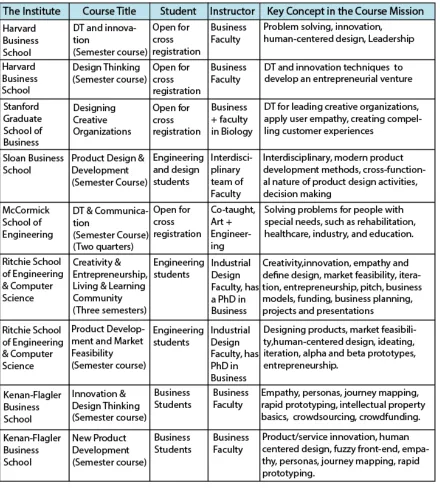
Table 2.3 Sample of the courses with design thinking in the title or reference topic ... 41
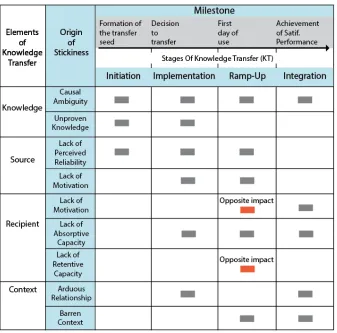
Table 3.4 Connection between transfer stages and elements of knowledge transfer (KT) based on origin of stickiness, based on Szulanski (2000) ... 58
Table 4.4 Sample of courses with DT in their title or as a topic in the syllabus. ... 61
Table 4.4 Sample of courses with DT in their title or as a topic in the syllabus. ... 62
Table 5.4 Initial Stage of Knowledge Transfer (KT) ... 65
Table 6.4 Implementation Stage of Knowledge Transfer (KT) ... 69
Table 7.4 Ramp-Up Stage of Knowledge Transfer (KT) ... 74
Table 8.5 Connection between transfer stages and elements of knowledge transfer (KT) based on origin of stickiness, based on Szulanski (2000). ... 88
LIST OF FIGURES
Figure 1.1 The conceptual model of design thinking process by d.school ... 17 Figure 2.1 The conceptual model of design thinking process and its phases by Ogilvie
and Liedtka (2011). Presented in “Designing for Growth: A Design
Thinking Toolkit for Managers” book ... 18 Figure 3.1 The conceptual model of design thinking process by Noble and Durmusoglu
(2015). Presented in “Design Thinking: New Product Development
Essentials from the PDMA” book ... 19 Figure 4.2 Conceptual Framework ... 29 Figure 5.2 Example of coding process. The full in-depth interviews transcribed and
reported in the first column and the initial coding and focused coding in
the second and third column ... 34 Figure 6.3 Important terms associated with DT in the sampled DT courses: content
analysis and word counting. ... 43 Figure 7.4 Important associated terms with DT in the mission of the sampled DT
courses: the content analysis and word counting ... 63 Figure 8.5 Example of students' Taught Map, D100 Design Inquiry Course, NCSU,
Instructor: Prof. Tania Allen ... 100 Figure 9.5 Design Thinking thought map, topic-Student assignment- D100 course-
CHAPTER 1: MOTIVATION AND RESEARCH QUESTIONS
New challenges in the market
The rapid pace of innovation and the impact of social, cultural, political, and economic factors have shaped the success of technological development (Cobb, Agogino, Beckman & Speer, 2008). Being successful in today’s highly technological and globally competitive world requires the use of a different set of skills from those that were needed before (Shute & Becker, 2010). Understanding complex customer needs has become a major challenge for creative minds (Andrews & Roland, 1987). Traditional education has focused on isolated subjects, which is the result of “breaking down a complex real-life phenomenon into little parts” (Scheer et al., 2012, p.9) and lacks context and humanitarian information, and a connection to the real-life context (Scheer et al., 2012). Therefore, isolated disciplines have faced significant challenges in responding to society’s needs. Furthermore, critical thinking, logical reasoning, practical ingenuity and communication skills are all needed to solve complex problems. Several
disciplines have identified these to be critical component skills for their students to learn in order to be successful in their future careers (Cobb et al., 2008; Rotherham & Willingham, 2009).
In this context, educators in many disciplines were looking for a pedagogy that gives serious consideration to user needs and preferences, particularly in markets that are rapidly changing and in which user needs are uncertain (Luchs, Griffin, Noble, Swan & Durmusoglu, 2015).
As an initial research question and through extensive literature review, this study
perspective, this study investigated how DT emerged from the design discipline and how it has been transformed by other disciplines.
Although the integration of DT has introduced exciting potential for non-design academic programs, notable criticisms of and debates about this phenomenon have emerged in the design literature. These criticisms stem from the fact that these DT practices are distanced from their origin, housed in non-design programs, and mostly taught by non-design faculty.
More than a decade of teaching design thinking in non-design disciplines
In the first paper, this study reviewed DT courses. The objective was not to describe design thinking; rather, the goal was to identify opportunities for designers and design educators that arise from the adaptation of design thinking in non-design disciplines. By reviewing
available literature, looking at DT courses outside design and conducting initial semi-structured interviews, this study identified some strategies that have been afforded by the integration of DT into non-design disciplines that can be useful for designers. The question was: can the design community embrace the benefits of cross–disciplinary knowledge in the DT process, and transfer relevant practices from the business and engineering domains to the larger design context? Could adaptation of the DT process in non-design disciplines be beneficial for designers as well?
Design thinking knowledge transfer: the possible stickiness in the process
process, but rather this topic has been taught for over a decade in many academic institutions. Therefore, we could expect to find some level of design knowledge integration in business and engineering programs.
In the second paper, this study followed Szulanski’s (2000) knowledge transfer model to describe the “stickiness” in the process of DT knowledge adaptation in non-design disciplines. This model describes challenges at various stages of knowledge acquisition, including initiation stickiness, implementation stickiness, ramp-up stickiness, and integration stickiness.
Design thinking and prototyping
Relative to the outcome from the second paper, the absorptive capacity of non-design instructors in implementation of prototyping in DT courses was identified as one of the major points of stickiness in DT knowledge transfer. In the paper, the authors summarized that leading the hands-on experience in the DT process is very challenging and it does require design
expertise. Design experts use reflection and personal insight in the prototyping training and the judgmental stage for evaluating the product and the outcome of projects.” Non-design instructors in general lack sufficient experiential and judgment knowledge necessary for prototyping
training.
Thesis in the Context of Broad Literature Review
Literature Review Outline
In the plan of action and research of this study, the first step was a review of the literature to illustrate the changes in design thinking, from early emergence of the term in the design discipline to its progress in other disciplines, specifically in management programs. The literature review covered the following topics:
- The emergence of design thinking in the design discipline - The emergence of new theories in the field of design. - The change in the status of designers
- Human-centered approach
The literature review was focused on why non-design disciplines, specifically business and engineering programs, became interested in design thinking topics and identifying the main values of design thinking for business and engineering programs. The review was structured as follows:
- The distribution of design thinking in non-design disciplines
- A new paradigm in academic education: Discipline-based education vs. interdisciplinary education
- Design thinking pedagogy vs. non-design discipline pedagogy - Design thinking and engineering
- Business interest in design thinking - The impact of IDEO
- The potential of design thinking for cross-disciplinary education
The History and Emergence of Design Thinking
The emergence of design thinking in the design discipline
In some cases, designing cutting-edge products and services has required going beyond general recognition of customers (Andrews & Roland, 1987). Being successful in today’s highly technological and globally competitive world requires a different set of skills than were needed before (Shute & Becker, 2010). The 21 century’s academic environments have to support and make students ready “to read critically, think and reason logically, and solve complex problems” (Rotherham & Willingham, 2009). Education find itself in a stage of transformation toward integrative thinking in order to facilitate students in learning skills.
It was in this environment that design thinking gradually became of more interest among different disciplines. Design thinking began to receive attention from researchers after Rowe (1987) introduced the concept. Since then, different interpretations and multiple models of design thinking have emerged, and design thinking has crossed disciplines. Each discipline approaches design thinking from a slightly different perspective.
As Kimbell (2011) explained, thinking has always been an important component of any design activity, but what design thinking emphasizes is “the intangible work done by designers” (p. 289). In 1960s design research, the concentration was on objects and craft, but design
The emergence of new theories in the field of design
In the 1960s, the main concern of design was the form and physicality of objects. For Alexander (1972), “the ultimate object of design was form” (p.15). Simon (1969) showed how production of artifacts can impact human activities. In his famous comparison between design and science, he suggested that science is responding to “what it is” and design to “what it ought to be.” Simon says, “designers’ work is abstract; their job is to create a desired state of affairs” (Kimbell, 2011). Based on Simon’s perspective, design can be “the core of all professions”, and it is not limited to design or engineering.
Donald Schön (1983) introduced the idea of reflection-in-action and its impact on the problem-framing process in the design discipline. Peter Rowe (1987) argued that the nature of the problem-solving process itself shapes the solution. In his book Design Thinking, he turned his attention toward the unique process of design in solving problems. Designers are seen as using “an iterative process that moves from generating insights about end users, to idea generation and testing, to implementation” (Kimbell, 2011, p.287). They use prototypes and visual artifacts, which is central to building effective communication in multidisciplinary teams. “They ask ‘what if?’ questions to imagine future scenarios rather than accepting the way things are done now” (2011, p. 287). Their creative ways of solving problem can be applicable to many research subjects.
The change in the status of designers
The second factor was the change in the status of designers and the types of problems they were expected to solve. The first big change was in the types of problem designers were asked to tackle, which often “seemed far afield from traditional design” (Brown & Wyatt, 2015). “The meaning of value and the process of value creation are rapidly shifting from a product- and firm-centric view to personalized consumer experiences” (Sanders & Stappers, 2008). Instead of designing consumer products, companies were interested in strategies that impacted consumer experiences (Brown & Wyatt, 2015).
Alexander’s (1971) perspective on design, with its emphasis on form and objects, was found to be limited because it reflected designers’ isolated perspectives on the form and
physicality of objects, with less attention to incorporating the experience of consumers. The new types of questions in design directed designers’ attention toward real-life contexts to explore user experience and new ways of framing problems.
The design process had the flexibility for this transformation. The new term, “design thinking,” highlighted an emphasis on intangible systems in parallel with tangible objects in design research (Buchanan, 1992). Kimbell (2011) believed that Buchanan’s paper “Wicked problems in design thinking” (1992) transformed design theory “from its legacy in craft and industrial production towards a more generalized design thinking.” (p.292) Therefore, it could be applied to nearly anything, “whether a tangible object or intangible system.”
Design thinking then demonstrated how distinctively designers were approaching
‘thinking’ becomes an instrument for prediction, problem-solving and action. Simon (1969) argued that the way researchers approach problem-solving has important impact on the types of solutions that will emerge from the process. In fact, “The nature of the problem-solving process itself shapes the solution” (Kimbell, 2011, p.291).
Human-centred approach
The human-centered approach to problem-solving became another important
characteristic of the design thinking process, which at the time was different from technology- or organization-centered ways of thinking in non-design disciplines. (Kimbell, 2011).
As human-centered design began to be emphasized in new design theories, designers found that they needed to cross-disciplinary boundaries and broaden their scope to better frame problems. Therefore, design thinking introduced a type of teamwork that shifted from a process of innovation involving movement from “hierarchies to networks and from bureaucratic
discipline to team-work and multi-skilling” (Kimbell, 2011, p.288).
Many disciplines in higher education in the United States have shown a growing interest in design thinking throughout the last decade. It is not difficult today to find design thinking courses offered in different disciplines. Business schools have pushed their agenda to include design thinking courses, including Tepper Business School, Harvard Business School, Yale School of Management, UNC Kenan-Flagler Business School and Poole College of
Management. Others have developed new educational strategies based on design thinking concepts, such as the Design + Innovation Club at Yale. Table 3 provides a summary of some design thinking courses at different business schools in U.S. The table is not inclusive; rather it just a few examples to showcase the diversity of design thinking courses and their distribution in many high-ranked business schools.
The distribution of design thinking in non-design disciplines
Traditionally, education has focused on the scientific perspective, a small set of disciplines and isolated subjects, which is the result of “breaking down a complex real-life phenomenon into little parts” (Scheer et al., 2012, p.9). This isolated scope often lacks context and humanitarian information, and “a connection to the real-life context will be missing” (Scheer et al., 2012,p.10). The complexity of human behavior “makes the formulation of problems and their solutions difficult” (Plattner, Meinell & Leifer, 2012). This was the time during which design thinking caught the attention of various disciplines.
A new paradigm in academic education: discipline-based education vs. interdisciplinary education
disciplines, such as engineering, education, and management, showed a similar shift of
perspective toward the constructionism paradigm, which involves human actions and behavior in the research process (Shute & Becker, 2010, Scheer et al., 2012). Meaning cannot be explored separate from the context, as suggested in the post-positivism paradigm. Meanings are
“collectively created” and are “created by culture” (Crotty,1998).
Design thinking introduced a different pedagogy that was capable of moving students beyond the acquisition of pure knowledge toward actual application of knowledge. Design thinking introduced a holistic approach that encourages students to think “across boundaries, thereby enabling real and fundamental innovations” (Plattner, Meinell & Leifer, 2012).
Education welcomed integrative thinking in order to facilitate students in learning skills needed in 21st century. From educational perspective, design thinking has been discussed as process to develop a better pedagogical approach in order to enhance learning. Design Thinking is a form of constructivist teaching with “project- and problem-based pedagogic frameworks” (Dym et al., 2005, p.110). Learning will be supported by experimentation, iteration and collaboration (Resnick & Rosenbaum, 2013) and through that, students will explore new possibilities and new path for solving problems. (Dym et al., 2005).
Design thinking pedagogy vs. non-design discipline pedagogy
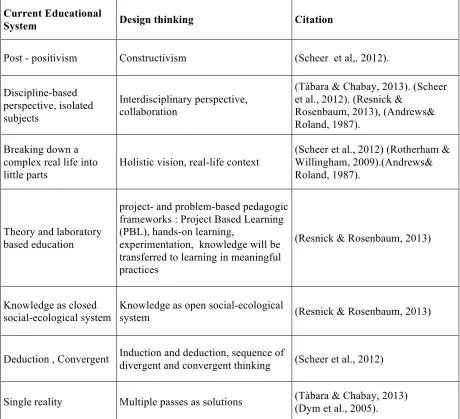
Some studies have compared important characteristics of design thinking pedagogy with that of the traditional educational system. Table 1 provides a summary of some characteristics that distinguish design thinking from the thinking in the non-design educational system.
The differences can be characterized as follows: design thinking follows the
frameworks; design thinking also moves away from convergent perspectives (breaking down complex issues into smaller parts) to holistic perspectives (inductive + deductive). These differences may help to explain why various disciplines have become interested in the design thinking processes.
Table 1 Comparison between characteristics of current educational system with the key attributes of design thinking pedagogy (the summary of literature review of this study)
The traditional educational system faced the challenge of finding new educational
strategies to facilitate cross-disciplinary education and broaden the scope of students’ projects to
Current Educational
System Design thinking Citation
Post - positivism Constructivism (Scheer et al,. 2012).
Discipline-based perspective, isolated subjects
Interdisciplinary perspective, collaboration
(Tàbara & Chabay, 2013). (Scheer et al., 2012). (Resnick &
Rosenbaum, 2013), (Andrews& Roland, 1987).
Breaking down a complex real life into little parts
Holistic vision, real-life context
(Scheer et al., 2012) (Rotherham & Willingham, 2009).(Andrews& Roland, 1987).
Theory and laboratory based education
project- and problem-based pedagogic frameworks : Project Based Learning (PBL), hands-on learning,
experimentation, knowledge will be transferred to learning in meaningful practices
(Resnick & Rosenbaum, 2013)
Knowledge as closed social-ecological system
Knowledge as open social-ecological
system (Resnick & Rosenbaum, 2013)
Deduction , Convergent Induction and deduction, sequence of
divergent and convergent thinking (Scheer et al., 2012)
include the complexity of human behavior and real-life contexts. At that time, design thinking appeared to be an important alternative for disciplines, specifically management and engineering programs.
Miller (2017) summarized design thinking principles as: "radical collaboration," "show don't tell," "focus on human values," "craft clarity," "embrace experimentation," "mindfulness of process," and "bias toward action." These can be summarized as: empathize, define, ideate, prototype and test. Non-design discipline found these values in design thinking pedagogy and decided to incorporate the process into their educational frameworks.
Design thinking and engineering
Engineering programs have been one of the important hosts for design thinking pedagogy. The core concentration in engineering programs is the application of scientific principles to technological problems (Razzouk & Shute, 2012). However, industry and
engineering programs were influenced by the human-centric and user-centric perspectives that emerged from the transformation of education in the 1980s.
Engineering programs received constant feedback from industry that their graduates were not well prepared for working in industry (Todd & Magleby, 2004). Engineering programs were looking for courses in which they could offer real problems along with real-world expertise (Todd, Magleby, 2004). In a 1997 report by the National Science Foundation, one area emphasized was systemic engineering education reform to include teamwork, project-based learning (PBL), and close interaction with industry. (Dym et al., 2005)
(Dym et al., 2005). Design thinking encourages students to explore problems with users in real-life contexts and even by crossing the boundaries of their discipline. Design thinking is defined as an “analytic and creative process that engages a person in opportunities to experiment, create and prototype models, gather feedback, and redesign” (Razzouk & Shute, 2012,p.330).
In the words of Banathy (1996), science, including engineering, values objectivity, rationality and neutrality and is concerned with objective truth, while the humanities value subjectivity, imagination and commitment and are concerned with justice. Design can play an interesting role in integrating these two perspective, since it has connections to both the humanities and science (Owen, 1998).
Some believe that design thinking can help engineering research achieve closer interactions with people and social problems, and can provide engineering students with a broader perspective on problems. Therefore, the engineering discipline became interested in design thinking pedagogy as a way to create a cross-disciplinary mindset that encouraged a climate of debate, developing a sense of empathy with users, and promoting respect of different viewpoints (Razzouk & Shute, 2012) among students. As a result, students can acquire a
different set of skills that can support them in their future jobs.
Business interest in design thinking
Management scholars began to show an interest in design pedagogy in the mid-1980s. The media reflected interest in topic starting around 2004 that peaked in 2009 (Johansson
management consulting and was the author of The Design of Business: Why Design Thinking Is the Next Competitive Advantage (2009). The second is the creation of the, IDEO foundation in 1991; it became the most famous design consultancy firm in the world, and has greatly
influenced design thinking distribution in both industry and academia.
Martin maintained that designers have developed “a way of thinking that is distinct from conventional management thinking” (Dunne & Martin, 2006,p.518). From the perspective of Dunne and Martin (2006), MBA academic tools are overwhelmingly logical and rational. They said that the business discipline is on “the cusp of a design revolution in business,” They
suggested that a design-thinking paradigm in MBA programs would encourage students “to think broadly about problems, develop a deep understanding of users, and recognize the value in the contributions of others.”
Design thinking was expected to bring two important values to the business educational system. First, from an educational perspective, design thinking is a form of experimental and project-based learning that encourages inductive, integrative, and cross-disciplinary pedagogy in order to develop critical and strategic thinking. This is a critical value because business teaching materials are overwhelmingly logical and rational, and cannot address the inconsistent and complex problems arising in the 21st century (Dunne &Martin, 2006). Therefore, design thinking is important to equip students with the skills needed to respond quickly to the
unpredictable market (Cobb et al., 2008). Design thinking “is best applied in situations in which the problem, or opportunity, is not well defined, and/or a breakthrough idea or concept is
needed” (Luchs et al., 2015,p.2).
components of empathy, invention, and iteration (Ogilvie & Liedtka, 2011). In the collaborative and cross-disciplinary process of design thinking, students study problems in their real-world contexts and learn how to be flexible and comfortable with ambiguity, specifically in relation to human behavior (Luchs et al., 2015).
In the book Design Thinking: Integrating Innovation, Customer Experience and Brand Value Lockwood (2010) suggested some values of design thinking for businesses: 1) design as a differentiator (brand equity, customer loyalty and customer orientation); 2) design as integrator (product development and user-oriented innovation models); 3) design as a transformer (the company’s ability to cope with change); and 4) design as good business (a source for society at large through inclusive and sustainable design). In most cases in industry, designers play the role of design thinkers.
The impact of IDEO
brands, and bring their products and services to market faster”. There was a positive reaction to these ideas, and encouragement from industry that business people including academic people can benefit from integrating design thinking in their practices.
Conceptual models of design thinking process
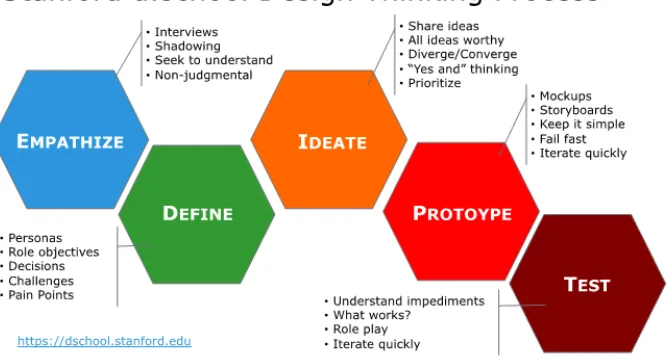
The purpose of this section is to examine the various design thinking concept models found in the literature in order to study DT process from design, business and engineering perspectives. The first conceptual model is suggested by the Stanford d.school (figure 1).
The d.school’s conceptual framework for design thinking involves five modes:
empathize, define, ideate, prototype and test. The figure below illustrates some of the details of the practices and methods for each mode. For example, in empathize mode, the purpose is to collect data through interviews with users and seek to understand all the details relevant to the subject of the research without judging the ideas presented.
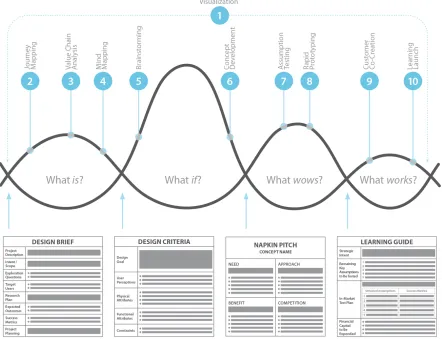
Another model for the design thinking process was presented by Ogilvie and Liedtka (2011) in their book Designing for Growth: A Design Thinking Toolkit for Managers (figure 2).
Their model provides better visualization of the sequence of divergent and convergent thinking in the design thinking process. Their purpose was to develop a simpler and more practical model for the design thinking process. Instead of “fancy vocabulary like ‘ideation’ and ‘co-creation,’” these authors suggested that the design process deals with four very basic
questions: What is? What if? What wows? and What works? “What is stage explores current
19 reality. What if envisions a new future. What wows makes some choices. What works takes us into the marketplace” (Ogilvie, &Liedtka, 2011,p.21).
Despite the differences between the two models, they represent very similar modes for the design thinking process. For instance, the ‘what is’ mode in the Ogilvie and Liedtka (2011) model is similar to the empathize mode in the d.school model. And ‘what if’ is similar to the define mode in the d.school model.
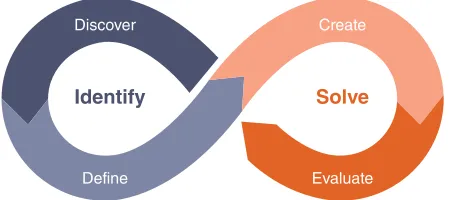
Noble and Durmusoglu (2015) suggested another conceptual model for the design thinking process in their book Design Thinking: New Product Development Essentials from the PDMA (figure 3). They proposed a framework for design thinking with the goal of reflecting “the shared elements of existing frameworks, with the objective of retaining the most important elements of design thinking and their distinctions, while simplifying their depiction and
terminology” (Noble & Durmusoglu, 2015)
These authors believed that design thinking “as it exists today has co-evolved across a variety of disciplines and industries”(p.3). They suggested that the most powerful feature of design thinking is “its emphasis on identifying the right problems to solve in the first place.” In fact, they define design thinking “as a systematic and collaborative approach for identifying and
1.2 A Framework of Design Thinking
There are literally dozens, if not hundreds, of specific design thinking–related meth-ods and tools available, and this book will explore many of these. Learning about just a few of these and understanding how they are used together is likely more valuable than trying to experiment with them without any context. The following framework is intended to provide that context, by organizing these methods and tools based on their role or purpose.
Design thinking, as a systematic and collaborative approach for identifying and
creatively solving problems, includes two major phases: identifying problems and solving problems. Both of these phases are critical, but in practice most people and project teams within companies are more inclined to focus on the latter, that is, on solving problems. We are naturally creative beings, and given any problem—however ill-defined—most of us can generate a set of ideas. Unfortunately, these often will not be great ideas, that is, ideas that are both original and that solve the problems with the greatest potential. One of the most powerful features of design thinking is its emphasis on identifying the right problems to solve in the first place. This is, therefore, a key element of the following framework, as indicated by the two phases of design thinking depicted in Figure 1.1: Identify and Solve. Next, I describe the purpose of each of the modes within these two phases, followed by a discussion of the iterative nature of the process as a whole.
Discover
The purpose of the first mode of the design thinking framework (see Figure 1.2) is to Discover new customer insights. One of the challenges for many product development teams is that they are immersed in the world of products and, often, technologies. While that is clearly important expertise, it can limit their field of view and perspective; market information tends to get framed in terms of product specifications relevant to exist-ing products. As a consequence, well-intended research, even when conducted with product users, is often unintentionally biased toward relatively minor modifications to
Create
Identify Solve
Evaluate Discover
Define
Figure 1.1: A framework for design thinking.Figure 3 The conceptual model of design thinking process by Noble and Durmusoglu (2015). Presented in “Design Thinking:
creatively solving problems”(p.4). Based on their definition, their model consists of two major phases: identifying problems and solving problems.
In this model of design thinking, identifying the problem involves two stages: discover and define. The goal in the discover phase is to find new customer insights. This is similar to the what is mode in the Ogilvie and Liedtka model and the empathize mode in the d.school model, which focus on gaining empathy with customers. In the define stage, the challenge is similar to the what if and define modes in the previous models; the objective is to identify “the needs and insights worthiest of pursuit through the next phase of the process”(p.6). In the solve phase, researchers create concepts and share them with target markets; multiple iterations of feedback and evaluation are used to improve the concepts (Noble & Durmusoglu, 2015).
These three models of the design thinking process embody similar objectives and paths for innovation. However, the model developed by Ogilvie and Liedtka (2011) is more
comprehensive and includes the sequence of divergent and convergent thinking and methods that can support researchers in each phase of the process.
The potential of design thinking for cross-disciplinary education
Human behavior is “overwhelmingly context dependent” (Leifer & Meinel, 2016) and it has a significant effect on the choices made by customers in the market. The importance of the design thinking process is that it changes the mindset of researchers and places emphasis on the “role of consumers in the process of design and development” (Brown, 2009). In the design thinking process, considerable time is allocated to the problem-framing phase. Design thinking models encourage researchers to think more broadly about problems in their real-world contexts and these models give researchers flexibility in reframing and changing problem statements based on a continues process of observing problems in context. Design thinking gives
researchers the alternative of including human behavior parameters in research. From the initial phase of problem definition through the testing stage, researchers interact closely with end users. Prototyping has always been inspirational and an alternative to visually representing the final concept. However, in the design thinking process, prototyping plays a critical role in inspiring new ideas and sets the stage for learning (Brown, 2009). Also, prototypes help “multidisciplinary teams work together” (Kimbell, 2011,p.287)
profession” and its strategies have been identified as relevant to all disciplines (Scheer, et al. 2012,p.10)
Design thinking has considerable potential for cross-disciplinary projects. It has introduced a very flexible educational platform, and many disciplines have adapted and
integrated the design thinking process and pedagogy into their curricula. This study has the goal of looking more closely at the integration of design thinking into non-design disciplines. Talking with non-design instructors who teach design thinking, and exploring different courses and models of the design thinking process, allow this study to identify the methods and process that have been added to and integrated into the design thinking process from non-design disciplines. The conceptual models of the design thinking process and integration of design thinking into different disciplines indicate the potential and possibilities of design thinking educational platforms for cross-disciplinary education. However, it is important to study the impact of design thinking on cross-disciplinary education and its level of success in creating cross-disciplinary pedagogy in the academic context.
Definitions: multidisciplinary, interdisciplinary and transdisciplinary
There are different types of educational collaboration: multidisciplinary, interdisciplinary and transdisciplinary. The ultimate goal of collaborative education of all three types is to
Multidisciplinary
This is the first level of collaboration between disciplines, and involves the least integration of disciplines. Faculties become "gatekeepers" who determine “which other disciplines are invited to participate in an independent, discipline-specific team that conducts separate assessment, planning, and provision of services with little coordination” (Dyer, 2003,p.186).
Interdisciplinary
This is a format in which faculty teams are required to develop an infrastructure in which their groups “work interdependencey and increases responsibility on the part of team members for group performance and student outcomes” (Dyer, 2003,p.186). The interdisciplinary model involves more interaction between disciplines compared with the multidisciplinary model. In the interdisciplinary model, instructors become responsible for understanding students’ needs to collaborate with other disciplines and developing and implementing curricula and teaching strategies accordingly (Dyer, 2003). Curricula need to address student learning and/or behavioral issues and facilitate communication between parties in the teaching/learning setting (Dyer, 2003).
Transdisciplinary
enough in their own disciplines to enjoy the teaching and learning that take place while giving up some roles and skills and acquiring new ones” (Dyer, 2003,p.187).
Integration and collaboration of disciplines can occur in different formats, ranging from the least integration in the multidisciplinary model to the blurring of the boundaries between disciplines and the high level of integration in the transdisciplinary model. Data from design thinking courses can support this study to illustrate if design thinking courses can demonstrate any model of cross-disciplinary education?
Summary of the literature review
The isolated and discipline-based educational system proved that it could not respond to all the demands of the market in the 1980s, specifically when the human dimension was
important to the inquiry. Several disciplines have found that “today’s highly technological and globally competitive world requires a person to develop and use a different set of skills than were needed before” (Shute & Becker, 2010). To the extent that students are exposed to real-life business contexts, they become aware of the complexity of customer needs, and the importance of applied research and multidisciplinary approaches to problems (Andrews & Roland, 1987).
Educational literature suggests that educators should support students in developing and honing 21st century skills (e.g., design thinking, systems thinking, and teamwork skills) that enhance their problem-solving capability and prepare them for college and careers (Razzouk & Shute, 2012).
have mostly been focused on constraints, such as budgets or the ease of implementation, great design inevitably starts with the question: “What if anything were possible?” (Ogilvie & Liedtka, 2011). The educational system is also seeking better types of pedagogy such as project-based learning and learning by doing, which primarily focus on the components of multidisciplinary approaches to the problem (Andrews & Roland, 1987).In addition, approaches that encourage empathy, invention, and iterations have been shown to enhance learning, innovation and problem-solving processes (Ogilvie & Liedtka, 2011).
The search for new integrative disciplines to complement the arts and sciences has become one of the central themes of intellectual and practical life in the 20th century (Buchanan, 1992). Because knowledge acquisition is still fragmented into isolated subjects, several
disciplines in academia were looking for an alternative pedagogy to help teachers implement holistic and interdisciplinary learning (Scheer et al., 2012). The emergence of DT is important in this context (Buchanan, 1992).
When DT emerged more than a decade ago, “it offered a response to the ebbs and flows of a global, mediatized economy of signs and artifacts” (Kimbell, 2011); in this context,
professional designers play increasingly important roles, “less as makers of forms and more as cultural intermediaries, or as the “glue” in multidisciplinary teams” (Kimbell, 2011).
Design thinking has since been distributed in diverse disciplines such as engineering and business. Various design thinking courses have been developed and taught in business and engineering programs for more than a decade.
Literature also called attention to critics and opposing reaction towards the DT
movement. Some scholars have suggested that DT is an overused term that has been applied in both the design and non-design domains, and that “it will fade away as soon as another new trend comes to light” (Ashkan, 2014). Considering this risk, our objective in this study is not to
describe DT; rather, the goal is to discover the expectations and intentions of the larger educational system in adapting DT courses.
CHAPTER 2: DESIGN OF THE STUDY
Paper Topic 1: What designers can learn from the non-designers that teach it?
Design Thinking (DT) practices are distanced from their origins in design discipline, housed in non-design programs, and mostly taught by non-design faculty. After more than a decade of DT practice in academia, relatively little has been written been adapted, and perhaps transformed to meet the specific needs of the various non-design disciplines. Could these adaptations be beneficial for designers as well?
Paper Topic 2: Design Thinking: the process of knowledge transfer.
The purpose of this study was to understand challenges in DT knowledge transfer based on the individual instructors’ journeys in integrating DT into their courses. This study
distinguished between initiation stickiness, implementation stickiness, ramp-up stickiness and followed Szulanski’s (2000) knowledge transfer model to describe the “stickiness” in the process of DT adaptation.
Paper Topic 3: What it means prototyping in design thinking?
Conceptual Framework
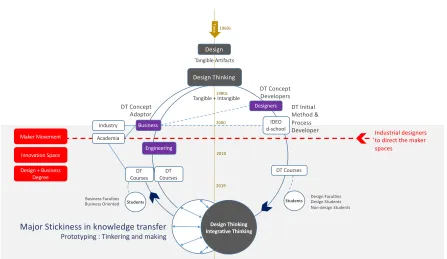
The conceptual framework of this study (figure 4) highlighted the shift from design to design thinking, and the transformation of DT as it was adapted to various academic disciplines. The transformation from design to design thinking happened primarily in the 1980s (Rowe, 1987). Since then, different interpretations and models of DT emerged, and DT crossed
disciplines. Each discipline approaches DT with slightly different perspective. ‘Thinking’ in the term DT emphasized “the intangible work done by designers” (Kimbell, 2011). Therefore, this shift brought attention to the “process of design” in the 1980s.
Around 2000, DT showed significant growth in non-design programs, especially in business (Ashkan, 2014). The innovative design consulting firm IDEO helped to popularize DT. Another strong influence was the Hasso Plattner Institute of Design, known simply as the d.school, a DT institute based in Stanford University. IDEO and d.school have been cited in the literature (e.g. Miller, 2017, Dunne, Martin, 2006, Kelley, 2001) as successful cases for DT practices in industry and important sources of DT growth in non-design programs.
This study’s conceptual framework will guide audiences along the academic path of DT as a movement in engineering and business disciplines. Starting in the year 2000, the conceptual framework highlights the growing DT cross-disciplinary dynamic. Additional milestones include the maker movement phenomenon, the appearance of maker/innovation spaces in academic institutes, and the progressively increasing focus on experimental learning in higher education.
The concept map of this study focuses on the stickiness and difficulties in DT knowledge transfer. The prototyping process is explored in more detail as an important element in
Ti m e Design Tangible Artifacts 1960s 1980s Tangible + Intangible
2000 Designers DT Concept Adaptor DT Courses Industry DT Courses 2010 DT Initial Method & Process Developer IDEO d-school 2019
Design + Business Degree Engineering Business Faculties Business Oriented DT Courses
Academia Industrial designers to direct the maker
spaces
Students Design FacultiesDesign Students Non-design Students DT Concept Developers Design Thinking Design Thinking Integrative Thinking Students Innovation Space
Major Stickiness in knowledge transfer
Prototyping : Tinkering and making
Business Maker Movement
Methodology plan: grounded theory
In the current study, grounded theory methodology was used to investigate the role of DT pedagogy in the creation of cross-disciplinary environments in education. In grounded theory, the goal is conceptual thinking and theory generation, rather than theory verification (Khan, 2014). Grounded theory in fact, begins with “openly exploring and analyzing inductive data and leads to developing a theory grounded in data” (Thornberg, Charmaz, 2014).
The objective was to provide a more comprehensive examination of the DT process. The theory was grounded in data collected from DT courses and instructors, and partially from students’ projects, to demonstrate the process of knowledge transfer between design, business and engineering programs. The value of using grounded theory is that it has roots in the actual experience of faculty who have taught DTin their department for considerable time.
The initial data was collected from DT courses (or courses that have sessions on DT topics) in design, business and engineering programs. The main goal was to identify the
perspective of the individual instructors and extract their methods and strategies in teaching DT courses.
This study explored how these methods and strategies might be useful in the DT process, and how design, business and engineering programs can potentially benefit from creative new strategies that have emerged in the educational framework of DT courses.
researcher the flexibility to “investigate individual and collective actions” of the instructors and concentrate on what DT instructors do and “the meaning they make of their actions” (Walker and Myrick,2006).
The topics and procedure in the three papers that comprise this study reveal the
continuous procedure and the impact of each stage in the plan for the following study. Figure (5) shows the summary of grounded theory research procedure.
Tentative theoretical category
The grounded theory process starts with research questions and initial data collection. In this approach, analysis of the initial data “evokes insights, hunches, ‘Aha!’ experiences, or questions that might lead researchers to change or add a new data collection method” (Charmaz, 2006).
This study started with the premise that DT has already spread across disciplines and may no longer be a design-specific way of thinking. DT has become part of the curriculum in various departments with the expectation it will provide an innovative process for problem framing and a multidisciplinary way of thinking, involving sequences of divergent (expansion) and convergent
(consolidation) thinking (Scheer, et al. 2012). Therefore, it seems that DT requires diverse methods and strategies from other disciplines (not just design-oriented methods). This tentative theoretical category encouraged us to explore the perspectives of DT faculty and discover the expectations and intentions of the larger educational system in adapting DT courses
Data Collection
This study used a qualitative grounded theory (GT). This methodology is not limited to any particular data-gathering method, but uses information gathering methods that best fit the actual research problem and the ongoing analysis of the data (Charmaz and Kathy, 2000). In developing the three papers, this study incorporated qualitative interviews, course documents and course observations.
The primary data collection began with interviews with selected DT instructors at NC State University, plus additional DT instructors identified through convenience sampling and a referral network. This study then proceeded with semi-structured in-depth interviews with DT instructors in design, business and engineering departments. As secondary data, this study also included content analysis of students’ projects. Details about specific methods and data
collection procedures are discussed separately in each of the three papers.
Theoretical Sampling
collect next and where to find them” (Charmaz and Kathy, 2000). In a review of the literature, this study uncovered a close relationship between the emergence of DT and an increasing focus on experimental learning in higher education across disciplines. Further into the research, the maker movement was also found to coincide with the expansion of DT pedagogy in academia. These general themes propelled the study forward, in terms of what data to collect next and where to find them.
Coding
Focused coding
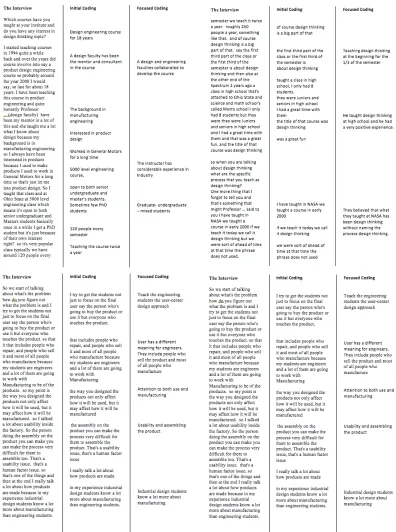
Following the focus coding guideline described by Charmaz and Kathy (2000), we proceeded to develop more directed, selective and conceptual codes than the initial codes. Then, in order to ‘discover’ the most significant or frequent initial codes that make the most analytical sense, we moved back and forth between the different phases of coding (Charmaz, Kathy, 2000). It allowed the review and coding of a high volume of documents compared to similar analysis by a researcher and support the study to identify possible hidden or less obvious relationships among coding categories.
Theoretical Coding
As we introduced the focus codes into the study, we compared many times, back and forth, the focus codes from different interviews. Also, the codes were set side-by-side with the results from theoretical sampling from the literature. These comparisons helped us to develop the theoretical codes. Theoretical codes “consist of ideas and perspectives that researchers import to the research process from outside, from a range of theories” (Charmaz, Kathy, 2000).
Some of the theoretical codes in this study were imported from Szulanski’s (2000) model of knowledge transfer to explain the stickiness and challenges in the process of DT knowledge transfer from design to non-design disciplines. To investigate the implementation of DT in course in detail, this study analyzed focused codes brought from experimental learning theory by Kolb (2014). Maker movement and tinkering were two other theoretical codes utilized in this study.
we chose (or constructed) and used the ‘best’ theoretical codes as analytical tools to relate categories to each other and integrate them into a grounded theory. (Charmaz, Kathy, 2000).
Memo writing
As we compared codes from the interviews and analyzed and categorized our thoughts, we raised several questions, ideas and thoughts about DT courses, the instructors and their perspectives. Such analytic, conceptual or theoretical notes are called memos. In the context of GT, a memo is documentation of the researcher's thinking process and theorizing from data. Charmaz, Kathy, 2000). Similar to coding, there are two stages for memo writing. Initial memos helped “to shift from initial coding to focused coding” (Charmaz, Kathy, 2000). Later in the GT analytic process, memos become longer, more conceptualized, and more like written results Charmaz, Kathy, 2000).
Final stage: emergence of theory
External criteria for judging the quality of the Grounded Theory
Corwin and Clemens (2012) suggested that the method called ‘member checks and triangulation’ can reduce biases, raise the credibility of a GT, and increase the overall validity of research. In relevancy of theory, we question if the extracted theory is meaningful for relevant people in the field (Thornberg, Charmaz, 2014). Member Check is the strategy that can support this aspect of our quality standard of research. In fact, findings from interviews can share with interviewee to receive their feedback. The interviewees’ confirmation will increase credibility of the research findings (Groat, Wang, 2002).
To achieve member checks and triangulation, the outcomes of this study were described in three peer-reviewed papers. The first two papers were published in credible international e conferences, the 20th International Conference on Engineering & Product Design Education (E&PDE 2018) and the Academic Design Management Conference (ADMC18). The third paper will be submitted to one of the following Journals: Journal of Management Education, AMLE (Academy of Management Learning and Education), or Thinking Skills and Education.
Final Note
CHAPTER 3: DESIGN THINKING, WHAT DESIGNERS CAN LEARN FROM THE NON-DESIGNERS THAT TEACH IT
Abstract
Many disciplines in higher education are increasingly adopting design thinking. Design thinking (DT) is defined as the intersection of the design, business and engineering disciplines (Brown, 2008). In the discipline-based environment of academia, adoption of design thinking by faculty of non-design disciplines such as business and engineering involves risks of repurposing knowledge from another discipline. Design thinking introduces a different pedagogy that moves students beyond the acquisition of pure knowledge toward application of knowledge. Design thinking introduces a holistic approach that encourages students to think across boundaries, thereby enabling real and fundamental innovations (Plattner, Meinell & Leifer, 2012)
Although the integration of DT has introduced exciting potential for non-design academic programs, studies have criticized the growth of DT in non-design and STEM disciplines as these design thinking practices are distanced from their origins, housed in non-design programs, and mostly taught by non-design faculty (Ogilvie & Liedtka, 2011). However, after more than a decade of DT practice in academia, relatively little has been written about how design thinking has been adapted, and perhaps transformed to meet the specific needs of the various non-design disciplines. Could these adaptations be beneficial for designers as well?
transient process, but rather as a topic that has been taught for over a decade in many academic institutions. Therefore, we can expect to find some level of design knowledge integration in business and engineering programs.
In the discipline-based environment of academia, it is notable that some business and engineering faculties are recognizing a gap and presenting an opportunity for their educational platform and deciding to take risks in their courses by becoming hosts for another discipline. These non-design faculties have a good understanding of both the gaps and opportunities in their curricula and the potential value of design for their disciplines, so they have been integrating some version of design thinking into their courses.
Non-design instructors have been successful in highlighting the value of design thinking in their disciplines, and in integrating it into their curricula. For example, Roger Martin, dean of the Rotman School of Management at the University of Toronto in Canada suggests that
non-design instructors seem to be in a better position to illustrate the existing gaps in the
product/project development process in their disciplines, specifically those that can be addressed by design thinking methods, such as encouraging students to approach problems from the user’s perspective and build empathy.
The objective of this study was not to describe design thinking, but rather to identify for designers and design educators the opportunities that arise from the adaptations of the DT approach in non-design disciplines. The methodology of this study included semi-structured interviews, designed to encourage open discussion and gather unanticipated findings. This study investigated the benefits of design thinking knowledge transfer across different disciplines.
Methods
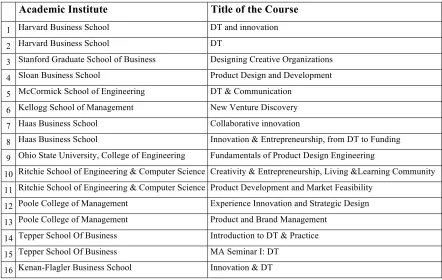
To study the DT status in the practical setting across disciplines in academia, this study first reviewed either syllabi or on-line course descriptions of 16 courses in 11 universities in the United States (Table 2). In the Google search engine, we searched for three key words: design thinking, course and the name of different academic institutions in the United States. The 6 out of 11 academic institutes were selected randomly from the list of top twenty university in United States.
Because of the limited information in course syllabi, qualitative in-depth interviews were conducted with design, business and engineering faculty. The other 5 out of 11 academic
Table 2. Sample of the courses with design thinking in the title or reference topic
Academic Institute Title of the Course
1 Harvard Business School DT and innovation
2 Harvard Business School DT
3 Stanford Graduate School of Business Designing Creative Organizations
4 Sloan Business School Product Design and Development
5 McCormick School of Engineering DT & Communication
6 Kellogg School of Management New Venture Discovery
7 Haas Business School Collaborative innovation
8 Haas Business School Innovation & Entrepreneurship, from DT to Funding 9 Ohio State University, College of Engineering Fundamentals of Product Design Engineering
10 Ritchie School of Engineering & Computer Science Creativity & Entrepreneurship, Living &Learning Community 11 Ritchie School of Engineering & Computer Science Product Development and Market Feasibility
12 Poole College of Management Experience Innovation and Strategic Design
13 Poole College of Management Product and Brand Management
14 Tepper School Of Business Introduction to DT & Practice
15 Tepper School Of Business MA Seminar I: DT
16 Kenan-Flagler Business School Innovation & DT
The purpose of in-depth interviews was to understand if non-design instructors integrated any type of business and engineering tools into the DT process. The six interviews with DT instructors were the secondary data collection through purposeful and referral sampling strategy and they were conducted with two design, two business and two engineering instructors.
Purposeful sampling is relevant because individuals are selected based on their experience of the central phenomenon (Creswell, John, 2013). Data from interviews was collected from a limited number of instructors and from four academic institutes in United States and results were developed based on the most common perspectives, thoughts and suggestions by the instructors. This study is intended to continue collection of data from a larger cohort of instructors to validate our findings. The semi-structured in-depth interviews in this study design provided an
Design Thinking as a Platform for Knowledge Transfer
Deduction, induction and abduction are the key factors of reasoning. The DT approach offers a great potential for abductive reasoning (Dorst, 2011) and approaching complex
problems. Abductive reasoning should encompass creative steps of both inductive and deductive reasoning. However, the majority of methods and processes of design involve a style of thinking characterized by synthesis, inductive reasoning and divergent thinking (Norman, Klemmer, 2014).
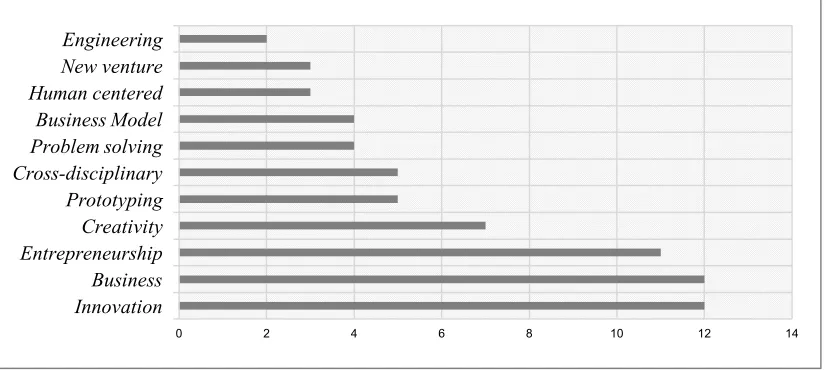
In analyzing the content of course syllabi, a common pattern was the integration of design thinking in some sessions of the existing business and engineering courses as a design tool to fill the gap and encourage divergent thinking, empathy and human-centered design. Prototyping also has been seen as a design tool for exploration and interaction. In addition to terms such as “creativity,” “innovation,” “prototyping,” “human-centered design,” and “problem solving,” this study uncovered other important associated terms with design thinking in the 16 design thinking courses.
Looking at Figure 7, terms such as “entrepreneurship,” “new venture,” and “business model” were repeated considerably. Design thinking in business courses seems more relevant in the early stage of idea generation, new venture creation and in entrepreneurial approaches. It is important to note that DT was as a supplement with the existing business and engineering tools.
first stage [of design thinking] which is journey mapping. StageGate also does not include
prototyping. That’s why I use Darden’s [Business School] DT model because it has stages that
align with StageGate.”
Figure 6 Important terms associated with DT in the sampled DT courses: content analysis and word counting.
In addition to the StageGate model, other business tools and concepts were reported as especially relevant for teaching the DT process, including value proposition, lean startup,
business canvas, and cost analysis. These findings suggest that designers could learn and benefit from analyzing how engineering and business professionals have identified and creatively addressed the gaps in the DT process and educational materials.
Noble and Durmusoglu (2015) compared the Lean Canvas model with the original and most popular business model canvas by Osterwalder and Pigneur (Osterwalder, Pigneur,
2010). They explained how Lean Canvas could embed the complexity and uncertainty of human behavior in the canvas model, to offer a flexible method for the DT process. In lean start-up, research teams learn to develop minimum viable prototypes (MVP) and engage in agile development cycles and iterative process until a viable business strategy emerges and is
converted into customer value (Noble, Durmusoglu, 2015). This process encourages researchers
0 2 4 6 8 10 12 14