UTHM CERTIFICATE VERIFICATION USING MICROTEXT DOUBLE CHECK DIGIT
ZAHRADDEEN ABUBAKAR PINDAR
A thesis submitted in
fulfillment of the requirement for the award of the Degree of Master of Computer Science
Faculty of Computer Science and Information Technology Universiti Tun Hussein Onn Malaysia
ABSTRACT
ABSTRAK
CONTENTS
TITLE i
DECLARATION iii
DEDICATION iv
ABSTRACT v
CONTENTS vii
LIST OF TABLES xii
CHAPTER 1 INTRODUCTION
1.1 Introduction 1
1.2 Problem Statement 3
1.3 Objectives 4
1.4 Scope 4
1.5 Thesis Organization 4
CHAPTER 2 LITERATURE REVIEW
2.1 Introduction 6
2.2.1 Printer and Scanner Identification 7
2.2.2 Digital Signatures 7
2.2.3 Watermarking 8
2.3 Overview of Check Digit Methods 8
2.4 Overview of Common Errors 9
2.4.1 Single Digit Error 9
2.4.2 Single Transposition Error 9
2.4.3 Twin Error 10
2.4.4 Jump Transposition Error 10
2.4.5 Jump Twin Error 10
2.4.6 Phonetic Error 11
2.5 Overview of Error Detection Methods 11 2.5.1 The UPC Modulus 10 Method 12
2.5.2 Modulus 11 Method 13
2.5.3 Luhn 10 Method 14
2.5.4 Analysis 15
CHAPTER 3 METHODOLOGY
3.1 Introduction 17
3.2 System Framework 17
3.2.1 Double Check Digit & Certificate
Generation 18
3.2.2 Detailed Design of Verification
Procedure 19
3.3 The Design of Double Check Digit System 20 3.3.1 Design of Double Check Digit 20 3.3.1.1 Computing first Check Digit 20
3.3.1.1.1 Mathematical Terminology
for First Check Digit 22 3.3.1.2 Computing second Check Digit 22
3.3.1.2.1 Mathematical Terminology
3.4 Interface Design 26
3.4.1 Interface Design 27
3.5 Summary 28
CHAPTER 4 IMPLEMENTATION
4.1 Introduction 29
4.2 Development of Double Check Digit Method 29
4.3 System Requirement 31
4.3.1 Development of Double Check Digit
Method Interface 31
4.3.2 Development of Online Verification Interface 32
4.4 Summary 36
CHAPTER 5 TEST AND ANALYSIS OF RESULT
5.1 Introduction 37
5.2 Test of Double Check Digit Method 37 5.2.1 Analysis of Test Result for Single Digit Error 38 5.2.2 Analysis of Test Result for Single Transposition
5.2.3 Analysis of Test Result for Jump Transposition
Error 40
5.2.4 Analysis of Test Result for Twin Error 41 5.2.5 Analysis of Test Result for Phonetic Error 42 5.2.6 Analysis of Test Result for Jump Twin Error 43 5.2.7 Analysis of Test Result for Double Jump
Transposition Error 44
5.2.8 Analysis of Test Result for Double Phonetic
Error 45
5.2.9 Analysis of Overall Test Result 46
5.3 Summary 48
CHAPTER 6 CONCLUSION & FUTURE WORK
6.1 Conclusion 49
6.2 Future work 50
REFERENCES 51
LIST OF TABLES
Table 2.1 Error pattern, Form and Frequency of Occurrence 11 Table 2.2 Check Digit Methods and their Success Rates 16 Table 3.1 Double Check Digit Mathematical Formula 24 Table 3.2 Character conversion table (ASCII Table) 25 Table 5.1 Single Digit Error Test Result 39 Table 5.2 Single Transposition Error Test Result 40 Table 5.3 Jump Transposition Error Test Result 41 Table 5.4 Jump Transposition Error Test Result 42
Table 5.5 Phonetic Error Test Result 43
Table 5.6 Twin Error Test Result 44
LIST OF FIGURES
Figure 2.1 Abstract view of UPC modulus 10 method 12 Figure 3.1 Double Check Digit & Certificate Generation 18
Figure 3.2 Verification procedure 19
Figure 3.3 Diagrammatical Representation of 1st Check Digit
Method 21
Figure 3.4 Diagrammatical Representation of 2nd Check Digit
Method 23
Figure 3.5 New UTHM Certificate 26
Figure 3.6 Verification Interface 27 Figure 3.7 Sample of Generated Output upon Successful
Match 28
Figure 3.8 Sample of Generated Output upon un-Successful
Figure 4.1 Function for creating 1st and 2nd Check Digits 30 Figure 4.2 Interface for Creating Double Check Digit 32 Figure 4.3 Illustrating Online Verification Interface 33 Figure 4.4 Generated Output upon Successful Match 34 Figure 4.5 Generated Output upon un-Successful Match 35 Figure 5.1 Diagram illustrating Single Error Test Result 38 Figure 5.2 Diagram illustrating Single Error Test Result 39 Figure 5.3 Diagram illustrating Jump Transposition Error
Test Result 40
Figure 5.4 Diagram illustrating Twin Error Test Result 41 Figure 5.5 Diagram illustrating Phonetic Error Test Result 42 Figure 5.6 Diagram illustrating Jump Twin Error Test Result 43 Figure 5.7 Diagram illustrating Double Jump Transposition
Error Test Result 45
Figure 5.8 Diagram illustrating Double Phonetic Error Test
Figure 5.9 Diagram illustrating Total Average Accuracy of all Three
LIST OF SYMBOLS AND ABBREVIATIONS
α - Alpla
⊕ - XOR
CD1 - 1st Check Digit CD2 - 2nd Check Digit
UPC - Universal Product Code
LIST OF APPENDICES
APPENDIX TITLE
A Test Data and Result for Single Digit Error 54 B Test Data and Result for Single transposition Error 55 C Test Data and Result for Jump Transposition Error 56 D Test Data and Result for Twin Error 58 E Test Data and Result for Phonetic Error 59 F Test Data and Result for Jump Twin Error 60 G Test Data and Result for Double Jump Transposition
Error 61
H Test Data and Result for Double Phonetic Error 62 I Proposed Algorithm Pseudocode 64 J Proposed Algorithm Program (C++) 65
CHAPTER 1
INTRODUCTION
1.1 Background
The advent of modern electronic device has aided people to accomplish their task easily, in such situations documents are forged without difficulties using these devices. As the integrity of documents is being threatened, unauthorized changes whether intentional or unintentional violate its integrity (Khan, Zaman & Asger, 2013). The continuous improvement in printer and scanner technology has aided fraudulent individuals to produce high quality fake documents. As a result, important documents such as academic transcript can easily be forged and proving its genuity requires tremendous time and evidence, as Albrecht (2013) outlined that investigation requires several activities such as initial discovery, interviews, search and legal prosecution. Chapter XVIII of the laws of Malaysia Penal Code Act 574 2006 describes the falsification of document as making a document with the intention of causing it to be believed that such document originated from a genuine and credible source (Malaysia, 2006).
hash functions are detective mechanisms that can be used to detect unauthorized changes (Chen, Niemenmaa & Gligorosk, 2012; Damn, 2000).
Documents can be classified into electronic and paper document. Several work have been done in recent years to develop methods that identify changes made in electronic documents in the areas of watermaking (Nayem, 2012; Athina, 2012) and digital signatures (Calabrese, 2010; Katz, 2010; Kiltz, 2013). Athina (2012) pointed out that despite digital documents have much advantages over printed documents in terms of production, storage, transportation and searching, hence it is more susceptible to forgery attack. Recent work has also been done in the area of identification of printers used in fraudulent purposes (Chaing, 2008; Mace, 2010). However, Mace (2010) argues that perpetrators can use high quality paper which makes it harder to trace the source.
Check digit has been in use extensively around the world for a long time. The first notable check digit algorithm was developed by an IBM scientist Hans Peter Luhn and it is specified in ISO/IEC 7812-1(Luhn, 1960). Check digits algorithms are also used in International Bank Account Number (IBAN) in bank account number used in many countries, International Standard Book Number (ISBN) numbers of books and UPC found in groceries (Khalid, 1998; Kamaku, Mwathi & Kivunge, 2012; Siddharth, 2012).
Check digit methods can be grouped into weighted and non-weighted check digit method. Weighted check digit methods produce single check digits and thus, they dominate the development of the existing check digit methods. They are found in IBAN, ISBN and UPC. Non-weighted check digit methods include the once developed by Verhoeff (1969) and Damm it uses a method of dihedral group of order to detect errors.
the first check digit is to identify errors and the second check digit is to identify omitted digits in a code word. Gumm (1985) also argued that it can be known that a digit is omitted by simply counting the number of digits. However, it can still be argued that an effective double check digit method can be designed to detect errors.
1.2 Problem Statement
Modern conventional check digit methods such as such as ISBN, UPC and IBAN impose weight on every digit position before addition or multiplication as seen in methods check digit methods. Gumm (1985) pointed out that single errors will be detected for any chosen sequence weight denoted as αi, but the particular choice of sequence of (α1, α2,…., αn) will determine the properties of the method in detecting transposition errors i.e. single, jump and jump twin errors. This rule applies to all check digit methods that use weighing system. Verhoeff (1969) and Damn (2000), methods on the other hand use complex permutations in generating check digits.
The ability of a check digit method to capture errors is determined by the combination and positioning of digits in the weight (Gumm, 1986). The incapacity of a check digit method to detect errors can lead to unwanted costs, for instance when the ISBN of a book is wrongly keyed in, it may result in the purchase of a different book, so also entering a wrong debit card may result in a debit from a wrong account number. Hence, this problem necessitates the design of check digit method with effective combination and positioning of digits in the weight.
1.3 Objectives
The objective of this thesis is to achieve the following goals:
1. To propose a double check digit system for verification of UTHM student certificate.
2. To develop a prototype based on the proposed method mentioned in (1). 3. To validate the effectiveness of the algorithm on an online prototype system. 4. To compare the proposed method with other existing check digit methods in
detecting errors.
1.4 Scope
The domain of this research concentrates on the development of a double check digit method based on modulus 10 for verifying the integrity of UTHM certificates.
1.5 Thesis Organization
This thesis will discuss several phases involved in the design and development of the double check digit method. Below are the outlines of this thesis.
Chapter 1 discusses the problem statement, objectives and scope of this research.
Chapter 2 of this thesis is divided into two sections. The first section discusses mechanisms and tools used in protecting the integrity of a certificate. The second section discusses types of errors that occur, check digit methods and their mathematical concepts, error detection rates and various examples.
Chapter 4 describes the development and implementation of the proposed method. An online interface prototype was also developed to illustrate the procedure for validation of student’s certificates.
Chapter 5 presents a comparative analysis that was carried out by comparing the accuracy of the proposed method and accuracy of other three (3) check digit methods. An analysis of the strength and weakness of the results have been presented in this Chapter.
CHAPTER 2
LITERATURE REVIEW
2.1 Introduction
This chapter describes related mathematical terms, principles and examples, overview of UTHM certificate and current existing check digit methods and evaluation criteria for check digit methods, which are relevant in the development of the new check digit method.
2.2 Overview of Certificate Verification Methods
2.2.1 Printer and Scanner Identification
Several works have been done in this area. Chiang (2008) discusses the concept of signal processing tools which prevents falsification of documents and allows the identification of the printers used in printing a particular document, thus this would provide information about the manufacturer, vendor and the person who purchased the printer. Hence, if the printer was used for malicious purposes, the perpetrator might face legal prosecutions. Chaing (2008) and Mace (2010) outlined that there are two basic strategies used in signal processing tools; passive and active strategy. The first strategy is used both in scanners and printers. It includes symbolizing a device by using some “intrinsic signatures” embedded in the scanned image of printed document. These features are unique to the particular device, model or manufacture. Modeling of the device is required to embed the signature, and also development of detection and decoding tool in order to detect and decode the signature in the scanned or printed document. The other strategy mentioned by Chaing (2008) and Mace (2010) is the active strategy. It includes embedding as “extrinsic signature” on a printed document. The printer based signature is then embedded on the document by the printer. Thus, like the intrinsic signature, the extrinsic signature also requires modeling of the device to embed the signature, and also development of detection and decoding tool to detect and decode the signature on printed document. The information on the embedded signature can further be used as evidence before the court of law.
2.2.2 Digital Signatures
2.2.3 Watermarking
Watermarking is another mechanism used in protecting the integrity intellectual property rights of digital media such as text, audio, video and images. Bamatraf (2010) describes watermarking as the process of hiding or embedding an imperceptible signal or signature into a given document. The imperceptible signature is called watermark. A water mark can be visible or invisible. Bamatraf (2010) argues that the watermark embedded into a document needs to be robust enough to withstand alterations caused by fraudulent individuals or malevolent attacks. Like most integrity protecting mechanism, a watermarking algorithm is made up of two main basic algorithms; the embedding and an extraction algorithm. The embedding algorithm embeds the signature on the document while the detection algorithm detects the signature and decodes its content.
2.3 Overview of Check Digit Methods
2.4 Overview of Common Errors
Errors in machine communication are caused by human operation as Abdel-Ghaffar (1998) has outlined. These errors could be intentional and unintentional. Study has shown that there are 5 prominent types of errors (Gallian, 1996; Abdel-Ghaffar, 1998; Siddarth, 2012). This section discusses the types of errors and their examples.
2.4.1 Single Digit Error
This error occurs when only a single digit in the whole string of numbers or alphabets is typed wrongly.
Example 2.1
123456 are typed as 124356. Here the digit 4 is typed as 3.
2.4.2 Single Transposition Error
This type of error occurs when the nth and the (n + 1 )th digits are replaced by the
(n + 1)th and the nth respectively.
Example 2.2
This type of error occurs when two consecutive identical digits are incorrectly typed as two other identical digits.
Example 2.3
124456 typed as 129956. Here the digits 44 are incorrectly typed as 99.
2.4.4 Jump Transposition Error
This type of error occurs when the nth and the (n + 2)th digits are replaced by the (n + 2)th and the nth respectively.
Example 2.4
123456 typed as 123654. Here the digits 4 and 6 are jump transposed.
2.4.5 Jump Twin Error
This type of error occurs when the nth and (n + 2)th digits are identical and are mistyped as two other identical digits.
Example 2.5
2.4.6 Phonetic Error
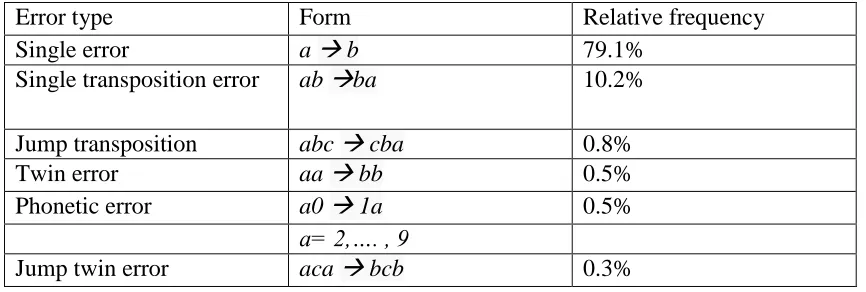
A typical example of phonetic error is when 13000 (thirteen thousand) is heard as 30000 (thirty thousand). It can also be noted that more than one type or error can occur at a time. Table 2.1 below gives a summary of a large experiment carried out on types of errors and their pattern and the frequency of their occurrences. The next subsection will discuss on the current most prominent error detection methods.
Table 2.1 Error pattern, form and frequency of occurrence (Gallian, 1996; Damm, 2000).
Error type Form Relative frequency
Single error a b 79.1%
Single transposition error ab ba 10.2%
Jump transposition abc cba 0.8%
Twin error aa bb 0.5%
Phonetic error a0 1a 0.5%
a= 2,…. , 9
Jump twin error aca bcb 0.3%
2.5 Overview of Error Detection Methods
Error detection methods have two basic components; the part that assigns and append check digit to the code and the checking part to ensure if a particular code is correct (Gallian, 1996).
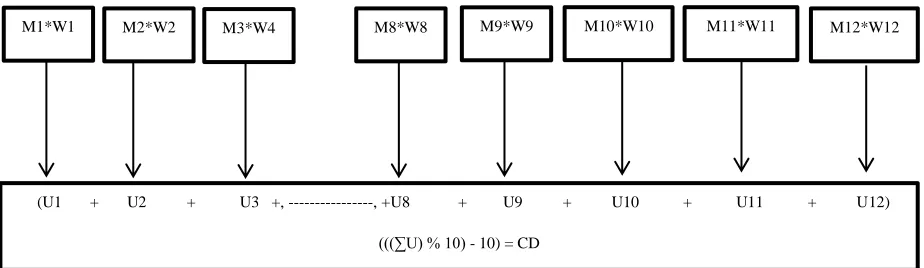
[image:25.612.106.539.324.470.2]The modulus 10 method is used to detect errors in UPC (Gallian, 1996; Siddarth, 2012). The method uses with its modulus as 10. It is a numeric code consisting of thirteen digits of which the first twelve digits represent the product code. The first digit identifies a broad category of product type, the next five digits identify the manufacturer, the next five the product, and the last is the check digit. Figure 2.1 below illustrates an abstract view of UPC check digit method.
[image:26.612.107.569.301.435.2]
Figure 2.1 Abstract view of UPC modulus 10 method
In the above illustration, the check digit for UPC is produced. The first code digit M1 is multiplied with the weight W1, the result is denoted as (M1*W1). This produces the first intermediate result “U1”. The second digit code M2 is also multiplied with its weight W2, the result is denoted as (M2*W2). This produces the second intermediate result “U2”. This process is continued until the 12th
code digit “U12” i.e(M12*W12). The intermediate results (U1, U2, U3… U12) are summed up. The summed up result is modulu with 10 (ten), and then 10 (ten) is subtracted from the result. This would produce the first check digit. It is denoted as (∑U % 10) - 10 = CD.
(U1 + U2 + U3 +, ---, +U8 + U9 + U10 + U11 + U12) (((∑U) % 10) - 10) = CD
M12*W12 M11*W11
M10*W10 M9*W9
M8*W8 M3*W4
Definition 2.1
The check digit α 13 for the UPC number α 1, α 2… α 12 is chosen to satisfy the condition. Where Weight W1, W2, W3…. W12 is denoted by weighing factor (3, 1, 3, 1, 3, 1, 3, 1, 3, 1, 3, 1).
∑
Verification Formula:
Example 2.4
Say888307882572 is the UPC of a product. Let’s compute the check digit. 3*8+8+3*8+3+3*0+7+3*8+8+3*2+5+3*7+2
24+8+24+3+7+24+8+6+5+21+2= 132 and 132+8 ≡ 0 (mod 10), Therefore 8 is the check digit.
2.5.2 Modulus 11 Method (ISBN)
Definition 2.2
The check digit α10 for the ISBN number α n α n-1… α 2, where α 2 is the last digit. Where Weight W1, W2, W3…. W9 is denoted by weighing factor (10, 9, 8, 7, 6, 5, 4, 3, 2).
∑
Verification Formula:
Example 2.5
Say 0198538030 is an ISBN of a book and 8 is the check digit. Let’s compute the check digit.
1*0+1*2+3*9+4*8+5*5+6*3+7*8+8*0+9*3+10*0 ≡ 0 (mod 11)
2+27+32+25+18+56+27= 187+0 ≡ 0 (mod 11). Therefore 0 is the check digit
2.5.3 Luhn 10 Method
Definition 2.3
The check digit
α
7 for the IBM number is;α
1,α
2… α7, whereα
8 is the last digit (2.3)Example 2.6
For a number such as 123-4567
(α 7+ α 6+ α 5+ α 4+ α 3+ α 2) ≡ 0 (mod 10) 1+2+3+4+5+6+7 ≡ 0 (mod 10)
Therefore 2 is the check digit
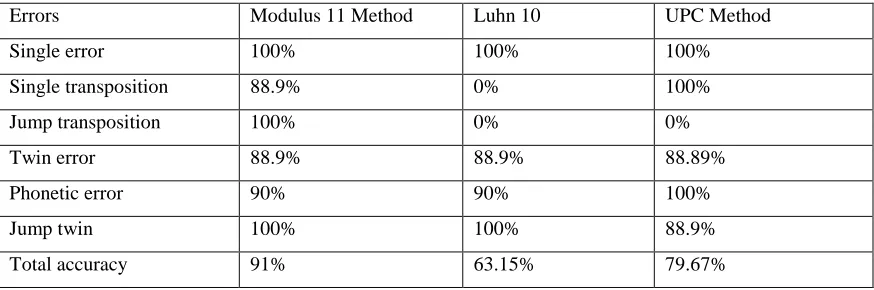
2.5.4 Analysis
Errors Modulus 11 Method Luhn 10 UPC Method
Single error 100% 100% 100%
Single transposition 88.9% 0% 100%
Jump transposition 100% 0% 0%
Twin error 88.9% 88.9% 88.89%
Phonetic error 90% 90% 100%
Jump twin 100% 100% 88.9%
Total accuracy 91% 63.15% 79.67%
From the table above, it can concluded that the Modulus 11 is the most effective check digit coding scheme as it detects all single error and single transposition which are the most common types of errors. Luhn 10 check digit method is the least effective as it does not detect single and jump transposition error. In this thesis, we propose a new method to improve the effectiveness of Modulus 10 method in jump transposition errors.
2.6 Summary
[image:30.612.109.546.128.273.2]CHAPTER 3
DOUBLE CHECK DIGIT
3.1 Introduction
This chapter discusses the design of the double check digit algorithm to secure the integrity of UTHM certificate. The algorithm will compute the student matric number and the last four digits of the passport number to produce the double check digit. A detailed explanation of the system framework of the check digit system will be explained. The procedure for computing and verification of the double check digit along with detailed designs will be explained in later section of this chapter.
3.2 System Framework
3.2.1 Double Check Digit & Certificate Generation
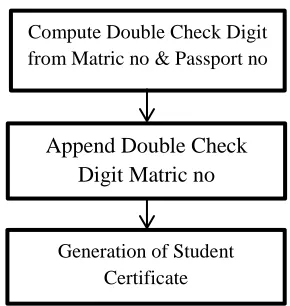
[image:32.612.220.365.326.479.2]As mentioned in the earlier section, this section discusses the procedure of computing the double check digit and generation of the student certificate. Figure 3.1 below gives an illustration of the first category of the system framework.
Figure 3.1 Double Check Digit & Certificate Generation
The above figure illustrates how the double check digit is generated. The student matric number and last four (4) digits of the passport number are computed to produce the double check. The last four digits of the identification card number will be used in cases where student does not possess a passport. The double check digit will be appended to the matric number and then printed on the student certificate. This is done at the Center for Postgraduate Studies (Master and PhD) and Center for Undergraduate Studies.
Compute Double Check Digit from Matric no & Passport no
Append Double Check Digit Matric no
3.2.2 Detailed Design of Verification Procedure
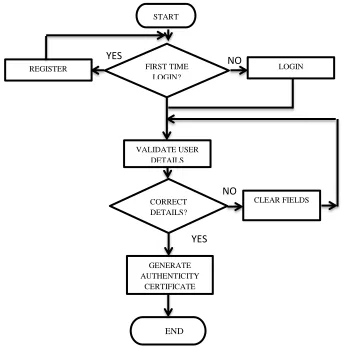
[image:33.612.143.485.249.606.2]The user category on the other hand, is the process of verifying the genuity of the certificate. This process involves keying in the user details into the online system for verification. However, the student needs to first login into their SMAP Online account. The verification page would be found on the SMAP Online website. A detail description of the process flow is illustrated in the flowchart in figure 3.2 below.
Figure 3.2 Verification procedure
The process will begins by requesting enter their user login ID and password into system. Upon a successful login, users will be requested to key-in their detail for verification. The system would compare the keyed in details with the information in the
CLEAR FIELDS CORRECT
DETAILS? START
REGISTER
VALIDATE USER DETAILS
LOGIN FIRST TIME
LOGIN?
END GENERATE AUTHENTICITY
CERTIFICATE
YES NO
NO
genuine. However, the system will show that the certificate is not genuine upon a negative match.
3.3 The Design of Double Check Digit System
This section discusses the design of the double check digit system for check digit computing and check digit verification.
3.3.1 Design of Double Check digit
The algorithm as mentioned in the earlier chapters is a modification of UPC modulus 10 check digit method. While the UPC method is a single check digit method, however the modified method is a double check digit method i.e. when a code is computed using the modified check digit, two check digits are produced which distinguishes it with the latter that produces only one check digit. The diagrammatic view of the current UPC method has been illustrated in Section 2.4.1 of Chapter 2.
3.3.1.1 Computing First Check Digit
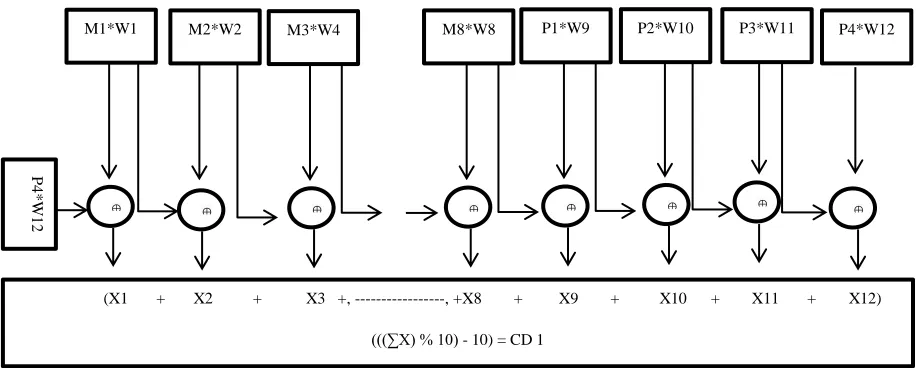
weight W2, the result is denoted as (M2*W2). To produce the second intermediate result “X2”, the result is then XOR with (M1*W1) i.e. (M1*W1) ⊕ (M2*W2). This process is continued until the 12th code digit “X12” i.e (P3*W11) ⊕ (P4*W12). The intermediate results(X1, X2, X3… X12) are summed up and modulu with 10 (ten), and then 10 (ten) is subtracted from the result. This would produce the first check digit. It is denoted as (∑X % 10) - 10 = CD 1. Hence interdependence is created between code digits. Figure 3.3 below represents a diagrammatical representation of the method described above.
Figure 3.3 Diagrammatical Representation of 1st Check Digit Method Below are the legends for the above diagram
(X1 + X2 + X3 +, ---, +X8 + X9 + X10 + X11 + X12) (((∑X) % 10) - 10) = CD 1
P4*W12 ⊕ P3*W11 ⊕ ⊕ P2*W10 ⊕ P1*W9 ⊕ M8*W8 P 4 * W 1 2 ⊕ M3*W4 ⊕ M2*W2 ⊕ M1*W1 Legends:
+ : Addition W1-12 : Weight T1-12 : Intermediate result * : Multiplication M1-8 : Matric no. P1-4 : Passport no. ⊕ : XOR X1-12 : Intermediate result
The double check digit is denoted by the following mathematical formula:
The equation below represents a mathematical method for computing the 1st check digit. ⊕ ( ⊕ )
( ⊕ ) ( ⊕ )
The above formula can be further deducted into the equation below:
( ⊕ ) ∑ ⊕ [ ] [ ]
∑ [ ] ⊕ [ ] [ ] (3.3)
Verification Formula:
3.3.1.2 Computing Second Check Digit
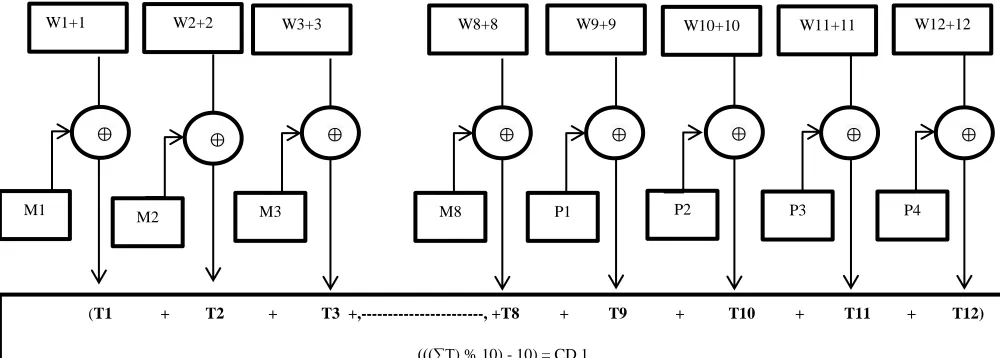
between codes is not created is it was done in the first method. Figure 3.4 below represents a diagrammatical representation of the method described above.
Figure 3.4 Diagrammatical Representation of 2nd Check Digit Method Below are the legends for the above diagram
3.3.1.2.1 Mathematical Terminology for Second Check Digit
The equation below represents a mathematical method for computing the 2nd check digit. ⊕ ⊕ ⊕ ⊕ M1 W1+1 ⊕ W10+10 ⊕ W8+8 ⊕ W3+3 ⊕ ⊕ W9+9 ⊕ W2+2 ⊕ W12+12 ⊕
(T1 + T2 + T3 +,---, +T8 + T9 + T10 + T11 + T12)
(((∑T) % 10) - 10) = CD 1
P2 M8
M3 P1 P3
M2 P4
W11+11
Legends:
+ : Addition W1-12 : Weight T1-12 : Intermediate result * : Multiplication M1-8 : Matric no. P1-4 : Passport no. ⊕ : XOR X1-12 : Intermediate result
Verification Formula:
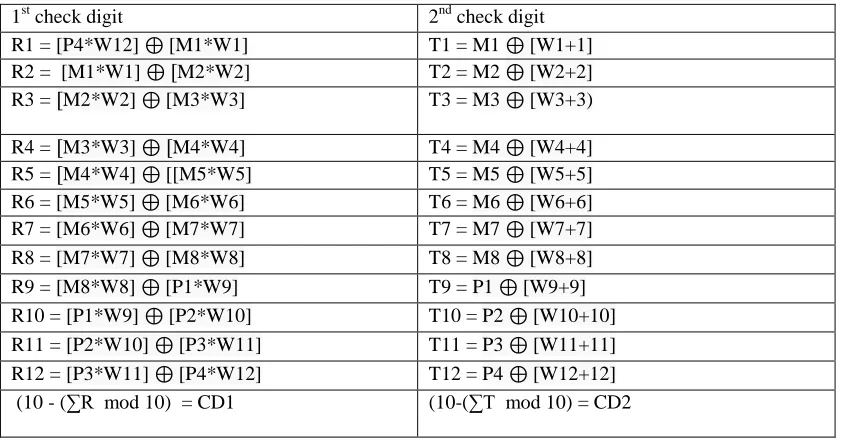
[image:38.612.118.539.250.470.2]The above table illustrates a break-down of the mathematical formula above Table 3.1 Double Check Digit Mathematical Formula
Double check digit =CD1||CD2. The two check digits are concatenated.
3.3.1.3 Character Conversion
UTHM student matric numbers consist of alphabets and numbers (alphanumeric). Thus, need for a character conversion scheme to convert the alphabets into decimal numbers before computing the matric number to produce the check digit. The system will be design to accept only uppercase letter. However if lower case letters are entered, the system will convert it into uppercase and then into decimal.
1st check digit 2nd check digit R1 = [P4*W12] ⊕ [M1*W1] T1 = M1 ⊕ [W1+1] R2 = [M1*W1] ⊕ [M2*W2] T2 = M2 ⊕ [W2+2] R3 = [M2*W2] ⊕ [M3*W3] T3 = M3 ⊕ [W3+3)
REFERENCES
Albrecht, C. C, (2013). Prevention, F. Fraud and Forensic Accounting in a Digital Environment. (http://www.theifp.org/research-grants/IFP-Whitepaper-4.pdf). Anitha, V. & Velusamy, R. L. (2012). Authentication of Digital Documents Using
Secret Key Biometric Watermarking. International Journal of Communication Network Security ISSN: 2231 – 1882, Vol.1 (Issue 4).
Bamatraf, A., Ibrahim R. & Salleh M. N. M. (2010). Digital Watermarking Algorithm Using LSB. 2010 International Conference on Computer Applications and Industrial Electronics (ICCAIE 2010). Kuala Lumpur, Malaysia.
Chen, Y., Niemenmaa, M., Vinck, A. J. & Gligoroski, D. (2012). On Some
Properties of a Check Digit System. 2012 IEEE International Symposium on Information Theory Proceedings (ISIT). pp. 1563-1567.
Damm, M. (2000). Check Digit Systems Over Groups and Anti-symmetric Mappings. Archiv der Mathematik, 75(6). pp. 413-421.
Gallian, J. A. (1996). Error Detection Methods. ACM Comput. Surv., 28. pp. 504–517. Gallian, J. A. (1991). The Mathematics of Identification Numbers. Coll. Math. J., 22,
pp. 194–202.
Gumm, H. P. (1985). A New Class of Check Digit Methods for Arbitrary Number Systems. IEEE Tran. Inf. Th. 31. pp. 102–105.
Gumm, H. P. (1986). ENcoding of Numbers to Detect Typing Errors. Inter. J. Applied Eng. Ed.2, pp. 61–65.
Hemant, K., Srikant N. & Sanjay S. (2010). A UID numbering Scheme. Retrieved from http://www.uidai.gov.in.
Khan, Q., Butt, M. A., Zaman, M. & Asger, M. (2013). A Novel Approach Based Information Integrity Modeling. system, 2(1). pp. 190-197.
Kamaku, W., Mwathi, C., & Kivunge, B. (2012). Limitations in the Convectional ISBN-10 Code. American International Journal of Contemporary
Research. Vol2. No.2. pp. 553-569.
Khaled, A. S. (1998). Detecting substitutions and transpositions of characters. The Computer Journal 41.4. pp. 270-277.
Mace, J. C. (2010). Printer Identification Techniques and Their Privacy Implications. Computing Science, Technical Report Series, No. CS-TR-1211.
University of Newcastle.
Malaysia (2006). Laws of Malaysia: Offences Relating To Documents and To Currency Notes and Bank. Penal Act 574. Forgery 46, 2006. Retrieved from
http://www.agc.gov.my.
Nyeem, H., Boles, W. & Boyd, C. (2012). On The Robustness and Security of Digital Image Watermarking. In Informatics, Electronics & Vision (ICIEV), 2012 International Conference, IEEE. pp. 1136-1141.
Prenee, B., Rene G. & Joos V. (1990). Information Integrity Protection and Authentication in a Banking Environment. Proceedings of
SECUBANK. pp. 9-14.
Siddharth, A. (2012). Error Detection in Numeric Codes. Resonance-Heidelberg 17.7. pp. 653-665.
Schulz, R. H. (2001). Check character systems and anti-symmetric mappings. Computational Discrete Mathematics. Springer Berlin Heidelberg, Chicago. pp. 136-147.