Preparation and Evaluation of Surface Morphology and Swelling Behavior of
Ternary Blend Films
Ravindra Chougale
*, Deepak Kasai
aand Saraswati Masti
b*P G Department of Studies in Chemistry, Karnatak University, Dharwad - 580 003, Karnataka, India aDepartment of Materials Science, Mangalore University, Mangalgangothri - 574 199, Karnataka, India
bDepartment of Chemistry, Karnatak Science College, Dharwad - 580 001, Karnataka, India
_____________________________________________________________________________________________
ABSTRACT
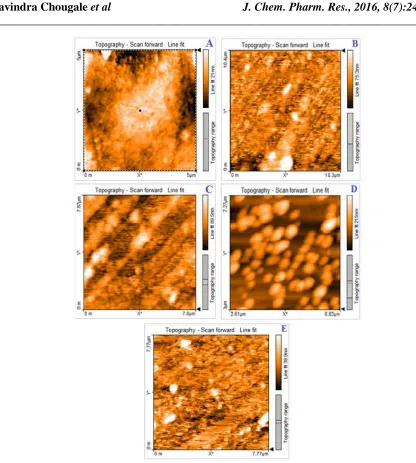
The present study aims to prepare ternary blend films composed of chitosan/guar gum/vanillin (CH/GG/Vn) by solvent casting method. The surface morphology and interaction among the components of blend films were determined by Atomic force microscopy (AFM) and Fourier transform infrared spectroscopy (FTIR). The blend films were subjected to swelling study under water and different pH media. The roughness of the blend films increased with increase in guar gum and vanillin (wt%). By the addition of equal weight percent of GG/Vn into chitosan film, the swelling behavior enhanced than pure chitosan and swelling behavior at different pH medium than water. Based on the results, we conclude that the prepared blend films can find potential application in pharmaceutical industry for drug delivery.
Key words: Chitosan, surface morphology, swelling behavior, FTIR and AFM.
_____________________________________________________________________________________________
INTRODUCTION
Chitosan is a natural polysaccharide derived from the naturally occurring chitin in crab and shrimp shells [1-2]. Chitosan is biocompatible, biodegradable and non toxic in nature. The most promising feature of chitosan, its excellent property to form porous structures [3] that has been widely used in diverse fields like food processing, medical field in cell transplantation, tissue regeneration and biotechnology [4-10]. Chitosan has ability to form clear and flexible film with good mechanical properties. In addition, the absence of pores [11] makes chitosan degrades before its melting. Many medical applications of chitosan depend on adsorption processes which in turn related the surface of material. The surfaces of chitosan films widely discussed [12-16] and microstructures, including roughness can be effectively examined by using atomic force microscopy (AFM). Swelling and chemical resistivity of blend films plays an important role in control and development of mechanism for filtration and separation and also in drug delivery. The objective of the study is to prepare ternary blend films of CH/GG/Vn and to investigate the surface morphology of blend films, swelling and chemical resistivity of blend films.
EXPERIMENTAL SECTION
Fig. 1. Chemical Structures of Raw Materials
Preparation of blend films
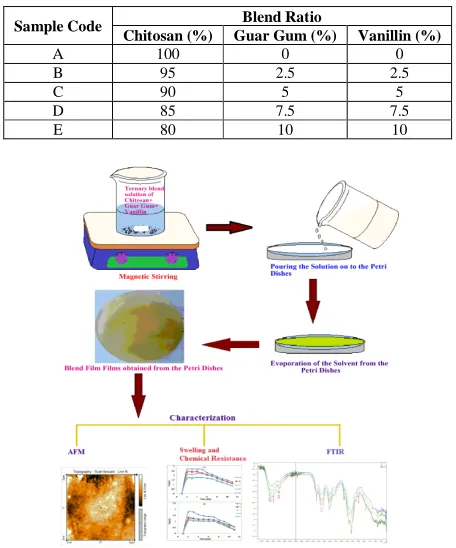
[image:2.595.184.412.359.633.2]Ternary blend films of chitosan/guar gum/vanillin (CH/GG/Vn) were prepared by solvent casting technique. Different weight percent of individual chitosan dissolved in 2% acetic acid. Guar gum and vanillin was dissolved in water separately. The individual solutions were mixed with each other and stirred overnight on magnetic stirrer to get clear and homogeneous ternary blend solution (100/00/00, 95/2.5/2.5, 90/5/5, 85/7.5/7.5, 80/10/10). After ensuring viscosity and clear homogeneity, blend solution poured onto Petri dishes and allowed to evaporate at room temperature. Then films were peeled off from the Petri dishes and kept in desiccators until use.
Table 1. Composition of Chitosan/Guar gum/Vanillin Blend Films
Sample Code Blend Ratio
Chitosan (%) Guar Gum (%) Vanillin (%)
A 100 0 0
B 95 2.5 2.5
C 90 5 5
D 85 7.5 7.5
E 80 10 10
Fig. 2 . Pictorial Representation of Research Work Carried out in the Present Study
Dynamic Swelling in Water and Different pH Medium
The swelling of the blend films also studied in different pH disciplines by swelling measurements in water and pH-1.2 and 9.0 using standard buffer solutions at room temperature. All the weight measurements carried out taken in digital electronic balance (Shimadza AUX120, Japan, accuracy of ±0.1mg). Previously weighed dry films were immersed in excess of the buffer solution and in water. After certain intervals of time, the films were taken out from the solution and wiped with blotting paper to remove adhered liquid drops. The increase in weight of the film measured. The swelling ratio (S) and total water holding capacity of the films at equilibrium (percent equilibrium water content, %EWC) calculated by using following equations.
S = (1)
%EWC = X100 (2)
Chemical Resistance
The influence of acidic and basic condition (chemical resistance) on films were investigated by immersing known weight (Ti) of films (size 1x1 cm) in 100 ml of 1 N NaOH and 1 N HCl solution. At different time intervals (24–
120 hours) samples removed from the solution then dried and weighed (Waci) accurately. The percent of chemical
resistance (Pcr) calculated (in term of weight loss) from the following equation.
Percent chemical resistance = X100
Where Ti = initial weight and Waci = weight after certain interval.
Fourier transform infrared spectroscopy (FT-IR)
The FTIR spectroscopy was used in order to determine the possible interactions among the components of CH/GG/Vn blend films. The FTIR spectra of films were recorded by using an attenuated total reflection (ATR) method in IR spectrometer (FT-IR-ATR, Prestage 21, Shimadzu, Japan). Samples were analyzed between 400 and 4000 cm-1 with a resolution of 4 cm-1.
RESULTS AND DISCUSSION
Atomic force microscopy (AFM)
Fig. 3. Tapping mode AFM images: A) Chitosan, B) 95/2.5/2.5, D) 85/7.5/7.5 and E) 80/10/10 blend films
Equilibrium Swelling Study in Different Solvents
Table 2shows the results obtained from equilibrium swelling in different solvents. The order of swelling observed in different solvents as follows H2O>C2H5OH> DMF>CCl4>n-butyl alcohol. Greater swelling observed in water
compared to other solvents which could be due to the hydrophilic nature of the blend films. In ethanol, DMF, CCl4
and n-butyl alcohol swelling decreases it could be due to the non availability free hydroxyl groups.
Table 2. % Swelling Behavior of Blend Films Different Solvents
% of Swelling Behavior
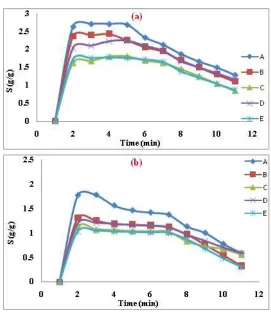
[image:4.595.80.496.71.534.2]Fig. 4. Swelling isotherms of CH/GG/Vn in H20
[image:5.595.162.433.390.702.2]Fig. 5 a, b shows the diagram of dynamic swelling in different pH medium. In assessing the swelling in different pH medium, it was noted that different pH medium (pH- 1.2 and 9.0) influences much on blend films compare to pure chitosan. Under both acidic and basic conditions blend films not stable and showed swelling up to 60 minutes thereafter due to instability, films started to degrade. Weight of the blend films initially increased due to swelling but as the exposure time increased decomposition of blend films noticed. All blend films have good response towards pH and the order of the swelling observed as water >pH 1.2> 9.0. The results confirm that, at higher pH the cross link between the three components can breakdown easily and degradation of films can be observed.
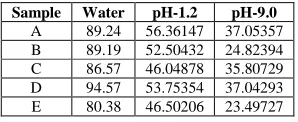
Table 3.Equilibrium Water Content in Water and pH 1.2 and 9.0
Sample Water pH-1.2 pH-9.0
A 89.24 56.36147 37.05357
B 89.19 52.50432 24.82394
C 86.57 46.04878 35.80729
D 94.57 53.75354 37.04293
E 80.38 46.50206 23.49727
The results of equilibrium water content (Table. 3) showed that blend films has presented highest water holding capacity. But in different pH medium the blend films where completely unstable exhibiting lower water content.
Chemical Resistivity
In this study, results of chemical resistance showed that (Table 4, 5) resistance of the films in acidic and basic medium (1N NaOH and 1N HCl) decreases with the increase in exposure of time. Also significant increase in percent of degradability of blend films under such chemicals was noticed. The results of chemical study were similar to the above discussion. This could be due to the effect of acidic and basic medium on blend films causing breaking of bonds.
Table 4. Chemical Resistances (In terms of % wt. loss) of Blend Films of CH/GG/Vn at Different Time Intervals against (A) 1 N NaOH
Sample 24 Hour(%) 48 Hour (%) 72 Hour (%) 96 Hour (%) 120 Hour (%)
A 5.3 11.1 12.7 15.4 17.0
B 11.2 13.1 14.4 16.0 17.0
C 10.4 10.4 12.0 13.8 15.4
D 9.7 10.8 12.8 15.3 16.3
E 5.8 8.6 11.6 12.72 13.6
Table 5. Chemical Resistances (In terms of % wt. loss) of Blend Films of CH/GG/Vn at Different Time ntervals against (B) 1N HCl
Sample 24 Hour(%) 48 Hour (%) 72 Hour (%) 96 Hour (%) 120 Hour (%)
A 3.9 7.5 8.5 11.6 17.1
B 1.5 3.7 6.5 10.4 15.2
C 2.6 6.7 16.0 21.2 25.6
D 9.4 12.7 26.2 30.6 37.2
E 11.2 15.3 24.2 31.6 35.5
Fourier transform infrared spectroscopy (FT-IR)
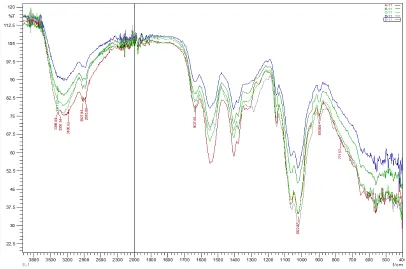
FTIR spectra of pure chitosan and CH/GG/Vn are shown in Fig. 6. Pure chitosan shows a broad absorption peak at 3395 cm-1 due to –OH and N-H stretching [17-19]. Theabsorption band at 3427cm−1 attributed to -OH stretching vibrations, while the peak at 2922 and 2810 cm−1 indicates the presence of C−H aliphatic stretching vibrations. Chitosan is characterized by its saccharide structure for which the peaks appear at 899 cm−1and 1154 cm−1. Absorption peak at 1076 cm-1 attributed to the C-O stretching band.
+
Fig. 6. FTIR Spectra of Pure Chitosan & Chitosan/Guar gum/Vanillin Blend films
CONCLUSION
In the present study, the surface morphology, swelling and chemical resistance of CH/GG/Vn blend films were studied. The results of AFM study attests that blend films showed different surface morphology with increasing concentration of GG/Vn. The results of swelling behavior confirms that blend films were hydrophilic in nature, showed more swelling in water and more active in different pH solutions (pH 1.2 and pH 9.0). Meanwhile, the reduced chemical resistance was noticed, which suggests that blend films not stable at acidic and basic medium. Based on the results we can conclude that blend films can be suitable alternative to synthetic material which can find application in pharmaceutical as well as in food packaging industry.
REFERENCES
[1] R A A Muzzarelli; editor. Natural chelating polymers. Pergamon Press, London,1973. 83.
[2] H I Bolker; editor. Natural and synthetic polymers: An introduction, marcel dekker, New York, 1974.106. [3] J Berger; M Reist; JM Mayer; O Felt; R Gurny. Eur. J. Pharm. Biopharm., 2004, 57(1), 35-52.
[4] G Lu; L Zhu; L Kong; L Zhang; Y Gong; N Zhao; X Zhang. Tsinghua Sci. Technol., 2006, 11(4), 427-432. [5] S Hirano; Y J Noishiki., J. Biomed. Mater. Res., 1985, 19(4), 413-417.
[6] O Pillai; R Panchagnula. Curr. Opin. Chem. Biol., 2001, 5(4), 447-451. [7] E Khor; LY Lim. Biomater., 2003, 24(13), 2339-2349.
[8] S Yuan; TJ Wei. Bioact. Compat. Polym., 2004, 19(6), 467-479.
[9] YW Cho; YN Cho; SH Chung; W Ko. Biomater., 1999, 20(22), 2139-2145. [10] G Crini. Bioresour. Technol., 2006, 97(9), 1061-1085.
[12] WH Nosal; DW Thompson; L Yan; S Sarkar; A Subramanian; JA Woollam. Colloid Surf. B., 2005, 43(3-4), 131-137.
[13] WH Nosal; DW Thompson; L Yan; S Sarkar; A Subramanian; JA Woollam. IColloids Surf. B., 2005, 46(1), 26-31.
[14] Y Feng; Z Han; J Peng; J Lu; B Xue; L Li; H Ma; E Wang. Mater. Lett., 2006, 60(13-14), 1588-1593. [15] CG Aimoli; MA Torres; MM Beppu. Mater. Sci. Eng. C., 2006, 26(1), 78-86.
[16] J Fu; J Ji; W Yuan; J Shen. Biomaterials. 2005, 26 (33), 6684-6692.
[17] P Fernandez-Saiz; JM Lagaron; P Hernandez-Munoz; MJ Ocio. Int. J. Food Microbiol., 2008, 124(1), 13–20. [18] SJ Yoon; DC Chu; LR Juneja. J. Clin. Biochem. Nutr., 2008, 42(1), 1-7.