Munich Personal RePEc Archive
OLG life cycle model transition paths:
alternate model forecast method
Evans, Richard W. and Phillips, Kerk L.
BYU Department of Economics
20 August 2010
OLG Life Cycle Model Transition Paths:
Alternate Model Forecast Method
∗
Richard W. Evans
† Brigham Young UniversityKerk L. Phillips
‡ Brigham Young Universitykerk [email protected]
August 2010
(version 10.08.d)Abstract
The overlapping generations (OLG) model is an important framework for analyzing any type of question in which age cohorts are affected dif-ferently by exogenous shocks. However, as the dimensions and degree of heterogeneity in these models increase, the computational burden imposed by rational expectations solution methods for non-stationary equilibrium transition paths increases exponentially. As a result, these models have been limited in the scope of their use to a restricted set of applications and a relatively small group of researchers. In addition to providing a de-tailed description of the benchmark rational expectations computational method, this paper presents an alternative method for solving for non-stationary equilibrium transition paths in OLG life cycle models that is new to this class of model. We find that our alternate model forecast method reduces computation time to 15 percent of the benchmark time path iteration computation time, and the approximation error is less than 1 percent.
keywords: Computable General Equilibrium Models, Heterogeneous Agents, Overlapping Generations Model, Distribution of Savings
JEL classification: C63; C68; D31; D91
∗We thank Shinichi Nishiyama for helpful comments and code. We are grateful to the
Quanti-tative Society for Pension and Savings 2009 Summer Workshop participants and Brigham Young University R2 Seminar Series
participants for constructive comments. Matthew Yancey provided helpful research assistance. All errors are our own.
†Brigham Young University, Department of Economics, 167 FOB, Provo, Utah 84602, (801)
422-8303,[email protected].
‡Brigham Young University, Department of Economics, 166 FOB, Provo, Utah 84602, (801)
1
Introduction
In 2008, the overlapping generations (OLG) model proposed by Samuelson (1958)
turned 50.1 OLG models provide a dynamic general equilibrium setting with
hetero-geneous agents that looks more simple and intuitive on the surface than the more
conventional models with infinitely lived agents. The OLG framework is invaluable
for analyzing any type of question in which age cohorts are affected differently by
exogenous shocks. However, the intuitive structure of new generations of finitely
lived agents being born in each period comes at a cost. The first two fundamental
welfare theorems do not hold in OLG models, and the computation of non-stationary
equilibrium transition paths can require a tremendous computational burden.
It is the latter complexity of OLG models—namely, the increased computational
burden of computing non-stationary equilibrium transition paths—that we wish to
address in this paper. In particular, we propose a new method for computing the
equi-librium transition path, which we call the alternate model forecast (AMF) method.
As the AMF method represents an approximation of the benchmark rational
expec-tations time path iteration (TPI) solution method, we compare the AMF method to
the TPI method in terms of both speed and accuracy.
As a recent example of the constraints exacted by the computational
require-ments for equilibrium transition paths in OLG models with a significant degree of
heterogeneity and uncertainty, Nishiyama and Smetters (2007) lament that “[t]he
more extensive model contained in this paper requires the addition of another state
variable, which significantly increases the...required computation time from several
hours to typically several days per simulation.” Even a computation time of several
hours makes procedures like forecasting prohibitive if the model must be simulated
numerous times in order to approximate the distribution of forecasts.
The benchmark conventional solution method for the non-stationary rational
ex-pectations equilibrium transition path in OLG models is outlined in Auerbach and
1
Kotlikoff (1987, ch. 4) for the perfect foresight case and in Nishiyama and Smetters
(2007, Appendix II) for the stochastic case. We call this method time path iteration
(TPI). We will show the conventional TPI method is a rational expectations
equilib-rium concept in which each agent correctly forecasts the decisions of the other agents,
thereby correctly forecasting the future distribution of savings.
Our new AMF solution method incorporates some of the flavor of the finding of
Krusell and Smith (1998) that the law of motion for the aggregate variables can be
closely approximated by a finite dimensional function instead of the often infinite
dimensional true law of motion. In particular, we show that using a simple
func-tion of the mean of the distribufunc-tion, rather than the entire distribufunc-tion of wealth,
delivers a computed equilibrium transition path of the economy that is very close to
the benchmark TPI transition path. We call this method AMF because the model
used to forecast aggregate variables is arbitrary and comes from outside the model
of the economy. In this sense, the AMF method relaxes the rational expectations
assumption in that some error is introduced into agents’ forecasts. As in Krusell and
Smith (1998), the approximation becomes nearer to the benchmark transition path
the more moments are used in the alternate model forecast method. But the increase
in accuracy diminishes in the number of moments. This idea of agents not using all
available information is also similar to the rational inattention concept of Mankiw
and Reis (2002) and Sims (2003).
We find that the AMF transition path solution method reduces computation time
by 85 percent with an approximation error of less than 1 percent. This result is robust
to both the degree of heterogeneity in the model and the distance of the initial state
to the new steady-state equilibrium.
This paper is organized as follows. Section 2 describes a model with S-period
lived agents with heterogeneous stochastic ability and defines both the steady-state
equilibrium and the non-steady-state transition path equilibrium. Section3describes
the benchmark equilibrium TPI solution method, the AMF solution method, and
2
Model
2.1
Household problem
A measure 1/S of individuals with heterogeneous working ability e∈ E ⊂ R is born
in each period t and live for S ≥ 2 periods. Their working ability evolves over their
lifetime according to an age-dependent i.i.d. process es ∼ fs(e), where fs(e) is the
age-dependent probability distribution function over working ability e. Individuals
are endowed with a measure of time in each periodt that they supply inelastically to
the labor market. Let s represent the periods that an individual has been alive. The
fixed labor supply in each period t by each age-s individual is denoted by n(s).
At time t, all generation s agents with ability e know the real wage rate wt and
know the one-period real interest rate rt on bond holdings bs,t that mature at the
beginning of periodt. In each periodt, age-sagents with working abilityechoose how
much to consumecs,t and how much to save for the next period by loaning capital to
firms in the form of a one-period bondbs+1,t+1 in order to maximize expected lifetime
utility of the following form,
Us,t =E "S−s
X
u=0
βuu(cs+u,t+u) #
where u(cs,t) =
(cs,t)1
−σ
−1
1−σ ∀s, t (2.1)
where u(c) is a constant relative risk aversion utility function, σ > 0 is the
coeffi-cient of relative risk aversion, β ∈ (0,1) is the agent’s discount factor, and E is the
expectations operator.
Because agents are born without any bonds maturing and because they purchase
no bonds in the last period of lifeS, the per-period budget constraints for each agent
normalized by the price of consumption are the following,
wtes,tn(s)≥cs,t+bs+1,t+1 for s = 1 ∀t (2.2)
(1 +rt)bs,t+wtes,tn(s)≥cs,t+bs+1,t+1 for 2≤s≤S−1 ∀t (2.3)
where es,t ∈ E ⊂ R is an age-specific working ability shock that is i.i.d. and has a
discrete support with age-dependent probability mass function fs(e).
es,t ∈ Es={es,1, es,2, ...es,J} ⊂RJ ∼fs(e) =θs(e) (2.5)
The i.i.d. age-dependent probability mass function fs(e) assigns probabilities θs(e)
to each possible ability level es,t such that PeJ
e=e1θs(e) = 1 for all ages s. The law
of large numbers ensures that θs(ej) percent of all age-s households have working
abilityej. The expected value of ability at agesis ¯es ≡E(es,t) = PeJ
e=e1θs(e)es,t. We
assume that the work ability shock is either private information to the household or
is manifest after the workers have been hired. In addition to the budget constraints
in each period, we impose a borrowing constraint.2
bs,t ≥0 ∀s, t (2.6)
We next describe the Euler equations that govern the choices of consumption cs,t
and savings bs+1,t+1 by household of age s and ability e in each period t. We work
backward from the last period of life s = S. Because households do not save in
the last period of life bs+1,t+1 = 0 due to our assumption of no bequest motive, the
household’s final-period maximization problem is given by the following.
max
cS,t
(cS,t)1
−σ
−1
1−σ s.t. (1 +rt)bS,t+wteS,tn(S)≥cS,t ∀t (2.7)
Because the s =S problem (2.7) involves only time-t variables that are known with
certainty, the solution to the problem is trivially that the household consumes all of
its income in the last period of life.
cS,t= (1 +rt)bS,t+wteS,tn(S) ∀t (2.8)
2
In general, maximizing (2.1) with respect to (2.2), (2.3), (2.4), and (2.6) gives the
following set of S−1 intertemporal Euler equations,
(cs,t)
−σ
=βE
(1 +rt+1) (cs+1,t+1) −σ
for 1 ≤s≤S−1, ∀t
(2.9)
that become inequalities when optimal savings is negative bs+1,t+1 < 0. Note from
(2.3) that cs,t in (2.9) depends on the household’s age s, which ability shock es,t the
particular age-s household received, and the initial wealth with which the household
entered the period bs,t. The expectations operator E on the right-hand side of (2.9)
integrates out any expected heterogeneity in ability es+1,t+1 in the next period.
How-ever, the presence of next period prices rt+1 and wt+1 on the right-hand-side of (2.9)
requires an assumption about the housdhold’s beliefs about the distribution of capital
in the next period and, therefore, about other households’ choices.
As will be shown in Section 2.3, equilibrium prices depend on the entire
distribu-tion of capital. Let the object Γt={γt(s, e, b)} ⊂RS×RJ×RB represent the entire
distribution of capital in period t among all types of households s, e, and b, where
each γt(s, e, b) represents the fraction of the total population that is age s, ability e,
and wealth b. Let general beliefs about the future distribution of capital in period
t+u be characterized by the linear operator Ω(·) such that:
Γe
t+u = Ωu(Γt) ∀t, u≥1 (2.10)
where the e superscript signifies that Γe
t+u is the expected distribution of wealth at
time t+u based on general beliefs Ω(·) that are not constrained to be correct.
Now we can express the policy function for savings in the next period from (2.9)
as a function of the state and beliefs b′
= φ(s, e, b|Ω), where s ∈ {1,2, ...S −1},
e ∈ {e1, e2, ...eJ}, and b = {b1, b2, ...bB}. Discretizing the support of the current
period wealth in bond holdings b allows us to not have to account for the history of
ability shocks received up to age s. That is, equations (2.8) and (2.9) are perfectly
identified but represent PS−1
v=1 J
v equations and PS−1
v=1 J
live S = 10 periods and there are only J = 5 different abilities, then (2.8) and
(2.9) represent 2,441,405 equations and 2,441,405 unknowns. Discretizing the possible
values of current wealth to B points such that bs,t ∈ {b1, b2, ...bB} allows us to deal
with only (S−1)×J ×B equations and unknowns. If the number of points in the
support ofbisB = 100, then (2.8) and (2.9) only represent 4,500 equations and 4,500
unknowns.
2.2
Firm problem
A unit measure of identical, perfectly competitive firms exist in this economy. The
representative firm is characterized by the following Cobb-Douglas production
tech-nology,
Yt=AKtαN1
−α
t ∀t (2.11)
whereAis the fixed technology process andα ∈(0,1) andNtis measured in efficiency
units of labor. Firms hire workers before their ability shock is realized.3 Profit
maximization results in the real wage wt and the real rental rate of capital rt being
determined by the marginal products of labor and capital, respectively.
wt= (1−α)
Yt
Nt
∀t (2.12)
rt=α
Yt
Kt
∀t (2.13)
There is no expectations operator in (2.12) and (2.13) because the ability shock to
households is i.i.d., and we assume that firms know the distribution of the shock. So
if the wage clears the labor market, then all the firm needs to know is the average
ability of each age cohort ¯es.
3
2.3
Market clearing and equilibrium
Labor market clearing requires that aggregate labor demandNtmeasured in efficiency
units equal the sum of individual efficiency labor supplied es,tn(s). The supply side
of market clearing in the labor market is trivial because household labor is supplied
inelastically. Capital market clearing requires that aggregate capital demandKtequal
the sum of capital investment by householdsbs,t. Aggregate consumptionCtis defined
in (2.16), and investment is defined by the standard Y =C+I constraint as shown
in (2.17).
Nt=
1 S S X s=1 eJ X
e=e1
θs(e)es,tn(s) ∀t (2.14)
Kt=
S−1
S S X s=2 eJ X
e=e1 bB
X
b=b1
γt(s, e, b)b ∀t (2.15)
Ct ≡
S−1
S S X s=2 eJ X
e=e1 bB
X
b=b1
γt(s, e, b)c(s, e, b) +
1
S
eJ
X
e=e1
θ1(e)c(1, e,0) ∀t (2.16)
Yt=Ct+Kt+1−(1−δ)Kt (2.17)
wherec(s, e, b) in (2.16) is the optimal consumption rule for each household resulting
from the optimal savings rule b′
=φ(s, e, b|Ω) through the period budget constraints
(2.2), (2.3), and (2.4). Then the steady-state rational expectations equilibrium for
this economy is defined as follows.
Definition 1(Steady-state rational expectations equilibrium). A non-autarkic steady-state rational expectations equilibrium in the overlapping generations model with S-period lived agents and heterogeneous ability e is defined as a constant dis-tribution of capital
Γt= ¯Γ = ¯γ(s, e, b) ∀t,
a savings decision rule given beliefs b′
= φ(s, e, b|Ω), consumption allocations cs,t
for all s and t, aggregate firm productionYt, aggregate labor demand Nt, aggregate
capital demand Kt, real wage wt, and real interest rate rt for all t such that the
following conditions hold:
i. households optimize according to (2.6), (2.8) and (2.9),
iii. markets clear according to (2.14), (2.15), and (2.17),
iv. and the steady-state distribution Γt = ¯Γ is induced by the policy rule b
′
=
φ(s, e, b|Ω).
Note that the steady-state rational expectations equilibrium definition has no
con-straint that beliefs be correct Γt+1 = Γet+1 = Ω(Γt). The steady-state assumption that
Γt = Γt+1 = ¯Γ removes the need for beliefs about other households’ actions because
Γt+1 is known.
The steady-state rational expectations equilibrium is computed by guessing a
steady-state distribution ¯Γi, whereiis the index of the guess, and finding the implied
steady-state real wage and real interest rate ¯wi and ¯ri.4 The policy function for each
individual can then be found by backward induction by first solving the age-S−1
savings problem for bS for all values of bS−1 and eS−1,
[1 + ¯ri]bS−1+ ¯wieS−1n(S−1)−bS −σ
=...
β(1 + ¯ri)E
[1 + ¯ri]bS+ ¯wieSn(S)
−σ (2.18)
and then using the solution forbS to solve the previous period problem for bS−1.The
process is repeated from the age S−1 Euler equation (2.18) backward to the age-1
Euler equation.
[1 + ¯ri]bs+ ¯wiesn(s)−bs+1
−σ
=...
β(1 + ¯ri)E
[1 + ¯ri]bs+1+ ¯wies+1n(s+ 1)−bs+2
−σ
for s∈ {S−2, S−3, ...2,1}
(2.19)
Once a policy function is found b′
= φi(s, e, b|Ω) given the guess for the
steady-state distribution of wealth ¯Γi and the corresponding steady-state real wage ¯wi and
real interest rate ¯ri, the policy function can be used to check if the next period
distribution of wealth ¯Γ′
i is equal to the initial guess for the steady-state distribution
4
of wealth ¯Γi. If they are equal, then ¯Γ = ¯Γi = ¯Γ′i. If they are not equal, then choose
another steady-state distribution that is a convex combination of the initial guess and
the new implied distribution ¯Γi+1 =ρΓ¯′i+ (1−ρ)¯Γi where ρ∈(0,1).5
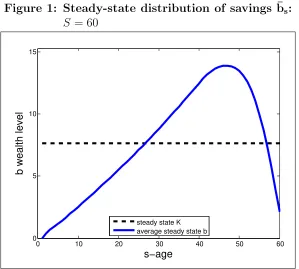
Figure 1 shows the computed steady-state equilibrium distribution of savings ¯Γ
over the life cycle for a particular calibration of the model parameters [S, β, σ, α, ρ, A] =
[60,0.96,3,0.35,0.2,1]. We assume that labor is supplied inelastically, and we
cali-brate the labor supply at each age to match the average labor supply reported by
age in the CPS monthly survey.6 The steady-state aggregate capital stock shown in
Figure1is ¯K Γ¯
= 7.62, and the steady-state equilibrium real wage and real interest
rate are ¯w Γ¯
= 1.43 and ¯r Γ¯
= 0.08, respectively.
Figure 1: Steady-state distribution of savings ¯bs: S = 60
0 10 20 30 40 50 60
0 5 10 15
s−age
b wealth level
steady state K average steady state b
Outside of the steady state, an age-shousehold’s intertemporal consumption
deci-sion in each period from (2.9) also depends on both the current period’s distribution
of capital Γt and the expected value of next period’s distribution of capital Γt+1. But
Γt6= Γt+1 in general outside of the steady state.
5
A detailed description of the algorithm for computing the steady-state distribution is given in AppendixA-1.
6
[image:11.612.158.457.302.571.2]h
1 +r(Γt) i
bs,t+w(Γt)es,tn(s)−bs+1,t+1
−σ
=...
βE
"
1 +r(Γt+1)
h
1 +r(Γt+1)
i
bs+1,t+1+w(Γt+1)es+1,t+1n(s+ 1)−bs+2,t+2
−σ#
for 1≤s ≤S−1, and b1,t =bS+1,t = 0, ∀t
(2.20)
The non-steady-state equilibrium in this economy is much more complicated
be-cause the savings policy rule depends not only on age s, ability e, individual wealth
b and beliefs Ω, but also on the current distribution of capital Γ.
b′
=φ(s, e, b,Γ|Ω) (2.21)
In contrast to the steady-state equilibrium, this means that each household must be
able to forecast future prices, and therefore future capital distributions, in order to
make its own savings decisions with the added complication that the capital
distribu-tion is changing over time. Let general beliefs about the future distribudistribu-tion of capital
in period t+u be characterized by the linear operator Ω(·) as in (2.10).
The expression of individual beliefs in (2.10) is a weak assumption in the sense
that it does not constrain the beliefs to be correct. However, it is a strong
assump-tion in that it implies the following two properties. First (2.10) implies that each
household knows the entire distribution of savings Γt at time t. It also implies that
each household has symmetric beliefs about the savings policy function of all the
other households. That is, Ω(·) has no s subscript. We can now define a general
non-steady-state rational expectations equilibrium.
Definition 2 (Non-steady-state rational expectations equilibrium). A non-steady-state rational expectations equilibrium in the overlapping generations model with S-period lived agents and heterogeneous abilitye is defined as a distribution of capital Γt, household beliefs about how the distribution of capital will evolve Ω (Γt),
a policy function b′
stockKt, real wage wt, and real rental ratert for all t such that:
i. households have symmetric beliefs Ω(·) about the future savings decisions of the other agents described in (2.10), and those beliefs about the future distribution of savings equal the realized outcome (rational expectations),
Γt+u = Γet+u = Ω u
(Γt) ∀t, u≥1
ii. households policy function b′
= φ(s, e, b,Γ|Ω) maximizes utility according to (2.6) and (2.9),
iii. firms choose aggregate labor demand Nt and aggregate capital demand Kt
op-timally according to (2.12) and (2.13), respectively,
iv. and markets clear according to (2.14), (2.15), and (2.17).
One implication of households having symmetric beliefs is that they will have
symmetric policy functions. In other words, (2.10) implies the following.
Γe
t+u = Ω u(Γ
t) ∀t, u≥1 ⇒ b
′
=φ(s, e, b,Γ|Ω) ⊥ t (2.22)
That is, if the equilibrium savings choice is bs+1,t+1 according to Definition 2 for
an age-s household given the state (s, es,t, bs,t,Γt), then an age-s household in a
dif-ferent period t+u will choose the same equilibrium savings rate if the same state
(s, es,t+u, bs,t+u,Γt+u) occurs. The intuition is that if a household knows what savings
levelbs+1 it would choose at any ages, abilityes, wealthbs, and distribution of wealth
Γ, then the symmetry of the problem implies that the household knows what all the
other households would choose at any age s, ability es, wealth bs, and distribution Γ.
With Definition2, the non-steady-state equilibrium can be computed by rewriting
the set of S−1 intertemporal Euler equations from (2.20) in the following way.
h
1 +r(Γt) i
bs,t+w(Γt)es,tn(s)−bs+1,t+1
−σ
=...
βE
"
1 +r Ω(Γt)
h
1 +r Ω(Γt) i
bs+1,t+1+w Ω(Γt)
es+1,t+1n(s+ 1)−bs+2,t+2
−σ#
for 1≤s≤S−1, and b1,t =bS+1,t = 0, ∀t
The rational expectations equilibrium assumption (i) in Definition 2 that beliefs be
correct Γe
t+u = Γt+u implies that a new agent s = 1 at time t can correctly forecast
all future wages and interest rates given the current distribution of capital.
wt+u =w(Ωu(Γt)) and rt+u =r(Ωu(Γt)) 1≤u≤S−1 (2.24)
Knowing the path of wages and interest rates will allow each household to backward
induct their non-steady-state equilibrium savings policy function b′
= φ(s, e, b,Γ|Ω)
in the same way as the steady-state distribution of capital. The solution to this
non-steady-state equilibrium problem is a fixed point in which the savings policy function
b′
= φ(s, e, b,Γ|Ω) induces the transition path for the distribution of capital Γt+u
consistent with the path implied by beliefs Ωu(Γ t).
3
Transition Path Solution Methods
This section outlines the benchmark time path iteration (TPI) method for solving the
non-steady-state rational expectations equilibrium transition path of the distribution
of savings and then details our new alternate model forecast (AMF) method for
computing the equilibrium transition path. Because the AMF method represents an
approximation of the rational expectations assumption, we compare the AMF method
to the benchmark TPI method in terms of both speed and accuracy.
3.1
Benchmark: Time path iteration
The most common method of solving for non-steady-state equilibrium transition path
for the capital distribution in OLG models is finding a fixed point for the transition
path of the distribution of capital for a given initial state of the distribution of
cap-ital. This solution method is detailed for the perfect foresight case in Auerbach and
Kotlikoff (1987, ch. 4) and for the stochastic case inNishiyama and Smetters (2007,
Appendix II). The idea is that the economy is infinitely lived, even though the agents
policy functions by iterating on individual value functions, one must recursively solve
for the policy functions by iterating on the entire transition path of the endogenous
objects in the economy (see Stokey and Lucas (1989, ch. 17)).
The key assumption is that the economy will reach the steady-state equilibrium ¯
Γ described in Definition 1 in a finite number of periods T < ∞ regardless of the
initial state Γ0. The first step is to assume a transition path for aggregate capital
Ki = {Ki
1, K2i, ...KTi} such that T is sufficiently large to ensure that ΓT = ¯Γ and
Ki
T (ΓT) = ¯K Γ¯
. The superscript i is an index for the iteration number. The
transition path for aggregate capital determines the transition path for both the real
wage wi ={wi
1, wi2, ...wTi} and the real return on investment ri ={r1i, r2i, ...riT}. The
exact initial distribution of capital in the first period Γ1 can be arbitrarily chosen
as long as it satisfies Ki
1 = S −1
S PS
s=2
PeJ
e=e1 PbB
b=b1γ1(s, e, b)b according to market
clearing condition (2.15). One could also first choose the initial distribution of capital
Γ1 and then choose an initial aggregate capital stock K1i that corresponds to that
distribution. As mentioned earlier, the only other restriction on the initial transition
path for aggregate capital is that it equal the steady-state levelKi
T = ¯K Γ¯
by period
T. But the aggregate capital stocksKi
t for periods 1< t < T can be any level.
Given the initial capital distribution Γ1 and the transition paths of aggregate
capital Ki ={Ki
1, K2i, ...KTi}, the real wage wi ={wi1, w2i, ...wTi}, and the real return
to investment ri ={ri
1, r2i, ...riT}, one can solve for the optimal savings policy rule for
each type of S−1-aged agent for the last period of his lifebS,2 =φ1(S−1, e, b) using
his intertemporal Euler equation, where the “1” subscript on φ represents the time
t= 1 savings decision with the real wage wi
1 and real interest rater1i.7
1 +ri
1
bS−1,1+wi1eS−1,1n(S−1)−bS,2
−σ
=...
β 1 +ri
2 E
1 +ri
2
bS,2+w2ieS,2n(S)
−σ (3.1)
The final two savings decisions of each type of S−2-aged household in period 1,
bS−1,2 and bS,3, are characterized by the following two intertemporal Euler equations
7
Note that the Γ and Ω that usually appear in the policy functionsφhave been dropped because they are assumed in the guess of the transition pathKi
and are solved by backward induction.
1 +ri
1
bS−2,1+w1ieS−2,1n(S−2)−bS−1,2
−σ
=...
β 1 +ri
2 E
1 +ri
2
bS−1,2+w2ieS−1,2n(S−1)−bS,3
−σ
1 +ri
2
bS−1,2+wi2eS−1,2n(S−1)−bS,3
−σ
=...
β 1 +r3i
E
1 +r3i
bS,3+wi3eS,3n(S) −σ
(3.2)
The solution to the second equation delivers the savings policy function for bS,3 =
φ2(S−1, e, b). This policy function is then used in the first equation of (3.2) in order
to solve for the policy function bS−1,2 =φ1(S−2, e, b).
This process is repeated for every age of household in t = 1 down to the age-1
household at time t= 1. This household solves the full set of S−1 savings decisions
characterized by the following equations.
wi
1e1,1n(1)−b2,2
−σ
=...
β 1 +r2i
E
1 +ri2
b2,2+wi2e2,2n(2)−b3,3
−σ
1 +ri
2
b2,2+wi2e2,2n(2)−b3,3
−σ
=...
β 1 +r3i
E
1 +ri3
b3,3+wi3e3,3n(3)−b4,4
−σ
...
1 +ri S−1
bS−1,S−1+w
i
S−1eS−1,S−1n(S−1)−bS,S −σ
=...
β 1 +rSi
E
1 +riS
bS,S+wSieS,Sn(S) −σ
(3.3)
Once the remaining lifetime decision rules have been solved for all households alive
in periodt= 1, the set of first period policy functionsφ1(s, e, b) is complete. The first
period policy functionφ1(s, e, b) is then combined with the first period distribution of
capital Γ1 to compute the second period distribution of capital Γ2.The second period
distribution of capital Γ2 implies an aggregate capital stockKi ′
2 through (2.15) which
is not equal to the originally assumed second period aggregate capital stockKi′
in general.
For every 1< t < T, the set of period-t policy functionsφt(s, e, b) is computed by
solving the full set ofS−1 savings decisions for the age-1 household at periodt. The
policy rule φt(s, e, b) is then combined with the distribution of savings Γt computed
in periodt−1 in order to compute the distribution of savings in the next period Γt+1.
The new Γt+1 implies an aggregate capital stock Ki ′
t+1 that, in general, is not equal
to the originally assumed aggregate capital stock Ki′
t+1 6=Kti+1.8
Once this process has been completed for all 1< t < T, a new transition path for
the aggregate capital stock has been computedKi′
={Ki′ 1, Ki
′ 2, ...Ki
′
T}. Let |·|be the
sup norm. Then the fixed point necessary for the equilibrium transition path from
Definition2has been found when the distance betweenKi′
and Ki is arbitrarily close
to zero.
|Ki′ −Ki|< ε for ε >0 (3.4)
If the fixed point has not been found |Ki′
−Ki|> ε, then a new transition path for
the aggregate capital stock is generated as a convex combination of Ki′
and Ki.
Ki+1 =ρKi′+ (1−ρ)Ki for ρ∈(0,1) (3.5)
This process is repeated until the initial transition path for the aggregate capital
stock is consistent with the transition path implied by those beliefs and household
and firm optimization. The time path iteration (TPI) non-steady-state equilibrium
transition path is characterized in Definition 3.
Definition 3 (Time path iteration (TPI) equilibrium transition path of the distribution of capital). Given some initial distribution of wealth Γ1, a
steady-state distribution of wealth arrived at afterT periods ΓT = ¯Γ, and a transition path
for the aggregate capital stock Ki = {Ki
1, K2i, ...KTi} such that K1i = K1(Γ1) and KT = ¯K Γ¯
according to (2.15), the equilibrium transition path of the distribution of wealth {Γt}Tt=1 and the associated transition path of the aggregate capital stock
K={Kt}Tt=1 is defined as the path of the distribution of wealth for which the level of
aggregate capital Ki′
implied by household and firm optimization b′
=φ(s, e, b) and
8
A check here for whetherT is large enough is ifKi′
T = ¯K Γ¯
beliefs is arbitrarily close to the beliefs for the transition path of aggregate capital
Ki ={K1(Γ
1), K2 Ω(Γ1
, K3 Ω2(Γ 1
, ...KT ΩT
−1
(Γ1
},
K
i′
−Ki < ε
where | · |is the sup norm and ε >0 is arbitrarily close to zero.
In essence, the TPI method iterates on beliefs represented by a transition path for
the aggregate capital stockKiuntil a fixed point in beliefs is found that are consistent
[image:18.612.157.456.289.538.2]with the transition path implied by optimization based on those beliefs.
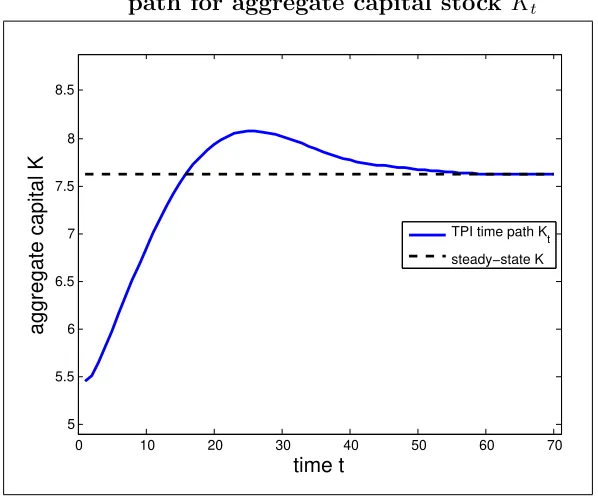
Figure 2: TPI computed equilibrium transition path for aggregate capital stock Kt
0 10 20 30 40 50 60 70
5 5.5 6 6.5 7 7.5 8 8.5
time t
aggregate capital K
TPI time path K
t
steady−state K
Figure 2 shows the TPI computed transition path of the aggregate capital stock
using the same calibrated example from the steady-state computation in Section
2.3. A detailed outline of the computational algorithm is given in Appendix A-2.
The benchmark TPI computational method shows the aggregate capital stock Kt
converging to its steady state ¯K in roughly 60 periods. It took 31 hours, 59 minutes,
and 39 seconds to compute the solution by time path iteration.
The equilibrium transition path overshoots the steady state and takes 60 periods
steady state. The initial state K0 = 5.45 is 28 percent less than the steady-state
aggregate capital stock level ¯K = 7.62 to which it must converge. Also, the initial
distribution of savings Γ0 is very different from the steady-state distribution ¯Γ.
3.2
Relax rational expectations: Alternate model forecast
We propose an alternative method for computing non-steady-state rational
expec-tations transition paths in OLG life cycle models that we call the alternate model
forecast (AMF) method. AMF approximates the rational expectations requirement
from part (i) of Definition 2 that each agent knows the policy function of all other
agents. Instead, AMF uses a weaker assumption that agents use some general
alter-native model to forecast in each period the transition path of the aggregate capital
stock
Kf
u, wuf, rfu S
u=t for the remaining periods of their lives, where the “f”
super-script represents forecast values. This forecasted series is then updated each period
when the value of the capital stock next period is realized.
The approximation error in the AMF method comes from agents’ beliefs about the
future trajectory of the distribution of capital not being exactly correct, Γe
t+u 6= Γt+u
for all u ≥ 1. But the size of the error is limited because beliefs are updated after
each period as new information becomes available. In contrast to the benchmark TPI
method from Section 3.1, AMF is faster because the household decision rules only
have to be computed for one transition path rather than iterating until beliefs equal
the truth.
This approach of using a forecasting method from outside the model is analogous
to the approach taken byKrusell and Smith(1998). They conjectured a law of motion
for the moments of the distribution of wealth in an infinitely lived heterogeneous agent
environment, and the moments determined the levels of the aggregate variables. They
found that a simple log-linear law of motion was enough to closely approximate the
benchmark rational expectations equilibrium.
The AMF method also has some of the flavor of the rational inattention concept of
Mankiw and Reis(2002) andSims(2003) who justify relaxing the information burden
infre-quently and agents have limited information-processing capacity. We use this type of
assumption in the AMF method in order to streamline computation time. However,
we find that the resulting equilbrium transition path has a very small approximation
error relative to the benchmark TPI rational expectations transition path.
Let Ωa(·) represent the general form of the alternative model each agent uses to
forecast the transition paths of the aggregate capital stock, real wage, and real rental
rate {Kf
u, wuf, rfu}Su=t which are functions of the distribution of capital Γu at time u.
Then let the forecast for the aggregate capital stock be generated by the following
general alternative model:
Γft+u = Ω u
a(Γt) s.t. lim
u→∞Ω
u
(Γt) = ¯Γ (3.6)
where wtf+u and r f
t+u are just functions of K f
t+u Ωua(Γt)
. The only condition that
must be imposed on the alternative model is that the forecasts must go to the steady
state in the limit limu→∞Ωu(Γt) = ¯Γ. With
Kf
u, wuf, rfu S
u=t, each agent can choose
their savings for the next period bs+1,t+1 as well as planned savings levels bps+u,t+u for
u∈ {2,3, ..S−s}for the remaining periods of life given the forecasted transition path
of the aggregate variables in the same way as described in equations (3.1) through
(3.3) in Section 3.1. The “p” superscript refers to a planned policy decision because
that policy will likely change by the time the household needs to make that choice
due to the updating of the forecast.
At the end of periodt, the distribution of capital for the next period Γt+1has been
decided and implies an aggregate capital stock that is not equal to the forecasted
capital stock Kt+1(Γt+1) 6= Ktf+1, in general. With the new aggregate capital stock
Kt+1, each agent repeats the process of forecasting the future values of the aggregate
variables using the alternative model Ωa(·) until the transition path reaches the steady
state in period T. Each distribution of capital Γt+u calculated using the alternative
model from (3.7) and the corresponding time-tallocations and prices in the computed
equilibrium transition path{bt}Tt=1represents an alternate model forecast
Definition 4 (Alternate model forecast (AMF) equilibrium transition path of the distribution of capital). Given some initial distribution of capital Γ0 and
a steady-state distribution of capital arrived at after T periods Γt = ¯Γ for t ≥ T,
the alternate model forecast (AMF) equilibrium transition path of the distribution of capital{Γt}Tt=1 is defined as the individual distributions of capital Γt calculated by
forecasting future aggregate variables using the alternative forecasting model Ωa(·)
specified in equation (3.7) that is specified as follows:
Γft+1 = Ωa(Γt) ⇒ Γft+u = Ωua(Γt) s.t. lim
u→∞Ω
u(Γ t) = ¯Γ
Each individual distribution of capital is calculated using the remaining life forecasts of aggregate variables Ktf+u according to equations (3.1) through (3.3).
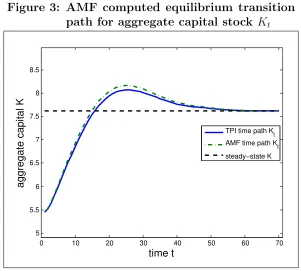
Figure3 shows the AMF computed transition path of the aggregate capital stock
using the same calibrated example from the steady-state computation in Section 2.3.
To this point, the alternative model Ωa(·) has been generally specified. In practice,
it could be a complex econometric model based on observed data, or it could be an
extremely simple interpolation. We use a na¨ıve linear forecast between the current
aggregate capital stock and the steady state to forecast the future aggregate capital
stock,
Kt+1=Kt+
¯
K−Kt
T −t (3.7)
where ¯K is the steady-state capital stock,t is the current period, andT is the period
in which the economy has reached the steady state.9 The AMF rule (3.7) is simply
a linear forecast between the current state Kt and the steady state ¯K. The na¨ıve
alternative model is conservative in that our computed approximation errors should
represent an upper bound. A detailed outline of the computational algorithm is given
in Appendix A-3.
The AMF transition path is very close to the benchmark TPI transition path even
though we use a fairly na¨ıve alternative model to forecast future wage rates and
inter-est rates. In terms of mean percent deviation from the TPI path, the approximation
9
We tried this with a log-linear forecast between the current state and the steady state, similar toKrusell and Smith(1998), and the transition path was nearly identical to the one from Figure3
Figure 3: AMF computed equilibrium transition path for aggregate capital stock Kt
0 10 20 30 40 50 60 70
5 5.5 6 6.5 7 7.5 8 8.5
time t
aggregate capital K
TPI time path K
t
AMF time path Kt
steady−state K
error of the AMF path was only 0.7 percent. It took 4 hours, 50 minutes, and 9
seconds to compute the solution by the AMF method, which is roughly 15 percent of
the TPI computation time.
3.3
Comparison of solution methods and robustness
Because the AMF method is an approximation of the benchmark TPI method, the
goal of this paper is to compare the AMF method to the TPI method in terms
of both computing time and accuracy. The benchmark time path iteration (TPI)
method for computing the non-steady-state equilibrium transition path of the
distri-bution of capital is the exact rational expectations equilibrium concept. The alternate
model forecast (AMF) method approximates the benchmark TPI method by using
the alternative model Ωa(·) to forecast future aggregate variables rather than the
TPI method’s rational expectations requirement. In addition to comparing
compu-tation speed and accuracy for the calibration given previously, we show how these
comparisons change with different calibrations.
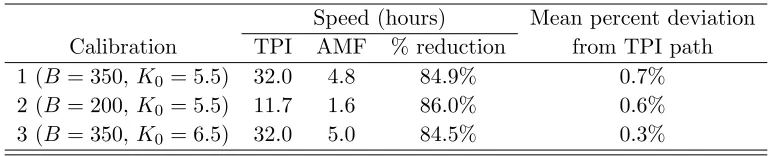
method to the TPI method for Calibration 1 from Sections3.1 and3.2that generated
the transition paths in Figure 3 as well as for two additional calibrations that differ
[image:23.612.113.498.184.262.2]in terms of initial states and degree of heterogeneity.
Table 1: Computation times and accuracy of TPI and AMF methods
Speed (hours) Mean percent deviation Calibration TPI AMF % reduction from TPI path 1 (B = 350, K0 = 5.5) 32.0 4.8 84.9% 0.7% 2 (B = 200, K0 = 5.5) 11.7 1.6 86.0% 0.6% 3 (B = 350, K0 = 6.5) 32.0 5.0 84.5% 0.3%
All computations were performed using MatLab on a Dell PowerEdge 2950 with 8 Intel Xeon E5345 2.33GHz processor cores, 16 GB of RAM, and 500 GB RAID hard drive.
The accuracy and speed comparison for the example presented in Sections 3.1
and 3.2 are presented in the first line of Table 1as Calibration 1. The AMF method
reduces the computation time from almost 32 hours to just under 5 hours, an 85%
reduction. To measure the approximation error of the AMF transition path from the
benchmark TPI transition path shown in Figure3, we use the mean percent deviation
(MPD) of the AMF path from the TPI path over the first τ periods where τ = 60 in
this case.
M P D = 1
τ
τ X
t=1
KAM F
t −KtT P I
KT P I t
(3.8)
The approximation error in Calibration 1 is less than 1 percent (0.7%).
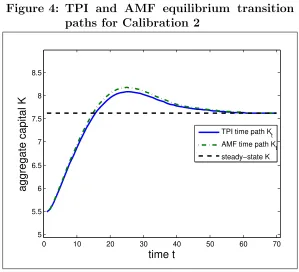
In Calibration 2, we test the speed and accuracy of the AMF method in a version
of the model with less heterogeneity. We use a basic simplification of reducing the
grid points in the discretized continuum of possible wealth levels to B = 200 with
the same bounds. The computation times for both the TPI and AMF methods are
less, and the speed reduction of the AMF method over the TPI method is about the
same as the baseline calibration. The approximation error of the AMF method in
Calibration 2 is a little bit smaller than that of the baseline calibration. Figure 4
shows the TPI and AMF transition paths for Calibration 2.
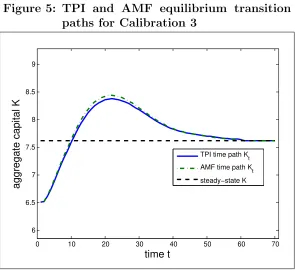
In Calibration 3, we test the speed and accuracy of the AMF method in a version
Figure 4: TPI and AMF equilibrium transition paths for Calibration 2
0 10 20 30 40 50 60 70
5 5.5 6 6.5 7 7.5 8 8.5
time t
aggregate capital K
TPI time path K
t
AMF time path Kt
steady−state K
in the baseline calibration. We keep the same number if grid points B = 350 as in
the baseline calibration. The computation times for both the TPI and AMF methods
are comparable to the baseline calibration with a reduction in computation time of
84.5%. The mean percent deviation of the AMF transition path is smaller than that
of the TPI method in Calibration 3 as would be expected with an initial state that
is closer to the steady state. Figure 5 shows the TPI and AMF transition paths for
Calibration 3.
In each calibration, the AMF method reduces computation times by about 85
percent, and the mean percent deviations are less than 1 percent. It is important
to note that the calibrations with the highest approximation error used an initial
state that was relatively far away from the new steady state. In practice, most
policy experiments study changes that imply a much smaller difference between the
initial state and the new steady state. The results of this paper suggest that the
approximation error of the AMF method will be significantly less than 1 percent in
Figure 5: TPI and AMF equilibrium transition paths for Calibration 3
0 10 20 30 40 50 60 70
6 6.5 7 7.5 8 8.5 9
time t
aggregate capital K
TPI time path Kt
AMF time path Kt
steady−state K
4
Conclusion
We propose a method for computing rational expectations equilibrium transition
paths for OLG life cycle models that reduces computation time relative to the
bench-mark TPI method by 85 percent and has an approximation error of less than 1 percent.
For our main calibration, the AMF method reduced the computation time from 32
hours to less than 5 hours.
The AMF method presented in this paper used extremely na¨ıve alternative models
for forecasting future prices. When these models are actually taken to the data
to perform policy experiments, more sophisticated alternative models could further
reduce the approximation error without increasing computation time. For example,
a VAR could be used to forecast future prices based on past observables in the data.
An obvious extension of our AMF method is to use it to calculate transition paths
for infinite horizon models. Krusell and Smith (1998) use a similar idea to estimate
the parameters of a stationary equilibrium in an environment with infinitely lived
heterogeneous agents. The AMF method extends this idea and could simplify the
Another characteristic common to the infinitely lived heterogenous agent models
that is often missing in large OLG life cycle models is an uninsurable aggregate
shock. A transition path in an environment with aggregate uncertainty would be
a stochastic object and would require some notion of confidence intervals computed
by simulation. Because each computation of a transition path by the benchmark
TPI method can take more than a day, simulation of confidence intervals can be
computationally impractical. The increased computational speed of the AMF method
makes simulation more practical.10
Lastly, linearization methods are most commonly use for computing equilibrium
solutions to dynamic general equilibrium models, but they have not been applied to
OLG life cycle models with occasionally binding constraints. Uhlig (1999) and
Chris-tiano (2002) present the standard method of undetermined coefficients linearization
method for these types of models. Computers are particularly well suited for dealing
with linear systems, and few methods can match linearization in speed. However,
both Christiano and Uhlig note that the method of undetermined coefficients only
works in models in which there are no occasionally binding constraints.11
Borrow-ing constraints are a leadBorrow-ing example of occasionally bindBorrow-ing constraints and are an
important characteristic of OLG life cycle models. A linearization method for
solv-ing OLG life cycle models with occasionally bindsolv-ing constraints has the potential to
increase computation speeds enough to easily simulate the models.
Much research has been dedicated to solution methods for DSGE models with
infinitely lived agents. Taylor and Uhlig (1990) survey a number of papers
dedi-cated to various solution methods to the nonlinear rational expectations stochastic
growth model. More recently, Aruoba, Fern´andez-Villaverde, and Rubio-Ram´ırez
(2006) compare perturbation methods, finite elements methods, Chebyshev
polyno-mial approximation, and value function iteration solution methods on the stochastic
neoclassical growth model. Fern´andez-Villaverde and Rubio-Ram´ırez(2006) focus on
10
As an example, 1,000 simulations of the TPI transition path in main calibration presented in Section 3.1would take 3.65 computer years. The same simulations would take only 0.55 computer years using the AMF method.
11
the value of perturbation methods in solving the growth model. It is our hope that
more efforts are dedicated to transition path solution methods for the valuable OLG
APPENDIX
A-1
Computational algorithm for steady-state
equi-librium
The computation of the steady-state equilibrium described in Definition 1 requires the following steps. The MatLab code for this steady-state computation is available upon request.
1. Calibrate the exogenous parameters of the model S, β, σ, α, ρ, A, the distri-bution of the ability shock fs(e), and the inelastic labor supply function as a
function of age n(s).
• We chose the parameter values [S, β, σ, α, ρ, A] = [60,0.96,3,0.35,0.2,1].
• The inelastic labor supply function of agen(s) was calibrated to match the average labor supply by age reported in the CPS monthly survey, where the maximum average hours worked is normalized to unity.
n(s) =
[0.87,0.89,0.91,0.93,0.96,0.98] for 1≤s≤6
1 for 7≤s≤40
0.95,0.89,0.84,0.79,0.73,0.68,0.63,0.57,0.52, ...
0.47,0.40,0.33,0.26,0.19,0.12,0.11,0.11,0.10,0.10,0.09
for 41≤s≤60
• The discretized approximation of the ability shock is the following seven ability types es,t ∈ {0.1,0.5,0.8,1.0,1.2,1.5,1.9} with a mass function
fs(e) = {0.04,0.09,0.20,0.34,0.20,0.09,0.04} for all s. We could have
just as easily made the probability distribution be conditional on s but that does not increase the computation time.
2. Discretize the space of possible wealth levels into B possible values such that
b∈ {b1, b2, ...bB}, where b1 = 0 and bB <∞.
• We chose a discretized support of B = 350 equally spaced points between
b1 = 0 andbB = 15.
• Note that we have to impose a savings maximum constraint due to there being some states in which the household wants to save more than their current wealth level. Setting bmax = 15 is high enough to minimize the
number of states in which the upper bound binds. The smoothness of Fig-ure1at its peak shows that the upper bound creates a minimal distortion.
3. Choose an arbitrary initial guess for the steady-state distribution of wealth ¯
Γ0 = ¯γ0(s, e, b) such that ¯γ0(s, e, b)∈[0,1] and Ps P
e P
• Our initial guess was simply the distribution across abilities by age spread across each possible wealth levelγ0(s, e, b) =fs(e)/[(S−1)B] for all s, e,
and b.
4. Use ¯Γ0 to calculate steady-state values for ¯K0, ¯Y0, ¯r0 and ¯w0 using equations
(2.11), (2.12), (2.13), (2.14), and (2.15).
5. Taking ¯r0 and ¯w0 as given each period, solve for the optimal policy rule of each agent b′
=φ(s, e, b|Ω) by backward induction.
6. Use b′
=φ(s, e, b|Ω) and ¯Γ0 to calculate the distribution of wealth in the next
period ¯Γ′ 0.
7. Generate a new guess for the steady-state distribution of wealth ¯Γ1 as a convex
combination of the two distributions from the previous step ¯Γ1 =ρΓ¯′0+(1−ρ)¯Γ0,
where ρ∈(0,1).
8. Repeat steps (4) through (7) until the distance between ¯Γi and ¯Γ
′
i is arbitrarily
close to zero, where i is the index of the iteration number. Let | · | be the sup norm and let ε > 0 be some scalar arbitrarily close to zero. Then the steady state ¯Γ is found when
Γ¯i −Γ¯
′
i < ε.
In our example, the computation of the steady-state equilibrium took 3 hours, 5 minutes, and 25 seconds. Figure 1 shows the steady-state aggregate capital stock ¯K
A-2
Computational algorithm for TPI transition
path
The computation of the time path iteration (TPI) transition path described in Defi-nition 3 requires the following steps. The MatLab code for this TPI transition path computation is available upon request.
1. Using the parameterization from the steady-state computation, and choose the value forT at which the non-steady-state transition path should have converged to the steady state. We used T = 60.
2. Choose an initial state of the aggregate capital stock K0. Choose an initial distribution of capital Γ0 consistent with K0 according to (2.15).
• We chose an initial capital stock of K0 = 5.45, which is consistent with a simple initial distribution of wealth—the distribution of ability by age spread across all possible wealth levels γ0(s, e, b) = fs(e)/[(S−1)B] for
alls, e, and b.
3. Conjecture a transition path for the aggregate capital stock Ki = {Ki t}
∞
t=0
where the only requirements are that Ki
0 = K0 is your initial state and that Ki
t = ¯K for all t≥T. The conjectured transition path of the aggregate capital
stockKi, along with the exogenous aggregate labor supply from (2.14), implies
specific transition paths for the real wage wi = {wi t}
∞
t=0 and the real interest
rate ri ={ri t}
∞
t=0 through expressions (2.11), (2.12), and (2.13).
4. With the conjectured transition paths wi and ri, one can solve for the lifetime
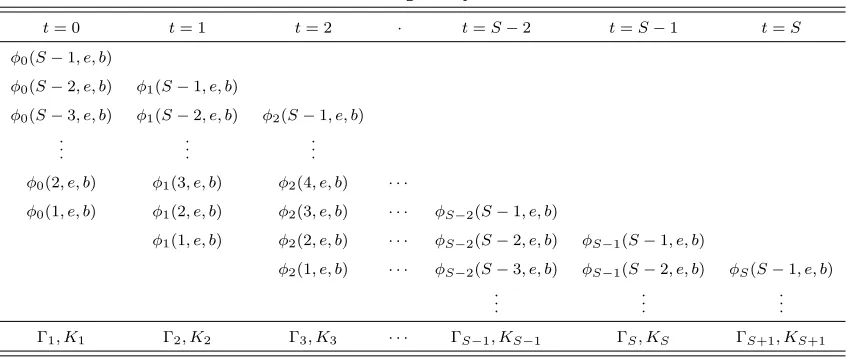
policy functions of each household alive at time t = 1 by backward induction using the Euler equations of the form (3.3). Rows 1 through 5 of Table 2
illustrate this process.
• The first line is solving for the solution of the individual who is ageS−1 at timet= 0 obtaining b2,1 =φ0(S−1, e, b) from equation (3.1).
• Each subsequent row from Table 2 represents the solution of the lifetime savings policy functions of an individual with more years remaining in their life at timet= 0, down the the person who is age s= 1 at time t = 0 and has the entire set of S−1 policy functions characterized by (3.3).
5. In similar fashion to step (4), solve for the lifetime policy functions by backward induction for the age s = 1 household at times 2 ≤ t ≤ T. In Table 2, this means solving for the policy functions in the last two rows down to the age
s= 1 household at time t=T.
6. Each column in Table 2 represents a complete set of policy functions for the corresponding period. Using the initial distribution of wealth Γ0 and all the
Table 2: TPI backward induction policy function solution method
t= 0 t= 1 t= 2 · t=S−2 t=S−1 t=S
φ0(S−1, e, b)
φ0(S−2, e, b) φ1(S−1, e, b)
φ0(S−3, e, b) φ1(S−2, e, b) φ2(S−1, e, b)
..
. ... ...
φ0(2, e, b) φ1(3, e, b) φ2(4, e, b) · · ·
φ0(1, e, b) φ1(2, e, b) φ2(3, e, b) · · · φS−2(S−1, e, b)
φ1(1, e, b) φ2(2, e, b) · · · φS−2(S−2, e, b) φS−1(S−1, e, b)
φ2(1, e, b) · · · φS−2(S−3, e, b) φS−1(S−2, e, b) φS(S−1, e, b)
..
. ... ...
Γ1, K1 Γ2, K2 Γ3, K3 · · · ΓS
−1, KS−1 ΓS, KS ΓS+1, KS+1
next period distribution of wealth Γ1 and the corresponding aggregate capital
stockKi′
1 can be calculated. Consecutively repeat this procedure for each time
period (column of Table2) until a new transition path for the aggregate capital stock has been computed Ki′
={Ki′
t}Tt=0.
7. Generate a new guess for the transition path of the aggregate capital stockKi+1
as a convex combination of the initially conjectured transition path Ki and the
newly generated transition path Ki′
.
Ki+1 =ρKi′
+ (1−ρ)Ki where ρ∈(0,1)
8. Repeat steps (4) through (7) until the distance betweenKi′
andKiis arbitrarily
close to zero, where i is the index of the iteration number. Let | · | be the sup norm and let ε > 0 be some scalar arbitrarily close to zero. Then the equilibrium transition path of the economy from Definition 3 is found when when Ki
′ −Ki
< ε.
A-3
Computational algorithm for AMF transition
path
The computation of the alternate model forecast (AMF) transition path described in Definition 4 requires the following steps. The MatLab code for this AMF transition path computation is available upon request.
1. Conjecture an alternative model forecast method Ωa.
• We use a linear trend from the current stateKt to the steady state ¯K.
Kt+1 = Ωa(Kt) ⇒ Kt+1 =Kt+
¯
K−Kt
T −t (3.7)
• Our specific alternative model is written as a law of motion for the aggre-gate capital stock, but it implies a law of motion for the average wealth. From (2.15) we know that aggregate capital Kt is just a function of the
average wealth.
Kt=
S−1
S ¯bt (A.3.1)
So the alternative model Ωa implies a similar linear law of motion for the
moments by combining (3.7) with (A.3.1).
¯bt+1 = Ωa ¯bt
⇒ ¯bt+1 = ¯bt+
¯
bss−¯bt
T −t (A.3.2)
2. Solve the lifetime savings policy functions φ(s, e, b) for each agent alive at time
t by backward induction using the alternate model forecast method (3.7) to obtain the forecasted series of prices over those lifetimes. (This step is the same as step 4 in Appendix A-2.)
3. Use the complete set of policy functions for the current period in order to calculate the next period’s distribution of wealth Γt+1 and the corresponding
aggregate capital stock Kt+1.
4. Repeat this process until the distribution of wealth ΓT and the aggregate capital
stockKT have been computed for timeT. Make sure that ΓT = ¯Γ andKT = ¯K.
References
Aruoba, S. B., J. Fern´andez-Villaverde, and J. F. Rubio-Ram´ırez(2006): “Comparing Solution Methods for Dynamic Equilibrium Economies,” Journal of Economic Dynamics and Control, 30(12), 2477–2508.
Auerbach, A. J.,andL. J. Kotlikoff(1987): Dynamic Fiscal Policy. Cambridge University Press.
Christiano, L. J. (2002): “Solving Dynamic General Equilibrium Models by a Method of Undetermined Coefficients,”Computational Economics, 20(1-2), 21–55.
Christiano, L. J., and J. D. Fisher (2000): “Algorithms for Solving Dynamic Models with Occasionally Binding Constraints,” Journal of Economic Dynamics and Control, 24(8), 1179–1232.
Fern´andez-Villaverde, J., and J. F. Rubio-Ram´ırez(2006): “Solving DSGE Models with Perturbation Methods and a Change of Variables,” Journal of Eco-nomic Dynamics and Control, 30(12), 2509–2531.
Ghiglino, C., and K. Shell (2003): “The Economic Effects of Restrictions on Government Budget Deficits: Imperfect Private Credit Markets,” Economic The-ory, 21(2/3), 399–421.
Krusell, P., and A. A. Smith, Jr. (1998): “Income and Wealth Heterogeneity in the Macroeconomy,”Journal of Political Economy, 106(5), 867–896.
Mankiw, N. G., and R. Reis (2002): “Sticky Information versus Sticky Prices: A Proposal to Replace the New Keynesian Phillips Curve,” Quarterly Journal of Economics, 117(4), 1295–1328.
Nishiyama, S., and K. Smetters (2007): “Does Social Security Privatization Produce Efficiency Gains?,”Quarterly Journal of Economics, 122(4), 1677–1719.
Samuelson, P. A. (1958): “An Exact Consumption-Loan Model of Interest With or Without the Social Contrivance of Money,”Journal of Political Economy, 66(6), 467–482.
Sims, C. A. (2003): “Implications of Rational Inattention,” Journal of Monetary Economics, 50(3), 665–690.
Solow, R. M.(2006): “Overlapping Generations,” inSamuelsonian Economics and the Twenty-First Century, ed. by M. Szenberg, L. Ramrattan,andA. A. Gottesman, pp. 34–41. Oxford University Press.
Taylor, J. B., and H. Uhlig (1990): “Solving Nonlinear Stochastic Growth Mod-els: A Comparison of Alternative Solution Methods,” Journal of Business and Economic Statistics, 8(1), 1–17.
Uhlig, H. (1999): “A Toolkit for Analyzing Nonlinear Dynamic Stochastic Models Easily,” in Computational Methods for the Study of Dynamic Economies, ed. by R. Marimon, and A. Scott, pp. 30–61. Oxford University Press, New York.
Weil, P. (2008): “Overlapping Generations: The First Jubilee,” Journal of Eco-nomic Perspectives, 22(4), 115–134.