Journal of Chemical and Pharmaceutical Research, 2018, 10(11): 48-62
Research Article
CODEN(USA) : JCPRC5
ISSN : 0975-7384
48
Design and Synthesis of New Types of Macro Cycles Containing Tetralactone
Functionalities
Giriraj S.Mandloi
1, Smita Joshi
2, Alka Mishra
3and Sulbha Amlathe
1*1Department Applied Chemistry, UIT, Barkatullah University, Bhopal – 462064, MP, India 2
Chemistry Department, SNGPG College, Bhopal – 462064, MP, India
3CSIR-Advanced Materials and Processes Research Institute (AMPRI) Bhopal -462026, MP, India
____________________________________________________________________________
ABSTRACT
The synthesis of the novel macrocycle rings derived from bola-shaped diester–dicarboxylic acid in addition to syntheses of macro cyclic tetra lactones with various diacids and ditosylated diols ring compounds. The structures of these compounds are established by electro spray ionization mass spectrometry (ESI-MS), Fourier transform infrared spectroscopy (FT-IR), FE-SEM, NMR spectroscopic methods and thermal decomposition experiments using Mettler Toledo TGA/DSC1, STARe under a nitrogen atmosphere. The heating rate of the thermal decomposition employed was 10°C min-1, wherever applicable.
Keywords: Bola-shaped; Diacids; Ditosylated diols; Macro cyclic tetra lactones
_____________________________________________________________________________
INTRODUCTION
A macrocycle is defined as a cyclic macromolecular cyclic portion of a molecule [1-5]. In the chemical literature,
macrocycles varyingly include molecules containing rings of 8 or more atoms. In general, coordination chemists
define a macrocycle more narrowly as a cyclic molecule with three or more potential donor atoms that can
coordinate to a metal centre [6]. A well-known example is the group of drugs known as macrolides. The IUPAC
definition notes that a "cyclic macromolecule has no end-groups but may nevertheless be regarded as a chain," and
that "macrocycle is sometimes used in the literature for molecules of low relative molecular mass that are not
considered 'macromolecules [7-9]. This property of coordinating macrocyclic molecules is termed the macrocycle
effect, and is a special example of the chelate effect. This so-called macrocyclic effect is thought to be a
combination of the entropic effect seen in the chelate effect, together with an additional energetic contribution that
comes from the reorganized nature of the ligating groups [10,11]. Macrocycles have been in use for several decades
as synthetic dyes. For the purposes of this study, a macrocycle is defined as a cyclic compound with nine or more
members including at least three donor atoms. Starting with simple and existing lactones, the chemistry of more
elaborated carbohydrate-based lactones, such as α, β-unsaturated δ-lactones as well as other types of bicyclic
systems will then be presented and discussed [12-15]. Among many polymers, polyethylene glycol is one of the
49
systems, plastics industry and so on [16]. Polyethylene glycol is a very important biocompatible polymer that
facilitates solubilisation and long-term circulation of proteins, viruses and other biological macromolecules [17-19].
It can provide charge-neutral synthetic coatings on nanoparticles that dictate its solubility and interactions with
macromolecules and cell surfaces. Similar to various ring compounds, metallomacrocycles deserve significant
importance because of their potential applications in varieties of interdisciplinary research. Macrocycles, possessing
a cyclic ring and a metal active site, are important [20-22]. In the present study, we report the synthesis of the novel
macrocycle rings derived from bola-shaped diester–dicarboxylic acid in addition to syntheses of macro cyclic tetra
lactones with various diacids and ditosylated diols ring compounds. The structures of these compounds are
established by electro spray ionization mass spectrometry (ESI-MS), Fourier transform infrared spectroscopy
(FT-IR), and NMR spectroscopic methods, wherever applicable.
MATERIALS
All chemicals were used as received from the manufacturer without further purification. P-toluenesulfonyl chloride
(PTSC), Diethylene glycol (DEG), Tetra ethylene glycol (TEG), tetrahydrofuran (THF) sodium hydrogen carbonate
(SHC), Acetonitrile (ACN), Potassium carbonate (K2CO3) and hydrochloric acid (HCL) were purchased from
Sigma-Aldrich or EMD. Microanalysis of the compounds was done using an Elemental HITACHI CHNS/O
analyzer, Germany at CSIR, AMPRI, Bhopal. Mass analysis was performed using electron spray ionization (ESI+)
technique on water QT of-micro mass spectrometer. FT-IR spectra were recorded using KBr pellets on a
Perkin-Elmer Spectrum DRS, FT-IR spectrometer. 1H and 13C NMR spectra were recorded (200 and 50.3 MHz,
respectively) on a BRUKER Advance DPX 200 NMR spectrometer using methanol-d4 or CDCl3. 900 pulses for 1H
(8.9 µs) and 13C (5.9 µs) nucleus was determined using Bruker XWIN-NMR software using standard ‘‘paropt”
pulse program at CSIR, CSMCRI, Bhavnagar, Gujarat and SAIF at Panjab University Chandigarh. All 1H NMR and
13C NMR spectra were calibrated with respect to TMS and TMS was used as an internal reference for solvents such
as CDCl3 and CD3OD. Thermal decomposition experiments using Mettler Toledo TGA/DSC1, STARe under a
nitrogen atmosphere. The heating rate of the thermal decomposition employed was 10°C min-1.
METHODOLOGY
Syntheses
The synthesis of Tosylated diol (TD) compounds and macro cyclic tetra Lactones (MCTL) are depicted in Table 1
and Table 2, respectively. These compounds were synthesized and characterized by using various spectroscopic
techniques such as NMR, FT-IR, MS, and TGA/DSC. All these diacids compounds were own as per syntheses in
previous Chapeter-1, the compounds (1b, 1d, 1e and 1f) as spacer moiety shown in Figure 1. Phthalic anhydride is
head group upon introducing spacer moiety 4-butyne diol (b) 1, 4-cyclohexane dimethanol (d), ethane-1, 2-diol (e),
50
OH
O
O O
X
O
O
O OH
Diacid
HO OH
OH OH
(b)
(d)
(f)
X
Spacer moieties
HO
OH
4-butyne diol
1, 4-cyclohexane dimethanol
2-Butyene-1, 4-diol
HO OH
Ethane-1,2-diol
[image:3.612.150.466.69.389.2](e)
Figure 1. Dihydroxy diacids compounds used as spacer moiety
General Procedure for the Synthesis of Tosylated Diol Synthesis, Method-A
Sodium hydroxide (12.0 g, 0.33 mol) dissolved in water (100 mL) and glycols (0.15 mol) in THF (100 mL) were
mixed in the flask. To the stirred mixture at 0ºC was added p-toluenesulfonyl chloride (62.9 g, 0.33mol) in THF
(150ml) drop wise over 2 h, and stirring was continued for an addition 2 h. at that temperature. The mixture was
then poured into 10% aqueous hydrochloric acid at 0ºC. The precipitate dissolute was filtered, washed with water
and aqueous dilute sodium hydrogen carbonate, and then dried in a vacuum. Recrystallization from Methanol gave
the ditosylate in 79-89% yield.
Synthesis of Tosylated Diol
51
S H3C
O Y O S O O O O
H3C
Glycol/THF Ditosylated Diol NaOH/Water S CH3 Cl O O + HO HO
Y=1, 2
Glycols P-toluenesulfonyl chloride
[image:4.612.139.480.78.235.2]10% aqueous HCl/0ºC
Table 1. Syntheses of Ditosylated diols with P-toluenesulfonyl chloride and various glycols
Sr. No.
P-toluenesulfonyl chloride
Glycols Ditosylated diols Yield
%
1
S CH3
Cl O O HO O OH 79 2
S CH3
Cl O O OH O O HO S
H3C
O O O O O O S O O H3C
89
Yields are unoptimized and refer to isolated pure compounds.
Synthesis and characteristics of Ditosylated diols formed with P-toluenesulfonyl chloride and different Glycols
are as under: Compound No.1: i.e. 4-Methyl-benzenesulfonic acid 2-[2-toluene-4-sulfonylloxy) -ethoxy] -ethyl
ester (TS-1).
Take Diethylene Glycol (4.732 ml, 0.05 mol) and add tosylchloride (19.06 g, 0.1 mol) and sodium hydroxide (4 g,
0.1mol) were allowed to react in dry ACN according method A to afford the Diethylene Glycol Ditosylate 1 (Yield,
79%) as White crystalline precipitate. 1H NMR δ (CDCl3, 400.13MHz): 7.33-7.78 (m, 8H, Ar-H), 4.17-4.15 (t, 2 H,
O2SOCH2), 4.07-4.09 (t, 4H, -CH2),3.58-3.61 (t, 4H, -CH2), 2.44 (s, -CH3); 13C NMR δ (CDCl3, 125.76MHz):
144.49 (quat -C), 138.2 (quat-C), 128.77 (quat -C), 129.33 (quat -C), 129.70 (=CH), 130.94 (=CH), 131.37 (=CH),
131.82 (=CH), 65.56 (-CH2), 24.91 (-CH3). IR spectral data: (Vmax/cm -1
), 3973, 3924, 3776, 3729, 2869, 2591, 2520,
2413, 2273, 2201, 19125, 1597, 1216, 1023, 947, 829, 675, 578. HRMS (ESI+): Calcd. for C18H22O7S2Na (M+Na+):
414, Found 414.1.
52
Compound No.2: i.e,. 4-Methyl-benzenesulfonic acid 2-{2-[2-toluene-4- sulfonylloxy)-ethoxy]-ethoxy}-ethyl ester
(TS-2).
Take Triethylene Glycol (6.60 ml, 0.05mol) and add tosylchloride (21.0 g, 0.1 mol) and sodium hydroxide (4 g, 0.1
mol) were allowed to react in dry ACN according method A to afford the Diethylene Glycol Ditosylate 2 (Yield,
89%) as White crystalline precipitate. 1H NMR δ (CDCl3, 400.13 MHz): 7.73-7.79 (m, 8H, Ar-H), 4.26-4.26 (t, 2
H, O2SOCH2), 4.12-4.19 (t, 4H,-CH2), 3.52-3.69 (t, 4H, -CH2), 2.44 (s, -CH3) ; 13
C NMR δ (CDCl3, 125.76MHz):
144.49 (quat -C), 138.2 (quat -C), 128.77 (quat -C), 129.33 (quat -C), 129.70 (=CH), 130.94 (=CH), 131.37 (=CH),
131.82 (=CH), 70.50 (-CH2), 65.56 (-CH2), 24.91 (-CH3). IR spectral data: (Vmax /cm-1), 3973, 3880, 3803, 3729,
3673, 2871, 2743, 2690, 2594, 2518, 2404, 2269, 2115, 1935, 1824, 1726, 1180, 1017,913, 813, 695, 664, 578.
HRMS (ESI+): calcd. for C20H26O8S2Na (M+Na+): 458, Found 458.1.
General Procedure for the Synthesis of Macro Cyclic Tetra Lactones, Method-B
To an oven-dried flask dicarboxylic acids (2.5 mol) in dry ACN (150 mL) were charged under inert atmosphere. To
the above solution, tosylated diols (2.5 mmol) was added and the reaction mixtures were stirred and after dissolving
the compound add K2CO3. The Reaction mixture was stirred at 80-85ºC for 24 hrs. The Progress of the reaction was
monitored using Thin Layer Chromatography (TLC). Finally, the white solid obtained in the reaction was
evaporated. The residue was extracted with CHCl3 and water mixture. The resultant CHCl3 layer was collected and
evaporated. The residue obtained was kept at 0ºC for overnight. The analysis was used to confirm the formation of
compounds.
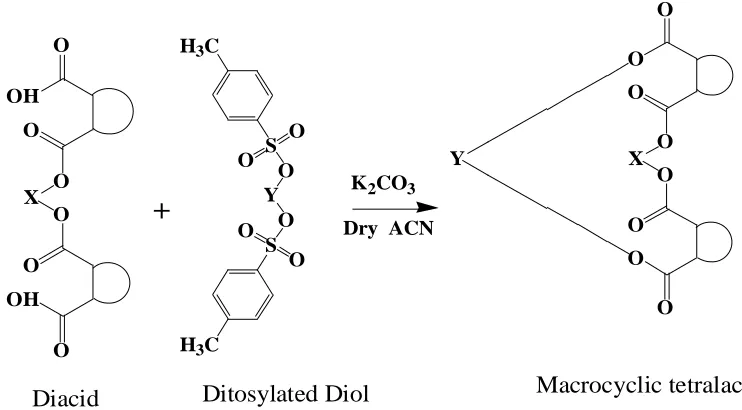
Synthesis of Macro Cyclic Tetralactone
Mechanism
OH O
O O
X O
O
O OH
S H3C
O Y
O S
O O
O O
H3C
Dry ACN
Diacid
O
O O
O X
O
O
O
O Y
Ditosylated Diol
K2CO3
Macrocyclic tetralactone
[image:5.612.108.479.433.638.2]+
Table 2. Syntheses of Macro cyclic tetra lactones with various diacids and Ditosylated diols
53
1 O O HO O O OH O O 1b S CH3 O O O O O O S O O H3CTS-2 O O O O O O O O O O M-1 85 2 O O HO O O HO O O 1d S CH3 O O O S O O O O H3C
TS-1 O O O O O O O O O M-2 90 3 O O HO O O HO O O 1d S CH3 O O O O O O S O O H3C
TS-2 M-3 O O O O O O O O O O 85 4 O OH O O HO O O O 1e S CH3 O O O S O O O O H3C
TS-1 M-4 O O O O O O O O O O 80
5 O
HO O O HO O O O 1f S CH3 O O O O O O S O O H3C
TS-2 M-5 O O O O O O O O O O 87
54
130.82 (=CH), 129.36 (=CH), 80.22 (-C=C-), 53.12 (-CH2). IR spectral data: (Vmax /cm-1), 3447, 2991, 2856, 2683, 2559, 2113, 1755, 1731, 1696, 1598, 1580, 1494, 1428, 1372, 1315, 1285, 1152, 951, 764. HRMS(ESI+): calcd. for C26H24O10Na (M+Na+): 519, Found 519.17.
Macro cycle compound No. M-2: Bolaamphiphile diacid 1 d (0.744 g, 0.002 mol), Diethylene Glycol Ditosylate
(0.828 g, 0.002 mol) and K2CO3 (0.552g, 0.004 mol), were allowed to react in dry ACN according to the method-B
to afford the macro cyclic tetralactone M-2 (Yield, 90%). 1HNMR d (CDCl3, 500.13 MHz): 7.54-7.87 (m, 8H,
Ar-H), 4.22-4.24 (t, 4H,-CH2), 1.21-1.86 (m, 10H, -CH2) cyclohexane; 13
CNMR d. (CDCl3, 125.76 MHz): 174.31
(C=O), 167.34 (C=O), 132.52 (quat -C), 132.14 (quat -C), 130.66 (=CH), 130.00 (=CH), 129.71 (=CH), 128.84
(=CH), 70.50 (-CH2), 37.13 (-CH), 28.73 (-CH2), 24.40 (-CH2). IR spectral data: (Vmax /cm-1), 3478, 3030, 2922,
2558, 2363, 1743, 1689, 1598, 1492, 1422, 1283, 1249, 1125. HRMS (ESI+): calcd. for C30H34O10Na (M+ Na+):
577, Found 577.52.
Macro cycle compound No. M-3: Bolaamphiphile diacid 1d (0.744 g, 0.002 mol), Triethylene Glycol Ditosylate
(0.91g, 0.002 mol) and K2CO3 (0.552g, 0.004 mol), were allowed to react in dry ACN according to the method-B to
afford the macro cyclic tetra lactone M-3 (Yield, 85%).1HNMR d (CDCl3, 500.13MHz): 7.54-7.87 (m, 8H, Ar-H),
4.22-4.24 (t, 4H,-CH2), 1.21-1.86 (m, 10H, -CH2) cyclohexane; 13CNMR d. (CDCl3, 125.76 MHz): 174.31 (C=O),
167.34 (C=O), 132.52 (quat -C), 132.14 (quat -C), 130.66 (=CH), 130.00 (=CH), 129.71 (=CH), 128.84 (=CH),
70.50 (-CH2), 37.13 (-CH), 28.73 (-CH2), 24.40 (-CH2). IR spectral data :( Vmax/cm-1), 3478, 3030, 2922, 2558,
2363, 1743, 1689 1598, 1492, 1422, 1283, 1249, 1125. HRMS (ESI+): calcd. for C26H24O10Na (M+ Na +): 519,
Found 519.17.
Macro cycle compound No. M-4: Dicarboxylic acid 1e (0.882g, 0.002 mol), Diethylene Glycol Ditosylate (0.828 g,
0.002 mol) and K2CO3 (0.550 g, 0.004 mol), were allowed to react in dry ACN according to the method-B to afford
the macro cyclic tetra lactone M-4 (Yield, 80%). 1H NMR δ (DMSO, 400.13MHz): 7.40-7.79 (m, 8H, Ar-H), 5.65
(t, 1H, -CH), 3.53-3.66 (m, 2H, -CH2), 2.31-2.42 (d, 3H, -CH3), 13
C NMR δ (CD3OH, 50 MHz): 167.1 (C=O), 167.0
(C=O), 132.4 (quat –C), 129.8 (quat –C), 133.1 (=CH), 133.0 (=CH), 128.9 (=CH), 128.8 (=CH), 71.7-67.0 (–CH2),
17.9 (-CH3). IR spectral data: (Vmax /cm-1), 3426 (-OH), 3071 (Ar.-CH), 2966, 2877 (Aliphatic -CH), 2675, 2542,
2110, 1721 (C=O ester), 1694 (C=O acid), 1601, 1420, 1311, 1126 (C-O), 1017,913, 813, 695, 664, 578. HRMS
(ESI+) calcd. for C28H30O9Na (M+ Na+): 533, Found 533.38.
Macro cycle compound No. M-5: Bolaamphiphile diacids 1f (0.744 g, 0.002 mol), Triethylene Glycol Ditosylate
(0.91 g, 0.002 mol) and K2CO3 (0.552 g, 0.004 mol), were allowed to react in dry ACN according to the method-B
to afford the macro cyclic tetralactone M-5 (Yield, 87%). 1H NMR δ (DMSO, 400.13 MHz): 7.15-7.70 (m, 8H,
Ar-H), 2.344 (d, 3H, -CH3), 3.52-3.65 (m, 2H, -CH2), 5.65 (t, 1H, -CH). 13
C NMR δ (CD3OH, 50 MHz): 167.8 (C=O),
169.5 (C=O), 133.5 (quat –C), 167.6 (quat –C), 132.3 (=CH), 129.5 (=CH), 129.2 (=CH), 128.5 (=CH), 73.2-62.9 (–
CH2), 20.0-19.88 (-CH3). IR spectral data: (Vmax /cm-1) 169.58 (C=O), 168.86 (C=O), 132.36, 132.01(quat-C),
131.37, 131.05, 129.04, 128.53 (=CH), 72.7 (–CH2), 61.4 (–CH2). HRMS (ESI+) calcd. for C25H26O10 (M+ Na+):
55
RESULT AND DISCUSSION
The main objective was to develop a simple and cost proficient route to obtain a new type of macro cyclic tetra
lactones (MCTL) functionalities compounds. The synthesis described here, depicted in high yield in above Table 1
and Table 2 respectively. Figure 1, bolaamphiphiles is based on modified diols spacer moiety reaction briefly noted
in the introduction of marcrocyclic tetralactone compounds. Ditosylated diols were converted to glycols by reaction
with p-toluenesulfonyl chloride (PTC). Since ditosylated diols have two terminals CH3 groups, tosylation occur on
both ends, but adding 1:1 mol of ditosylated diols and diacid to produced macrocyclic tetralactone produced 80-90%
reported yields for these compounds.
NMR Investigation
1
HNMR and 13CNMR spectra of compounds showed in Table 1 and Table 2, respectively, recorded in
CD3OD and CDCl3 (all data given in experimental section) and the corresponding spectra are presented in Figure
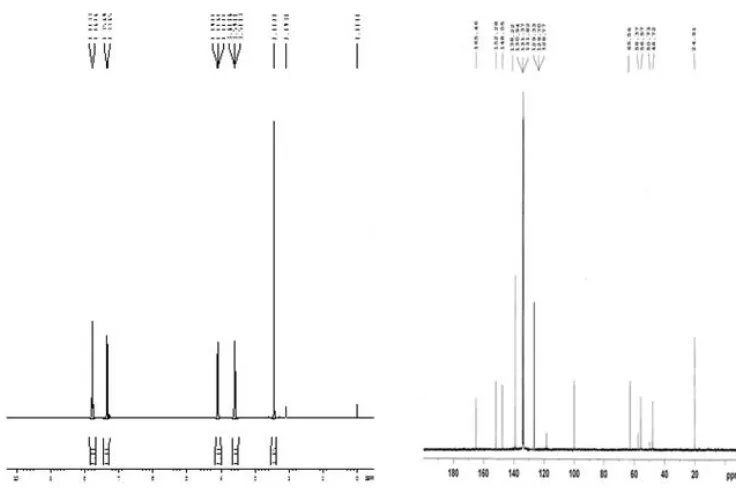
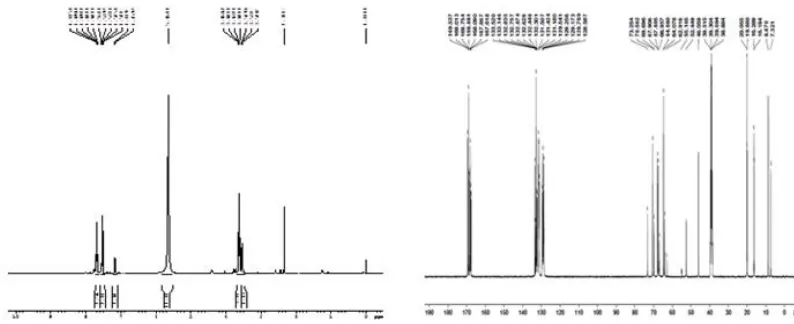
2a and 2b and Figure 3a and 3b of compound TS-1 and TS-2, and similarly in Figure 4a and 4b of Macrocyclic
compounds M-5 respectively. The 1H NMR signal correspond to the -O2SOCH2 and -CH2, -CH3 groups of the
compound (TS-1-TS-2) and dissolved in CD3OD and CDCl3 gives a broad signal at 7.33-7.78 (m, 8H, Ar-H),
4.17-4.15 (t, 2 H, O2SOCH2), 4.07-4.09 (t, 4H, -CH2),3.58-3.61 (t, 4H, -CH2), 2.44 (s, -CH3 δ in (TS-1) and 7.73-7.79
(m, 8H, Ar-H), 4.26-4.26 (t, 2 H, -O2SOCH2), 4.12-4.19 (t, 4H,-CH2), 3.52-3.69 (t, 4H, -CH2), 2.44 (s, -CH3) in
(TS-2) merged with an aromatic region. Similarly the 1H NMR signal correspond to aromatic 8-CH exhibits three to four
signals at in compound (M-1-M-5) is 7.27-7.84, 7.54-7.87, 7.54-7.87, 7.40-7.79 , 7.15-7.70 (m, 8-CH, Ar-H),
cyclohexane in 1.21-1.86, and 1.21-1.86 (m, 10H, -CH2) compounds in (M-2 and M-3), respectively, and 4.35-4.37
(t, 4H, -CH2), 4.22-4.24 (t, 4H,-CH2), 4.22-4.24 (t, 4H,-CH2), 3.53-3.66 (m, 2H, -CH2), 3.52-3.65 (m, 2H, -CH2) δ,
and aliphatic CH2 hydrogen’s two distinct double signals for compound (M-1-M-5) in CDCI3 and DMSO
respectively. A similar observation based on the 13C NMR data lead us to conclude the formation of tosylated diols
144.49 (quat -C), 138.2 (quat -C), 128.77 (quat -C), 129.33 (quat -C), 129.70 (=CH), 130.94 (=CH), 131.37 (=CH),
131.82 (=CH), 65.56 (-CH2), 24.91 (-CH3) in compound (TS1), 144.49 (quat C), 138.2 (quat C), 128.77 (quat
-C), 129.33 (quat --C), 129.70 (=CH), 130.94 (=CH), 131.37 (=CH), 131.82 (=CH), 70.50 (-CH2), 65.56 (-CH2), 24.91
(-CH3) in compound (TS-2), and similarly, all the data of Macro cyclic tetra lactones are given in experimental
56
Figure 2. (a) 1HNMR (400.13MHz) Spectra of compound (TS-1) in CDCl
3,(b) 13CNMR (125.76MHz); (b) Spectra of compound
[image:9.612.138.506.70.314.2](TS-1) in CDCl3
Figure 3.(a) 1HNMR (400.13MHz) Spectra of compound (TS-2) in CDCl
3, (b) 13CNMR (125.76MHz) Spectra of compound
[image:9.612.128.512.362.540.2]57
Figure 4.(a) 1HNMR (400.13MHz) Spectra of compound (M-5) in DMSO, (b) 1HNMR (50MHz) Spectra of compound (M-5) in
CD3OH
FT-IR Investigation
All ditosylated diols (TS-1 and TS-2) and macro cyclic tetra lactones compounds from (M-1 to M-5) possessing is
known to provide lactone-based macrocyclic compounds. Though there are significant numbers of macrocycles
available in with lactone (-C (=O)-O-) based rings is rare in the literature. With an aim to synthesize the macrocyclic
compound possessing both lactone functional groups, we have adapted the reaction monitored using TLC at 0ºC for
the overnight condition in the present synthesis. Accordingly, the bola-shaped diester dicarboxylic compound (L-1)
was obtained by desymmetrizing phthalic anhydride using ethanediol. Mechanism-3.3 represents, the various
synthetic strategies made to order for the arrangement of five different macrocyclic compounds, from (M-1 to M-5)
using the TS-1 and TS-2, respectively. The response of an assortment of spacer ditosylated diols gave the macro
cyclic compounds. In general, the syntheses of macrocycles compounds with lactones were performed by treating
the diol and anhydride in the presence of 10% aqueous hydrochloric acid and K2CO3 respectively. In our endeavour
to understand the formation of M-1 to M-5, we recommend for same order in the mechanism-3.4. The aromatic
carboxyl unit as well as -O2SOCH2- functional groups in common (all data given in experimental section) and the
corresponding spectra are presented in compound TS-1 and M-5 respectively. The sharp peak at 1726 to 1597cm-1
region for all compounds described to the C=O stretching mode of the end -CH3 group characteristics of the
formation of ditosylated diols. The Peak appeared around 3973 to 3880 cm-1 indicates the presence of carboxylic
groups. The additional single in the FT-IR region at 1696-1694 cm-1 region indicates the C=O group in all
macrocyclic compounds from M-1 to M-5.
Mass Spectra Investigation
The spectra of ditosylated diols for compounds form (TS-1 and TS-2), as well as the macro cyclic tetra lactones
compounds from (M-1 to M-5) recorded (all data are given in experimental section) and the mass spectrum of
compounds TS-1 and M-5 is depicted. The dominant middle peak indicates the existence of sodium (M+ Na+) such
observation of positive MS peak obtained with sodium ion adduct for the neutral compounds is not uncommon.
58
All these data of the long-established form (TS-1 and TS-2) as well as macrocyclic tetra lactones compounds from
(M-1 to M-5) the proposed chemical formulas of all structures. For the accomplishment more information about the
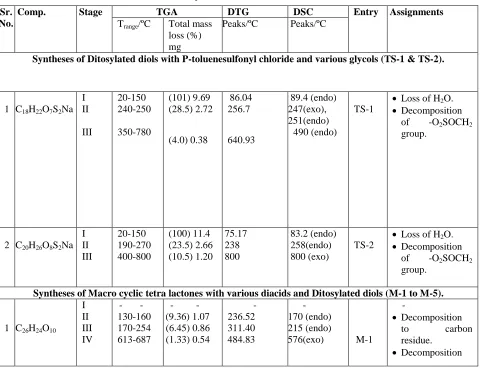
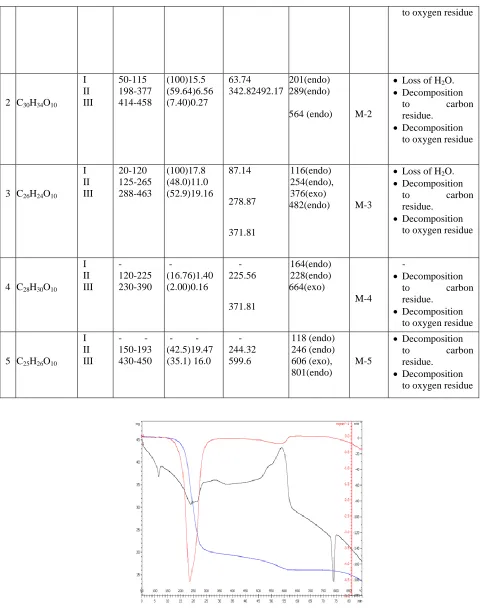
thermal constancy of the obtained compounds, TGA, DSC and DTG are performed. The thermal decomposition of
the compounds TS-1 and TS-2 and macrocyclic tetra lactones compounds from (M-1 to M-5) take place in the Table
2. The first loss, located in the range of 20-140 °C, with 9.6 % weight loss is credited to the development of water
molecules. The dehydration processes are interpreted by an endothermic peak in the DSC curve at 251.95°C and
245.22, at the same time, the DTG curve presents a melting process at 274.01°C and 283.58 by the exothermic peak
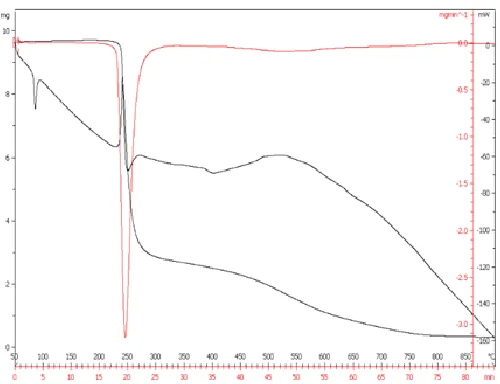
for the compound of the TS-1 as shown in Figure 5.Similarly, the macrocyclic tetra lactones compound of M-5 as
shown in Figure 6 respectively. The tetra lactones are decomposed completely between 190 and 697 °C. The
experimental values for the mass loss in this stage are 70.39 % and 85.58 %, while the calculated values are 73.40 %
and 85.42 %, respectively. When the temperature is above 697 °C, the TGA curve presents a platform, implying
there is no weight changing in this range.The thermal analysis of the samples from Syntheses of (TS-1 & TS-2) as
well as macrocyclic tetra lactones compounds from (M-1 to M-5) were carried out on Mettler Toledo USA make
(Model TGA/DSC1, STARe System SW 9.20.), from temperature range 25 to 850°C using platinum crucible under
[image:11.612.73.555.353.727.2]nitrogen atmosphere (40-50 cm3/min) shown in Table 3 given below.
Table 3. The character parameters of TGA, DTG and DSC curves of Syntheses of (TS-1 and TS-2) as well as macro cyclic tetra lactones compounds from (M-1 to M-5)
Sr. No.
Comp. Stage TGA DTG DSC Entry Assignments
Trange/ºC Total mass
loss (%) mg
Peaks/ºC Peaks/ºC
Syntheses of Ditosylated diols with P-toluenesulfonyl chloride and various glycols (TS-1 & TS-2).
1 C18H22O7S2Na I II III 20-150 240-250 350-780 (101) 9.69 (28.5) 2.72 (4.0) 0.38 86.04 256.7 640.93 89.4 (endo) 247(exo), 251(endo) 490 (endo) TS-1
Loss of H2O.
Decomposition of -O2SOCH2 group.
2 C20H26O8S2Na I II III 20-150 190-270 400-800 (100) 11.4 (23.5) 2.66 (10.5) 1.20 75.17 238 800 83.2 (endo) 258(endo) 800 (exo) TS-2
Loss of H2O.
Decomposition of -O2SOCH2 group.
Syntheses of Macro cyclic tetra lactones with various diacids and Ditosylated diols (M-1 to M-5).
1 C26H24O10 I II III IV - - 130-160 170-254 613-687 - - (9.36) 1.07 (6.45) 0.86 (1.33) 0.54 - 236.52 311.40 484.83 - 170 (endo) 215 (endo) 576(exo) M-1 - Decomposition
to carbon
59
to oxygen residue
2 C30H34O10 I II III 50-115 198-377 414-458 (100)15.5 (59.64)6.56 (7.40)0.27 63.74 342.82492.17 201(endo) 289(endo)
564 (endo) M-2
Loss of H2O.
Decomposition
to carbon
residue. Decomposition
to oxygen residue
3 C26H24O10 I II III 20-120 125-265 288-463 (100)17.8 (48.0)11.0 (52.9)19.16 87.14 278.87 371.81 116(endo) 254(endo), 376(exo)
482(endo) M-3
Loss of H2O.
Decomposition
to carbon
residue. Decomposition
to oxygen residue
4 C28H30O10 I II III - 120-225 230-390 - (16.76)1.40 (2.00)0.16 - 225.56 371.81 164(endo) 228(endo) 664(exo) M-4 - Decomposition
to carbon
residue. Decomposition
to oxygen residue
5 C25H26O10 I II III - - 150-193 430-450 - - (42.5)19.47 (35.1) 16.0 - 244.32 599.6 118 (endo) 246 (endo) 606 (exo), 801(endo) M-5 Decomposition
to carbon
residue. Decomposition
[image:12.612.72.556.66.676.2]to oxygen residue
60
Figure 6. The simultaneous TGA, DSC and DTA curves of compound M-5
Electron Microscopic ObservationInvestigation
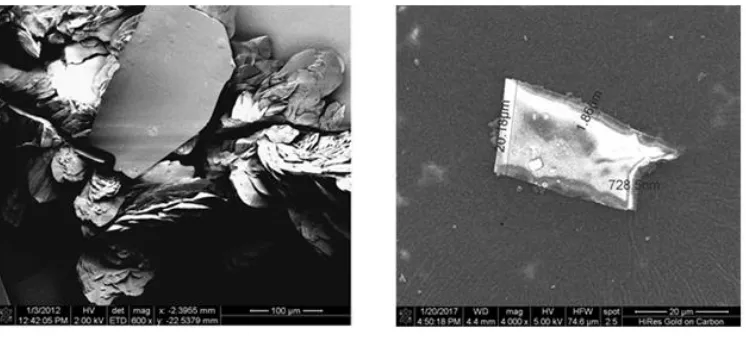
Further to examine their morphology using FE-SEM (Figure 7). The FE-SEM micrograph obtained with gold cotted
for all ditosylated diols for compounds form (TS-1 and TS-2) as well as macrocyclic tetra lactones compounds from
(M-1 to M-5) recorded in the solid state. All compounds showed the formation of bone, and sharp rigid plate type
architecture measured with an understanding from the weak -O2SOCH2…. O and O–H. . .O syntheses of
macrocyclic tetra lactones with various diacids and ditosylated diols, an attempt has been made to derived a
reasonable enlargement mechanism to understand the morphological difference obtained by FE-SEM image. The
benzene ring and the flexibility at the central spacer with various diacids and ditosylated diols section combinedly
facilitate to interconnect the adjacent molecules and form a single stranded bone structures (TS-1 and TS-2) through
its strong intermolecular carboxylic hydrogen bond shown in compound (TS-1), (Figure 8a and 8b). Similarly, the
C-H…O interaction mediated through C=O group of the ester unit from (M-1 to M-5), involves in strong inter
interaction with several dimension with (20.18 µm × 1.86 µm × 728.5 nm) the neighboring the dimensionality of the
molecules packing. The increase in the number of carbon and the flexibility on the spacer moiety, increase the pitch
distance of the bone, sharp rigid plate strand in the order TS-1 <M-5. In order to forms impersonate fascinatingly
structures, measured through FE-SEM is a micrometer range from (5.63–12.46µm), the corresponding bones type
structure show the hollowness in the molecular structure (TS-1 and TS-2) in few Angstrom. It is considered as
essential to understanding the mechanism through which the supramolecular self-assembly takes place. In full of
meaning humorously structures strong head group interactions, caused by hydrogen bonding with aromatic
61
Figure 7. (a) The FE-SEM image (TS-1), (b) The FE-SEM image (TS-2)
Figure 8. (a) The FE-SEM image (M-1), (b) The FE-SEM image (M-5)
CONCLUSION
In this work, a simple synthetic method has been designed that produces two new ditosylated diols (TS-1&TS-2)
and five macrocyclic tetra lactones compounds from (M-1 to M-5) possessing is known to provide lactone-based
macrocyclic compounds are synthesized and their appropriate the synthesis of macrocycles with lactones were
performed by treating the with various diacids and ditosylated diols. Chemical formulas of all compounds are
established by spectroscopic techniques and elemental analyses. It is thought that this thermal stability ditosylated
diols (TS-1&TS-2) and lactone-based compounds from (M-1 to M-5) could be useful, especially in extraction
studies, and the crucial aspect for this aim. In the next study, these compounds will be used in an extraction process
for making complexes in water with transition-metal cations, such as Co2+, Ni2+, Cu2+, and Zn2+ through molecular
self-assembly.
[image:14.612.121.489.75.241.2] [image:14.612.141.514.275.444.2]62
[1] Still WC; Galynker I. Tetrahedron. 1981, 37, 3981-3996. [2] Still WC; Galynker I. Tetrahedron. 1981, 37, 3970-3979.
[3] Dunitz JD. Perspectives in Structural Chemistry by JD Dunitz, JA Ibers editor. (2nd edn.), Wiley Publishers, New York, 1968.
[4] Jenkins AD, Suter UW. Pure Appl Chem.1996, 68 (12), 2287–2311. [5] Weller M. Inorganic Chemistry, 6th edition, Oxford University Press, 2014.
[6] Melson GA. Coordination Chemistry of Macrocyclic Compounds. Plenum Press, New York, 1979. [7] Bilgin A; Ertem B; Agın DF; Gok Y; Karslıoğlu S. Polyhedron. 2006, 25, 3165.
[8] Arisa J; Rojrit R; Mongkol S. Tetrahedron Lett. 2007, 48, 1817.
[9] Cakır U; Ozer M; Icen MA; Ugras HI; Bulut M. Dyes and Pig. 2004, 60, 177.
[10]Lalot J; Manier G; Stasik I; Demailly G; Beaupere D. Carbohydr Res. 2001, 335, 55–61. [11]Chaveriat L; Stasik I; Demailly G; Beaupe`re D. Carbohydr Res. 2004, 339, 1817–1821. [12]Zalipsky S; Harris JM. J Am Chem Soc. 1997, 680.
[13]Gallant AJ; Patrick BO; MacLachlan MJ. J Org Chem.2004, 69, 8739–8744. [14]Wessjohann AL; Rivera DG; Coll F. J Org Chem.2006, 71, 7521–7526. [15]Haber J; Pamin K; Poitowicz J. J Mol Catal A: Chem. 2004, 224, 153–159. [16]Selvakumar PM; Suresh E; Subramanian PS. J Mol Struct. 2009, 919, 72–78. [17]Shimizu T; Masuda M; Minamikawa H. Chem Rev.2005, 105, 1401–1443. [18]Estroff LA; Hamilton AD. Chem Rev.2004, 104, 1201–1218.
[19]Muthusamy S; Gnanaprakasam B; Suresh E. Org Lett.2006, 8, 1913–1916. [20]Chen Y; McDaid P; Deng L. Chem Rev.2003, 103, 2965–2984.
[21]Seref Ertul; Mevlut Bayraki; Dincer Beduk A. Iran J Chem Chem Eng.2008, 27(4).