Journal of Chemical and Pharmaceutical Research, 2014, 6(2):446-450
Research Article
CODEN(USA) : JCPRC5
ISSN : 0975-7384
Evaluation of the antimicrobial activities of novel 1,2 and 1,5-diols
C. A. M. A. Huq* and M. A. Mohamed Musthafa
P.G. and Research Department of Chemistry, The New College, Chennai, T. N., India
_____________________________________________________________________________________________ABSTRACT
The synthesis of novel 1,2-diols 1-5 and 1,5-diols 6&7 have been carried out as reported[8,9] from our laboratory. The compounds 1-5, 6&7 were screened for their antimicrobial activity. They have been tested for antibacterial activity against Gram –Positive bacteria Staphylococcus aureus and against Gram-Negative bacteria Escherichia coli, Klebsiella pneumoniae, Salmonella thypi and Vibrio cholera.The antifungal activity has been tested against Candida albicans and Aspergillus flavus.
Keywords: Antimicrobial activity, antibacterial activity, antifungal activity, 1, 2–diols, 1, 5-diols.
_____________________________________________________________________________________________
INTRODUCTION
The hydroxyl structural moiety is found in numerous pharmaceutically active compounds and therefore represents an interesting template for medicinal chemistry [1]. In particular phenyl ethanol derivatives have good antifungal properties [2, 3]. 2-[2-(Hydroxymethyl) Phenyl] ethanol derivatives are reported [4] as potential antibacterial agents. Eckstein et al. [5] found that 2-nitropropan-1, 3-diol derivatives possessed antifungal activity. Croshaw, Groves, and Lessel [6] examined 2-bromo-2-nitropropan-1, 3-diol and showed it to be active against both bacteria and, to a lesser extent, fungi. Theantimicrobial studies of 3-hetarylazoquinoline-2,4-diol compounds has been reported [7]. Hence herein we report the antimicrobial studies of the novel 1,2-diols, 1-5 and 1,5–diols 6&7 whose synthesis is reported [8,9] from our laboratory..
EXPERIMENTAL SECTION
All m.ps are uncorrected. The homogeneity of the compounds was checked by Thin Layer Chromatography (TLC) over silica gel. 1H NMR spectra were recorded in CDCl3 using TMS as an internal standard on a Bruker 300 spectrometer at 500 MHz.13C NMR were recorded on a Bruker 300 spectrometer at 75 MHz and mass spectra on Jeol DX 303 spectrometer.
General Procedure for the Synthesis of 1, 2-diols, (1-5)
General Procedure for the Synthesis of 1, 5-diols, (6&7)
To a solution of the 1,2-diol [(3or 4) 0.0005 mol].in dry t-BuOH(10ml) was added a suspension of t-BuOK (0.0005 mol.) in dry t-BuOH (10ml).The mixture was refluxed under nitrogen atmosphere for 4h and quenched with a saturated solution of ammonium chloride (10 ml). The product formed was extracted with diethyl ether (3x 10 ml). The ether layer was washed with water, dried over anhydrous sodium sulphate and evaporated. Purification of the residue by column chromatography on silica gel, with ethyl acetate- hexane (1: 10 ml) as eluent afforded the corresponding 1, 5- diol
Antimicrobial activity
In this work, we report the in vitro study of antimicrobial activity of the novel 1,2-diols (1-5), and1,5-diols 6&7 against Gram –Positive bacteria Staphylococcus aureus and against Gram-Negative bacteria Escherichia coli, Klebsiella pneumoniae, Salmonella thypi and Vibrio cholera.The antifungal activity has been tested against the fungi Candida albicans and Aspergillus flavus.
Antimicrobial assay
Screening of antimicrobial activity was carried out in the following sequence
(i) Preparation of nutrient agar (ii) Preparation of Mc Ferland standards (iii) Inoculums preparation. (iv) In vitro Antimicrobial Sensitivity Determination by Agar well diffusion method.
(i) Preparation of nutrient agar
The nutrient agar was prepared by dissolving beef extract(1.5g), peptone(0.5g), yeast extract (1.5g), sodium chloride (0.5g) and agar (1.5g) 100ml of distilled water. The pH was adjusted to 7.2 followed by sterilization in an autoclave at 1210C / 15LB for 15 minutes. The sterile molten agar media was then cooled to 500C. About 15 ml of the media was poured on a sterile petri-plate and allowed to cool to room temperature.
(ii) Preparation of 0.5 Mc Ferland standards
0.5ml of solution A (1.175g of barium chloride in 100 ml of distilled water) was added to 99.5 ml of solution B (1 ml of 0.36 N sulphuric acid in 100 ml of distilled water) and mixed well with magnetic stirrer, then distributed in test tubes with a screw cap of the same size as those containing the bacterial/ fungal culture.
(iii) Preparation of bacterial and fungal inoculums.
The cooled sterile broth medium was poured into sterile petri-plates having a uniform depth of 4mm; this is equivalent to approximately 25 ml in a 90mm plate. Once the medium had solidified then the culture was inoculated on the medium. The turbidity of the culture was adjusted with sterile broth so as to correspond to 0.5 Mc Ferland standards. Immediately after standardisation, a sterile cotton swab was immersed in the bacterial/ fungal suspension and then rotated and compressed against the wall of the test tube, so as to remove the excess fluid.
(iv) In vitro Antimicrobial Sensitivity Determination by Agar well diffusion method.
In vitro antimicrobial sensitivity of the antibiotics and the test compounds synthesised were determined by well diffusion method as recommended by the National Committee for Clinical Laboratory Standards (NCCLS) [12]. The well diffusion test was performed using medium, as per the procedure described by Magaldi et al [13] .A sterilized 10 mm cork borer was used to make agar wells on the sterile nutrient agar plates. 24 hours sub cultured bacteria/ fungi were inoculated in the petri-plates, with a sterile cotton swab. Compounds were dissolved in DMSO solvent separately and poured in the wells with varying concentrations ranging from from 50µ L, 100µL, 150µL and 200µL, using a micropipette. 100% DMSO was used as a control. The plates were incubated for 24 hours at 370C. Antibiotic Streptomycin was used as a reference antibacterial agent and Amphotericin-B were used as a reference antifungal agent. The tests were carried out in triplicates.
RESULTS AND DISCUSSION
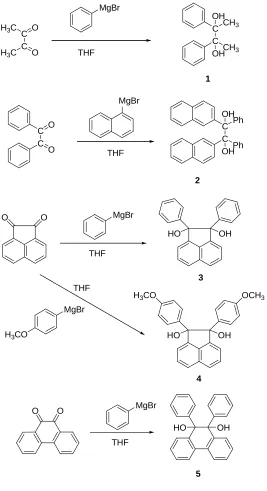
The synthesis of the different diols 1-5, 6 & 7 is outlined in Scheme 1 and Scheme 2. Physical data of the diols are shown in Table-1. The TLC and melting points of all the diols 1-5, 6 & 7 are in agreement with the proposed structures reported [8,9] from our laboratory.
C CH3 C
CH3 OH OH
C Ph C
Ph OH OH
OH HO
OH HO
H3CO OCH3
OH HO
C H3C
C H3C
MgBr MgBr
THF
THF O
O
C C
O
O
MgBr
THF
O O
MgBr
H3CO
THF
MgBr
THF
O O
1
2
3
4
5
[image:3.595.173.440.71.562.2]Scheme - 1
Table I: Physical data of the diols, (1-7)
Entry Product Molecular Formula Melting Point (0C) Yield(%) of Product
1 1 C16H18O2 79 – 80 80
2 2 C34H26O2 123-125 79
3 3 C24H18O2 130-131 88
4 4 C26H22O4 159-160 70
5 5 C26H20O2 171-173 79
6 6 C24H18O2 119-120 88
OH HO
H3CO OCH3
OH HO OH HO 3 OH HO
H3CO OCH3
4
t-BuOK / t-BuOH
N2 atm. RT
N2 atm. RT
t-BuOK / t-BuOH
6
7
Scheme- 2
Biological activities
[image:4.595.128.491.68.351.2]The results of in vitro study of antibacterial activity of the diols (1-7) against each of the five bacterial species (Staphylococcus aureus, Escherichia coli, Klebsiella pneumoniae, Salmonella thypi and Vibrio cholera.) are reported in the Table- 2
Table-2
S. No. Organisms (Bacteria)
Zone of Inhibition (mm) 1 (Std.) 2 (Std.) 3 (Std.) 4 (Std.) 5 (Std.) 6 (Std.) 7 (Std.)
1 Escherichia coli 8
(21) 8 (24) 8 (23) 11
(20) - (24) 9 (25)
9 (23)
2 Staphylococcus aureus 10
(22) 9 (20) 8 (20) 9
(20) 9 (18) 10 (23)
- (20)
3 Klebsiella pneumonia 8
(15) 9 (15) 8 (17) 9 (18) 9 (17) 7 (13) 7 (15)
4 Salmonella thypi 8
(15) 8 (15) 9 (16) 8 (18) 9 (15) 8 (18) 10 (15)
5 Vibrio cholera 9
(10) 10 (10) 7 (10) 10 (10) 9 (11) 9 (10) 7 (10)
(Std)= Streptomycin. - = No zone of Inhibition
The foregoing data shows that 1, 2, 3, 4, 6 and 7 are moderately active against Escherichia coli. The compounds 1-6 are moderately active against Staphylococcus aureus., and compounds 1-7 are moderately active against, Klebsiella pneumonia and Salmonella thypi..The compounds 1-7 are highly active against Vibrio cholera.
The results of the antifungal activity of the tested novel compounds against the fungi Candida albicans and Aspergillus flavus are summerised in Table -3 and Table-4.
Table-3 - The antifungal activity of the novel diols against the fungi Candida albicans
Entry Compound (Diol)
Zone of Inhibition (mm) Day 3 Day 4 Day 5 Day 6
1 1 5 7 8.5 9
[image:4.595.136.468.425.567.2]Table-4 - the antifungal activity of the novel diols against the fungi Aspergillus flavus
Entry Compound (Diol)
Zone of Inhibition (mm) Day 3 Day 4 Day 5 Day 6
1 1 2 15 19 22
2 2 - 20 31 33
3 3 - 23 32 35
4 4 - 13 20 27
5 5 5 12 15 21
6 6 - 18 27 30
7 7 - 15 20 24
The fungus Candida albicans is the fourth most common human pathogen resistant to the drug Amphotericin- B.
In this study the same drug was taken as standard control to compare the zone of inhibition with that of the synthesised organic compounds.
For antifungal study, the results were taken for consecutive four days from third day of incubation and given importance up to sixth day of incubation. From the data given in Table – 3, it is observed that all the seven organic compounds, played significant role on the pathogenic fungi
Candida albicans. The growth control effect was very high than the standard, Amphotericin- B.
From the data given in Table – 4, it is observed that all the seven organic compounds, showed very good growth control against Aspergillus flavus from the fourth day of incubation.
From these antifungal activity results, the comparative account of inhibitory activity of the seven organic diols on Candida albicans and Aspergillus flavus revealed that the diol, 3, showed very high inhibitory activity against Candida albicans. The diols 2, 3 & 6 showed very high inhibitory activity against Aspergillus flavus.
CONCLUSION
In summary, we are reporting the antibacterial and antifungal studies of the novel 1,2-diols and 1.5-diols. The antibacterial studies reveal that the diols are having very high antibacterial activity against the bacteria Vibrio cholera. The antifungal studies of the diols shows that the diols 2, 3 & 6 have high antifungal activity against the fungi Candida albicans and Aspergillus flavus compared to Amphotericin-B, which is resistant to these fungi.
Acknowledgements
The authors thank the management of The New College, Chennai, India, for providing the necessary facilities and support.
REFERENCES
[1] S.H. Lim, S.M. Hudson, Carbohyd. polym., 2004, 56, 227,.
[2] R.B. Tirodkar, R.N. Usganokar, Indian J.Chem., 1972, 10, 1060,
[3] M. Odabas, Odabasog" lu, Ct ig~dem Albayrak a, Resit O" zkanca b, Fatma Zehra Aykan, Peter Lonecke, J. Mol. Struct., 2007,71, 840.
[4] P. Mahnivel and F.Nawaz Khan, J. Chil. Chem. Soc, 2009, 54, 2, http://dx.doi.org/10.4067/S0717-97072009000200019
[5] Eckstein, Z., E. Grochowski, R. Kowalik, and T. Urbanski, Bull. Acad. Pol. Sci. Ser. Soc. Chim., 1963,11,687. [6] Croshaw, B., M. J. Groves, and B. Lessel, J. Pharm. Pharmacol., 1964, 16, 127.
[7] Fatma ¨OZT¨URK, Leyla AC¸IK, Izzet S¸ENER, Fikret KARCI, Emine KILIC¸Turk. J. Chem., 2012, 36, 293. [8] Kalilur Rahiman, Syed Sulaiman Hussaini, C. A. M. A. Huq, Curr. Sci, 2002, 82, 1138.