CHARACTERIZATION OF SOFT SOIL USING MULTI-CHANNEL ANALYSIS OF SURFACE WAVES (MASW) AND ELECTRICAL RESISTIVITY METHOD (ERM)
KASBI BIN BASRI
A thesis submitted in
fulfilment of the requirement for the award of the Master of Civil Engineering
Faculty of Civil and Environmental Engineering Universiti Tun Hussein Onn Malaysia
iii
ACKNOWLEDGEMENT
First and foremost, praise to Allah SWT for the sustenance and guidance throughout my thesis. Second, my sincerest gratitude to my supervisor, Assoc. Prof. Dr. Adnan Bin Zainorabidin, who has supported me throughout my thesis with his patience and knowledge whilst allowing me the room to work in my own way. I attribute the level of my degree to his encouragement and effort and without him, this thesis would not have been completed. One simply could not wish for a better and friendlier supervisor.
Next, I would like to forward my appreciation to Ministry of Education for sponsoring my study through MyBrain 15.
Sincere thanks also to all my friends especially Mr Mohd Jazlan Bin Mad Said and Mr Mohamad Niizar Abdurahman for their help and support throughout my thesis. They have dedicated their time to give me further understanding regarding my thesis.
v
ABSTRACT
ABSTRAK
vii
TABLE OF CONTENT
ACKNOWLEDGEMENT iv
ABSTRACT v
ABSTRAK vi
TABLE OF CONTENT viii
LIST OF TABLES xiv
LIST OF FIGURES xvi
LIST OF SYMBOLS AND ABBREVIATIONS xxii
LIST OF APPENDIX xxiii
CHAPTER 1 INTRODUCTION 1
1.1 Research background 1
1.2 Problem statement 2
1.3 Aim 3
1.4 Objectives 3
1.5 Scope of research 4
1.6 Significance of research 4
1.7 Thesis layout 5
CHAPTER 2 LITERATURE REVIEW 6
2.1 Introduction 6
2.2 Soft soil 6
2.2.1 Peat soil 6
2.2.2 Clay soil 8
ix
2.3.1 Shear wave velocity (Vs) 10
2.3.2 Past research on shear-wave velocity (Vs) 11
2.4 Soil resistivity 13
2.5 Geophysics 14
2.6 Seismic 16
2.6.1 Seismic waves 17
2.6.1.1 Rayleigh wave 18
2.6.2 Seismograph 19
2.7 Multichannel analysis of surface waves (MASW) 20
2.7.1 Active MASW method 20
2.8 Factors influencing MASW data acquisition 23
2.8.1 Seismograph configuration 23
2.8.1.1 Acquisition setup 23
2.8.1.2 Receiver spread 24
2.8.1.3 Layout geometry 25
2.8.2 Equipment configuration 25
2.8.2.1 Receiver spacing 26
2.8.2.2 Source offset 26
2.8.2.3 Number of traces and total spread length 27
2.8.2.4 Type of source and receiver 28
2.8.3 Wave attenuation and amplitude 28
2.8.3.1 Spherical spreading 29
2.8.3.2 Absorption 29
2.8.3.3 Additional factors 30
2.8.4 Topography 30
2.8.5 Other related factors 31
2.9 Factors influencing MASW data processing 31
2.9.1 Dispersion curve plotting 31
2.9.1.1 Fundamental mode 33
2.9.1.2 Higher mode 33
2.9.3 Number of iterations 33
2.9.4 Stacking 34
2.10Electrical Resistivity Method (ERM) 34
2.10.1 Type of array 37
2.10.1.1Schlumberger array 37
2.10.1.2Wenner array 38
2.10.1.3Comparison of different arrays 39
2.10.2 Cation exchange capacity (CEC) 39
2.10.3 Factors affecting data acquisition 39
2.10.3.1Type of setup 39
2.10.3.2Electrode spacing 40
2.10.4 Factors affecting data processing 40
2.10.4.1Apparent resistivity 40
2.10.4.2Pseudosection data plotting method 41
2.10.4.3Root mean square error 42
2.10.5 Electrical Resistivity Method software 42
2.10.5.1RES2DMOD 42
2.10.5.2RES2DINV 43
2.11Chapter summary 43
CHAPTER 3 RESEARCH METHODOLGY 44
3.1 Introduction 44
3.2 Site location 46
3.2.1 Parit Nipah, Johore 46
3.2.2 RECESS UTHM, Johore 48
3.3 Geophysical method 50
3.4 Multi-channel analysis of surface waves (MASW) 50
3.4.1 Instruments preparation 51
3.4.2 In-situ data acquisition 52
3.4.3 ABEM Terraloc Mk8 operation setup 55
3.4.4 Data processing and analyzing 60
xi
3.5 Electrical Resistivity Method (ERM) 61
3.5.1 Instruments preparation 62
3.5.2 In-situ data acquisition 64
3.5.3 SAS 4000 terrameter configuration 66
3.5.4 Data processing and analyzing 69
3.5.5 Generated soil stratigraphy 73
3.6 Soil profile determination 73
3.7 Chapter summary 76
CHAPTER 4 RESULTS AND DISCUSSIONS 77
4.1 Introduction 77
4.2 Soil profile at Parit Nipah 77
4.3 Multichannel analysis of surface waves results 78
4.3.1 Dispersion curves obtained on peat 79
4.3.1.1 0.5 meter receiver spacing 79
4.3.1.2 1.0 meter receiver spacing 81
4.3.1.3 1.5 meter receiver spacing 84
4.3.2 Effect of receiver spacing on peat dispersion curves 86 4.3.3 Dispersion curves obtained on soft clay soil 88
4.3.3.1 0.5 meter receiver spacing 88
4.3.3.2 1 meter receiver spacing 91
4.3.3.3 1.5 meter receiver spacing 93
4.3.4 Effect of receiver spacing on soft clay dispersion
curves 95
4.3.5 Comparison between dispersion curves obtained on
peat and soft clay soil 96
4.3.6 Shear-wave velocity profile for peat 98
4.3.6.1 0.5 meter receiver spacing 98
4.3.6.2 1.0 meter receiver spacing 102
4.3.6.3 1.5 meter receiver spacing 106
4.3.7 Effect of receiver spacing on peat shear-wave
4.3.8 Shear-wave velocity profile for soft clay 114
4.3.8.1 0.5 meter receiver spacing 115
4.3.8.2 1.0 meter receiver spacing 118
4.3.8.3 1.5 meter receiver spacing 123
4.3.9 Effect of receiver spacing on soft clay shear-wave
velocity profile 126
4.4 Electrical Resistivity Method 129
4.4.1 Soil stratigraphy for peat 129
4.4.1.1 1 m electrode spacing at x-axis 129 4.4.1.2 1.5 m electrode spacing at x-axis 130 4.4.1.3 1 m electrode spacing at y-axis 131 4.4.1.4 1.5 m electrode spacing at y-axis 132 4.4.1.5 Comparison between soil profile obtained
using ERM and peat sampler 133
4.4.2 Soil stratigraphy for soft clay 134
4.4.2.1 1 m electrode spacing at x-axis 135 4.4.2.2 1.5 m electrode spacing at x-axis 136 4.4.2.3 0.3 m electrode spacing at y-axis 137 4.4.2.4 0.6 m electrode spacing at y-axis 138
4.4.2.5 Peat resistivity profile 140
4.4.3 Soft clay resistivity profile 148
4.5 Comparison between peat and soft clay shear-wave
velocity 155
4.6 Comparison between peat and soft clay resistivity value 156 4.7 Correlation between peat shear-wave velocity and
resistivity value 157
4.8 Correlation between soft clay shear-wave velocity and
resistivity value 158
CHAPTER 5 CONCLUSION 160
xiii
5.2 Objective 1: To determine shear-wave velocity (Vs) profile
of soft soil using Multichannel Analysis of Surface Waves 160 5.3 Objective 2: To identify the effect of different receiver
spacing on MASW dispersion curve resolution 161 5.4 Objective 3: To determine the soft soil stratigraphy and
resistivity value using Electrical Resistivity Method with
complementary from peat sampler and borehole data. 161 5.5 Objective 4: To establish correlation between 1-D shear-
wave velocity profile and 1-D resistivity value 162
5.6 Knowledge contribution 162
5.7 Recommendations for future research 163
LIST OF TABLES
2.1 Peat soil distribution in Malaysia 7
2.2 Characteristic of organic material according to their degree of
decomposition 8
2.3 The Von Post scale of humification 8
2.4 Field and laboratory test employed for dynamic investigation of soil 10
2.5 Site class definition 11
2.6 Summary of previous research regarding soil shear wave velocities 11
2.7 Resistivity of common geological materials 13
2.8 Summary of previous study on soil resistivity value 14 2.9 Summary of 12 commonly used geophysical surveying methods for
geotechnical investigations 15
2.10 Data acquisition parameters for active MASW survey (in meters) 22 2.11 Sample interval and record length used by previous researchers 23
2.12 Equipment setup used by previous researchers 25
3.1 Borehole data from site investigation on RECESS UTHM soft soil 49
3.2 Summary of MASW configuration 53
3.3 List of equipment used for Electrical Resistivity Method 63
4.1 Soil profile at Parit Nipah 78
4.2 Percentage difference of minimum and maximum frequency with
different receiver spacing at peat 87
4.3 Percentage difference of minimum and maximum frequency with
different receiver spacing at soft clay 95
4.4 Summary of shear-wave velocity value obtained using 0.5 m receiver
xv
4.5 Summary of shear-wave velocity value obtained using 1 m receiver
spacing 102
4.6 Summary of shear-wave velocity value obtained using 1.5 m receiver
spacing 109
4.7 Summary of shear-wave velocity value of soft clay obtained using
0.5 m receiver spacing 116
4.8 Summary of shear-wave velocity value of soft clay obtained using
1 m receiver spacing 120
4.9 Summary of shear-wave velocity value of soft clay obtained using
1.5 m receiver spacing 124
4.10 Percentage difference between Schlumberger 1.5 m, Schlumberger
1 m and peat sampler 134
LIST OF FIGURES
2.2 The particle motions when the seismic waves pass the medium 18
2.3 Seismic wave front and seismic ray 18
2.4 Seismic waves recorded by seismogram 19
2.5 An illustration of different types of waves in MASW method 21 2.6 Typical terrain conditions favorable and unfavorable for the MASW
survey 31
2.7 The three different models used in the interpretation of resistivity
measurement 34
2.8 A conventional four electrode array (C1 and C2 – two current electrodes,P1 and P2 – resulting voltage difference at two potential
electrodes) to measure the surface resistivity 35 2.9 Common array used in resistivity surveys and their geometrical factors 36
2.10 A simple electrical circuit 37
2.11 Definition of resistivity 37
2.12 Schlumberger array 38
2.13 Wenner array 38
2.14 The pseudosection build up by the measurement sequence 41 2.15 Arrangement of the blocks used in a model together with the data
points in the pseudosection 42
3.1 Flowchart of methodology 45
3.2 Location of Parit Nipah 46
3.3 Geological map of Parit Raja 47
3.4 Site condition at Parit nipah 47
xvii
3.6 Site condition at RECESS UTHM 49
3.7 Procedure of MASW 50
3.8 MASW instruments 51
3.9 Array line configuration 53
3.10 Active MASW instruments arrangement 54
3.11 ABEM Terraloc quick procedure 55
3.12 The quick menu 56
3.13 Acquisition setup menu 57
3.14 The trig setup menu 57
3.15 The noise monitor setup menu 58
3.16 The acquisition filter setup menu 58
3.17 Receiver spread dialog menu 59
3.18 Layout geometry dialog menu 59
3.19 Flowchart of SeisImager processes 60
3.20 Fundamental steps involved in ERM 62
3.21 Electrical Resistivity Method main equipment 63
3.22 Arrangement for short and long setup 64
3.23 Location of ERM array setup 65
3.24 Array line and pseudosection examples; (a) Wenner, (b) Schlumberger 65
3.25 The control knobs on the SAS 4000 66
3.26 Main dialog menu 66
3.27 Record manager menu 67
3.28 Record option 67
3.29 Example of VES with pre-defined protocols 68
3.30 Acquisition setting menu 68
3.31 Data acquisition interface 68
3.32 Power off selection 68
3.39 File option menu 69
3.40 Edit menu 70
3.41 Exterminate bad datum points option 70
3.43 Save and read inversion file menu 72
3.44 Display sections submenu 72
3.45 2-D model 72
3.46 Print submenu 73
3.47 Sampling point layout 74
3.48 Peat sampler equipment 74
3.49 Peat sample obtain using peat sampler 75
3.50 General procedure to obtain sample using peat sampler 75 4.1 Dispersion curves obtained using 0.5 m receiver spacing with different
offset distance from x-axis; (a) 0 m, (b) 3 m and (c) 6 m; and from
y-axis; (d) 0 m, (e) 3 m and (f) 6 m 80
4.2 Dispersion curves obtained using 1.0 m receiver spacing with different offset distance from x-axis; (a) 0 m, (b) 3 m and (c) 6 m; and from
y-axis; (d) 0 m, (e) 3 m and (f) 6 m 82
4.3 Dispersion curves obtained using 1.5 m receiver spacing with different offset distance from x-axis; (a) 0 m, (b) 3 m and (c) 6 m; and from
y-axis; (d) 0 m, (e) 3 m and (f) 6 m 85
4.4 Dispersion curves obtained using 0.5 m receiver spacing with different offset distance from x-axis; (a) 0 m, (b) 5.75 m and (c) 11.5 m; and
from y-axis; (d) 0 m, (e) 5.75 m and (f) 11.5 m 89 4.5 Dispersion curves obtained using 1.0 m receiver spacing with different
offset distance from x-axis; (a) 0 m, (b) 5.75 m and (c) 11.5 m;
and from y-axis; (d) 0 m, (e) 5.75 m and (f) 11.5 m 92 4.6 Dispersion curves obtained using 1.5 m receiver spacing with different
offset distance from x-axis; (a) 0 m, (b) 5.75 m and (c) 11.5 m 94 4.7 1-D shear-wave velocity profile of peat using 0.5 m receiver spacing 99 4.8 Vs for peat using 0.5 m receiver spacing at x-axis 100 4.9 Vs for peat using 0.5 m receiver spacing at y-axis 101 4.10 Average Vs for peat using 0.5 m receiver spacing with respect to x-axis
and y-axis 102
xix
4.12 Vs for peat using 1 m receiver spacing at x-axis 105 4.13 Vs for peat using 1 m receiver spacing at y-axis 106 4.14 Average Vs for peat using 1 m receiver spacing with respect to x-axis
and y-axis 106
4.15 1-D shear-wave velocity profile of peat using 1.5 m receiver spacing 107 4.16 Vs for peat using 1.5 m receiver spacing at x-axis 110 4.17 Vs for peat using 1.5 m receiver spacing at y-axis 111 4.18 Average Vs for peat using 1.5 m receiver spacing with respect to
x-axis and y-axis 111
4.19 Average Vs for peat using 0.5, 1 and 1.5 m receiver spacing at x-axis 113 4.20 Average Vs for peat using 0.5, 1 and 1.5 m receiver spacing at y-axis 113 4.21 Average Vs of peat with respect to x-axis and y-axis 114 4.22 1-D shear-wave velocity profile of soft clay using 0.5 m receiver
spacing 115
4.23 Vs of soft clay using 0.5 m receiver spacing at x-axis 117 4.24 Vs of soft clay using 0.5 m receiver spacing at y-axis 117 4.25 Average Vs of soft clay using 0.5 m receiver spacing at x-axis and
y-axis 118
4.26 1-D shear-wave velocity profile of soft clay using 1 m receiver spacing 119 4.27 Vs of soft clay using 1 m receiver spacing at x-axis 121 4.28 Vs of soft clay using 1 m receiver spacing at y-axis 122 4.29 Average Vs of soft clay using 1 m receiver spacing with respect to
x-axis and y-axis 122
4.30 1-D shear-wave velocity profile of soft clay using 1.5 m receiver
spacing 123
4.31 Vs of soft clay using 1.5 m receiver spacing at x-axis 125 4.32 Average Vs of soft clay using 1.5 m receiver spacing at x-axis 125 4.33 Average Vs of soft clay using 0.5 m, 1 m and 1.5 m receiver spacing
at x-axis 127
4.34 Average Vs of soft clay using 0.5 m, 1 m and 1.5 m reeiver spacing
4.35 Average Vs of soft clay with respect to x-axis and y-axis 128 4.36 Peat stratigraphy using 1 m electrode spacing at x-axis;
(a) Schlumberger array, (b) Wenner array 130 4.37 Peat stratigraphy using 1.5 m electrode spacing at x-axis;
(a) Schlumberger array, (b) Wenner array 131 4.38 Peat stratigraphy using 1 m electrode spacing at y-axis;
(a) Schlumberger array, (b) Wenner array 132 4.39 Peat stratigraphy using 1.5 m electrode spacing at y-axis;
(a) Schlumberger array, (b) Wenner array 133 4.40 Soft clay stratigraphy using 1 m electrode spacing at x-axis;
(a) Schlumberger array, (b) Wenner array 136 4.41 Soft clay stratigraphy using 1.5 m electrode spacing at x-axis;
(a) Schlumberger array, (b) Wenner array 137 4.42 Soft clay stratigraphy using 0.3 m electrode spacing at y-axis;
(a) Schlumberger array, (b) Wenner array 138 4.43 Soft clay stratigraphy using 0.6 m electrode spacing at y-axis;
(a) Schlumberger array, (b) Wenner array 140 4.44 Peat resistivity value using 1 m electrode spacing at x-axis 141 4.45 Peat resistivity value using 1.5 m electrode spacing at x-axis 143 4.46 Peat resistivity value using 1 m electrode spacing at y-axis 144 4.47 Peat resistivity value using 1.5 m electrode spacing at y-axis 146 4.48 Peat resistivity value with different configuration 147 4.49 Resistivity value of soft clay using 1 m spacing at x-axis 149 4.50 Resistivity value of soft clay using 1.5 m spacing at x-axis 150 4.51 Resistivity value of soft clay using 0.3 m spacing at y-axis 151 4.52 Resistivity value of soft clay using 0.6 m spacing at y-axis 153 4.53 Comparison of resistivity value obtained using different array
configuration 154
xxi
LIST OF SYMBOLS AND ABBREVIATIONS c cc CEC D Dmin dx ERM f-v Gmax h I Lo MASW Damping coefficient
Critical damping coefficient Cation exchange capacity Damping ratio
Minimum damping ratio Receiver spacing
Electrical Resistivity Method Frequency-velocity
Maximum shear modulus Thickness
Current
Array line offset distance
Multichannel Analysis of Surface waves ρ R Density Resistance RMS RMSE S/N V Vp Vs X1
Root mean square Root mean square error Signal to noise
Voltage
P-wave velocity Shear-wave velocity Source offset
xxiii
LIST OF APPENDIX
APPENDIX TITLE PAGE
A B
Borehole data for RECESS
Borehole data geotechnical investigation report
CHAPTER 1
INTRODUCTION
1.1 Research background
2
The ERM is a geophysical method used to determine the subsurface resistivity distribution by injecting current into the ground through two current electrodes (C1 and C2), and measuring the resulting voltage difference at two potential electrodes (P1 and P2) (Loke, 1999). The Electrical Resistivity Method comprises of a 1-D sounding survey, 2-D imaging survey and 3-D surveys. The ability of 2-D Earth resistivity measurement to map the electrical resistivity distribution in the Earth allows the estimation of the subsurface heterogeneity (Slob, 2004).
Soft soil is considered as challenging soil especially due to its special features and high degree of compressibility. Peat is a representative material of soft soils and classified as highly organic with organic content more than 75% (Kolay et al., 2011). It is brownish in color and is formed by decomposed organic matter that have accumulated over a thousand years, with lack of oxygen and under waterlogged conditions. Peat is well known to deform and fail under light surcharge load, and it is characterized with low shear strength (5-20 kPa), high compressibility, high organic content (>75%) and high water content (>200%) (Zainorabidin and Wijeyesekera, 2007). While, clay is a fine-grained soil material that become plastic due to their water content and non-plastic when dried. The clay soil material also combines one or more clay minerals with traces of metal oxides and organic matter.
1.2 Problem statement
The dynamic soil properties and soil stratigraphy are conventionally collected by boring. This method is intrusive, takes longer time and higher cost before the data are obtained. The advancement of geophysical method in the past few decades allowed the investigation of subsurface exploration to be done in more time efficient manner and non-intrusive way. MASW method and ERM are some example of geophysical method used in subsurface exploration. The MASW method provides the shear-wave velocity profile of soil. The shear-wave velocity is one of the important parameters in determining the shear modulus which is one of the key factors to determine the soil stiffness. While, the ERM generates the soil stratigraphy and provides the resistivity value of the soil. In this research, the efficiencies of both methods were investigated to provide better alternatives in geotechnical investigation in future works.
Several doubts also arises regarding the optimization of the MASW method and ERM to provide reliable and high accuracy data. Hence, investigation of the data acquisition configuration and data analyzing are included in this research. The main purpose is to compare different configuration and data analyzing to achieve the best results. Therefore, the application of MASW method and ERM with the optimum configuration, will allow the subsurface exploration of the geotechnical investigation being done in a more time efficient manner and non-intrusive. Thus, providing knowledge to develop safer and more economic engineering design with efficient construction technique.
1.3 Aim
The purpose of this research is to establish soft soil profile using MASW method and ERM.
1.4 Objectives
This research embarks the following objectives:
4
ii. To identify the effect of different receiver spacing on MASW dispersion curve resolution.
iii. To determine the soft soil stratigraphy and resistivity value using Electrical Resistivity Method with complementary from peat sampler and borehole data. iv. To establish correlation between 1-D shear-wave velocity profile and 1-D
resistivity value.
1.5 Scope of research
This research focused on the establishment of soil profile at Parit Nipah and RECESS. The active 1-D MASW method and 2-D ERM were used to obtain the shear wave velocity and resistivity value (soil stratigraphy) respectively. Schlumberger and Wenner protocol were used for the ERM. The depth of peat layer at Parit Nipah was determined using peat sampler. While, the depth of soft clay at RECESS was determined from the borehole data obtained from the previous study.
1.6 Significance of research
1.7 Thesis layout
This thesis comprises the following contents:
i. Chapter 1: This chapter explains the core of this research such as the purpose, objectives and scope.
ii. Chapter 2: This chapter describes the soft soil characteristics and dynamic behavior. Geophysical method namely MASW method and ERM also described with all the necessary terms involved in this research. Previous researches regarding the topic also included.
iii. Chapter 3: This chapter explains the method used in this research in details. The method includes 1-D MASW method, 2-D and 1-D ERM and peat sampler.
iv. Chapter 4: This chapter shows the results obtained from this research. The results were also discussed and compared with the previous researcher. v. Chapter 5: This chapter provides the conclusions and recommendation for
CHAPTER 2
LITERATURE REVIEW
2.1 Introduction
This chapter explained theoretically all the definitions, terms and keywords, related to this research. It includes the definition of geophysics, seismic, Multichannel Analysis of Surface Waves (MASW), the applications of seismic, Electrical Resistivity Method (ERM), resistivity, the applications of resistivity and soft soil. The previous results with similar interest from previous researchers were also listed.
2.2 Soft soil
The soft soil is considered as the most challenging soils compare to other type of soil. According to Vermeer and Neher (1999), high degree of compressibility is the special features of this type of soil. Near-normally consolidated clays, clayey silts and peat are categorized as soft soil (Vermeer and Neher, 1999).
2.2.1 Peat soil
and shrubs (International Wetlands, 2010).The peatland ecosystem is the most efficient carbon sink as peatland plants capture the CO2 which is naturally released. Peat soil usually dark brown or black in colour, often with distinctive smell (Whitlow, 2001). Peat is classified as highly organic with organic content more than 75 percent and represent the extreme form of soft soil (ASTM, 2002). Peat properties reflect the peat environment, development process of peat and the types of peat-performing plant (Kolay et al., 2011).
The total area of peat soils in Malaysia is 2,457,730 ha which is 7.45% of Malaysia’s 32,975,800 ha total land area (International Wetlands, 2010). The area division of the Malaysian peat soil is as shown in Table 2.1. Sarawak owned 69.08% of total peat soil in Malaysia which is the largest area followed by peninsular Malaysia 26.16% then Sabah 4.76%. Most of the lowland peatlands in Malaysia have developed along the coast and some had developed far inland along the former coastline (International Wetlands, 2010).
Table 2.1: Peat soil distribution in Malaysia (International Wetlands, 2010)
Region ha %
Sarawak 1,697,847 69.08
Peninsular Malaysia 642,918 26.16
Sabah 116,965 4.76
Total 2,457,730
The peat underlying mineral soil are usually clay and sand (International Wetlands, 2010). The International Wetlands (2010) state that the water table of peat must be 20-30 cm below the peat surface or higher to prevent peat decomposition and drying out which will subsequently release carbon dioxide (CO2).
8
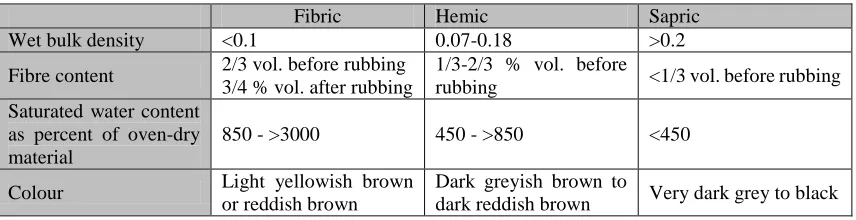
[image:30.612.115.543.231.341.2]from 1.0 to 1.6 Kg m-3. The bulk density of peat, depending upon the ash content, decomposition degree and components of plant residues, is also low, usually ranging from 0.1 to 0.5 Mg m-3 (Jinming and Xuehui, 2002). Table 2.2 shows the characteristic of organic material according to their degree of decomposition, while, the degree of humification according to the Von Post scale was shown in Table 2.3.
Table 2.2: Characteristic of organic material according to their degree of decomposition (Soil Survey Stuff, 1999)
Fibric Hemic Sapric
Wet bulk density <0.1 0.07-0.18 >0.2
Fibre content 2/3 vol. before rubbing
3/4 % vol. after rubbing
1/3-2/3 % vol. before
rubbing <1/3 vol. before rubbing
Saturated water content as percent of oven-dry material
850 - >3000 450 - >850 <450
Colour Light yellowish brown
or reddish brown
Dark greyish brown to
dark reddish brown Very dark grey to black
Table 2.3: The Von Post scale of humification (Von Post, 1922)
Symbol Description
H1 Almost all the plant residues are still present; water in the peat is transparent.
H2 The plant residues are barely decomposed; water is transparent but with a light brown colour. H3 Small amount of plant residues are decomposed; water is turbid and brown.
H4 Small amounts of plant residues are decomposed; water is very turbid, but the peat cannot flow between the fingers.
H5 The plant residues are somewhat decomposed, but the organisms can still be discerned; water is brown and very turbid; small parts of the peat can flow between the fingers.
H6 Large quantities of the plant residues are decomposed; about 1/3 of the peat can flow between the fingers, and the remains of plants left in the hand can still be discerned.
H7 The plant residues are highly decomposed and about ½ peat can flow between the fingers; the water is clear in colour.
H8 The plant residues are highly decomposed and 2/3 of the peat can flow through the fingers; plant remains in the hand are hydrolysed rootstocks and the woody material.
H9 Fully decomposed; all parts are fluid and the organisms cannot be discerned. H10 Fully decomposed; the peat is all washed away with water.
2.2.2 Clay soil
aluminum silicates composed of two basic units: (1) silica tetrahedron and (2) alumina octahedron (Das and Sobhan, 2014). Clays become plastic due to their water content and non-plastic when dried.
The clay particles carry a net negative charge on their surface and in dry condition the negative charge is balanced by exchangeable cations (Das and Sobhan, 2014). Therefore, the presence of clay minerals provide cation exchange sites and has a great influence on the soil conductivity (Huat et al., 2014). According to Long et al. (2012), high clay content contribute to very low resistivity values.
2.3 Dynamic behavior of soil
In geotechnical earthquake engineering problems, the determination of dynamic soil properties is extremely important and critical task. The applications include geotechnical design applications, site characterization, settlement analyses, seismic hazard analyses, site response analysis and soil-structure interaction (Heureux and Long, 2016). Dynamic soil properties includes shear wave velocity (Vs), shear modulus (G), damping ratio (D) and Poisson’s ration (v) (Luna and Jadi, 2000). According to Kishida et al., (2009) research on dynamic properties of highly organic soil are limited which only consist of Union Bay in Washington State (Seed and Idriss, 1970), Queensboro Bridge in New York (Stokoe et al., 1994), Sherman Island in California (Boulanger et al., 1998; Wehling et al., 2003), Mercer Slough in Washington State (Kramer, 2000), and Ojiya City in Japan (Tokimatsu and Sekiguchi, 2007).
10
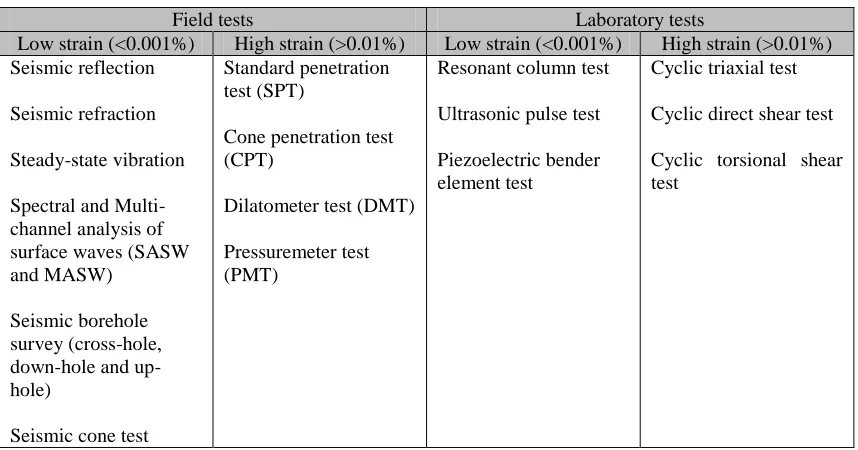
Table 2.4: Field and laboratory test employed for dynamic investigation of soil (Kumar et al., 2014)
Field tests Laboratory tests
Low strain (<0.001%) High strain (>0.01%) Low strain (<0.001%) High strain (>0.01%) Seismic reflection
Seismic refraction
Steady-state vibration
Spectral and Multi-channel analysis of surface waves (SASW and MASW)
Seismic borehole survey (cross-hole, down-hole and up-hole)
Seismic cone test
Standard penetration test (SPT)
Cone penetration test (CPT)
Dilatometer test (DMT)
Pressuremeter test (PMT)
Resonant column test
Ultrasonic pulse test
Piezoelectric bender element test
Cyclic triaxial test
Cyclic direct shear test
Cyclic torsional shear test
2.3.1 Shear wave velocity (Vs)
Shear wave velocity is equal to the square root of the ratio of shear modulus (G), which is a constant of the medium, to density (𝜌) of the medium as mentioned in Equation 2.1.
v = √𝐺/𝜌. (2.1)
According to Bessason and Erlingsson (2011), shear-wave velocity is a key parameter to compute the stiffness of a soil layer. The increases in shear-wave velocity causes increases in material shear strength (rigidity) (Ivanov et al., 2008). Therefore, the shear-wave velocity is directly proportional to the stiffness or rigidity. This critical parameter also is important in an earthquake hazards investigations and can be used to determine the respond of the highway and the highway structures in the event of an earthquake (Anderson et al., 2007). Table 2.5 shows site class definition according to International code council, Inc., (2000).
to Luo et al. (2009), under the assumption of a mildly lateral shear-wave velocity variation, the inverted 1-D shear-wave velocity model is obtained from the average of the Earth covered by the geophone spread.
Table 2.5: Site class definition (International Code Council, Building Officials, 2000)
Site Class Soil Profile Name
Average Properties in Top 100 feet (as per 2000 IBC section 1615.1.5) Soil Shear Wave Velocity, Vs
Feet/second Meters/second
A Hard rock Vs > 5000 Vs > 1524
B Rock 2500 < Vs ≤ 5000 762 < Vs ≤ 1524
C Very dense soil and soft rock 1200 < Vs ≤ 2500 366 < Vs ≤ 762
D Stiff soil profile 600 < Vs ≤ 1200 183 < Vs ≤ 366
E Soft soil profile Vs < 600 Vs < 183
2.3.2 Past research on shear-wave velocity (Vs)
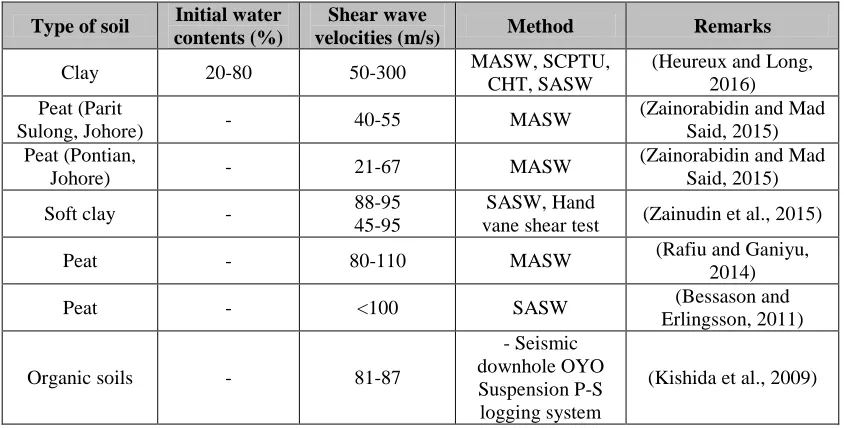
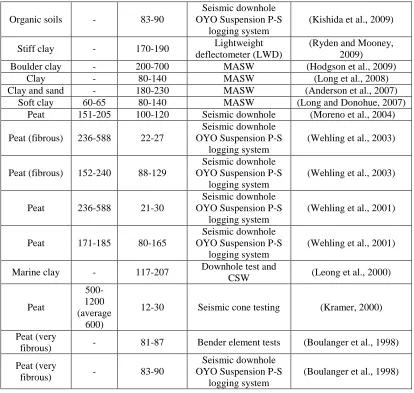
[image:33.612.117.539.468.682.2]The determination of shear-wave velocities of soil has grown intensely due to its importance in dynamic soil properties. Many researches have develop soil shear-wave velocities using different method at different type of soil. Table 2.6 shows some of the previous research using different type of method at soft soil location.
Table 2.6: Summary of previous research regarding soil shear wave velocities
Type of soil Initial water contents (%)
Shear wave
velocities (m/s) Method Remarks
Clay 20-80 50-300 MASW, SCPTU,
CHT, SASW
(Heureux and Long, 2016) Peat (Parit
Sulong, Johore) - 40-55 MASW
(Zainorabidin and Mad Said, 2015) Peat (Pontian,
Johore) - 21-67 MASW
(Zainorabidin and Mad Said, 2015)
Soft clay - 88-95
45-95
SASW, Hand
vane shear test (Zainudin et al., 2015)
Peat - 80-110 MASW (Rafiu and Ganiyu,
2014)
Peat - <100 SASW (Bessason and
Erlingsson, 2011)
Organic soils - 81-87
- Seismic downhole OYO Suspension P-S logging system
12
Table 2.6: Summary of previous research regarding soil shear wave velocities (continued)
Organic soils - 83-90
Seismic downhole OYO Suspension P-S
logging system
(Kishida et al., 2009)
Stiff clay - 170-190 Lightweight
deflectometer (LWD)
(Ryden and Mooney, 2009)
Boulder clay - 200-700 MASW (Hodgson et al., 2009)
Clay - 80-140 MASW (Long et al., 2008)
Clay and sand - 180-230 MASW (Anderson et al., 2007)
Soft clay 60-65 80-140 MASW (Long and Donohue, 2007)
Peat 151-205 100-120 Seismic downhole (Moreno et al., 2004)
Peat (fibrous) 236-588 22-27
Seismic downhole OYO Suspension P-S
logging system
(Wehling et al., 2003)
Peat (fibrous) 152-240 88-129
Seismic downhole OYO Suspension P-S
logging system
(Wehling et al., 2003)
Peat 236-588 21-30
Seismic downhole OYO Suspension P-S
logging system
(Wehling et al., 2001)
Peat 171-185 80-165
Seismic downhole OYO Suspension P-S
logging system
(Wehling et al., 2001)
Marine clay - 117-207 Downhole test and
CSW (Leong et al., 2000)
Peat
500-1200 (average
600)
12-30 Seismic cone testing (Kramer, 2000)
Peat (very
fibrous) - 81-87 Bender element tests (Boulanger et al., 1998)
Peat (very
fibrous) - 83-90
Seismic downhole OYO Suspension P-S
logging system
(Boulanger et al., 1998)
2.4 Soil resistivity
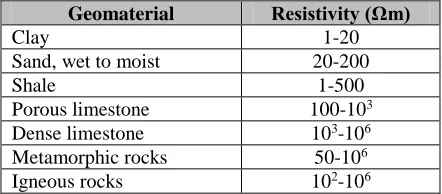
[image:35.612.217.438.405.502.2]Soil resistivity is defined as the measurement of how much soil resist to the flow of electricity. Subsurface electric resistivity distribution measurement in 2-D allows the estimation of heterogeneity (Slob, 2004). The soil resistivity value also is considered as one of the critical factor to determine the grounding system. Different type of soils have different resistivity and conductivity value. Materials resistivity varied greatly from one another, thus, measuring the resistivity of unknown material has the potential to identify the material (Herman, 2001). The resistivity of soil depends on the degree of saturation, the resistivity of pore fluid, porosity, and shape, size of particles (Kim et al., 2011). The surface conductivity of the colloids (i.e. clay or/and humus) and presence of ions also shows significant effects on the soil resistivity (Huat et al., 2014). The resistivity value is very dependent on water content (Reynolds, 1997). Table 2.7 displayed the resistivity of some of the common geological materials.
Table 2.7: Resistivity of common geological materials (Everett, 2013)
Geomaterial Resistivity (Ωm)
Clay 1-20
Sand, wet to moist 20-200
Shale 1-500
Porous limestone 100-103
Dense limestone 103-106
Metamorphic rocks 50-106
Igneous rocks 102-106
14
chargeable colloidal particles which resulted in a lower electrical resistivity. The CEC are the main factor in determination of peat electrical conductivity in normal condition, whereas at the more acidic site, organic matter and water content are more influential (Walter et al., 2016).
The presence of clay or the clay layer often shows very low resistivity value. The presence of clay fraction provide cation exchange sites, thus, contributes to lower resistivity (Huat et al., 2014). Jakalia et al. (2015) measured the resistivity of saturated clay and concluded that the presence of saturated clay contributed to very low resistivity zone. The resistivity of clay is ranged from 1 – 100 ohm.m with 30 – 40 % water content and 100 – 200 ohm.m for dry clay.
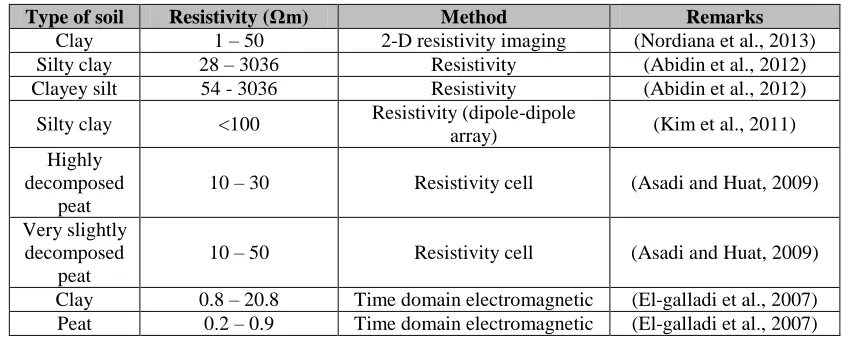
[image:36.612.115.540.424.594.2]Application of resistivity method shows arising confidence with several correlation either with borehole data or among the geophysical methods. Delineation of alluvium zone (10 – 800 ohm.m) and granite bedrock (>2500 ohm.m) using 2-D resistivity which is agreed by the borehole data (Ali et al., 2013). Table 2.8 shows the summary of some soil resistivity value obtained by the previous researchers.
Table 2.8: Summary of previous study on soil resistivity value
Type of soil Resistivity (Ωm) Method Remarks
Clay 1 – 50 2-D resistivity imaging (Nordiana et al., 2013)
Silty clay 28 – 3036 Resistivity (Abidin et al., 2012)
Clayey silt 54 - 3036 Resistivity (Abidin et al., 2012)
Silty clay <100 Resistivity (dipole-dipole
array) (Kim et al., 2011)
Highly decomposed
peat
10 – 30 Resistivity cell (Asadi and Huat, 2009)
Very slightly decomposed
peat
10 – 50 Resistivity cell (Asadi and Huat, 2009)
Clay 0.8 – 20.8 Time domain electromagnetic (El-galladi et al., 2007)
Peat 0.2 – 0.9 Time domain electromagnetic (El-galladi et al., 2007)
2.5 Geophysics
applied to the ‘solid earth’ which by means, exclude the hydrosphere and atmosphere (Sharma, 1997). The study of Earth processes includes the laboratory experiments, computational and theoretical modelling, remote imaging, and direct observation.
[image:37.612.115.544.313.676.2]Geophysical exploration is one of the main field study in solid earth geophysics. It has rapidly expended over the years with the introduction of several methods and techniques. In geological and geotechnical investigation for civil engineering problems, a large area must be investigated. Therefore, geophysical method provide useful tools in such wide area investigations. The summary of 12 commonly used geophysical surveying methods for geotechnical investigations were listed in Table 2.9.
Table 2.9: Summary of 12 commonly used geophysical surveying methods for geotechnical investigations (Anderson et al., 2008)
Geophysical Method Measured Parameter(s) Physical Property or Properties Physical Property Model (Geotechnical Application) Typical Site Model (Geotechnical Application) Shallow seismic refraction
Travel times of refracted seismic
energy (p- or s- wave)
Acoustic velocity (function of elastic moduli and density)
Acoustic velocity-depth model often with
interpreting layer boundaries
Geologic profile
Shallow seismic reflection
Travel times and amplitudes of reflected seismic
energy (p- or s- wave)
Density and acoustic velocity (acoustic velocity is a function of elastic moduli and density)
Acoustic velocity-depth model often with
interpreted layer boundaries Geologic profile Cross-hole seismic tomography
Travel times and amplitudes of seismic energy (p-
or s- wave)
Density and acoustic velocity (acoustic velocity is a function of elastic moduli and density)
Model depicting spatial variations in acoustic value
Geologic profile
Multichannel analyses of surface waves
(MASW)
Travel times of surface wave energy generated
using an active source (e.g., sledge hammer)
Acoustic velocity (function of elastic moduli and density)
Acoustic (shear-wave) velocity-depth model often interpreted layer boundaries Geologic profile Refraction micro-tremor (ReMi)
Travel times of passive surface wave energy
Acoustic velocity (function of elastic moduli and density)
16
Table 2.9: Summary of 12 commonly used geophysical surveying methods for geotechnical investigations (Anderson et al., 2008) (continued)
Geophysical Method Measured Parameter(s) Physical Property or Properties Physical Property Model (Geotechnical Application) Typical Site Model (Geotechnical Application) Ground penetrating radar
(GPR)
Travel times and amplitudes of reflected pulsed EM energy Dielectric constant, magnetic permeability, conductivity and EM velocity EM velocity/depth model with interpreted layer boundaries Geologic profile Electro-Magnetics (EM) Response to natural- induced EM energy Electrical conductivity and inductivity Conductivity-depth model often with interpreted layer boundaries Geologic-hydrologic profile Electrical resistivity Potential differences in response to induced current Electrical resistivity Resistivity-depth model often with interpreted layer boundaries Geologic-hydrologic profile Induced polarization (IP) Polarization voltages or frequency dependent ground resistance
Electric capacitivity Capacitivity-depth model
Model depicting spatial variations in clay content (or
metallic mineralization)
Self potential (SP)
Natural electrical potential differences Natural electric potentials Model depicting spatial variation in natural electric potential of the subsurface
Hydrologic model (seepage through
dam, levee, or fractured bedrock,
etc.)
Magnetics
Spatial variations in the strength of the geomagnetic field Magnetic susceptibility and remanent magnetization Model depicting spatial variations in magnetic susceptibility of subsurface Geologic profile or map (location of faults, variable depth to bedrock,
etc.)
Gravity
Spatial variations in the strength of gravitational field
of the Earth
Bulk density
Model depicting spatial variations in the density of
the subsurface often with interpreted layer
boundaries
Geologic profile or map (location of voids, variable depth to bedrock,
etc.)
2.6 Seismic
new for stabilizing soil, and most of the tests carried out have been exploratory nature. The tests employ seismic wave, P-wave, S-wave, Love wave and Rayleigh waves.
2.6.1 Seismic waves
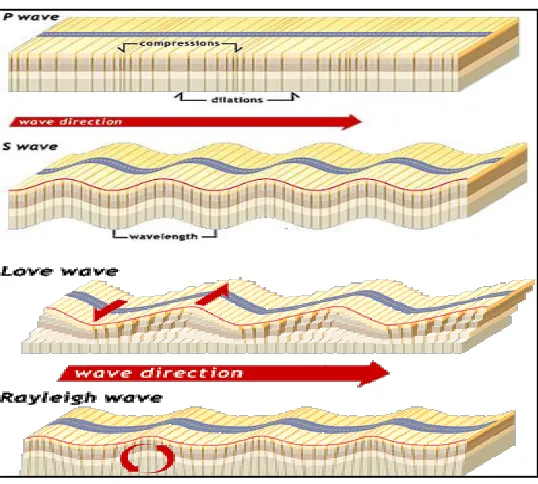
Seismic waves are waves of energy that travel through the Earth’s layers, and are a result of an earthquake, explosion, or a volcano that imparts low-frequency acoustic energy. There are many types of seismic waves, such as, compressional body waves (P-waves), shear body waves (S-waves), Love waves (L-waves), Rayleigh waves (R-waves), etc. The P-waves and S-waves are categorized as body waves while R-waves and L-waves are surface waves. Seismic waves propagate at a rate governed by material properties such as bulk and shear moduli and density. Figure 2.1 shows example of particle motion waves pass through a medium.
18
Figure 2.1: The particle motions when the seismic waves pass the medium (Central Weather Bureau, 2012)
Figure 2.2: Seismic wave front and seismic ray
2.6.1.1 Rayleigh wave
[image:40.612.130.528.362.521.2]waves that makes the ground move up and down in a retrograde elliptical pattern as shown in Figure 2.1. According to Xia et al. (1999), Rayleigh waves are the result of interfering P and Sv waves. Particle motion is constrained to the vertical plane consistent with the direction of wave propagation. In addition, Rayleigh wave has smaller attenuation, high S/N ratio, stronger immunity of interference and shear wave velocity is the dominant property (Luo et al., 2009). The longer wavelength surface waves penetrate deeper into the earth compared to the shorter wavelength (Pei et al., 2006). The strong particle motion close to the surface of Rayleigh wave is attenuated with depth (Bessason and Erlingsson, 2011). The inversion of the dispersive phase velocity of the surface (Rayleigh and/or Love) wave will produce the S-wave velocity (Xia et al., 1999).
2.6.2 Seismograph
[image:41.612.152.501.444.602.2]The seismograph is an equipment used by seismologists to measure the ground acceleration of the Earth. The records of the arrival times of seismic waves recorded by the seismograph is called seismogram. Figure 2.3 shows a various seismic waves arrival times created by a seismograph which is shown by the seismogram image.
20
2.7 Multichannel analysis of surface waves (MASW)
MASW is a seismic exploration method evaluating ground stiffness in 1-D, 2-D, and 3-D formats for various types of Geotechnical engineering projects. Since its first introduction in the late 1990s by the Kansas Geological Survey (Park et al., 1999), it has been utilized by many practitioners and researched by many investigators worldwide. The MASW exploits multichannel recording and processing techniques in order to solve the problem associated with the Spectral Analysis of Surface Waves (SASW) (Huang and Mayne, 2008).According to Xia et al., (2002), MASW is an environmentally-friendly method for estimation of shear-wave velocity with depth. It is also economically reliable compared to several other method. This survey deals with surface waves in the lower frequencies range 1-30 Hz and much shallower depth of investigation (Park et al., 2007). In the matter of time for example, MASW method needed approximately a few minutes to obtain the data.
2.7.1 Active MASW method
Table 2.10: Data acquisition parameters for active MASW survey (in meters) (Park Seismic LLC., n.d.)
Depth (Zmax)1
(m)
Source (S)2
(lb)
Receiver (R)3
(Hz)
Receiver Spread (RS) (m) SR Move6 (dx) Recording8
Length4
(D)
Source offset5
(X1)
Receiver Spacing
(dx) Lateral Resolution
7
dt9 (ms) T10 (sec) Vertical Stack11
24-ch* 48-ch High Medium Low C N VN
≤ 1.0 ≤ 1 4.5-100 1-3 0.2-3.0 0.05-0.1 0.02-0.05 1-2 2-4 4-12 0.5-1.0 0.5-1.0 1-3 3-5 5-10
(1)** (40) (2.0) (0.4) (0.1) (0.05) (1) (2) (4) (0.5) (0.5) (3) (5) (10)
1-5 1-5 4.5-40 1-15 0.2-15 0.05-0.6 0.02-0.3 1-2 2-4 4-12 0.5-1.0 0.5-1.0 1-3 3-5 5-10
(5) (10) (10) (2) (0.5) (0.25) (1) (2) (4) (0.5) (0.5) (3) (5) (10)
5-10 5-10 ≤ 10 5-30 1-30 0.2-1.2 0.1-0.6 1-2 2-4 4-12 0.5-1.0 0.5-1.0 1-3 3-5 5-10
(10) (4.5) (20) (4) (1.0) (0.5) (1) (2) (4) (0.5) (0.5) (3) (5) (10)
10-20 ≥ 10 ≤ 10 10-60 2-60 0.4-2.5 0.2-1.2 1-2 2-4 4-12 0.5-1.0 1.0-2.0 1-3 3-5 5-10
(20) (4.5) (30) (10) (1.5) (1.0) (1) (2) (4) (0.5) (0.5) (3) (5) (10)
20-30 ≥ 10 ≤ 4.5 20-90 4-90 0.8-3.8 0.4-1.9 1-2 2-4 4-12 0.5-1.0 1.0-2.0 1-3 3-5 5-10
(20) (4.5) (50) (10) (2.0) (1.5) (1) (2) (4) (1.0) (1.0) (3) (5) (10)
30-50 ≥10(20) ≤ 4.5 30-150 6-150 1.2-6.0 0.6-3.0 1-2 2-4 4-12 0.5-1.0 1.0-3.0 1-3 3-5 5-10
or
passive (4.5) (70) (15) (3.0) (2.0) (1) (2) (4) (1.0) (1.0) (3) (5) (10)
> 50 ≥10(20) ≤ 4.5 > 50 > 10 > 2.0 > 1.0 1-2 2-4 4-12 0.5-1.0 ≥ 1.0 1-3 3-5 5-10
or
passive (4.5) (150) (30) (6.0) (4.0) (1) (2) (4) (1.0) (2.0) (3) (5) (10)
2.8 Factors influencing MASW data acquisition
In every research, there are always factors that affect the testing or result obtained. Careful action need to be taken to minimize the error caused by these factors. In this subtopic, several factors that related to MASW data acquisition are stated and discussed. Those factors are seismograph setting, equipment configuration, topography, and dispersion curve plotting.
2.8.1 Seismograph configuration
The seismograph is an equipment used to record the waves received by the sensor. In this study, ABEM Terraloc MK8 is used to record the waves. The critical configuration for the seismograph involved the acquisition setup, receiver spread and layout geometry.
2.8.1.1 Acquisition setup
[image:45.612.112.544.641.714.2]The acquisition setup interface involves the configuration for the setup, trig, noise and filters. For the setup, it involves the sampling interval, number of samples, pre-trig or delay, number of stacks, stack mode and re-arm mode. The pre-trig or delay, stack mode and re-arm mode, can be configured according to the needs during the data acquisition. The sampling interval and number of sample are critical as it will determine the recording time for each data set. Short recording time will cause incomplete data set recorded. While, long recording time increase the possibility of recording ambient noise (Taipodia and Dey, 2012). Table 2.11 shows some sample interval and record length used by earlier researchers.
Table 2.11: Sample interval and record length used by previous researchers
Author (Year) Type of soil Total receiver length (m)
Nearest offset (m)
Sample interval (µs)
No of samples (Madun et al.,
2016) Marine clay 23 and 115 2 and 5 250 – 500 4096 - 8192
(Xia et al.,
24
The number of stacks is determined according to the environment and type of soil involves. When the environment involves high noise due to traffic such as at urban location, high number of stacking is needed to increase the signal-to-noise ratio. Limited noise such as at rural area need less number of stacking as the signal-to-noise ratio is already high. However, the type of soil also affect the determination of number of stacking. Weak soil such as highly organic soil will interrupt the wave travel during data acquisition which directly affect the S/N ratio. Therefore, by increasing the number of stacking will improved the S/N ratio. As for the hard soil, the wave travel will be less affected which provide high signal-to-noise ratio.
The trigger setup involved the configuration of trig input mode, trig input level, external trig/arm out mode and verify timeout (ms). High value of input level increased the sensitivity of the trigger which means lower signal level is needed to trig the terraloc (“Seismic System Reference Manual for ABEM Terraloc ® Mk6 v2 and Mk8 with ABEM SeisTW for Windows XP ® 2009-05-19,” 2009). The environment noise should also be consider to prevent auto-trigger due to high sensitivity trigger. The noise monitor can be set on or off. However, it is recommended to turn it on to allow noise monitoring before and during data acquisition. The damping value define the sensitivity of the recorder. Lower damping value will increase the sensitivity of source detection. But, with the presence of high noise, it is recommended to set higher value to prevent auto-triggered by the noise. The threshold level does not affect much in this study, therefore, it is set as zero.
The filter setting allows the data filtering during data acquisition. However, it is best to turn of this setting to produce high quality data with minimum altering. This is to provide engineer with the real in-situ data.
2.8.1.2 Receiver spread
REFERENCES
Abdul-Nafiu, A. K., Mohd. Nordin, M. N., Abdullah, K., Saheed, I. K., & Abdullah, A. (2013). Effects of electrode spacing and inversion techniques on the efficacy of 2D resistivity imaging to delineate subsurface features. American Journal of Applied Sciences, 10(1), 64–72.
Abem (2010). ABEM SAS 4000 Instruction Manual, (33), 148.
Abidin, M. H. Z., Saad, R., Ahmad, F., Wijeyesekera, D. C., & Baharuddin, M. F. T. (2012). Integral Analysis of Geoelectrical (Resistivity) and Geotechnical (SPT) Data in Slope Stability Assessment, 1(2), 305–316.
Agus, S., Ismail, B., & Amirkhan, S. (2010). The Performance Evaluation of Lightweight Concrete Piles on UTHM’s Soft Soil under Static and Dynamic Loading Tests. International Journal of Integrated Engineering, 53–65.
Aizebeokhai, A. P., Oyeyemi, K. D., & Kayode, O. T. (2015). Multiple-gradient array for near-surface electrical resistivity tomography. Near-Surface Asia Pacific Conference, 324–327.
Ali, N., Saad, R., & Mohd Muztaza, N. (2013). Integration of Seismic Refraction and 2D Electrical Resistivity in Locating Geological Contact. Open Journal of Geology, 03(02), 7–12.
Anderson, N., Thitimakorn, T., Hoffman, D., Stephenson, R., & Luna, R. (2007). A Comparison of Four Geophysical Methods for Determining the Shear Wave Velocity of Soils. Engineering, XIII(1), 11–23.
Apostolopoulos, G. (2008). Combined Schlumberger and dipole-dipole array for hydrogeologic applications. Geophysics, 73(5), 189–195.
165
ASTM (2002). ASTM D4427-02 Standard Classification of Peat Samples by Laboratory Testing. American Society of Testings and Methods, ASTM, 92(Reapproved), 5–7. Baines, D., Smith, D. G., Froese, D. G., Bauman, P., & Nimeck, G. (2002). Electrical
resistivity ground imaging (ERGI): A new tool for mapping the lithology and geometry of channel-belts and valley-fills. Sedimentology, 49(3), 441–449.
Bessason, B., & Erlingsson, S. (2011). Shear wave velocity in surface sediments. Jokull, 51–64.
Boulanger, R. W., Arulnathan, R., Harder Jr., L. F., Torres, R. A., & Driller, M. W. (1998). Dynamic Properties of Sherman Island Peat. Journal of Geotechnical and Geoenvironmental Engineering, 124(1), 12–20.
Burger, H. R., Sheehan, A. F., & Jones, C. H. (2006). Introduction to Applied Geophysics. New York: W.W. Norton & Company, Inc.
Das, B. M., & Sobhan, K. (2014). Principles of Geotechnical Engineering (Eighth). United States of America: Cengage Learning.
Dey, T. and, Taipodia, J., & Dey, A. (2012). A Review of Active and Passive MASW Techniques. Egceg.
Edwards, L. S. (1977). A Modified Pseudosection for Resistivity and Ip. Geophysics, 42(5), 1020–1036.
Eijkelkamp Agrisearch Equipment (2014). Peat Sampler Operating Instruction. Netherlands: Eijkelkamp Agrisearch Equipment.
El-galladi, A., El-qady, G., & Metwaly, M. (2007). Mapping Peat Layer Using Surface Geoelectrical Methods at Mansoura Environs, Nile Delta, Egypt, 34, 59–78.
Everett, M. E. (2013). Near-Surface Applied Geophysics (First edit). Cambridge: Cambridge University Press.
Geo Services (2001). Geotechnical Investigation Report for "Cadangan Membina dan Menyiapkan Sebuah Bangunan Pusat Mahasiswa di Kolej Universiti Teknologi Tun Hussein Onn, Mukim Parit Raja, Daerah Batu Pahat, Johor Darul Takzim. Technical Report.
Google Maps (n.d.-a). Jalan Kampung Parit Nipah Darat. Retrieved August 27, 2016, from https://goo.gl/maps/ZX1kZEddfN42
https://goo.gl/maps/sHktvoENyNM2
Griffiths, D. H., & Barker, R. D. (1993). Two-dimensional resistivity imaging and modelling in areas of complex geology. Journal of Applied Geophysics, 29(3-4), 211–226.
Hayashi, H., Yamazoe, N., Mitachi, T., Tanaka, H., & Nishimoto, S. (2012). Coefficient of earth pressure at rest for normally and overconsolidated peat ground in Hokkaido area. Soils and Foundations, 52(2), 299–311.
Herman, R. (2001). An introduction to electrical resistivity in geophysics. American Journal of Physics, 69, 943.
Heureux, J. S. L., & Long, M. (2016). Correlations between shear wave velocity and geotechnical parameters in Norwegian clays. Proceedings of the 17th Nordic Geotechnical Meeting, 299–308.
Hodgson, J. A., Donohue, S., O’Connell, Y., Krahn, H., Reid, G., & Young, M. (2009). A geophysical journey around Ireland. First Break, 27(8), 35–42.
Huat, B. B. K., Prasad, A., Asadi, A., & Kazemian, S. (2014). Geotechnical of Organic Soils and Peat.
Huat, B., Prasad, A., Asadi, A., & Kazemian, S. (2014). Geotechnics of Organic Soils and Peat. London: CRC Press.
International Code Council. (2000). International building code. Falls Church, Va.:International Code Council.
International Wetlands. (2010). A Quick Scan of Peatlands in Malaysia, 86.
Ivanov, J., Miller, R. D., Morton, S., & Peterie, S. (2015). Dispersion-Curve Imaging Considerations When Using Multichannel Analysis of Surface Wave (MASW) Method. Symposium on the Application of Geophysics to Engineering and Environmental Problems 2015, 556–566.
Ivanov, J., Miller, R. D., & Tsoflias, G. (2008). Some Practical Aspects of MASW Analysis and Processing. Symposium on the Application of Geophysics to Engineering and Environmental Problems 2008, 1186–1198.
167
Resistivity Measurements Using The Electrical Resistivity Method : A Case Study of A Maize Farm Under Different Soil Preparation Modes At KNUST Agricultural Research Station, Kumasi. International Journal of Scientific & Technology Resesarch, 4(1), 9–18.
Jinming, H., & Xuehui, M. (2002). Physical and Chemical Properties of Peat. Encyclopedia of Life Support Systems: Coal, Oil Shale, Natural Bitumen, Heavy Oil and Peat, II.
Kim, M. Il, Kim, J. S., Kim, N. W., & Jeong, G. C. (2011). Surface geophysical investigations of landslide at the Wiri area in Southeastern Korea. Environmental Earth Sciences, 63(5), 999–1009.
Kishida, T., Wehling, T. M., Boulanger, R. W., Driller, M. W., & Stokoe, K. H. (2009). Dynamic Properties of Highly Organic Soils from Montezuma Slough and Clifton Court. Journal of Geotechnical and Geoenvironmental Engineering, 135(4), 525– 532.
Kolay, P. K., Sii, H. Y., & Taib, S. N. L. (2011). Tropical Peat Soil Stabilization using Class F Pond Ash from Coal Fired Power Plant. International Journal of Civil and Environmental Engineering, 3(2), 79–83.
Kramer, S. L. (2000). Dynamic Response of Mercer Slought Peat. Journal of Geotechnical and Geoenvironmental Engineering, 90, 504–510.
Kumar, S. S., Murali Krishna, A., & Dey, A. (2014). Parameters Influencing Dynamic Soil Properties: A Review Treatise. International Journal of Innovative Research in Science, 3(4), 47–60.
Leong, E. C., Anand, S., Cheong, H. K., & Pan, T. C. (2000). In-situ measurement of shear wave velocities at two soft soil sites in Singapore, (161).
Ling, F. N. L., Kassim, K. A., Tarmizi, A., Karim, A., Tiong, K., & Tan, C. K. (2013). Geochemistry Properties of Southern Malaysian Organic Soil, 287, 1340–1344. Loke, M. H. (2004). Tutorial : 2-D and 3-D electrical imaging surveys. Geotomo Software
Malaysia, 127.
Loke, M. H. (1999). Electrical imaging surveys for environmental and engineering studies. Cangkat Minden Lorong, 6574525, 63.
Instruction Manual. Geotomo Software.
Loke, M. H., Wilkinson, P. B., & Chambers, J. E. (2010). Fast computation of optimized electrode arrays for 2D resistivity surveys. Computers and Geosciences, 36(11), 1414–1426.
Long, M., & Donohue, S. (2007). In situ shear wave velocity from multichannel analysis of surface waves (MASW) tests at eight Norwegian research sites. Canadian Geotechnical Journal, 44(5), 533–544.
Long, M., Donohue, S., L’Heureux, J. S., Solberg, I. L., Rønning, J. S., Limacher, R., Lecomte, I. (2012). Relationship between electrical resistivity and basic geotechnical parameters for marine clays. Canadian Geotechnical Journal, 49(10), 1158–1168. Long, M., Dublin, C., Connor, P. O., Geoservices, A., & Wexford, C. (2008). Rapid,
cost-effective and accurate determination of in-situ stiffness using MASW at Bothkennar. Ground Engineering, 43–46.
Lowrie, W. (2007). Fundamentals of Geophysics (Second Ed.). Cambridge: Cambridge University Press.
Luna, R., & Jadi, H. (2000). Determination of dynamic soil properties using geophysical methods. First International Conference on the Application of Geophysical and NDT Methodologies to Transportation Facilities and Infrastructure, 1–15.
Luo, Y., Xia, J., Liu, J., Xu, Y., & Liu, Q. (2009). Research on the middle-of-receiver-spread assumption of the MASW method. Soil Dynamics and Earthquake Engineering, 29(1), 71–79.
Madun, A., Ahmad Supa’at, M. E., Ahmad Tajudin, S. A., Zainalabidin, M. H., Sani, S., & Yusof, M. F. (2016). Soil investigation using Multichannel Analysis of Surface Wave (MASW) and borehole. ARPN Journal of Engineering and Applied Sciences, 11(6), 3759–3763.
Mansor, H., & Zainorabidin, A. (2016). Strain Behavior of Parit Nipah Peat Stress-Strain Behavior of Parit Nipah Peat.
169
Mohamed, A. M. E., El, A. S. A. A., Azim, F. A., & Taha, M. A. (2013). Site-specific shear wave velocity investigation for geotechnical engineering applications using seismic refraction and 2D multi-channel analysis of surface waves. NRIAG Journal of Astronomy and Geophysics, 2(1), 88–101.
Moreira, C. A., Lapola, M. M., & Carrara, A. (2016). Comparative analyzes among electrical resistivity tomography arrays in the characterization of flow structure in free aquifer. Geofisica Internacional, 55, 119–129.
Moreno, C. a, Rodriguez, E. E., & Characterization, P. (2004). Dynamic Behavior of Bogota’s Subsoil Peat and It’s Effect in Seismic Wave Propagation. Stress: The International Journal on the Biology of Stress, 1–15.
Morris, M., Ronning, J. S., & Lile, O. B. (1997). Detecting lateral resistivity inhomogeneities with the Schlumberger array. Geophysical Prospecting, 45(3), 435– 448.
Neil, A., Neil, C., Rick, H., & Phil, S. (2008). Geophysical Methods Commonly Employed for Geotechnical Site Characterization. Transportation.
Nordiana, M. M., Saad, R., Nawawi, M. N. M., Azwin, I. N., & Mohamad, E. T. (2013). Case Study: Shallow Subsurface Geology Mapping Using 2-D Resistivity Imaging with EHR Technique. APCBEE Procedia, 5, 134–140.
Oh, Y., Jeong, H., Lee, Y., & Shon, H. (2003). Safety Evaluation of Rock‐Fill Dam by Seismic (MASW) and Resistivity Methods. Symposium on the Application of Geophysics to Engineering and Environmental Problems 2003, 1377–1386.
Park Seismic LLC. (n.d.). MASW-Data Acquisition. Retrieved June 16, 2016, from http://www.masw.com/DataAcquisition.html
Park, C. B., & Carnevale, M. (2010). Optimum MASW Survey — Revisit after a Decade of Use. GeoFlorida 2010: Advances in Analysis, Modeling & Design, (Gsp 199), 1303–1312.
Park, C. B., Miller, R. D., & Xia, J. (2007). Multichannel analysis of surface waves. The Leading Edge, 26(1), 60–64.
Park, C. B., Miller, R.D., & Xia, J. (1999). Multichannel analysis of surface waves. Geophysics, 64, 800–808.
Park, C. B., Miller, R., & Xia, J. (1997). Multi-Channel Analysis of Surface Waves (MASW) - A summary report of technical aspects, experimental results and perspective, 26.
Park, C. B., Miller, R. D., & Miura, H. (2002). Optimum field parameters of an MASW survey. Society of Exploration Geophysicists of Japan, Tokyo.
Pei, D., John N. Louie, & Satish K. Pullammanappallil. (2006). Annual International Meeting, SEG, Expanded Abstracts, 1172–1175.
Penumadu, D., & Park, C. B. (2005). Multichannel Analysis of Surface Wave (MASW) Method for Geotechnical Site Characterization. Earthquake Engineering and Soil Dynamics, 1–10.
Ponziani, M., Slob, E. C., & Vanhala, H. (2011). Influence of Water Content on the Electrical Conductivity of Peat, I(1), 14–21.
Popescu, M., Șerban, R. D., Dea, P. U. R., & Onaca, A. (2016). Conventional Geophysical Surveys for Landslide Investigations: Two Case Studies From Romania, 11(1), 281– 292.
Rafiu, B. A., & Ganiyu, O. B. (2014). Estimation of Shear Wave Velocity for Near- surface Characterisation; Case Study: Ifako / Gbagada Area of Lagos State, S. W. Nigeria, 4(5), 831–840.
Reynolds, J. M. (1997). An introduction to applied and environmental geophysics. New York: Wiley.
Reynolds, J. M. (2011). Electrical resistivity sounding and tomography. Technical Summary Sheet No. 2, (2), 1–2.
Ryden, N., & Mooney, M. A. (2009). Analysis of surface waves from the light weight deflectometer. Soil Dynamics and Earthquake Engineering, 29(7), 1134–1142. Seed, H. B., & Idriss, I. M. (1970). Analyses of ground motions at Union Bay, Seattle
during earthquakes and distant nuclear blasts. Bulletin of the Seismological Society of America, 60(1), 125–136.