Efficient Wireless Channel Estimation using Alamouti
STBC with MIMO and 16
Akansha Gautam
M.Tech. Research ScholarKNPCST, Bhopal, (M. P.)
ABSTRACT
The wireless communication system is better for the new generation of data communication technology, because it facilitates the user to communicate of share information through mobile devices in mobile situation without any leased or dedicated line. This research field is continuously
by the researchers to innovate new techniqu
and easier for the users with lots of facilities. In this paper the communication system is analyzed for channel with applying Alamouti STBC coding with multiple inputs
(MIMO) system. The proposed system is outperformed implemented with 16-PSK modulation. The system configured and tested for 4xM and 2xM, where M is number of receiver antennas.
Keywords
STBC, MIMO and 16 PSK.
1.
INTRODUCTION
Wireless systems of communication have recently turned to a strategy known as Multiple Input Multiple Output
improve the quality (bit-error rate) and data rate
advantage can increase the quality of service and revenues of the operator. This is done by using multiple transmit and receive antennas, as well as appropriate coding
take advantage of spatial and temporal diversity to combat the random fading induced by multi-path propagation of the signal and maximize efficient use of bandwidth. There is a
in transmitting data over a matrix rather than vector channel. The transmission of data over MIMO channels has traditionally focused on data rate maximization or diversity maximization, and space-time codes were developed as a means to the latter. There are two types of STCs have been developed, Trellis Codes and Block Code. “The decoding system
space-time trellis decoding (measured by number of states at the decoder) increases exponentially as a function of the diversity level and transmission rate” [5]. The Space Block Codes we’ll discuss here are often preferred because, the assumption of flat fading Rayleigh channels (whose coefficients are constant and scalar, they may
[image:1.595.56.553.632.722.2]simple linear processing at the receiver Likelihood Sphere Decoder) [5].
Figure 1:
Efficient Wireless Channel Estimation using Alamouti
STBC with MIMO and 16-PSK Modulation
Rajani Gupta
Assistant Professor and HeadKNPCST, Bhopal, (M. P.)
Assistant TIT College
is better for the new generation of data communication technology, because it facilitates the user to communicate of share information without any leased continuously exploring nnovate new techniques to make more for the users with lots of facilities. In this paper the communication system is analyzed for channel with applying inputs multiple output . The proposed system is outperformed when . The system configured is number of receiver
Wireless systems of communication have recently turned to a Input Multiple Output (MIMO) to error rate) and data rate (bits/sec). This advantage can increase the quality of service and revenues of This is done by using multiple transmit and coding methods. They take advantage of spatial and temporal diversity to combat the path propagation of the signal of bandwidth. There is a basic gain than vector channel. ransmission of data over MIMO channels has traditionally on data rate maximization or diversity maximization, as a means to the latter. wo types of STCs have been developed, Trellis system complexity of time trellis decoding (measured by number of trellis states at the decoder) increases exponentially as a function of transmission rate” [5]. The Space-Time preferred because, the assumption of flat fading Rayleigh channels (whose are constant and scalar, they may be decoded using simple linear processing at the receiver (the Maximal
1.1 Space-Time Coding Model
Suppose we have a MIMO system with n transmits and m receives antennas. At the
symbols belonging to a constellation set, such as QAM or HEX, are parsed into blocks: s(n) = [s(nK), . . . , s(nK + K 1)]T of size K × 1. The block s(n)
which maps s(n) to column vectors in the following
Where the coded symbol cij belong to the constellation set and P is the frame(block) length. At each time slot t, signals c 1, 2, . . . , n are transmitted simultaneously from the n
antennas [6]. Ultimately, each transmit antenna sees a differently encoded version of the same signal.
these signals are resolved by the receiver into a That has the effect of combating
occurred in the separate channels. There to STBCs , the scheme of Alamouti
recently [2] and [7] have developed what they call Perfect STCs. These codes are so called because they satisfy a number of design criteria and only occur in
results suggest that these PSTBCs often outperform other STBCs p. 26 in [7].
2.
PROPOSED METHODOLOGY
The above mentioned wireless comm into consideration for the simulation and
performance of the existing system. The existing wireless communication system adopting MISO with 8 Modulation and Alamouti STBC to make system better. But in this paper the proposed system is adopting multiple input multiple output (MIMO) system which is better for reliable delivery of information from source to destination, to
the security and data rate technique adopt 16
and to achieve better bit error probability the Alamouti STBC is integrate with the mentioned system.
the proposed methodology is given
Figure 1: Block diagram of the Proposed Methodology
Efficient Wireless Channel Estimation using Alamouti
PSK Modulation
Pankaj Soni
Assistant Professor TIT College Bhopal, (M. P.)ing Model
system with n transmits antennas tennas. At the transmitter, information nstellation set, such as QAM or s(n) = [s(nK), . . . , s(nK + K − of size K × 1. The block s(n) is encoded by the ST encoder column vectors in the following n× m ST
(1)
belong to the constellation set and At each time slot t, signals cit, i =
1, 2, . . . , n are transmitted simultaneously from the n transmit antennas [6]. Ultimately, each transmit antenna sees a of the same signal. Being received, these signals are resolved by the receiver into a single signal. combating multi-path fading that has separate channels. There are many approaches to STBCs , the scheme of Alamouti being the first [1]. Very recently [2] and [7] have developed what they call Perfect so called because they satisfy a number of design criteria and only occur in a few cases. Simulation results suggest that these PSTBCs often outperform other
PROPOSED METHODOLOGY
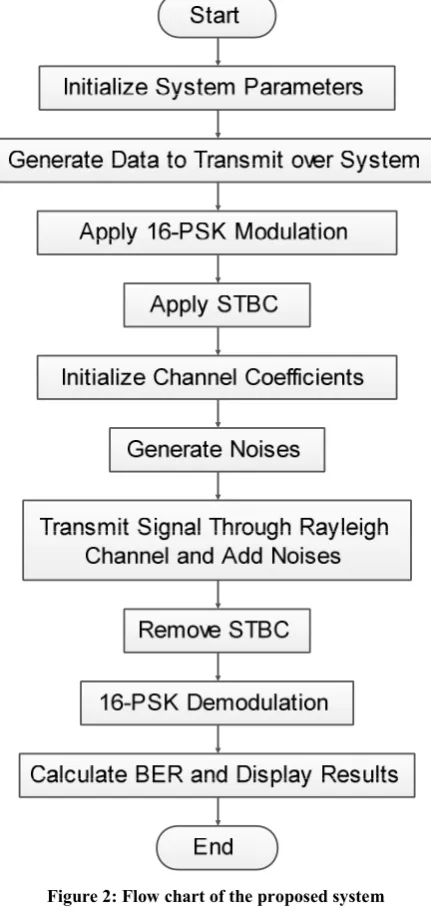
The major block of the proposed system are 16-PSK modulation applied on the input data, followed by Alamouti STBC coding which needs to be initialize channel.
Figure 2: Flow chart of the proposed system implementation of simulation model
Here the system considers Rayleigh Fading Channel, now signal is transmitted through the channel and during transmission noises has been added. At the receiver side STBC is removed and the signal is recovered followed by demodulation with 16-PSK technique and will get output data. The proposed system implemented on simulation tool and the step by step execution of the implemented system is given in the flow chart of the system refer Figure 2.
The steps of simulation are as follows: a. Start simulation
b. Initialization of system parameters(variable) to create artificial environment
c. Generate data to transmit over system so that end to end performance of the system is calculated
d. Data is modulated with 16-PSK modulation which is better and having increased data rate than 8-PSK modulation
e. Applying STBC on modulated signal
f. Initialize channel coefficients for MIMO suitable for space time structure
g. Generate noise signal which will is being added during transmission through channel
h. Transmission through Rayleigh Fading channel i. Remove STBC to recover signal
j. Demodulate signal with 16-PSK scheme k. Calculate BER and display results l. End of simulation
3.
SIMULATION RESULTS
Wireless communication system is implemented and the outcomes of the proposed system are explained in this section. The outcome is in terms of bit error rate (BER). BER is the figure of merit to analyze end to end performance calculated for certain range of signal to noise ratio (SNR).
The proposed system is evaluated under different MIMO configurations which are shown in the figures given below.
3.1 MIMO 2 x 2 Configurations
[image:2.595.314.553.429.660.2]This configuration is analyzed with 2 transmitters and 2 receivers and the BER is achieved minimum is of the range of 10-3.5 which is lower than existing work (i.e. 10-2.4) as shown in Figure 3.
Figure 3: BER versus Curve for 2x2 MIMO with 16-PSK and Alamouti STBC
3.2 MIMO 2 x 4 Configurations
This configuration is analyzed with 2 transmitters and 4 receivers and the BER is achieved minimum is of the range of 10-2.9 which is lower than existing work (i.e. 10-2.4) as shown in Figure 4.
0 5 10 15 20 25 30
10-4 10-3 10-2 10-1 100
SNR[dB]
B
E
R
BER Curve for Alamouti STBC MIMO for 1000 Symbols and 2x2 with PSK
Figure 4: BER versus Curve for 2x4 MIMO with 16-PSK and Alamouti STBC
3.3 MIMO 2 x 6 Configurations
[image:3.595.316.554.140.334.2]This configuration is analyzed with 2 transmitters and 6 receivers and the BER is achieved minimum is of the range of 10-3 which is lower than existing work (i.e. 10-2.4) as shown in Figure 5.
Figure 5: BER versus Curve for 2x6 MIMO with 16-PSK and Alamouti STBC
3.4 MIMO 2 x 8 Configurations
This configuration is analyzed with 2 transmitters and 8 receivers and the BER is achieved minimum is of the range of 10-3.3 which is lower than existing work (i.e. 10-2.4) as shown in Figure 6.
Figure 6: BER versus Curve for 2x8 MIMO with 16-PSK and Alamouti STBC
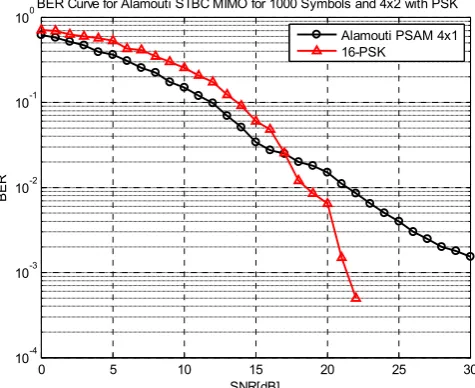
3.5 MIMO 4 x 2 Configurations
This configuration is analyzed with 4 transmitters and 2 receivers and the BER is achieved minimum is of the range of 10-3.5 which is lower than existing work (i.e. 10-2.9) as shown in Figure 7.
Figure 7: BER versus Curve for 4x2 MIMO with 16-PSK and Alamouti STBC
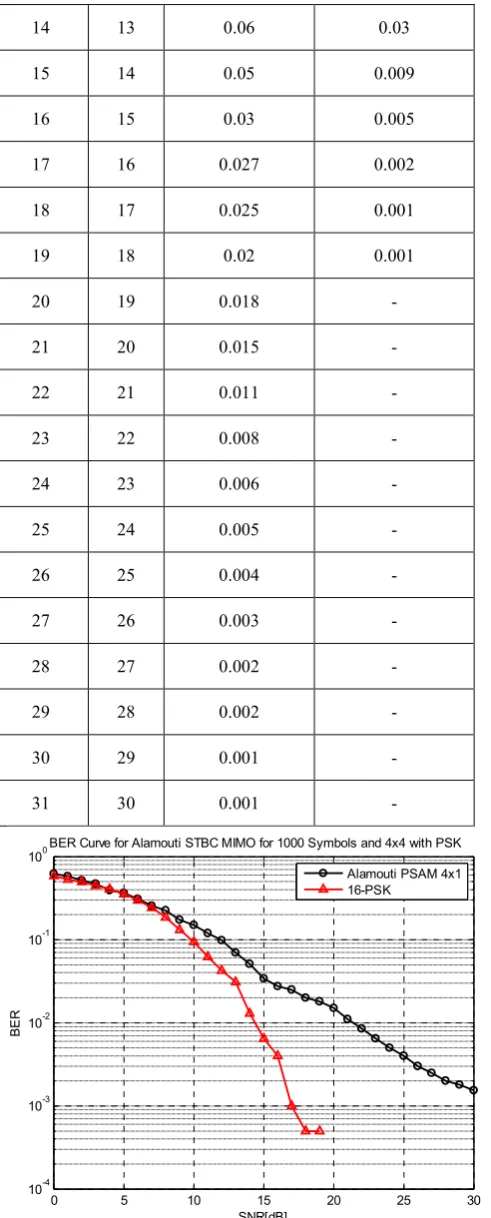
3.6 MIMO 4x 4 Configurations
[image:3.595.57.297.327.492.2] [image:3.595.58.548.439.770.2]This configuration is analyzed with 4 transmitters and 4 receivers and the BER is achieved minimum is of the range of 10-3.5 which is lesser than existing work (i.e. 10-2.9) as shown in Figure 8.
Table 1. Comparison between proposed & previous work-
S. No. SNR Previous results Proposed results
1 0 0.61 0.58 2 1 0.57 0.54 3 2 0.51 0.49 4 3 0.47 0.43 5 4 0.39 0.37 6 5 0.36 0.33 7 6 0.30 0.28 8 7 0.25 0.23 9 8 0.22 0.20 10 9 0.17 0.14 11 10 0.15 0.09 12 11 0.12 0.06 13 12 0.09 0.03
0 5 10 15 20 25 30
10-3 10-2 10-1 100
SNR[dB]
B
E
R
BER Curve for Alamouti STBC MIMO for 1000 Symbols and 2x4 with PSK
Alamouti PSAM 2x1 16-PSK
0 5 10 15 20 25 30
10-3 10-2 10-1 100
SNR[dB]
B
E
R
BER Curve for Alamouti STBC MIMO for 1000 Symbols and 2x6 with PSK
Alamouti PSAM 2x1 16-PSK
0 5 10 15 20 25 30
10-4 10-3 10-2 10-1 100
SNR[dB]
B
E
R
BER Curve for Alamouti STBC MIMO for 1000 Symbols and 2x8 with PSK
Alamouti PSAM 2x1 16-PSK
0 5 10 15 20 25 30
10-4 10-3 10-2 10-1 100
SNR[dB]
B
E
R
BER Curve for Alamouti STBC MIMO for 1000 Symbols and 4x2 with PSK
14 13 0.06 0.03 15 14 0.05 0.009 16 15 0.03 0.005 17 16 0.027 0.002 18 17 0.025 0.001 19 18 0.02 0.001 20 19 0.018 - 21 20 0.015 - 22 21 0.011 - 23 22 0.008 - 24 23 0.006 - 25 24 0.005 - 26 25 0.004 - 27 26 0.003 - 28 27 0.002 - 29 28 0.002 - 30 29 0.001 - 31 30 0.001 -
Figure 8: BER versus Curve for 4x4 MIMO with 16-PSK and Alamouti STBC
4.
CONCLUSION AND FUTURE SCOPE
The results of the proposed model after simulation is displayed in the previous section and the analysis of the system with BER tell us that the proposed approach is better with the reduced
error probability with the MIMO architecture used in the technique. The 2xM and 4xM configuration giving better BER for higher signal power range keeping number of receivers (M) lower or equal to number of transmitters. But when number of receivers is increased than the transmitters BER for all the signal powers perform better than the existing work which was pilot assisted STBC MISO system.
The MIMO architecture shown that the performance can be better than MISO used with 16-PSK modulation and Alamouti STBC, and it is also definite that with the more efficient modulation technique like QAM instead of PSK, the proposed system will perform.
5.
REFERENCES
[1] S. Alamouti. A simple transmit diversity technique for wireless communications. IEEE Journal on Selected Areas in Communications, 16:1451–1458, Oct 1998. [2] J.-C. Belfiore, G. Rekaya, and E. Viterbo. The golden
code: A 2 x 2 full-rate space-time ode with non-vanishing determinants. 2004.
[3] M. O. Damen, A. Tewfik, and J. C. Belfiore. A construction of a space-time code based on number theory. IEEE Trans. Inform. Theory, 48:753–760, Mar 2002.
[4] A. Fr¨0lich and M. Talylor. Algebraic Number Theory. Cambridge University Press, 1991.
[5] D. Gesbert, M. Shafi, D. shan Shiu, P. J. Smith, and A. Naguib. From theory to practice: An overview of mimo space–time coded wireless systems. IEEE Journal on Selected Areas in Communications, 21(3):281–302, Apr 2003.
[6] F. Oggier, G. Rekaya, J.-C. Belfiore, and E. Viterbo. Perfect space time block codes.2004.
[7] L. Poo. Space-time coding for wireless communication: A survey.
[8] L. Yang and G. B. Giannak is. Analog space-time coding for multi-antenna ultra-wideband transmissions. IEEE Trans. on Communications, 52(3):507–517, Mar2004. [9] Akansha Gautam, Rajni Gupta, "Channel Estimation of
STBC System: A Review". International Journal of Scientific Progress and Research, Vol 05, Number 01, pg 36-40. 2014.
[10] H. Cheon and D. Hong, “Performance Analysis of Space-time Block Codes in Time-varying Rayleigh Fading Channels”, IEEE transactions, 2002.
[11] V. Tarokh, H. Jafarkhani, and A.R. Calderbank, “Space-time Block Codes from Orthogonal Designs”, IEEE Transactions on Information Theory, Vol . 45, No. 5, pp. 1456-1467, July 1999.
[12] S.M Alamouti, “A simple Transmitter Diversity Scheme for Wireless Communications”, IEEE Journal on Selected Areas in Communications, Vol. 16, pp. 1451-1458, October 1998.
[13] S. Ohno and G. B. Giannakis, “Optimal Training and Redundant Pre-coding for Block Transmissions with Application to Wireless OFDM”, IEEE Transactions on Communications, November 2000.
[14] V. Tarokh and H. Jafarkhani, “A differential Detection Scheme for Transmit Diversity,” IEEE Journal on
0 5 10 15 20 25 30
10-4
10-3
10-2
10-1
100
SNR[dB]
B
E
R
BER Curve for Alamouti STBC MIMO for 1000 Symbols and 4x4 with PSK
Selected Areas in Communications, Vol. 18, No. 7, pp. 1169-1174, July 2000.
[15] Ben Slimane, E.; Jarboui, S.; Ben Mabrouk, Z.; Bouallegue, A., "Pilot assisted channel estimation in MIMO-STBC systems over time-varying fading channels," Modeling and Optimization in Mobile, Ad Hoc, and Wireless Networks (WiOpt), 2014 12th International Symposium on , vol., no., pp.119,124, 12-16 May 2014.
[16] Quadeer, A.A.; Sohail, M.S., "Enhanced channel estimation using Cyclic Prefix in MIMO STBC OFDM sytems," Signal Processing and Information Technology (ISSPIT), 2010 IEEE International Symposium on , vol., no., pp.277,282, 15-18 Dec. 2010.
[17] Hsiao, C.; Chi-Yun Chen; Tzi-Dar Chiueh, "Design of a dual-mode baseband receiver for 802.11n and 802.16e MIMO OFDM/OFDMA," VLSI Design, Automation and Test, 2009. VLSI-DAT '09. International Symposium on , vol., no., pp.331,334, 28-30 April 2009.
[18] Minggang Luo; Liping Li; Bin Tang, "A Blind Modulation Recognition Algorithm Suitable for MIMO-STBC Systems," Computer and Information Technology (CIT), 2012 IEEE 12th International Conference on, vol., no., pp.271,276, 27-29 Oct. 2012.