2College of Computer Science, National Chiao Tung University, Taiwan
Received 3 November 2015; accepted 22 February 2016; published 25 February 2016
Copyright © 2016 by authors and Scientific Research Publishing Inc.
This work is licensed under the Creative Commons Attribution International License (CC BY). http://creativecommons.org/licenses/by/4.0/
Abstract
The fast technology development of 5G mobile broadband (5G), Internet of Things (IoT), Big Data Analytics (Big Data), Cloud Computing (Cloud) and Software Defined Networks (SDN) has made those technologies one after another and created strong interdependence among one another. For example, IoT applications that generate small data with large volume and fast velocity will need 5G with characteristics of high data rate and low latency to transmit such data faster and cheaper. On the other hand, those data also need Cloud to process and to store and furthermore, SDN to provide scalable network infrastructure to transport this large volume of data in an optimal way. This article explores the technical relationships among the development of IoT, Big Data, Cloud, and SDN in the coming 5G era and illustrates several ongoing programs and applications at Na-tional Chiao Tung University that are based on the converging of those technologies.
Keywords
5G, Internet of Things (IoT), Software Defined Networks (SDN), Big Data Analytics, Cloud Computing
1. Introduction
8. Universal Memory 16. Natural User Interfaces
Table 2. IEEE communications society top 10 trends 2015.
1) 5G
2) FIBER EVERYWHERE
3) VIRTUALIZATION, SDN & NFV
4) EVERYWHERE CONNECTIVITY FOR IoT & IoE
5) BIG DATA, COGNITIVE NETWORKS
6) CYBERSECURITY
7) GREEN COMMUNICATIONS
8) SMARTER SMARTPHONES, CONNECTED SENSORS
9) NETWORK NEUTRALITY, INTERNET GOVERNANCE
10) MOLECULAR COMMUNICATIONS
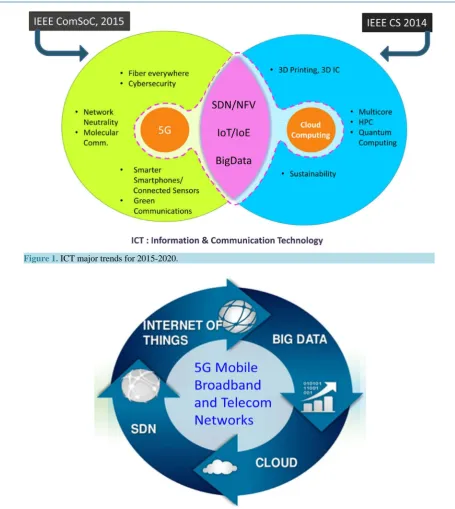
tions technologies) to watch out up to 2020 in term of their potential, convergence and applications. Figure 1 depicts the overlapping of these five major ICT trends. It also illustrates how the infrastructure deployment of 5G mobile broadband and the architectural integration of Cloud Computing strongly impact the development of IoT, Big Data, and SDN. This paper explores the technical relationships of these five areas and discusses several ongoing programs and applications currently under development at NCTU based on these technologies.
2. The Roles of 5G, IoT, Big Data, Cloud, and SDN till 2020
Although so far the 5G mobile broadband requirements and standard specifications are not ready yet, 5G tech-nology research & development are already started and some 5G features or subsystems are readily available. By Year 2020 the commercial 5G will be available and IoT applications will be deployed everywhere with mo-bile broadband technology. Moreover, the Big Data generated by IoT applications will become a norm and Cloud will be largely utilized to compute, store and virtualize network functions (NFV). Also, the underlying network infrastructure will adopt SDN to reduce both capital expense (CAPEX) and operational expense (OPEX). Figure 2 further illustrates the roles of 5G, IoT, Big Data, Cloud and SDN and their relationships. This figure is modified based on the reference [4] by inserting 5G mobile broadband in the center.
3. Technical Relationships among IoT, Big Data, Cloud, & SDN in 5G Era
Figure 1. ICT major trends for 2015-2020.
Figure 2. Relationship among 5G, IoT, Big Data, Cloud and SDN based on [4].
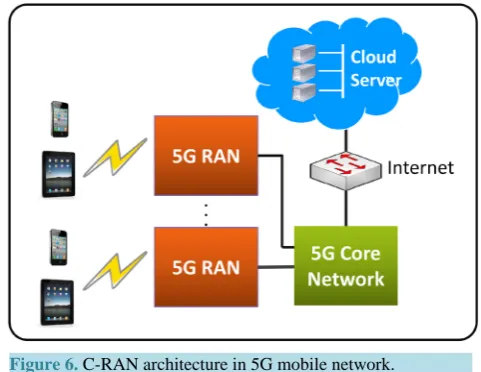
RAN and softwarized 5G then are developed.
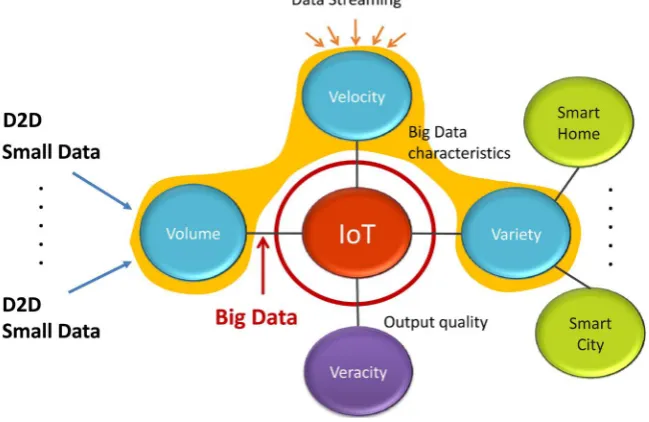
As illustrated in Figure 4, 5G will serve as a better gateway and transport network for IoT applications so that IoT data can be delivered more efficiently and economically. In addition, IoT will become one of the major sources of Big Data by producing large volume, fast velocity, and many varieties of data [6] as illustrated in Figure 5.
[image:3.595.179.452.356.582.2]Figure 3. Technical relationships among 5G & IoT, Big Data, Cloud, and SDN.
Figure 4. 4G/5G as the gateway for IoT applications.
[image:4.595.153.478.496.707.2]Figure 6. C-RAN architecture in 5G mobile network.
4. Ongoing Programs and Applications at National Chiao Tung University (NCTU)
In this section, we describe five ongoing programs and applications at NCTU that are closely related to the SDN, Cloud, Big Data, IoT, and 5G technologies [7]-[17].4.1. Program on SDN-Enabled Cloud-Based Broadband and Wireless Network Technologies and Services
This program is a national program to support the SDN Industry-Academia Cooperation, led by both NCTU and CHT (Chunghwa Telecom, the largest mobile & telecom operator in Taiwan) with 5 other networking and communications companies in Taiwan. This is a multi-year program with the target to set up a testbed for end- to-end testing and to help establish an ecosystem for local SDN industry.
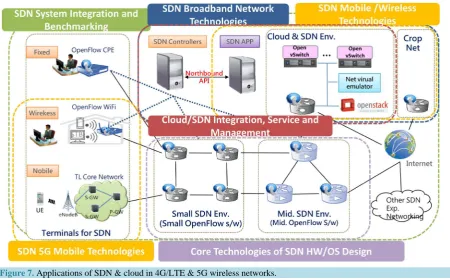
Figure 7 shows the scope of this program that covers mobile access, WiFi access, broadband core and data center cloud end-to-end application systems.
Figure 8 further shows both the structure of the program and its network configuration across NCTU, CHT and another university National Tsing Hwa University (NTHU).The program includes research and development involving 4G/LTE, B4G/5G, SDN, Cloud, SDN for Wi-Fi, and SDN for WAN technologies. There are five sub-programs: 1) SDN broadband network technologies and services, 2) SDN mobile/wireless network tech-nologies and services, 3) SDN and cloud integration services and management, 4) SDN switch-related devices and systems and 5) SDN system integration and field trials.
The program is intended to construct an SDN network in NCTU, CHT and NTHU, respectively. These SDN networks then will be interconnected to form a wide area SDN network in Taiwan. Eventually, we plan to have this end-to-end system connected to the global network. The SDN switches deployed in this testbed will be mostly small or medium scale due to their experimental nature. Also included in this testbed are SDN-based Wi-Fi access points. Cloud-based data centers will be deployed in each location of NCTU, CHT and NTHU. Three types of SDN controllers including OpenDaylight, Ryu and Floodlight are currently under trial in the experimental network. Our architecture assumes the scenario of multiple SDN controllers with a hierarchical topology on which useful SDN APPs such as load balancer, network optimizer for video delivery, network co- ordinator (including visualization), dynamic flow configuration, end-to-end service configuration, dynamic policy- based traffic engineering, and multitenant network automation can be developed and deployed.
4.2. Program on Big Data Analytics for Network Traffic and Management Data
In this program, we address the network performance issues with two experimental networks: BML at NCTU campus and ITRINET of ITRI.
Figure 7. Applications of SDN & cloud in 4G/LTE & 5G wireless networks.
Figure 8. SDN technical R&D center and projects at NCTU.
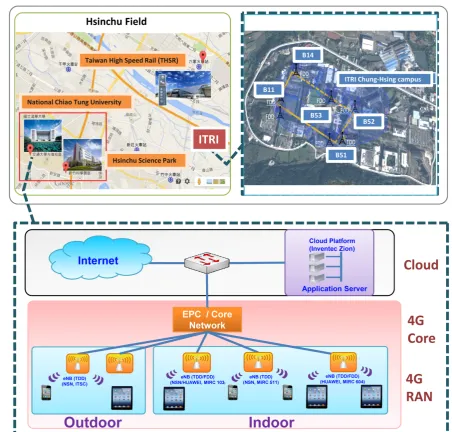
that covers a much greater area of Hsinchu County than NCTU and includes additionally ITRI (Industrial Tech-nologies Research Institute), HSIP (Hsinchu Science Industrial Park) and THR (Taiwan High-speed Rail, Hsin-chu station). The right upper part of Figure 9 illustrates how ITRINET covers various R&D buildings in the corporate campus of ITRI such as B11, B12, B51, etc.
Figure 9. Greater Hsinchu 4G/LTE & Future 5G experimental network ITRINET (include ITRI, NCTU, THR & HSIP).
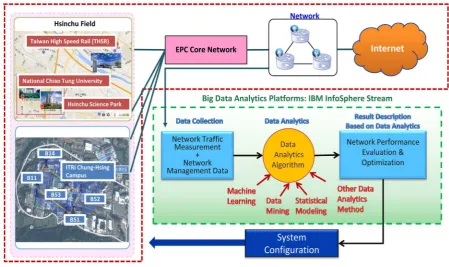
Then, data analytics methods based on machine learning, data mining and statistical modeling are applied to analyze the collected data. Finally, we apply the results thus generated to network performance evaluation and optimization by providing a feedback loop for system re-configuration. The whole operational cycle includes the technologies of 4G/LTE, B4G/5G, Big Data Analytics, Cloud, and Traffic Engineering.
Figure 10. Big Data analytics for Traffic engineering of ITRINET.
[image:8.595.99.531.386.690.2]relational table is a 4 × 4 table with 4 fields: 1) DUT Device Type, 2) UE capability Information (FGI), 3) DNS (TTL), and 4) HTTP (User Agent). This device relational table is created by applying multivariate statistical analytics on the network traffic flow and LTE UE connection related information. Then by extracting specific features, we are able to identify the types of DUT such as Dongle, Smartphone, CPE, etc.
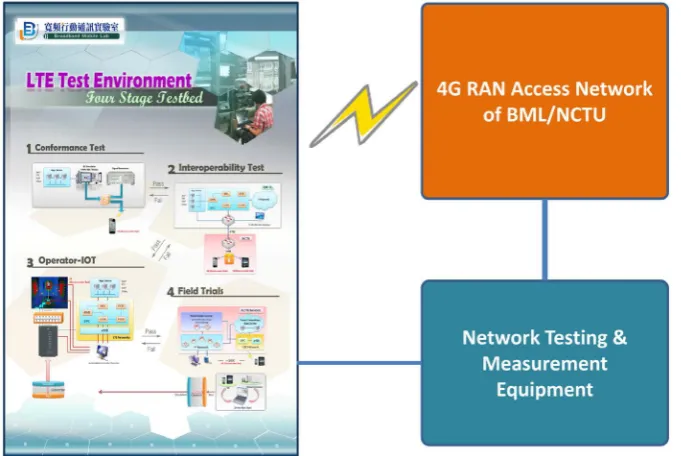
[image:9.595.86.538.571.717.2]Figure 12. Data generation by endpoints from testing & measurement.
Table 3. DUT relational table.
DUT Device Type UE FGI DNS-TTL HTTP-User Agent
Dongle A 0100 0110 0000 0101 0001
1000 0000 0000 128
Mozilla/5.0 (Windows NT 6.1; WOW64) AppleWebKit/537.36 (KHTML, like Gecko)
Chrome/43.0.2357.134 Safari/537.36\r\n
Dongle B 0101 1111 0000 1111 1111
1100 1000 0000 63
Mozilla/5.0 (Windows NT 6.1; WOW64) AppleWebKit/537.36 (KHTML, like Gecko)
Chrome/43.0.2357.134 Safari/537.36\r\n
Smart Phone 0101 1110 0000 1101 1101
1000 1000 0000 43 iPhone6,2/8.3 (12F70)\r\n
CPE 0101 1111 0000 1111 1111 1100 1000 0000 127
Mozilla/5.0 (Windows NT 6.1; WOW64) AppleWebKit/537.36 (KHTML, like Gecko)
4.5. Applications on Data Analytics for Traffic Flow Created by APP’s of SD
To fulfill the Quality of Service (QoS) requirements from users, it is important to make effective use of the net-work resource. We can optimize the performance of a netnet-work by applying data analytics to traffic engineering. In particular, it is important to classify mobile applications traffic intended by the user with data analytics.
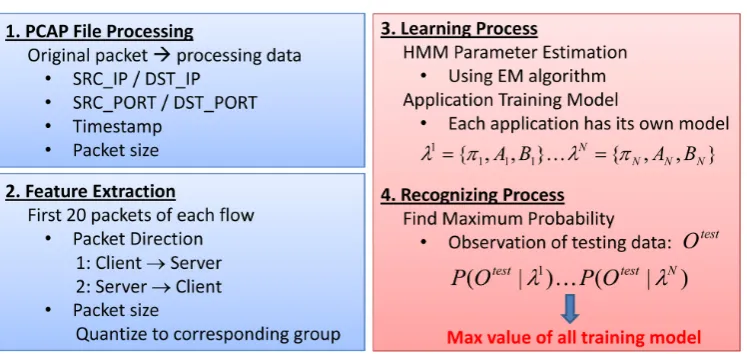
[image:10.595.91.536.391.721.2]We propose a HMM-based (Hidden Markov Model) model to classify the mobile applications. By surveying related work, we have realized that there are different handshake patterns of well-known application protocols. Also, according to the observation of some specific mobile applications, we discover that every mobile Internet service has its unique negotiation process at the beginning when service starts. HMM was widely used to recog-nize time-dependent sequences and find out unknown patterns of data, such as speech recognition, handwriting recognition.
Table 4. Traffic Flow Template (TFT): Use to specify the packet filters associated.
UL Packet Filter ID DRB Packet Filter Evaluation Precedence Protocol Number (IPv4)/ Next Header (IPv6) Remote Address and Subnet Mask Single Local Port (UE) Local Port Range (UE) Single Remote Port Range (NW) Remote Port Range (NW) IPSec SPI Range Type of Service (IPv4)/ Traffic Class (IPv6) and Mask Flow Label (IPv6)
1 DRB2 6 6 (TCP)
IPv4: 172.168.8.0 [255.255.255.0]
IPv6: 2001:0ba0::[ffff:ffff::]
60051 - - - -
2 DRB2 2 17 (UDP) - - - 60201 - - - -
3 DRB3 7 6 (TCP)
IPv4: 172.168.8.0 [255.255.255.0]
IPv6: 2001:0ba0::[ffff:ffff::]
- 60100:60200 - - - - -
4 DRB3 3 17
(UDP) - - - -
60300:
60400 - - -
5 DRB3 5 50 IPSec
(ESP) - - - 0x0F80F0000 - -
6 DRB3 1 - - - -
00101000, Mask = 11111100
-
7 DRB3 6 - - - -
8
DRB1 (default bearer)
255 6
Figure 13. Classification model of Internet application traffic.
ICT major trends.
Acknowledgements
This work was supported by the Ministry of Science and Technology (MOST) of Taiwan and National Chiao Tung University under grants: MOST 103-2622-E-009-012-, 103-2221-E-009-138-, 103-2218-E-009-032-, 104-2221-E-009-023- and NCTU-ICTL 104Q707.
References
[1] Lin, B-S.P. (2015) The Roles of SDN, Cloud, IoT, & Big Data, in 5G Networks and Their Technical Relationships & Applications. Invited Talk, IEEE VTS APWCS 2015, Singapore.
[2] Alkhatib, H., et al. (2015) IEEE CS 2022 Report. IEEE Computer Society, IEEE.
[3] Neira, E.M. (2015) IEEE ComSoc CTN Special Issue on Ten Trends That Tell Where Communication Technologies
are Headed in 2015.
[4] Tucker, L. (2013) On the Cloud of the Future. Cloud Computing Summit, San Jose.
[5] Kleiner, T. (2015) 5G Research in Horizon 2020.
[6] Thadani, A. and Andreoli, P. (2014) Realizing Business Value from Convergence of IoT + Big Data Technologies. 2014 Midwest Architecture Community Collaboration (MACC) Conference, Minneapolis, 13 November 2014.
[7] Dinh, H.T., Lee, C., Niyato, D. and Wang, P. (2013) A Survey of Mobile Cloud Computing: Architecture, Applications, and Approaches. Wireless Communications and Mobile Computing, 13, 1587-1611.
http://dx.doi.org/10.1002/wcm.1203
[8] Lin, B-S.P., et al. (2013) The Design of Cloud-based 4G/LTE for Mobile Augmented Reality with Smart Mobile De-vice. Proceedings of 2013 IEEE International Symposium on Mobile Cloud, Computing, and Service Engineering (IEEE Mobile Cloud 2013), Redwood City, 25-28 March 2013, 561-566. http://dx.doi.org/10.1109/sose.2013.57
[9] Lin, B.-S.P., Tung, L-P., Hsieh, I-C., Liu, T-H. and Chou, S-Y. (2015) The Design of Big Data Analytics for Testing & Measurement and Traffic Flow on an Experimental 4G/LTE Network. Proceedings of IEEE WOCC 2015, Taipei, 23- 24 October 2015, 40-44. http://dx.doi.org/10.1109/wocc.2015.7346173
[10] Lin, B-S.P., Tung, L-P., Hsieh, I-C. and Chou, S-Y. (2015) Performance Estimation of MAR for Outdoor Navigation Applications on an 5G Mobile Broadband by Mobile Smart Devices. Proceedings of IEEE APWCS 2015, Singapore, 19-20 August 2015, 1-6.
[11] Lin, F.J., Ren, Y. and Cerritos, E. (2013) A Feasibility Study on Developing IoT/M2M Applications over ETSI M2M Architecture. Proceedings of the 1st International Workshop on Internet of Things Technologies (IoTT), Seoul, 15-18 December 2013, 558-563. http://dx.doi.org/10.1109/icpads.2013.100
[12] Chen, H.W. and Lin, F.J. (2014) Converging MQTT Resources in ETSI Standards Based M2M Platform. Proceedings of IEEE iThings, Taipei, 1-3 September 2014, 292-295. http://dx.doi.org/10.1109/ithings.2014.52
[13] Cerritos, E. and Lin, F.J. (2014) M2M-Enabled Real-Time Trip Planner. Proceedings of the 2nd International Work-shop on Internet of Things Technologies (IoTT), Hsinchu, 16-19 December 2014, 886-891.
http://dx.doi.org/10.1109/padsw.2014.7097902