Takagi-Sugeno Fuzzy System based Stable Direct
Adaptive Control of Nonlinear Systems
Bharat Bhushan
Department of Electrical Engineering, Delhi Technological University,
Delhi-110042
Sudarshan K.Valluru
Department of Electrical Engineering, Delhi Technological University,
Delhi-110042
Madhusudan Singh
Department of Electrical Engineering, Delhi Technological University,
Delhi-110042
ABSTRACT
This paper proposes a novel idea for stable direct adaptive control of nonlinear systems using Lyapunov function with fuzzy approach. Stable direct adaptive control law consists of an ideal control, and a sliding mode control. Sliding mode controller is used to ensure the stability of Lyapunov function. Stability of direct adaptive control law is tested on two nonlinear systems. Non linear systems analyzed are ball beam system and cart pole system. A computer simulation is performed on nonlinear systems by using MATLAB.
Keywords
Fuzzy system, Lyapunov function, adaptive control, ball beam system and cart pole system.
1. INTRODUCTION
A Fuzzy based mathematical model of a controller was described and designed with incorporation of Fuzzy Logic Controller (FLC) [1]. To test the performance of controller, a nonlinear system considered which was described by the least square identification method [2] and simulation studies were performed. It was observed that the performance of controller was robust for a wide range of operation and improved the system stability. Self tuning features [3] for both the data and the rule base can be designed by using FLC. The design of proportional derivative [4], linear quadratic and nonlinear controllers are based on differential geometric notions. Adaptive tracking control architecture for a class of continuous time nonlinear systems is performed for an explicit linear parameterization of the uncertainty in the dynamics is either unknown or impossible. The architecture of fuzzy systems, [5] expressed as a series expansion of basis functions. The controller output [6] has provided the result of applying fuzzy logic theory to manipulate the given set of control laws for nonlinear systems. The parameters of the membership functions in the fuzzy rule base [7] are changed according to adaptive algorithm for the purpose of controlling the system state in a user-defined sliding surface. The fuzzy sliding mode controller [8] efficiently controls most of the complex systems even though their mathematical models are unknown. The dynamic behavior of the controlled system can be approximately dominated by a fuzzified sliding surface. Fuzzy logic control and sliding mode control techniques have been integrated to develop a fuzzy sliding mode controller. A decentralized fuzzy logic controller [9] has been designed for large-scale nonlinear systems. An approximate method [10] is formulated for analyzing the performance of a broad class of linear and nonlinear systems controlled by using fuzzy logic. Decision rules can be automatically [11] generated for FLC to provide a stable closed loop system using Lyapunov function. Fuzzy logic system [12] that uses adaptive sliding mode control can approximate the unknown function of nonlinear systems. The FLC[13] which produces desirable transient performance for nonlinear systems which promises
applied to design a Takagi-Sugeno type FLC for a biped robot walking problem. In this paper we discussed the fuzzy logic control system in Section 2, the proposed stability design approach using Lyapunov Function in Section 3, dynamics of nonlinear systems and simulation results in Section 4 are presented. Conclusion is given in Section 5 followed by References in Section 6.
2. TAKAGI SUGENO FUZZY SYSTEMS
For the functional fuzzy system singleton fuzzification is used and the premise is defined as same for the rule of the standard fuzzy system .The consequents of the rules are different, however instead of a linguistic term with an associated membership function, in the consequent a function
have been used that does not have an associated membership function. The argument of contains the fuzzy system inputs which are used in the premise of the rule.For the functional fuzzy system an appropriate operation for representing the premise and defuzzification is obtained as
(1)
Where represents premise membership function and number of rules, respectively
where fixed real numbers . The functional fuzzy system is
referred to as a”Takagi-Sugeno fuzzy system”. Consider a Takagi-Sugeno fuzzy system that is given by
Where if are constants
Also for
(5)
Where is the point in the jth input universe of discourse where the membership function for the ith rule achieves a maximum, and is the relative width of membership function for the jth input and the ith rule. First term is the standard fuzzy system.
Let
(6) and
(7) And also
(8)
so that
(9)
which represents the Takagi-Sugeno fuzzy system
3.
STABLE
DIRECT
ADAPTIVE
CONTROL
USING
LYAPUNOV
STABILITY APPROACH
A.
Adaptive control
For adaptive control aim is that reference model, trajectory to be tracked be and its derivatives are ,…, such that output and its derivatives ,…, follow the reference trajectory. Assume that and its derivatives ,…, are bounded. For a reference input and reference trajectory
(10)
For , , as . (11) Hence choose
. (12)
For ,
(13) Or
(14)
Or
(15)
Parameters ,…, specify the dynamics of how evolves over time and how and its derivatives evolve over time. Figure 1 shows the block diagram for adaptive control using fuzzy logic system.
Fig.1 Adaptive Control using Takagi-Sugeno Fuzzy System
B.
Online Approximator
Consider the plant
(16) (17)
(18)
Here is the order of the plant. denotes the - th derivative of . and are the known components of the plant dynamics, and represent the non-linear dynamics of the plant that are unknown. and are approximated with and by adjusting the and . The parameters and are defined within the
u(t) Controller
Designer
System Identification
Controller Plant
Controller Parameter
Plant Parameter
compact parameter sets and respectively. be defined within the space through which the trajectory will travel under closed loop control.
(19)
(20)
(21)
(22)
so that and are approximation errors, which arise when and are represented by finite size approximators. The approximations of and of the actual system are
(23) (24)
where the vectors and are updated online. The parameter errors are
(25) (26)
In addition to the assumptions made in the indirect adaptive control case, also required is
(27)
for all , and that there exist positive constants such that
(28)
Also it is assumed here a function such that
(29)
for all This requirement is often met in practice since is considered as the rate of change of the “gain” on the input term, it is often the case that this will be bounded . For example, notice that if is constant that we know lies in a fixed interval, then all these coefficients are satisfied with , for all .
C.
Controller Approximator
There exists some ideal controller
(30)
where is defined the same as in indirect adaptive control case. Let
(31)
Where is a known part of the controller and
(32) So that is the approximation error. It is assumed that , where is a known bound on the error in representing the ideal controller .The approximation is
(33)
Where the matrix is the updated online .The parameter error is
(34) Consider the control law
(35)
which is the sum of an approximation to an ideal control law, and a sliding mode control term. With this, the derivative of the tracking error becomes
(36)
Adding and subtracting and then using definition of , we get
(37)
(38) Or
in manner analogous to the indirect case,
(39)
D.
Controller Parameter Updates
Consider the following Lyapunov function candidate
(40)
where .Since , is radially unbounded. The Lyapunov candidate is used to measure both the error in tracking and the error between the desired controller and the current controlle5r.Taking the time derivative of equation (14) yields
(41) Substituting ,as defined in equation (13) ,we find
(42) Use the update law
(43) So is an adaption gain. Since ,
(44) and so
(45)
We use a projection method to ensure that so in an analogous manner to the indirect case,
(46)
E.
Sliding Mode Control Term and
Stability Properties
Once again a sliding mode control term is used to compensate for the approximation error in modeling by a finite size approximator. In
(47)
(48) which ensures that
(49) so that is a non-increasing function of time.
All signals are bounded and so we get asymptotic tracking .There are practical application where can be designed so that the resulting transient performance can be improved. In an analogous manner to the indirect case, it is possible to define a smoothed version of the sliding mode control term that will only result in reducing to a neighborhood of zero.
4. SIMULATION RESULTS AND
DISCUSSION
A.
Dynamics of Ball Beam System
Consider a 4th order nonlinear system, ball and beamsystem shown in figure 2, for the simulation. The beam is made to rotate in a vertical plane by applying the torque at the centre of rotation and the ball is free to roll along the beam. The ball remains in contact with the beam. Let be the state of the system, be the output of the system and u be the input to the system. Then
system can be represented by the state-space model
(50)
[image:4.595.318.540.73.226.2]Where u is the input to the system, and B,G are the system parameter
Fig.2 Ball Beam System
B.
Simulation Results and Discussion of
Ball Bam System
Fig.3 Membership Functions for input Error
[image:4.595.322.523.254.372.2]Fig. 4 Membership Functions for input change in error
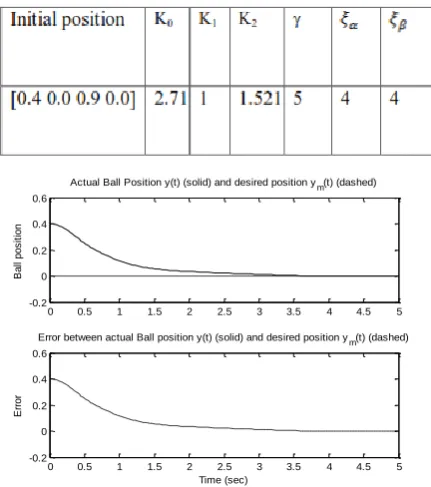
Table 1 Tuned Design Parameters for Ball Beam System
Fig.5 Actual Ball Position, Desired Ball Position and Error between Actual and Desired Ball Position
E
Error
NL
N
M
M
N
N
N
M
M
PM PL
PPL NM
NM
-0.3 -0.1
0.1
0.3
0.3
0 0.5 1 1.5 2 2.5 3 3.5 4 4.5 5
-0.2 0 0.2 0.4 0.6
B
a
ll
p
o
s
it
io
n
Actual Ball Position y(t) (solid) and desired position ym(t) (dashed)
0 0.5 1 1.5 2 2.5 3 3.5 4 4.5 5
-0.2 0 0.2 0.4 0.6
Time (sec)
E
rr
o
r
[image:4.595.320.536.412.656.2] [image:4.595.86.249.509.630.2]Fig.6 Actual Beam Angle, Desired Beam Angle and Error between Actual and Desired Beam Angle
Universe of discourse for membership function has been taken from -0.3 to 0.3 have been shown in figures 3 and 4. Total sixteen rules have been used. Design parameters , γ,
and are tuned in order to get desired results as shown in Table 1. Figure 5 and 6 shows it has been observed that Ball Position converges to origin and Beam angle converges to zero such that at balance Ball position and Beam angle are at origin.
C.
Dynamics of Inverted Pendulum
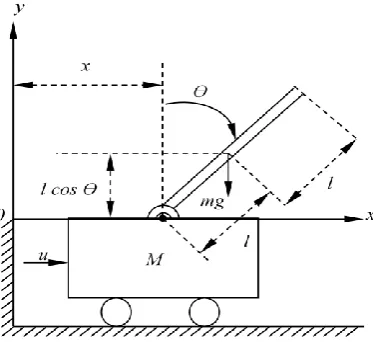
A single-input multi-output inverted pendulum shown in figure 7 can be represented by a fourth order non-linear equation.
Fig.7 Inverted Pendulum Mounted on Cart
Let d be the distance of the cart from centre and be the angle of the pendulum.
Defining the state vector , The system equations can be written as follows:
(51)
(52)
(53)
(54)
Mass of the cart, M = 0.455 kg Mass of pendulum, m = 0.210 kg Half length of pendulum rod, l = 0.305 m Acceleration due to gravity, g = 9.81m/s2 u= input force applied to the cart, N
[image:5.595.323.539.85.643.2]D. Simulation Results and Discussion of
Cart Pole System
[image:5.595.320.539.184.441.2]Table 2 Tuned Design Parameters for Inverted Pendulum System
Fig. 8 Actual Cart Position, Desired Cart Position and Error between Actual Cart Position and Desired Cart
[image:5.595.64.251.434.605.2]Position
Fig. 9 Actual Pendulum Angle, Desired Pendulum Angle and Error between Actual and Desired Pendulum Angle.
Universe of discourse for membership function has been taken from -0.3 to 0.3 as shown in figures 3 and 4. Total sixteen rules have been used. Design parameters , γ, and are tuned in order to get desired results as shown in Table 2. Figure 8 and 9 shows that Cart position converges to origin and Pendulum angle also converges at origin which is also the requirement for a balance of Inverted Pendulum on Cart. Also error reduces to zero for both Cart position as well as Pendulum angle.
0 0.5 1 1.5 2 2.5 3 3.5 4 4.5 5
-0.5 0 0.5 1
B
e
a
m
a
n
g
le
Actual Beam angle y(t) (solid) and desired Beam angle y
m(t) (dashed)
0 0.5 1 1.5 2 2.5 3 3.5 4 4.5 5
-0.5 0 0.5 1
Time (sec)
E
rr
o
r
Error between actual Beam angle y(t) (solid) and desired Beam angle y
m(t) (dashed)
0 0.5 1 1.5 2 2.5 3 3.5 4 4.5 5
-0.2 0 0.2 0.4 0.6
Actual position of cart y(t) (solid) and desired position of cart ym(t) (dashed)
P
os
iti
on
o
f
ca
rt
0 0.5 1 1.5 2 2.5 3 3.5 4 4.5 5
-0.2 0 0.2 0.4 0.6
Time (sec)
E
rr
or
Error between actual position and desired position of cart
0 0.5 1 1.5 2 2.5 3 3.5 4 4.5 5
-0.1 0 0.1 0.2 0.3
Pendulum angle y(t) (solid) and ym(t) (dashed)
0 0.5 1 1.5 2 2.5 3 3.5 4 4.5 5
-0.1 0 0.1 0.2 0.3
Time (sec)
E
rr
o
[image:5.595.329.522.483.634.2]5. CONCLUSION
A Stable adaptive control using Lyapunov function has been proposed. Takagi–Sugeno fuzzy system is used for identification and to control nonlinear systems. The proposed stable adaptive control law is tested on Ball Beam System and Inverted Pendulum mounted on a cart. It has been observed that Ball Position converges to origin and Beam angle converges to zero such that at balance Ball position and Beam angle are in equilibrium at origin. Inverted pendulum on a cart taken as, another nonlinear system and has been observed that inverted pendulums angle reaches to zero while cart Position converges at origin which is the requirement for a balance between inverted pendulum and position of cart. Above nonlinear systems have been tested for given initial positions and confirms the stability of proposed direct adaptive control law.
6. REFERENCES
[1]. Ramaswamy, M. Riese, R. M. Edwards and K. Y. Lee, “Two Approaches For Automating the Tuning Process of Fuzzy Logic Controllers,” Proc. of IEEE Int. Conf. on Decision and Control, pp. 1753-1758, 1993.
[2]. C.T. Ayday and I. Eksin, “Fuzzy Identification of Nonlinear Systems,” Proc. of IEEE Int. Conf., pp. 289-292, 1993.
[3]. C. Y. Shieh and S. S. Nair, “A New Self Tuning Fuzzy Controller Design and Experiments,” Proc. of IEEE Int. Conf., pp. 309-314, 1993.
[4]. D. J. Pack, M. Meng and A. C. Kak, “Comparative Study of Motion Control Methods for a Nonlinear System,” Proc. of IEEE Int. Conf. pp. 1413-1418, 1993.
[5]. Sudarshan K Valluru and T.N.Rao, “Introduction to Neural Networks, Fuzzy Logic and Genetic Algorithms” Jaico Publishing House, Mumbai, 2011.
[6]. C. K. Chak and G. Feng, “Nonlinear System Control with Fuzzy Logic Design,” Proc. of IEEE Int. Conf., pp. 1592-1596, 1994.
[7]. S. C. Lin and Y. Y. Chen, “Design of Adaptive Fuzzy Sliding Mode for Nonlinear System Control,” Proc. of IEEE Int. Conf., pp. 35-39, 1994.
[8]. C. C. Kung and C. C. Liao, “Fuzzy-Sliding Mode Controller Design for Tracking Control of Nonlinear System,” Proc. of American Control Conference, pp.180-184, June 1994.
[9]. Z. M. Yeh, “A Decentralized Fuzzy Logic Controller Design,” Proc. of IEEE Int. Conf., pp. 602-607, 1994. [10]. S. S. Farinwata, “Robust Stability of Fuzzy Logic
Control Systems,” Proc. of American Control Conference, pp. 2267-2271, June 1995.
[11]. C.Y. Tsai and T. H. S. Li, “Design of Lyapunov Based Fuzzy Logic Controller,” Proc. of IEEE Int. Conf., pp. 396-401, 1996.
[12]. S. Jeoung, J. Han, K. Im and W. Ham, “Adaptive Fuzzy Sliding Mode Control of Nonlinear System: The Second Control Scheme,” Proc. of IEEE Int. Conf., pp. 269-274, 1996.
[13]. F. H. F. Leung, L. K. Wong and P. K. S. Tam, “Fuzzy model based controller for an inverted pendulum,” Electronic Letters, vol. 32, no. 18, pp. 1683-1685, 1996. [14]. Y. Tang, N. Zhang and Y. Li, “Stable Fuzzy Logic
Control of a Class of Nonlinear Systems,” Proc. of IEEE Int. Conf. , pp. 361-365, 1996.
[15]. S. Lei and R. Langari, “ An approach to Synthesis and Approximation of Stable Fuzzy Logic Controllers,” Proc. of IEEE Int. Conf., pp. 1446- 1452, 1996.
[16]. E. P. Dadios and D.J. Williams, “Multiple Fuzzy Logic Systems: A Controller for the Flexible Pole-Cart Balancing Problem,” Proc. of IEEE Int. Conf. on Robotics and Automation, pp. 2276-2281, 1996. [17]. S. Jagannathan, “Adaptive Fuzzy Logic Control of
Feedback Linearizable Discrete-Time Nonlinear Systems,” Proc. of IEEE Int. Conf., pp. 133-138, 1996. [18]. L. K. Wong, F.H.F. Leung and P. K. S. Tam, “Lyapunov
function Based Design of Heuristic Fuzzy Logic Controllers,” Proc. of IEEE Int. Conf., pp. 281-285, 1997.
[19]. L.K. Wong, F.H.F Leung and P. K. S. Tam, “ Lyapunov Function Based Design of Fuzzy Logic Controllers and its Application on Combining Controllers,” IEEE Trans. On Industrial Electronics, vol. 45, no. 3, pp. 502-509, 1998.
[20]. B. Yoo and W. Ham, “ Adaptive Fuzzy Sliding Mode Control of Nonlinear System,” IEEE Trans. On Fuzzy Systems, vol. 6, no. 2, pp. 315-321, May 1998.
[21]. W. Li, “Design of a Hybrid Fuzzy Logic Proportional Plus conventional Integral-Derivative Controller,” IEEE Transaction on Fuzzy Systems, vol. 6, no. 4, pp. 449-463, Nov. 1998.
[22]. P. Y. Guo, Z. H. Guang and Z. Bien, “Design of fuzzy direct adaptive controller and stability analysis for a class of nonlinear system,” Proc. of the American Control Conferences, pp. 2274-2279, 1998.
[23]. W. Chang, Y. H. Joo, J. B. Park and G. Chen, “Robust Fuzzy Model Based Controller for Uncertain Systems,” Proc. of IEEE Int. Fuzzy Systems Conf., pp. 486-491, 1999.
[24]. H. Han and C. Y. Su, “Further Results on Adaptive Control of a Class of Nonlinear Systems with Fuzzy Logic,” Proc. of IEEE Int. Fuzzy Systems Conf. , pp. 1309-1314, 1999.
[25]. B. K. Yoo and W. C. Ham, “Adaptive Control of Robot Manipulators using Fuzzy Compensator, Part-II,” Proc. of the IEEE Int. Conf. on Intelligent Robots and Systems,” pp. 52-57, 1999.
[26]. E. Kim, H. Lee and M. Park, “Limit Cycle Prediction of a Fuzzy Control System Based on Describing Function Method,” IEEE Transactions on Fuzzy Systems, vol. 8, no. 1, pp. 11-22, Feb. 2000.
[27]. B. K. Yoo and W. C. Ham , “Adaptive Control of Robot Manipulator using Fuzzy Compensator,” IEEE Transaction on Fuzzy Systems, vol. 8, no. 2, pp. 186-199, April 2000.
Journal of Dynamic Systems, Measurement and Control, vol. 123, pp. 113-116, March 2001.
[29]. P.P. Mohanlal and M.R. Kaimal, “Exact Fuzzy Modeling and Optimal Control of the Inverted Pendulum on Cart,” Proc. of the IEEE Conf. on Decision and Control, pp. 3255-3260, 2002.
[30]. M. Petrov, I. Ganchev and A. Taneva, “Fuzzy PID Control of Nonlinear Plants,” Proc. Of IEEE Int. Symposium, pp.30-35, 2000.
[31]. W. Chang, J. B. Park, Y. H. Joo and G. Chen, “Output Feedback Fuzzy Control for Uncertain Nonlinear Systems,” Journal of Dynamic Systems, Measurement and Control, vol. 125, pp. 521-530, 2003.
[32]. Z. Vicek, “Analysis of Autoregressive Fuzzy Systems,” Proc. of IEEE Int. Conf., pp. 1233-1238, 2004..
[33]. Y. H. Cheng, X. S. Wang and J. Q. Yi, “Fuzzy Variable Structure Control For Trajectory Tracking of Two Link Flexible Manipulators,” Proc. of IEEE Int. Conf. on Machine Learning and Cybernetics, pp. 711-714, 2003.
[34]. J. Yu, W. Gu and Y. Zhang, “New Adaptive Fuzzy Sliding Mode Control System for SISO Nonlinear System,” Proc. of the 5th
World Congress on Intelligent Control and Automation, pp. 1196-1199, 2004.
[35]. Z. Chen, C. Shan and H. Zhu, “Adaptive Fuzzy Sliding Mode Control Algorithm for a Non-Affine Nonlinear System,” IEEE Transactions on Industrial Informatics, vol. 3, no. 4, pp. 302-311, 2007.
[36]. C. H. Lee, B.R. Chung, F. K. Chang and S. K. Chang, “Adaptive Back stepping Control for a Class of Nonlinear Uncertain Systems Using Fuzzy Neural Networks,” Proc. Of IEEE Int. Conf. on Machine Learning and Cybernetics, pp. 431-436, 2007.