Gamified Approach to Database Normalization
Kavisha Duggal
Asst. Professor of Lovely Professional University Jalandhar Punjab, India
Anukool Srivastav
Student of Lovely Professional University Jalandhar
Punjab, India
Satvinder Kaur
Student of Lovely Professional University Jalandhar
Punjab, India
ABSTRACT
This paper explores how gamification can be applied in learning the normalization concepts in database. Modeling the concept with game challenges improves the learning. The model consists of different levels; each level corresponding to a normal form. The levels are further divided into stages. On crossing each stage, the student (player) would get points depending on the difficulty level. The gamification provides positive effect; however, the effects are greatly dependent on the context in which the gamification is being implemented, as well as on the users using it. A good database design depends on tools required to minimize redundancy and anomalies, preserve known functional dependencies, prevent spurious information from emerging, and identifying keys. This proposed model will make learning normalization more interactive and easier.
General Terms
Database Normalization, Gamification in education, Virtual Learning Environments, game mechanic
Keywords
Gamification, Normalization, E-learning, database normal forms,computer education
1.
INTRODUCTION
Games and game-like elements have begun to invade the real world. Gamification is the use of game thinking, game mechanics, game dynamics and frameworks in a non-game context in order to engage users, solve problems, improve user experience, and promote desired behaviours. In simpler words, gamification is simulated learning[3]. Gamification is a recently coined concept referring to design that affords gracefulness into a non-game activity. Gamification is an emerging technique that refers to the use of digital game design techniques and video game elements to solve non-game problems, such as business and social impact challenges [2]. It is applicable to a number of areas including business applications, education, training etc. The primary goals of gamification are to tap into the psychology of motivation to both improve user interaction and interest. The ‗gamification‘ concept is increasingly taken over in business, in education, health-care and other public-good oriented professions, and, consequently, in academic research as well. This upsurge is accompanied by animated debates and blazing criticism, currently situated mainly in opinion articles and in conference venues[3]. A frequently used model for gamification is to equate an activity in the non-game context with points and have external rewards for reaching specified point thresholds. One significant problem with this model of gamification is that it can reduce the internal motivation that the user has for the activity, as it replaces internal motivation with external
motivation. If, however, the game design elements can be made meaningful to the user through information, then internal motivation can be improved as there is less need to emphasize external rewards.
[image:1.595.317.544.591.629.2]2.
GAMIFICATION IN EDUCATION
Gamifying education can be beneficial for both learners and teachers. Intuition suggests that gamification may be able to motivate students to learn better and to care more about studies. Making the case for gamification, however, requires more than intuition. We must clearly define what is meant by gamification, evaluate it for its benefits and drawbacks, explore current implementations and future possibilities, and better understand the theoretical rationale behind gamification [5]. This will allow us to create effective interventions rather than guessing in the darkby adding game elements, such as rewards, leader boards etc., in a syllabus the learning process can become a more joyful experience. Gamification gives a more dynamic character to education and promotes lifelong learning. As reported on the web site of Wired UK, this approach is being applied for example in Code academy, a social learning platform dedicated to programming [8]. In this paper we define key design goals and propose a model of a normalization aimed at computer database education, which includes (1) structure of the platform, (2) concept of gamification-driven normal forms progress, (3) basic platform functionalities, and (4) methodology of implementation [6]. A new gamifying is being developed, which will eventually serve as a proof of concept for the design proposed here. Nevertheless, conceptualizing gamification [2] in the manner presented here allows us to connect the concept to the literature on motivational affordances in IS research, and further, break down the studies reviewed herein3.
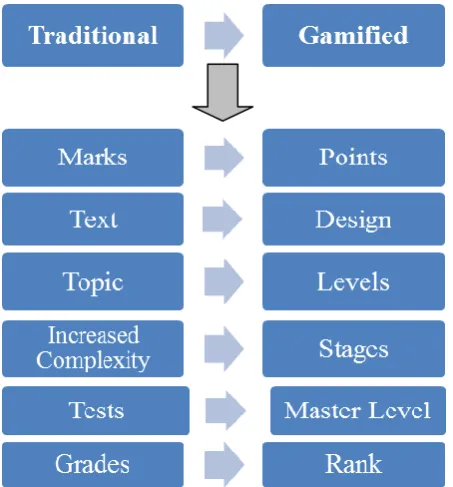
NOMENCLATURE EQUIVALENCY
OF TRADITIONAL AND GAMIFIED
APPROACH FOR NORMALIZATION[2]
Figure 2: Traditional Vs. Gamified Model
4.
PROPOSED NORMALIZATION
DESIGN METHODOLOGY
[image:2.595.319.538.263.412.2]According to the methodology for reaching to next level students need to complete on each preceding level by completing all the stages. Each level of game is equivalent to a normal form.
Figure 3.1: Normalization Levels
Figure 3.2: Levels into stages and associated points
redundancy will be given to play. As the stages will increase the redundancy within the levels will be increased. Once a student will complete all the stages, Level-1 will be completed [8]. If the student fails to complete any of the stages then the game will be over and the points/score will be shown to them.
5.
GAMIFICATION APPROACH FOR
NORMAL FORMS
5.1
Gamifying 1NF (Level 1):-
This form requires any duplication of columns in the same table to be removed. Then separate tables will be developed for each entity of related information and each identified with a primary key. A primary key is a unique identifier for each record, creating a column for your primary key helps eliminate redundancy of entities within a table. This problem can be gamified by dividing it into different stages according to the level of redundancy.
Figure 4: Different stages for Level 1
5.1.1. Stage 1: (Easy Level)
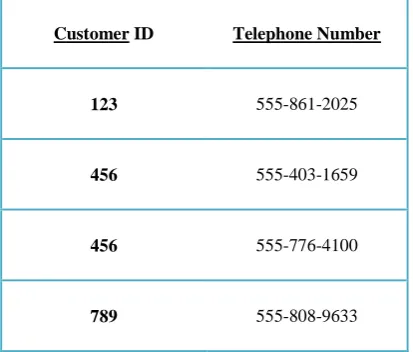
In this level students will be given generalized tables like (student, customer, order etc.) that contain less redundancy means that table can be normalized by decomposition into two tables. Consider an example of CUSTOMER relation that is in un-normalized form (contains redundancy due to multivalued attributes).
Above table can be decomposed into following two tables to remove the redundancy.
Customer ID First Name Surname Telephone
123 Robert Ingram 555-861-2025
456 Jane Wright 555-403-1659
555-776-4100
[image:2.595.55.292.481.713.2]789 Maria Fernandez 555-808-9633
[image:2.595.308.563.548.656.2]Table 1.2: Customer Name
Table 1.3 : Customer Telephone Number
5.1.2 Stage 2: High level
In this level students will be given tables that contain more redundancy means that table need to be normalized by decomposition into at least three tables.
Example Table "Company‖ that is not normalized:
Table 2.1: Company table
Name Pers. ID
Dept. No.
Dept. Name
Project No.
Project Name
Job in Project
Salary / h
A S 1 1 Europe 5,7,8
Soap, Pasta, Olive Oil
Analysis, Leader, Marketing
13,18,15
S K 1 2 USA 5,8
Soap, Olive Oil
Leader,
[image:3.595.311.547.193.284.2]Leader 18,18
Table 2.2: Employees table
Name Pers. ID Dept. No. Dept.
Name
A S 1 1 Europe
S K 1 2 USA
Table 2.3: Projects table
Project No. Project Name
5 Soap
7 Pasta
[image:3.595.48.255.250.426.2]8 Olive Oil
Table 2.4: Project Assignment
Project No.
Pers. ID Dept. No.
Job in Project
Salary/h
5 1 1 Analysis 13
5 1 2 Leader 18
7 1 1 Leader 18
8 1 1 Marketing 15
8 1 2 Leader 18
Thus in company table the level of redundancy is high and require more effort of student. So the points /score for successful decomposition will be high (like 10 points).Once all the stages of Level 1 will be completed student will be moved to next level 2.
5.2
Gamifying 2NF (Level 2):-
Please In 2NF no non-prime attribute should be functionally dependent on a part of a candidate key that means we have to remove any of the partial dependency. So to gamify the 2NF we need to perform following steps.
i. First student need to identify the candidate (or primary) keys.
ii. Once the candidate keys are known then table will be decomposed.
iii. In decomposition student need to conform that one decomposed tables must include primary key and attributes that are fully functional dependent on that primary key and other decomposed table will include remaining attributes that are not dependent.
Customer ID First Name Surname
123 Robert Ingram
456 Jane Wright
789 Maria Fernandez
Customer ID Telephone Number
123 555-861-2025
456 555-403-1659
456 555-776-4100
EXAMPLE: Table 3: Sample example of Level 2 ‘Client Rental’ Table
Client No PropertyNo cName pAddress rentStart rentFinish Rent ownerNo oName
CR76 PG4 Akash Jalandhar 1-Jan-14 31-Jan-15 350 CO40 Ram
CR76 PG16 Akash Delhi 1-Feb-14 1-Mar-14 450 CO50 Mohan
CR56 PG4 Nikhil Jalandhar 1-Feb-13 31-Mar-13 350 CO40 Ram
CR56 PG36 Nikhil Ludhiana 1-Mar-13 1-May-13 375 CO50 Mohan
CR56 PG16 Nikhil Delhi 1-Apr-14 1-May-13 450 CO50 Mohan
ClientNo PropertyNo cName pAddress rentStart rentFinish rent ownerNo oName
fd1 (primary key)
fd2
fd3
(partial dependency)
(Transitive Dependency) fd4
Fd5
[image:4.595.51.544.95.277.2]Fd6 (Candidate Key)
Figure 5: First Normal Form ‘Client_Rental’ table’s Functional dependencies
After the decomposition through 2NF the ClientRental’ table have the following tables: - Client (clientNo, cName), Rental (clientNo, propertyNo, rentStart, rentFinish) ,PropertyOwner (propertyNo, pAddress, rent, ownerNo, oName)
Table 3.1: Client Table 3.3: Rental
Client No cName
CR76 Akash
CR56 Nikhil
PropertyNo pAddress Rent OwnerNo oName
PG4 Jalandhar 350 CO40 Ram
PG16 Delhi 450 CO50 Mohan
PG36 Ludhiana 375 CO50 Mohan
Table 3.2: Property Owner
lientNo PropertyNo RentStart RentFinish
CR76 PG4 1-Jan-14 31-Jan-15
CR76 PG16 1-Feb-14 1-Mar-14
CR56 PG4 1-Feb-13 31-Mar-13
CR56 PG36 1-Mar-13 1-May-13
[image:4.595.46.534.103.505.2] [image:4.595.50.513.301.509.2]5.3
Gamifying 3NF (Level 3):-
In 3NF, no non-prime attribute should be functionally dependent on a set of non-prime attributes[6]. So we have to remove the transitive dependency among the attributes. To gamify the 3NF we need to perform following steps.
i. Provide set of functional dependency between the attribute so that transitivity dependency an easily be identified.
ii. Now with the help of FD (Functional dependency the student can decompose the table easily).
Example:
[image:5.595.49.281.283.438.2]In above ClientRental‘ table after 2NF to transform the PropertyOwner relation into 3NF we must first remove this transitive dependency by creating two new relations called PropertyForRent and Owner. The new relations have the form.
Table 4.2: Owner 1
3NF: Decomposition of Property_Owner table
5.4
Gamifying 4NF (Level 4)
[image:5.595.368.549.372.528.2]In 4NF we have to remove multi-valued dependencies in tables, so user first need to identify multivalued dependency in given table and then decompose it.
[image:5.595.52.281.548.724.2]Table 4.3: Example of 4NF
Table that is 3NF but not in 4NF
Car Color Engine
Mustang Red F3.2L
Mustang Red F4.5L
Mustang White F4.5L
Mustang Blue F4.5L
Cirrus Red C2.1L
Cirrus Red C3.0L
Cirrus Green C2.1L
Cirrus Green C3.0L
The primary identifier is [Car, Color, and Engine]. None of the attributes are dependent on any of the other attributes —
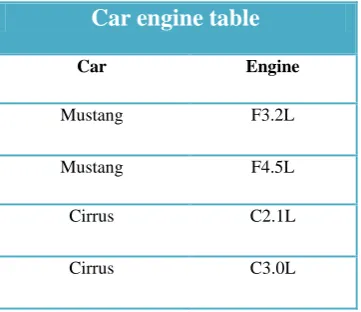
thus, there is no partial key dependency or transitive dependency. The MVDs (multi-valued dependencies) in this case can be fixed by breaking up the original table into two tables
Table 4.4: Car color table
Table 4.1 Property for Rent
PropertyNo pAddress rent ownerNo
PG4 Jalandhar 350 CO40
PG16 Delhi 450 CO50
PG36 Ludhiana 375 CO50
OwnerNo oName
CO40 Ram
CO50 Mohan
Tables that are in 4NF
Car color table
Car Color
Mustang Red
Mustang White
Mustang Blue
Cirrus Red
Cirrus Green
Table 4.5: Car Engine table
Car engine table
Car Engine
Mustang F3.2L
Mustang F4.5L
Cirrus C2.1L
6.
GAMIFIED EVALUATION –
IMMEDIATE RESULTS
Evaluation will be done stage by stage and on the completion of the level. The evaluation of the each stage will be based on work done by each student at different stages. For correct evaluation of each set of relation given to the students a predefined normalized form will be used to compare the both form will be used to compare the both values [6]. At beginning the user will be given choice to selection the type of database they want to play for example Student, Customer, Employees, and Sales etc.
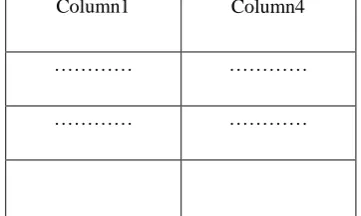
If the decomposition of this relation consists of following relations then evaluation will be based on the attributes selected by the student that will be compared with the available original decomposition of table.
Table 5.2: Normalized Form 1
Column1 Column2 Column3
…… ……… ………
….… ……… ………
….… ……… ………
Table 5.3: Normalized Form 2
If the attributes are matched then the points to the students will be given based on difficulty level of each stage.
7.
FUTURE SCOPE
The next step of our research will be to test how the platform works in a real educational environment. The proposed model for the normalization can be implemented by using a high level language. So as a future work we have to design new methods to automate the normalization with different levels, and also develop the tools to enable them to create and modify the gamified learning experiences easily, making the underlying technological infrastructure transparent. Unsupervised scoring/Points systems (Goldberg & Song, 2004) may also be an interesting solution to this problem, and response-driven feedback approaches (Fernandez Aleman, Palmer-Brown & Jayne, 2011) can help us to produce meaningful and rapid feedback
Furthermore this model can be enhanced for advanced normal forms like BCNF, 5NF etc. to nomalize them using gamification.
8.
CONCLUSION
The model proposed here for the normalization using gamification is one of the modern concepts. It aims not only to improve student motivation but also encourage them to participate in various activities of learning, they could otherwise neglect, like learning from instructional materials, practicing coding, taking part in database competitions and help them to learn normalization with fun.
This study also suggests that evening out challenge distribution over the term and making them fairly rewarded might significantly improve student participation and performance rather than learning normalization concepts from books. Students seem to score better with the gamified version of the concept and grade differences between them seem to decrease. For future work we would like to further study the impact of our approach over student outcomes and perform a formal engagement evaluation.
9.
ACKNOWLEDGMENTS
This study was supported by the Lovely Professional Uuniversity as well as carried out as part of a research project under guidance of Kavisha Duggal (Asst. Professor).
10.
REFERENCES
[1] Hamari, J., Koivisto, J., & Sarsa, H. (2014). Does Gamification Work? – A Literature Review of Empirical Studies on Gamification. In proceedings of the 47th Hawaii International Conference on System Sciences, Hawaii, USA, January 6-9, 2014.
[2] Gamification in education - learn computer programming with fun , Balraj Kumar ,Parul Khurana, ISSN: 2278-5183 International Journal of Computers and Distributed Systems Vol. No.2, Issue 1, December 2012
[3] Gamification in Education: What, How, Why Bother? Joey J. Lee, Teachers College Columbia University, NY Jessica Hammer, Teachers College Columbia University, NY
[4] Laurent Moccozet, Camille Tardy, Wanda Opprecht, Michel Léonard ―Gamification-based assessment of group work‖
[5] Gamification-based e-learning Platform for Computer Programming Education Paweł Baszuro, Jakub Swacha (X World Conference on Computers in Education July
2-Column1 Column2 Column3 Column4
…..
……
…….…
…
……
……
……
……
….
……
……
……
Column1 Column4
………… …………
[image:6.595.70.251.610.718.2]………… …………
[6] Preprint Version of the final Manuscript: Domínguez, A., Saenz-de-Navarrete, J., de-Marcos, L., Fernández-Sanz, L., Pagés, C.,Martínez-Herráiz, J.J. Gamifying learning experiences: Practical implications and outcomes. Computers & Education. 63. pp. 380-
[7] 392. Improving Participation and Learning with Gamification, Gabriel Barata, Sandra Gama, Joaquim Jorge, Daniel Gonçalves
[8] O. Inbar, N. Tractinsky, O. Tsimhoni, and T. Seder. Driving the scoreboard: Motivating eco-driving through
in-car gaming. In Proc. CHI ‗11 Workshop Gamification: Using Game Design Elements in Non-Game Contexts. ACM, 2011.
[9] G. Barata, S. Gama, J. Jorge, and D. Gonçalves. Engaging engeneering students with gamification. In Proc. VSGAMES 2013, 2013