Application of Genetic Algorithm in Radio Network
Coverage Optimization – A Review
Alenoghena C. O
Dept. of Telecom. EngineeringFederal University of Tech Minna, Nigeria.
Emagbetere J. O
Dept. of Electrical/ElectronicUniversity of Benin Benin City, Nigeria.
Edeko F. O
Dept. of Electrical/ElectronicUniversity of Benin Benin city, Nigeria.
ABSTRACT
Network optimization is about maximizing capacity, reducing associated cost, and enhancing service quality. As customers demand better and cheaper services from wireless service providers the need for better network coverage has increased and researchers has been working on it. Radio coverage generally is affected by variables such as base station performance, antenna arrangements and the locations of base stations and users Genetic algorithm (GA) has found its usage in telecommunications field because of the challenging factors and parameters involve in radio coverage optimization. A detailed review on the use of GA in achieving coverage optimization in cellular networks has been presented in this work. The paper looks at recent applications and detail analysis of each of the processes in GA application. It has been shown that the use of GA will provide a near optimal solution of radio facility placement hence the benefits from this evolutionary approach can be described as not only time saving but also efficient..
General Terms
Optimization algorithms.
Keywords
Base station; Coverage; Fitness function; Genetic Algorithm; optimization.
1.
INTRODUCTION
The increasing use of radio communication throughout Europe and subsequent congestion of frequency spectrum resulted in the introduction of the cellular system of communication for commercial operation in 1992 [1]. The cellular network requires that a coverage area be divided into different cells and sectors using the principle of frequency re-use. The many advantages of the cellular network over its land line both for the subscriber and service providers has led to unprecedented patronage and hence increase in mobile phone users, making cellular telephony the economically most important form of wireless communications world-wide. Optimization of the radio coverage entails operating the network to its optimum (best) output state. Optimization is the process of adjusting the inputs to or characteristics of a device, mathematical process, or experiment to find the minimum or maximum output or result [2]. It is an established fact that an optimized network performs better—and subscribers notice the difference, hence operators have been investing in and upgrading their networks to meet demand, since they realize that their success will be based on a differentiated service quality, attractive services, and a good value proposition [1].
In the cellular network planning process like the GSM, the base transceiver systems (BTS) are considered the most important element in the whole network. This is due to their role in building a physical connection between the base stations and mobile stations (users’ devices) through air interface; Cell planning is done to ensure coverage and avoid interference in a network, deciding where to place the base station of a cellular network is a very important issue that is usually decided during the process of cell planning. The total radio coverage area is defined as the area where the power received from the base stations is more than a given threshold.[3].
Job el al [4] used genetic algorithm to determine the best placement for base station antennas in a 3G network, with key emphasis on coverage maximization with interference and cost minimizations. Rodney et al [5] compared the use of genetic algorithm and tabu search for the optimal placement of base station in a radio network with coverage optimization as common objective. Gaber et al [6] used traditional and random weighted forms of GA for the optimal placement of base station while taking coverage and health effect as objective functions, GIS optimizer is used for initialization of the population. Yong et al [7] used a multi objective GA for the placement of base station using real number representation.
Possible base stations were randomly generated with binary encodings of parameters in Job [4]; Rodney [5] and Yong [7]. Gaber [6] used GIS tool to determine initial population taking environmental constraints into consideration and real numbers vector representation. Coverage optimization and cost minimization represented by minimum number of base station was a common objective function, Young [7] however has BS power as added objectives. Weights were assigned to the multi objective functions with Gaber [6] comparing the use of penalty function against random weighting, weighting allocation was done to favour coverage optimization. Results from Job et al [4] showed a 98% coverage in the network, as implemented on a flat terrain without considering constraints. Simulation results of Rodney et al [5] showed GA performing better than Tabu search for increased randomness of mutation operators. Results from Gaber [6] showed less base station and higher coverage obtained for Cairo city as compared with an existing network, also random weighted GA proved better as compared to traditional GA. Yong [7] has 99.78 % coverage as optimal with traffic, map and terrain taken into consideration.
2.
EXTENSIVE REVIEW OF RADIO
COVERAGE OPTIMIZATION USING
G.A
In this section, detail review of all the processes involve in radio coverage optimization using GA is discussed. The processes discussed are basically radio coverage optimization variables and optimization algorithms. Detail discussions are subsequently presented.
2.1
Radio Coverage Optimization
Variables
Network optimization is about maximizing capacity, reducing associated cost, and enhancing service quality. As customers demand better and cheaper services from wireless service providers the need for better network coverage has increased and researchers has been working on it. Radio coverage generally is affected by variables such as base station performance, antenna arrangements and the locations of base stations and users [8]. Measures carried out by radio engineers to improve network coverage can be grouped into three major categories, with table 1 below shows the summary of the comparative analysis of the optimization variables.
Table 1. Comparative analysis of optimization variables
S/N Optimization Variables
Limitation Remark
1. Transmit power & Antenna solution
Bonded by realizable values
Variables has been exhaustively worked on 2. Micro and Pico
cells
Local congestions and handover issues
Variables has been exhaustively worked on
3. Optimal facility location
Difficult to model and no exact solution
Variable not researched on exhaustively
2.1.1
Transmit Power and Antenna Solutions
Radio coverage for a defined area can be improved by increase of transmits power or adjustment of the antenna, that is, higher antenna heights and higher transmission power. Alexander et al, [9] in their work presented a rule-based algorithm for optimizing the two most important parameters of a UMTS base station, CPICH power and antenna tilts. In their work they established the fact that the major drawback of these options is that higher antenna heights are often difficult to achieve, also very high transmit power (e.g. > 100 Watts) in a base station transmitter is not cost effective, also doubling the antenna gain also means doubling the size of the antenna etc.[10].2.1.2
Introduction of micro cells and pico cells:
Presently 80 to 90 % of current world wide GSM subscribers fall into the category of slow moving and stationary hand portable units [8]. Micro and pico cells are introduced tocontain the microcells RF radiation to within the street canyons. The use of micro cells in an area allows the frequency reuse within the microcell coverage resulting in greater spectrum efficiency, better coverage and enhanced capacity [8]. While acknowledging the use of micro cells in obtaining better network coverage the use has resulted in their major drawback which is frequent handovers disturbing smooth packet transfer and local congestion [11].
2.1.3
Optimality of facility location:
Finding the most optimal locations to place base stations which encompasses the antenna and other transmission facilities poses one of the most challenging design problems in the planning and deployment of a communications network [12]. Facility location for a network has to take into cognizance parameters such as traffic density, interference, channel condition, and even safety and security. The combination of these conflicting parameters to realize an optimized position has been found to be a very complex problem, one in which we will not be able to establish a polynomial time algorithm in the theory of computational complexity. The use of artificial intelligence have been undergoing much research and genetic algorithm has been found to be useful for solving this type of NP-hard problem.[10] this paper investigates how the genetic algorithm is been used to accomplish the optimal placement of cellular base transceiver systems (BTS) in other to achieve coverage optimization.
3.
OPTIMIZATION ALGORITHMS
The birth of wireless communication has resulted in a host of design issues that are very complex involving network design, resource allocation, interference cancellation and signal detection. Most of these problems have large search space which makes them non-deterministic polynomial (NP)-hard hence solutions using analytical approaches have proved to be intractable and tedious. These reasons have made many researchers to propose various techniques of heuristics methods for solving these problems. A heuristic is a part of an optimization algorithm that uses the information currently gathered by the algorithm to help to decide which solution candidate should be tested next or how the next individual can be produced. Heuristics are usually problem class dependent. Most importantly, heuristic methods lie in the fact that they are not limited by restrictive assumptions about the search space like continuity, existence of derivative of objective function etc.
computationally simple and easy to implement. One of the drawbacks is their possibility to converge prematurely to a suboptimal solution. Use of heuristic methods like genetic algorithm has therefore been used to solve these problems. As new technologies come to the market network providers have to employ intelligent optimization means to ensure that networks are accurately designed to meet the demands of, and profit from, the new generation of high-speed data users [14], for instance, 3G network coverage optimization is hinged on the optimal location of facilities in the cellular network as there is no requirement for frequency optimization.
4.
GA AND FACILITY PLACEMENT
FOR COVERAGE OPTIMIZATION
Genetic Algorithm’s (GA) Sophisticated nature has made it an efficient searching tool as it found application in complicated problems in business, pattern recognition, scheduling, etc [15]. The application of Genetic algorithm in solving telecommunications challenges can be justified by the fact that factors that challenge optimal service are generic in nature; GA is an optimization tool capable of giving optimum results in situation where there are many conflicting options, this is because it has the capability to search large spaces efficiently without the need for derivative information. They operate on a population of potential solutions applying the principle of survival of the fittest to produce, hopefully, better and better approximations to solution. They always produce high quality solutions because they are independent of the choice of the initial configurations. Moreover, they are computationally simple and easy to implement. One of the drawbacks is their possibility to converge prematurely to a suboptimal solution.
GA utilizes a clearly defined procedure for solving problems with a finite time for termination.
Three major issues are addressed in the implementation of GA’s these are;
Coding of the parameters
Development of the fitness function Chromosome selection strategy
Basic steps taken in the implementation of Genetic algorithm begins with defining the optimization variables, its constitution and cost. It ends by testing for convergence.
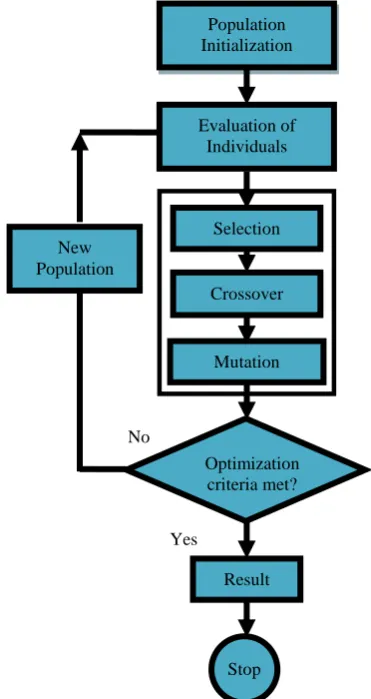
Research works reviewed for this paper are on optimal placement of network facilities i.e, antennas and base transceiver stations (BTS). The optimization objectives common to all is coverage and the use of fewer facilities represented as economy or cost reduction. The implementation of the placement optimization using genetic algorithm have been handled by the researchers under review, followed the process of application which is in line with the flow chart in fig 1
4.1
Problem Representation
The first step in the implementation of a GA is taking a decision on what mode/form the information about the system will be represented, this usually includes encoding all relevant parameters, this can be either direct encoding where strings can be read directly or indirectly where a decoding algorithm is used to expand the strings into meaningful information. Originally GA used binary numbers in its operation, in which case a binary string representation of 1’s and 0’s constitutes the system representation. However other coding system is been used which include integer values, real values and ordered set of symbols. For the facility placement under review binary coding were mostly used with the candidate solutions encoded as fixed length bit strings called chromosome. (e.g. 101110, 111111, 010101) with each bit representing some aspect of the proposed solution to the problem. In representing a problem with binary strings, the resolution, and number of bits that will adequately represent the chromosome will be calculated, this however will depend on the type and range of parameters.
[image:3.595.321.507.77.427.2]When binary encoding is been used the determination of number of bits that will constitute the string ‘chromosome’ will be obtained thus;
fig 1: flow chart showing the basic steps for implementing GA in a facility location optimization problem
Population Initialization
Evaluation of Individuals
New Population
Result Optimization criteria met?
Yes
Stop Selection
Crossover
Mutation
Where;
m is the required binary bits
a is the lower limit of the decimal range b is the upper limit of the decimal range p is the required precision in decimal points
4.2
Population Initialization
The population is a collection of “candidate solutions” usually referred to as chromosomes or individuals, the first generation of a population is made up of individuals composed of ‘genes’ which are the defining characteristic of that individual making it eligible to be referred to as a candidate solution for the optimization problem. The initial pollution size is usually based on an estimate of the site requirement which involves determining the number of base stations required to meet adequately the coverage and capacity constraints. The site estimates are usually determined based on cell computation using wave propagation models and basic cell planning calculations, most commonly used is the Hata Okumura model [7; 4] Initial population are generated from a cell plan map with likely base station location chosen based on coverage, The larger the initial population the longer it takes to run the algorithm as the GA spends most of the time on evaluating population. The chromosome can be represented as an array of bits, a number, an array of numbers, a matrix, a string of characters or any other data structure and must satisfy given precision and constraints and be suitable for the implementation of genetic operators [3; 11; 12].
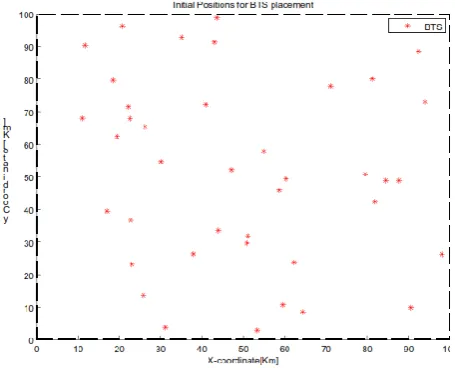
[image:4.595.57.285.468.652.2]With the use of random operator in MATLAB, a set of base station can be generated, randomly distributed over a given area ( fig. 2), these form the set of initial population that will be well distributed in the cause of the implementation of the algorithm to obtain an optimal distribution taking all defined constraints into consideration.
Fig. 2: Random generated candidate solution using MATLAB
4.3
Fitness Evaluation
Fitness evaluation is the process of evaluating the fitness of a
optimization have been achieved. The fitness function has been shown to be a combination of several functions for a multi objective optimization problem, where certain design requirements are defined as constraints which are observed by way of violation. Usually these constraints are built into the algorithm and thereafter used to evaluate the fitness function in order to assign a value to each chromosome.
The fitness function for most facility placement algorithm is multi objective, the objectives include coverage, economy; transmit power, and sometimes environmental impact.
For a single objective function, the coverage is given as:
F
Having defined the objective function, the processor assigns a fitness value on each chromosome base on calculation results obtained using propagation models and function equations. The value assigned to an individual is relative to the rest of the population.
4.4
Genetic Operators/Reproduction
The reproduction process of the algorithm follows a sequence of selection, cross over and mutation, reproduction defines the rules for generating the gene sequence of offspring from the parents chromosome.
4.4.1
Selection
The selection process is analogous to the survival of the fittest in the natural world [16], in the GA operation, based on the fitness value allocated to each chromosome, selection is done to select parents for crossover, and the system is expected to choose the more fit individuals in the population while still preserving the population diversity. Several means of selecting a population exist with their advantages and disadvantages,
In the Facility placement problems reviewed mention is made of rank-based, roulette wheel and tournament selections methods. Researchers have compared these three selection methods and from results based on fitness cost indicated that tournament selection utilizes a more efficient method of choosing fitter parents for mutation though choice could be problem dependant.
4.4.2
Cross over
Cross over is the process of inter linking two chromosomes where genes are exchanged resulting in new chromosomes carrying the features of both parents. It is analogous to combination of genes in biology resulting in a haploid, it can be referred to as the sexual combination with relation to life and evolution. It involves the introduction of sub solutions on different chromosome resulting in an entire new chromosome or generation. Cross over is done to accelerate search; the basic cross over methods include single point cross over, multipoint and uniform cross over.
4.4.3
Mutation
guided mutation. Mutation probability is advice to be low to the tune of 0.1% to avoid premature convergence and at most 1% as the case may be.
4.5
Ending Criteria
The complete process from population initialization to mutation resulting in the production of a new set of “candidate solution” can be referred to as one generation. The GA is run over several generations in order to determine the best set of solutions and typically ended at the best convergence; that is when the best fit converges to the average. There are however other stopping criteria which include
Fixed number of generations reached
Budgeting: allocated computation time/money used up
An individual is found that satisfies minimum criteria
The highest ranking individual's fitness is reaching or has reached a plateau such that successive iterations are not producing better results anymore. Manual inspection. May require start-and-stop
ability
Combinations of the above
Usually GA is ended with an output display of both data and graphs of best solutions to the facility placement. One that will give best coverage and minimum number of facilities while takings environmental and safety constraints into consideration.
5.
CONCLUSION
Research findings have shown that radio coverage optimization can be addressed through optimal location of network facilities, resulting in an optimization problem that takes several variables into consideration many of which are conflicting. No one parameter can be taken independently, as these variables when combined results in a non -linear complex problem with computational complexity thereby requiring the service of meta heuristic technique like GA. Genetic Algorithm has been shown to provide a near optimal solution of radio facility placement, benefits of which can be described as time saving and efficient. The reviews though carried out on simulations works show that results obtained are largely dependent on choice of parameters such as population size, selection and reproduction parameters, while speed of execution is dependent on the population size, the larger the size the longer the iterations. In all, GA is customizable, challenging and interesting, its implementation calls for harmonization of genetic operation
6.
REFERENCES
[1] Motorolla Cellular Infrastructure Group “CP02 Introduction to GSM Cellular” Training Manual 1999 – 2002 printed in the U.K. .
[2] Haupt R., & Haupt S. “Practical Genetic Algorithms” (2004) 2nd edition, published by John Wiley & Sons, Inc USA , Wiley-Interscience publication ISBN 0-471-45565-2.
[3] Kai L. et al (1998 ) “Radio Coverage Optimization with Genetic Algorithms” The 9th
IEEE International Symposium on Personal, Indoor and Mobile Radio Communication vol.1 pg 318-312.
[4] Job M., Anish K., Ben V. W, (2008) “Optimization of Antenna Placement in 3G Networks using Genetic Algorithms” Proc IEEE Third International Conference on Broadband communication, Information Technology and Biomedical Applications pg. 30 – 37
[5] Rodney S. R, Avinash M. “Cell Planning Using Genetic Algorithm and Tabu Search” 978-1-4244-4457-1/09/$25.00 ©2009 IEEE pgs 640-645
[6] Gaber S. M., El-Sharkawi M. E., and Nour El-deen M. “Traditional genetic algorithm and randoM-weighted genetic algorithm with gis to Plan radio network” URISA Journal Vol. 22, No. 1 • 2010.
[7] Yong S. C, Kyung S. K., Nam K. (2008) ”The Displacement of Base Station in Mobile Communication with Genetic Approach” EURASIP Journal on Wireless Communications and Networking, Article ID 580761.
[8] Lucent Technologies “GSM Network RF Optimization workshop” assessed online on 15th
Jan 2011
[9] Alexander G., Stefan J., Yee Y. C., and Martin T. “A Rule-Based Algorithm for Common Pilot Channel and Antenna Tilt Optimization in UMTS FDD Networks” ETRI Journal, Volume 26, Number 5, October 2004 pg. 437 – 442
[10]Jorg Z., Robin H., Heinz M. (2003) “ENCON: an evolutionary algorithm for the antenna placement problem” Elsevier Science Ltd, Computers & Industrial Engineering pg. 209-226.
[11]Yamada, T.; Hoa, P.T.;(2006) “Unified micro-cellular network with pico cells to avoid local congestion” IEEE Wireless Telecommunications Symposium, 2006. WTS '06.
[12]Rodney S. R, Avinash M. “Cell Planning Using Genetic Algorithm and Tabu Search” 978-1-4244-4457-1/09/$25.00 ©2009 IEEE pgs 640-645
[13]Weise T. (2009) “Global Optimization Algorithms = Theory and Applications second edition www.it-weise.de assessed August 2010
[14]Motorola White paper (2008) “Intelligent Optimization: Advancing Optimization in 3G Networks to Enhance Service Quality, Network Efficiency, and Business Performance Through User-Centric Data Analysis” Motorola Inc. USA.
[15]Hishamuddin J. (2011) lecture notes on Genetic Algorithm, Faculty of Mechanical Engineering Unuversiti Teknologi Malaysia, unpublished.