http://dx.doi.org/10.4236/ce.2014.512118
Turnitin Adoption and Application at a HEI:
A Developmental Approach
Juliet Stoltenkamp, Martha Kabaka
Centre for Innovative Educational and Communication Technologies (CIECT), University of the Western Cape, Cape Town, South Africa
Email: [email protected], [email protected]
Received 14 March 2014; revised 10 April 2014; accepted 30 April 2014
Copyright © 2014 by authors and Scientific Research Publishing Inc.
This work is licensed under the Creative Commons Attribution International License (CC BY). http://creativecommons.org/licenses/by/4.0/
Abstract
Issues of plagiarism are mutual debates across Higher Education Institutions (HEI). As a result, in-stitutions have employed software detection tools as a measure to deter such unacceptable aca-demic practices. This study explores experiences related to the adoption and implementation of Turnitin (Tii) perspective through a developmental approach at a HEI, namely, the University of the Western Cape (UWC), South Africa, during the period 2010 January to 2013 June . A case study approach was adopted targeting the lecturers, their assistants and Centre for Innovative Educa-tional and Communication Technologies (CIECT) Tii support team members. Qualitative research design was applied. This was in addition to an analysis of data collected from post-Tii training workshop evaluation questionnaires, and random email enquiries and responses between lectur-ers and the CIECT team on Tii mattlectur-ers. The paper reflects on the slow uptake of Tii by the lecturlectur-ers, which is worrisome as the students are dependent on their commitment. The support team en-courages a developmental, rather than a punitive approach. Students need to be encouraged by their lecturers to submit assignments and subsequently improve on their academic writing ac-cording to originality reports retrieved from Tii. The researchers hope that these findings would highlight the importance of the dissemination of an anti-plagiarism document which will enable plagiarism discourse.
Keywords
Turnitin, Developmental Approach, Lecturers, Policy, Marketing
1. Introduction
a developmental approach at a HEI, namely, the University of the Western Cape (UWC), South Africa. In Sep-tember 2009 the University of the Western Cape (UWC) purchased a Tii campus license. This system is hosted on the World Wide Web and operates from multiple data centers, checking similarity indexes (plagiarised text) within student repositories, the internet and archived materials; periodicals; journals and publications.
The CIECT Director was responsible for the implementation and roll-out to the campus community. The CIECT support team received train-the-trainer sessions before embarking on marketing and capacity building strategies. In 2010, Tii was rolled-out to the campus community. Training workshops are marketed to lecturers who are interested on a weekly or monthly basis; and further supported by office consultation.
1.1. Lecturer Training Process
The main emphasis of lecturer (instructor) training is not to focus on the actual report generation; rather to focus on the interpretation of the generated report. A lecturer is trained to setup a “class” within the Tii system, with specific criteria related to the generation of a similarity index report. For example, a lecturer can decide whether bibliographic material, small matches and quoted material should be selected or deselected for submission pur-poses.
The CIECT team has created just-in-time training manuals (lecturer and student) which are available for the campus-wide community http://turnitin.uwc.ac.za/(University of the Western Cape, Undated). Users are also able to access the Tii online Help Centre at http://turnitin.com/en_us/support/help-center, which provides clear steps, screenshots and instructional videos. Lecturers are expected to request Tii student training sessions, which entail the following: access to a specific “Tii class” (using automated passwords); password security issues; submissions; and interpretation of the generated report.
1.2. Developmental vs. Punitive Approach
Institutions employ specific approaches in implementing Tii ant-plagiarism system, with the most commonly applied being developmental or punitive approaches. The CIECT team’s roll-out plan entails a developmental approach, whereby lecturers are expected to set-up “classes”, allowing multiple submissions. Hence, UWC lec-turers are encouraged to allow students to peruse, review, and discuss originality reports prior to the final dead-line. This approach is viewed as non-punitive and enables the students to improve their writing skills. “Al-lowing students to submit drafts and view their originality reports reduces anxiety in students, helping them to correct their mistakes or omissions and feel better that they are on a level playing field with their peers” (Gra-ham-Mathesona & Starrb, 2013). In addition, the developmental approach provides an opportunity for second- language English speakers; and those who are not competent English writers, by giving them an opportunity to review their academic papers (Parry, 2013). On the other hand, a punitive approach implies that institutions en-force students’ usage of Turnitin software. This approach does not permit students acess to their originality re-ports, as the reports are merely used to “catch” the plagiarist (Curach, Undated). A punitive approach leads to a “counter-productive situation of students focusing their energy on attempting to “beat” the software rather than developing their academic writing skills and gaining confidence in their abilities to produce authentic work”, cited by Lake, 2008 & Singer, 2010 - in (Prescott, 2012: 2).
The authors of this paper argue that students’ writing skills should also be developed through their commit-ment to self-directed learning; rather than focusing on the final submission of a written piece. Research argues that, “while no single project or tool will provide a panacea to the on-going challenges… to academic writing, using Tii as a formative tool to support student’s progress can be effective, particularly in relation to building confidence and competencies” (O’Hara, Carter, & Manassee, 2007).
On the other hand, whilst UWC feels confident about this developmental approach, critiques argue that the approach does not effectively discourage students from cheating, as was found in Northampton University (Pickard, Howe, & Fitzgerald, 2010). Furthermore, Penketh and Beaumont (2013: 11) argue on a “problematic nature of encouraging the development of student writing via the introduction of Turnitin, since it is situated as a tool associated with final submission as well as being associated clearly with issues of malpractice”.
2. Review of Relevant Literature
stu-dents. “Turnitin is the world’s leading web-based solution for plagiarism prevention, used by educators world-wide to check students’ papers for originality, to enable web based peer review and for digital grading of student work” (Turnitin White Paper, 2012: 19). Tii operates by comparing and analysing document texts for similar matches to other sources. This ensures that people correctly acknowledges others’ work. Hence, non-original content is highlighted for the responsible author to review and rework (Indiana University, 2012; Whitsed & Colbeck, Undated: 128).
According to the Tii official website, 2013 statistics indicate that more than 3500 HEIs’ are making use of the anti-plagiarism system (http://turnitin.com/en_us/customers/college-and-university). There was an increase glo-bally in 2010, in the number of HEIs who purchased Tii licenses; and by 2012, the software was available in 10 different languages and processing approximately 200,000 papers a day (Stapleton, 2012: 125).
Plagiarism issues are not new within HEIs; rather they are increasingly becoming more complex due to easily accessible content via the internet. Hence, there is definitely a place for the Tii anti-plagiarism software within institutions as it provides for an opportunity for the students to grow academically (Australian College of Ap-plied Psychology, Undated). Some of the commonly accepted types of plagiarism include: “act of submitting another’s work, word-for-word, as one’s own; written piece that contains significant portions of text from a sin-gle source without alterations; changing key words and phrases but retaining the essential content of the source in a paper; paraphrasing from other sources and making the content fit together seamlessly; and self-plagiarising” (Turnitin White Paper, 2012: 4; University of Oklahoma, Undated). On the other hand, there seems to be limited global consensus on plagiarism and what it actually entails (Collins and Amodeo (2005) cited by Zeman, Steen, & Zeman, 2011: 432; DesVoss & Rosatib, 2002)).
Following, research raises questions about students’ understanding of how to write academic papers; and if so, if they are aware of plagiarism implications (Zeman, Steen, & Zeman, 2011: 432). This argument is supported by work of Batane (2010), who found that a number of students stated that they had limited writing skills which led to the fear of submitting their work in Tii. Thus, institutions directly bear the consequences of the image and quality of their graduates. Hence, institutions who implement Tii enable students to make submissions and “identify whether they have accomplished true revision” (Turnitin White Paper, 2010: 9). Through revision, struggling students develop their writing skills, while academics also manage to support the students’ weak areas based on the GradeMark retrieved from Tii. This implies that the roles of academics go beyond class faci-litation and grading student academic work (Turnitin White Paper, 2010: 11).
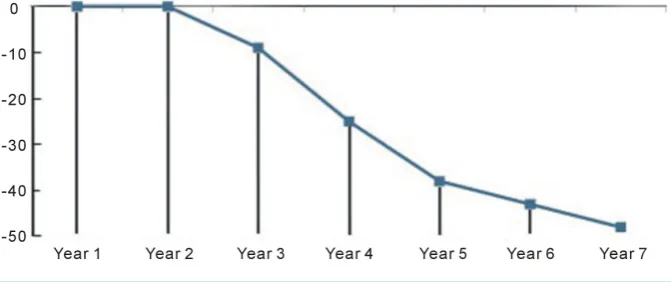
In addition, recent research based on an analysis of United States (US) HEIs, who made regular use of Tii over a period of 7 years, established a 48% reduction in the “incidents of unoriginal student work over time”, as indicated in Figure 1: Effectiveness of decrease in unoriginal content in US HEIs.
[image:3.595.147.483.555.696.2]Despite such benefits derived from Tii, Shaw (2012) gives a harsh critique and states that students’ usually intend to be dishonest, thus the use of Tii did not really enforce any positive discipline among students. Shaw further points out that despite warning two groups of students about the consequences of plagiarism, it did not deter them. Research carried out by Batane (2010) at the University of Botswana, indicated that some students did not take plagiarism issues seriously, due to a lack of punitive measures which encourages others to cheat. This issue can be alleviated when a clear policy framework is implemented within a HEI (Eastern Mennonite
University Undated). Furthermore, Tii is also described as a “punishment tool”, enforcing students, thereby “violating intellectual property rights” (Vlasits, 2006; Ganesan, 2006).
3. Methodology
The research entailed a case-study methodology of UWC lecturers and the CIECT Tii support team during the period, May 2010 to Mid-June 2013. A qualitative research design was applied and data were collected from two (2) different types of questionnaires; a facilitation evaluation form; and email enquiries. Lecturers and CIECT Tii support team members were targeted to complete these open-ended questionnaires regarding the us-age of the Tii system (overall experiences and application).
The lecturer questionnaire was administered through Google Drive (a link was sent to the university commu-nity via email). It focused on areas such as: 1) Faculty/Department; usage of Tii; attendance of Tii training; 2) Tii support (follow-up training, office consultation, telephonic and email support); and 3) lecturers’ understand-ing of the functionalities of Tii (creatunderstand-ing classes, addunderstand-ing assignments, review and the interpretation of plagiarism reports). It should be highlighted that only 38 out of 871 lecturers’ responses were received. However, this search was conducted during the institutional examination period. This may have contributed to the low re-sponse rate.
The questionnaire which targeted CIECT support team members (8 staff members) was manually distributed. It focused on areas such as: training and facilitation experiences. The research was conducted during the same period to maintain consistency. These members were selected as they are directly linked to daily Tii support.
In addition, data were collated and analysed from constructive feedback by lecturers (10 post-training evalua-tion forms, randomly selected from 210 forms). The informaevalua-tion focused on specific facilitaevalua-tion methodologies (content, facilitators, attitudes and skills attained). However, it should be noted that not all the relevant informa-tion fields were completed.
Furthermore, data collated from 50 (out of approximately 500) randomly selected email responses and en-quiries, submitted between the periods May 2010 to June 2013, was analysed in relation to experiences; and challenges encountered. These emails contained critical content, considering that email communication is one of the major forms of communication between the lecturers and the CIECT Tii support team.
Lastly, the researchers are also part of the CIECT team and are familiar with the implementation and applica-tion of Tii. The lead author, Director of CIECT, is responsible for the overall implementaapplica-tion and roll-out plan. These questionnaires; lecturer training evaluation forms; and emails were analysed and reported.
4. Results
The research reports that: 1) 80% of the respondents had sought support from the CIECT team between May 2010 and June 2013; 2) 278 out of 871 lecturers attended scheduled Tii training sessions; 3) only 38 lecturers responded to the lecturer questionnaire; and of these respondents, only 26 had attended the scheduled Tii train-ing workshops; 4) and 90% of the respondents reflected positively regardtrain-ing the quality of the scheduled Tii training facilitation, related training content, and one-one-one office training consultations provided by the CIECT team.
At the time of this research, lecturers from 24 Departments (of 47)—were making use of the system. While, only twenty six (26) respondents (of the 38) made use of the Tii system. Students’ Tii usage and scheduled training sessions are dependent on the lecturers’ adoption and related requests. However, research reflects a low lecturer adoption rate which directly hinders the student developmental approach as they are not able to submit academic work for plagiarism detection. Only 70% of the respondents fully understood all the functionalities of the Tii system. It is evident that limited understanding hinders optimal usage of the system. Ninety-five (95%) of the respondents indicated that there is a need for mandatory Tii usage by lecturers and students, which will lessen academic plagiarism. However, a lecturer expressed his doubt about the 100% effectiveness of the soft-ware. At the time of this research, four (4) years since the development of the plagiarism policy, there remains a lack of the dissemination of the document. Furthermore, the use of the anti-plagiarism system is not mandatory. The results of the research is further discussed in detail, Section 5.
5. Research Discussion
and supported with relevant academic citations. The main themes include: 1) constant marketing, training and support for capacity building; 2) institutional Tii adoption rate; 3) students’ Tii usage vs. lecturers’ commitment; 4) lecturers’ understanding of Tii functionalities; 5) lecturers approval of Tii as a valuable anti-plagiarism tool; 6) confusion on usage of Tii at UWC; and 7) institutional anti-plagiarism policy document dissemination.
5.1. Constant Marketing, Training and Support for Capacity Building
A dedicated Tii support team, consisting of 4 members, is responsible for the implementation and roll-out of the Tii anti-plagiarism system; and related marketing and training for capacity building—to the entire campus community. Hence, marketing and training strategies have been developed, including online and conventional paper-based marketing: emails, blogs, UWC intranet, printed calendar schedules and “just-in-time” online train-ing environment (http://turnitin.uwc.ac.za/ (University of the Western Cape, Undated)). Instructional manuals for lecturers and students have also been developed. Scheduled training workshops are marketed and lecturers also receive one-on-one consultation if they are not able to attend the scheduled calendar interventions. These capacity building interventions are supplemented support with telephonic and email support on a daily basis, upon request. The research highlighted that 80% of the respondents (lecturer’s questionnaire), had sought sup-port from the CIECT team. Supsup-port during the adoption phases of Tii has been found to be very critical by re-searchers such as Mulcahy and Goodacre (2004), who argue that, a lack of quality support can lead to failed project implementation.
Capacity building interventions also links to research which states that, online marketing enables efficiency and quality feedback, giving academics an opportunity to clarify plagiarism issues; as Tii issues are not just “black and white” (Fearn, 2011: 4; Mulcahy & Goodacre, 2004: 694). Between May 2010 and June 2013, 278 lecturers attended scheduled Tii training sessions. This number is indicative of a slow uptake by lecturers during this period. However,Figure 2 below reflects that 454 “instructor accounts” were created by the UWC Tii ad-ministrator. This is due to the fact that during the pilot implementation phase in 2009, the UWC Tii administra-tor added lecturers prior to training sessions; but they did not actually attend. Furthermore these accounts also reflect those created by lecturers who had the “know-how” and only requested that the administrator creates a UWC account.
It should be noted that only 38 lecturers responded to the lecturer questionnaire; and of these respondents, only 26 had attended the scheduled Tii training workshops. Surprisingly, even though the CIECT team regularly markets the training workshops, 10 respondents claimed that they had never received any communication related to scheduled training and support. For example, following are some comments retrieved from questionnaires: “…communicate with lecturers on Tii upcoming training dates”. “…keep lecturers informed on different methods students are using to defeat Tii software”. Another respondent indicated that, “I never received any information
about such training”. Contrary to such responses, it was noted that the Tii support team commonly argued on
Figure 2. Tii statistics for UWC, May 2010-June 2013 (Retrieved from University of the Western Cape Turnitin account-
[image:5.595.96.538.507.697.2]the questionnaire that, “some academics often delete important UWC communication, including CIECT market-ing communication”.
In addition, respondents also requested communication related to anti-plagiarism Conferences, especially those taking part in Africa, such as the International Tii African Academic Integrity seminar, which was held at University of Cape Town on 20th May 2013. These respondents argued that if the institution encouraged and updated Tii users to attend such seminars, they could learn more.
Furthermore, 90% of the respondents (as per lecturer questionnaire, training evaluation questionnaire and email communications) reflected positively regarding the quality of the scheduled Tii training facilitation; re-lated training content; and one-one-one office training consultations provided by the CIECT team. One major reason for building capacity among academics in the adoption of Tii is to ensure that, “a solid basis for more ef-fective and efficient services and activities; consequently supporting the development of knowledge and under-standing” (EQUAL, 2006).
5.2. Institutional Tii Adoption Rate
According to the institutional Tii statistics (UWC), at the time of this research, lecturers from 24 Departments (of 47)—were making use of the system. Figure 2 indicates the Tii statistics for UWC, May 2010-June 2013.
Figure 2 depicts 454 active academic Tii users, namely instructors. It also shows that during the period, May 2010 and June, 2013, 18681 UWC students were registered within the Tii system. There were 49055 paper sub-missions; and 48980 originality reports were retrieved. The similarity indexes (plagiarism detection averages) are depicted by percentages within a colour range.
Furthermore, the respondents were requested to state their respective Faculties and Departments. This enabled the researchers to identify that only twenty six (26) respondents (of the 38)—actually made use of the Tii system. Although this number is low and worrisome for the Tii support team, it represented lecturers across all 7 Facul-ties of UWC.
5.3. Students’ Tii Usage Versus Lecturers’ Commitment
Students’ Tii usage and scheduled training sessions are dependent on the lecturers’ adoption and related requests. The onus is on the lecturer to attend scheduled Tii workshops, in order to create a “class account” (discipline specific); and thereafter to schedule specific student training sessions. Section 4.2 reflects a low lecturer adop-tion rate which directly hinders the student developmental approach as they are not able to submit academic work for plagiarism detection. This was confirmed by the CIECT team respondents who stated that the high numbers of student complaints were linked to lecturers’ non-commitment.
Following, a large number of students have contacted the CIECT support team for assistance regarding access and usage, even though their lecturers have created “Tii classes”. This has led to written complaints by some students, highlighting the fact that only some students are required to submit originality reports, while others have not been assigned to a specific Tii class.
Hence, there is a current trend, whereby students who wish to improve their academic writing and protect their intellectual property, have requested to create independent “Tii classes”—without the approval by the sub-ject-matter expert. As authors, Davis and Carroll (2009), cited in Turnitin (2012: 2) state that, “using Turnitin as a formative assessment tool helped students avoid plagiarism, decrease student tendencies to rely heavily from on sources, improve citation practices and improve paraphrasing skills”. Other researchers elsewhere found out that “87% of students said that using Turnitin with their assignments was a good idea” (Sheridan and Brake 2005, cited in Turnitin 2012 website).
5.4. Lecturers’ Understanding of the Tii System
respondent could only make use of one (1): “review and interpret plagiarism report.
It is evident that limited understanding hinders optimal usage of the system. “Instructors who choose to use Turnitin must become familiar with the tool itself and the ethical issues related to using such a tool, understand its capabilities and limitations, and provide their students with notification regarding this tool’s use”
(http://www.clemson.edu/ccit/learning_tech/ccit_training/ott/turnitin/).
Following, the CIECT team receives continuous enquiries related to the Tii system functionalities. Hence, the support team emphasised the “non-commitment by lecturers to attend capacity building sessions” which further leads to a lack of understanding—of the benefits of the Tii system.
Furthermore, the support team highlighted that during some capacity building sessions, it was noted that par-ticipants hesitated to ask questions regarding functionalities. Instead, they preferred to pose questions via email, telephonic or one-on-one consultations. There are many reasons as to why some adults’ may be reluctant to con-tribute or ask for relevant clarifications during a workshop. This may include “fear of having the wrong answer or that their comments will show ignorance”, among other reasons (Keller’s, Undated).
5.5. Lecturers Approval of Tii as a Valuable Anti-Plagiarism Tool
The institution’s academic reputation depends on the quality of research output and graduates. Ninety-five (95%) of the respondents indicated that there is a need for the lecturers and students to make use of the Tii system as it provides many benefits. For example, a respondent stated that, “the use of Tii should be mandatory to reduce plagiarism”. In addition, another respondent stated that it should be “compulsory for all staff and all students to receive training and to use Turnitin”. A respondent also stated that “the deployment of Tii is probably one of the best things we’ve done, to give effect to the University Plagiarism Policy, and to address the widespread
plagia-rism among our students and help them improve their writings. We have students on the Dean’s Merit list who
have turned out to be serial plagiarists. It is as bad as that...Tii is one of the best tools to combat plagiarism and develop students’ writing skills”.
These findings link with previous research which reflects on the positive benefits of Tii. Williams (2007) cited in Turnitin (2012: 2), reported that “nearly 50% of faculty said that their time searching for plagiarism de-creased”.Brown, Jordan, Rubin and Arome (2010) also state that the Tii anti-plagiarism system provides one of the best methods in dealing with students’ academic unethical practices.
Following, a respondent further promoted the usage of Tii in the institution, as he was concerned about some students who have appeared on a Dean’s merit list; yet they are “serial plagiarists”. In addition, a respondent expressed the need for Tii training, as he had experienced “a fair degree of plagiarism” within his Department.
On the other hand, a lecturer expressed his doubt, claiming that the software was not 100% effective, as he had identified aspects of plagiarised material after his students had submitted. This feedback links with other critiques of Tii, such as Carr (2013) who found that some lecturers admitted that not all Departments had the “ability to stop students from cheating, and others also classified their ability to prevent cheating as low”. In ad-dition, another critique highlights that mandatory Tii usage creates tension and interferes with student human rights—like it happened before, where a “McGill University student who sued the university and won his right not to submit assignments to Turnitin” (Lowe, Schendel, & White, 2006; http://cyberdash.com). Furthermore, Rivard (2013) emphasises the creation of hostile learning environments: “plagiarism detection services can compromise academic integrity by potentially undermining students’ agency as writers, treating all students as always already plagiarists, creating a hostile learning environment, shifting the responsibility of identifying and interpreting source misuse from teachers to technology, and compelling students to agree to licensing agree-ments that threaten their privacy and rights to their own intellectual property”.
5.6. Institutional Anti-Plagiarism Policy Document Dissemination
An institutional anti-plagiarism document was debated and approved by the Senate in 2011. The responsibilities of Faculty and the support units are clearly stipulated. However, the research highlighted that there was a lack in the dissemination of the document as lecturers expressed confusion regarding the mandatory use of the Tii sys-tem. One respondent stated: “I do not request for Tii reports in my postgraduate class so I don’t need to attend the trainings”.
disci-plines. The research highlighted an inconsistency and clarification regarding the agreed similarity index per-centage for the institution. The support team stated that this creates confusion amongst lecturers, often from the same Department who set different similarity text detection percentages for the same discipline. In addition turers also make their own decision regarding percentages for different academic levels (year of study). A lec-turer stated that “clear UWC policy guidelines should be helpful, especially as the bar is going to be set at around 17%for thesis”.
This situation experienced by UWC during adoption phases, are not unique. Cohen (2010: 5) wrote: “confu-sion over the meaning of the originality report percentage was a concern to staff who was tempted to just check high percentage matches without considering the implications of plagiarism occurring with lower percentage matches”.
6. Challenges
There were a number of challenges reported by respondents. Even though there is extensive marketing regarding capacity building sessions, some lecturers expressed that they did not have the time to attend the scheduled Tii training sessions. The support team expressed the importance of attendance, as it would reduce the requests for one-on-one office consultations. Furthermore, lecturers who fail to attend scheduled training sessions are not able to respond sufficiently to student queries; set-up criteria; and select appropriate options for the effective in-terpretation of the similarity index reports.
In addition, some lecturers expect students to submit papers without any prior training and access to the sys-tem. Lecturers are expected to set the parameters for submissions, thus allowing multiple-submissions, in order for students’ to decrease the similarity percentage. This situation does not allow for the developmental approach. Following, postgraduate students request to be assigned as personal instructors in order to submit their papers; as some respective supervisors do not make use of the Tii system.
The CIECT team is responsible for training and the lecturers should not refer their students to the support team for issues related to their specific subject-matter and the interpretation of similarity reports.
The research also reflected on common technical challenges: problems with retrieving Tii student passwords; delayed communication related to student passwords; incorrect capturing of surnames or names which affect the creation of lecturer accounts; and incorrect creation of accounts by the lecturers. One respondent indicated that some of these problems could be eliminated through the integration of Tii with the institutional Marks Admini-stration System (MAS). These challenges could be linked to the lack of dissemination of the plagiarism policy document within the institution.
7. Study Limitations
The lecturer questionnaire was distributed via Google Drive, a valuable online survey tool, available via various modes of delivery. The responses were available in “real time”; however, the researchers felt that they needed face-to-face interaction at times, in order clarify some of the responses. Furthermore, the research was con-ducted during the institutional examination period, which had an impact on the lecturer respondents. Moreover, these research findings cannot be generalised as they are based on a small case-study.
8. Recommendations
The research recommends the importance of the dissemination of the institutional plagiarism policy by Deans, Departmental HODs and Deputy-Deans of teaching-and-learning. The policy should be aligned to discussions regarding training, implementation and curriculum development planning. In addition, each Faculty should as-sign skilled administrators to assist lecturers with the review and interpretation of student similarity index re-ports.
9. Conclusion
Acknowledgements
Researchers wish to extend their appreciation to all the CIECT Tii support team members, for their commitment in providing us with all relevant information when it was needed.
References
Australian College of Applied Psychology (u.d). Turnitin.
http://www.acap.edu.au/current-students/managing-my-course/assessment-information/turnitin/.
Batane, T. (2010). Turning to Turnitin to Fight Plagiarism among University Students. Educational Technology & Society, 13, 1-12.
Brown, V., Jordan, R., Rubin, N., & Arome, G. (2010). Strengths and Weaknesses of Plagiarism Detection Software. Journal of Literacy and Technology, 11, 110-131.
Cohen, J. (2010). Using Turnitin as a Formative Writing Tool. Journal of Learning Development in Higher Education, 2. Curach, L. (u.d). Turnitin or Turnitoff? Academic Integrity.
http://www.uws.edu.au/__data/assets/powerpoint_doc/0004/58522/Liz_Curach_-_turnitin_or_turnitoff_presentation.ppt
Carr, D. F. (2013). Many Higher Ed CIOs Want More IT Resources.
http://www.informationweek.com/government/leadership/many-higher-ed-cios-want-more-it-resources/d/d-id/1110505
EQUAL (2006). Learning How to Build Capacity: Successful Examples from Round 1, Equal Asylum Seekers; Capacity Building V3.doc. http://ec.europa.eu/employment_social/equal_consolidated/data/document/etg5-capacity-building.pdf
Ganesan, H. (2006). Pro: Should Teachers Use Turnitin.com? http://silverchips.mbhs.edu/story/6923.
Graham-Mathesona, L., & Starrb, S. (2013). Is It Cheating or Learning the Craft of Writing? Using Turnitin to Help Students Avoid Plagiarism. The Journal for the Association for the Learning Technology (ALT), 21.
Indiana University (2012). Using Turnitin.Com: A Guide for Instructors. Centre for Innovative Teaching and Learning. http://www.indiana.edu/~turnitin/tii_fall2011.pdf.
Keller’s, J. J. (u.d). Engaging the Adult Learner. https://www.jjkellertraining.com/trainingresources/1809/osha
Lowe, C., Schendel, E., & White, J. (2006). Issues Raised by Use of Turnitin Plagiarism Detection Software. http://cyberdash.com/plagiarism-detection-software-issues-gvsu
Mulcahy, S., & Goodacre, C. (2004). Opening Pandora’s Box of Academic Integrity: Using Plagiarism Detection Software. In R. Atkinson, C. McBeath, D. Jonas-Dwyer, & R. Phillips (Eds.), Beyond the Comfort Zone: In Proceedings of the 21st ASCILITE Conference (pp. 688-696). Perth. http://www.ascilite.org.au/conferences/perth04/procs/mulcahy.html
O’Hara, M., Carter , C., & Manasse, G. (2007). Getting It Write: A Multi-Disciplinary Approach to Student Academic Sup-port. http://www.plagiarismadvice.org/resources/engaging-students/item/ohara-casestudy
Penketh, C., & Beaumont, C. (2013). “Turnitin Said It Wasn’t Happy”: Can the Regulatory Discourse of Plagiarism Detec-tion Operate as a Change Artefact for Writing Development? Innovations in Education and Teaching International, 15. http://www.tandfonline.com/doi/pdf/10.1080/14703297.2013.796721
Pickard, J., Howe, R., & Fitzgerald, R. (2010) Embedding UNPAC. In Supporting Academic Integrity: Approaches and Re-sources for Higher Education (pp. 24-26). York: Higher Education Academy and JISC.
http://www.heacademy.ac.uk/assets/documents/academicintegrity/SupportingAcademicIntegrity_v2.pdf
Prescott, T. (2012). How Does Using Turnitin in a Formative Way Change Student Attitudes towards Plagiarism? Bellerbys College. http://archive.plagiarismadvice.org/documents/conference2012/finalpapers/Prescott_fullpaper.pdf
Rivard, R. (2013). Turning on Turnitin.
http://www.insidehighered.com/news/2013/04/16/writing-professors-question-plagiarism-detection-software.
Shaw, C. (2012). Use of Turnitin Software Does Not Deter Cheating; Study Finds. http://www.timeshighereducation.co.uk/418740.article
Turnitin (2010). A Summary of the Effectiveness of Turnitin.
http://pages.turnitin.com/rs/iparadigms/images/Turnitin_Summary_of_Effectiveness.pdf
Turnitin (2012). Literature Review; Independently Published Studies on Turnitin Services.
http://pages.turnitin.com/rs/iparadigms/images/Turnitin_Independent_Literature_Review_hires.pdf
Turnitin White Paper (2012). The Plagiarism Spectrum; Instructor Insights into the 10 Types of Plagiarism. http://pages.turnitin.com/rs/iparadigms/images/Turnitin_WhitePaper_PlagiarismSpectrum.pdf
University of the Western Cape (u.d). http://turnitin.uwc.ac.za/
Vlasits, J. (2006). Con: Should Teachers Use Turnitin.com? http://silverchips.mbhs.edu/story/6922
Whitsed, C., & Colbeck, D. (u.d). A Tale of Two Cities: Implementing a Developmental Approach to Academic Integrity in two Australian Universities. http://www.apcei.catl.uwa.edu.au/procs?f=44844
Zeman, L. D., Steen, J. A., & Zeman, N. M. (2011). Detection Software in a Graduate Policy Course: A Mixed-Methods Evaluation of Plagiarism. Journal of Teaching in Social Work, 31, 431-441.
currently publishing more than 200 open access, online, peer-reviewed journals covering a wide range of academic disciplines. SCIRP serves the worldwide academic communities and contributes to the progress and application of science with its publication.
Other selected journals from SCIRP are listed as below. Submit your manuscript to us via either