Munich Personal RePEc Archive
Integrated Rural Development
Programmes and Projects: An
Assessment of the Italian case
Francesco, Mantino
FAO workshop on Innovative experiences for rural development in
the Latin American and Caribbean region
September 2006
Integrated Rural Development Programmes and Projects:
An Assessment of the Italian case
by Francesco Mantino
(National Institute of Agricultural Economics, Rome)
1. The more general framework of the introduction of the integrated approach
Many of the policies addressed to rural development in Italy derive from the European Union (EU) framework.
EU policies designed to support economic development play an important role within the framework of national policies. For many areas today the presence of such policies constitutes a potentially important factor for development. This is so for various reasons.
First of all, because of the considerable amount of resources involved.
Secondly, because of the very ambitiousness of the strategies and of the objectives that these policies have assumed over time. As a matter of fact, what are involved are not individually-targeted forms of public intervention, but rather a whole set of tools that are functional in terms of a strategy for development for a given region or a certain area.
Thirdly, because of the involvement of a great number of actors in the general programming process and, in various instances, in the definition of local programming as well. Such involvement, coming within the framework of a rather broad partnership, is one of the more peculiar characteristics of EU interventions.
For all these reasons taken together (the amount of resources involved, the ambitious strategies and goals, and the involvement in a partnership of multiple actors promoting development) EU intervention is distinctly different from more traditional practice. Above all, it differs from many national policies for merely providing support and incentives to economic sectors.
In this respect, it must be recognised that many of the most innovative forms of public intervention in the economy and in social areas are the result of EU policies, including the impulse that these have produced in the regards of national and regional policies. A good example comes from the programmes deriving from European Commission initiatives (INTERREG, LEADER, URBAN, EQUAL, etc.), which have introduced completely new tools, objectives, intervention methods and procedures previously unknown within the framework of policies for national or regional development. The innovative impact that these forms of EU intervention, which originated from specific initiatives of the Commission, have had on the traditional framework of national and regional policies has been considerable, and in many cases even devastating, in that it brought to light the deficiencies, the difficulties and the true and proper incapacity of the internal administrative structure to keep pace with the new and more modern conceptions of public intervention. In those places where the terrain were more fertile and ready to incorporate these new models, they have taken root and been embodied within national and regional policies. Sometimes these new approaches have been financed by regions with their own resources.
the years, especially when compared to the amount of national and regional resources that were contemporaneously made available.
We likewise find the ambitiousness of the strategies and objectives, formalised in the Operational Programmes (Ops) of the Objective 1 regions, and in the Rural Development Programmes (RDPs) of the remaining regions. Finally, we also find the involvement of multiple actors in the definition of the strategies and objectives of the programmes.
In such context a growing interest has been focused on integrated programmes and projects. I find that the concept of integrated policies for rural areas, as for every kind of area, are one of the most great challenges of the European, national and regional intervention. In this paper I will try to answer to the following questions:
a) which are the main types of integrated policies for rural areas in Italy;
b) which are the principal features of the integrated approach in these policies;
c) which factors can explain the success or even the lack of success in the Italian context;
d) which implications there can be for the implementation in other contexts.
2. The main type of integrated policies and their principal features
Among the Italian modalities of implementation of integrated rural development, it is worth to mention the following ones:
a) the LEADER programme;
b) the Integrated Territorial Projects (ITPs);
c) the Territorial Pacts (TPs);
d) the Rural Districts (RDs).
The first three types derive essentially from the EU policy framework. The greatest diffusion of these instruments was in 90s, so it is relatively recent within the Italian experience. LEADER programmes have been introduced at the end of 80’s (LEADER I) with the second reform of Structural Funds: this programmes was re-proposed in the period 1994-99 (LEADER II) and also within the current period (2000-2006, with the LEADER+ name). Territorial Pacts have also a strong national specificity within the European panorama, both in terms of financial resources and in terms of methodology. Integrated Territorial Project have been introduced in the most recent times, within the current programming phase (2000-2006) of the European Structural Funds, both in the less developed Regions (Objective 1) and in the regions with restructuring processes (Objective 2). Rural Districts are a very recent creation within the Italian policy framework, their importance is negligible in terms of resources and there is no concrete implementation (some exception is just a experimental case, as in Tuscany).
These different modalities of conceiving and implementing integrated rural policies at the local level have several common features, and they can be summarized as follows:
b) this approaches are strongly placed-based, in that they are implemented in well defined territorial boundaries, usually neither too large nor too small to guarantee an adequate public financial endowment to collective needs;
c) they integrate different policy instruments and cover the need of different sectors, but taking agriculture as one of the most crucial and however focusing upon rural area rather than farm households;
d) they involve local actors through formal (more frequent) or informal partnerships;
e) they manage funds in a decentralised system, in that the decisions concerning the implementation phase are taken by the local partnerships rather than by the central (national or regional) administrations.
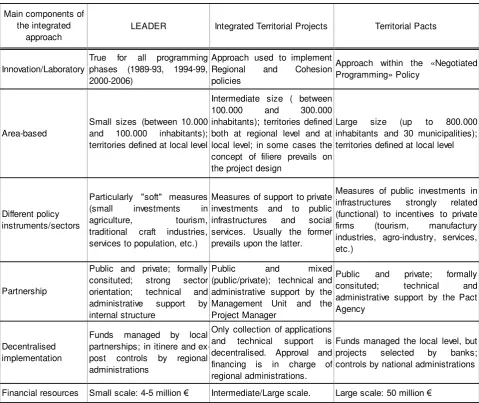
[image:4.595.57.537.362.765.2]These five features identifies the core of integrated approaches in Italy. Nevertheless, the intensity with which these features are actually embodied into policies can explain the differences between LEADER, IPTs, TPs and RDs. The table 1 summarize the main features of three types of approaches: LEADER, IPTs and TPs; the Rural Districts are too recent and very differently conceived in Italian Regions to be compared with the other approaches.
Table 1 – Main features of integrated rural development programmes in Italy
LEADER Integrated Territorial Projects Territorial Pacts
True for all programming phases (1989-93, 1994-99, 2000-2006)
Approach used to implement Regional and Cohesion policies
Approach within the «Negotiated Programming» Policy
Small sizes (between 10.000 and 100.000 inhabitants); territories defined at local level
Intermediate size ( between 100.000 and 300.000 inhabitants); territories defined both at regional level and at local level; in some cases the concept of filiere prevails on the project design
Large size (up to 800.000 inhabitants and 30 municipalities); territories defined at local level
Particularly "soft" measures (small investments in agriculture, tourism, traditional craft industries, services to population, etc.)
Measures of support to private investments and to public infrastructures and social services. Usually the former prevails upon the latter.
Measures of public investments in infrastructures strongly related (functional) to incentives to private firms (tourism, manufactury industries, agro-industry, services, etc.)
Public and private; formally consituted; strong sector orientation; technical and administrative support by internal structure
Public and mixed (public/private); technical and administrative support by the Management Unit and the Project Manager
Public and private; formally consituted; technical and administrative support by the Pact Agency
Funds managed by local partnerships; in itinere and ex-post controls by regional administrations
Only collection of applications and technical support is decentralised. Approval and financing is in charge of regional administrations.
Funds managed the local level, but projects selected by banks; controls by national administrations
Small scale: 4-5 million € Intermediate/Large scale. Large scale: 50 million € Main components of
Main differences can be summarized as follows:
a. Innovation/laboratory concept. This concept is especially true for the LEADER programme and for the initial phase of Territorial Pacts. This is less true for the other approaches and for the most recent experiences of integrated projects. These are increasingly seen as an
“ordinary” procedure to implement rural policies, although not the only one and the most
relevant under the financial profile. In any case, and especially for the future policies, the integrated approaches have to be considered not like an interesting room for laboratory, but a consolidated way to conceive and provide support to rural areas. This new vision can be confirmed when we look at the most recent programming documents of rural development and cohesion policy in Italy.
b. Placed-based definition. This concept is applied in the three approaches, although the scale of territorial definition is really different. The territorial dimension is one of the distinctive characteristics of the LEADER. Even more, it can be stated without a shadow of doubt that it is made an integral part of LEADER, given that the initiative is based on a series of projects for local development in areas having a certain size and characteristics. Certainly, the new LEADER+ initiative has a more solid, clear-cut territorial dimension than LEADER
II, which in many regions was given an “extensive” application, to the extent of covering
the entire regional territory. The territorial concentration of LEADER+ has been strengthened by two factors: one, by the reduction of the number of GAL; and two, by the predetermination of the admissible areas. This latter represents a choice that allows a more rational employment of scarce resources, even more scarce than in the previous cycle of programming for 1994-99. LEADER concerns small rural areas, while ITPs and TPs are designed for bigger areas, where the criteria of definition do not only involve sector or rural considerations, but more general and inter-sector needs. Consequently, also the amount of public investments committed to each project changes, and rises up to an average of 50 million €. Another important aspect concerns the way areas are defined: here there are two different approaches, a top-down definition at the level of regional programme and a bottom-up definition according to the spontaneous aggregation of local actors and institutional stakeholders (municipalities and provinces, mountain communities). These two different approaches have several implication on the consistency between strategies, objectives and concrete implementation of the projects.
c. Multi-instruments and multi-sector vision. All approaches assume this overall vision of the
rural economy and society. LEADER particularly focuses on “soft” actions, while ITPs and
TPs also include more relevant type of interventions in infrastructures, social services and sector investments. The integration principle is stronger within the Territorial Pacts, being the link between infrastructures and sector investments a pre-requisite to approve and finance the single Pact.
whose partnerships usually are driven by stronger sector representatives, the other programmes follow strategies more driven by non-agricultural interests.
e. Decentralised system. Here we can find a crucial difference between the three programmes: all the most relevant functions in implementing the project are substantially devolved to the partnership in the LEADER programme, while in the other two programmes the approval of individual projects and their financing are attributed to an external subject (the bank) in the Territorial Pacts or are kept centrally on the hands of regional administrations. In these cases is hard to say how devolving the decision-taking process to local institutions is improving effectiveness and efficiency of rural policies.
3. The main results and problems emerging from the different approaches: a short
comparative analysis
Which factors can explain the success or the failure of integrated placed-based rural development policies in achieving their objectives in the Italian context? What are the circumstances and the conditions for producing the best results and being a model for future policies?
In order to answer these questions we should firstly examine which main effects these approaches have produces after their completion. We will examine four main types of effects:
a) Creation of employment;
b) Effects on private investments;
c)
Effects on the local governance and the effectiveness of policies;
d)
Other effects
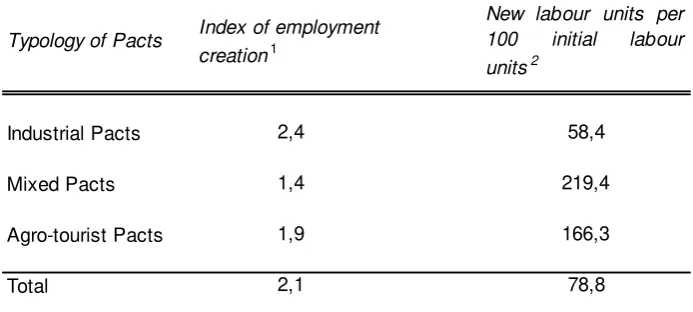
Creation of employment.
Table 2
–
Employment effects of Territorial Pacts in Italy
Effects on private investments.
The effects on private investments are extremely important, under different profiles.
Firstly, for the amount of investment generated within each territory; secondly, for the
external economies which public investments contribute to create to private sectors;
finally, for the effects on the quality of private investments that public expenditures
contribute to produce. The ratio between private investments and public expenditures of
Agro-tourist Pacts is the most favourable (table 3), also in terms of new plants. This means
that these types of Pacts have stronger relations within each territory with private sectors
and are able to stimulate positive externalities for the private sector.
Table 3
–
Effects on private investments of Territorial Pacts in Italy
Industrial Pacts
Mixed Pacts
Agro-tourist Pacts
1Number of new labour units per 100.000 € of public expenditures
2 Calculated on a sample of 15 Territorial Pacts
Source: Magnatti P., Ramella F., Trigilia C., Viesti G., Patti Territoriali, Il Mulino,
Total 2,1 78,8
2,4 58,4
1,4
1,9
219,4
166,3
Index of employment creation1
New labour units per
100 initial labour
units2 Typology of Pacts
Industrial Pacts
Mixed Pacts
Agro-tourist Pacts
1 Ratio between private investments and public expenditures.
Source: Magnatti P., Ramella F., Trigilia C., Viesti G., Patti Territoriali, Il Mulino,
2,4 59,1
Total 1,4 44,7
1,4 38,6
0,4 44,4
Typology of Pacts Index of creation of private investments1
Public expenditures provided by LEADER helped to address high quality investments in a
higher proportion than the mainstream rural development programmes. If we look at the
investment for the quality of local products, we can affirm that their importance is much
more relevant than in other programmes (up to 25-30% of the global resources for rural
development against 1-2% of the Rural Development Programmes, see figure 1). The
LEADER programme aimed at fulfil these needs, covering a role that should have been
played by the other programmes (EU and national) or by Cohesion and Regional policy.
This strategy was particularly developed in Italy: among the first six European regions
who spend more on supporting of local quality products, three come from the Italian
context (Piedmont, Sardinia and Calabria).
Source: European Commission, The ex-post evaluation of LEADER II, Bruxelles, 2003
Effects on the local governance and the effectiveness of policies.
Integrated approaches are frequently mentioned as having positive effects on the local
governance and the effectiveness of policies. LEADER and Territorial Pacts are considered
the most interesting laboratories to study these kind of effects. Studies on Italian
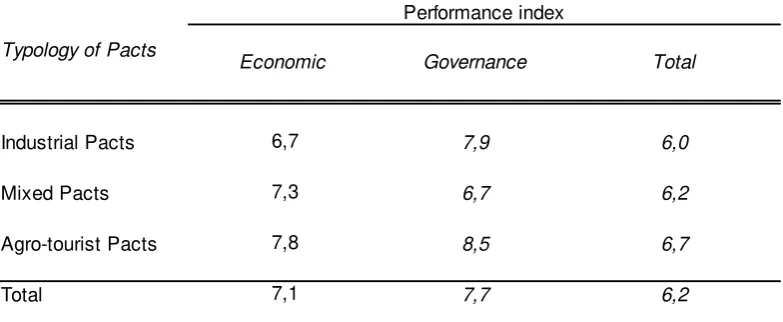
Territorial Pacts have introduced a series of performance indexes: a) the first one
(economic performance), based on the impact on the local economy, the enhancement of
the productive structure and the labour market, the endowment of infrastructures; b) the
second one is concerning the local governance, and it is based on the efficiency of
administrative procedures, the cooperation between public and private actors, the
capability of strategy and project designing; c) finally the third one is a global index that
included the previous ones, the efficiency of public spending and the capability of using
Leader II - Expenditures for the quality of local products (% of total espenditures)
0 5 10 15 20 25 30
other sources to finance rural development (i.e. other EU/national programmes). For all
the types of indexes examined, Agro-tourist Pacts show the best performance, both in
relative and absolute terms.
1 [image:9.595.114.506.326.487.2]Table 4
–
The performance of Territorial Pacts in Italy
Other effects
Some other effects is mentioned as far as future expectations are concerned. In some area
the intensity of investments (in terms of added value of the area), the employment effects
and the creation of external economies have positive effects on the future expectations and
therefore on the future investments.
Now can return to our first questions concerning the main factors explaining the success
or the failure of integrated placed-based rural development policies. Among the most
relevant factors of success can be mentioned the following ones:
a.
The characteristics of the territory and the social and economic context
b.
The design of the strategy
1
It must be stressed that these indexes can vary between 0 an 10, so that values of Agro-tourist Pacts are very close to the maximum value.
Industrial Pacts
Mixed Pacts
Agro-tourist Pacts
Source: Magnatti P., Ramella F., Trigilia C., Viesti G., Patti Territoriali, Il Mulino, Bologna, 2 7,8
Total 7,1
8,5 6,7
7,7 6,2
6,7
7,3
7,9
6,7
6,0
6,2
Economic Governance Total
Performance index