http://dx.doi.org/10.4236/acs.2015.54034
Relationship between the Concentration
of Impurity and Albedo in Snow Surface
Yuki Komuro, Toshitaka Suzuki
Graduate School of Science and Engineering, Yamagata University, Yamagata, Japan Email: [email protected]
Received 25 August 2015; accepted 6 October 2015; published 9 October 2015
Copyright © 2015 by authors and Scientific Research Publishing Inc.
This work is licensed under the Creative Commons Attribution International License (CC BY).
http://creativecommons.org/licenses/by/4.0/
Abstract
Recent decline of cryosphere typified by retreat of glaciers is often explained by temperature rise due to global warming. However, the existence of glaciers shrinking since before 1950s warming accelerated suggested that decline of cryosphere may be due to not only temperature rise, but also another possibility. As a possible cause of snow and ice melting, it has been pointed out that the surface albedo reduction due to increase of snow impurity, aeolian dust and anthropogenic pollu-tant, for example. To clarify the quantitative relationship between albedo and impurity in snow surface, we investigated the correlativity of turbidity and metal concentration in snow to the snow surface albedo from the simultaneous observations on the snow-covered area in Yamagata, Japan. The observed albedo shows a tendency of decrease with the turbidity increase in snow surface, we could find strong correlation between the albedo and the turbidity in 76% of contribution factor using logarithmic regression analysis. The relationship of albedo to total concentration of Fe and Al in snow surface shows the similar tendency to turbidity, we could model the relationship using logarithmic equation with high value of contribution ratio, 74% and 66%, respectively. The con-centration ratio of Fe/Al is nearly constant with about 0.75, which is close to mean crustal ratio of both elements, therefore, it can be said there is a strong correlation between the albedo and the concentration of mineral particle in snow surface. We cannot find a significant correlation be-tween the albedo and total concentration of Na in snow surface. It can be considered that Na ex-isted as dissolved ion has not significant effect to the albedo in snow surface. These results indi-cate that the snow albedo correlates strongly with the particulate matter in snow surface, which is typified by mineral particle.
Keywords
1. Introduction
Recently, rapid decline of cryosphere typified by retreat of polar and alpine glaciers and decrease of sea ice area have attracted attention as the results of global warming problem. Characteristic white area of the cryosphere re-flects most of incident solar radiation, because of the high surface albedo, the ratio of reflected radiation to inci-dent radiation on earth’s surface. Disappearing of surface snow and ice accelerate warming, and impact heavily on global weather and climate, because it enhances the absorption of solar radiation on earth’s surface due to denude under covered soil and sea surface. Furthermore, it is expected that retreat of alpine glacier decrease wa-ter resource and further desertification around the glacier. The cause of cryosphere decline is often explained by the temperature rise due to global warming. However, it is reported that alpine glaciers has been shrinking since before the recent global warming [1] and the melting rate of snow and ice is inexplicable only by the tempera-ture rise due to the grobal warming [2]. These previous studies indicate inconsistent result with the generally accepted theory, which explain the cause of snow and ice melting in recent years by the global warming.
While the albedo on snow surface (snow albedo) is generally high, approximately 80% - 90%, it is characte-rized by a reduction in snow albedo with the contamination of light-absorbing impurities such as soil and soot particles into the snow [3] [4]. The snow albedo reduction accelerates snow melting due to the increase of snow surface absorption of solar radiation. Additionally, the accumulation of impurity occurred by snow melting on snow surface accelerate the snow albedo reduction. In general, the increase of absorption energy on snow sur-face by the albedo reduction is greater than the increase of absorption energy by the atmospheric warming [2]. Therefore, the estimation of the role of albedo reduction is very important for snow and ice melting.
Separation of particle in snow using filtration method and measurement of dry weight are often used as the estimation method of impurity amount in snow [5] [6]. It has also been made an attempt to separate the organic matter from the impurities by the ignition method, and the fact is expected that most of the weight of cryoconite existing on glaciers is dominated by mineral particles [7]. However, the previous study comparing the impurity amount and albedo in snow surface from field observation data is not enough, it has not been reached that un-derstand quantitatively the relationship between the both factors.
This study aims to clarify the quantitative relationship between albedo and impurity amount in snow surface by the simultaneous measuring on the snow-covered area in Yamagata, Japan. We measured and compared the albedo and turbidity in snow surface. Furthermore, we decompose the particulate components in snow by ap-plying microwave acid digestion method [8], and clarify the quantitative relationship between albedo and total concentration (dissolved + particulate) of Al, Fe and Na in snow surface, which become a proxy of mineral and sea salt particles.
2. Method
In the winter of 2010-2011, we carried out the simultaneous observations of the snow albedo measuring and surface snow sampling at the campus of the Yamagata University, located in Yamagata city, Japan. We meas-ured surface albedo on snow using the albedometer (Hukuseflux, SRA01) in shortwave and near infrared region (305 - 2800 nm). The snow albedo was calculated from the ratio of measured reflected radiation and incident radiation on snow surface. The measurements of both radiations were recoded to the data logger (HIOKI, 3645) every 2 second, and the 3 minutes average were used for the calculation of albedo on snow surface. The albedo and snow were acquired 67 times on the horizontal snow surface at the various site in the campus of the Yama-gata University from 13:00 to 14:00 LT.
We scraped off the surface snow with 50 ml centrifuge tube, collected snow sample in the tube. After the snow sample was melted at ambient temperature, we transported 10 ml of melt water to a glass vial for turbidity measurement. The remaining sample water was used for the measurement of metal components. The turbidity in snow was measured using desktop turbidity meter (Eutech, TN-100), according to the method based on ISO7027.
HF (Kanto Chemical Co., the Ultrapure) were used in the acid digestion experiment. Using the ICPAES, the concentration of metal components was determined by the calibration curve method with standard substance (SPEC CertiPrep, XSTC-13).
3. Results and Discussion
The relationship of albedo and turbidity in snow surface is shown in Figure 1. Snow albedo data shows a ten-dency of decrease with the turbidity increasing in snow surface. In regression analysis, contribution ratio (R2 × 100%) indicate the strength of correlativity between independent variable and dependent variable. In the case of the relationship of albedo and turbidity, we obtained highest correlation by using the logarithmic regression.
Therefore, we modeled the relationship of albedo and turbidity in snow surface using logarithmic regression. It is found that there is a strong correlation between albedo and turbidity in snow surface by 76% of contribution ratio (Figure 1).
We divided the all observed data (in Figure 1) in two groups by the surface condition on snow. In Figure 2, we show the relationship of albedo and turbidity in sampling points where were not disturbed artificially, e.g. footprints and tracks. Figure 3 shows the relationship of albedo and turbidity observed in snow surface where were disturbed artificially. The data of undisturbed points was high albedo and low turbidity (Figure 2). This may be due to the observed snow surface that was not contained the dirt by human activities and kept a natural state after snowfall. In the Figure 2, the contribution ratio between the albedo and turbidity in snow surface was 56%. The data observed on disturbed points was the result of low albedo and high turbidity compared to undis-turbed points (Figure 3). It is possible cause that the human activities carried the dart and formed numerous
Figure 1. The albedo and turbidity in snow surface. The solid line and expression shows the regression curve and formula using loga-rithmic equation.
Figure 3.The albedo and turbidity in snow surface at the disturbed points. The regression curve and formula using logarithmic equation are indicated by the solid line and expression.
roughness on the snow surface, because the disturbed points are characterized by the human and vehicle move-ments like the parking space. The contribution ratio of albedo and turbidity in snow surface observed on dis-turbed points was 61%.
In Figure 4 and Figure 5, we show the relationship between albedo and total concentration of Fe (t-Fe) and Al (t-Al) in snow surface. The snow albedo decrease with t-Fe and t-Al increasing. This tendency is same of re-lationship between turbidity and snow albedo. As the result of comparing albedo with t-Fe and t-Al in snow sur-face using logarithmic regression analysis, contribution ratio became 74% and 66%, we found strong correlation between the both metal concentrations and albedo.
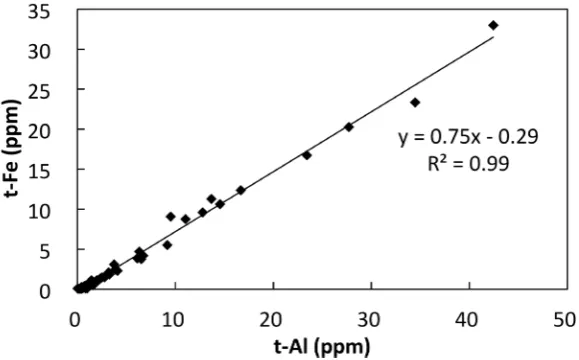
The relationship of t-Fe and t-Al in snow surface is shown in Figure 6. The 99% of contribution ratio be-tween t-Fe and t-Al was found by the liner regression analysis, and the ratio of concentrations was an almost constant with 0.75. This value of concentration ratio is close to the mean crustal composition ratio of 0.68 [9], and thus indicates that most of Fe and Al in snow surface was supplied by the mineral particles, which is the crustal surface origin. Because t-Fe and t-Al correlate strongly with albedo in snow surface as showed by Figure 4 and Figure 5, it can be said there is a strong correlation between the albedo and mineral aerosol load in snow surface.
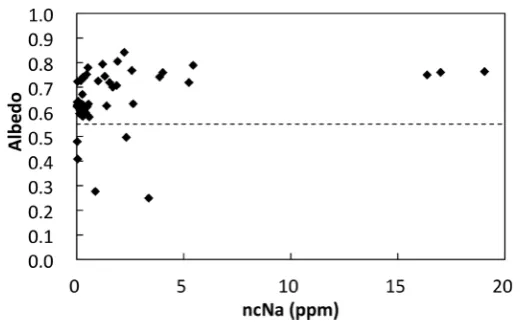
In Figure 7, we showed the relationship between albedo and total concentration of Na (t-Na) in snow surface. Unlike the case of t-Fe and t-Al, there is not a particular relationship between albedo and t-Na in snow surface. Though we performed a regression analysis using various functions, the contribution ratio of snow albedo and t-Na did not exceeds 1%. Therefore, we divided the all observed data shown in Figure 7 to two groups, which are t-Na increasing group, the area under the broken line, and small changing group, the area over the broken line, with snow albedo decreasing, and advanced additionally the discussion removing contribution of crustal origin Na from t-Na. In Figure 8, we show the relationship between albedo and the concentration of non-crustal Na (ncNa) in snow surface, which removed contribution of crustal origin Na from t-Na. We assumed that t-Al in snow originated entirely from crustal surface, and calculated the ncNa from the following equation:
[
ncNa] [
= t-Na]
−(
Na Al)
crust×[
t-Al]
(1) where [t-Na] and [t-Al] are the concentration of t-Na and t-Al, (Na/Al)crust is the mean Na/Al ratio in the crust [9], [ncNa] is the concentration of ncNa. We plotted only the data exceeded 0 ppm of ncNa concentration in theFigure 8. Most of the data plotted in the area under the broken line in Figure 7 were not plotted in Figure 8, because the concentration of ncNa indicated less than or equal to 0 ppm. In the area under the broken line, it can be consider that most of Na in the snow was supplied principally by the mineral particles of crustal origin as the ncNa concentration was below 0 ppm in despite of substantial amount of t-Na.
Figure 4. The albedo and t-Fe in snow surface. The solid line and expression shows the regression curve and formula by logarithmic equation.
Figure 5. The albedo and t-Al in snow surface. The regression curve and for-mula using logarithmic equation are shown by the solid line and expression.
[image:5.595.170.460.515.695.2]Figure 7. The albedo and t-Na in snow surface. The broken line divided the shown date to two groups, which are the t-Na increasing group and small changing group with snow albedo decreasing.
Figure 8. The albedo and ncNa in snow surface. The broken line divided the shown date to two groups, which are the ncNa increasing group and small changing group with snow albedo decreasing.
has no relationship with the albedo reduction on snow surface, because the plotted data in the area over the bro-ken line doesn’t show the tendency to point lower albedo as higher concentration of ncNa. The significant origin of the ncNa in snow may be sea salt of oceanic origin, which exists as dissolved component in snow. If the ncNa in this study is dominated largely by the sea salt Na, it is considered that Na existing as dissolved ion has not significant effect on albedo reduction in snow surface. And this result suggests the possibility of bring similar results for the other dissolved components.
From the relationship between albedo and total concentration of metal components in snow surface, we showed that the particulate components as typified by mineral particles among the metal components correlate strongly with albedo in snow surface. It is expected that early and accelerated snowmelt due to the increase of mineral particle mass in snow. In the result of previous study using climate simulation [10], the albedo change with the relative variation of mineral dust flux into snow surface has a significant impact to the past ice volume change on the earth surface. By applying the metal analysis using microwave acid digestion method to the ice core samples, we can calculate selectively the mass of mineral particles in the past snow surface [11]. In the fu-ture, we can restore the change of past snow albedo by analysing the concentration of mineral particle in the ice core samples.
[image:6.595.183.446.289.452.2]ta, Japan, and investigated the correlativity of turbidity and total concentration of metal components to the albe-do. The observed albedo data show a tendency of decrease with the turbidity increasing in snow surface, and we could find the strong correlation of both factors with 76% of contribution ratio using the logarithmic regression analysis. As a result of comparing the albedo with t-Fe and t-Al in snow surface, we could also model the rela-tionship of snow albedo and both concentrations using the logarithmic equation with the contribution ratio, which reached high value of 74% and 66%. Additionally, the concentration ratio of t-Fe and t-Al was nearly constant at 0.75, which was relatively close in value to the mean crustal composition ratio of 0.68, and thus it was indicated that the albedo correlate strongly with the mineral particle mass in snow surface. There is no sig-nificant correlation between the albedo and t-Na in snow surface, because t-Na might be dominated strikingly by the sea salt and fusible Na, we can consider that Na existing as dissolved ion has no significant effect to the al-bedo in snow surface. The results of this study imply that particulate components represented by mineral par-ticles among the metal component relate especially to the albedo in snow surface. In the future, we can restore the change of past snow albedo by analysing the concentration of mineral particle in the ice core samples.
Acknowledgements
The authors thank the financial support by the ESPEC Foundation for Global Environment Research and Tech-nology (Charitable Trust) (ESPEC Prize for the Encouragement of Environmental Studies).
References
[1] Kaser, G., Hardy, D.R., Molg, T., Bradley, R.S. and Hyera, T.M. (2004) Modern Glacier Retreat on Kilimanjaro as Evidence of Climate Change: Observation and Facts. International Journal of Climatology, 24, 329-339.
http://dx.doi.org/10.1002/joc.1008
[2] Rikiishi, K. (2009) The Recent Decline of Cryosphere as Seen from the Seasonal and Decadal Changes of Snow Sur-face Albedo. The Symposium on Polar Meteorology and Glaciology Program and Abstracts, 32, 24.
[3] Warren, S.G. and Wiscombe, W.J. (1980) A Model for the Spectral Albedo of Snow. Ⅱ: Snow Containing Atmos-pheric Aerosols. Journal of the AtmosAtmos-pheric Sciences, 37, 2734-2745.
http://dx.doi.org/10.1175/1520-0469(1980)037<2734:AMFTSA>2.0.CO;2
[4] Dumont, M., Brun, E., Picard, G., Michou, M., Libois, Q., Petit, J.-R., Geyer, M., Morin, S. and Josse, B. (2014) Con-tribution of Light-Absorbing Impurities in Snow to Greenland’s Darkening since 2009. Nature Geoscience, 7, 509-512. http://dx.doi.org/10.1038/ngeo2180
[5] Motoyoshi, H., Aoki, T., Hori, M., Abe, O. and Mochizuki, M. (2005) Possible Effect of Anthropogenic Aerosol De-position on Snow Albedo Reduction at Shinjo, Japan. Journal of the Meteorological Society of Japan, 83A, 137-148. http://dx.doi.org/10.2151/jmsj.83A.137
[6] Aoki, T., Motoyoshi, H., Kodama, Y., Yasunari, T.J., Sugiura, K. and Kobayashi, H. (2006) Atmospheric Aerosol De-position on Snow Surfaces and Its Effect on Albedo. SOLA, 2, 13-16. http://dx.doi.org/10.2151/sola.2006-004
[7] Takeuchi, N., Matsuda, Y., Sakai, A. and Fujita, K. (2005) A Large Amount of Biogenic Surface Dust (Cryoconite) on a Glacier in the Qilian Mountains, China. Bulletin of Glaciological Research, 22, 1-8.
[8] Suzuki, T. and Sensui, M. (1991) Application of the Microwave Acid Digestion Method to the Decomposition of Rock Samples. Analytica Chimica Acta, 245, 43-48. http://dx.doi.org/10.1016/S0003-2670(00)80199-3
[9] Taylor, S.R. (1964) Abundance of Chemical Elements in the Continental Crust: A New Table. Geochimica et
Cosmo-chimica Acta, 28, 1273-1285. http://dx.doi.org/10.1016/0016-7037(64)90129-2
[10] Bar-Or, R., Erlick, C. and Gildor, H. (2008) The Role of Dust in Glacial-Interglacial Cycles. Quaternary Science
Re-views, 27, 201-208. http://dx.doi.org/10.1016/j.quascirev.2007.10.015
[11] Sato, H., Suzuki, T., Hirabayashi, M., Iizuka, Y., Motoyama, H. and Fujii, Y. (2013) Mineral and Sea-Salt Aerosol Fluxes over the Last 340 kyr Reconstructed from the Total Concentration of Al and Na in the Dome Fuji Ice Core.