http://dx.doi.org/10.4236/ijohns.2015.45058
How to cite this paper: Subramaniam, V., Jain, R., Saraswathy, S.Y.I. and Mishra, V. (2015) Online Case Based Self-Study Modules as an Adjunct Learning Tool in Otorhinolaryngology: A Pilot Study. International Journal of Otolaryngology and Head & Neck Surgery, 4, 344-349. http://dx.doi.org/10.4236/ijohns.2015.45058
Online Case Based Self-Study Modules as an
Adjunct Learning Tool in
Otorhinolaryngology: A Pilot Study
Vijayalakshmi Subramaniam1*, Rashmi Jain2, Sivan Yegnanarayana Iyer Saraswathy3,
Varun Mishra4
1Department of Otorhinolaryngology, Yenepoya Medical College, Yenepoya University, Mangalore, India 2Department of Ophthalmology, Yenepoya Medical College, Yenepoya University, Mangalore, India 3Department of Community Medicine, PSG Institute of Medical Sciences & Research, Coimbatore, India 4Information Technology Consultant, Bangalore, India
Email: *[email protected], *[email protected]
Received 14 July 2015; accepted 4 September 2015; published 7 September 2015 Copyright © 2015 by authors and Scientific Research Publishing Inc.
This work is licensed under the Creative Commons Attribution International License (CC BY).
http://creativecommons.org/licenses/by/4.0/
Abstract
Background/Need for innovation: Undergraduate students in Otolaryngology are on the lookout for easy modes of learning which can help them understand concepts better as well as score more in examinations. A need was hence felt to introduce a new learning resource to supplement tradi-tional teaching-learning methods. Methods: Digital, case based self–study modules were prepared using all open source technology and validated by experts in the specialty. The modules were up-loaded on a website specifically created for the purpose. They were pilot tested on twenty con-senting third year undergraduate (MBBS) students using a crossover design. Post test comprising of multiple choice questions was administered to the students after a period of two weeks. Feed-back was obtained from faculty and students. Results: Test scores were found to be significantly higher amongst students who used the learning modules as a supplement to regular bedside teaching (p < 0.001; Wilcoxon signed rank test). Majority of students agreed that the modules helped them gain confidence during internal assessment examinations and would help revision. Conclusions: Online, case based, self-study modules helped students to perform better when used as a supplement to traditional teaching methods. Students agreed that it enabled easy under-standing of subject and helped them gain confidence.
Keywords
Self-Study Modules, Teaching-Learning Methods, Web-Based Instruction, Online Learning
1. Introduction
The undergraduate student is overburdened with information and is on the lookout for easier modes of learning for concept enhancement and better performance in examinations. Information Technology based (IT) applica-tions have permeated through almost every field and medical education is no exception. Undergraduate training in Otolaryngology (ORL) is mainly imparted through traditional classroom based teaching, bedside clinics and operating room teaching. The combination of a web based forum with traditional methods would provide for a blended learning environment. While, bed side clinics continue to be the best setting in which the skills of his-tory taking, physical examination, clinical reasoning, decision making, empathy and professionalism can be taught as a whole to medical students, online learning when combined with traditional methods is easily repeat-able and can thus increase the effectiveness of teaching. As a facilitator in ORL, the first author felt the need to introduce a new learning resource to revive student interest in the subject of ORL and to promote active self-directed learning. This project was undertaken to develop case oriented self-study modules in ORL, eva-luate the impact of these modules on student learning as well as assess student and faculty feedback on these on-line self learning modules.
2. Methodology
This study was done in a private medical college affiliated to a Deemed University in South India. Approval was obtained for the project from the University ethics committee. Discussions were initiated with IT experts in the university. Department faculty was apprised of the proposed project. Specific learning objectives for four “MUST KNOW” cases (Deviated Nasal septum, Antrochoanal polyp, Ethmoidal polyposis and Chronic Tonsil-litis) were written. Digital self learning modules comprising interlinked history, clinical examination, investiga-tions, diagnosis and patient management were developed. Videos and images were used. Flash player was used as a container for all videos. Hot PotatoesTM Version 6 (Free software for creating interactive multiple-choice, short-answer, jumbled-sentence, crossword, matching/ordering and gap-fill exercises for the World Wide Web;
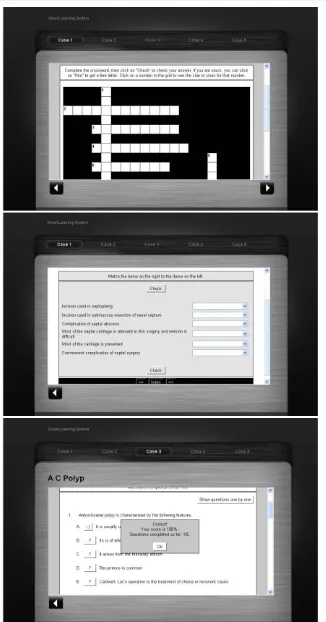
http://hotpot.uvic.ca/) was used for creating the quizzes, crosswords, matching and gap fill exercises (Figure 1). Feedback questionnaire for was designed using SurveyMonkey® (Online questionnaire and survey software;
http://www.surveymonkey.com/). The modules were validated by experts in the specialty and uploaded on a dedicated website created for the purpose. The learning modules were pilot tested on 20 third year undergra-duate (MBBS) students who gave consent to participate in the study. A cross over design was adopted and the students were randomly divided into two groups of 10 each. Access to two modules was secured to each group respectively. Both the groups were taught all the 4 cases during the bed side clinics as well.
After a period of two weeks, a post test comprising 40 multiple choice questions (10 questions pertaining to each module) was administered to both the groups. Student feedback on the modules was obtained using a 5-point Likert Scale questionnaire (5 = Very strongly agree 4 = Strongly agree 3 = Agree 2 = Strongly disagree 1 = Very strongly disagree). Faculty perceptions were assessed using a questionnaire. Post test scores obtained were statistically analyzed using Wilcoxon signed rank test. Internal consistency of the student feedback ques-tionnaire was estimated by Cronbach alpha calculated using MS-Excel calculator. Likert scale responses were interpreted using Consensus measure [1].
3. Results
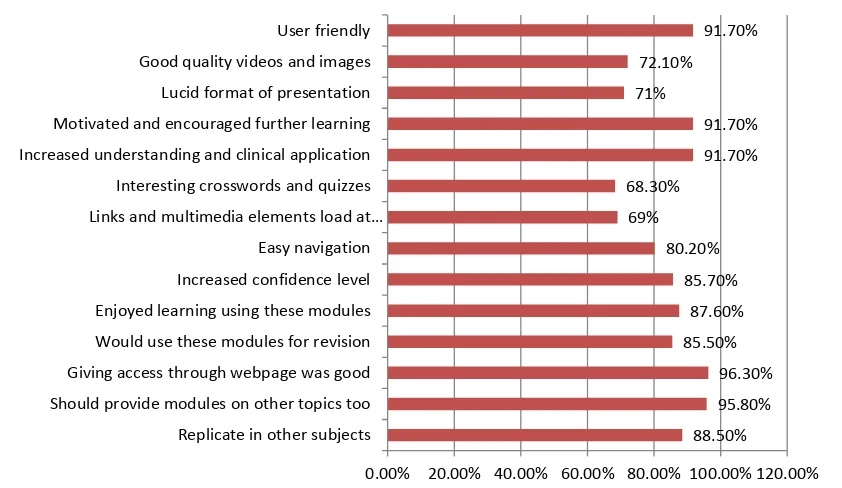
Figure 2. Students feedback-consensus measure (Values closer to 100 indicate greater agreement and values greater indicate greater disagreement).
summarised in Table 1. Post test scores were found to be significantly higher amongst students who used the learning modules as a supplement to traditional teaching (p < 0.001 as calculated by Wilcoxon signed rank test).
4. Discussion
Web based instruction has been gaining popularity in medical education in recent years. The combination of on-line instruction with traditional teaching methods has been observed to enhance learning outcomes [2]-[5]. Otorhinolaryngology (ORL) is one of the subjects taught to medical students during the third year medical un-dergraduate (MBBS) course in India. Teaching is accomplished through lectures, seminars and patient demon-strations. The internet offers an enriching platform and permits students to learn at their own pace. Online self study modules are an effective and inexpensive tool that could be used to enhance learning. They are easily re-peatable and promote self-directed learning.
Online learning modules have been introduced in specialties such as emergency medicine, and pediatric and adolescent gynecology and increase in knowledge as well as test scores has been demonstrated [4] [5]. A pilot study done in the field of dermatology suggested that interactive IT based self learning modules could be com-bined effectively with a “play area concept”. Although these did not improve student performance in their writ-ten examinations, the authors have opined that these modules would promote self-directed learning among stu-dents and thus enhance the quality of teaching and learning in dermatology [6]. Similarly, in a study where free online otolaryngology educational modules were provided to residents, quantifiable improvement in examina-tion scores was not noted. However, it was recommended as an inexpensive way to enhance learning opportuni-ties. The ease of access alone without the need to carry a textbook or journal made these modules a valuable learning resource [2].
The results of this study showed improved student performance when these modules were used as a supple-ment to traditional teaching methods as evidenced by better post test scores. Since the modules were case based, students opined that they were practical and increased their understanding of the subject. They also agreed strongly that they would use these modules to revise for exams. They found some of the crosswords tough for which they are being given more practice time. Both students and faculty remarked that the website was slow and videos took long to load. This aspect is being looked into by the IT experts. This was a pilot study and hence had the limitations of being tried on a small sample of students. The number of topics covered was also limited. However, the results are encouraging and gave us confidence that such modules could be prepared using open source technology even in resource limited settings like ours.
88.50% 95.80% 96.30% 85.50% 87.60% 85.70% 80.20% 69% 68.30% 91.70% 91.70% 71% 72.10% 91.70%
0.00% 20.00% 40.00% 60.00% 80.00% 100.00% 120.00% Replicate in other subjects
Should provide modules on other topics too Giving access through webpage was good Would use these modules for revision Enjoyed learning using these modules Increased confidence level Easy navigation Links and multimedia elements load at …
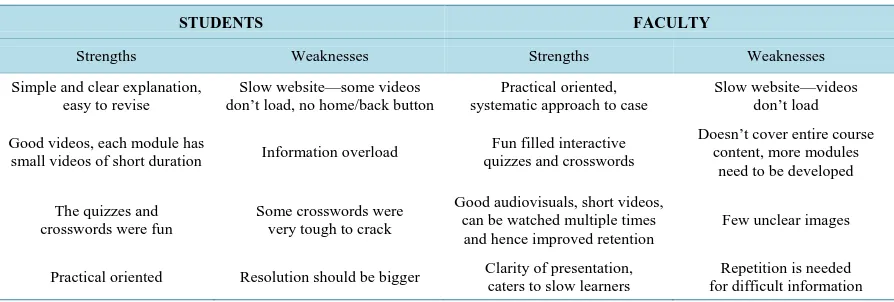
[image:4.595.104.525.81.325.2]Table 1. Summary of strengths and weaknesses of learning modules as described by students and faculty.
STUDENTS FACULTY
Strengths Weaknesses Strengths Weaknesses
Simple and clear explanation, easy to revise
Slow website—some videos don’t load, no home/back button
Practical oriented, systematic approach to case
Slow website—videos don’t load
Good videos, each module has
small videos of short duration Information overload
Fun filled interactive quizzes and crosswords
Doesn’t cover entire course content, more modules
need to be developed
The quizzes and crosswords were fun
Some crosswords were very tough to crack
Good audiovisuals, short videos, can be watched multiple times and hence improved retention
Few unclear images
Practical oriented Resolution should be bigger Clarity of presentation, caters to slow learners
Repetition is needed for difficult information
Future Plans
We plan to improve the existing modules based on the feedback received from students and make them more interactive. We also plan to develop more modules to cover the entire otolaryngology curriculum in future.
5. Conclusion
Online case based self learning modules increased students performance when used as an adjunct to traditional teaching methods for undergraduate teaching in ORL. They enabled easy understanding of subject among stu-dents and fostered confidence in them. These would help in revision for examinations. They serve as an efficient means of enhancing self-directed learning. It is therefore suggested that a virtual repository of case oriented self learning modules is created and used for training and assessment of students.
Source(s) of Support
This study was done as part of the Education Innovation Project during the FAIMER Fellowship Program at PSG-FAIMER Regional Institute, Coimbatore, India.
Conflicting Interest
Nil.Acknowledgements
This study was done as part of the Education Innovation Project during the FAIMER Fellowship Program at PSG-FAIMER Regional Institute, Coimbatore, India. The authors acknowledge the support of Dr. Ghulam Jee-lani Qadiri, Principal, Yenepoya Medical College, Mangalore, Dr. Thomas V. Chacko, Director, PSG-FRI and fellows and faculty of PSG-FAIMER Regional Institute, Coimbatore, India.
References
[1] Tastle, W.J., Russell, J. and Wierman, M.J. (2008) A New Measure to Analyze Student Performance Using the Likert Scale. Information Systems Education Journal, 6. http://isedj.org/6/35/
[2] Cabrera-Muffly, C., Bryson, P.C., Sykes, K.J. and Shnayder, Y. (2015) Free Online Otolaryngology Educational Mod-ules: A Pilot Study. JAMA Otolaryngology—Head & Neck Surgery, 141, 324-328.
http://dx.doi.org/10.1001/jamaoto.2015.41
[3] Kandasamy, T. and Fung, K. (2009) Interactive Internet-Based Cases for Undergraduate Otolaryngology Education. Otolaryngology—Head and Neck Surgery, 140, 398-402. http://dx.doi.org/10.1016/j.otohns.2008.11.033
[5] De Silva, N.K., Dietrich, J.E. and Young, A.E. (2010) Pediatric and Adolescent Gynecology Learned via a Web-Based Computerized Case Series. Journal of Pediatric and Adolescent Gynecology, 23, 111-115.
http://dx.doi.org/10.1016/j.jpag.2009.09.008
[6] Kaliyadan, F., Manoj, J., Dharmaratnam, A.D. and Sreekanth, G. (2010) Self-Learning Digital Modules in Dermatolo-gy: A Pilot Study. Journal of the European Academy of Dermatology and Venereology, 24, 655-660.