JUNE-JULY, 2017, VOL. 4/22 www.srjis.com Page 5911 ROLE OF DESIGN TRAFFIC FOR ROAD DEVELOPMENTUSING FLEXIBLE
PAVEMENT
Yogesh Kumar Bajpai
Indian roads congress has specified the design procedures for flexible pavements based on CBR values. The Pavement designs given in the previous edition IRC:37-1984 were applicable to design traffic upto only 30 million standard axles (msa). The earlier code is empirical in nature which has limitations regarding applicability and extrapolation. This guidelines follows analytical designs and developed new set of designs up to 150 msa in IRC:37-2001.These guidelines will apply to design of flexible pavements for Expressway, National Highways, State Highways, Major District Roads, and other categories of roads. Flexible pavements are considered to include the pavements which have bituminous surfacing and granular base and sub-base courses conforming to IRC/ MOST standards. These guidelines apply to new pavements.
Keywords: Pavement, Design, Flexible, Traffic
INTRODUCTION
As per IRC recommendation, California Bearing Ratio (CBR) value of subgrade is used for
design of flexible pavements. California Bearing Ratio (CBR) value is an important soil
parameter for design of flexible pavements and runway of air fields. It can also be used for
determination of sub grade reaction of soil by using correlation. It is one of the most
important engineering properties of soil for design of sub grade of roads. CBR value of soil
may depends on many factors like maximum dry density (MDD), optimum moisture content
(OMC), liquid limit (LL), plastic limit (PL), plasticity index (PI), type of soil, permeability of
soil etc. Besides, soaked or unsoaked condition of soil also affects the value. These tests can
easily be performed in the laboratory. the estimation of the CBR could be done on the basis
of these tests which are quick to perform, less time consuming and cheap, then it will be easy
to get the information about the strength of subgrade over the length of roads, By considering
this aspect, a number of investigators in the past made their investigations in this field and
designed different pavements by determining the CBR value on the basis of results of low
cost, less time consuming and easy to perform tests.
Scholarly Research Journal's is licensed Based on a work at www.srjis.com
JUNE-JULY, 2017, VOL. 4/22 www.srjis.com Page 5912 INTRODUCTION
Design Traffic method considers traffic in terms of the cumulative number of standard axles
(8160 kg) to be carried by the pavement during the design life. This requires the following
information:
1. Initial traffic in terms of CVPD
2. Traffic growth rate during the design life
3. Design life in number of years
4. Vehicle damage factor (VDF)
5. Distribution of commercial traffic over the carriageway
Initial traffic:
Initial traffic is determined in terms of commercial vehicles per day (CVPD). For the
structural design of the pavement only commercial vehicles are considered assuming laden
weight of three tons or more and their axle loading will be considered. Estimate of the initial
daily average traffic flow for any road should normally be based on 7-day 24- hour classified
traffic counts (ADT). In case of new roads, traffic estimates can be made on the basis of
potential land use and traffic on existing routes in the area.
Design life:
For the purpose of the pavement design, the design life is defined in terms of the cumulative
number of standard axles that can be carried before strengthening of the pavement is
necessary. It is recommended that pavements for arterial roads like NH, SH should be
designed for a life of 15 years, EH and urban roads for 20 years and other categories of roads
for 10 to 15 years.
Vehicle Damage Factor:
The vehicle damage factor (VDF) is a multiplier for converting the number of commercial
vehicles of different axle loads and axle configurations to the number of standard axle-load
repetitions. It is defined as equivalent number of standard axles per commercial vehicle. The
VDF varies with the axle configuration, axle loading, terrain, type of road, and from region to
region. The axle load equivalency factors are used to convert different axle load repetitions
into equivalent standard axle load repetitions. For 173 these equivalency factors refer IRC:
37-2001. The exact VDF values are arrived after extensive field surveys.
Vehicle distribution:
A realistic assessment of distribution of commercial traffic by direction and by lane is
necessary as it directly affects the total equivalent standard axle load application used in the
JUNE-JULY, 2017, VOL. 4/22 www.srjis.com Page 5913 Single lane roads:
Traffic tends to be more channelized on single roads than two lane roads and to allow for this
concentration of wheel load repetitions, the design should be based on total number of
commercial vehicles in both directions.
Two-lane single carriageway roads:
The design should be based on 75 % of the commercial vehicles in both directions.
Four-lane single carriageway roads:
The design should be based on 40 % of the total number of commercial vehicles in both
directions.
Dual carriageway roads:
For the design of dual two-lane carriageway roads should be based on 75 % of the number of
commercial vehicles in each direction. For dual three-lane carriageway and dual four-lane
carriageway the distribution factor will be 60 % and 45 % respectively.
Pavement thickness design charts:
For the design of pavements to cany traffic in the range of lto 10 msa, use chart 1 and for
traffic in the range 10 to 150 msa, use chart 2 of IRC: 37-2001. The-design curves relate
pavement thickness to the cumulative number of standard axles to be carried over the design
life for different sub-grade CBR values ranging from 2 % to 10 %. The design charts will
give the total thickness of the pavement for the above inputs. The total thickness consists of
granular sub-base, granular base and bituminous surfacing.
Pavement composition:
Sub-base:
C14.2 Sub-base materials comprise natural sand, gravel, laterite, brick metal, crushed stone
or combinations thereof meeting the prescribed grading and physical requirements. The
sub-base material should have a minimum CBR of 20% and 30% for traffic upto 2 msa and traffic
exceeding 2 msa respectively. Sub-base usually consist of granular material or WBM and the
thickness should not be less than 150 mm for design traffic less than 10 msa and-200 mm for
design traffic of 10-msa and above.
Base:
Cl 4.2 The recommended designs are for unbounded granular bases which comprise
conventional water bound macadam (WBM) or wet mix macadam (WMM) or equivalent
confirming to MOST specifications. The materials should be of good quality with minimum
JUNE-JULY, 2017, VOL. 4/22 www.srjis.com Page 5914 Bituminous surfacing:
The surfacing consists of a wearing course or a binder course plus wearing course. The most
commonly used wearing courses are surface dressing, open graded premix carpet, mix seal
surfacing, semi-dense bituminous concrete and bituminous concrete. For binder course,
MOST specifies, it is desirable to use bituminous macadam (BM) for traffic upto 5 msa and
dense bituminous macadam (DBM) for traffic more than 5 msa.
Design of pavement with geosynthetic application
Though many design methodologies have emerged which address geotextiles in pavement ,
two theories based on original work contributed greatly to a better understanding of
geosynthetic applications for pavement namely the method. These methods are suggested for
the design of unpaved roads, providing geotextiles at the subgrade -base interface. Barenberg
considered the lateral restraint action of geotextiles in the pavement whereas Giroud and
Noiray considered the tension membrane effect of geotextiles in addition to lateral restraint.
DESIGN METHODS FOR UNPAVED PAVEMENTS USING GEO-SYNTHETICS
There are two main approaches to the design of temporary and unpaved roads. The first
assumes no reinforcing effect of the geosynthetics that is it acts as separator only. The second
approach considers a possible reinforcing effect due to the geosynthetic. Apparently the
separation function is more important for thin roadway sections with relatively small live
loads where anticipated rut depth is of the order of 50 mm to 100 mm. In such cases the
design procedure assumes no reinforcing effect, which is a conservative approach. On the
other hand for large live loads on thin road sections where 176 deep ruts (> 100. mm) may
occur and also for thicker road sections on soft subgrades the reinforcing function becomes
increasingly more important if the stability is to be maintained.
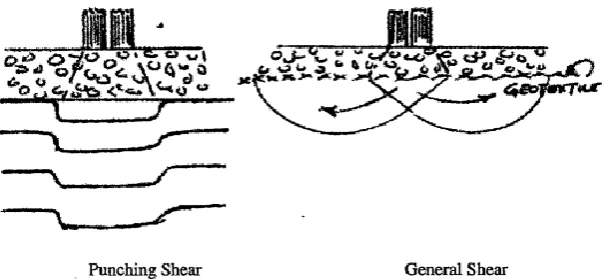
Soils having low CBR values require membrane type reinforcement. This changes the mode
[image:4.595.146.451.598.737.2]of bearing capacity failure from punching shear to general shear.
JUNE-JULY, 2017, VOL. 4/22 www.srjis.com Page 5915 IMPORTANCE OF SUBGRADE ON PAVEMENTS
Coarse grained soils serve as good subgrades for supporting pavements where as fine grained
soils, particularly clayey soils pose problems to pavements. Pavement failure occurs due to
two mechanisms, one is due to the combination of densification and repetitive shear and the
second is due to the deformation of pavement component layers with more contribution from
subgrade, particularly in clayey soils.
Generally flexible pavements are done using CBR method. The Rate of loading, size of
piston and compaction energy is certain limitations on CBR value. The subgrade soil at the
edge regions of pavement is not properly reflected in CBR test as the sample is not confined
in vertical direction. The risk of shear of subgrade soil is not considered in the methods group
index, McLeod and AASHTO.
Similar to a shallow foundation, the soil-bearing capacity of the subgrade plays a large role in
supporting a road pavement and transferring the vehicle loads. It is necessary that no shear
failure occurs within the subgrade.
IMPACT OF EXPANSIVE SUBGRADE ON PAVEMENTS
The phenomenon of swelling soils in the country is recently being slowly recognized and
more often when this has manifested itself in the form of extensive damage to the pavements.
Swelling soils are widely distributed in areas of volcanic deposition or origin with tropical
climate and also in arid and/or semi desert climates. In tropical volcanic settings, alumina rich
volcanic ash gets deposited in general over a large area. Some get concentrated in depressions
or low areas which are fully saturated with water. This regular inundation tends to leach the
alumina and concentrate these at the bottom 1.0 meter to 2.0 meters generally and sometimes
deeper depending on the leaching effects.
In expansive clayey subgrade due to cyclic shrinkage and swelling phenomenon there is
seasonal moisture fluctuation and more over they also loose strength due to softening after
swelling which might lead subgrade intrusion into overlying layers and penetration of sub
base material into it.
California bearing ratio (CBR) is an empirical test and widely applied in design of flexible
pavement over the world. This method was developed during 1928-29 by the California
Highway Department. Use of CBR test results for design of roads, introduced in USA during
2nd World War and subsequently adopted as a standard method of design in other parts of the
world, is recently being discouraged in some advanced countries because of the imperialness
JUNE-JULY, 2017, VOL. 4/22 www.srjis.com Page 5916 The California bearing ratio (CBR) test is frequently used in the assessment of granular
materials in base, subbase and subgrade layers of road and airfield pavements. The CBR test
was originally developed by the California State Highway Department and was thereafter
incorporated by the Army Corps of Engineers for the design of flexible pavements.
The significance of the CBR test emerged from the following two facts, for almost all
pavement design charts, unbound materials are basically characterized in terms of their CBR
values when they are compacted in pavement layers and the CBR value has been correlated
with some fundamental properties of soils, such as plasticity indices, grainsize distribution,
bearing capacity, modulus of subgrade reaction, modulus of resilience, shear strength,
density, and molding moisture content.
Because these correlations are currently readily available to the practicing engineers who
have gained wide experience with them, the CBR test remains a popular one. Most of the
Indian highways system consists of flexible pavement; there are different methods of design
of flexible pavement. The California Bearing Ratio (CBR) test is an empirical method of
design of flexible pavement design. It is a load test applied to the surface and used in soil
investigations as an aid to the design of pavements. The design for new construction should
be based on the strength of the samples prepared at optimum moisture content (OMC)
corresponding to the Proctor Compaction and soaked in water for a period of four days before
testing. In case of existing road requiring strengthening, the soil should be moulded at the
field moisture content and soaked for four days before testing.
The design of the pavement layers to be laid over subgrade soil starts off with the estimation
of subgrade strength and the volume of traffic to be carried. The Indian Road Congress (IRC)
encodes the exact design strategies of the pavement layers based upon the subgrade strength
which is most commonly expressed in terms of the California Bearing Ratio (CBR). For the
design of pavement CBR value is invariably considered as one of the important parameter.
With the CBR value of the soil known, the appropriate thickness of construction required
above the soil for different traffic conditions is determined using the design charts, proposed
by IRC.
CBR value can be measured directly in the laboratory test in accordance with IS:2720
(Part-XVI) on soil sample procured from the work site. Laboratory test takes at least 4 days to
measure the CBR value for each soil sample under soaked condition. In addition, the test
requires large quantity of the soil sample and the test requires skill and experience without
JUNE-JULY, 2017, VOL. 4/22 www.srjis.com Page 5917 References
Bose S, Sridhar R, Kamaraj C, Sharma G and Kumar G (2005), ‘Investigation of moisture damage to bituminous pavement and effect on field performance – case studies', Journal of Indian Road Congress, 66 (3), Paper No. 517, 438 – 449
Brito L A T (2011), ‘Design of methods for Low Volume Roads’, Ph.D Thesis, University of Nottingham, Report. Chakarbarti S, Ratwat M S and Mondal B (1995), ‘Highway Design and Maintenance Standards Model (HDM) Calibration and adaption of Indian conditions’, Journal of Indian Roads Congress, Volume 56-1, 75-101
Chakraborty P and Das A (2003), Principles of Transportation Engineering, Prentice Hall, India.
Colin A, Franco P E (2007), 'Pavement Preservation utilizing crumb rubber asphalt', Journal of the Indian Roads Congress, Volume 68-2, 163-174.
Collopl A C and Cebon D (1995), ‘Parametric study of factors affecting flexible pavement performance, ‘Journal of Transportation Engineering’, 121, 485 – 494.
Crovette J A (2005), 'Development of Rational Overlay Design procedures for flexible pavements', Wisconsin Highway Research Programme, SDR #0092-00-05, Report
CRRI (1994), 'Pavement performance study on existing sections', Central Road Research Institute, Report. Das A and Pandey B B (1999), 'Mechanistic-Empirical Design of Bituminous roads: An Indian perspective',
Journal of Transportation Engineering © ASCE 125(5), 463- 471.