0095-1137/05/$08.00⫹0 doi:10.1128/JCM.43.7.3033–3037.2005
Copyright © 2005, American Society for Microbiology. All Rights Reserved.
MINIREVIEW
Toward Standardization of Diagnostic PCR Testing of Fecal Samples:
Lessons from the Detection of Salmonellae in Pigs
B. Malorny
1and J. Hoorfar
2*
Federal Institute for Risk Assessment (BfR), D-12277 Berlin, Germany,1and Danish Institute for Food and
Veterinary Research (DFVF), DK-1790 Copenhagen, Denmark2
Why fecal samples? The International Organization for Standardization and the European Committee for Standard-ization have recently decided to include the standardStandard-ization of fecal testing in their agenda. The aim is to prepare documents describing standardized protocols for the detection of epide-miologically important zoonotic agents, which can often be found in low numbers in fecal samples in food production animals. The effort is to provide standard protocols for primary samples as part of the farm-to-fork approach. Samples taken from the primary production herds have been rather neglected in the standardization efforts compared to food or clinical samples.
The work will include both conventional and PCR-based methods in order to improve the detection limit, particularly in subclinically infected herds. The present review with recom-mendations is the first of three reviews which will pave the way for standard protocols, facilitating the comparison of epidemi-ological data and providing quantitative methods for microbi-ological risk assessments.
WHAT DO WE KNOW ABOUTSALMONELLAIN PIGS?
Salmonellaspp. are some of the most common food-borne
pathogens of humans (34). The estimated costs associated with human salmonellosis are nearly $1 billion (range, $0.6 to $3.5 billion) annually in the United States (8). Pork is, in addition to beef, dairy, poultry, and seafood, a major vehicle for the
trans-mission ofSalmonellafrom animals to humans. The reduction
of human salmonellosis within communities would save sub-stantial clinical and economic resources. One major key to reducing the economic burden is the reduction of the level of
Salmonella in livestock animals (37). For example, in 1995
Denmark introduced a nationwide control program of
control-ling Salmonellain pork by monitoring the whole food chain
from “feed to food.” The program successfully reduced the
level ofSalmonellain pork from 3.5% in the year 1993 to 0.7%
in the year 2000 and saved the Danish state $25.5 million (27).
However, the eradication ofSalmonellain swine herds can
be difficult because of the continual nature of the animal pro-duction system and, therefore, a control strategy should focus on reducing the infection pressure at the herd level (37). Feces
are the main sample matrix taken forSalmonellamonitoring
programs in swine herds, since pigs shed the pathogen through feces, which can be easily collected from individual animals.
The detection ofSalmonellain feces is done mainly by using
traditional bacteriological methods, despite the availability of rapid, cost-effective, and reliable PCR-based methods devel-oped within the last few years. Here, an automated PCR
test-ing system for monitortest-ing Salmonella in swine herds could
screen thousands of feces samples in a short period to obtain substantial data for qualitative and quantitative risk assess-ments. The expected high proportion of negative samples could then be discarded, whereas the positive samples could be cultured for the isolation of strains useful for further epidemi-ological studies. However, although the technology is available, such a system has not yet been implemented. The main reason for not using PCR testing more widely could be the lack of standardized protocols directed towards the detection and quantification of pathogens in such a difficult material as feces. Although substantial PCR standardization efforts have been done on food samples (26), important primary samples such as feed and feces have not yet received sufficient attention.
PREVALENCE AND IMPACT OFSALMONELLA
IN PIG FECES
The detection ofSalmonellain pigs is difficult, because
in-fection does not commonly result in clinical symptoms.
How-ever, subclinicalSalmonellainfections in pigs are an important
food safety problem because of the transmission route of
Sal-monellathrough the food chain to humans.
Salmonellain pigs can be divided in two groups. The first
group consists of the host-adapted serotype Choleraesuis and is usually associated with acute septicemia and enterocolitis. The second group consists of all other serotypes, which have broader host ranges and are associated with systemic, enteric, or unapparent symptoms. In 1995, the USDA National Animal Health Monitoring System conducted a national study of U.S.
pork producers in 16 states.Salmonellawas found in 17.5% of
the 988 pens sampled (35). Some of the more frequent
Salmo-nella entericaserotypes from nonclinical finishing swine were
serotype Derby, serotype Agona, serotype Typhimurium, sero-type Brandenburg, and serosero-type Mbandaka. Serosero-type Choler-aesuis was, after serotype Derby, the second-most-isolated se-rotype from clinical swine. In Europe, the predominant
* Corresponding author. Mailing address: Danish Institute for Food and Veterinary Research (DFVF), Bu¨lowsvej 27, DK-1790 Copenha-gen, Denmark. Phone: 45-723-46 251. Fax: 45-723-46 001. E-mail: [email protected].
3033
on May 15, 2020 by guest
http://jcm.asm.org/
serotype isolated from pigs is serotype Typhimurium, followed by serotype Derby (13). A national survey in Great Britain conducted over a 12-month period beginning in 1999 revealed
thatSalmonellawas present in 23% of cecal samples (11). Half
of these salmonellae were serotype Typhimurium, mainly phage types DT104, DT193, DT208, and U302, all of which are resistant to a number of antibiotics. In Denmark, 6.2% of cecal samples were found positive in a study investigating 13,468 pigs with a high prevalence of serotype Typhimurium (6). Nearly half of the strains belonged to the phage type DT12.
Shedding of Salmonella by an asymptomatic carrier pig is
intermittent and often in small numbers (14). This makes the
detection ofSalmonellavery difficult, and sensitive methods for
detection are needed. The duration of shedding in asymptom-atic Danish swine herds has been estimated to be on average
around 18 to 26 days (22). The occurrences ofSalmonellacan
vary between and within age groups within herds, and shedding was found on more than one occasion. Individual animals may remain carriers for up to 36 weeks (39).
Pigs infected withSalmonellaand showing clinical symptoms
often shed the pathogen in large numbers in their feces. A number of studies have shown that during acute disease, pigs
will shed up to 106serotype Choleraesuis organisms (32) or 107
serotype Typhimurium organisms per gram of feces (15, 39).
Pigs infected experimentally with 108CFU of a serotype
Ty-phimurium DT104 strain via the oral route had shedding rates
up to 109 CFU during acute disease within the first days of
infection (unpublished data).
Further background information on the epidemiology, trans-mission, pathogenesis, disease, and measures for control of
Salmonellain pigs is reviewed by Fedorka-Cray et al. (13).
TRADITIONAL VERSUS PCR-BASED DETECTION TESTS
Nearly all studies investigating the prevalence ofSalmonella
in pig feces use reference culture methods. Samples from herds with peak clinical salmonellosis can be easily identified directly and without any enrichment by plating on selective agars, whereas samples from chronically infected pigs or from the environment always require preenrichments and selective en-richments. Various selective media have been used in epide-miological studies (13), and some of them fail to isolate the host-adapted serotype Choleraesuis (10). For the isolation of
Salmonella from poultry feces material, many studies have
shown that modified semisolid Rappaport-Vassiliadis (MSRV) medium leads to higher sensitivities after 48 h of incubation at
41.5°C⫾1°C (36). It is obvious that MSRV also could be more
appropriate than liquid Rappaport-Vassiliadis medium for the examination of swine feces. However, the large microbial load of feces, with highly competing background floras, can hamper
the identification of Salmonellaon the agar plates.
Further-more, MSRV is intended for the detection of motile salmo-nellae and is less appropriate for the detection of nonmotile salmonellae.
Surprisingly, few reports exist on PCR-based methods for
the detection ofSalmonellain swine feces (31, 33), and
com-prehensive comparisons of culture and PCR on swine feces
have not yet been published. The detection ofSalmonellaat
low levels by PCR methods still requires an enrichment culture
step for the multiplication of the cells prior to the PCR assay
(to a level of approximately 103to 104cells per ml of enriched
broth). Thus, careful consideration should be given to the
enrichment strategies for Salmonella cells in swine feces in
combination with subsequent PCR testing. An optimal enrich-ment should inhibit the growth of background flora but
simul-taneously recover and multiply sublethally damaged
Salmo-nellacells.
Often, buffered peptone water (BPW) is used as the nonse-lective broth, although it confers the risk of the overgrowth of
Salmonellacolonies by a high level of background flora. The
addition of novobiocin (0.1%) in the preenrichment step using BPW followed by plating on MSRV could facilitate the
detec-tion ofSalmonella(19). Novobiocin causes a reduction in the
number of gram-positive competitive background floras,
lead-ing to a higherSalmonella/non-Salmonellaratio. Enrichment
culture prior to PCR was also successfully performed by using a pooled culture broth of tetrathionate, selenite, and Rappa-port-Vassiliadis medium (31). After 5 days of selective incu-bation, there was a consistent detection by PCR compared to the cultural method. Of 67 swine fecal samples tested, 41 were positive by both methods. The PCR method detected two
ad-ditional fecal samples as Salmonella positive. This indicates
that a longer selective incubation could be useful to increase the sensitivity of the method. However, more careful time-course studies under identical conditions are needed to clarify the appropriate nonselective preenrichment and selective en-richment times necessary for PCR testing.
SAMPLE TREATMENT OR DNA PURIFICATION?
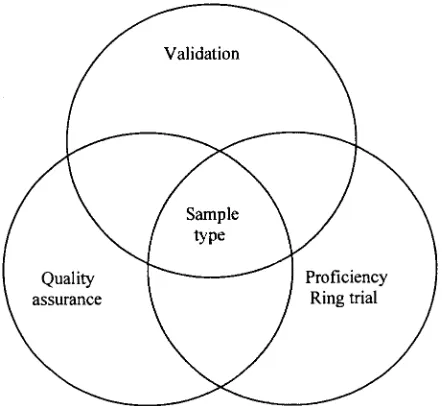
It is known that feces contain large amounts of phenolic and metabolic compounds and polysaccharides that are inhibitory for PCR. Common inhibitors are DNases, polysaccharides, and proteases (38). Thus, sample treatment should be assessed before evaluating the primer selectivities on target and non-target strains (Fig. 1) (16). Much effort has been spent to neutralize such substances by using effective DNA purification protocols or PCR facilitators. Amplification facilitators are substances that can enhance the efficiency of PCR. For feces, it was shown that the addition of bovine serum albumin (BSA) is most effective for overcoming PCR-inhibitory substances (2). Many authors have used 0.4% (wt/vol) BSA in the PCR (2, 29):
this concentration allowed DNA amplification byTaq
polymer-ase in the presence of 4% instead of 0.4% (vol/vol) feces. The purity of the BSA seems to play a minor role (29). However, acetylated BSA in high concentrations could inhibit the PCR (23), and it is highly recommended that proteinase-free BSA fractions are used. Another strategy to overcome PCR
inhibi-tion is to use a polymerase that is more resistant thanTaq. For
the rTthand Pwopolymerases it was found that a 0.4% fecal
homogenate in the PCR was not inhibitory in comparison to
Taqand other polymerases (1). A multifactorial design
exper-iment would help to investigate all aforementioned parameters in a single experimental setup (21).
DNA purification methods can, in addition to removing in-hibitors, concentrate total genomic DNA, especially from bac-teria. A study has shown, using pig fecal samples, that the commercially available QIAmp stool kit yielded higher, and less degraded, DNA than did the conventional
on May 15, 2020 by guest
http://jcm.asm.org/
form extraction method commonly used (18). Many studies which isolated food-borne pathogens directly from feces also used this kit, with good reproducibilities and sensitivities (17, 29). Silica membrane columns provide a convenient method for purification of DNA which is relatively free of inhibitors. Spin columns can, however, result in cross-contamination dur-ing the handldur-ing steps. Therefore, high safety standards are needed in the laboratory to avoid cross-contamination.
QUANTITATIVE PCR DATA
It is prerequisite to estimate the levels of Salmonella
con-tamination in a swine herd or at the slaughterhouse in order to assess the risk of hygiene failure and provide appropriate risk management options. The culture-based most probable num-ber (MPN) test (7) is particularly useful for the determination
of low concentrations ofSalmonellain feces. Higher levels of
Salmonella(⬎500 CFU/g feces) can be determined by direct
plating on selective agar, such as xylose lysine deoxycholate. However, high levels of background flora can disturb the
growth of Salmonella. Meanwhile, the use of real-time PCR
allows a faster and reliable method for the quantification of
Salmonella in pig feces. Similar to what is seen with direct
plating, higher levels could be readily detected directly without an enrichment step. We developed a pre-PCR processing pro-tocol based on the QIAmp stool kit (QIAGEN), followed by a real-time PCR assay originally used (25) for the detection of
Salmonellain food. This assay, including a reference standard
DNA and an internal amplification control, showed an accu-rate standard curve over a 5-log-unit linear range, enabling accurate detection down to 100 to 200 CFU/g of feces.
However, the small-volume (1 ml) sample taken for an in-dividual PCR-based test may not facilitate the direct detection
of low numbers ofSalmonella. An MPN-PCR strategy could
therefore be employed (especially attractive as an alternative to the labor-intensive culture-based MPN method). Here, the
detection of different concentrations ofSalmonellais usually
done after the first selective enrichment step. Based on the
presence or absence ofSalmonellain the enriched broth, the
MPN can be exactly calculated as applied for the culture-based MPN (7). A semiquantitative strategy using real-time PCR could be the calculation of the proportionality of cycle thresh-old values to the primary sample material; that is, a sample
with a higher initialSalmonellaload may result in lower cycle
threshold values (reverse correlation). This has been shown for
Campylobacterspp. in chicken rinse (20) but could be
interest-ing to evaluate for feces, which have much higher levels of background flora than does chicken rinse. An important issue here is the calculation of the detection probability (21), in particular with a logistic regression model to accurately eval-uate the detection limit of PCR (16).
CONCLUDING REMARKS AND RECOMMENDATIONS FOR STANDARDIZATION
Various gaps and recommendations for standardization have been identified and should be considered in future.
(i) BPW broths used for a preenrichment step can come from different producers, and they can contain minor differ-ences in composition (sometimes between batches) which can
affect the growth rate ofSalmonellaand its compatibility with
the subsequent PCR assay. Furthermore, the time necessary for preenrichment has historically been optimized for selective culturing, not for PCR. There are some indications that a shorter preenrichment time (e.g., 6 h) may improve the PCR detection limit because of the consequent low number of back-ground floras (9, 12, 24).
(ii) It is necessary to develop pre-PCR sample treatment methods that are specifically designed for the feces.
(iii) The use of nonproprietary DNA purification methods should be encouraged in order to avoid the use of certain commercial kits in proficiency trials. However, manufacturers could provide kits that have performances similar to those of noncommercial reference methods and that comply with the standard requirements.
(iv) Available DNA polymerase enzymes and buffers can vary substantially, with some being more prone to inhibition by the harsh inhibitors of feces than others. Special attention should be given to this issue in standardized protocols.
(v) In real-time PCR, the interaction of a probe dye with feces needs to be investigated in order to remove any possible quenching effect of the matrix on the fluorescence activity of the probes.
(vi) The aforementioned issues should be considered in light of the newly standardized procedures for PCR testing, which recommend the inclusion of internal amplification control, the processing of positive and negative controls (3), a consensus on the determination of the cutoff level in real-time PCR (5), and the use of statistical calculations for determining detection probability (24).
The availability of more-advanced but user-friendly real-time PCR provides us with a cost-effective alternative to cul-ture-based detection and quantification methods. It remains,
however, to investigate the fate of sublethally injured
Salmo-nellacells as well as the interference by deadSalmonellacells
[image:3.585.53.274.69.272.2]in pig feces. PCR based on DNA detection is not able to
FIG. 1. Integrated approach to establishment of diagnostic PCR according to Hoorfar et al. (16). Adapted from reference 16 with permission of the publisher.
on May 15, 2020 by guest
http://jcm.asm.org/
discriminate between dead and viable cells. However, the sam-pling of feces freshly taken directly from the ceca of pigs minimizes the detection of dead cells. Stressed cells must be considered as a risk, as they often do not multiply in selective cultural media but are still detected by PCR. In future, meth-ods should be developed to discriminate among vital, sub-lethally injured, and dead cells. A promising application is the ethidium monoazide (EMA)-PCR. EMA can selectively enter cells with damaged membranes and subsequently be covalently bound to DNA, inhibiting the PCR (28). Recently, it was shown that EMA-PCR is a tool valuable for the quantitative
distinction between viable and dead Campylobacter cells in
poultry (30).
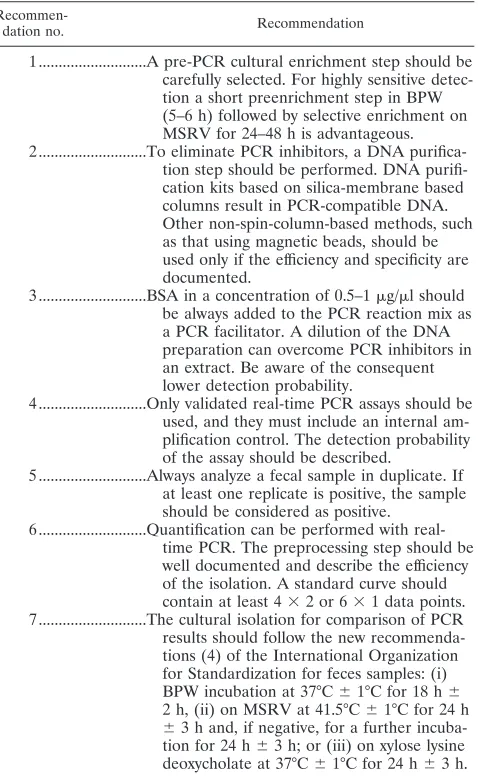
Practical recommendations for the use of PCR-based
meth-ods to detectSalmonellain swine feces are given in Table 1.
ACKNOWLEDGMENTS
The work was supported in part by the European Union through the Food-PCR 2 research project as part of the Network of Excellence MED-VET-NET (FOOD-CT-2004-506122) under the 6th RTD Frame-work and by the Deutsche Forschungsgemeinschaft project
“Experi-mentelle Analyze der Wirkungsmechanismen von Probiotika beim Schwein.”
The authors thank Nigel Cook of CSL for the critical reading.
REFERENCES
1.Al-Soud, W. A., and P. Rådstro¨m.1998. Capacity of nine thermostable DNA polymerases to mediate DNA amplification in the presence of PCR-inhib-iting samples. Appl. Environ. Microbiol.64:3748–3753.
2.Al-Soud, W. A., and P. Rådstro¨m.2000. Effects of amplification facilitators on diagnostic PCR in the presence of blood, feces, and meat. J. Clin. Mi-crobiol.38:4463–4470.
3.Anonymous.2003. Microbiology of food and animal feeding stuffs—poly-merase chain reaction (PCR) for the detection of food-borne pathogens— general method specific requirements (ISO 22174:2005). International Or-ganization for Standardization, Geneva, Switzerland.
4.Anonymous.2005. ISO 6579—microbiology of food and animal feeding stuffs—horizontal method for the detection ofSalmonella(doc ISO/TC34 SC 9 N 681, annex D: detection ofSalmonellaspp. in animal faeces and in samples of the primary production stage). International Organization for Standardization, Geneva, Switzerland.
5.Anonymous.2005. Microbiology of food and animal feeding stuffs—real-time polymerase chain reaction (PCR) for the detection of food-borne pathogens—general requirements and definitions (CEN/TC 275/WG 6/TAG 3 N 0110:2005). European Committee for Standardization, AFNOR, Paris, France.
6.Baggesen, D. L., H. C. Wegener, F. Bager, H. Stege, and J. Christensen.1996. Herd prevalence ofSalmonella entericainfections in Danish slaughter pigs determined by microbiological testing. Prev. Vet. Med.26:201–213. 7.Blodgett, R.2001. Most probable number determination from serial
dilu-tions. Appendix 2. FDA’s bacteriological analytical manual. [Online.] http: //www.cfsan.fda.gov/⬃ebam/bam-toc.html.
8.Buzby, J. C., T. Roberts, C. T. J. Lin, and J. M. MacDonald.1996. Bacterial foodborne disease—medical costs and productivity losses. USDA Economic Research Service, Washington, D.C.
9.Croci, L., E. Delibato, G. Volpe, D. De Medici, and G. Palleschi.2004. Comparison of PCR, electrochemical enzyme-linked immunosorbent assays, and the standard culture method for detectingSalmonellain meat products. Appl. Environ. Microbiol.70:1393–1396.
10.Davies, P. R., W. E. Morrow, F. T. Jones, J. Deen, P. J. Fedorka-Cray, and I. T. Harris.1997. Prevalence ofSalmonellain finishing swine raised in different production systems in North Carolina, USA. Epidemiol. Infect. 119:237–244.
11.Davies, R. H., R. Dalziel, J. C. Gibbens, J. W. Wilesmith, J. M. Ryan, S. J. Evans, C. Byrne, G. A. Paiba, S. J. Pascoe, and C. J. Teale.2004. National survey forSalmonellain pigs, cattle and sheep at slaughter in Great Britain (1999–2000). J. Appl. Microbiol.96:750–760.
12.Ellingson, J. L., J. L. Anderson, S. A. Carlson, and V. K. Sharma.2004. Twelve hour real-time PCR technique for the sensitive and specific detection ofSalmonellain raw and ready-to-eat meat products. Mol. Cell. Probes 18:51–57.
13.Fedorka-Cray, P. J., J. T. Gray, and C. Wray.2005.Salmonellainfection in pigs, p. 191–207.InC. Wray and A. Wray (ed.),Salmonellain domestic animals. CABI Publishing, Oxon, United Kingdom.
14.Gray, J. T., T. J. Stabel, and P. J. Fedorka-Cray.1996. Effect of dose on the immune response and persistence ofSalmonella choleraesuis infection in swine. Am. J. Vet. Res.57:313–319.
15.Gutzmann, F., H. Layton, K. Simkins, and H. Jarolmen.1976. Influence of antibiotic-supplemented feed on occurrence and persistence ofSalmonella typhimuriumin experimentally infected swine. Am. J. Vet. Res.37:649–655. 16.Hoorfar, J., P. Wolffs, and P. Radstro¨m.2004. Diagnostic PCR: validation and sample preparation are two sides of the same coin. APMIS112:808–814. 17.Inglis, G. D., and L. D. Kalischuk.2003. Use of PCR for direct detection of
Campylobacterspecies in bovine feces. Appl. Environ. Microbiol.69:3435– 3447.
18.Jensen, A. N., and J. Hoorfar. 2002. Optimal purification and sensitive quantification of DNA from fecal samples. J. Rapid Meth. Automat. Micro-biol.10:231–244.
19.Jensen, A. N., G. Sørensen, D. L. Baggesen, R. Bødker, and J. Hoorfar.2003. Addition of novobiocin in pre-enrichment step can improveSalmonella cul-ture of modified semisolid Rappaport-Vassiliadis. J. Microbiol. Methods 55:249–255.
20.Josefsen, M. H., N. R. Jacobsen, and J. Hoorfar.2004. Enrichment followed by quantitative PCR both for rapid detection and as a tool for quantitative risk assessment of food-borne thermotolerant campylobacters. Appl. Envi-ron. Microbiol.70:3588–3592.
21.Knutsson, R., C. Lo¨fstro¨m, H. Grage, J. Hoorfar, and P. Rådstro¨m.2002. Modeling of 5⬘nuclease real-time responses for optimization of a high-throughput enrichment PCR procedure forSalmonella enterica. J. Clin. Mi-crobiol.40:52–60.
22.Kranker, S., L. Alban, J. Boes, and J. Dahl.2003. Longitudinal study of
[image:4.585.46.285.87.476.2]Salmonella entericaserotype Typhimurium infection in three Danish farrow-to-finish swine herds. J. Clin. Microbiol.41:2282–2288.
TABLE 1. Recommendations for the PCR-based detection of Salmonellain feces
Recommen-dation no. Recommendation
1 ...A pre-PCR cultural enrichment step should be carefully selected. For highly sensitive detec-tion a short preenrichment step in BPW (5–6 h) followed by selective enrichment on MSRV for 24–48 h is advantageous. 2 ...To eliminate PCR inhibitors, a DNA
purifica-tion step should be performed. DNA purifi-cation kits based on silica-membrane based columns result in PCR-compatible DNA. Other non-spin-column-based methods, such as that using magnetic beads, should be used only if the efficiency and specificity are documented.
3 ...BSA in a concentration of 0.5–1g/l should be always added to the PCR reaction mix as a PCR facilitator. A dilution of the DNA preparation can overcome PCR inhibitors in an extract. Be aware of the consequent lower detection probability.
4 ...Only validated real-time PCR assays should be used, and they must include an internal am-plification control. The detection probability of the assay should be described.
5 ...Always analyze a fecal sample in duplicate. If at least one replicate is positive, the sample should be considered as positive.
6 ...Quantification can be performed with real-time PCR. The preprocessing step should be well documented and describe the efficiency of the isolation. A standard curve should contain at least 4⫻2 or 6⫻1 data points. 7 ...The cultural isolation for comparison of PCR results should follow the new recommenda-tions (4) of the International Organization for Standardization for feces samples: (i) BPW incubation at 37°C⫾1°C for 18 h⫾ 2 h, (ii) on MSRV at 41.5°C⫾1°C for 24 h ⫾3 h and, if negative, for a further incuba-tion for 24 h⫾3 h; or (iii) on xylose lysine deoxycholate at 37°C⫾1°C for 24 h⫾3 h.
on May 15, 2020 by guest
http://jcm.asm.org/
23.Kreader, C. A.1996. Relief of amplification inhibition in PCR with bovine serum albumin or T4 gene 32 protein. Appl. Environ. Microbiol.62:1102– 1106.
24.Lo¨fstro¨m, C., R. Knutsson, C. E. Axelsson, and P. Radstro¨m.2004. Rapid and specific detection ofSalmonellaspp. in animal feed samples by PCR after culture enrichment. Appl. Environ. Microbiol.70:69–75.
25.Malorny, B., E. Paccassoni, P. Fach, C. Bunge, A. Martin, and R. Helmuth. 2004. Diagnostic real-time PCR for the detection ofSalmonellain food. Appl. Environ. Microbiol.70:7046–7052.
26.Malorny, B., P. T. Tassios, P. Rådstro¨m, N. Cook, M. Wagner, and J. Hoorfar.2003. Standardization of diagnostic PCR for the detection of food-borne pathogens. Int. J. Food Microbiol.83:39–48.
27.Nielsen, B., L. Alban, H. Stege, L. L. Sorensen, V. Mogelmose, J. Bagger, J. Dahl, and D. L. Baggesen.2001. A newSalmonellasurveillance and control programme in Danish pig herds and slaughterhouses. Berl. Muench. Tieraer-ztl. Wochenschr.114:323–326.
28.Nogva, H. K., S. M. Dromtorp, H. Nissen, and K. Rudi.2003. Ethidium monoazide for DNA-based differentiation of viable and dead bacteria by 5⬘-nuclease PCR. BioTechniques34:804–813.
29.Rudi, K., H. K. Hoidal, T. Katla, B. K. Johansen, J. Nordal, and K. S. Jakobsen.2004. Direct real-time PCR quantification ofCampylobacter jejuni
in chicken fecal and cecal samples by integrated cell concentration and DNA purification. Appl. Environ. Microbiol.70:790–797.
30.Rudi, K., B. Moen, S. M. Dromtorp, and A. L. Holck.2005. Use of ethidium monoazide and PCR in combination for quantification of viable and dead cells in complex samples. Appl. Environ. Microbiol.71:1018–1024. 31.Sibley, J., B. Yue, F. Huang, J. Harding, J. Kingdon, M. Chirino-Trejo, and
G. D. Appleyard. 2003. Comparison of bacterial enriched-broth culture, enzyme linked immunosorbent assay, and broth culture-polymerase chain reaction techniques for identifying asymptomatic infections with Salmonella in swine. Can. J. Vet. Res.67:219–224.
32.Smith, H. W., and J. E. T. Jones.1967. Observations on experimental oral infection withSalmonella dublinin calves andSalmonella choleraesuisin pigs. J. Pathol. Bacteriol.93:141–156.
33.Stone, G. G., R. D. Oberst, M. P. Hays, S. McVey, and M. M. Chengappa. 1994. Detection ofSalmonellaserovars from clinical samples by enrichment broth cultivation-PCR procedure. J. Clin. Microbiol.32:1742–1749. 34.Thorns, C. J.2000. Bacterial food-borne zoonoses. Rev. Sci. Tech. Off. Int.
Epizoot.19:226–239.
35.United States Department of Agriculture.1997. Shedding ofSalmonellaby finisher hogs in the U.S. [Online.] http://www.aphis.usda.gov/vs/ceah/ncahs /nahms/swine/swine95/sw95gap.htm.
36.Voogt, N., M. Raes, W. J. Wannet, A. M. Henken, and A. W. van de Giessen. 2001. Comparison of selective enrichment media for the detection of Sal-monellain poultry faeces. Lett. Appl. Microbiol.32:89–92.
37.Wegener, H. C., T. Hald, W. D. L. Fo, M. Madsen, H. Korsgaard, F. Bager, P. Gerner-Smidt, and K. Molbak. 2003.Salmonellacontrol programs in Denmark. Emerg. Infect. Dis.9:774–780.
38.Wilson, I. G.1997. Inhibition and facilitation of nucleic acid amplification. Appl. Environ. Microbiol.63:3741–3751.
39.Wood, R. L., and R. Rose.1992. Populations ofSalmonella typhimuriumin internal organs of experimentally infected carrier swine. Am. J. Vet. Res. 53:653–658.