Commodity Price Volatility under New
Market Orientations
Weaver, Robert D and Natcher, William C
Penn State University
2000
Online at
https://mpra.ub.uni-muenchen.de/9862/
Robert D. Weaver and William C. Natcher
Penn State University
Department of Agricultural Economics and Rural Sociology
March 2000
Paper Presented at the AES Annual Meeting 2000
Manchester, U.K.
Commodity Price Volatility under New Market Orientations
Robert D. Weaver and William C. Natcher*
*Professor and Research Assistant,
Department of Agricultural Economics, Pennsylvania State University
Abstract
Recent national and international regulatory reforms (e.g. U.S. FAIR and other GATT
compliance reforms) in agricultural markets has led some observers to wonder whether the
private sector is able to produce a level of price volatility that is socially acceptable. In this
paper, we examine the post reform track record of price volatility and its transmission across
vertically linked and geographically linked markets. Livestock, grain, and dairy market data
(monthly) are considered across the U.S. and E.C. The standard commodity-pricing model
supports the hypothesis that competitive storage acts to reduce the volatility of cash prices.
Further, speculative attacks and stock outs have been shown to induce increased volatility.
This motivates a scope of consideration that includes prices as well as stock levels to assess
their contribution to price volatility.
The paper considers evidence based on three decades of monthly data and advanced
time series techniques. First, univariate volatility estimates based on the autoregressive
conditional heteroskedasticity (GARCH) model are evaluated and compared to historical
temporal variation to highlight the importance of well grounded estimation of volatility.
Next, the relationships between stocks and the conditional mean, as well as the conditional
and unconditional variances of the price series, are assessed for dairy and grain products.
Finally, reform associated changes in the structure of the transmission of volatility through
vertical markets are considered for dairy products and across geographic markets is
Background.
Extensive literature over the past fifty years has considered the relationship between
inventory levels and price volatility. On the basis of such a relationship, a rationale for a role
for public sector management of commodity price volatility was developed showing that
governments could stabilize prices by managing stocks. However, the feasibility and
efficacy of such buffer schemes was later questioned when private sector intertemporal
arbitrage and government budget constraints were recognized, see Helmberger, et al. These
results were further strengthened as international trade and gaming among market
coordinating intermediaries (grain traders) were added to models. During the same period,
two other types of changes have influenced commodity markets: 1) expansion of the scope of
forward contracting mechanisms such as futures and options markets as well as the use of
forward contracting, and 2) liberalization of international trade. Over the past decades,
reforms in trade policy as well as government budget constraints has led to reduction of
government managed stocks. At the same time, private sector stocks have not expanded,
resulting in significant decreases in stock-to-use ratios for many commodities. These
changes in the government role in farm markets were most dramatically announced by the
F.A.I.R. Act in 1996. Extensive farm press and extension coverage (e.g. AgriFinance, 1997;
Yonkers and Dunn, 1996) has suggested that volatility would or has dramatically increased as
a result of F.A.I.R. However, the actual impacts of F.A.I.R. are unclear. First it was passed
after a substantial period of evolution in the role of government in farm markets. This is
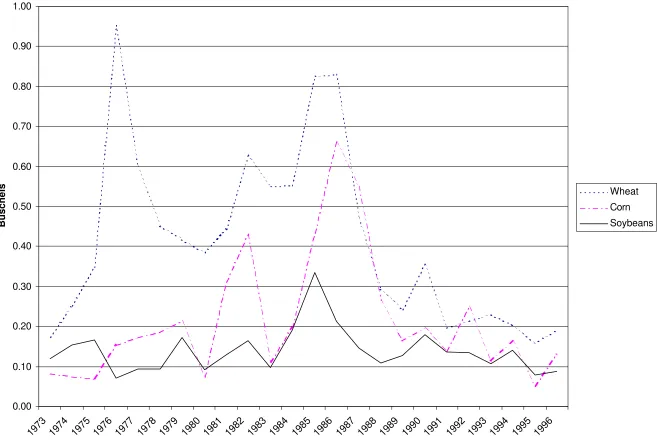
highlighted in Figure 1 from which it is apparent that stocks-to-use ratios began to decline
sharply in 1986 to a new equilibrium level that was found in about 1989. From this
perspective, F.A.I.R. appears to have simply formalized an adjustment already accomplished.
volume. This setting motivates an examination of volatility in commodity prices over the
past several decades.
Of interest in this paper is the impact of changes in market conditions on the volatility
of commodity prices. Agricultural markets in the U.S. have been impacted by at least four
important types of policies that may have impacted price volatility: U.S. government farm
programs, and U.S. macro, trade and tax policy. The implications of each of these types of
policy for price volatility has received some attention in the literature. However, the joint
implications of changes in these policies has not been considered. Miranda and Helmberger
simulated the implications of government storage programs on competitive price stability
showing that it is feasible for public storage to stabilize market prices beyond the level
associated with perfectly competitive private storage. More broadly, the U.S. farm programs
have attempted to stabilize farm level prices through a combination of instruments and
actions including: setting of limit prices, price management through public storage and trade
transactions, subsidies for private on-farm storage, a variety of supply control instruments,
and trade policies. While a detailed modeling and simulation approach might be taken to
characterize and analyze each of the associated policy regimes, such an approach is
complicated by the jointness of the implementation of these programs as well as by
implementation that varied both temporally and spatially.
In very general terms, Crain and Lee identified three eras of post-World War II farm
programs: quota dominated, mandatory programs (January 1950- April 1964); acreage
control, voluntary programs (April 1964-December 1985); and increasingly market oriented
programs (December 1985 - 1997). Considering natural volatility of spot and futures wheat
prices across these programs Crain and Lee assumed volatility to constant across daily
observations within program regimes and found evidence that volatility had changed
was associated with each of the three regimes noted above. Crain and Lee conclude wheat
price volatility was higher in the 1964-85 policy regime then the 1985-93 regime. Using
dummy variables to characterize salient features of the policy regimes, they found that
mandatory and long-term land diversion programs are associated with low volatility in prices.
In contrast, they found low loan rates are associated with high levels of volatility. These
results provide support for press and extension observations concerning changes in volatility
that would be associated with F.A.I.R.
While these past studies are suggestive of a role of government programs in altering
the volatility of prices, the market setting for agricultural commodities is complicated
simultaneously by farm, tax, macro, and trade policies of both the U.S. and its trading
partners. Further, changes in government programs analyzed by Crain and Lee involved
numerous changes impacting incentives and constraints affecting private sector production,
storage, trade, and utilization decisions. The confluence of these policies and their
differential implementations suggest that a less structured approach to assessing changes in
price volatility is of interest. In this paper, we re-examine volatility within the most recent
of Crain and Lee regimes using less restrictive time series methods. We retain focus on the
particular regimes identified by Crain and Lee, however, we do so based on the interpretation
that the regimes reflect periods of common underlying political orientation toward
interventionist policy, rather than simple changes in farm policy.
Approach
To proceed, we evaluate volatility both over time and across commodities exposed to
different levels of policy intervention. We consider the past several decades of experience
for two commodities that have been the target of U.S. interventionist government programs:
wheat and corn. Further, we consider a substitute commodity, soybeans, which has not been
fundamentals as well as by competition for land. Finally, to allow for consideration of a
commodity that is much less influenced by U.S. policy, we consider cocoa. For each
commodity we analyze daily data to allow for consideration of volatility within trading
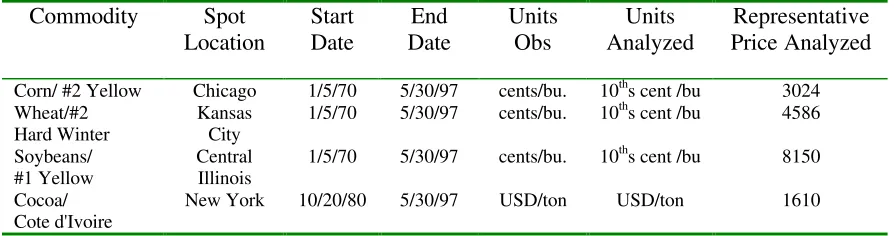
periods. Details on data are summarized in Table 1.
To analyze price volatility, define the price series as {Pt}. A natural estimator of the
volatility of prices has been based on measures of the variation within fixed marketing
intervals, see e.g. Poterba and Summers, Brunetti and Gilbert, Park, or Cho and Frees,
Peterson, et al.:
1)
∀ i=1,…I
where,
i=market interval
wi=interval width
ti=time of occurrence of the ith interval
The market interval has varied over studies, however, the utility of this measure relies upon
its consistency with the underlying data generating mechanism. Where the series {Pt} follows
a random walk in levels, and where the trading interval index i is set equal to the sampling
index (t) that indicates the observation date, then Si is estimated for each observation date and
1) provides an estimator of the conditional variance ht of {Pt}. Alternatively, where {Pt}
follows a random walk in logarithms of levels, 1) would not measure conditional variance.
In practice, trading interval width (wi) is defined based on market activity. In this study,
daily data is used and the trading interval is defined as the business week. Based on 1), the
market interval is allowed to vary to accommodate variation in the number of business days
in trading periods (e.g. due to holidays). To relate estimates of Si based on overlapping
intervals requires the additional assumption that prices generated within the interval (e.g. five
(
1)
days of prices) follow from the same underlying distribution.
An alternative approach is to draw an estimate of conditional variance from a more
general model of the data generation process. Here, we allow for such a general form by
using a GARCH(1,1):
2)
∆Pt=β0 + β1∆Pt-1 + µt
where µt~N(0,ht) and ht=α0 + α1µ2t-1 + φ1ht-1 + νt. Furthermore, νt is assumed to be Gaussian.
By comparison to the natural estimator 1), an estimate of ht drawn from 2) provides an
estimate that varies over each observation without concern for specification of trading
intervals. In contrast, the natural volatility estimator provides only an estimate for each
trading interval, implicitly assuming the underlying stochastic process within that interval has
a constant variance. Further, the specification 2) allows for an autoregressive form in
differences, and an error that evolves according to a GARCH(1,1). When the observed price
series follows the process 2) with β0 = β1 = 0, the natural estimator provides a sample
estimate of ht for each observation. However, the small sample size within these market
intervals, and the likelihood that {Pt} does not follow a simple random walk, motivates a
strong interest in GARCH based estimates of conditional variance. To implement 2), we
impose the a priori restriction β0 = 0.
In order to identify the properties of the data generating process of Pt, we first
examine the characteristics of µt in equation 2) using Jarque-Bera test for normality as well as
direct tests of several alternative heteroscedastic forms. Results presented in Table 2 indicate
that the null hypothesis of normality is rejected for each commodity. The heteroscedasticity
tests were conducted to determine if the conditional variance of the series varies over the
approach (ARCH LM) to testing the hypothesis
Ho: c1=c2=...=cq=0
Ha: not Ho
as a restriction on:
3)
µ2
t=a + c1µ2t-1 + c2µ2t-2 + ... + cpµ2t-q + et
When the GARCH term is introduced, Lee (1991) shows the LM test for
GARCH(p,q) errors is identical to the LM test for ARCH(q) provided p≤q. In addition to
the ARCH LM test, two additional forms of heteroscedasticity were examined as noted in
Table (2). Each test regresses the squared residuals on a measure of the magnitude of the
dependent variable, the estimated price change and the squared estimated price change,
respectively. In both cases, these specific forms of heteroscedasticity are rejected. In
summary, the tests find strong evidence for non-normal residuals and motivates the use of a
GARCH specification.
In the financial literature, ARCH and GARCH processes have been extensively used
to estimate the conditional variance of price series and examine its evolution across a
changing economic environment, see Najand and Yung, Antoniou and Holmes, Baldauf and
Santoni. Baldauf and Santoni consider the impact of programmed trading on price volatility
by allowing the ARCH model of variance to change across two periods defined based on
existence of programmed trading. Antoniou and Holmes considered the impact of the
commencement of futures trading in the FTSE-100 Index on spot market volatility by
considering changes in an estimated GARCH process. Najand and Yung considered the
impact of changes in trading volume on the mean of a GARCH process.
GARCH and ARCH models have also been employed in the commodity market
Jansen, and Penson; and Chavas and Holt. Aradhyula and Holt applied a GARCH model to
retail meat prices to determine whether the conditional variances of the series varied over the
sample period. The results suggest the constant conditional variance assumption can be
rejected for the period and consequently the GARCH specification provided more
information about the precision of mean forecasts. Hans, et al. investigated the relationship
between the money supply and agricultural and industrial prices within a multivariate ARCH
and GARCH framework. Specifically, a vector autoregression (VAR) (G)ARCH model was
applied to the farm product price index, industrial product price index, and the money supply
(M1). The authors conclude the conditional mean and variance of agricultural prices are
more sensitive to changes in the money supply than are industrial prices. Moreover, the
results suggest the conditional mean and variance of the three variables exhibit a high degree
of correlation. Finally, Chavas and Holt evaluated the hog-corn price ratio and find evidence
that the process generating the pork cycle is nonlinear. Based on this finding the authors
apply a GARCH model to quarterly observations of the hog-corn price ratio and conclude the
model can account for some but not all of the nonlinearity.
The GARCH model provides a basis for interpretation of the nature of price
adjustment. Note the conditional variance from equation 2) can be written as,
(4)
ht=α0 + α1(µ2t-1 – ht-1) +(α1+φ1)ht-1 + νt
With this specification the term (µ2t-1 – ht-1) can be viewed as the shock to volatility while the
parameter α1 indicates the impact of recent innovations in price. Furthermore, φ1indicates
change in volatility induced by the accumulation of past innovations. Interpreting
innovations as news allows us to interpret these coefficients in terms of transient vs.
impacts of innovations.
Stationarity of a GARCH(p,q) process requires that,
(5)
Therefore, a GARCH(1,1) model is stationary if α1 + φ1<1. In the special case when the
parameters sum to unity, the GARCH model has a unit root and Engle and Bollerslev (1986)
refer to such a model as an IGARCH.1 That is, if (α1 + φ1)<1 then shocks will dissipate or
vanish while shocks will accumulate or persist if (α1 + φ1)≥1. The GARCH specification
provides a basis for examining market efficiency.represents a measure of efficiency. Under
an IGARCH process, shocks to volatility persist infinitely suggesting that arbitrage fails to
adjust the level of volatility to a long run equilibrium. Further, whenever φ1>0, finite
memory persistence exists suggesting markets are slow to react.
The issue of volatility persistence has been addressed by a number of authors in the
financial literature, e.g. Lock and Sayers, Poterba and Summers, and Chou. Locke and
Sayers investigate the relations between the arrival of information and the persistence of
volatility in the S&P 500 index futures market. The authors utilize a number of variables to
represent the flow of information such as contract volume, floor transactions, the number of
price changes, and executed order imbalance. They conclude that all of the variables explain
a significant portion of returns variance but even after information adjustment the S&P 500
returns continued to exhibit volatility persistence.
Another study which investigated the persistence of volatility in the equity markets
was conducted by Poterba and Summers (P-S). Here the authors examine the relationship
1
If the error term follows an IGARCH process, the unconditional variance of µt is infinite implying that any shock to the conditional variance has a permanent impact the unconditional variance. The unconditional variance of µt is expressed as,
σ2
=α0/(1-α1-φ1)
As the sum of α1 and φ1 tends to unity, σ2 tends to infinity and consequently, neither µt or µt2 satisfy the definition of covariance-stationary (Hamilton 1994). However, Nelson(1990) shows that σ2 is strictly stationary if α0>0 and the error term of the GARCH process is such that
∑ ∑
= =
< +
q
i
p
j j i
1 1
1
between price volatility and price levels for the S&P 500 index during the period 1928-1984
and the results suggest shocks to the market appear not to persist. Finally, Chou utilized a
GARCH model to investigate volatility persistence and changing risk premium in equity
markets and comes to an entirely different conclusion from P-S. That is, Chou finds a high
degree of volatility persistence in stock returns. He concludes the discrepancy between his
findings and P-S’s is the result data frequency. P-S utilized monthly observations while
Chou utilized weekly data.
The price series analyzed are reported graphically in Figure 2. Several features of
price variation are apparent from these figures. First, substantial autocorrelation in direction
of change appears to exist for each of the commodities. Second, the variation of corn and
wheat appear to follow similar patterns and those patterns are distinct from those of soybeans
and cocoa. Stationarity of the underlying price series was examined using augmented
Dickey-Fuller tests and the results strongly support the conclusion that each price series is
I(1) in levels. This supports the interpretability of the natural volatility measure and motivates
the use of first differences in 2).
Natural volatility estimates based on a business week marketing interval are
presented graphically in Figure 3. Again, corn and wheat appear to follow similar processes
which are distinct from that followed by soybeans or cocoa. Further, the graphics suggest
that some autocorrelation in volatility exists. That is, high levels of volatility are followed by
subsequent periods of high volatility. This is strongest for corn and wheat, and weakest for
cocoa. A substantial shock to volatility is apparent for corn and wheat in late 1996, a period
associated with the introduction of the F.A.I.R. Act. The observed autocorrelation in
volatility further motivates the use of GARCH. Graphically, a further feature of importance
to note is that evidence of systematic increases in volatility are not apparent. This observation
was further supported by testing each volatility series for stationarity which resulted in the
hypothesis of unit root being rejected in every case.2 These findings of stationarity provide
evidence that supports the inference that a persistent data generating mechanism exists for
each price series over the sample period. Based on this inference, it is of interest to consider
the descriptive statistics that characterize these series. As noted in Table 1, the units for corn,
wheat, and soybeans are comparable, though their scales are not. As reported in Table 3, the
mean level of volatility for the sample period was 29.652 for corn, 26.214 for cotton, 41.222
for wheat, and 80.383 for soybeans suggesting that average volatility was highest for the crop
not managed by farm programs. Similar ordering of the commodities follows from a
comparison of the standard deviations of volatility – soybeans were found to have the highest
volatility. These results lend support to the conclusion of Miranda and Helmberger that
government storage programs can reduce price volatility. However, these results may be
misleading given that sample kurtosis and skewness values suggest each series is represented
by a non-normal distribution. Together the results further motivate the utility of GARCH.
Next, consider the GARCH results. The random walk hypothesis necessary for
interpretability of the natural estimates is rejected by the GARCH results. As is apparent
from Table 4, the coefficient of the lagged difference is statistically significant for each of the
commodities. This result implies that the use of natural volatility measures will be inefficient
(Mills ). ARCH and GARCH coefficients estimated in the GARCH(1,1) are statistically
significant and nonnegative with the exception of the GARCH coefficient for soybeans.
Results for the coefficient of the lagged innovation (α1 ) indicate comparable estimates in
2
The augmented Dickey-Fuller test was performed by estimating the following equation,
∆Pt= β1Pt-1 + β2∆Pt-1+…+βρ∆Pt-ρ + µt
magnitude for corn and wheat, both suggesting a small response to recent shocks. In
contrast, the results for soybeans indicate a more substantial response to recent shocks. The
GARCH coefficient φ1 indicates autocorrelation in conditional variance suggesting that some
persistence in volatility for corn, wheat, and cocoa (see Table 4). In fact, estimates are
consistent with IGARCH processes for corn and wheat. No significant persistence is found
for soybeans.
The unconditional variance estimates for each commodity during the entire sample
period and along within each regime is presented in Table 5. The unconditional variance has
also been normalized by the mean price change in each subperiod to allow for comparisons.
The results indicate corn and wheat are characterized by an IGARCH process during the first
regime while no such evidence is found during regimes 2 and 3. Alternatively. the
unconditional variance for soybeans and cocoa suggest a stationary GARCH process.
Comparing the normalized unconditional variance for each commodity indicates
soybeans experienced the highest level of volatility over the entire sample period. Notice that
the unconditional variance increased across regimes for both wheat and corn while
decreasing for soybeans and cocoa. Moreover, it appears that as public involvement was
reduced in the corn and wheat markets, price volatility became uniformly disbursed across
commodities.
The possibility of a systematic shift in volatility due to changes in market orientation
through changes in U.S. and trading partner farm, trade, macro, and tax policies can now be
investigated. First, we must recall that the estimated volatility series across the sample
appear to reflect no obvious structural breaks (see Figure 4). To proceed, we adopt three
policy regimes based on Crain and Lee's argument: acreage control, voluntary programs
-1993), and a period of substantial market reform (January 1994 – June 1997). While
structural breaks could be examined parametrically, in this paper, we limit our consideration
to these regimes.
Two approaches are taken. First, the natural volatility series are reexamined within
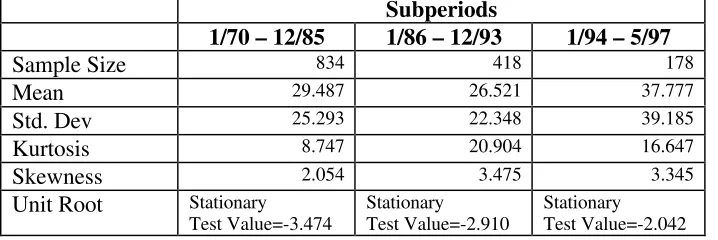
these regimes. Tables 6a – 6d present descriptive statistics. Unit roots of the natural
volatility measures within regimes were rejected in each subperiod except for soybeans
during the period of January, 1994 to June, 1997. Although the volatility series appeared
stationary across the entire sample (1970-1997), the results in Tables 6a – 6d suggest that the
characteristics of volatility in each subperiod changed for each commodity. For example, the
mean level of volatility for cocoa decreased from 37.749 in the first period to 16.677 in the
final. Similarly, the standard deviation also decreased for cocoa in each period. That within
each regime except for the period 1/94 - 5/97 when the volatility of corn increased. A
common characteristic of all four commodities is that the mean level of volatility decreased
from the first period to the second period. And with the exception of cocoa the mean level
increased from the second to third periods.
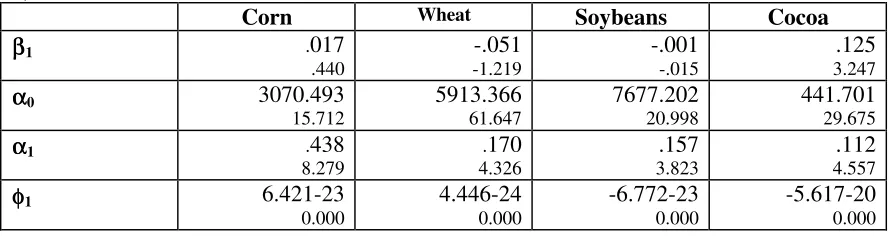
Next, the GARCH models were re-estimated within the policy regimes. Results
reported in Tables 7a – 7c provide the basis for several interesting inferences. First, it has
already been noted that policies impacting wheat and corn were progressively relaxed in a
definite movement toward stronger market orientation as regimes 1-3 are considered. As is
apparent from Table 7a – 7c, the persistence of volatility in corn and wheat decreases from
regime 1 through to regime 3 where no significant GARCH persistence is found. The
absence of persistence is found consistently across regimes for soybeans. These results
suggest that as market orientation in corn and wheat markets increased price volatility
became a contemporaneous phenomenon and persistence was not found. Furthermore,
identified with results supporting a random walk. In regime 2, a significant ARCH and
GARCH process is found with a strong persistence in volatility indicated. In regime 3, no
persistence is found, though a lagged impact of innovations is found.
Conclusion
The results from analyzing the prices of corn, wheat, soybeans, and cocoa for the
period January, 1970 – June, 1997 suggest a number of noteworthy characteristics. First,
price levels for each commodity appear to be I(1) while the volatility series is I(0). Next, the
natural volatility estimator suggests the level of volatility increased from 1970 to 1997 for
corn and wheat while the GARCH results suggest the persistence of volatility decreased. The
diminution of volatility persistence suggests these markets became increasingly efficient for
the period. Contrary to the corn and wheat markets, the mean level of volatility for soybeans
decreased over the sample period. Moreover for soybeans, no significant persistence was
0.00 0.10 0.20 0.30 0.40 0.50 0.60 0.70 0.80 0.90 1.00
1973 1974 1975 1976 1977 1978 1979 1980 1981 1982 1983 1984 1985 1986 1987 1988 1989 1990 1991 1992 1993 1994 1995 1996
Buschels
Wheat
Corn
[image:17.792.62.719.63.508.2]Tables
Table 1. Heteroscedasticity Test Results3
Corn Wheat Soybeans Cocoa
Jarque-Bera* 744.98 14384.63 76741.60 1301.82
ARCH LM†
559.24 405.21 1058.48 167.17
ε2
t on y(hat)‡ .00 .00 .00 .00
ε2
t on y(hat)2 .30 1.43 .02 10.24
*5% critical value=5.99
†5% critical value=5.99
[image:18.612.83.530.249.367.2]‡5% critical value=3.84
Table 2. Daily Price Data Analyzed
Commodity Spot Location Start Date End Date Units Obs Units Analyzed Representative Price Analyzed
Corn/ #2 Yellow Chicago 1/5/70 5/30/97 cents/bu. 10ths cent /bu 3024 Wheat/#2
Hard Winter
Kansas City
1/5/70 5/30/97 cents/bu. 10ths cent /bu 4586
Soybeans/ #1 Yellow
Central Illinois
1/5/70 5/30/97 cents/bu. 10ths cent /bu 8150
Cocoa/ Cote d'Ivoire
New York 10/20/80 5/30/97 USD/ton USD/ton 1610
Table 3. Distributional Statistics of Natural Volatility Estimates (Weekly)
Corn 1/70 - 5/97
Wheat 1/70 - 5/97
Soybeans 1/70 - 5/97
Cocoa 10/80 - 5/97
Sample Size 1430 1430 1430 867
Mean 29.652 41.222 80.383 26.214
Std. Dev. 26.832 38.046 93.712 18.870
Kurtosis 14.910 19.807 60.078 5.517
Skewness 3.056 3.199 5.952 1.982
Unit Root Unit Root
Test Value=-0.331 Unit Root Test Value=-0.068 Unit Root Test Value=-0.402 Unit Root
[image:18.612.84.547.406.582.2]Test Value= -0.956
Table 4: GARCH(1,1) Summary Statistics
Corn Wheat Soybeans Cocoa
ββ1 0.022348
1.771 -0.023693 -2.005 0.085530 19.941 0.104694 6.473 3
1. Jarque-Bera: Test: (T-K)/6 [S2 + 1/4(K-3)2]~ χ22 where T= number of observations
K= kurtosis S= skewness
2. ε2t= β0+ β1ε2t-1 + β2ε2t-2
where the test statistic is: (T-2)R2~χ22 3. ε2t= β0+ β1y(hat)
where the test statistic is: TR2~χ21 4. ε2t= β0+ β1y(hat)2
α
α0 11.103924
12.992 5.871791 8.864 14745 43.873 3.667696 4.598 α
α1 0.122241
27.443 0.139187 28.599 0.367983 29.256 0.041037 15.977
φφ1 0.881215
[image:19.612.84.535.185.368.2]251.696 0.878281 250.466 4.150461E-20 0.002 0.956916 382.394
Table 5. Unconditional Variance
Corn Wheat Soybeans Cocoa
Entire Sample
Unconditional Variance
-3,185.88 -336.15 23,330.10 1,791.74
Normalized -115.44 -9.09 312.76 75.90
Regime 1
Unconditional Variance
-512.33 -266.68 31,553.90 2048.34
Normalized -18.66 -7.35 367.44 66.46
Regime 2
Unconditional Variance
1,275.49 2,629.36 12,599.90 968.56
Normalized 50.89 82.16 217.81 43.83
Regime 3
Unconditional Variance
5,463.51 7,124.54 9,107.00 497.41
Normalized 159.85 137.06 148.74 30.40
Table 6a. Subperiod Distributional Statistics of Natural Volatility Estimates (Weekly) for Corn.
Subperiods
1/70 – 12/85 1/86 – 12/93 1/94 – 5/97
Sample Size 834 418 178
Mean 29.487 26.521 37.777
Std. Dev 25.293 22.348 39.185
Kurtosis 8.747 20.904 16.647
Skewness 2.054 3.475 3.345
Unit Root Stationary
Test Value=-3.474
Stationary Test Value=-2.910
Stationary Test Value=-2.042
[image:19.612.84.443.402.522.2]Table 6b. Subperiod Distributional Statistics of Natural Volatility Estimates (Weekly) for Cocoa.
Subperiods
10/80 – 12/85 1/86 – 12/93 1/94 – 5/97
Sample Size 267 418 178
Mean 37.749 22.985 16.677
Std. Dev. 22.862 15.421 8.733
Kurtosis 5.754 8.422 4.220
Skewness 1.503 1.896 1.144
Unit Root Stationary*
Test Value=-6.054
Stationary Test Value-5.107
Stationary Test Value=-4.459
[image:20.612.84.445.254.377.2]*5% critical value is –1.95
Table 6c. Subperiod Distributional Statistics of Natural Volatility Estimates (Weekly) for Wheat.
Subperiods
1/70 – 12/85 1/86 – 12/93 1/94 – 5/97
Sample Size 834 418 178
Mean 39.448 36.637 60.299
Std. Dev. 38.541 26.240 51.412
Kurtosis 12.949 7.626 28.541
Skewness 2.607 1.941 3.919
Unit Root Stationary*
Test Value=-3.407
Stationary Test Value=-2.052
Stationary Test Value=-2.193
*5% critical value is –1.95
Table 6d. Subperiod Distributional Statistics of Natural Volatility Estimates (Weekly) for Soybeans.
Subperiods
1/70 – 12/85 1/86 – 12/93 1/94 – 5/97
Sample Size 834 418 178
Mean 94.087 60.373 63.163
Std. Dev. 112.081 55.916 47.804
Kurtosis 49.164 25.990 9.827
Skewness 5.394 3.869 2.250
Unit Root Stationary*
Test Value=-3.844
Stationary Test Value=-3.104
Non-Stationary Test Value=-1.484
[image:20.612.82.440.421.546.2]Table 7a. GARCH(1,1) Parameter Estimates for the Period January 5, 1970 – December 22, 1985
Corn Wheat Soybeans Cocoa
ββ1 .006
.343* -.006 -.385 .068 5.689 .065 2.167 α
α0 4.661
5.636 5.067 7.903 19311 30.218 2044.248 39.409 α
α1 .131
17.677 .151 23.403 .384 19.405 .002 .202
φφ1 .878
[image:21.612.87.527.263.380.2]154.552 .868 195.066 .004 1.042 4.332-23 0.000 * T-statistics
Table 7b. GARCH(1,1) Parameter Estimates for the Period December 23, 1985 – December 30, 1993
Corn Wheat Soybeans Cocoa
ββ1 .042
1.623 -.067 -3.818 .119 7.359 .108 4.913 α
α0 161.987
10.979 57.846 7.014 8530.115 25.454 8.717 3.987 α
α1 .207
11.425 .113 12.596 .323 12.740 .052 8.824
φφ1 .666
27.483 .865 94.615 8.685-24 0.000 .939 134.200
Table 7c. GARCH(1,1) Parameter Estimates for the Period December 31, 1993 – June 2, 1997
Corn Wheat Soybeans Cocoa
ββ1 .017
.440 -.051 -1.219 -.001 -.015 .125 3.247 α
α0 3070.493
15.712 5913.366 61.647 7677.202 20.998 441.701 29.675 α
α1 .438
8.279 .170 4.326 .157 3.823 .112 4.557
φφ1 6.421-23
[image:21.612.84.529.425.543.2]References
Agri Finance (1997). "1996 Farm Bill Increases Risk." p. 24
Antoniou, A., and P. Holmes (1995) “Futures Trading, Information and Spot Price Volatility:
Evidence for the FTSE-100 Stock Index Futures Contracts Using GARCH.” Journal
of Banking & Finance Vol. 19 pp. 117-129
Aradhyula, S.V. and M.T. Holt (1988) "GARCH Time-Series Models: An Application to
Retail Livestock Prices." Western Journal of Agricultural Economics Vol 13 No. 2
pp. 365-374
Baldauf, B. and G.J. Santoni, (1991) “Stock Price Volatility: Some Evidence from an ARCH
Model” The Journal of Futures Markets, Vol. 11, No.2, pp. 191-200
Brunetti, C. and C.L. Gilbert (1995) “Metal Price Volatility”, 1972-95, Resource Policy, Vol.
21 No.4 pp. 237-254
Chavas, J. and M.T. Holt (1991) "On Nonlinear Dynamics: The Case of the Pork Cycle."
American Journal of Agricultural Economics pp. 819-828
Cho D.C., and E.W. Frees, (1988) “Estimating the Volatility of Discrete Stock Prices” The
Journal of Finance, Vol. XLIII pp. 451-466
Chou, R.Y. (1988) “Volatility Persistence and Stock Valuations: Some Empirical Evidence
Using GARCH.” Journal of Applied Econometrics Vol 3 pp. 279-294
Crain, S.J. and J.H. Lee (1996) “Volatility in Wheat Spot and Futures Markets, 1950-1993:
Government Farm Programs, Seasonality, and Causality.” The Journal of Finance
Vol. LI pp.325-343
Engle, Robert F. and Tim Bollerslev (1986) “Modelling the Persistence of Conditional
Variances.” Econometric Reviews Vol 5 pp. 1-50
Hamilton, James D. (1994) Time Series Analysis. Princeton University Press, Princeton NJ
Han, D.B., D.W. Jansen, and J.B. Penson, (1990) "Variance of Agricultural Prices, Industrial
Prices, and Money." American Journal of Agricultural Economics pp. 1066-1073
Helmberger, P.G., R.D. Weaver, and K.T. Haygood (1982) “Rational Expectations and
Competitive Price and Storage.” American Journal of Agricultural Economics Vol.
64. No. 2 pp. 266-270
Lee, J.H.H. (1991) “A Lagrange Multiplier Test for GARCH Models.” Economic Letters, 37, pp265-271
Locke, P.R. and C.L. Sayers (1993) “Intra-Day Futures Price Volatility: Information Effects
Miranda, M.J. and P.G. Helmberger (1988) “ The Effects of Commodity Price Stabilization
Programs.” The American Economic Review Vol. 78 pp. 46-58
Najand, M. and K. Yung (1991) “A GARCH Examination of the Relationship Between
Volume and Price Variability in Futures Markets.” The Journal of Futures Markets
Vol. 11 No. 5 pp. 613-621
Nelson, Daniel B. (1990) “Stationarity and Persistence in the GARCH(1,1) Model.”
Econometric Theory Vol 6 pp.318-34
Park, H.Y. (1996) “Trading Mechanisms and Price Volatility: Spot Versus Futures.” The
Review of Economics and Statistics pp. 175-179
Peterson, R.L., C. K. Ma, and R.J. Ritchey (1992) “Dependence in Commodity Prices.” The
Journal of Futures Markets Vol. 12 pp. 429-446
Poterba, J.M. and L.H. Summers (1986) “The Persistence of Volatility and Stock Market
Fluctuations.” The American Economic Review Vol. 76 pp. 1142-1151
Stuart, K. and C.F. Runge (1996) “Agricultural Policy Reform in the United States: An
Unfinished Agenda.” The Review of Marketing and Agricultural Economics.
Yonkers, R. D. and J.W. Dunn. "Managing Price Risk in the Absence of Government
Support Programs." Farm Economics. Pennsylvania State University, November,