http://dx.doi.org/10.4236/ojs.2015.55046
How to cite this paper: Kikawa, C.R., Shatalov, M.Y., Kloppers, P.H. and Mkolesia, A.C. (2015) On the Estimation of a Univa-riate Gaussian Distribution: A Comparative Approach. Open Journal of Statistics, 5, 445-454.
http://dx.doi.org/10.4236/ojs.2015.55046
On the Estimation of a Univariate Gaussian
Distribution: A Comparative Approach
Cliff R. Kikawa
*, Michael Y. Shatalov, Petrus H. Kloppers, Andrew C. Mkolesia
Department of Mathematics and Statistics, Tshwane University of Technology, Pretoria, South Africa Email: *[email protected], *[email protected]Received 19 June 2015; accepted 10 August 2015; published 13 August 2015
Copyright © 2015 by authors and Scientific Research Publishing Inc.
This work is licensed under the Creative Commons Attribution International License (CC BY). http://creativecommons.org/licenses/by/4.0/
Abstract
Estimation of the unknown mean, μ and variance, σ2 of a univariate Gaussian distribution
(
)
N µ σ, 2 given a single study variable x is considered. We propose an approach that does not re-quire initialization of the sufficient unknown distribution parameters. The approach is motivated by linearizing the Gaussian distribution through differential techniques, and estimating, μand σ2 as regression coefficients using the ordinary least squares method. Two simulated datasets on hereditary traits and morphometric analysis of housefly strains are used to evaluate the proposed method (PM), the maximum likelihood estimation (MLE), and the method of moments (MM). The methods are evaluated by re-estimating the required Gaussian parameters on both large and small samples. The root mean squared error (RMSE), mean error (ME), and the standard deviation (SD) are used to assess the accuracy of the PM and MLE; confidence intervals (CIs) are also con-structed for the ME estimate. The PM compares well with both the MLE and MM approaches as they all produce estimates whose errors have good asymptotic properties, also small CIs are ob-served for the ME using the PM and MLE. The PM can be used symbiotically with the MLE to pro-vide initial approximations at the expectation maximization step.
Keywords
Mean Squared Error, Method of Moments, Maximum Likelihood Estimation, Regression Coefficients
1. Introduction
The Gaussian distribution is a continuous function characterized by the mean µ and variance σ2
. It is regarded as the mostly applied distribution in all of the science disciplines since it can be used to approximate several other
distributions. We consider a single observation x obtained from a univariate Gaussian distribution with both the mean µ and variance, σ2, unknown, that is x~N
(
µ σ, 2)
, −∞ < < ∞µ
. In this paper the problems of estimat-ing the sufficient parameters of a normal distribution usestimat-ing the iterative methods are discussed. We then propose an algorithm that mitigates the problems associated with the iterative techniques. A thorough discussion of the iterative techniques and their related algorithms can be obtained from [1]-[6]. The mean µ and the variance σ2 are referred to as sufficient parameters in most of the statistics literature and this is due to the fact that they con-tain all information about the probability distribution function, see Equation (1).(
2)
(
)
1{
(
2)
1(
)
2}
, 2π exp 2
x
f µ σ = σ − − σ − x−µ (1)
An important problem in statistics is to obtain information about the mean, µ, and the variance, σ2 of a given population. The estimation of these parameters is central in areas such as machine learning, pattern recognition, neural networks, signal processing, computer vision and in feature extraction, see [6]-[11].
The rationale and motivation for the proposed approach are presented in Section 2. The methodological steps and the datasets simulated to validate the proposed approach are discussed in Section 3. Explicit estimation steps using the ordinary least squares method are presented in Section 4. Statistical analysis results on simulations are presented in Section 5. The error distribution analyses are presented in Section 6. Accuracy results for the pro-posed method (PM) and maximum likelihood estimation (MLE) methods are presented in Section 7. In Sections 8 and 9 we provide a thorough discussion of the results and some concluding remarks on the study findings.
2. Rational and Motivation
Numerical methods for estimating parameters of a Gaussian distribution function are well known like the bisec-tion method, Newton-Raphson, secant, false posibisec-tion, Gauss-Seidel, see [12]-[15]. Other methods for obtaining analytical solutions are, the maximum likelihood estimation (MLE), maximum distance estimation, maximum spacing estimation and moment-generating function method, see [16]-[18]. However, these approaches are largely dependent on guess initial values. The guess initial values may not guarantee convergence, could take a longer time or even fail to converge in case they are far from the optimal solution, hence requiring high exper-tise for their application, see [19]. The MLE is regarded as the standard approach to most of the nonlinear esti-mation problems as it always converges to the required minimum given “good” initial guess approxiesti-mations, however, it requires the maximization of the log-likelihood method [20]. Application of the MLE procedure may present a challenge if necessary software is not available; it requires the applicant to have a mathematical back-ground as it is necessary for the user to transform the likelihood function into its natural logarithm, referred to as the log-likelihood in most of the statistical literature. Since the maximum of the function is usually required, it is constrained that the derivative of the parent function is obtained a priori, and solving for the parameters being maximized. However, this can only be achieved by maximizing the log-likelihood function and not the parent function. Another difficulty is encountered at the initialization step, according to [21]: “One question that pla-gues all hill-climbing procedures is the choice of the starting point. Unfortunately, there is no simple, universally good solution to this problem.” as cited by [22]. We present a method for computing acceptable parameter val-ues for the mean and variance that could be applied as initial gval-uess valval-ues when the proposed approach is used symbiotically with the MLE.
3. Methodology
known mean, µ, and standard deviation, σ, of the respective datasets using the three methods, that is the PM, MLE and MM.
In the course of estimation of the parameters using the PM, we anticipate that, there is a shift of the estimated parameters from their “true” values. The amount of this shift is what is commonly referred to as accuracy, and is computed as the difference between the known values and the estimates from the underlying process [26]. The distribution of the errors from the evaluated approaches is an important aspect that gives a clue on which as-sessment methods are to be employed, that is standard, visual or otherwise non parametric measures.
Transformation and Re-Characterization
It is always a requirement to estimate the parameters of a Gaussian distribution in most of the data modelling aspects involving normally distributed observations. In this section the method we present has not been consi-dered before in the statistical literature that has been reviewed. The approach is to transform the original Gaus-sian function (1), and this is done by taking its first derivative and subsequently introducing new parameters ei-ther as linear or their combination.
( )
(
) (
2)
2 3
1 2 1
d exp ,
2 π 2
x
f f x x µ x µ
σ σ
′
= = − − − −
(2)
(
) (
2)
2 3
1 1
exp ,
2
2π σ x µ x µ
σ
= − − − −
(3)
(
) (
2)
2 2
1 1 1
exp ,
2
2π x µ x µ
σ σ σ
= − − − −
(4)
(
)
2(
)
22 2 2 2
1 1 1 1
exp exp .
2 2
2π 2π
x
x µ µ x µ
σ σ σ σ σ σ
= − − − + − −
(5)
Re-arranging Equation (5)
( )
(
)
2(
)
22 2 2 2
1 1 1 1
exp exp .
2 2
2π 2π
x
f x µ x µ x µ
σ σ σ σ σ σ
′ = − − − − −
(6)
We observe from Equation (6) that the original function (1) is contained in both the first and second terms. Hence, we write Equation (6) as
( )
(
2)
(
2)
2 x , 2 x , ,
x
f x µ f µ σ f µ σ
σ σ
′ = − (7)
( )
( )
2 2 ,
x
f x f x
µ
σ σ
= − (8)
where
( )
(
, 2)
x
f x = f µ σ .
Introducing new parameters in Equation (8) to formulate a model linear in the new parameters, we obtain a simple linear model of the form
( )
( )
( )
,f′ x =ϕf x −τxf x (9)
where ϕ µ2 σ
= and τ 12 σ
= .
There are well-recognised approaches for obtaining the parameter,
ϕ
and τ such as, least-squares, Baye- sian techniques and maximumlikelihood methods [27]-[29]. In this estimation problem we consider the least squares method since Equation (9) represents a simple linear least square model and it satisfies atleast one or two of the following assumptions:1) Each of the independent variables (in this case f x
( )
) in the model is multiplied by an unidentified para- meter.4. Estimation Criteria
Parameter estimation is an important aspect in most of the statistical modelling frame-works. The major goal of estimation is to obtain the numerical values of the regression coefficients associated with individual or a com- bination of the regressors [30]. For the proposed approach the estimation is as follows,
If a dataset say,
{
xj,f x( )
j}
for j=1, 2,,n is available, then let( )
j( )
j( )
j ,f′ x =ϕf x −τxf x (10)
be an estimation of f′
( )
xj at the point xj with the error of this estimation as( ) ( )
ˆj j j
e = f′ x −f′ x . (11)
We estimate the error, since it is known that an important part of estimation is the assessment of how much the computed value will vary due to noise in the dataset. When information concerning the deviations is not available, then there is no basis on which comparison of the estimated value to the “true” or target value can be
done [30].
The sum of squares of the errors over all the data points is
2 1 n
j j
E=
∑
=e (12)( ) ( )
(
)
2ˆ n
j j
j f′ x f′ x
=
∑
− (13)( )
{
( )
( )
}
(
)
2. n
j j j
j f′ x ϕf x τxf x
=
∑
− − (14)In Equation (14), variables xj and f x
( )
j are known; f′( )
xj can be computed uisng numerical methods, Davis (2001), in this case we apply the Newton’s difference quotient method [31]( )
( ) ( )
11
,
j j
j j
j j
f x f x
f x y
x x
+ +
−
′ = =
− (15)
So that,
( )
( )
{
}
(
)
2,
j j j
E= y − ϕf x −τxf x (16)
as the goal function for the ordinary least sqaures estimation of the parameters
ϕ
and τ. Available statistical software packages can be used to obtain estimates ϕˆ and ˆτ . It is now possible to relate the model (1) para- meters with the estimated parameters of Equation (16) as2 2
1
ˆ µ and ˆ .
ϕ τ
σ σ
= = (17)
The estimates of Gaussian distribution parameters are then estimated as
2 1 ˆ
ˆ and ˆ .
ˆ ϕ
σ µ
τ τ
= = (18)
5. Method Evaluation
In oder to evaluate the performance of the proposed method (PM), we perform simulations of the father and daughters heights using Mathematica software [24] and compute their respective means and standard deviations,
67.7; 2.8
F F
µ = σ = and µD =63.8;σD =2.7 as the required or true parameters. Another dataset on housefly wing lengths [25] is also simulated and it’s mean and standard deviation computed, that is, µ =HF 45.5;
3.9 HF
σ = .
Table 1. Height of the father, required parameters, µF=67.7; 2.8, 1000σF= n= , Pearson and Lee (1906).
MM MLE PM
ˆ
µ 67.71 67.82 67.74
ˆ
[image:5.595.87.537.187.245.2]σ 2.84 2.72 2.80
Table 2. Height of the daughter, required parameters, µD=63.8; 2.7, 1000σD= n= , Pearson and Lee (1906).
MM MLE PM
ˆ
µ 63.83 63.71 63.80
ˆ
[image:5.595.87.537.274.330.2]σ 2.72 2.76 2.77
Table 3. Housefly wing lengths, required parameters, µHF=45.5; σHF =3.9, 100n= , Sokal and Hunter (1955).
MM MLE PM
ˆ
µ 44.55 45.78 45.15
ˆ
σ 3.98 3.76 3.98
6. Error Distribution Analysis
We are frequently faced with a situation of processing volumes of data whose generative process we are uncertain about, yet it is always necessary to understand the sampling theory and statistcial inference before carrying out any parameter estimation in statistical modelling problems [30]. In this paper we consider perform- ing exploratory analysis on the error distribution as generated by each of the three evaluated approaches on esti- mating the “true” or required parameters
µ
and σ.6.1. Visualization of Normality
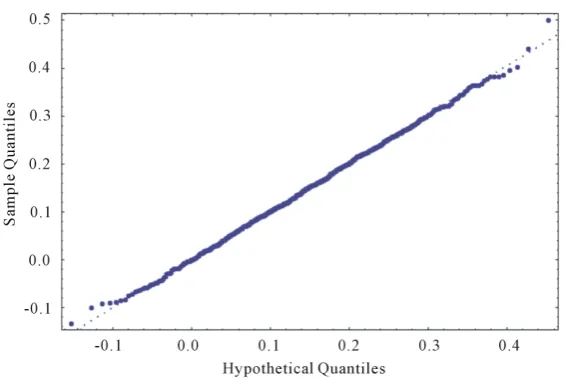
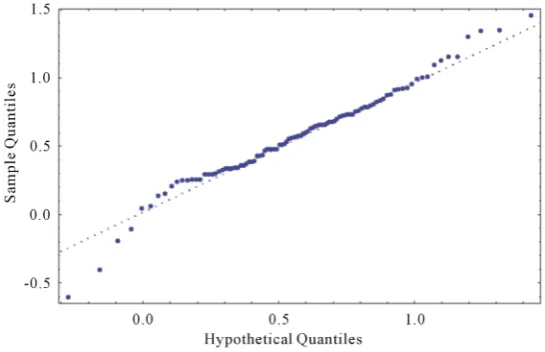
We aim at establishing the distribution of the errors from the PM in comparison to those from the standard method, that’s MLE. We would wish to use the easier standard statistical techniques like, the Pearson Chi- Square, the Jacque-berra, and the Kolmogorov-Smirnov methods to test for normality in the errors, but such tests are usually more receptive in case of large datasets. In that case visual methods have been preferred, see Figures 1-6, and these have several advantages [32].
6.1.1. Histogram Plots
Error distribution can with little effort be observed by a histogram of the sampled errors, where the error counts are plotted. Such a histogram presents an overview of the normality of the error distribution, seeFigures 1-6. For comparison with normality, normal distribution curves are superimposed on the histograms. The figures illu- strate the distribution of errors, ∆h, in inches for father’s height and housefly wing length. All plots from the PM and MLE almost a “perfect” match as there is no heavy tailing. This could be attributed to absence of outliers in the datasets and also errors originating from normally distributed datasets.
Figure 1.Error distribution for the MLE on father’s height, expected counts
[image:6.595.172.455.298.465.2]μ = 0.15; σ = 0.09.
Figure 2.Error distribution for the PM on father’s height; expected counts μ = 0.11; σ = 0.09.
Figure 3.Normal Q-Q plot for the error (∆h) distribution from MLE on the
[image:6.595.173.456.499.690.2]Figure 4.Normal Q-Q plot for the error (∆h) distribution from PM on the
[image:7.595.175.452.301.483.2]fa-ther’s height, n = 1000.
Figure 5. Normal Q-Q plot for the error (∆h) distribution from MLE on the
housefly wing lengths, n = 100.
[image:7.595.177.450.520.696.2]7. Accuracy Assessment
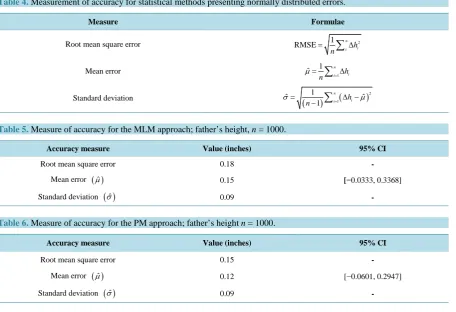
When normal distribution for the parent dataset, and no outliers are exhibited as shown in Section 6, then the accuracy measures in Table 4 can be adopted. The accuracy measures in the normal distribution fram-work are defines as follows
InTable 4, ∆hi denotes the difference between the observed and estimated value. Where i is the sampled data point, and n is the sample size. Assuming that the generated errors follow a normal distribution as established in Section 6, seeFigures 1-6. Then from the theory of errors, it is well known that 68.3% of data will fall within the interval µ σ± , where μ is the systematic mean error and σ is the standard deviation, [26]. When we require to measure accuracy based on the 95% confidence level, then the interval will be µ±1.96⋅σ . In this work we have employed and compared the methods described in Table 4 since the underlying errors from all the estima-tion methods assumed a normal distribuestima-tion. Both the histogram and Q-Q plots have justified the assumpestima-tion of normally.
Accuracy Results
Results generated by the standard measures of Table 4, are presented. We note that application of the standard measures impies that the generated errors follow a normal distribution as established in Section 6.Tables 5-8 show results for PM and MLE.
Tables 5-8 show the accuracy measures considered to evaluate the performance of the PM and the MLE, on two datasets of different sizes, that is n=1000 and n=100, for the father’s height and housefly wing lengths The PM produces smaller standard deviations as compared to the MLE on the small sample, for the large sam-ples, the methods produce the same standard deviation, which could be interpreted as equal performance of the methods on large samples, though this cannot be generalised subject to further research.
8. Results and Discussion
[image:8.595.89.546.418.730.2]The PM has been compared with some of the current methods in use that is, MM and MLE. These were preferred
Table 4. Measurement of accuracy for statistical methods presenting normally distributed errors.
Measure Formulae
Root mean square error 1 2
RMSE= n
∑
ni∆hiMean error µˆ=1n
∑
ni=1∆hiStandard deviation ( ) 1( )2
1
ˆ ˆ
1
n i
i h
n
σ= = ∆ −µ
−
∑
Table 5. Measure of accuracy for the MLM approach; father’s height, n = 1000.
Accuracy measure Value (inches) 95% CI
Root mean square error 0.18 -
Mean error ( )µˆ 0.15 [−0.0333, 0.3368]
Standard deviation ( )σˆ 0.09 -
Table 6.Measure of accuracy for the PM approach; father’s height n = 1000.
Accuracy measure Value (inches) 95% CI
Root mean square error 0.15 -
Mean error ( )µˆ 0.12 [−0.0601, 0.2947]
Table 7.Measure of accuracy for the MLM approach; housefly wing lengths n = 100.
Accuracy measure Value (mm) 95% CI
Root mean square error 0.73 -
Mean error ( )µˆ 0.47 [−0.6437, 1.5741]
Standard deviation ( )σˆ 0.57 -
Table 8.Measure of accuracy for the PM approach on the housefly wing lengths (n = 100).
Accuracy measure Value (mm) 95% CI
Root mean square error 0.66 -
Mean error ( )µˆ 0.55 [−0.1710, 1.2610]
Standard deviation
( )
σˆ 0.37 -due to their computation lure and availability inmost of the statistical Software packages. Secondly the MLE method is more preferred and widely applied due to its good asymptotic properties. Three standard datasets from
[24] and [25] have been used. However, on further tests only two datasets were considered, that is the height of
the father and housefly wing lengths; this was to decrease on the intensity of the work to be presented.
Section 5, contains the computation results for PM, MM and MLE. Tables 1-3 illustrate and show the parameter estimates obtained from the methods. It is observed that all the approaches give comparable results with the “true” or required values of the parameters given in the captions of the respective tables.
In order to use standard techniques that are employed for accuracy measurements, the errors have been tested for normality, see Section 6. Statistical visualization techniques were preferred to other statistical tests which are said to be sensitive in the presence of outliers and large datasets [26].Figure 1 andFigure 2 illustrate the histo-grams of the errors and clearly show a normal distribution since more of the information contained in the errors lies under the normal curve that is superimposed. The Q-Q plots inFigures 3-6 have also been used as a meas-ure of testing for normality of the generated errors. It is observed that there are almost straight lines produced in all the cases. This implies that the actual distribution of the generated errors is indeed normally distributed.
9. Conclusion
This research laid out an easy approach to computing the parameters of a univariate normal distribution which is an important distribution in applied statistics and in most of the science disciplines. It serves as a platform or bench mark for studying more complex distributions, like the mixture of two or more Gaussians, mixture of ex-ponentials and other continuous distributions which are very useful in pattern recognition, machine learning and unsupervised learning. The simplicity of the approach is time saving in computation and guarantees convergence to the required values, this is not usually the case in the conventional analytical and numerical methods as these may fail or take a long time to converge depending on the quality of initial approximations.
Acknowledgements
The authors wish to thank the Directorate of Research and Innovation of Tshwane University of Technology for funding the research under the Postdoctoral research fund 2014/2015. The anonymous reviewer and editors whose criticisms led to an improved version of the manuscript.
References
[1] Anita, H.M. (2002) Numerical Methods for Scientist and Engineers. Birkhauser-Verlag, Switzerland.
[2] Baushev, A.N. and Morozova, E.Y. (2007) A Multidimensional Bisection Method for Minimizing Function over Simplex. Lectures Notes in Engineering and Computer Science, 2, 801-803.
[3] Darvishi, M.T. and Barati, A. (2007) A Third-Order Newton-Type Method to Solve Systems of Nonlinear Equations.
Applied Mathematics and Computation, 87, 630-635.
Interna-tional Journal of Emerging Science, 3, 119-130.
[5] Murray, W. and Overton, M.L. (1979) Steplength Algorithm for Minimizing a Class of Nondifferentiable Functions.
Computing, 23, 309-331. http://dx.doi.org/10.1007/BF02254861
[6] Hornberger, G. and Wiberd, P. (2005) User’s Guide for: Numerical Methods in the Hydrological Sciences, in Numeri-cal Methods in the HydrologiNumeri-cal Sciences. http://dx.doi.org/10.1002/9781118709528
[7] Bishop, C.M. (1991) A Fast Procedure for Retraining the Multilayer Perceptron. International Journal of Neural Sys-tems, 2, 229-236. http://dx.doi.org/10.1142/S0129065791000212
[8] Bishop, C.M. (1992) Exact Calculation of the Hessian Matrix for the Multilayer Perceptron. Neural Computation, 4, 494-501. http://dx.doi.org/10.1162/neco.1992.4.4.494
[9] Bishop, C.M. and Nabney, I.T. (2008) Pattern Recognition and Machine Learning: A Matlab Companion. Springer, In preparation.
[10] Mackay, D.J.C. (1988) Introduction to Gaussian Processes. In: Bishop, C.M., Ed., Neural Networks and Machine Learning, Springer.
[11] Mackay, D.J.C. (2003) Information Theory, Inference and Learning Algorithms. Cambridge University Press, Cam-bridge.
[12] Richard, J., Douglas, F. and Burden, L. (2005) Numerical Analysis. 9th Edition, Cengage Learning, Boston. [13] Robert, W.H. (1975) Numerical Analysis. Quantum Publishers, New York.
[14] Bhatti, S. (2008) Analysis of the S. pombe Sister Chromatid Cohesin Subunit in Response to DNA Damage Agents During Mitosis. PhD Thesis, University of Glasgow. http://theses.gla.ac.uk/292/
[15] Wood, G. (1989) The Bisection Method in Higher Dimensions. Mathematical Programming, 55, 319-337.
[16] Myung, I.J., Forster, M. and Browne, M.W. (2000) Special Issue on Model Selection. Journal of Mathematical Psy-chology, 44, 1-2.
[17] Myung, I.J. (2003b) Tutorial on Maximum Likelihood Estimation. Journal of Mathematical Psychology, 47, 90-100.
http://dx.doi.org/10.1016/S0022-2496(02)00028-7
[18] Berndt, E.K., Hall, B.H. and Hall, R.E. (1974) Estimation and Inference in Nonlinear Structural Models. Annals of Economic and Social Measurement, 3, 653-665.
[19] Kloppers, P.H., Kikawa, C.R. and Shatalov, M.Y. (2012) A New Method for Least Squares Identification of Parame-ters of the Transcendental Equations. International Journal of the Physical Sciences, 7, 5218-5223.
http://dx.doi.org/10.5897/IJPS12.506
[20] Krishnamoorthy, K. (2006) Handbook of Statistical Distributions with Applications. Chapman & Hall/CRC, London.
http://dx.doi.org/10.1201/9781420011371
[21] Duda, R.O., Hart, P.E. and Stork, D.G. (1995) Pattern Classification and Scene analysis. John Wiley and Sons, New York.
[22] Fayyad, U., Reina, C. and Bradley, P.S. (1998) Initialization of Iterative Refinement Clustering Algorithms. Proceed-ings of the 4th International Conference on Knowledge Discovery and Data Mining (KDD98), New York, 27-31 Au-gust 1998, 194-198.
[23] Kikawa, C.R., Shatalov, M.Y. and Kloppers, P.H. (2015) A Method for Computing Initial Approximations for a 3-Pa- rameter Exponential Function. Physical Science International Journal, 6, 203-208.
http://dx.doi.org/10.9734/PSIJ/2015/16503
[24] Pearson, K. and Lee, A. (1903) On the Laws of Inheritance in Man: Inheritance of Physical Characters. Biometrika, 2, 357-462. http://dx.doi.org/10.1093/biomet/2.4.357
[25] Sokal, R.R. and Hunter, P.E. (1955) A Morphometric Analysis of DDT-Resistant and Non-Resistant Housefly Strains.
Annals of the Entomological Society of America, 48, 499-507. http://dx.doi.org/10.1093/aesa/48.6.499
[26] Hohle, J. (2009) Accuracy Assessment of Digital Elevation Models by Means of Robust Statistical Methods. Japan Society of Photogrammetry and Remote Sensing, 64, 398-406. http://dx.doi.org/10.1016/j.isprsjprs.2009.02.003
[27] Searl, R.S. (1971) Linear Models: John Wiley and Sons, Hoboken.
[28] Kay, M.S. (1993) Fundamentals of Statistical Signal Processing: Estimation Theory. Prentice-Hall, Upper Saddle River.
[29] Muller, K.E. and Stewart, P.W. (2006) Linear Models Theory: Univariate, Multivariate, and Mixed Models. John Wi-ley and Sons, Hoboken. http://dx.doi.org/10.1002/0470052147
[30] NIST/SEMATECH (2012) e-Handbook of Statistical Methods. http://www.itl.nist.gov/div898/handbook/ [31] Burden, R.L. and Douglas, J.F. (2000) Numerical Analysis. 7th Edition, Brooks/Cole, Pacific Grove.