Integrated Bayes Network and Hidden Markov Model for Host
Based IDS
NagarajuDevarakonda
Dept of Computer Science & EngineeringAcharya Nagarjuna University, Nagarjuna Nagar, Guntur -522510, India
V Valli Kumari
Dept of Computer Science & SystemsEngineeringAndhra University Visakhapatnam-530003, India
ABSTRACT
Today Internet is more popular for many users and business applications such as banking, social networks, education, entertainment, scientific research, and recently cloud computing. The number of services provided by the internet service providers through Internet is rapidly increasing. For many applications security has become a serious issue for anyone connected to the Internet. Security should be provided by the ISPs to the Internet users in the form confidentiality, integrity, and authentication. These can be provided through IDS. In our paper we have proposed a simple, easy and efficient approach for building IDS using integrated model of Bayes Net with Hidden Markov Model. The first phase of the model is to build the Bayesian network using the dataset. Once the network is built the conditional probability or joint probability for each node can be determined. The Bayes network has been used as state transition diagram for HMM. The HMM parameters can be estimated using the Bayesian Network. We have used a standard kddcup99 dataset for building the model. This model can be able to differentiate the intruders from normal users with low false positive rate and high true positive rate. The model works for even high dimensional data streams with high performance detection rate and robust to noise.
Keywords
IDS, Bayes Network, HMM, training, and conditional probability tables
1.
INTRODUCTION
To provide the highest level of secrecy for users of their information technology systems and to assure their intellectual freedom is protected.
The access to information at various levels of organization is dependent on the policy of the organization. In general users at lower level can‟t have full access to the information, whereas at the top level has full access.
An Organization may have many types of information such as staff records, financial records, personnel records, and business records. Individual information includes academic,
Srinivasulu Pamidi
Dept of Computer Science & Engineering V R SiddhrathaEngg. College, Kanuru, Vijayawada-520007, India
A Govardhan
Dept of Computer Science & Engineering Jawaharlal Nehru Technological University, HyderabadHyderabad-500085, India
Scientific,engineering, research, personal and business correspondence, and other records created and managed by employees.
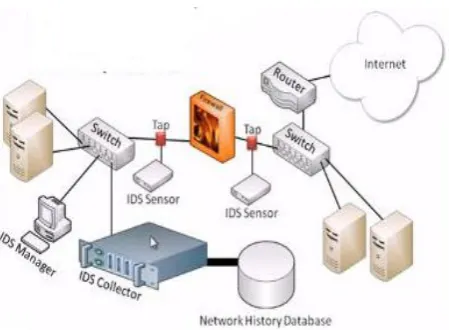
Network intrusion detection systems (NIDS)[11-14] is becoming a standard network security tool. In this section we give the basic infrastructure required to build IDS System [6]. Some of the IDS components on the network have been explained which are shown in the figure 1[7]. IDS Sensors gather information of the wire in the Internet. Now the way they gather information is by using a tap connected to the wire. The tap is like a splitter, it allows the traffic to flow across the wire normally. But at the same time a copy of everything which is going across the wire sent down to the sensor. These sensors send the information down to the IDS collector.
The collector does the analysis to determine whether data is just normal or is an attack is taking place. The other device, IDS Manager that would be a Personal Computer (PC) or a laptop that has client software on it that allows the use of the computer to manage the information of various IDS devices. Let us look at the various types of Intrusion Detection Systems. An active IDS is also known as Intrusion Detection and Prevention System (IDPS) [4].
A passive IDS is a system that is configured to monitor and analyze network traffic and alert the user to possible intrusions. A passiveIDS will not be capable of performing any protective or corrective functions on its own. NIDS[8-9] usually consists of a network appliance with a Network Interface Card operating in immoral mode and a separate interface. The IDS is placed along a boundary and monitors all traffic on that device.
Fig 1. Network Environment Infrastructure for Intrusion Detection System
A Signature-based IDS references a database of previous attack signatures. The meaning of signature is recorded evidence of an intrusion or attack. Every intrusion leaves a mark behind. These path are called signatures and can be used to identify and prevent the same attacks in the future. Based on these signatures Knowledge-based (Signature-based) IDS identify intrusion attempts.
The disadvantages of Signature-based IDS [10] are signature database must be continually updated and maintained, and Signature-based IDS may fail to identify unique attacks. A Behavior-based (Anomaly-based) IDS references a baseline or learned pattern of normal system activity to identify active intrusion attempts. Abnormalities from this model or pattern cause an alarm to be triggered. High false alarms are often associated with Behavior-based IDS.
2. DATASET DESCRIPTION
We conducted experiments on KDDCup99 dataset [3], [13]. The 1998 DARPA Intrusion Detection Evaluation Program was prepared and managed by MIT Lincoln Labs. The objective was to survey and evaluate research in intrusion detection. A standard set of data to be audited, which includes a wide variety of intrusions simulated in a military network environment, was provided.
A connection is a sequence of TCP packets starting and ending at some well defined times, between which data flows to and from a source IP address to a target IP address under some well defined protocol. Each connection is labeled as either normal, or as an attack, with exactly one specific attack type. Each connection record consists of about 100 bytes. Attacks fall into four main categories:
DOS: denial-of-service, e.g. syn flood;
R2L: unauthorized access from a remote machine, e.g. guessing password;
U2R: unauthorized access to local superuser (root) privileges, e.g., various ``buffer overflow'' attacks;
Probing: surveillance and other probing, e.g., port scanning.
The dataset contain a total of 41 attributes in which there are 6 symbolic (discrete) and remaining are continuous type. To use Bayes network the attributes must be discrete type and data should be complete (no missing values). So the data has been preprocessed which is explained as follows:
The rows have been removed which contains missing values for any attribute. We have chosen four attributes from 41 attributes of kddcup99 namely protocol_type, src_bytes, dst_bytes, and count. The continuous attributes src_bytes, dst_bytes, and count have been discretized. In the following way the variables have been discretized:
src_bytes : „L‟, ‟M‟, and „H‟,
dst_bytes : „l‟, „m‟, „h‟,
count: „low‟, „mid‟, „high‟.
The dataset has 22 atack types such as smurf, Neptune, satan,etc. The 22 attacks have been replaced by four types namely DoS, R2L, U2R and Probe which are explained above.
3.
BAYES NETWORK
Bayes Nets or Bayesian networks [15-17] are graphical representation for probabilistic relationships among a set of
random variables. Given a finite set of
discrete random variables where each variable may take
values from a finite set, denoted by .
A Bayesian network is an annotated directed acyclic graph (DAG) G that encodes a joint probability distribution over . The nodes of the graph correspond to the random variables
. The links of the graph correspond to the direct
influence from one variable to the other. If there is a directed link
from variable to variable , variable will be a parent
of variable . Each node is annotated with a conditional
probability distribution (CPD) that represents
, where denotes the parents of
in . The pair ( , CPD) encodes the joint distribution
. A unique joint probability distribution over
from is factorized as:
(1)
We have used tabu search algorithm for finding a well scoring Bayes network structure. Tabu search [1] is a higher level heuristic procedure for solving optimization problems, designed to guide other methods to escape the trap of local optimality.
It uses flexible structured memory to permit search information to be exploited more thoroughly than by rigid memory systems. It uses conditions for strategically constraining and freeing the search process embodied intaburestrictions and aspiration criteria. It uses memory functions of varying time spans for intensifying and diversifying the search. Tabu search is hill climbing till an optimum is reached. The best network found in this traversal is returned.
The conditional probability tables of a Bayes network can be estimated once the structure has been learned. The network
}
,...,
{
X
1X
nX
i
X
)
(
X
iVal
X
n
X
X
1,...,
i
X
X
jX
ij
X
))
(
|
(
X
iPa
X
ip
Pa
(
X
i)
i
X
G
G
)
,...,
(
X
1X
np
X
G
i i i
n
p
X
Pa
X
X
X
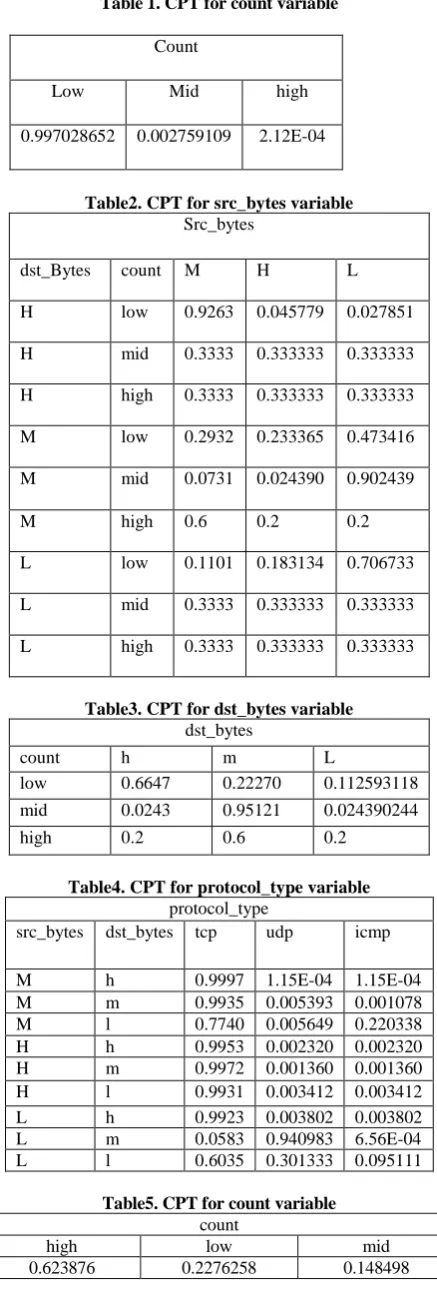
types and shown in figures 2 and 3 respectively. The Conditional Probability Tables (CPTs) for normal records dataset of figure 2 shown in tables 1 to 4. The CPTs for attack type records dataset of figure 3 shown in tables 5 to 8.
Figure 2: BayesNetwork for Normal Records
[image:3.595.338.557.76.723.2]Figure 3: BayesNetwork for Intrusion Record
Table 1. CPT for count variable
Table2. CPT for src_bytes variable
Src_bytes
dst_Bytes count M H L
H low 0.9263 0.045779 0.027851
H mid 0.3333 0.333333 0.333333
H high 0.3333 0.333333 0.333333
M low 0.2932 0.233365 0.473416
M mid 0.0731 0.024390 0.902439
M high 0.6 0.2 0.2
L low 0.1101 0.183134 0.706733
L mid 0.3333 0.333333 0.333333
L high 0.3333 0.333333 0.333333
Table3. CPT for dst_bytes variable
dst_bytes
count h m L
low 0.6647 0.22270 0.112593118
mid 0.0243 0.95121 0.024390244
high 0.2 0.6 0.2
Table4. CPT for protocol_type variable
protocol_type
src_bytes dst_bytes tcp udp icmp
M h 0.9997 1.15E-04 1.15E-04 M m 0.9935 0.005393 0.001078 M l 0.7740 0.005649 0.220338 H h 0.9953 0.002320 0.002320 H m 0.9972 0.001360 0.001360 H l 0.9931 0.003412 0.003412 L h 0.9923 0.003802 0.003802 L m 0.0583 0.940983 6.56E-04 L l 0.6035 0.301333 0.095111
Table5. CPT for count variable
count
high low mid
0.623876 0.2276258 0.148498
Count
Low Mid high
0.997028652 0.002759109 2.12E-04
count
Dst_bytes
Protocol_type Src_bytes
count
Dst_bytes Protocol_type
Table6. CPT for protocol_type variable
protocol_type
Count Icmp tcp udp
High 0.9365916 0.063347 6.13E-05 Low 0.1231726 0.831961 0.04487 Mid 0.003863 0.995364 7.73E-04
Table 7.CPTfor src_bytes Variable
count Protocol_type H L M
high icmp 0.910835 6.55E-05 0.0891 high tcp 9.66E-04 0.99807 9.66E-04 high udp 0.333333 0.333333 0.333333 low icmp 0.755102 0.24354 0.001361 low tcp 0.108015 0.86836 0.023622 low udp 0.003717 0.97777 0.018587 mid icmp 0.882353 0.05882 0.058824 mid tcp 2.59E-04 0.99948 2.59E-04
mid udp 0.2 0.6 0.2
Table 8. CPT for dst_bytes variable
dst_bytes
Count src_bytes l h M
High H 0.998068 9.66E-04 9.66E-04 High L 0.998533 7.34E-04 7.34E-04 High M 0.523373 0.47571 9.17E-04 Low H 0.952351 0.01708 0.030571
Low L 0.853659 0.13821 0.00813
Low M 0.882353 0.05882 0.058824 Mid H 0.999483 2.58E-04 2.58E-04 Mid L 0.333333 0.333333 0.333333 Mid M 0.333333 0.333333 0.333333
4. HIDDEN MARKOV MODEL WITH
BAYES NETWORK
Hidden Markov Model represents a very useful tool to model data-sequences, and to capture the underlying structure of a set of strings of symbols. HMM [5] is a state full model, where the states are hidden. Two probability density functions are associated to each hidden state: one provides the probability of transition to another state, and the other provides the probability that a given symbol is emitted from that state.
According to [2], an HMM" is characterized by the following expression.
λ = {A, B, π} (2)
Where
N is the number of states in the model.
M is the number of distinct observation symbols per state, i.e. the discrete alphabet size.
A is the state transition probability distribution matrix[18]. In our case it is NxN matrix.
θi=1..N is the emission parameter for an observation associated
with state i
B is the observation symbol probability distribution matrix[18]. In our case it is NxM matrix.
π is the initial state distribution[19]. Each element πi is the
probability that the initial state is the ith state.
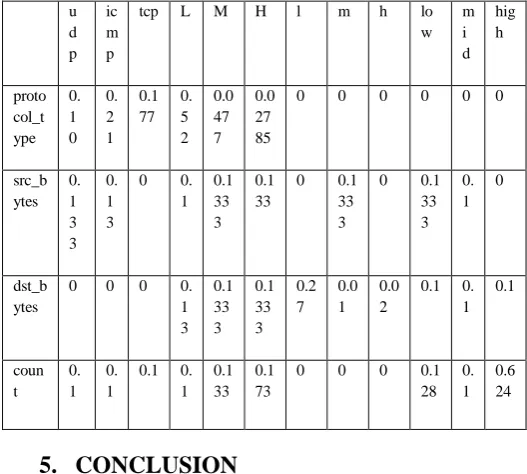
Mapping the Bayes Network (BN) parameters to HMM parameters as follows:
The parameters which are same for both BN and HMM: N, M, A, and B.
The values of these parameters have been initialized for the KDDCUP99 dataset as N = 4, M = 12.
The parameters A and B have been initialized to some random values as follows:
Table 9. State Transition Probability Matrix A
protocol_type src_bytes dst_bytes count
protocol_type 0.50 0 0.30 0.20
src_bytes 0.50 0.3 0.1 0.1
dst_bytes 0.20 0.1 0.5 0.2
[image:4.595.309.573.344.581.2]count 0.60 0.2 0.1 0.1
Table 10.Emission Transition Probability Matrix B
5.
CONCLUSION
Our IDS model is designed with Bayes Hidden Markov Model for Intrusion detection. The attributes have been selected with high entropy. This will reduce the data size with the same performance. It is trained and tested with kddcup99 dataset. The joint probabilities have estimated with full data which is also called model learning has done as the first phase. This part of the work is Bayes Network and BN parameters have been initialized. Some of these BN parameters are same as the HMM parameters. In the second phase the model has been tested which shows high performance in detecting intrusions for large and high dimensional datasets. The same is to be tested on other real time data streams. Our approach is simple and easy to implement for real time applications to the network security applications.
u d p ic m p
tcp L M H l m h lo
w m i d hig h proto col_t ype 0. 1 0 0. 2 1 0.1 77 0. 5 2 0.0 47 7 0.0 27 85
0 0 0 0 0 0
src_b ytes 0. 1 3 3 0. 1 3
0 0.
1 0.1 33 3 0.1 33
0 0.1
33 3
0 0.1
33 3 0. 1 0 dst_b ytes
0 0 0 0.
1 3 0.1 33 3 0.1 33 3 0.2 7 0.0 1 0.0 2
0.1 0.
1 0.1 coun t 0. 1 0. 1
0.1 0.
1 0.1 33
0.1 73
0 0 0 0.1
28 0. 1
REFERENCES
[1] Staff.kfupm.edu.sa/DAD/sanaulla/work/TABU1.doc [2] L. Rabiner, A tutorial on hidden markov models and selected
applications in speech recognition, Proceedings of the IEEE 77 (2) (1989) 257–286.
[3]http://www.kdd.org/kddcup/index.php?section=1999&method =info
[4] http://www.omnisecu.com/security/infrastructure-and-email-security/types-of-intrusion-detection-systems.htm
[5] Hidden Markov Model:
http://en.wikipedia.org/wiki/Hidden_Markov_model
[6] Intrusion Detection Systems - INTRODUCTION,
DETECTION METHODOLOGIES:
http://encyclopedia.jrank.org/articles/pages/6646/Intrusion-Detection-Systems.html
[7] Dorothy E. Denning. An intrusion detection model. IEEE Transactions on Software Engineering, SE-13(2):222–232, 1987.
[8] James P. Anderson. Computer security threat monitoring and surveillance.Technical report, James P. Anderson Co., 1980.
[9] Richard Heady, George Luger, Arthur Maccabe, and Mark Servilla. The architecture of a network level intrusion detection system.Technical report, University of New Mexico, 1990.
[10] Frederick K. K.: Network Intrusion Detection
Signatures.December 19, 2001,
http://online.securityfocus.com/infocus/1524
[11] Elson D. :Intrusion Detection, Theory and Practice.March 27, 2000, http://online.securityfocus.com/infocus/ 1203
[12]Frederick K. K.: Network Intrusion Detection
Signatures.December 19, 2001,
http://online.securityfocus.com/infocus/1524.
[13] P Srinivasulu, D Nagaraju, P Ramesh Kumar, and K NageswaraRao, “Classifying the Network Intrusion Attacks using Data Mining Classification Methods and their Performance Comparison” JCSNS International Journal of Computer Science and Network Security, VOL.9 No.6, June 2009.
[14] Nagaraju Devarakonda, Srinivasulu Pamidi, V Valli Kumari, A Govardhan “Outliers Detection as Network Intrusion Detection System Using Multi Layered Framework” Advances in Computer Science and Information Technology: First International Conference on Computer Science and Information Technology, Springer, CCSIT 2011,Jan 2011.
[15] http://www.bayesnets.com/#BayesNetsStructureLearning
[16] http://www.cs.ubc.ca/ ~murphyk/ Bayes/bnintro.html
[17] http://www.autonlab.org/tutorials/bayesnet.html
[18] figment.cse.usf.edu/~sfefilat/data/papers/WeBCT8.23.pdf