http://dx.doi.org/10.4236/wjnst.2014.44028
How to cite this paper: Zheng, X.J., Deng, B.Q., Ou, W. and Gou, F.J. (2014) Conversion of U-238 and Th-232 Using a Fusion Neutron Source. World Journal of Nuclear Science and Technology, 4, 222-227.
http://dx.doi.org/10.4236/wjnst.2014.44028
Conversion of U-238 and Th-232 Using a
Fusion Neutron Source
Xianjun Zheng
1, Baiquan Deng
2*, Wei Ou
3, Fujun Gou
3 1HOPE Innovations Inc., Ontario, Canada2Southwestern Institute of Physics, Chengdu, China
3Institute of Nuclear Science and Technology, Sichuan University, Chengdu, China Email: *[email protected]
Received 16 July 2014; revised 30 August 2014; accepted 14 September 2014
Copyright © 2014 by authors and Scientific Research Publishing Inc.
This work is licensed under the Creative Commons Attribution International License (CC BY).
http://creativecommons.org/licenses/by/4.0/
Abstract
This article proposes a general framework for the conversion of U-238 and Th-232 utilizing fu-sion-produced neutrons. This recognizes that emerging fusion technologies may not produce suf-ficient net energy output to justify stand-alone applications, yet may be commercially viable for breeder transmutation or hybrid fusion-fission reactor concepts proposed herein to dispose of nuclear wastes and long life high radioactive fission products remaining in shutdown nuclear power plants. Results show that this could be achievable within a decade, given an appropriate fu-sion source. However, if 20% beryllium of nuclei density is added to the convertor blanket, the ef-ficiency of the conversion process can be significantly increased. Also, the neutron energy spec-trum resulting from dense D-D plasma core fusion is much softer than D-T fusion neutron source, hence the probability of (n, p) (n, α) backward decay reaction paths will be smaller and the con-version efficiency will be elevated.
Keywords
Conversion, Breeder, D-D Fusion
1. Neutron Capture by U-238
In any operating nuclear reactor containing U-238, some plutonium-239 will accumulate in the nuclear fuel due to continuous neutron capture by U-238 followed by two-beta decays. Plutonium present in reactor fuel can ab-sorb neutrons and fission just as U-235 can. Fission of plutonium-239 provides about one-third of the total energy produced in a typical commercial nuclear power plant. Spent nuclear fuel commonly contains about 0.8%
2. A Pure Converter Concept
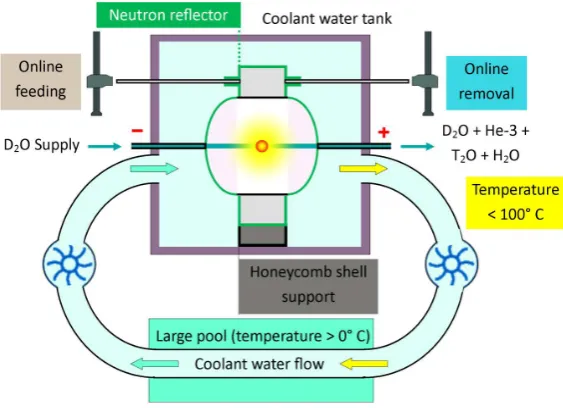
It is possible to design a pure converter that only converts U-238 existed within nuclear waste (>95%) into nuc-lear fuel, without the need to generate power. The advantages of such a simple converter include, but not limited to, operation in the temperature range between 0˚C and 100˚C and under atmosphere pressure. This can remove many engineering challenges for the design of brand new fusion/fission hybrid reactors and thus permit design-ers to focus on the convdesign-ersion related issues, for example, component material embrittlement due to neutron flux as well as irradiation damage such as voids, bubbles, cracks, etc.
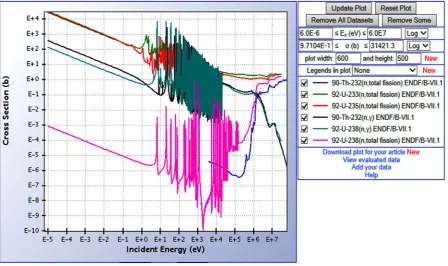
[image:2.595.90.539.439.705.2]In order to maximize the conversion rate turning U-238 into plutonium-239, the converter may be designed to work in the intermediate neutron energy range between, for example, 10 and 1000 eV, i.e., the resonance ab-sorption peaked domain shown in Figure 1. The neutron abab-sorption rate is greatly enhanced for U-238, by at least ten times. Meanwhile, the fission rates for U-235 and plutonium-239 can be reduced by at least 50%. Con-sequently, it is anticipated that >90% of the neutron source can be used for converting U-238 into pluto-nium-239, based on below estimation: 9 neutrons for conversion, 0.5 neutrons lost to the environment and 0.5 neutrons split fissile fuel nuclei into two. A simple converter concept is shown in Figure 2.
Figure 2. Overview of fuel converter driven by neutron source at fusion chamber.
3. D-D Fusion and Conversion Rate
There are two branches of D-D fusion reaction, each with 50% probability of occurrence,
(
)
(
)
2 2 3 1
1D+1D→2He 0.82 MeV +0n 2.45 MeV (1)
(
)
(
)
2 2 3 1
1D+1D→ 1T 1.01 MeV +1p 3.02 MeV (2)
The above two branches give a total energy release of 7.3 MeV (1.1696 10× −12J) and release a neutron with 2.45 MeV energy. Considering a net power output of 1 GW, associated with a gross power of 3.333 GW, here assuming a thermoelectric conversion efficiency of 30%, the corresponding fusion neutron yield can be calcu-lated as follows,
9
21 12
3.333 GW 3.333 10 J s
2.85 10 s 7.3 MeV 1.1696 10 J
DD neutron
I = = × − = ×
× (3)
Tritium and helium-3 gas collections per day are calculated as follows,
21 27
3 24 3600 2.85 10 3 1.66 10 kg 1.23 kg
day day
helium tritium
M − ≅M = × × × × × × − = (4)
HOPE Innovations patented dense plasma D-D fusion process [1] is expected to immediately burn some of the resulting tritium and helium-3 nuclei and the remaining He and tritium may be collected and stored in tanks for future usage with other fusion approaches such as D-T or advanced D-He3 fusion [2] [3]. D-T fusion will generate neutrons with 14.1 MeV energy, which is suitable for transmutation of nuclear waste.
Considering Equation (3), as well as a fuel conversion rate of 90%, the net electric power conversion rate for one operating converter is calculated as
1 GW
90% 200 MeV 24.66 GW 7.3 MeV
R= × × = (5)
4. Breeder and Hybrid Reactors [5]-[7]
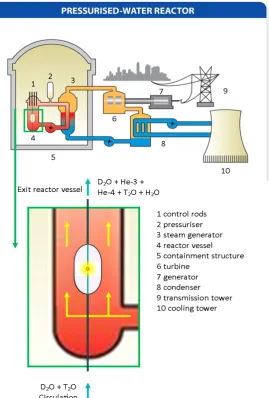
A breeder reactor can convert fertile material, such as U-238 and Th-232, as fast as it burns fissile material, such as plutonium-239 and U-233, during reactor operation. A possible breeder reactor concept is shown inFigure 4. Such a breeder reactor can work in a neutron energy range between, for example, 0.1 and 1000 eV, in order to achieve adequate plutonium-239 or U-233 burning rates. Meanwhile, it is capable of converting U-238 or tho-rium-232 to fuel at the same rate in order to sustain the nuclear reaction.
If the concentration of plutonium-239 increases, for example, the reactor power increases. This situation may be offset by lowering the D-D fusion neutron yield by, for example, reducing the fusion fuelling rate. This will, in turn, decrease the neutron capture rate of U-238 and eventually bring the concentration of plutonium-239 back to normal. On the other hand, if the concentration of plutonium-239 becomes lower, the reactor power de-creases. In this case, the fusion reaction rate can be increased in order to bring reactor power and the concentra-tion of plutonium-239 back to normal.
As an alternative to a breeder reactor, it is also possible to split the nucleus of a U-238 atom by a fast neutron with energy exceeding 1 MeV. In order to incorporate this behavior, a fusion / fission hybrid reactor can be de-signed to work in the neutron energy range of 2 - 14 MeV. A possible hybrid reactor concept is shown in Figure 5. The fission rate of U-238 for fast neutrons with energy > 2 MeV, Figure 1, can be optimized to match or ex-ceed its absorption rate for thermal neutrons (observed to be significant enough to initiate plutonium-239 burn-ing process in current nuclear power plants). For example, we may consider D-T fusion reactions that can gen-erate high-energy fusion neutrons (14.1 MeV),Figure 5.
5. Conclusion
[image:4.595.164.463.540.708.2]A pure converter concept, using dense plasma D-D fusion-produced neutrons, is proposed, and the potential conversion rates are discussed. Breeder and hybrid reactor approaches also have been considered in this article.
Figure 4. A breeder reactor based on modification of boiling water reactor.
[image:5.595.183.453.290.689.2]Foundation of China, Project approval No.: 11275135.
References
[1] Zheng, X.J. (2012) Continuous Fusion Due to Energy Concentration through Focusing of Conversing Fuel Particle Beams. International Patent Application No. PCT/CA2012/050392; Our Ref.: 21906-P39161PC00.
[2] Ou, W., Zheng, X.-J., Deng, B.-Q. and Gou, F.-J. (2014) Chinese Physics Letters, (to Be Published).
[3] Deng, B.Q. (2013) Fusion Reactor Physics-New Conception and New Technology. Chinese Atomic Energy Press, Bei-jing, Chapter 15-19, 129-166.
[4] Xiao, M. (CGN) (2013) Status and Perspective of Spent Fuel Management and Fuel Cycle in China. WNA Plenary Session. http://www.world-nuclear.org/info/Country-Profiles/Countries-A-F/China--Nuclear-Fuel-Cycle
[5] Deng, B.Q., Li, Z.X. and Feng, K.M. (2011) Tritium Well Depth, Tritium Well Time and Sponge Mechanism for Re-ducing Tritium Retention. Nuclear Fusion, 51, Article ID: 073041.http://dx.doi.org/10.1088/0029-5515/51/7/073041 [6] Deng, B.Q., Li, X.Z., Huang, J.H., et al. (2004)Computer Simulation of Tritium Inventory and Leakage of the Fusion
Experimental Reactor of FEB-E. Fusion Science and Technology, 46, 548.
![Figure 3. Illustration of Chinese nuclear fuel cycle [4].](https://thumb-us.123doks.com/thumbv2/123dok_us/8123763.794926/4.595.164.463.540.708/figure-illustration-chinese-nuclear-fuel-cycle.webp)