A Novel Face Matching Technique using Mean-Shift with
Region Merging
Shahab Ahmed
CSE Department RITS, Bhopal
India
Zeeshan Khan
CSE Department RITS, Bhopal
India
Anurag Jain
CSE Department RITS, Bhopal
India
ABSTRACT
We proposed a novel method for face matching from face image database. In our method we have taken set of face images so recognition decisions need to be based on comparisons of face image database. This paper presents an approach to region based face matching. The low level image segmentation method mean shift is used to divide the image into many small regions. As a popular segmentation scheme for color image, watershed has over segmentation as compared to mean-shift and also mean-shift preserves well the edge information of the object. The proposed method automatically merges the regions that are initially segmented by mean shift segmentation, effectively extracts the object contour and then, matches the obtained mask with test database image sets on the basis of color and texture. Extensive experiments are performed and the results show that the proposed scheme can reliably form the mask from the face image and effectively matches the mask with face image sets.
General Terms
Digital Image Processing, Segmentation, Face recognition.
Keywords
Face Matching, Image segmentation, Region merging, Watershed, Mean shift.
INTRODUCTION
Image Segmentation is a process of partitioning an image into multiple regions or sets of homogenous pixels. The goal of segmentation is to simplify and/or change the representation of an image into something that is more meaningful and easier to analyse. Image segmentation is typically used to locate objects and boundaries (lines, curves, etc.) in images. Actually, partitioning is done on the basis of same texture or colour. The result of image segmentation is a set of regions that collectively cover the entire image, or a set of contours extracted from the image. This technique has a variety of applications and one of them is face matching
Face matching is an important vision task with many practical applications such as biometrics, video surveillance, and content based image retrieval. A face matching system is a computer application for automatically identifying or verifying a person from a digital image or a video frame from a video source. One of the ways to do this is by comparing selected facial features from the image and a facial database. Face matching has a variety of applications on commercial, security, image retrieval and law enforcement. For a given face image, face matching matches with all the given images in database. This is quite a demanding task from the perspective of pattern recognition. Although there has been a rapid growth of large scale data bases, we have focused only on the accuracy with small databases. In this work, we
consider face matching as a law enforcement application in which an unknown face is to be matched on a database. In this work we first divide the face image into number of segments using mean-shift algorithm, then using region merging [1] iteratively merge the similar regions to find the desired mask of the face image. We used an iterative procedure to merge several regions based on the probability of the regions. Regions are merged until the user is satisfied with the segmentation. We are not using watershed algorithm because watershed gives over segmented regions and is more time consuming to find the desired mask as compared to mean shift. Finally the image mask obtained after merging is compared with database face images using a histogram approximation on the basis of color and texture..
1.
LITERATURE REVIEW
situations, the pixel intensities in each region follow Generalized Gaussian Distribution (GGD).
F.Lecumberry et al., [2] introduces a joint classification-segmentation framework with a twofold goal. First, to automatically select the SM (Shape models) that best represents the object, and second, to accurately segment the image taking into account both the image information and the features and variations learned from the on-line selected model. A new energy functional is introduced that simultaneously accomplishes both goals. The presentation of the framework is complemented with examples for the difficult task of simultaneously classifying and segmenting closely related shapes, such as stages of human activities.
Jean Stawiaski et al., [3] introduce the use of graph cuts to merge the regions to the watershed transform optimally. Watershed is a simple, intuitive and efficient way of segmenting an image. Unfortunately it presents a few limitations such as over –segmentation and poor detection of low boundaries. Segmentation process merges regions of the watershed over-segmentation by minimizing a specific criterion using graph-cuts optimization. Two methods were introduced, the first is based on regions histogram and dissimilarity measures between adjacent regions. The second method deals with efficient approximation of minimal surfaces and geodesics.
J. Ning et al., [4] presents a new region merging based interactive image segmentation method in which the users only need to roughly indicate the location and region of the object and background by using strokes, which are called markers. A novel maximal-similarity based region merging mechanism was proposed to guide the merging process with the help of markers. This method automatically merges the regions that are initially segmented, and then effectively extracts the object contour by labeling all the non-marker regions as either background or object.
F. Calderero et al., [5] presented a new statistical approach to region merging where regions are modeled as arbitrary discrete distributions, directly estimated from the pixel values. Under this framework, two region merging criteria are obtained from two different perspectives; leading to information theory statically measures: the Kullback-Leibler divergence and the Bhattacharya coefficient. The developed methods were size-dependent, which assures the size consistency of the partitions but reduces their size resolution. Thus, a size-independent extension of the previous methods, combined with the modified merging order, was also proposed.
A hybrid multidimensional image segmentation algorithm was proposed, [6] which combines edge and region-based techniques through the morphological algorithm of watersheds. An edge-preserving statistical noise reduction technique is used as a pre-processing stage in order to compute an accurate estimate of the image gradient. Then, an initial partitioning of the image into primitive regions is produced by applying the watershed transform on the image gradient magnitude. This initial segmentation is the input to a computationally efficient hierarchical (bottom-up) region merging process that produces the final segmentation.
Prasad Reddy et al., [7] proposed a color image segmentation method based on Finite Generalized Gaussian Distribution (FGGD). The observed color image is considered as a mixture
of multi-variant densities and the initial parameters are estimated using K-Means algorithm. The final parameters are estimated using EM algorithm and the segmentation is obtained by clustering according to the ML estimation of each pixel. However, computational time is more because of complex calculations.
Zhixin and Govindaraju [8] proposed hand written image segmentation using a binarization algorithm for camera images of old historical documents. The algorithm uses a linear approximation to determine the flatness of the background. The document image is normalized by adjusting the pixel values relative to the line plane approximation.
Felzenswalb and Huttenlocher [9] described image segmentation based on pair wise region comparison. The algorithm makes simple greedy decisions and produces segmentations that obey the global properties of being not too coarse and not too fine according to a particular region comparison function. The method is time linear in the number of graph edges and is fast in practice.
Mavrinac [10] proposed a color image segmentation using a competitive learning clustering scheme. Two fundamental improvements are made to increase the speed performance. i) Initialization of the system with two units rather than one ii) Reducing the number of iterations with no adverse effect and random selection among winning vectors in case of a tie. A very high number of clusters lead to over segmentation which is reduced using threshold and rival penalization.
Lei et al. [11] addresses the automatic image segmentation problem in a region merging style. With an initially over segmented image, in which many regions (or super pixels) with homogeneous color are detected, an image segmentation is performed by iteratively merging the regions according to a statistical test.
Sharon et al., [12] introduced fast multi-scale algorithm which uses a process of recursive weighted aggregation to detect the distinctive segments at different scales. It determines an approximate solution to normalized cuts in time domain i.e., linear in the size of image with few operations per pixel. The disadvantage is that the segmented image fails to give smoother boundaries.
Donnell et al., [13] introduced a phase-based user steered segmentation algorithm using Livewire paradigm that works on the image features. Livewire finds optimal path between users selected image locations thus reducing manual effort of defining the complete boundary. The phase image gives continuous contours for the livewire to follow. The method is useful in medical image segmentation to define tissue type or anatomical structure.
Jitendra et al., [14] proposed cue integration in image segmentation by using an operational definition of textons, the putative elementary units of texture perception and an algorithm for partitioning the image into disjoint regions of coherent brightness and texture. The method finds boundaries of regions by integrating peaks in contour orientation energy and differences in texton densities across the contour by cue integration.
similarity within the groups, which is used for segmentation. The method is optimized using generalized eigen value problem.
Hakan et al. [16] introduce a novel method for face recognition from image sets. In which each test and training example is a set of images of an individual’s face, not just a single image, so recognition decisions need to be based on comparisons of image sets. Methods for this have two main aspects: the models used to represent the individual image sets; and the similarity metric used to compare the models. Here, we represent images as points in a linear or affine feature space and characterize each image set by a convex geometric region (the affine or convex hull) spanned by its feature points. Set dissimilarity is measured by geometric distances (distances of closest approach) between convex models. To reduce the influence of outliers we use robust methods to discard input points that are far from the fitted model.
Costas Panagiotakis, Ilias Grinias, and Georgios Tziritas [17] proposed a framework for image segmentation which uses feature extraction and clustering in the feature space followed by flooding and region merging techniques in the spatial domain, based on the computed features of classes. They use a new block-based unsupervised clustering method which ensures spatial coherence using an efficient hierarchical tree equipartition algorithm. They divide the image into different-different blocks based on the feature description computation. The image is partitioned using minimum spanning tree relationship and mallows distance. Then they apply K-centroid clustering algorithm and Bhattacharya distance and compute the posteriori distributions and distances and perform initial labeling. Priority multiclass flooding algorithm is applied and in the end regions are merged so that segmentation results are produced.
Li Zhang and Qiang Ji [18] have proposed a Bayesian Network (BN) Model for Both Automatic (Unsupervised) and Interactive (Supervised) image segmentation. They construct a Multilayer BN from the over segmentation of an image, which find object boundaries according to the measurements of regions, edges and vertices formed in the over segmentation and model the relationships among the super pixel regions, edge segment, vertices, angles and their measurements. For Automatic Image Segmentation after the construction of BN model and belief propagation segmented image is produced. For Interactive Image Segmentation if segmentation results are not satisfactory then active input selection by user intervention selections are again carried out for segmentation.
2.
PROPOSED METHODOLOGY
In this work we first uses mean- shift algorithm for segmentation of image. Image Segmentation plays an important role in biometrics as it is the first step in image processing and pattern recognition. Now by using dynamic region merging approach we merge the similar regions on the basis of color.
The flowchart of the proposed algorithm is given below:
Input Image
Initial Segmentation
Region Merging
Satisfied with user ?
Construct mask
Template Eextraction
Template Matching Data Base
No
Yes
Result Fig. 1: Flow chart of proposed approach
We use an iterative and interactive approach for the segmentation of the image. User start the process and the model starts merging the regions, after first iteration some regions that are most probable merged with each other and results with less regions and fewer pixels. Probability is calculated for each iteration. This process continues until the user is satisfied or there are no region remains in the image. Once the user is satisfied it can stop the process. The final segmentation result is obtained by the user intervention. The user can also interact with the final segmented image to extract the object of interest from the image. Then finally we match the mask with database face images on the basis of color and texture.
3.
IMAGE SEGMENTATION
FRAMEWORK
3.1
Initial Segmentation
Fig. 2 (a) Original Image (b) Initial Segmented Image by using mean-shift algorithm
If I is set of all image pixels, then by applying segmentation we get different unique regions like { R1, R2, R3,…, Rn } which when combined formed ‘I’ . Basic formulation is as follows:
(a) = I where Ri ∩ Rj = ∅, i=1,n
(b) Ri is a connected region, i=1, 2….n. (c) P(Ri) = TRUE for i=1, 2.. n. (d) P(Ri ∪ Rj) = FALSE for i ≠ j.
Where P(Ri) is a logical defined over the points in set Ri. Condition (a) indicates that segmentation must be complete; every pixel in the image must be covered by segmented regions. Segmented regions must be disjoint. Condition (b) requires that points in a region be connected in some predefined sense like 4-neighbourhood or 8-neighbourhood connectivity. Condition (c) deals, the properties must be satisfied by the pixels in a segmented region e.g. P (Ri) = TRUE if all pixels in Ri have the same gray level. Last condition (d) indicates that adjacent regions Ri and Rj are different in the sense of predicate P.
3.2
Region Merging
Region merging algorithm is started from a set of segmented regions. This is because a small region can provide more stable statistical information than a single pixel, and using regions for merging can improve a lot the computational efficiency. We have many small regions available in the edge map. A region can be described in many aspects, such as the color, edge [19], texture [20], shape and size of the region. Among them the color histogram is an effective descriptor to represent the object color feature statistics and it is widely used in pattern recognition [21] and object tracking [22] etc. Color histogram is more robust than the other feature descriptors. This is because the initially segmented small regions of the desired object often vary a lot in size and shape, while the colors of different regions from the same object will have high similarity. Therefore, we use the color histogram to represent each region. The RGB color space is used to compute the color histogram. We uniformly quantize each color channel into16 levels and then the histogram of each region is calculated in the feature space of 16×16×16 = 4096 bins. Here we choose to use the Bhattacharyya coefficient [25, 26, 27] to measure the similarity between regions.
Fig.3 (a) (b) (c)
Fig.3 (a) Original Image, (b) Initial Segmeneted Image, (c) Merged Image using region merging (after 5th iterarion)
3.3
Constructing Mask
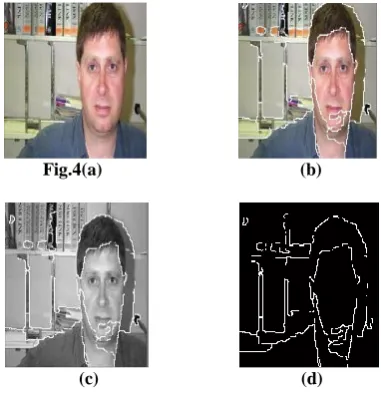
Now we construct the mask of the image after the regions are merged and the image with desired segments is generated for extracting object of interest from it. We convert the image into grayscale image to find the mask. We assign value 255 and 0 to the pixels at the boundaries and rest of the pixels in the image respectively. This constructs the mask of the image.
Fig.4(a) (b)
(c) (d)
Fig 4.(a) Input Image, (b) Segmented Image (c) Greyscale Image, (d) Image Mask
3.4
Object Extraction
We use the mask and Boundary Fill algorithm for extraction of object of interest from the segmented image. The object extraction from the image is also interactive. The user clicks on the desired region in the image. On the basis of the user click and the mask of the image the region’s pixel’s value set to the color value in the image and the rest of the part of the image pixel’s values are set to 0.
[image:4.595.71.275.70.185.2] [image:4.595.337.528.157.354.2] [image:4.595.55.280.640.732.2]Fig.5 (a) (b) (c)
Fig.5. (a) Grayscale Image, (b) Image Mask (c) Desired portion of Image.
3.5
Face Matching
After we get desired portion of face now we match this with the database face images on the basis of colour and texture. We proposed two algorithms for matching one for colour and other for texture.
Algorithm 1:Object Matching Using Color Feature
Algorithm 2: Object matching using texture
4.
RESULT AND ANALYSIS
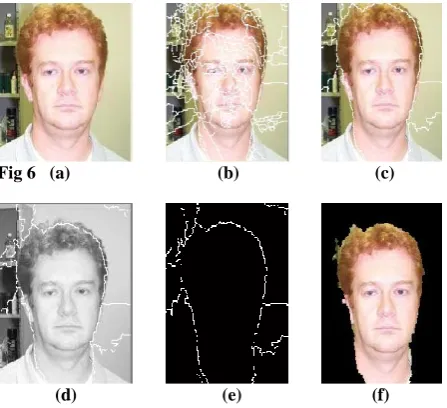
In order to examine this algorithm, the experimental results were under the software environment of Matlab .We tested the proposed model on several face images in the database. The database contains around 500 face images. All of the images are first over segmented using the mean shift method [24]. After that we perform similarity region merging to merge the regions on the basis of colour. Then finally we match the desired portion of face image obtained from image mask with our database. Results have shown in figures below:
Fig 6 (a) (b) (c)
(d) (e) (f) Fig.6 (a) Input Image, (b) Initial Segmented Image, (c) Merged Image using region merging (after 5th iterarion) (d) Grey-scale Image (e) Image mask (f) Desired portion of
Image
Results on the basis of colour in percentage:
Fig.7 (a) (b) (c)
(100.0000%) (79.2315%) (51.9856%)
(d) (e) (f)
(31.0201%) (26.0543%) (9.8952%)
We first take an input image (fig.6), done its initial segmentation with the help of mean-shift. Perform merging iteratively to find desired portion of image, then find its image mask and extract desired portion. We compare or match the obtained desired portion with 500 database face images on the basis of colour and texture and find the results in percentage. Some of the results are shown in the fig.7 and fig.8 on the basis on colour and texture respectively. It is better than the
Calculation of Texture for Query image
1. First we take a query Image. 2. Find Image mask of query Image
3. Now we calculate texture of extracted object by calculating eight adjacency or neighbors of each pixel.
4. If pixel value is at position (i,s) then we calculate pixel value of
(i+1,s), (i,s+1), (i-1,s), (i,s-1), (i+1,s+1),
(i-1,s-1), (i+1,s-1), (i-1,s+1).
5. Calculate texture of all the database images with the same method.
6. Compare texture of extracted object with texture of database images.
7. Show result in percentage
1. First we will select image. j = Set[filename,filepath];
2. WORK= Set(orgEdgeImage);
3. Start process of Region merging of Initial segmented regions i.e. WORK;
4. At every step check that whether that required object contour is obtained or not;
5. if (0) then go to step 3;
6. if (1) then select a seed pixels [p, q] from required object;
7. apply region growing method to obtain required contour;
Matching of Object with Database
8. Then we calculate histogram of input object and database images.
[image:5.595.54.282.70.163.2] [image:5.595.317.541.188.392.2] [image:5.595.315.541.453.675.2]previous methods in which watershed is used for initial segmentation because watershed gives over segmented image which takes more time in merging as compared to mean-shift. This proposed method is very efficient and simple and gives very good result.
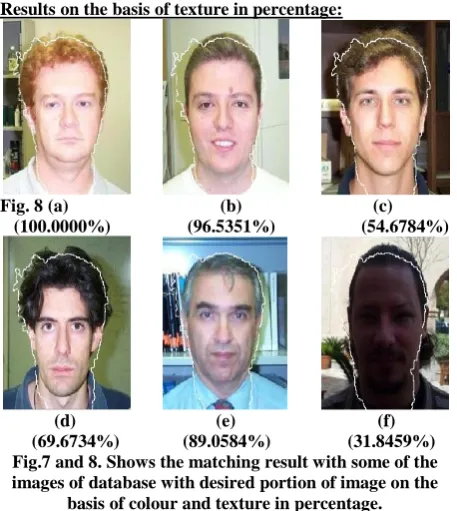
Results on the basis of texture in percentage:
Fig. 8 (a) (b) (c)
(100.0000%) (96.5351%) (54.6784%)
(d) (e) (f) (69.6734%) (89.0584%) (31.8459%)
Fig.7 and 8. Shows the matching result with some of the images of database with desired portion of image on the
basis of colour and texture in percentage.
Chart 1: Shows matching percentage of images of fig.7 and fig.8 respectively with respect to desired portion of
input image.
5.
CONCLUSION
To summarize, we present a new face matching technique based on interactive image segmentation framework. The proposed method can systematically capture the relationships among different image regions to perform effective image segmentation. An image is first over segmented with the help of mean-shift to produce an edge map. The model performs region-merging based on the colour histogram of the image using Bhattacharya coefficient. After region merging object i.e. desired portion of image is extracted from input image. Then we match the desired portion with the database face images on the basis of colour and texture. It is an iterative procedure and number of iterations depends on the user satisfaction. Finally, we want to point out that this application is not limited to image segmentation. It can find applications in many different computer vision problems including object tracking, object recognition, content based image retrieval etc. Our experimental results demonstrate the promising capability of the proposed face matching technique.
6.
REFERENCES
[1] Bo Peng, Lei Zhang and David Zhang, Automatic Image Segmentation by Dynamic Region Merging, ,” IEEE Trans. On Image Processing., vol.20, no.12, pp. 679– 698, DEC 2011
[2] F. Lecumberry, A. Pardo, and G. Sapiro, “Simultaneous object classifi- cation and segmentation with high-order multiple shape models,” IEEE Trans. Image Process., vol. 19, no. 3, pp. 625–635, Mar. 2010.
[3] J.Stawiaski and E. Decenciere, “Region Merging via Graph-cuts,” in Image Anal Stereol, 2008;27, pp. 39-45.
[4] J. Ning, L. Zhang, D. Zhang, and C.Wu, “Interactive image segmentation by maximal similarity based region merging,” Pattern Recognit., vol. 43, no. 2, pp. 445–456, Feb. 2010.
[5] F. Calderero and F. Marques, “General region merging approaches based on information theory statistical measures,” in Proc. 15th IEEE ICIP, 2008, pp. 3016– 3019.
[6] K. Haris, S. N. Estradiadis, N. Maglaveras, and A. K. Katsaggelos, “Hybrid image segmentation using watersheds and fast region merging,” IEEE Trans. Image Process., vol. 7, no. 12, pp. 1684–1699, Dec. 1998 [7] P. V. G. D. Prasad Reddy, K. Srinivas Rao and S.
Yarramalle, “Unsupervised Image Segmentation Method based on Finite Generalized Gaussian Distribution with EM and K-Means Algorithm,” Proceedings of International Journal of Computer Science and Network Security, vol.7, no. 4, pp. 317-321, April 2007.
[8] Z. Shi and V. Govindaraju, “Historical Handwritten Document Image Segmentation using Background Light Intensity Normalization,” SPIE Proceedings on Center of Excellence for Document Analysis and Recognition, Document Recognition and Retrieval, vol. 5676, pp. 167-174, January 2005.
[9] P. F. Felzenswalb and D. P. Huttenlocher, “Efficient Graph- Based Image Segmentation,” Proceedings of International Journal of Computer Vision, vol. 59, no. 2, pp. 167-181, 2004.
0 10 20 30 40 50 60 70 80 90 100
a b c d e f
Per
ce
n
tage
Image
Matching percentage of Images
color
[image:6.595.54.283.135.391.2][10] A. Mavrinac, “Competitive Learning Techniques for Color Image Segmentation,” Proceedings of the Machine Learning and Computer Vision, vol. 88, no. 590, pp. 33-37, April 2007.
[11] Y. Li, J. Sun, C. Tang, H. Shum, Lazy snapping, SIGGRAPH 23 (2004) 303–308.
[12] E. Sharon, A. Brandt and R. Basri, “Fast Multi-Scale Image Segmentation,” Proceedings of the IEEE Conference on Computer Vision and Pattern Recognition, vol. 1, pp. 70-77, 2000
[13] L. O. Donnell, C. F. Westin, W. E. L. Grimson, J. R. Alzola, M. E. Shenton and R. Kikinis, “Phase-Based user Steered Image Segmentation,” Proceedings of the Fourth International Conference on Medical Image Computing and Computer-Assisted Intervention, pp. 1022-1030, 2001
[14] J. Malik, S. Belongie, J. Shi and T. Leung, “Textons, Contours and Regions: Cue Integration in Image Segmentation,” Proceedings of Seventh International Conference on Computer Vision, pp. 918-925, September 1999.
[15] J. Shi and J. Malik, “Normalized Cuts and Image Segmentation,” IEEE Transactions on Pattern Analysis and Machine Intelligence, vol. 22, no. 8, pp. 888-905, 2000.
[16] Hakan Cevikalp and Bill Triggs, “Face recognition based on Image Sets,”IEEE Conference on Computer Vision and Pattern Recognition, San Francisco : United States(2010)"
[17] Costas Panagiotakis, Ilias Grinias, and Georgeios Tziritas “Natural Image Segmentaion Based on Tree
Equipartition, Bayesian Flooding and Region Merging”, IEEE Transactions on Image Processing, Vol. 20, No. 8, August 2011.
[18] Lei Zhang and Qiang Ji, “A Bayesian Network Model for Automatic and Interactive Image Segmentation”, IEEE Transaction on Image Processing, VOL. 20, NO. 9, September 2011.
[19] S. Birchfield, Elliptical head tracking using intensity gradients and color histograms, in: Proceedings of IEEE Conference on Computer Vision and Pattern Recognition, 1998, pp. 232-237.
[20] T.Ojala, M.Pietikainen, P.Maenpaa Multiresolution gray-scale and rotation invariant texture classification with local binary patterns, IEEE Transactionson Pattern Analysis and Machine Intelligence, 2002, pp.971-987. [21] M.J. Swain, D.H. Ballard, “Color indexing”
,International Journal of Computer Vision Vol. 7 No. 1, 2002, pp. 11-32.
[22] D. Comaniciu, V. Ramesh, P. Meer, “Kernel-based object tracking”, IEEE Transactions on Pattern Analysis and Machine Intelligence, 2003, pp. 564-577.
[23] D. Martin, C. Fowlkes, D. Tal, and J. Malik, “A database of human segmented natural images and its application to evaluating segmentationalgorithms and measuring ecological statistics,” in Proc. ICCV, 2001, pp. 416–423.