Munich Personal RePEc Archive
Deus Economicus
Oslington, Paul
Unjiversity of NSW
2005
Online at
https://mpra.ub.uni-muenchen.de/962/
D
EUS
E
CONOMICUS
Paul Oslington
School of Business, University of NSW/ADFA,
Northcott Drive, Canberra, ACT 2600. Australia.
Email [email protected]
Web: http://www.unsw.adfa.edu.au/sbus/staff_cvs/about_paul_osling.html
JEL subject categories: A12, Z12
JEL keywords: Rational Choice, Economics of Religion, Divine Action.
* Earlier versions were presented at Queens College University of Melbourne, Macquarie
University, and Regent College University of British Columbia, George Mason University,
and a conference “God and Economics” organised by Deirdre McCloskey and Arjo Klamer in
the Netherlands. I thank seminar participants and Philip Esler, Geoffrey Brennan, Gordon
Menzies, Keiran Sharpe and Paul Helm for helpful discussions and comments, with the usual
caveat.
Abstract
In recent years there has been an upsurge of interest in religion among economists, but the
content of religion has so far been neglected . This paper builds a rational choice model of
divine action, in particular of the structure of the divine offer of salvation and rational human
response. It considers why God might not save everyone, the pattern of salvation across
individuals with different preferences and endowments, and the way religious conversion and
revivals are often large and sudden changes. Rational choice analysis to divine human
interactions is a contribution to the renewal interdisciplinary conversation between economists
1) INTRODUCTION
In recent years there has been an upsurge of interest in religion among economists. Religion is
clearly important - Iannaccone (1998 pp1468-69) points out that 95% of Americans believe in God,
and 60% are members of a church, church contributions are around 1% of GDP, and clergy
employment is around 1.2% of the population. Less easily measured but probably more important are
religious influences on other employment and consumption decisions. The growing economics of
religion literature has shed light on many aspects of religion, including the allocation of time to
religious activities (Azzi and Ehrenberg 1975; Iannaccone 1990), the organisation of churches
(Iannaccone 1992; Ekelund Hebert and Tollison 2002, Barros and Garoupa 2002), free will and
predestination (Allen 2000), and the afterlife (Smith 1999; 2002),
In the economics literature a major gap is modelling the content of religion, especially divine action
(as noted by Iannaccone 1998 p1490, and Brennan and Waterman 1994 p 174-5). If rational choice
tools are as general and powerful as is claimed (for instance Becker 1976 ch 1) then they should
apply equally to divine as well as human action. To put it another way, any God an economist would
take seriously must be rational in the economists’ sense, or at least be able to be modelled this way.
If anything we might expect God to be more rational than humans - the perfection of rationality.
The only work in the economics literature along these lines is Brams (1980; 1983) modelling of
divine-human interactions. Brams believes economic theory “provides a powerful tool for clarifying
key theological concepts” (1983 pvii), and aims to demonstrate this by applying game theoretic tools
to the question: “If there existed a superior being who possessed the supernatural qualities of
omniscience, omnipotence, immortality and incomprehensibility how would he/she act differently
from us, and would these differences be knowable?” (1983 pvii). However these characteristics are
defined in ways that are difficult to relate to mainstream theology, for example omnipotence is
defined as the ability to continue moving when the opponents in a game must stop plus the ability to
delay (1983 p7) and incomprehensibility is defined as the ability to play mixed strategies (1983 p7).
Any translation of theology into the language of rational choice economics will involve some
stretching, but the definitions chosen limit the applicability of Brams’ results.
Turning to the religion literature, divine action is one of the least satisfactory areas of contemporary
theology (for instance Saunders 2002), perhaps because theologians have been reluctant to draw on
the insights of economics and other social sciences which study action. Recent discussions in the
possibilities for developing our understanding of divine action. Salvation is a sensible place to begin
economic analysis of divine action, as it is central to Christian theology and the pattern for much
other divine activity.
This paper applies rational choice theory to divine action, and in particular the salvation contracting.
The first contribution is to build a tractable model of divine action which yields a number of testable
predictions. The second contribution is to the philosophy of economics, showing how a rational
choice account relates to conventional theological accounts of divine action, and clarifying the issue
of the compatibility of a rational choice account with divine and human freedom. Thirdly the
analysis highlights some limitations of an economic approach to God, and is a contribution to the
renewal of interdisciplinary conversation between economics and theology represented by Oslington
(2003) or Schweiker and Matthewes (2004).
2) MODEL
(a) Setup
Consider a household production economy with many individuals i=1...n, each with an endowment
of factors of production xik k=1...q and an endowment of time ti. Individuals can produce j=1..m
commodities using factors and time to according to the production functions zj = f ( xkj, tj ) k=1...q.
Individuals derive utility from commodities according to Ui(z1...zj…zm). Utility functions are
assumed to be increasing, concave and homothetic. Endowments and utility functions differ between
individuals.
In equilibrium individuals are exchanging factors, employing labour, allocating time and producing
commodities to maximise utility. With equilibrium factor prices p and wage w, full income of an
individual is Yi =
∑
k
xki pki + ti w and maximised utility Ui( ). zˆ
Now introduce God who has a utility function UG (z1…zi … zn) which registers God’s satisfaction
with the choices of the i=1...n individuals. This divine utility function is assumed to be known to all
individuals, consistent with the Christian doctrine of revelation1. For simplicity it assumed to be
separable, allowing us to focus on God’s valuation of the bundle of a representative individual
UG(zi). It is assumed to be concave, but not necessarily increasing in each commodity. God desires
that humans enjoy the good things of creation, represented by UG (zi) being increasing in these good
1
things, but some commodities will be frowned upon by God (the reader can compose his or her own
examples) with UG(zi) decreasing in these2. The important point for the analysis is that divine and
human valuations of bundles diverge, following the Christian doctrine of the fall.
The God of the Christian scriptures is not merely a passive observer of human choices, but intervenes
in human affairs offering salvation to those who repent and have faith. Faith cannot be observed, but
is indicated by individuals conforming their choices to God’s will as expressed in the divine utility
function. The salvation contract God offers is as follows. If an individual chooses a bundle of
commodities which is approved by God, which means generating utility for God above some
threshold level:
(1) UG(zi)≥θ.
then individual i receives salvation.
Salvation denoted s is a discrete good, either gained or not gained, and yields utility Ui(s). This
utility is assumed to be finite, and need not just be afterlife rewards although it may include these.
The human problem is whether to rearrange one’s life to take advantage of the offer of salvation. Let
the best commodity bundle for individual i which satisfies the salvation constraint UG(zi) ≥ θ be
denoted i
z
~ . The individual will choose salvation if and only if the value of salvation exceeds the
opportunity cost of salvation, which is the difference between the values of the unconstrained and
constrained bundles:
(2) Ui(s) ≥ Ui( i) - U
ˆ
z i( i
z
~ ).
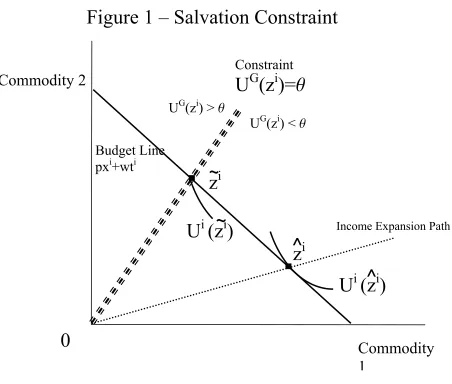
Examples of unconstrained and constrained bundles are given in figure 1. The unconstrained bundle
is the point of tangency between the budget constraint px i
ˆ
z i + wti≤ pxi+ wti and indifference curve
Ui(zi), in the usual fashion. The constrained bundle must satisfy UG(xi) ≥θ as well as the budget constraint. Figure 1 shows a linear salvation constraint where commodity 2 is positively valued by
God, and commodity 1 is frowned upon, so the bundle must lie on or below UG(xi) = θ if the
individual is to attain salvation. The constrained bundle is marked ~ and generates utility Uzi i(~ ). zi
The individual then compares the opportunity cost of salvation with the value of salvation in (2) and
chooses accordingly.
2
The divine problem has two parts. First, God must set the optimal salvation threshold. The number
of individuals saved is decreasing in θ, but the consumption reallocations of these saved towards
what God prefers is increasing in θ, so a rational maximizing God will have to balance these effects3.
In calculating optimal θ God will have to take account of changes in the consumption bundles
induced by the price effects of the salvation mechanism. The salvation mechanism will increase
demand for the commodities God values, increasing their relative prices and inducing individuals to
substitute away from these commodities.
The second part of the divine problem is checking the optimal salvation contract is gainful. Jesus’
sacrifice which opened the way to salvation was a costly act for God, and a rational God must check
that the divine utility gains from offering the contract exceed this cost which will be denoted C. The
sacrifice will be worthwhile for God if
(3) UG(~zi1…~zi n) - UG(z1…zn) > C
Throughout the paper it will be assumed that this condition is satisfied.
(b) Why Doesn’t God Save Everyone?
The first prediction of the model is that God will not offer a salvation contract where everyone is
saved. If God sets θ=0 then all individuals receive s, but there would be no rearrangement of
bundles and hence no utility benefits for God to balance the lump sum cost C. This cannot be an
equilibrium. On the other hand setting θ=¶ would mean no individuals choose s, and no
rearrangements, and this cannot be an equilibrium. Thus θ will be set between these extremes, with
the value depending on the forms of the divine and human utility functions and endowments. Some,
but not all individuals are predicted to choose salvation, and this is consistent with both the scriptures
and observation.
(c) Who is Saved?
Further predictions can be made about which individuals are likely to be saved. Utility functions
differ between individuals and those whose utility functions are closely aligned to God’s incur only
minimal utility losses in rearranging their bundles to gain salvation are more likely to choose
salvation.
Endowments of factors and time also differ randomly between individuals. Those with low incomes
are more likely to choose salvation because their opportunity cost of salvation is less than high
income individuals. In figure 1 the income consumption path for the unconstrained individual is
3
flatter than the divine salvation constraint, implying the difference between unconstrained and
constrained utility increases with income, as shown in figure 2. Unless this is so the salvation
constraint cannot bind, no individuals will be saved, and the model is degenerate. Figure 3 shows
the relationship implied by figure 2 between the probability of salvation and full income for an
individual with preferences randomly drawn from the set of possible preferences4. God here is a God
of the poor, as suggested by certain strands of Christian theology, but not exclusively so because both
preferences as well as endowments are randomly distributed5.
Across time, salvation would become more attractive in bad economic times as the opportunity cost
of salvation falls. Thus the model predicts religious revivals will typically occur during economic
downturns6.
(d) Conversion and Apostasy
Consider an individual with an income close to Yθ in figure 2, who is on the edge of accepting or
rejecting the salvation contract. A small shock to endowments or prices will lead to a large discrete
change in the consumption bundle. Salvation is thus not predicted to be like other commodities
which will be smoothly substituted by all individuals as economic conditions change. This accords
with observations of the dramatic nature of religious conversion and apostasy.
(e) Moderating Effect of Salvation
A saved individual’s life is predicted to be more stable than an unsaved individual’s the sense that
the consumption choices will be less responsive to shocks. The saved individual will also be less
greedy in the sense that marginal utility of income is lower, as illustrated in figure 2. These are
straightforward consequences of the LeChatelier principle that a constrained equilibrium will be less
responsive to parameter changes than an unconstrained maximum.
4
Varying assumptions about the divine utility function yields different relationships between salvation and income. For instance if all commodities are positively valued by God the divine constraint in figure 1 would be downward sloping with salvation above it. This implies the gap between unconstrained and constrained utility falls as income rises, so higher income individuals would be more likely to be saved. So a harsh God who frowns on consumption of some commodities is a God of the poor, while a softer God who disapproves of nothing is a God of the rich.
5
The model in Azzi and Ehrenberg (1975 p36) predicts a positive relationship between income and demand for religious commodities, flowing from their assumption that religious commodities are normal goods. The empirical support offered in the paper and elsewhere is mixed. Iannaccone (1998 p1472-4) finds no clear relationship between income and church attendance, although church attendance may not be a good indicator of salvation. A weak relationship would be consistent with the complicating effect of randomness in utility functions on the income- salvation relationship.
6
(f) The Unsaved
Paradoxically, the more effective is the salvation mechanism the more it will turn the unsaved away
from what God prefers. Individuals choosing salvation will force up the prices of inputs into
commodities God prefers be consumed, so that unsaved individuals will substitute away from
commodities God values to those God frowns upon.
3) LIMITATIONS OF ECONOMIC MODELLING
The analysis raises some issues for rational choice modelling of divine action:
(a) Free Will and Determinism
A difficulty with applying rational choice tools to God is that mainstream Christian theology holds
God to be omnipotent, making the specification of constraints awkward. The present model gets
around this difficulty by having God interact with individuals whose preferences are respected,
consistent with the Christian doctrine of free will.
However this creates another difficulty because Christian theology also holds that God is omniscient,
and moreover has created humans with their utility functions. If this is so then why would God not
create utility functions which match God’s, generating maximum possible divine utility without the
need for salvation contracts.
The analysis thus raises in a particularly sharp way the question of whether humans have free will in
any meaningful sense, and can reasonably held responsible by God for their choices7. It is not an
easy issue, and one which theologians have grappled with for centuries. Standard accounts of the
problem (e.g Zagzebski 1991) take freedom to be the ability of an agent to choose otherwise, and
point out the logical incompatibility of this with prior knowledge of the agent’s choice by an
infallible agent such as God. However this is not the only possible view of freedom – another view
(e.g. Wolf 1990) is that freedom is choosing for good reasons. In our rational choice account of
action preferences in conjunction with agent rationality constitute good reasons, and so the
knowledge of or creation of these by God facilitates rather than negates human freedom.
Predictability of the agents choice is perfectly consistent with freedom. And if free humans are also
responsible for their choices. The issue is not clear-cut, but is one that all economic modelling of
divine and human choices has to deal with.
7
(b) Beliefs and Intentions
Christian theology suggests that God cares not just about observed behaviour, but the beliefs and
intentions of agents. The model of salvation in this paper bypasses this issue, but more sophisticated
ways of dealing with beliefs and intentions within rational choice models are needed.
(c) Scarcity
All commodities in the model of this paper are scarce, but Christian theology seems to envisage
immaterial commodities not subject to scarcity. Robert Fogel (1999) recently introduced the idea of
spiritual capital to economics to deal with this issue, and Klamer (2004) the concept of non-scarce
common goods. Modelling of divine human interactions would be enriched by considering such
commodities.
(d) Conversion
Another difficulty is that conversion is portrayed in mainstream Christian theology as a radical
change, which does not sit easily with the economist’s usual insistence on fixed preferences.
Conversion seems to be something more radical even than the discontinuous switch from the
unconstrained to the constrained bundles portrayed in this paper.
(e) Church
The communal dimension of the Christian faith is missing from the model. The recent economics of
religion literature has modeled church as a club good (e.g. Iannaccone, 1992) but deliberately
4) CONCLUSION
This paper has applied rational choice tools to the content of religion, and in particular to divine
action in offering salvation and human response. Although a very simple model, it generates a
number of testable predictions consistent with casual observation of religious behaviour. It also
offers a challenge to empirical researchers to formally test these predictions as better data on the
economic dimensions of religious behaviour becomes available.
Applying rational choice tools to God is a way of exploring the limits of economic analysis; its
strengths, weaknesses and explanatory domain. It is hoped that modelling divine action in this way
will contribute to a renewal of interdisciplinary conversation between economics and theology, to the
enrichment of both. Such interdisciplinary conversation between other sciences (such as cosmology
REFERENCES
Allen, D. W. (2000). The Paradox of Choice: With an Application to Free Will Versus Predestination. Working Paper. Simon Fraser University, Canada.
Alston, W. P. (1988). "Divine Action and Human Action" in Divine Action edited by T. Morris. Ithaca, Cornell University Press.
Azzi, C. and R. G. Ehrenberg (1975). “Household Allocation of Time and Church Attendance.”
Journal of Political Economy 83(1): 27-56.
Barros, P. P. and N. Garoupa (2002). “An Economic Theory of Church Strictness.” Economic Journal 112(July): 559-76.
Becker, G. (1976). The Economic Approach to Human Behaviour University of Chicago Press.
Brams, S. (1980). Biblical Games: A Strategic Analysis of Stories in the Old Testament
Massachusetts, MIT Press.
Brams, S (1983) Superior Beings New York, Springer-Verlag.
Brennan, G. and A. M. C. Waterman, Eds. (1994). Economics and Religion: Are They Distinct?
Boston, Kluwer.
Ekelund, R. B., R. F. Hebert and R. D. Tollison (2002). “An Economic Analysis of the Protestant Reformation.” Journal of Political Economy 110(3): 646-71.
Fogel, R. (1999). “Catching up with the Economy.” American Economic Review 89(1): 1-16.
Iannaccone, L. (1990). “Religious Participation: A Human Capital Approach.” Journal for the Scientific Study of Religion 29(3): 297-314.
Iannaccone, L. (1992). “Sacrifice and Stigma: Reducing Free-Riding in Cults, Communes, and Other Collectives.” Journal of Political Economy 100(2): 271-91.
Iannaccone, L. (1998). “Introduction to the Economics of Religion.” Journal of Economic Literature 36(3): 1465-95.
Montgomery, J. D. (1996). “Contemplations on the Economic Approach to Religious Behaviour.” American Economic Review 86(2): 443-7.
Oslington, P., Ed. (2003). Economics and Religion Cheltenham, Edward Elgar. 2 volumes.
Saunders, N. (2002). Divine Action and Modern Science, Cambridge University Press.
Schweiker, W. and C. Matthewes, Eds. (2004). Having: Property and Possession in Religious and Social Life. Michigan, Eerdmans.
Smith, I. (1999). “Economics of the Apocalypse.” Journal of Institutional and Theoretical Economics 155(3): 443-57.
Smith, I. (2002). “A Rational Choice Model of the Book of Revelation.” Journal for the Study of the New Testament 85: 97-116.
Wolf S. (1990) Freedom within Reason Oxford, OUP.
Figure 1 – Salvation Constraint
Commodity 2
z
iBudget Line
px
i+wt
iz
iU
i( )
z
iU
i(z
i)
^
~
U
G(z
i) <
q
Income Expansion Path