http://dx.doi.org/10.4236/ojapps.2015.57032
On a Non-Perturbative Quantum Relativity
Theory Leading to a Casimir-Dark Energy
Nanotech Reactor Proposal
Mohamed S. El Naschie
Department of Physics, University of Alexandria, Alexandria, Egypt Email: [email protected]
Received 23 June 2015; accepted 6 July 2015; published 9 July 2015
Copyright © 2015 by author and Scientific Research Publishing Inc.
This work is licensed under the Creative Commons Attribution International License (CC BY). http://creativecommons.org/licenses/by/4.0/
Abstract
In this paper we outline a non-perturbative quantum relativity theory. Subsequently an actual de-sign of a nanotech energy reactor is based on spacetime vacuum fluctuation of the said quantum relativity theory. Using a compact heap of Fullerene nano particle moduli of a nano matrix device we propose that by maximizing the Casimir forces between these particles as a desirable effect, we can achieve a gradual rather than a sudden implosion pressure. We expect that this will result in a mini holographic universe from which energy can be extracted in a way to constitute a nano en-ergy reactor and function effectively on a hybrid principle somewhere between a Casimir effect and a cold fusion process based on the fusion algebra of a highly structured golden ring quantum field theory. The present theory depends upon many concepts and results, in particular J. Schwinger’s source theory as well as the modern theory of quantum sets, nonlinear dynamics, chaos and chaotic fractals.
Keywords
Quantum Relativity, Casimir Reactor, Dark Energy, Nano Spacetime Energy Reactor, Chaos and Fractals, Schwinger Source Theory, Fusion Algebra, Quantum Sets
1. Introduction
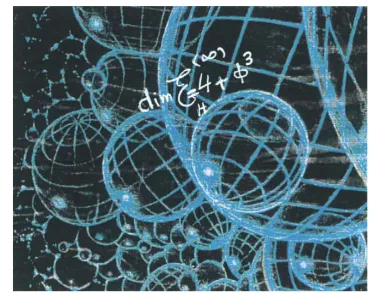
Figure 1. Banach-Tarski sphere decomposition Cantorian spacetime of E-infinity theory that is considered here to model our actual spacetime may be envisaged advantageously as in this artist impression. This is basically a two dimensional projec-tions in which each of the larger balls (circles) are a zero set ( )0;φ representing the quantum particle while the surface
(circumference) represents the empty set
(
−1,φ2)
which in turn represents the quantum wave [1] [17]. This wave is thensurrounded by an infinite hierarchy of smaller (fractal) spheres (surfaces), which may be seen as the emptier set
(
−2,φ3)
,i.e. the surface of the empty set quantum wave. Remarkably the average set of all zero and empty sets is an expectation value
equal −2;φ3 . In other words, −2;φ3 is our quantum spacetime, which is the cobordism of the quantum wave, which in
turn is the cobordism of the quantum particle, floating and propagating with the help of its wave in our Cantorian E-infinity spacetime [1] [2] [10] [11]. It is likewise remarkable that φ3
is simultaneously equal to the topological Casimir force as well as the topological mass of the ordinary energy of spacetime. Thus all matter and energy manifestations in our cosmos are essentially a manifestation of the zero point energy of the vacuum of spacetime. To obtain Einstein maximal energy den-sity we just need to firstly find the topological energy denden-sity by adding Kaluza-Klein D = 5 to φ3
of the spacetime vacuum and find the fractal Kaluza-Klein dimension 5 + φ3
then multiply this with the average Cantorian interval speed of light c =
φ squared. The result is
(
5+φ φ3)
2=2. Inserting in Newton’s kinetic energy one finds(
Einstein)
1(
) ( )
2 2 2E = m v→c
2 mc
= exactly as should be. The preceding explanation amounts to a paradigm shift in physics where the totally empty va-cuum of spacetime is taken as fundamental and everything else is derivable from it. To prove this point was a dream of Ser-bian American inventor N. Tesla who died in 1943 as well as Soviet physicist A. Zakharov. In fact in his later years Nobel Laureate J. Schwinger was a champion of cold fusion [12] which comes very near to our present concept of a Casimir-nano energy reactor [10] [11]. We also stress that we are making tacit use of the Banach-Tarski decomposition theorem as a Schwinger-like source [18] [21] [34].
Figure 2. Julian Schwinger, Nobel Laureate in Physics and an extraordinary proponent of cold fusion. Prof. Schwinger went as far as resigning from the American Physical Society in defence of scientific freedom [12]. In the resignation letter of Prof. Schwinger he lamented what he considered censorship of science exemplified by editors of famous mainstream journals re-jecting papers based upon pretentious and unfair reports by anonymous referees. On the whole Prof. Schwinger was a careful thinker and superior mathematician compared to his colleagues and co-Nobel Prize winner of the same year, the equally ex-traordinary Richard Feynman. The usual cheap shots like crackpot and old wood or numerologist could never be applied to this extraordinarily intelligent and super rational thinker. By being open minded like he was, Prof. Schwinger may have pro-voked conventional thinkers because he did not think very highly of the extensive use of Feynman’s diagrams and by intro-ducing an alternative theory to quantum field theory known as source theory [19] which he applied similar to the present work to the Casimir effect. In fact our Banach-Tarski theorem plays in our theory the role of a Schwinger source [18] [21].
Figure 3. The Feynman graph in the Schwinger source mirror. Richard Feynman is without a trace of a doubt one of the very greatest theoretical physicists of all times. However there is equally no doubt that his graphs method over emphasized the particle picture of a quantum particle. The present author admits that by temperament and pattern of thinking, he stands nearer to Feynman than Schwinger but never the less; the present Cantorian theory stands nearer to Schwinger’s source theory. Thus it is yet another example for a theory which is far cleverer than the scientist who developed it. For more about the shortcomings of summing Feynman graphs, the reader is referred to the superb advanced textbook of Prof. Herbert M.
Fried [34].
2. The Fractal inside the Complex
In some deep sense E-infinity success in dealing with fundamental problems in high energy quantum physics and cosmology is based upon replacing complex numbers and the associated quantum probability amplitude by highly structured golden mean ring based new probability [1] [4] [5]. In this new theory which starts with a one dimensional Mauldin-Williams random Cantor point, i.e. a Cantorian [4] is a topological probability given by the inverse ratio of the Hausdorff dimension of the one dimensional continuum, i.e. its topological Menger- Urysohn dimension DT = 1 to the Hausdorff dimension of the said Cantor set, i.e. DH = φ where
(
)
2 1 5
φ= + [4]. In other words and since combinatorial as well as geometrical probability fails in point set geometry to avoid results involving infinity and zero, we have only the following topological probability meas-ure left:
(
quantum)
H 1 .T
D P
D φ φ
= = = (1)
On the other hand what ever is left from the DT = 1 one-dimensional continuum after subtracting the random zero measure =0 Cantor set Hausdorff dimension DH = φ is a fat Cantor set with measure = − =1 0 1 and Hausdorff dimension equal DH−DT = − =1 φ φ2 [4] [11]. Such a φ2 Hausdorff dimension uniquely de-fines the empty set which following von Neumann-Connes’ dimensional function possesses a topological Menger-Urysohn dimension equal minus one [1] [4]. Since the random Cantor set is topological zero dimension, we have this way two Cantor sets arising from the classical unit interval bi-dimension D
( ) ( )
1 ≡ 1,1 , namely the zero measure thin Cantor set [1] [10] [11] [17]( ) ( )
0 0;D ≡ φ (2)
and the fat measure empty Cantor set [1] [10] [11] [17]
( )
(
2)
1 1;
D − ≡ − φ . (3)
the φ of D(0) could be seen as the pre-quantum particle while the φ2 of D
( )
−1 could be seen as the co-bordism of the particle, i.e. its quantum wave [1] [4]. However in view of the negative dimension −1 associ-ated with φ2, it could be just as well interpreted as an anti-quantum pre-particle [1] [4]. Next let us regress to the quantum amplitude of quantum probability of conventional quantum mechanics. As is well known, this the-ory is based on complex numbers and the associated probability amplitude, that is to say the square of a complex state vector that gives us the quantum probability of finding a quantum particle [1] [4] [5]. Proceeding in this manner we find the well known probability expression [9]2
P= V+W (4)
or
2
P= VW (5)
where V and W are complex numbers [9]. Our next task is to show how the involved complex number can be re-placed by the most irrational of all irrational numbers, namely the highly structured golden mean transfinite ring [15]. Transforming V and W as
(
particle)
V →φ (6)
and
(
)
2
anti-particle
W → −φ (7) and inserting in the union expression of P, one finds
(
)
22( )
3 2union
P = −φ φ = φ (8)
For the intersectional probability one finds
(
) ( )
( )
2 2 32( )
3 2inter-section
P = φ −φ = −φ = φ (9)
In other words we have the equality of P(union) and P(intersection) which is the familiar indistinguishability condition [4] that fully explains what is normally seen as the paradoxical outcome of the famous two-slit ex-periment with quantum particles [4].
We conclude that as the complex iteration leading to the famous Mandelbrot could be seen as the fractals in-side the complex numbers [9], so by the same token it is natural to replace conventional quantum mechanics by transfinite highly structured rings quantum mechanics [15]. In conclusion of this preliminary short discussion, we should note that φ6 is the Immirzi parameter which reconciles loop quantum gravity with superstrings [5] while φ3 is the latent Casimir topological pressure of the zero point spacetime vacuum, the inverse of which is the well known Hausdorff dimension of the core of E-infinity quantum spacetime, namely
3 3 1
1 4 4.236067977 4 4
1 4
4
H T
D = φ = +φ = = + D =
+ +
(10)
as shown on many previous occasions [1] [4]. A somewhat detailed discussion of quantum spacetime emerges from the pre-quantum zero set particle and pre-quantum empty set wave is given in Appendix 1. Here it is suffi-cient to mention on passing that quantum spacetime could be regarded within our theory as an empty pilot wave with the average bi-dimension −2,φ3
.
3. The Reinterpretation of Einstein’s
E
=
mc
2to Mean
E
= (
mc
2/22) +
mc
2(21/22)
and Zero Point Vacuum Fluctuation
linking the entire theory to the zero point vacuum energy of spacetime [11]-[13].
Let us start with the phenomenology of the wave collapse [9]. Taking any measurement in classical quantum mechanics means observing a particle and never a wave although we will of course find the tell tale sign of a wave, namely the interference pattern after the fact provided no measurement is taken [9]. In other words, the wave aspect of this wave particle duality can be observed only indirectly as interference pattern, which disap-pears on measurement [8] [9] [19]. Now since it is the wave that propagates in quantum spacetime (that means in the empty pilot wave space) even though it is formally a probability wave, then in the Bohmian quantum me-chanics at least we can say that the quantum wave energy is the kinetic energy of propagation and that we can-not measure it unless wave non-demolition measurement instruments are invented first [1] [9]. The potential en-ergy on the other hand is the enen-ergy of the particle that we can readily measure because it is statical and can be found easily using conventional methods [9]. Now we ask a new question, namely how can the proceeding in-terpretation be viewed from the point of the true persistent probability of the true vacuum of spacetime? Starting from quantum field fundamentals and the exposition of for instance J. Schwinger, this probability is given by [12] [18]
( )
eiWo
O O+ − = (11) where Wo is the familiar complex vector of quantum physics [9] [12] [18]. It is a well known fact that the real part of this complex form represents the statical part of W while the imaginary part is the dynamical part [9] [12] [18]. In other words, W consists of two effects, namely a statical real one which can be measured directly as a physical quantity analogous to the ordinary energy part of E, namely E = (mc2/22) while the kinetic energy is the imaginary part of W analogous to the dark energy of E, i.e.E = mc2(21/22) [17]. We conclude that had Einstein accepted quantum mechanics and moved on to quantum field theory, he would have realized that E = mc2 means far more than anyone ever thought. It is actually the explanation of dark energy when written as [10] [17]
(
2)
2(
)
22 21 22
E= mc +mc (12)
and goes on to explain dark matter when we incorporate the Kerr spinning singularity and arrive at the triadic division of E which takes the form [10] [17]
(
)
(
)
(
)
(
)
(
)
(
)
2 2 2
22 21 22 5 22
ordinary pure dark energy dark matter .
E mc mc mc
E E E
= + +
= + + (13)
This is very close indeed to the results of measurements and cosmic observation that led to the COBE and ac-celerated cosmic expansion Nobel Prize in Physics and Cosmology [1]. Taking a bird’s eye view of the entire energetic situation, we realize how close Schwinger’s conception of persistent probability of the vacuum is to our conception of spacetime being pilot wave energy with a quantum particle.
4. Some Mathematical Prerequisites
Let us start by recalling some facts about our Cantorian spacetime [4] [10] [11]. It is described by
3
2,
D = − φ where φ=
(
5 1 2−)
and −2 is the expectation topological dimension of the projectionwhile φ3
is the expectation value of the Hausdorff dimension of the same projection. From the above analy- sis and in view of previously obtained results [1] [2] [11], we notice immediately that φ3 is the cobordism of the quantum wave given by D WQ
( )
= −(
1,φ2)
as well as being the latent Casimir topological force of space-time all apart of being the inverse of its Hausdorff dimension, namely [4] [10] [11]( )
3 3 11 4 4 4.23606799 4
1 4
4
D H = φ = +φ = + =
+ +
(14)
Furthermore, it cannot pass unnoticed that φ3 is the topological mass of the ordinary part of the spacetime topological energy ET
( )
O =( )( )
φ3 φ2 2=φ5 2, which leads to the ordinary energy density( )
2(
5)
22 22
space associated with the surface of the zero set quantum particle, i.e. the empty set quantum wave. It is given as the product of the topological dark mass 5 which is the dimensions of Kaluza-Klein spacetime additive topo-logical volume with the square of the topotopo-logical Cantorian interval speed of light CT(Topological) = φ. That means
( )
55 2
T
E D = φ which leads to E D
( )
=(
5φ5 2)
mc2 ≅mc2(
21 22)
[10] [11]. After all this E-infinity and set theoretical manipulation, all that we really want to show and use is the fact that Casimir local effect and dark energy global effect are essentially the forces which produce and fuse atomic and sub-atomic particles to-gether. A. Zakharov described this intuitively as elementary particles floating in a spacetime spanned by these particles [13] which in turn are made of the fractal spheres spacetime [14]-[16] as imagined inFigure 1 and further elaborated upon in section 9 of the present work. This could also be viewed as a spacetime underpinning a transfinite version of ‘tHooft’s cellular automata quantum theory [20].5. Fusion Algebra [22] for a Casimir Gradual Implosion
What we just said in the preceding section may strike one at first glance as difficult to grasp since fusion, as we know it from a fusion bomb, i.e. hydrogen bomb requires a huge amount of heat which can be provided in prac-tice only via a fission bomb, i.e. an atom bomb [14]. From such a perspective cold fusion would seem like an unrealistic dream that can take place in nature only on the sun and similar hot stars or in a plasma [12] [13]. However we are proposing to manipulate the situation on the far smaller energy of nano measure spacetime, which is far less ‘hot’ than the Planck or the Compton measure of elementary particles [9]. Thus we are dealing in effect with the Casimir energy part with a twist. To understand what we mean we go back to the fission weapon [14]. In this case ignition takes place automatically at a critical mass [14]. That way one uses either the gun method where two sub-critical masses are shot together or the second well known method, which is the im-plosion method when a shockwave changes the density of a non-critical mass suddenly making it critical [14]. Here we propose using nano particles to cause a gradual controlled low speed implosion of a heap of suitable nano particles to maximise the Casimir effect leading to a semi cold fusion on the level of the resolution of a quantum field theory of nano particles so that large amounts of the so produced far higher than usual Casimir energy which will escape to the surface of the heap can be extracted [10]-[13]. In other words, we are creating mini universes resembling moduli of a mini multiverse [9] giving us in effect a cold fusion Casimir nano energy reactor with a deep intimate connection to the four dimensional fusion algebra used by the present author to simulate a highly structured golden ring quantum field theory [10]-[13] [22]-[34]. In this regard two well known theoretical effects will affect the real physical situation. The first is the physics and mathematics of surfaces and the 96% Dvoretzky measure concentration [15]. The second is the artificial high dimensionality of fractal sphere packing [16]. In what follows we would like to expand the preceding highly condensed ideas.
6. A Preliminary Design Proposal for a Cold Fusion Casimir Nano Energy Reactor
Let us leave the mathematical modelling of our reactor aside for now and ask ourselves how we will go on to build our reactor guided by the insight we gained so far. In practical terms it will all boil down to filling a small spherical shell with a huge amount of nano particles of various size and mixing it randomly and experiment with it to find an optimal density design. We expect to extract heat from this model by joining many such spaces in a fractal tree or network resembling a spacetime matrix that is, in the end analysis, our nano reactor [10]-[13]. In the most simplistic of terms we identify the things which we have to normally eliminate from a nanotechnologi-cal devices and just do the opposite here, i.e. maximizes what we normal minimize, namely the Casimir effect.7. The Maximal Total Energy Locked in the Fractal Kaluza-Klein Spacetime
To understand the theoretical scheme behind our design we need to understand the following. The entire topo-logical energy density of the universe is the product of a fractal Klein-Kaluza spacetime dimension 5 + φ3 and the topological dimension of the empty set φ2 [17]
(
)
(
3)
2topological 5
E = +φ φ . (15)
Inserting in Newton’s formula one finds [17]
(
)
1(
)
2(
3)
2 2( )
2Einstein 5 2 2
2
On the other hand the topological mass of dark energy m = 5 and the topological mass of ordinary energy m =
3
φ could be either m = 5 or m = φ3 by union, namely m = 5 + φ3 and with c = φ. This gives
(
)
(
3)
2Einstein topological 5
E = +φ φ and
(
)
1( )
2 2Einstein 2 2
E = mc =mc as anticipated [17]. In other words, in all the time since 1915, Einstein’s beauty harboured in E the quintessence of the quantum theory dualism of wave and particle [17]. To end this section let us show how to arrive to D = 5 + φ3 from monadic quantum par-ticle zero set and quantum wave empty set [10] [17]. Let us see first how the two dimensional projection of spacetime is constructed from the union of infinitely many sets for positive topological dimensions for n = 0 to n = plus infinity. This is a simple summable infinite series
(
) ( )
20
1 1 1 2
n
n
φ φ φ φ
+∞
=
= − = = +
∑
. (17)For the ground state vacuum we have to do the same for n = 0 to n = minus infinity. This is then
( )
(
) ( )
20
1 n 1 1 1 2 .
n
φ φ φ φ
−∞
=
= − = = +
∑
(18)The total sum is thus our fractal Klein-Kaluza dimensionality
(
) ( )(
)
32 2 5 .
D k−k = +φ = +φ (19) From this master expression successive reinterpretation leads to various fundamental results in an incredibly simple way. First taking on rational approximation 2+ →φ 2.5 we find that 2 2
(
+φ)
goes to the classical D = 5 Kaluza-Klein theory. Second we counted the unit border 0( )
01 1
φ = φ = twice as should be from one view point, however from another point of view it should be only once relative to an observer living in positive di-mension so that we have effectively a bosonic space with D = 4 + φ3. Finally taking only the fractal set and disregarding the unit set, we have 5+ − = +φ3 2 3 φ3 which upon rationalization, gives us our familiar D = 3 classical dimension.
8. The Reasonable Effectiveness of Highly Structured Theories as the Raison
D’Etre of E-Infinity Theory
this web of expected and unexpected relations connecting initially seemingly unrelated objects arises as a highly structured and coherent theory in the golden mean resolves many problems in high energy physics and cosmol-ogy in the incredibly simple way we described earlier on. We should emphasize the role of the marvellous mathematical device invented by Felix Hausdorff [4] [9]. It is a generalization of the topological dimension to transfinite point set but it is equally a measure of disorder complexity and entropy. Consequently it plays a role in measuring the energy density as well as the mass which made it possible to find a new interpretation of Ein-stein’s E = mc2 [17]. To put it in a single honest sentence, the physical E-infinity theory and its direct connection to K-theory, the mathematical E-infinity theory as well as n-category theory and four dimensional fusion algebra connected to sub-factors and golden ring highly structured topological quantum field theory [22] [24] is far cleverer than the present author who is supposed to have started it. I do not think one can say more than that.
9. Constructing Spacetime from Quantum Particles and Quantum Wave
In the following we give the quintessence of a non-perturbative quantum relativity theory. We start from von Neumann-Connes’ dimensional function for the x quotient noncommutative space [8] of which the Klein-Pen- rose fractal tiling universe [8] [9] is a generic quasi manifold
D= +a bφ (20)
where a b, ∈Z and φ=
(
5 1 2−)
. Inserting the appropriate Z in D one finds the corresponding dimensions D≡D(T,H) where T is the Hausdorff dimension of a bijected Menger-Urysohn topological dimension T.Conse-quently for the zero set pre-quantum particle one finds [1] [11]
( )( )
( )
0 1 0;
o
D = + φ = ≡φ D φ . (21)
On the other hand the quantum wave, which is the surface of the quantum particle, is given by the cobordism empty set D−1 of the zero set D0. Therefore one finds [1] [11]
( )( )
2(
2)
1 1 1;
o
D = + − φ =φ ≡D − φ . (22)
Proceeding in the same manner one finds an infinite number of successive empty and emptier still sets given by [1] [4] [11]
(
) ( )
2 3 2 2 2
2 1 1 1. 1 n n
φ φ φ φ φ φ φ
φ ∞ = = + + = + + + = ≡ −
∑
(23)Adding to this the quantum pre-particle φ we have 1+φ. In addition we should include the zero dimen-sional state given by φ0 =1 leading to a gross sum of 1 1+ + = +φ 2 φ. This is the basic Hausdorff dimension for three (n = 3) topological Menger-Urysohn dimension as given by von Neumann-Connes dimensional func-tion [8] or alternatively by the equivalent bijection formula of E-infinity [1] [4]
( )
( )
11 n
n c
d = φ − (24)
which for n = 3 gives us the same previous result, namely
( )3
( )
3 1( )
21 1 2 2.618003989
c
d = φ − = φ = + =φ . (25)
Now we can contemplate two possibilities to gauge 2+φ. The first is to measure it in terms of the pre-quantum particle φ and find the dimension of the core of E-infinity spacetime which is the Hausdorff di-mension corresponding to n=D( )T =4, namely [4] [11]
( )
( ) ( )
3 4 1 3
H-particle
2 1
1 1 4 4
1 4
4
D φ φ φ φ
φ − + = = = = + = + + + (26)
The second possibility is to gauge 2+φ in terms of the pre-quantum wave [1] [4] [11]
(H-wave) 2
( ) ( )
3 5 1( )
42
1 1 1 o 20
D φ φ φ φ α
φ
− +
where α =o 137+ko,
(
)
5 5
1 o
k =φ −φ is the inverse electromagnetic fine structure constant and φ5 is Hardy’s quantum entanglement. On the other hand, realizing the evident fact that a spacetime dimensionality must be consistent with the particle-wave duality then this dimensionality must be that given by the union of 4 + φ3 and
20 o
α , namely [4] [11]
(
)
(
3)
(
)
5 1H-particle, wave 4 20 11 11
1 11
11 o
D = +φ + α = +φ = +
+ +
(28)
This is simply the dimensionality of a fractal Witten’s M-theory [4] [7] or a fractal super gravity spacetime. This fractal M-theory clearly supports the particle-wave duality of quantum mechanics. It is now extremely in-sightful to note the following: since the pre-quantum wave
(
−1,φ2)
is the surface of the pre-quantum particle( )
0,φ and(
−2,φ3)
is the surface of the pre-quantum wave, then the average ambient spacetime in the same 2D holographic boundary [20], i.e. 1 4(
+φ3)
=φ3 is simply the same as the surface of the pre-quantum wave on average. Remembering that φ3 is the topological mass of the ordinary energy as well as being the latent topological Casimir force, one can easily realize that dark energy is a Casimir global energy and that a hybrid energy form can stem from this unity making the idea of cold fusion not as outlandish as some used to think. Consequently Nobel Laureate Julian Schwinger (seeFigure 2 andFigure 3) was not that far off in his warm enthusiasm for cold fusion [12]. Note also that Schwinger source [18] is replaced in the present theory by our Banach-Tarski theorem on sphere decomposition [21].10. Feynman Diagrams from a Source View Point
The attentive reader must have realized by now that the viewpoint behind the present work is much nearer to Schwinger’s source theory than it is to Feynman (seeFigure 2 and Figure 3). This is by no means surprizing. Feynman’s diagrams, apart of anything else, have an inbuilt bias towards the particle aspect of the quantum. Here however we presented a fairly balanced particle-wave picture. In fact we say ‘fairly’ because the wave is on our view nearer to spacetime itself being both empty sets and the only difference is the degree of emptiness of this empty set. By contrast the particle is a non-empty zero set. Elaborating further on the Feynman graphs method and referring to the above comments and the legend ofFigure 3 as well as our calculation in Section 9, it is well known that summing over subset of Feynman graphs that include infinite numbers of graphs. That way it is impossible to find an exact solution or in fact determine accurately the magnitude of error. This stands in marked contrast to Schwinger’s non-perturbative approach as well as our method as presented for instance in the short exact analysis given in Section 9. To sum up and put it in a nutshell, despite all the difference E-infinity theory comes much nearer to the functional formulation of Schwinger and Fradkin than to the very popular method of Feynman [34]. That incidentally is how we could tackle and solve the problem of dark energy and dark matter.
11. Conclusion
dimen-sionality and extract energy from its surface. The optimal high dimendimen-sionality was 5 + φ3 where five was the dimensionality of Kaluza-Klein spacetime and φ3 was the universal fluctuation of spacetime. The inside of each modulus was basically a self-similar matrix created by fractal packing of quasi-spherical nano particles. In this way the Casimir effect will be maximized creating slow imploding pressure which increases the Casimir force further still and makes a cold fusion environment possible enhancing our reactor and making it de facto a hybrid Casimir-cold fusion-dark energy nano reactor [10]-[12]. The present conclusions are yet another strong argument for the basic correctness of Schwinger’s source theory interpretation of the Casimir effect and the fea-sibility of a cold fusion energy reactor [12] [18].
References
[1] He, J.-H. (2014) A Tutorial Review on Fractal Spacetime and Fractional Calculus. International Journal of Theoretical Physics, 53, 3698-3718. http://dx.doi.org/10.1007/s10773-014-2123-8
[2] Auffray, J.-P. (2014) Quantum Meteorites: An Extemporaneous Description of the System of the World. Journal of Modern Physics, 6, 878-889. http://dx.doi.org/10.4236/jmp.2015.67092
[3] Nottale, L. (1996) Scale Relativity and Fractal Spacetime: Application to Quantum Physics, Cosmology and Chaotic Systems. Chaos, Solitons & Fractals, 7, 877-938. http://dx.doi.org/10.1016/0960-0779(96)00002-1
[4] El Naschie, M.S. (2004) A Review of E-Infinity and the Mass Spectrum of High Energy Particle Physics. Chaos, Soli-tons & Fractals, 19, 209-236. http://dx.doi.org/10.1016/S0960-0779(03)00278-9
[5] El Naschie, M.S. (2013) The Quantum Gravity Immirzi Parameter—A General Physical and Topological Interpretation. Gravitation and Cosmology, 19, 151-155. http://dx.doi.org/10.1134/S0202289313030031
[6] Witten, E. (1998) D-Branes and K-Theory. Journal of High Energy Physics, 12, 1-35. http://dx.doi.org/10.1088/1126-6708/1998/01/001
[7] May, J.P. (1977) E-Infinity Ring Spaces and E-Infinity Spectra. Lecture Notes in Mathematics, Springer, Berlin.
[8] Connes, A. (2000) Noncommutative Geometry Year 2000. Geometric and Functional Analysis. Special Volume, Birk-häuser-Verlag, 481-599. http://dx.doi.org/10.1007/978-3-0346-0425-3_3
[9] Penrose, R. (2004) The Road to Reality. Jonathan Cape, London.
[10] El Naschie, M.S. (2015) Kerr Black Hole Geometry Leading to Dark Matter and Dark Energy via E-Infinity Theory and the Possibility of Nano Spacetime Singularity Reactor. Natural Science, 7, 210-225.
http://dx.doi.org/10.4236/ns.2015.74024
[11] El Naschie, M.S. (2015) The Casimir topological Effect and a Proposal for a Casimir-Dark Energy Nano Reactor. World Journal of Nano Science & Engineering, 5, 26-33. http://dx.doi.org/10.4236/wjnse.2015.51004
[12] Schwinger, J. (2014-2015) Cold Fusion Theory: A Brief History of Mine. A Talk Read in an Evening Session by Eugene Mallove at the Fourth International Conference on Cold Fusion ICCF4, Maui, December 1994, Printed Online by Infinity Energy—The Magazine of New Energy Science & Technology.
www.infinite-energy.com/iemagazine1/colfusthe-html
[13] Jiang, X.L., Zhou, X.P. and Peng, W.M. (2014) Extraction of Clean and Cheap Energy from Vacuum. Materials for Renewable Energy & Environment, 2, 467-471.
[14] El Naschie, M.S. (1999) From Implosion to Fractal Spheres. A Brief Account of the Historical Development of Scien-tific Ideas Leading to the Trinity Test and Beyond. Chaos, Solitons & Fractals, 10, 1955-1965.
http://dx.doi.org/10.1016/S0960-0779(99)00030-2
[15] El Naschie, M.S. (2015) Banach Spacetime-Like Dvoretzky Volume Concentration as Cosmic Holographic Dark En-ergy. International Journal of High Energy Physics, 2, 13-21. http://dx.doi.org/10.11648/j.ijhep.20150201.12
[16] El Naschie, M.S. (2005) On 336 Kissing Spheres in 10 Dimensions, 528 P-Brane States in 11 Dimensions and the 60 Elementary Particles of the Standard Model. Chaos, Solitons & Fractals, 24, 337-457.
http://dx.doi.org/10.1016/j.chaos.2004.09.071
[17] El Naschie, Mohamed S. (2014) From E = mc2 to E = mc2/22—A Short Account of the Most Famous Equation in Physics and Its Hidden Quantum Entanglement Origin. Journal of Quantum Information Science, 4, 284-291.
http://dx.doi.org/10.4236/jqis.2014.44023
[18] Schwinger, J. (1975) Casimir Effect in Source Theory. Letters in Mathematical Physics, 1, 43-47. http://dx.doi.org/10.1007/BF00405585
[19] Finkelstein, D. (1996) Quantum Relativity. Springer, Berlin. http://dx.doi.org/10.1007/978-3-642-60936-7
[21] El Naschie, M.S. (1995) Banach-Tarski Theorem and Cantorian Micro Spacetime. Chaos, Solitons & Fractals, 5, 1503-1508. http://dx.doi.org/10.1016/0960-0779(95)00052-6
[22] El Naschie, M.S. (2009) Wild Topology, Hyperbolic Geometry and Fusion Algebra of High Energy Particle Physics. Chaos, Solitons & Fractals, 13, 1935-1945. http://dx.doi.org/10.1016/S0960-0779(01)00242-9
[23] Gillet, H. (1981) Riemann-Roch Theorem for Higher Algebraic K-Theory. Advances in Mathematics, 40, 203-289. http://dx.doi.org/10.1016/S0001-8708(81)80006-0
[24] Kodiyalam, V. and Saunder, V. (2001) Topological Quantum Field Theories from Subfactors. Chapman & Hall/CRC, Bacaraton and London.
[25] Witten, E. (1988) Topological Quantum Field Theory. Communications in Mathematical Physics, 117, 353-386. http://dx.doi.org/10.1007/BF01223371
[26] Baez, J.C. and Dolan, J. (1988) Higher-Dimensional Algebra III: N-Categories and the Algebra of Opetopes. Advances in Mathematics, 135, 145-206.http://dx.doi.org/10.1006/aima.1997.1695
[27] May, J.P. (2009) What Precisely Are E-Infinity Rings and E-Infinity Spectra. arXiv: 0903.2813v1
[28] Ketov, S.V. (1995) Conformal Field Theory. World Scientific, Singapore.
[29] Duplantier, B. and Rivasseau, V. (2003) Poincaré Seminar 2002. Vacuum Energy—Renormalization. Birkhauser, Ba- sel.
[30] Saller, H. (2006) Operational Quantum Theory I and II. Springer, Heidelberg.
[31] Milonni, P.W. (1994) The Quantum Vacuum, An Introduction to Quantum Electrodynamics. Academic Press, Boston. [32] Connes, A. and Marcolli, M. (2008) Noncommutative Geometry, Quantum Fields and Motives. American
Mathemati-cal Society Hindustan Book Agency.
[33] Stephenson, K. (2005) Introduction to Circle Packing. Cambridge University Press, Cambridge.