Munich Personal RePEc Archive
Preferential attachment and growth
dynamics in complex systems
Yamasaki, Kazuko and Matia, Kaushik and Buldyrev, Sergey
V. and Fu, Dongfeng and Pammolli, Fabio and Riccaboni,
Massimo and Stanley, H. Eugene
IMT Institute For Advanced Studies, Lucca
26 June 2004
Online at
https://mpra.ub.uni-muenchen.de/15908/
Preferential attachment and growth dynamics in complex systems
Kazuko Yamasaki1,2, Kaushik Matia2, Sergey V. Buldyrev2, Dongfeng
Fu2, Fabio Pammolli3, Massimo Riccaboni3 and H. Eugene Stanley2
1Tokyo University of Information Sciences, Chiba City 265-8501 Japan.
2Center for Polymer Studies and Department of Physics,
Boston University, Boston, MA 02215 USA.
3Faculty of Economics, University of Florence and CERM,
Via Banchi di Sotto 55, Siena 53100 Italy.
Abstract
Complex systems can be characterized by classes of equivalency of their elements defined
accord-ing to system specific rules. We propose a generalized preferential attachment model to describe
the class size distribution. The model postulates preferential growth of the existing classes and the
steady influx of new classes. According to the model, the distribution changes from a pure
expo-nential form for zero influx of new classes to a power law with an expoexpo-nential cut-off form when
the influx of new classes is substantial. Predictions of the model are tested through the analysis of
a unique industrial database, which covers both elementary units (products) and classes (markets,
firms) in a given industry (pharmaceuticals), covering the entire size distribution. The model’s
predictions are in good agreement with the data. The paper sheds light on the emergence of the
Many diverse systems of physics, economics, and biology [1–5], share in their growth
dy-namics two basic similarities: (i) The system does not have a steady state and is growing. (ii)
Basic units are born and they agglomerate to form classes. Classes grow in size preferentially
depending on the existing size. In the context of economic systems, units are products, and
the classes are firms. In social systems units are human beings, and the classes are cities.
In biological systems units can be bacteria, and the classes are the bacterial colonies.
The probability distribution function p(k) of the class size k of the systems mentioned
above share a universal behavior p(k)∼k−τ
with τ ≈2 [1, 3, 4, 6]. Other possible values of
τ are discussed and reported in [7]. Also, for most of the systems p(k) has an exponential
cutoff which is often assumed to be a finite size effect of the databases analyzed. Several
models [2, 9–13] explain τ ≈ 2 but none explains the exponential cutoff of p(k). Moreover,
these models describing p(k) ∼ k−τ
are not suitable to describe simultaneously systems
for which p(k) ∼ exp(−γk). Here we present a model with simple set of rules to describe
p(k) for the entire range of k, i.e., power law with an exponential cutoff. We show that
the exponential cutoff of the power law is not due to finite size but an effect of the initial
conditions from which the system starts to evolve. We also show that the functional form
of p(k) depends on the initial conditions of our model and changes from a pure exponential
to a pure power law (with τ = 2) via a power law with an exponential cutoff. We justify
our model by empirical analysis of a recently constructed pharmaceutical industry database
(PHID) [14, 15].
We now present a model, which has the following rules:
1. At time t = 0 there existsN classes, each with a single unit.
2. At each simulation step:
• (a) With probabilityb (0≤b≤1) a class with a single unit is born.
• (b) With probability λ (0< λ≤ 1) a randomly selected class grows one unit in
size. The selection of the class that grows is done with probability proportional
to the number of units it already has [“preferential attachment”].
• (c) With probability µ (0 < µ ≤ 1, µ < λ) a randomly selected class shrinks
one unit in size. The selection of the class that shrinks is done with probability
In the continuum limit the proposed growth mechanism gives rise to a master equation of
p(k, ti, t) which is the probability, for a classi born at simulation step ti, to have k units at
step t:.
∂p(k, ti, t)
∂t =λ
(k−1)
g(t) p(k−1, ti, t)
+µ(k+ 1)
g(t) p(k+ 1, ti, t)−(λ+µ)
k
g(t)p(k, ti, t)
(1)
whereg(t)≡N+(λ−µ+b)tis the total number of units at simulation steptandp(1, ti, ti) =
1. Equation (1) is the generalization of the master equation of birth and death processes [12].
The analytical solution of Eq. (1) is given by
p(k, t) = N
N +btp(k,0, t), + b N +bt
Z t
0
dtip(k, ti, t) (2)
where the functional form of p(k, ti, t) is given in [8]. The lengthy derivation of the full
solution of eq. 1 which is a power law(the second term of eq. 2) with an exponential cutoff
(the first term of eq. 2) will be presented elsewhere, here we present simulation results.
First we discuss two limiting solutions of Eq. (1).
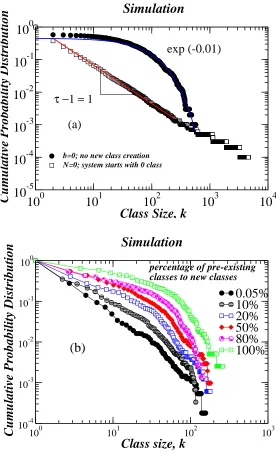
• Case i : No new classes are born (b = 0). The growth of the system is solely due to
the preferential attachment of new units to the pre-existing N classes. In this case
(Fig 1a) [12]
p(k)∼e− kN
t(λ−µ). (3)
This limiting case can be considered as one of the initial condition of the model where
birth or death of classes arenotallowed. We observe that this initial condition results
in a pure exponential distribution of the number of units inside classes.
• Case ii : At t = 0, N = 0, and new classes are born with probability b 6= 0. In this
case, for large times p(k) is a pure power law
p(k)∼k−τ
, τ = 2. (4)
This limiting case can be considered as another different initial condition of the model
where birth or death of classes are allowed starting from N = 0 classes. We observe
that this initial condition results in a pure power law distribution of the number of
This case is identical to the Simon model [13] and can be understood by the following
arguments. From case (i) we know that when the number of classes remains constant,
p(k) decays exponentially with k. The power law of case (ii) is the effect of
superposi-tion of many exponentials with different decay constants, each resulting from classes
born at different times (Fig 1a).
We next present a mean field interpretation of the result τ ≈ 2. At any moment t0 the
number of units in the already-existing classes is g(t0). Suppose a new class consisting of
one unit is created at time t0. According to rules 2b, 2c, the growth rate is proportional
to 1/g(t0). Neglecting the effect of the influx of new classes on g(t0), the average size k
of this class born at t0 is proportional to 1/g(t0). So the classes which were born at times
t > t0 remain smaller than the classes born earlier. If we sort the classes according to their
size, the rank R(k) of a class is proportional to the time of its creation R(k) ∝ t0. Thus
k ∼1/g(t0)∼1/t0 ∼1/R(t0) and we arrive to the standard formulation of the Zipf’s law [4]
according to which the size of a class k is inversely proportional to its rank. If we take into
account the decrease of the growth rate with the influx of new classes, one can show after
some algebrak∼R−(λ−µ)/(λ−µ+b)
, which includesk ∼R−1
as a limiting case forb→0. Since
R(k) is the number of classes whose size is larger than k, we can write in the continuum
limit R(k)∼Rk∞p(k)dk and hence p(k)∼k−2−b/(λ−µ)
.
The full solution of Eq. (1), a power law with an exponential cutoff, can be interpreted
using the following arguments. We start with N classes which are colored red, and let the
newly born classes be colored blue. Due to the preferential attachment rule, the red classes
remain on average larger than the blue classes. Thus for large k, p(k) is governed by the
exponential distribution of the red classes (Case i) while for smallk,p(k) is governed by the
power law distribution of the blue classes (Case ii) (Fig. 1b).
Now we apply this model to describe the statistical properties of growth dynamics of
business firms in pharmaceutical industry. PHID records quarterly sales figures of 48 819
pharmaceutical products commercialized in the European Union and North America from
September 1991 to June 2001. The products in PHID can be classified in five different
hierarchal levels A, B, C, D, and E (Fig. 2) [16]. Each level has a different number of
classes, and different initial conditions (Table I).
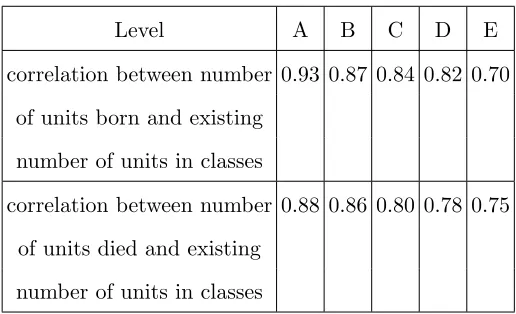
We observe that there are positive correlations between the number of units (products)
hierarchal level (Table II). This empirical observation supports preferential birth or death
mechanism (rules 2b, 2c) used in our model.
For levels A and B where the number of classes did not change we obtain an exponential
distribution (Figs. 3a, 3b) as predicted by limiting Case i of the model. For levels C and
D a weak departure from the exponential functional form [Figs. 3c, 3d] is due to the slight
growth in the number of classes.
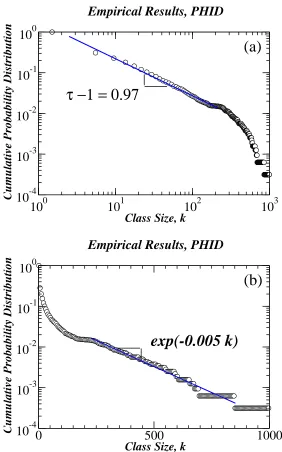
The full solution predicted by our model, i.e., the initial power law followed by the
exponential decay ofp(k) is observed empirically for level E (Fig. 4). For level E we observe
a power law with τ = 1.97 for k < 200, and an exponential cutoff for k > 200. From
the discussion above with red and blue classes we may infer that the exponential part of
p(k) arises from pre-existing firms, while the power law part of p(k) represents the young
firms that enter the market. We conclude by noting that our model is in agreement with
empirical observation where we observe p(k) to be pure exponential or a power law with an
exponential cutoff. Our analysis also sheds light on the emergence of the exponent τ ≈ 2
Level A B C D E
total number of 13 84 259 432 3913
classes in each levels
number of classes 0 0 8 20 458
born in each level
number of classes 0 0 0 0 252
[image:7.595.204.406.70.225.2]died in each level
TABLE I: Two different initial conditions for classes in PHID levels: (i) For levels A and B we
have no birth or death of classes. System grows with the birth or death of units to pre-existingN
classes (13 for level A and 84 for level B). (ii) For levels C and D system grows not only with the
birth or death of classes but also with birth and death of units inside classes.
Level A B C D E
correlation between number 0.93 0.87 0.84 0.82 0.70
of units born and existing
number of units in classes
correlation between number 0.88 0.86 0.80 0.78 0.75
of units died and existing
number of units in classes
TABLE II: Correlation of birth and death of units with existing number of units in classes for each
level in PHID. This observed correlation justifies the preferential birth or death of units which is
rule 2 b and 2 c of our model.
[1] H. Jeong, B. Tomber, R. Albert, Z. N. Oltvai, and A. L. Barab´asi,Nature 407, 651 (2000).
[2] S. V. Buldyrev, N. V. Dokholyan, S. Erramilli, M. Hong, and J. Y. Kimet al.,Physica A330,
653 (2003).
[3] M. Batty and P. Longley, Fractal Cities(Academic Press, San Diego, 1994).
[4] G. Zipf, Human behavior and the principle of last effort (Addison-Wesley, Cambridge, 1949).
[image:7.595.176.434.323.480.2](1998).
[6] R. Kumar, P. Raghavan, S. Rajagopalan, and A. Tomkins,Comput. Netw. 31, 1481 (1999).
[7] M. E. J. Newman, preprint condmat/0412004.
[8] p(k, ti, t) = (1−ηti,t)(1−
µ ληti,t)η
k−1
ti,t , and ηti,t = 1−
„
ti+N(λ−µ+b)−1
t+N(λ−µ+b)−1
« (λ−µ)
(λ−µ+b)
1−µ
λ „
ti+N(λ−µ+b)−1
t+N(λ−µ+b)−1
« (λ−µ)
(λ−µ+b)
[9] D. Champernowne, Economic Journal63, 318 (1953).
[10] J. Fedorowicz, Journal of American Society of Information Science 33, 223 (1982).
[11] X. Gabaix (1999), Quarterly Journal of Economics114, 739 (1999).
[12] W. J. Reed and B. D. Hughes,Phys. Rev. E 66, 067103 (2002).
[13] Y. Ijiri and H. A. Simon, Skew distributions and the sizes of business firms (North-Holland
Pub. Co., Netherlands, 1977).
[14] G. De Fabritiis, F. Pammolli, M. Riccaboni, Physica A324, 38 (2003).
[15] K. Matia, D. Fu, S. V. Buldyrev, F .Pammolli, M. Riccaboni and H. E. Stanley EPL67 498
(2004).
[16] The different levels A, B, C, D of PHID are the four different anatomical therapeutic chemical
(ATC) levels. Classes in ATC 1 are organs of the body, classes in ATC 2 are therapeutic
preparations, classes in ATC 3 and 4 are the chemicals and compounds respectively used in
10
010
110
210
310
4Class Size, k
10
-510
-410
-310
-210
-110
0Cumulative Probability Distribution
b=0; no new class creation N=0; system starts with 0 class
Simulation
τ −1 = 1
exp (-0.01)
(a)
100 101 102 103
Class size, k
10-4 10-3 10-2 10-1 100
Cumulative Probability Distribution
0.05%
10%
20%
50%
80%
100%
Simulation
percentage of pre-existing classes to new classes
[image:9.595.154.430.80.539.2](b)
FIG. 1: Simulation results of the model. (a) Symbols are data points from simulation, solid lines
are regression fits. We observe forb= 0 (i.e. no class creation ) cumulative probability distribution
is a pure exponential while forN = 0 (i.e. we start with zero initial class ) a pure power lawk−(τ−1)
with exponentτ = 2. (b) We observe that as we change the ratio of number of pre-existing classes
Level C: 259 classes
Level A : 13 classes
Level D: 432 classes
Total 48819 products
Level E: 3913 classes
PHID ( hierarchal classification )
[image:10.595.148.498.69.326.2]Level B: 84 classes
FIG. 2: In the pharmaceutical industry, products can be classified according to five levels. When
a particular product arrives in the market, it is labeled under any one of the 13 classes of the level
A, 84 classes of level B, and so on. Since the 19th century, the number of classes of level A or B has
remained constant even though the number of products within each class had a dramatic growth.
Over the period of our empirical analysis the number of classes in levels C and D increased by 3%
and 5% respectively. Products can also be grouped into firms which markets them (classification
0 2000 4000 6000 8000 10000
10
-110
0exp( -0.00031 k )
0 500 1000 1500 2000 2500 3000
10
-210
-110
0exp( -0.0015 k )
0 500 1000 1500
10
-310
-210
-110
0exp( -0.0039 k )
0 500 1000 1500
10
-310
-210
-110
0exp( -0.0044 k )
(a)
(b)
(c)
(d)
ClassSize, k
Cumulative Probability Distribution
[image:11.595.84.563.114.489.2]Empirical Results, PHID
FIG. 3: Figures (a)∼(d) corresponds to levels (A)∼(D) respectively. Products in the pharmaceuti-cal industry are classified into levels A, B, C and D. Levels A and B have fixed numbers of classes,
the number of classes in levels C and D increases by 3% and 5% respectively over the period of
our analysis. For instance, for level A (fig. 3 a) which contains only 13 classes, the distribution is
estimated from 13 random interger numbers which corresponds to classifying 48,819 products in
13 classes. Symbols represent data points in each level (a)∼(d) while solid lines are predictions of the model. Cumulative probability distributions for all levels are pure exponentials as predicted
10
010
110
210
3Class Size, k
10
-410
-310
-210
-110
0Cumulative Probability Distribution
Empirical Results, PHID
τ −1 = 0.97
(a)
0
500
1000
Class Size, k
10
-410
-310
-210
-110
0Cumulative Probability Distribution
Empirical Results, PHID
exp(-0.005 k)
[image:12.595.151.433.75.527.2](b)
FIG. 4: Empirical results from PHID level E. The classes analyzed here are the firms. Circles are
data points, solid lines are regression fits. (a) Log-log plot of cumulative probability distribution
of the class sizes show a power law decay k−(τ−1)