The DNA ejection process in bacteriophage
λ
Thesis by
Paul Grayson
In Partial Fulfillment of the Requirements
for the Degree of
Doctor of Philosophy
California Institute of Technology
Pasadena, California
2007
Abstract
Bacteriophages have long served as model systems through which the nature of life may be explored. From
a physical or mechanical point of view, phages are excellent examples of natural nanotechnology: they
are nanometer-scale systems which depend critically on forces, pressures, velocities, and other
fundamen-tally physical quantities for their biological functions. The study of the physical properties of phages has
therefore provided an arena for application of physics to biology. In particular, recent studies of the motor
responsible for packaging a phage gnome into a capsid showed a buildup of pressure within the capsid of
tens of atmospheres. This thesis reports a combined theoretical and experimental study on various aspects of
the genome ejection process, so that a comparison may be drawn with the packaging experiments. In
partic-ular, we examine various theoretical models of the forces within a phage capsid, deriving formulas both for
the force driving genome ejection and for the velocity at which the genome is translocated into a host cell.
We describe an experiment in which the force was measured as a function of the amount of genome within
the phage capsid, and another where the genome ejection velocity was measured for single phages under
the microscope. We make direct quantitative comparisons between the theory and experiments, stringently
Contents
Abstract i
1 Introduction 1
1.1 Phages as an arena for science . . . 1
1.1.1 The central position of phages in biology . . . 1
1.1.2 Phages as a focus of physical research in biology . . . 3
1.2 The phage ejection problem: how does the DNA get out? . . . 6
2 Models of bacteriophageλDNA ejection. 7 2.1 Theoretical model of internal pressure . . . 8
2.1.1 Goals for the model . . . 10
2.1.2 Simple model I: counterion entropy . . . 11
2.1.3 Simple model II: empirical interstrand forces . . . 14
2.1.4 Simple model III: only bending energy . . . 16
2.1.5 Comparison of the models . . . 19
2.2 Modeling the mobility of DNA during ejection . . . 21
2.2.1 Friction in the phage tail . . . 21
2.2.2 Friction in the phage head . . . 23
2.2.3 Friction from layer sticking (Grosberg/Rubinstein model) . . . 24
2.3 Calculating drag forces in the toilet-flush model . . . 27
2.3.1 Precise definition of osmotic pressure . . . 27
3 Experiments on the bacteriophage ejection process 33
3.1 Experimental measurement of ejection force . . . 33
3.1.1 Results . . . 35
3.1.2 Error analysis . . . 39
3.1.3 Discussion . . . 42
3.2 Real-timein vitromeasurement of DNA ejection . . . 44
3.2.1 Bulk measurements . . . 45
3.2.2 Single-molecule measurements . . . 52
3.2.3 Image processing for DNA length determination . . . 52
3.2.4 The effect of flow on the DNA length . . . 56
3.2.5 Length calibration . . . 59
3.2.6 Results . . . 60
3.2.7 Error analysis . . . 70
3.3 Real-timein vivomeasurement of DNA ejection . . . 72
3.3.1 Results . . . 73
3.3.2 Discussion . . . 76
3.4 Comparison to real-time experiments on DNA packaging . . . 77
3.4.1 Optical-tweezer measurements on DNA packaging:φ29,λ, and T4. . . 77
3.4.2 Viscosity effects on packaging . . . 77
3.4.3 Osmotic pressure effects on packaging . . . 79
3.4.4 Quantitative disagreement between theory and experiment forφ29 . . . 80
4 Implications and future work 82 5 Acknowledgments 85 5.1 People . . . 85
5.1.1 Collaborators . . . 85
5.1.2 Helpful Discussions . . . 86
5.2 Help with materials and facilities . . . 88
5.2.1 Strains . . . 88
5.3 Funding . . . 88
A Glossary 89 B Mathematical variables 90 C Protocols 91 C.1 Bacteriophage propagation . . . 92
C.1.1 Background . . . 92
C.1.2 Materials . . . 92
C.1.3 Procedure . . . 92
C.2 Extraction of phage DNA . . . 93
C.2.1 Background . . . 93
C.2.2 Materials . . . 93
C.2.3 Procedure . . . 93
C.3 Field inversion gel electrophoresis . . . 94
C.3.1 Procedure . . . 94
C.4 Growing cells on agarose pads . . . 95
C.4.1 Materials . . . 95
C.4.2 Procedure . . . 95
C.5 Lambda plate lysis . . . 96
C.5.1 Supplies . . . 96
C.5.2 Procedure . . . 96
C.6 Lambda plate lysis plates . . . 97
C.7 Osmotic pressure inhibition assay . . . 98
C.7.1 Materials . . . 98
C.7.2 Procedure . . . 98
C.8 Purification of LamB . . . 100
C.8.1 Background . . . 100
C.8.2 Materials . . . 100
C.8.3 Procedure . . . 101
C.9.1 Supplies . . . 103
C.9.2 Differential sedimentation . . . 103
C.9.3 CsCl gradient . . . 103
C.10 Real-timein vitrobulk ejection . . . 105
C.10.1 Materials . . . 105
C.10.2 Procedure . . . 105
C.11 Real-timein vitrosingle molecule ejection . . . 106
C.11.1 Initial preparation upstairs . . . 106
C.11.2 Downstairs at the microscope . . . 107
C.12 Real-timein vivosingle molecule ejection . . . 111
C.12.1 Materials . . . 111
C.12.2 Procedure . . . 111
C.13 TM buffer . . . 113
C.13.1 Procedure (10x) . . . 113
C.14 Tethering DNA fragments . . . 114
C.14.1 Materials . . . 114
C.14.2 Preparing labeledλ-bio DNA stock . . . 114
C.14.3 Cutting the DNA . . . 115
C.14.4 Tethering the DNA fragment . . . 115
C.15 Titering . . . 116
C.15.1 Background . . . 116
C.15.2 Materials . . . 116
C.15.3 Procedure (repeat for each sample to be titered) . . . 117
Chapter 1
Introduction
1.1
Phages as an arena for science
For the past fifty years, bacteriophages have served as excellent systems for studying the physics of
biolog-ical molecules at the nanometer scale, capable tools for biotechnology, and basic examples through which
we can better understand the processes of life. The reason that phages have been so widely used in the
bio-logical sciences is that they are some of nature’s simplest machines, consisting of little more then a tightly
coiled piece of genetic material enclosed by a strong protein shell, thecapsid. Phages can be easily
puri-fied whole or as separate components, and every phase of the lifecycle can be isolated and studiedin vitro.
Studying these simple machines can reveal properties of DNA, RNA, and proteins, teaching us how they
work together to allow the phage to reproduce.
1.1.1 The central position of phages in biology
Phages occupy a central position in the history of biology and continue to serve important roles throughout
the life sciences. Their simple life cycle, small size, and the ease with which wild phages may be tamed in
the laboratory makes them ideal units for performing many kinds of experimental manipulations, and their
huge diversity makes them readily available for many applications: the number of phages and phage species
exceed those of the bacteria by about an order of magnitude (Fuhrman 1999; Rohwer 2003). Here we will
list a few of the areas in which phages have had and continue to have a tremendous impact on biology.
In 1943, Luria and Delbr¨uck conducted an experiment using phageαthat was a quantitative
demonstra-tion that mutademonstra-tions occur randomly rather than in response to a selecdemonstra-tion event. By counting the numbers
the mutations occurred before the bacteria were exposed to phages. This experiment, together with a
simi-lar demonstration using phage T1 (Newcombe 1949), cemented the idea that random mutation is followed
by natural selection. It is interesting that the results of the experiments make sense only in the context of
specific mathematical models: this quantitative approach is reflected in the organization of this thesis.
McCarty and Avery used purified bacterial DNA to show that DNA is the material responsible for
car-rying genetic information. However, the scientific community was not convinced by this result until later,
when phages provided Hershey and Chase (1952) with a conceptually simple system for distinguishing
be-tween DNA and protein. Interestingly, the experiment of Hershey and Chase took place right around the
same time as the discovery of the structure of DNA (Watson and Crick 1953; Franklin and Gosling 1953).
It worked as follows: phage T2 was labeled either with radioactive32P or35S, targeting the DNA or the
protein, respectively. Then the phages were mixed with host E. colicells, into which the genetic
mate-rial was injected. The experimenters sheared the phage-cell complexes in a blender, separating the capsids
permanently from the injected genetic material. Genetic material remained in the cells, which could be
re-moved from solution by centrifugation, while the phage capsids remained suspended. Comparing sediment
to supernatant, it was shown that the genetic material contained32P, proving that it was made of DNA. The
claim that the genetic material is injected DNA clearly holds true to this day, though some exceptional cases
have been found among the phages, such as phage N4, which injects protein along with its DNA (Davydova
et al.2003). Further contributions to our understanding of the gene came from phage-based studies of the
genetic code, such as the map of the fine structure of a region of the phage T4 genome by Benzer (1955) or
R. Feynman’s unpublished study of frame-shift mutations in the same bacteriophage (Cricket al.1961).
Phages can function as tools for genetic engineering. Soon after the determination of the structure of
DNA, it was shown that phages could exchange entire genes between strains of bacteria through
trans-duction, a technique that is still in common use today Morseet al.(1956). With the discovery of
restric-tion enzymes, it became possible to constructvectors by directly cutting and splice genes of interest into
phages (Murray and Murray 1974; Rambach and Tiollais 1974; Thomaset al.1974; Tiollaiset al.1976).
At the cost of some added complexity, phages have technical advantages as vectors. For example, the phage
DNA packaging and ejection system is a more efficient method for transferring DNA into cells. For
ex-ample, the Lambda ZAP II system (Stratagene) allows up to a 10 kbp insert, with an efficiency of 1/2000,
technique ofphage display, in which a protein of interest is expressed on the phage capsid, allows anin vitro
connection to be made between gene and function. For example, a particular binding affinity can be tested,
and the genes producing high-affinity proteins can be recovered directly from the substrate (Dufneret al.
2006).
In the environment, phages constantly swap genes between distantly related species of bacteria, in an
example of what is known ashorizontal gene transfer. Horizontal gene transfer clouds our understanding of
evolution. For example, the gene encoding the 16S ribosomal RNA is commonly used as a marker to study
the position of cells on the tree of life. Suppose speciesAhas a similar 16S gene to that ofE. coli. Then we
would place it on a branch of the tree close toE. coli, indicating a close relationship. However, if the 16S
gene was transferred toA106years ago via a phage, the rest of the genes ofAcould be totally unrelated. In
fact, it is expected that this process has occurred very often throughout evolutionary history, making it much
more difficult to trace genes backwards and learn about the origin of life (Hommaet al.2007).
Phage-mediated gene transfer in the environment also has critical relevance for human health. Some
of the genes commonly transferred by phages induce pathogenicity in bacteria: for example, the toxin that
causes the diseaseCholerais produced by a gene that must be transferred to the cell via a bacteriophage
(Pol-litzer 1955; O’Shea and Boyd 2002). In fact, given the potential for virus-mediated gene exchange between
species, it is not surprising that similarities have been found between phages and plant, human, and archaeal
viruses. The principles we will learn by studying phages can apply to all domains of life (Riceet al.2004;
Hendrix 2004).
1.1.2 Phages as a focus of physical research in biology
Phages have also long been the focus of attention of physicists studying biology. As simple biological
machines with a well-defined, geometric structure, phages allow quantitative studies of biology, giving us
hope that a part of life can be completely understood via physical models. Different kinds of physical
models apply to different stages of the phage lifecycle, beginning with the gene regulation that produces
phage proteins and copies the genome in the correct quantity and at the correct time, followed by capsid
assembly and genome packaging, lysis of the host cell, receptor binding, and ejection of the genome into a
new host.
Since phages have few genes, their regulation is relatively simple, but each phage has unique features
pathways inλ, which was discussed in detail by Ptashne (1992). The protein CI maintains the lysogenic
state but also represses its own production via a process that involves folding 2.4 kbp of DNA into a loop.
This loop allows a long-range cooperativity that is crucial to turning on repression at the right concentration
of CI. Single-molecule quantitative studies are currently leading the way in understanding the dynamics of
loop formation that is critical to the genetic regulation ofλ(Zurlaet al.2006).
For a phage to reproduce, it must assemble new capsids from identical proteins, presenting a challenging
modeling problem: how do many identical copies of an protein “know” how to form a large capsid of precise
dimensions? The geometric complexity of an icosahedral phage capsid is characterized by what is known
as theT number. A minimal icosahedral phage has 60 copies of its capsid protein, three for each face of
the icosahedron, and is labeled asT = 1. More complex phages can be formed by replacing each triangle with some numberT of triangles. For example,λis aT = 7bacteriophage (Dokland and Murialdo 1993), which means it has approximately7×60 = 420copies of its capsid proteins gpE and gpD. Some of the proteins must arrange themselves into groups of 6-fold symmetry, while there must be exactly 12 groups of
5-fold symmetry for the icosahedron to form. It is interesting that the proteins always form the right ratio
of 5-fold to 6-fold groups and that they succeed in making a shell of consistentT number. Various models
seek to explain the assembly in terms of both equilibrium (Zandiet al.2004) and non-equilibrium (Hicks
and Henley 2006) descriptions.
Once a phage capsid is assembled, an energy-consuming motor packs DNA into the capsid, raising the
questions of how the DNA is arranged and how much force is required to force it entirely inside.
Earn-shaw and Harrison (1977) used X-ray scattering to determine thatλDNA is packed to a density of about
500 mg/mL, so that it takes up 50% of the volume of the capsid. Later, Cerritelliet al.(1997) recorded
cry-oelectron micrographs of phage T7 clearly showing circular loops of DNA packed into a hexagonal lattice.
It is thought that the DNA is wound from the outside in, so that an empty core remains in the center—an
arrangement known as an inverse spool. In more recent studies, thousands of cryoelectron images were
averaged together to produce three-dimensional images of the phage genome, in which several layers of
DNA are clearly resolved (Jianget al.2006; Changet al.2006; Landeret al.2006). High DNA density is
critical for the survival ofλ(Feisset al.1977), and it is a feature that sets the tailed dsDNA phages apart
from other viruses (Purohitet al.2003, 2005). Experiments and theory on DNA packing suggest that the
high DNA density in phages results in an internal pressure of tens of atm (Rauet al.1984; Parsegianet al.
detailed models for the DNA in a phage capsid has been developed, beginning with the pioneering work of
Riemer and Bloomfield (1978), who assumed that the DNA was packed tightly into an inverse spool, with
the strands of DNA touching each other at an interstrand separation ofd = 2nm. Later models took into account the repulsive forces between DNA strands, seeking to compute some kind of equilibrium between
these forces and the bending rigidity of DNA (Odijk 1998; Kindtet al.2001; Tzlilet al.2003; Purohitet al.
2003; Odijk 2004; Purohitet al.2005). In addition to the purely mathematical models, computer
simula-tions of the DNA packaging process can show how DNA moves from an extended conformation outside the
capsid to a tight coil within the capsid (Arsuagaet al.2002; Marenduzzo and Micheletti 2003; LaMarque
et al.2004; Aliet al.2004; Spakowitz and Wang 2005).
The strength of a packaging motor has been measured directly in a physical experiment by Smithet al.
(2001), who used optical tweezers to observe single packaging events in phage φ29. In this experiment, one end of the DNA is attached to a bead in an optical trap while the other end is being packaged into
the capsid. The experiment can be run in two basic modes: first, without feedback, the motor pulls on
the DNA, increasing tension until it stalls. Second, force-feedback can be used to probe the dependence
of the packaging rate on applied force. By comparing these results to the packaging rates when different
fractions of the DNA have been packaged into the capsid, Smithet al.were able to probe the internal force
in the phage head. These and further experiments (Fulleret al.2007) found that the force builds up to about
100 pN, and that the motor is barely strong enough to push in the entire genome.
After phages are packaged with DNA, the host cell lyses and frees them to infect new hosts. Phages
generally identify a host species with very specific receptors, sometimes more specifically than antibodies.
This suggests that phages may be useful as probes for identifying bacteria, and several such assays have
been demonstrated (Goodridgeet al.1999; Mosier-Bosset al.2003; Leeet al.2006).
Binding to a receptor initiates the transfer of DNA from the phage capsid into the cytoplasm of the
host cell. The first experiment designed to quantitatively measure the ejection process was performed by
Novick and Baldeschweiler (1988). In this experiment, vesicles containing an ethidium bromide solution
were prepared, with theλreceptor LamB inserted into the vesicle walls. Whenλphages were added to the
mixture, they bound to the LamB and spontaneously released their DNA into the vesicles, where the resulting
change in fluorescence could be measured in a fluorimeter. Unfortunately, there were only∼1000 molecules
of LamB present within each vesicle (Garciaet al.2007), so the experiment was only sensitive to the first
2005a; Grayson et al.2006) to demonstrate that the forces measured during packaging were also present
during ejection: up to 20 atm of external pressure was required to preventλDNA from beginning to exit
the capsid. We will discuss these experiments in detail in Section 3.1. With an understanding of the internal
force in hand, it is natural to try to visualize the dynamics of the entire ejection process. This was done
using an in vitroreal-time fluorescence assay on phage T5 adhered to a microscope coverslip (Mangenot
et al.2005), and the same general technique also was applied toλ(Graysonet al. 2007). We will discuss
that experiment in detail in Section 3.2. The main result of these experiments is that phage DNA can exit a
pressurized capsidin vitroat a high rate of∼60 kbp/s. However, the situationin vivois more complicated.
In fact, since the pressure within the phage capsid drops to zero as the DNA exits, this pressure will never be
enough to push in the entire phage genome against the cytoplasmic osmotic pressure of the host (∼3 atm).
Specific molecular motors such as RNA polymerase have been implicated in genome transport for phage T7
andφ29(Molineux 2001; Kempet al.2004; Gonz´alez-Huiciet al.2004), but it is not clear which motors are used for other phages, such asλ. In Section 3.3 we will discuss an attempt to observe the ejection process
in vivoforλ.
1.2
The phage ejection problem: how does the DNA get out?
The goal of this thesis is to clarify the physics of DNA ejection from bacteriophages, using phage λas
a specific example to study many aspects of the problem. It is arranged as follows: Chapter 2 develops
quantitative models that predict the forces encountered by the DNA during the ejection process: forces due
to internal pressure (Section 2.1), dynamic friction as the DNA exits the capsid (Section 2.2), and drag from
water rushing into the cell through the phage tail (Section 2.3). Chapter 3 explains in detail experiments
that have been performed on λ in order to test these models and inspire new theoretical developments:
static measurements of ejection pressure (Section 3.1), in vitro single-molecule observations of ejection
(Section 3.2), DNA packaging (Section 3.4), andin vivosingle-molecule ejection observations (Section 3.3).
Chapter 4 discusses the implications of this work for λand other viruses, suggesting avenues for further
research. Chapter 5 is a list of people and organizations who have helped directly and indirectly with this
Chapter 2
Models of bacteriophage
λ
DNA ejection.
This chapter focuses on theoretical models of the DNA ejection process inλ, a specific part of theλlifecycle
that is accessible to a variety of quantitative experiments. The unifying feature of our approach is that we
are interested in the forces that are present during the ejection process and the effect that the forces have on
the phage lifecycle. Even though a bacteriophage is very large compared to, say, an enzyme, its geometric
regularity on the nm scale suggests that it will be possible to apply straightforward mathematical modeling
to calculate the forces and predict their effects on the ejection process.
There are three reasons to believe a driving force is required to transfer DNA from a phage capsid,
across the cell membrane, and into the cell. First, the DNA must somehow penetrate the membrane, which
is not generally permeable to DNA. Whether this involves a specific channel or a simple puncture of the
membrane is not known. Second, the DNA must overcome roughly 3 atm of osmotic pressure within the
cell, or the DNA will be pushed out. Third, friction acts in opposition to the motion of the DNA, so some
force is necessary to transfer the DNA in a reasonable amount of time.
But what is the source of this force? The traditional model of DNA ejection says that is is simply the
pressure from compressed DNA—this is the picture that we will explore in Section 2.1. We will proceed
to estimate the speed with which the DNA can exit a capsid under this force in Section 2.2. However, in
the case ofφ29and T7, detailed experiments have proven that there is something else responsible for the motion: an energy-consuming motor within the cell (Molineux 2001; Kemp et al. 2004; Gonz´alez-Huici
et al. 2004). Whether this kind of motor is used inλ has not yet been established. It should be noted
that the differences in the DNA ends between the different phages may put different requirements on DNA
import. However, it is clear that for most phages some additional force will be required to overcome the
level. Section 2.3 is a detailed exploration of one model that can account for the translocation of the genome
against a cytoplasmic osmotic pressure.
We will base our models on phage λ, a typical tailed phage with a dsDNA genome, similar to the
majority of phages found in the environment (Fil´eeet al.2005). The genome of phageλis a single 48.5 kbp
piece of DNA with complementary 12 bp overhangs at each end: upon genome transfer into a host cell, the
complementary ends adhere, forming a plasmid-like circle of DNA from which genes can be transcribed.
The genome is stored within an icosahedral capsid with an inner surface we will approximate by a sphere:
model-based interpretation of X-ray scattering data puts the inner radius at 29.4 nm (Earnshaw and Harrison
1977), while a cryo-EM imaging study found approximately 27.5 nm (Dokland and Murialdo 1993). Not
knowing which experiment is likely to be more accurate, we will average the two values and use the radius
Rcapsid ≈28.5±1nm. DNA translocation takes place through a tail of lengthLtail ≈100nm. The radius
of the inside of the tail is unknown, but we will chooseRtail ≈2nm as a reasonable value for the purposes
of making estimates.
Some other physical constants will be important for the calculations in this section. DNA is modeled as
a cylinder of radiusrDNA = 1nm and length 0.34 nm/bp, with persistence lengthξ = κ/kBT = 50nm,
whereκis its flexural rigidity. The viscosity of water will play a role in understanding hydrodynamic drag;
at 37◦C, it has a value ofη = 0.7centipoise = 7×10⁻⁴N s m−2 = 7×10⁻¹⁰pN s nm−2. We will take
kBT = 4.28pN nm at 37◦C. Typically, experiments are performed withλin a buffered salt solution: we
will assume that the density of cations in solution is 10 mM.
Though we focus on λ in our calculations, this is just for specificity and for our later application to
experiments: it is important to keep in mind that the techniques we describe may be equally well applied to
any phage, by modifying the numbers given above and recalculating the predictions.
2.1
Theoretical model of internal pressure
One source of driving force is the pressure within theλcapsid caused by highly compressed DNA. There
are at least four pieces of evidence that the DNA pressure is critical to the survival ofλ:
• There is a maximum amount of DNA that can be packaged into aλcapsid (Feisset al. 1977). This
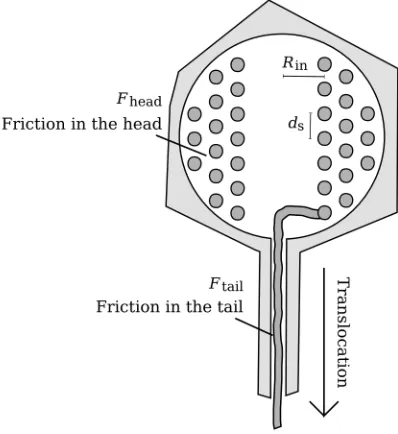
is unsurprising, since the capsid size is fixed, and at some point either the motor will not be strong
Figure 2.1: Diagram of a bacteriophage λ capsid. Three important dimensions are marked: Rcapsid ≈
28.5 nm represents the inner radius of the head, where the genome is stored; Rtail ≈ 2 nm is the inner
diameter of the tail tube through which the DNA is translocated (this value is unknown); andLtail ≈100nm
is the length of the tail.
Figure 2.2: The inverse-spool model of DNA packaging in a bacteriophageλcapsid, in cross section. The circles indicate the DNA genome, wound many times around the capsid, from the outside to the inside, terminating at an inner radiusRin. The DNA forms a hexagonal lattice with spacingds; the internal energy
[image:15.612.202.401.388.605.2]• There is a minimum amount of DNA required in aλcapsid, which is not due to the necessity of any
particular genes for reproduction (Feisset al. 1977). In fact, arbitrary DNA may be used to reach
the minimum. This may be due to an inability of the phage to inject its DNA into the cell when the
internal pressure is too low.
• Phages with long genomes have a strict requirement of Mg2+ ions for survival—this is almost
cer-tainly due to the pressure-reducing effect of Mg2+; without it, the capsids may explode (Parkinson
and Huskey 1971).
• DNA condensing ions such as spermine causeλphages to lose their infectivity. Since DNA
conden-sation involves increasing attractive forces between the DNA, it stands to reason that the effect on a
phage capsid is to reduce the internal DNA pressure, and if the pressure is necessary for infection, this
reduction in pressure could cause a loss of infectivity (Katsura 1983).
2.1.1 Goals for the model
The arguments about pressure within the phage capsid presented in the previous section must be made more
specific for us to proceed. What we mean when we say that internal pressure drives ejection is precisely
that there is a free energyGconf associated with the conformation of the DNA within a phage capsid, and thatGconfis an increasing function of the lengthLDNAof the packaged DNA. As the DNA exits the capsid,
LDNAdecreases, and we derive a force driving the ejection
Fconf= +
∂Gconf(LDNA, Vcapsid)
∂LDNA
, (2.1)
where the positive sign indicates that the force is directed into the host cell. Our objective is to make
quantitative predictions for the relationship
LDNA−→Fconf
for bacteriophageλunder conditions corresponding to the experiments described in Section 3.1. In fact, our
primary goal in developing the model is to compare its predictions to our experimental results, so we will
make sure it is both
(b) minimal, in that we will leave out effects that are poorly understood or too small to be tested.
To satisfy (b), we will first derive three simple models: two that just take the interaxial electric forces
into account ( Sections 2.1.2 and 2.1.3), and one that only takes DNA bending elasticity into account
(Sec-tion 2.1.4). We will conclude (Sec(Sec-tion 2.1.5) by comparing all three models in light of the precision of
experimentally-accessible data to find our minimal and complete model.
2.1.2 Simple model I: counterion entropy
A first step toward understanding pressure withinλis to compute how much of the internal volume of the
capsidVcapsidis taken up by theλgenome. Specifically, we are interested in the quantity
α= VDNA
Vcapsid
= πr
2
DNALDNA
4
3πRcapsid3
= 5.2×10
4nm3
9.7×10⁴nm3 = 0.53. (2.2)
We see that about 50% of the space inside ofλis taken up by DNA. This number is approximately the same
for all tailed phages, as shown in Table 2.1.2, while viruses that infect eukaryotic cells typically have a much
smaller value ofα. The following model shows thatα≈0.5, together with some very basic considerations, directly implies a pressure of tens or hundreds of atmospheres.
Experimentally, phage λmust always be suspended in a buffer solution containing both positive and
negative ions; the positive ions, in particular, are necessary to balance the negative charge (2 e−/bp) of DNA. Since 50% of the space in the capsid is taken up by DNA, the remaining 50% is filled with water
and counterions. Since the phage capsid is porous (except perhaps in the case of T4), counterions will be
exchanged freely with the experimental buffer. The volume of a base pair of DNA isVbp =πrDNA2 ·0.34nm,
so the counterion density is
ρ= 2e−/qionVbp, (2.3)
whereqionis the charge of the positive counterion. For Na+, we haveρ = 2nm−3, or 3.3 M. The entropy
ofN ions in a volumeV is approximated by
S=kBlogVN, (2.4)
so that the pressure is
T∂S(N, V) ∂V =
N
Host Virus Type Diameter (nm) Genome (kbp) α(%) Spacing (nm)
Bacteria λwt dsDNA 57 48.5 53.4 2.61
T7 dsDNA 55 40 49.0 2.72
φ29 dsDNA 44.1 19.3 45.9 2.81
λb221cI26 dsDNA 57 38 41.9 2.94
MS2 ssRNA 23 3.6 23.3 2.76
Eukarya poliovirus ssRNA 27 7.4 29.8 2.44
CCMV ssRNA 20.8 3.2 28.2 2.51
west nile ssRNA 34 11 22.2 2.83
HIV ssRNA 70 18.4 4.3 6.43
smallpox virus dsDNA 220 186 3.6 10.04
mimivirus dsDNA 400 800 2.6 11.81
SARS ssRNA 100 29.8 2.4 8.61
Table 2.1: Packing of the genome into various bacterial and eukaryotic viruses. For each virus, the table shows the capsid radius (averaged to give the correct volume for non-spherical viruses), genome type and size, the inferred fraction of space taken up in the capsid, α, and the resulting spacing between strands, assuming hexagonal packing throughout the interior. What we see here is that the tailed phage all have
α ≈ 50%, while RNA phages and eukaryotic viruses tend to have much lower values ofα. References for λ: Feiss et al. (1977); Earnshaw and Harrison (1977); Dokland and Murialdo (1993); T7: Cerritelli
et al.(1997); φ29: Taoet al.(1998); MS2: Koninget al.(2003); poliovirus: Lentzet al.(1997); CCMV:
which is the familiar expression for the osmotic pressureΠ. We have
ΠNa=ρ·kBT = 2nm−3·4pN nm= 8.0pN nm−2= 79atm. (2.6)
Alternatively, for Mg2+, we find an osmotic pressure reduced by a factor of two, to 40 atm.
The intent of the preceding estimates is to give us a feeling for the high concentrations and pressures
found within a phage capsid. Strictly, what the partial derivative in Equation 2.5 means is that this pressure
quantifies howGconfchanges if the capsid volume is changed without a concurrent change in the number of counterions. One way that the volume accessible to counterions can increase is if the DNA is translocated
into the capsid, say by a distance∆x. The change in accessible volume is given byπ rDNA2 ·∆x. This means that we multiply8.0pN nm−2by the cross-sectional area of DNA to findFconf= 25pN, an estimate for the scale of the force that the pressure applies to the DNA at the beginning of genome translocation. However,
as the DNA exits the capsid, the number of counterions within the capsid will change. We must add terms to
Fconfthat take into account the change inGconf with respect to the number of counterions. In the language of thermodynamics, these terms represent the difference in chemical potential encountered by the ions as
they exit the capsid.
To estimate the force more precisely, we consider a system of N ions, with N1 found in a volume
of water V1 within the capsid, and N2 found in a volume of water V2 outside of the capsid. Following
Equation 2.4, the numbers of arrangements of the ions inside and outside of the capsid areVN1
1 andV
N2
2 ,
respectively. An additional factor NN
1
accounts for the number of possible choices for which ions are found
within the capsid, giving us an expression for the total entropy:
S =kBlog
N N1
VN1
1 V
N2
2
≈kBlog
NN1
N1N1
VN1
1 V
N2
2
. (2.7)
We compute the force on the DNA by differentiating the free energy with respect to the lengthLDNAof the
DNA left inside the capsid:
Fconf=−T
dS dLDNA
≈ −kBT
dN1
dLDNA
logN − dN1
dLDNA
logN1 (2.8)
+ dN1
dLDNA
logV1−
N1
V1
·πr2DNA− dN1
dLDNA
logV2+
N2
V2
·πr2DNA
which we can rewrite conveniently as
Fconf =T
dS dLDNA
≈kBT
dN1
dLDNA
logρ1
ρ + (ρ1−ρ)·πr
2 DNA
, (2.9)
whereρ is the concentration of counterions outside of the capsid andρ1 is the concentration inside. The
force is positive,i.e., directed out of the capsid, and made up of two terms. The first corresponds to the force
required to transport ions against a chemical potential difference, while the second is the pressure-area force
that we calculated earlier. In terms of the parameters relevant toλ, we have
dN1
dLDNA
= 2e −
qion·0.34nm
; (2.10)
ρ1 =
2e−LDNA/qion/0.34nm
Vcapsid−πrDNA2 LDNA
. (2.11)
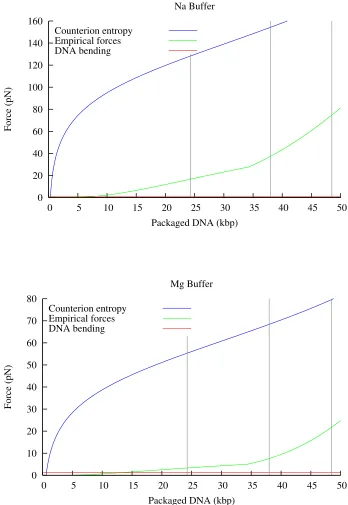
It is apparent that as DNA leaves the capsid, the pressure will decrease. A plot of the quantitative predictions
of this model is shown in Figure 2.4. What we see from this plot is that forces of 100–200 pN are predicted;
the shape of the curve is dominated by the logarithmic chemical potential term. In fact, by completely
ignoring the three-dimensional arrangement of the ions inside and outside the capsid, we are missing some
important details that reduceFconf to a fraction of this value. Theoretical treatments such as the Poisson-Boltzmann approximation or the theory of condensation by Manning (1969) would take into account the fact
that some ions remain close to DNA after its exit from the capsid, reducing the entropy gain from exiting
DNA. However, for a variety of reasons, first principles models of the pressure within tightly-packaged DNA
do not give very accurate results when compared to real-world data. Perhaps the most important is the fact
that the discrete nature of the ions is ignored in continuum statistical mechanics approximations. Ion-ion
interactions and the particular locations of the charged phosphate groups on the DNA backbone are both
difficult to model in a simple theory. A Monte Carlo simulation technique by Lyubartsev and Nordenski¨old
(1995) was successful in taking these features into account, but the effects of large-scale bending fluctuations
in the structure of DNA itself could not be included.
2.1.3 Simple model II: empirical interstrand forces
Beyond theoretical calculations, the most reliable numbers come from measurements on bulk DNA,
com-pressed by osmotic pressure (Rauet al.1984; Parsegianet al.1986; Podgorniket al.1995; Streyet al.1997,
into hexagonally packed liquid crystals, as a function of the interstrand spacingds(See Figure 2.2.) A main
result of this body of work is that the dependence fits well to an exponential in the relevant range for phage
packaging:
Π = Π0e−ds/c, (2.12)
where Π0 is the hypothetical pressure at zero spacing, andc is a decay constant that corresponds to the
length scale of the interactions between the DNA strands. The free energyGof DNA in the capsid is given
by integrating the forces required to assemble it from infinity:
G= Z ∞
ds
Π∂Vcapsid(LDNA, ds)
∂ds
d(ds) = √
3·Π0e−ds/c·LDNA
cds+c2
. (2.13)
In working with these expressions, note that for hexagonal packing of a lengthLDNAinto a volumeVcapsid,
√ 3 2 d 2 s = Vcapsid LDNA ; (2.14)
∂ds(LDNA, Vcapsid)
∂LDNA
=− ds
2LDNA
. (2.15)
Using these expressions can derive a force for inserting DNA from bulk solution into a phage capsid: it is
given by the derivative of the free energy
∂G(LDNA, Vcapsid)
∂LDNA
=
√
3 2 ·Π0e
−ds/c
d2s + 2cds+ 2c2
. (2.16)
There are three terms in Equation 2.16: thed2s term is what you get if you na¨ıvely multiply the pressure by
the effective areaVcapsid/LDNA of the DNA in the capsid, while the other two terms have to do with the
interaction energy of additional DNA with its neighboring strands (about 25% of the total of all three terms.)
Equation 2.16 was used to calculate the forces from the parametersΠ0andcin previous work (Purohitet al.
2003, 2005; Graysonet al.2006).
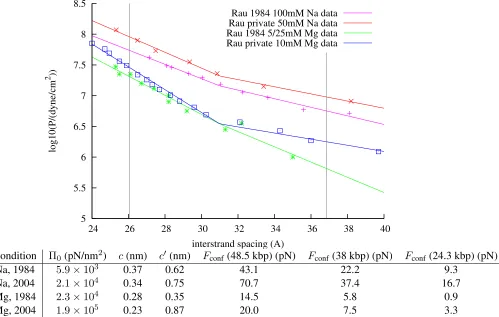
The values of the parametersΠ0 andccan be extracted from the measurements of Rauet al.. But how
accurately can we know these parameters? One way to address this issue is to use the variations found
in pressure measurements taken under slightly different buffer conditions, at different times, by different
experimenters. Figure 2.3 shows several sets of X-ray scattering data under different conditions.
dependence and another with a higher value ofc. Since the force is derived from an integral over all DNA
spacings, this will have an effect, especially at low packing fractions. Let us define the two exponential
regimes as: Π =
Π0e−ds/c ifds< a;
Π00e−ds/c0 otherwise.
(2.17)
Here we set
Π00 = Π0e−a/c+a/c
0
(2.18)
to ensure that the function is continuous. With this new formula, we can recalculate:
Gconf= √
3·Π0e−ds/c·LDNA
cds+c2
−√3·Π0e−a/c·LDNA
ca+c2
+√3·Π00e−a/c0 ·LDNA
h
c0a+c02i ifds< a; √
3·Π00e−ds/c0 ·L
DNA
h
c0ds+c02
i
otherwise.
(2.19)
Fconf = √ 3 2 ·Π0e
−ds/cd2
s + 2cds+ 2c2
−√3·Π0e−a/c·
ca+c2
+√3·Π00e−a/c0·hc0a+c02i ifds< a;
√
3
2 ·Π
0
0e−ds/c
0h
d2s + 2c0ds+ 2c02
i
otherwise.
(2.20)
Note that the equations imply thatFconfis a continuous function ofds, despite the change in parameters at
ds = a. The value ofds can be found as a function ofLDNAandVcapsid from Equation 2.14. Figure 2.3
shows our fits to the various sources of experimental data on DNA packing, together with predictions from
the present model forλ. What we see is a 30–60% variation ofFconf, depending on the source of the data used in fitting. This is due to differences in buffer conditions and also probably systematic errors in the
experimental techniques, which differ slightly between the datasets. We have chosen the parameters derived
from the more recent datasets for use in further calculations, including the plot ofFconfshown in Figure 2.4.
2.1.4 Simple model III: only bending energy
So far we have considered the energy required to bring strands of DNA in a closely packed arrangement.
5 5.5 6 6.5 7 7.5 8 8.5
24 26 28 30 32 34 36 38 40
log10(P/(dyne/cm
2 ))
interstrand spacing (A)
Rau 1984 100mM Na data Rau private 50mM Na data Rau 1984 5/25mM Mg data Rau private 10mM Mg data
Condition Π0(pN/nm2) c(nm) c0(nm) Fconf(48.5 kbp) (pN) Fconf (38 kbp) (pN) Fconf(24.3 kbp) (pN)
Na, 1984 5.9×10³ 0.37 0.62 43.1 22.2 9.3
Na, 2004 2.1×10⁴ 0.34 0.75 70.7 37.4 16.7
Mg, 1984 2.3×10⁴ 0.28 0.35 14.5 5.8 0.9
[image:23.612.85.584.189.506.2]Mg, 2004 1.9×10⁵ 0.23 0.87 20.0 7.5 3.3
Figure 2.3: Pressure vs. spacing data from Rau and Parsegian. Some of the sets were privately communi-cated to me (2004) for salts in the presence of 10mM TRIS, some were taken from the plots in Rauet al.
(1984). Parameters were extracted using exponential fits to the data from 24–32 nm. The vertical gray lines correspond to thedsvalues forλwhen 100% and 50% of the DNA is packed. For these spacings the forces
bent to fit into the capsid (Garciaet al.2007), so there is an additional energy that should be considered: the
bending energy of DNA, which is given in (Boal 2002):
∆Ebend = ∆L· 1
2ξkBT R
−2, (2.21)
whereR is the radius of curvature of a lengthL of DNA. Let us consider a model in which the capsid is
filled uniformly with a lengthLDNAof DNA, but only the bending energy contributes toFconf. Following Purohitet al.(2003), we will assume that the DNA is packed into an inverse-spool, though a ball-of-twine
model in which the axis of spooling varies with radius could lead to a slightly smallerFconf(calculation not shown). For an inverse spool, the total bending energy is given by an integral of Equation 2.21 over the
volume of the capsid, which can be thought of as a sum of many concentric cylindrical shells of DNA of
area4πrqR2capsid−r2. We will assume the DNA is packed down to an inner radius ofR
in, which gives
the following expression for the total energy:
Ebend =
ξkBT
2
Z Rcapsid
0
4πrqR2
capsid−r2r
−2 L
Vcapsid
dr (2.22)
= 4πξkBT LRcapsid
2Vcapsid ·
log R
Rin
+ logq1−R2
in/R2capsid
−q1−R2
in/Rcapsid2
(2.23)
≈ ξkBT L
2 ·(0.33·Rcapsid)
−2, (2.24)
where we have obtained the final approximation by putting in a value of 1 nm forRin, representing the
absolute limit of DNA bending. (The result is very weakly dependent onRin.) What this expression means
is that DNA has the same bending energy that it would have if it were all bent at an “average” radius of
0.33·Rcapsid. This means that DNA feels a force during translocation of
Fconf =
dEbend
dL = ξkBT
2 ·(0.33·Rcapsid)
−2≈1.2pN. (2.25)
This value is an upper bound for the contribution of DNA bending stiffness toFconf: according to the inverse spool model, at low packing fractions the DNA arranges itself around the outer surface of the capsid, with
a higher average radius than for a fully packed capsid, so we would expect the bending force to be lower.
However, as shown in Figure 2.4, the value of 1.2 pN is so low that we don’t expect it to play any important
2.1.5 Comparison of the models
Figure 2.4 compares the models derived in the previous three sections. What we can see from this graph is
that the model based on counterion entropy alone (Model 1) gives much higher predictions forFconf than the model based on empirical measurements of DNA (Model 2). Most of the difference between these two
models appears during the first 10 kbp of DNA packaging, due to the rising chemical potential difference as
the concentration of ions within in the capsid approaches molar levels. Model 3, taking into account only
the bending energy, predicts a relatively much smallerFconf, which only exceeds Model 2 when less than about 10 kbp is packaged. At these low packing fractions, the bending force is actually an overestimate,
since the DNA is able to rearrange, causingRinto be much larger. More detailed models allowRinto vary,
effectively combining Models 2 and 3 to compute a energy-minimizing arrangement for the capsid (Purohit
et al. 2003, 2005). However since the contribution of the bending energy to the force is so small, these
models do not predict a significantly different force from Model 2 alone. Model 2 will be used to calculate
0 20 40 60 80 100 120 140 160
0 5 10 15 20 25 30 35 40 45 50
Force (pN)
Packaged DNA (kbp) Na Buffer
Counterion entropy Empirical forces DNA bending
0 10 20 30 40 50 60 70 80
0 5 10 15 20 25 30 35 40 45 50
Force (pN)
Packaged DNA (kbp) Mg Buffer
[image:26.612.127.475.81.586.2]Counterion entropy Empirical forces DNA bending
2.2
Modeling the mobility of DNA during ejection
Section 2.1 explained how pressure produced by the confined DNA within a phage capsid leads to a force
Fconfduring translocation. Other forces may affect translocation: for example a forceFosmoriginates from internal osmotic pressure in the host cell. To a student of freshman physics, it is tempting to add up all of
the forces and apply Newton’s law. Suppose the total force isF = 1pN. Using the mass of theλgenome, we find the acceleration
dv dt =
F m =
1·10−12N
5·10−20kg = 2·10
7m/s2. (2.26)
Clearly such an acceleration can’t continue for very long: like all macromolecular systems, the DNA will
be constrained by molecular-scale friction. Instead of acceleration, we have a force balance:
Fconf+Fosm+Ffric(v) = 0. (2.27)
It is not clear how to address friction at the molecular level. However, since the DNA is in a fluid state (Strey
et al.1997), we expect the frictional forceFfric(v)to behave like macroscopic hydrodynamic drag,
increas-ing with velocity. In fact, it will be useful to assume a linear dependence:
Fconf+Fosm−v/µ= 0, (2.28)
whereµ, which we call themobility, characterizes the frictional force. The problem of modeling friction
during DNA ejection is thatµdepend on the configuration of the DNA. With one exception (Z´arybnick´y
1969), theoretical papers have avoided explicitly estimating the friction, focusing instead how the friction
should scale with parameters like the concentration of DNA within the capsid (Gabashvili and Grosberg
1991, 1992; Spakowitz and Wang 2005; Inamdaret al.2006). However, Section 3.2 describes an experiment
that can make a direct measurement ofµ, demanding a theoretical interpretation. This section aims to satisfy
that demand with several quantitative estimates ofµ.
2.2.1 Friction in the phage tail
In this section we discuss the drag that is experienced by the DNA as it translocates through the tail, due to
friction in a hypothetical layer of water between the DNA and the inner wall of the tail. The method of this
We begin by assuming that the pore opened by the phage is a annular tube: it is bounded by the DNA
on the inside and the tail proteins on the outside. The general solution for cylindrically symmetric flow with
an inner boundary atrDNAis a standard result; see, for example, Weisstein (2005). The flow velocityuis a
function only ofr, given by:
u(r) =u(rDNA)−
Q
4ηLtail
r2−rDNA2 −clog(r/rDNA)
. (2.29)
HereQrepresents the pressure difference along the length of the tail. In the case of DNA translocation at
velocity v, the boundary conditions are thatu(rDNA) = v andu(Rtail) = 0, resulting in a value for the
constantcof:
c= R
2
tail−rDNA2 −v· 4ηLtail
Q logRtail/rDNA
. (2.30)
The shear force exerted by the water on the DNA is given by
Ftail = 2πrDNALtailη
du
dr =−πrDNA Q
2 (2rDNA−c/rDNA) . (2.31)
Substituting the value ofcfrom Equation 2.30 and expanding the result, we find
Ftail =−πrDNA
Q
2
2rDNA−
R2
tail−rDNA2
rDNAlogRtail/rDNA
− v·2πηLtail
logRtail/rDNA
. (2.32)
Notice that Equation 2.32 consists of two terms: one that is linear in the pressure differenceQand one that
is linear inv. Using the values given earlier forη,Rtail,rDNA, andLtail, we find
Ftail = 3.7nm2·Q−2.2×10⁻⁴ pN·s
kbp ·v . (2.33)
We will examine the meaning ofQin Section 2.3; for now, let us assume thatQ= 0. Under the assumption that the tail provides the only source of friction, we find
µ= 4500 kbp
s·pN. (2.34)
What should be recognized in this case is thatµis independent of the configuration of the DNA: it will be a
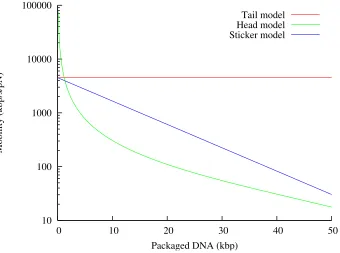
constant throughout the translocation process. Also, it should be understood that under this approximation,
other predictions for the mobility in Figure 2.5.
2.2.2 Friction in the phage head
Gabashvili and Grosberg (1991) suggested three sources of friction for genome translocation: friction in
the tail, friction between the DNA and the inner surface of the phage head, and friction between
neighbor-ing sections of DNA in the head. Section 2.2.1 focused on the first source of friction; in this section we
will make an estimate of the last, which is caused by DNA sliding past itself as it exits the capsid. In a
hexagonally-packed arrangement, one section of the DNA has six neighbors, separated from it by a water
layer of thicknessds−2·rDNA. As the DNA slides out of the capsid, each of the neighbor sections will
be moving, possibly in different directions. The central section will be subjected to a friction that depends
on how fast the neighbors move: if they move in opposition, the force will slow down translocation, while
if they move together, the force will speed up translocation. We have no way of knowing what the exact
arrangement of the DNA will be as it slides out, so we suggest a reasonable approximation: assume that the
opposing and aligned motions of the neighbor strands cancel out to an average of zero velocity. Then we
can imagine that the central strand is actually moving within a stationary tube of radiusds−rDNA, so the
force can be found with Equation 2.32:
Fhead = −
v·2πηLDNA
log (ds−rDNA)/rDNA
; (2.35)
µ = 1
2πηLDNA
·log ds−rDNA
rDNA
. (2.36)
Here,LDNAis the amount of DNA remaining in the capsid. According to Table 2.1.2, for a fully packedλ
(LDNA= 16µm) we haveds = 2.61nm. These numbers lead to the numerical result
µ= 6.8µm·s−1pN−1 = 20.kbp·s−1pN−1. (2.37)
The friction is about 200 times stronger under this approximation, which makes sense, since the genome
is about 200 times longer than the tail alone. However, as the DNA exits the capsid,LDNAwill decrease,
causingµto increase. The predictions of a mobility model, taking into account only the friction in head, are
2.2.3 Friction from layer sticking (Grosberg/Rubinstein model)
This section discusses an idea proposed by Rubinstein and Grosberg (2007) to explain experimental
mea-surements of mobility by Graysonet al.(2007) (we discuss the experiments in Section 3.2.) The basic result
of those experiments is thatµis an exponential function of the amount of DNA within the capsid with a
decay constant of L0 ≈ 10 kbp. The suggestion, based purely on the empirical observation of an
expo-nential dependence, is that this could be modeled by hypotheticalstickerson the DNA, spaced at a linear
densityσ on the DNA, that fluctuate between bound and unbound states. When bound, the DNA is “stuck”
and unable to translocate, but when the sticker is unbound, it may translocate freely. Suppose that when it
is moving freely in the head, it has mobilityµ0 = 4500kbp/s·pN given entirely by resistance in the tail.
To understand the implications of this model, we must compute how much time the DNA spends in its free
state.
We model the stickers with the assumption that each has a probability of being unbound given by the
Boltzmann factor:
P1 =
exp(−ε/kBT)
1 + exp(−ε/kBT)
, (2.38)
where ε is the sticking energy. Then the probability for theN = σL stickers to all be simultaneously unbound, allowing the DNA to move, is
P =
exp(−ε/kBT)
1 + exp(−ε/kBT)
σL
. (2.39)
Then the average mobility is given by
µ=µ0·
exp(−ε/kBT)
1 + exp(−ε/kBT)
σL
. (2.40)
Sinceεandσare unknown and probably unmeasurable constants, it will be most useful to rewrite this in a
simpler form:
µ = µ0·exp(−L/L0), with (2.41)
L0 = −σ−1log
exp(−ε/kBT)
1 + exp(−ε/kBT)
. (2.42)
equalσ−1 under any circumstances. In fact, for the likely situation thatε > kBT, we have
L0 =σ−1ε/kBT . (2.43)
Suppose, for example, sticking corresponds to a typical hydrogen bonding interaction withε/kBT ≈10.
Then we have
σ−1=L0/10≈1kbp. (2.44)
It is not clear what process could cause sticking every 1 kbp. The outer loops of DNA that make contact
with the capsid have sizes of approximately 300 bp, while an entire layer of DNA loops in the inverse spool
model contains about 5–10 kbp.
Alternatively, suppose that every base pair is equally likely to cause sticking:
σ−1 = 1bp; (2.45)
ε/kBT = 10−4. (2.46)
In this case, for the sticking model to be correct, we would have to think of a mechanism by which bases
can cause sticking with a probability of approximately10−4. The usefulness of this model is limited by our inability to think of a physical mechanism for the sticking process. In fact, since the model was just created
as an explanation for the data, we have no particular reason to believe that it accurately represents the reality
of the motion of the phage DNA. For example, it may be that a single loop or layer of DNA may move
without it being necessary for the entire length of the genome to be sliding; these possibilities may or may
not lead to different functional forms forµ. Despite the limitations of this model, its predictions are plotted
10 100 1000 10000 100000
0 10 20 30 40 50
Mobility (kbp/s/pN)
Packaged DNA (kbp)
[image:32.612.136.476.206.459.2]Tail model Head model Sticker model
Figure 2.5: Plots of the mobilityµ =v/F of DNA during the translocation process, under three different models, as a function of the amount of DNA within theλcapsid. The red curve takes into account only friction from the tail, giving a constant value forµ(see Section 2.2.1.) The green curve takes into account only friction from within the capsid, which gives a value that changes according to the spacing between the strands (see Section 2.2.2.) The blue curve takes into account only friction from “sticking” points spaced along the DNA, leading to an exponential dependence ofµon L; we have chosen the parameters so that
2.3
Calculating drag forces in the toilet-flush model
In the preceding sections we have discussed a theoretical model of the pressure within the capsid as well as
the friction that may be encountered during DNA translocation. It is also essential to consider the kinds of
forces that may be encountered whenλis actually ejecting its DNA into a host cell, since the phage/host
interaction may play an important role. Some discussion about the various kinds of effects that may come
into play during DNA translocationin vivois given in Section 3.3. Here we will describe the details of one
source of force that may speed up DNA translocation. The model described in this section is also described
elsewhere (Grayson and Molineux 2007).
2.3.1 Precise definition of osmotic pressure
Because bacterial cells lack a cytoskeleton, they rely on an internal pressure to push the cell membrane
outward. This pressure serves both to help maintain the cell shape and to allow the cytoplasm to increase in
volume as the cell grows. The internal pressure is created by the presence of concentrated solutes within the
cytoplasm, though it is unclear which solutes play the dominant role. Solutes by definition have an affinity
for water, so that there is an free-energy decrease associated with transferring a small volume ∆Vwater of water into the cell,
∆Fosm=−Π·∆Vwater, (2.47)
whereΠis the cytoplasmicosmotic pressure, a number that depends on the concentrations of various solutes in the cytoplasm relative to the extracellular space. This osmotic pressure can be measured in various ways:
Stocket al.(1977) measured the cellular contents ofE. coliunder various osmotic conditions and computed
a theoretical pressure of 0.33 pN/nm2forE. coligrowing rapidly but approaching saturation; Knaysi (1951)
appliedplasmolysis, a contraction of the cytoplasm away from the outer membrane, at various times during
growth of an E. coliculture, finding an osmotic pressure up to 1.5 pN/nm2 during initial rapid growth,
which stabilized at 0.2 pN/nm2. More references and discussion about the osmotic pressure withinE. coli
can be found in Neidhardt (1996), p. 1211. We will takeΠ = 0.3pN/nm2, or 3 atm as a standard value. In the absence of any constraints, water will flow into the cytoplasm, diluting the internal solutes, until the
pressure, defined by a free energy cost
∆Fhyd=P ·∆Vwater. (2.48)
In this case, water will continue to flow into the cell until an equilibrium is reached where the net free energy
benefit of transferring water is zero; where
P = Π. (2.49)
In many situations, this equilibrium is reached quickly, so there is no need to make a distinction between
osmotic pressure and the resulting hydrostatic pressure.
However, during rapid cell growth, the cytoplasm is clearly out of equilibrium to some extent, since
water is continuously flowing into the cell. In addition, there are various experimental techniques that
involve subjecting a cell to osmotic shocks, causing the cytoplasm to shrink or swell; in these experiments,
the cell is therefore temporarily out of equilibrium. The remainder of this section is concerned with the
problem of quantifying the extent to which the cell is out of equilibrium under these different conditions.
In particular, we will try to quantify the pressure imbalanceQ ≡Π−P, which will be positive whenever water is flowing into the cell, and negative when water is flowing out.
For the following estimates we will assume thatE. colihas a cell volume of0.4µm3 = 4×10⁸nm3. During rapid growth,E. colidivides once every 1200 s. This means that water must flow into the cell at a
rate of
Φ = 4×10⁸nm3/1200s= 3.3×10⁵nm3/s. (2.50)
The pressure imbalance depends on the permeability of the cytoplasmic membrane to water: a more
permeable membrane will allow the cell to stay closer to equilibrium. To estimate this permeability, we
turn to experiments in which measured osmotic shocks cause measurable changes in cytoplasmic volume.
Delamarche et al. (1999) report a water channel, AqpZ, that is present in the cytoplasmic membrane of
E. coli. In their experiments, cells are subjected to hyperosmotic shocks (Q <0), causing a shrinkage of the
cytoplasm, observable under cryo-electron microscopy, known as plasmolysis. From their graphs we see that
a 1 osM (2.6 pN/nm2) shock causes AqpZ+ cells to begin shrinking at a rate of∼0.2cell volumes/15 s= 5.3×10⁶nm3/s, while AqpZ- cells shrink much more slowly, at about6.7×105nm3/s. From this we can infer that AqpZ is the primary water device for water transport across the cytoplasmic membrane, and we
the influxΦof water andQ:
Φ = Q
2.6pN/nm2 ·5.3×10
6nm3/s=Q·2.1×106nm3/s·nm2/pN. (2.51)
The coefficient multiplyingQon the right side of Equation 2.51 is the permeability of the cell membrane
to water; the assumption of linearity allows us to make estimates for other conditions. For example, during
rapid growth, the rate of water influx implies a pressure imbalance of
Q= 3.3×10⁵nm3/s· 2.1×10⁶nm3/s·nm2/pN−1 = 0.16pN/nm2. (2.52)
Is the cell permeability given in Equation 2.51 reasonable? A simple hydrodynamics calculation shows
that it is. Laminar fluid flow through a cylindrical pipe is traditionally calculated using a formula owed to
Poiseuille:
Φ = Q
l π
8ηr
4 =Q·1.4×10⁴nm3/s, (2.53)
usingl = 2nm andr = 0.15nm as the length and radius of the AqpZ pore. This would imply that about 150 copies of AqpZ are required to give the cytoplasmic membrane the permeability given in Equation 2.51,
which is a very reasonable number for a membrane channel.
2.3.2 Implications of the toilet-flush model
The key result of the previous section is that the osmotic pressure imbalanceQofE. colicauses an influx
of water through all open channels. As we assumed already in Section 2.2.1, whenλbinds toE. coliit also
opens a channel through which water can flow: the space between the DNA and the inner surface of the tail.
This inrush of water will apply a force to the DNA, speeding up translocation into the cell.
Our goal is to compute the ratevat which DNA is translocated into the cytoplasm, in units of kbp/s, as
a function of the amount of DNA that has been translocated. The value ofvcan be compared to experiments
that quantitatively measure the translocation process. The basic equation that we will use to determine the
dynamics of the system is a balance of forces:
Fconf+Fosm+Ftail(v) = 0, (2.54)
respectively. The functionFtail(v) is the force due to water flowing between the tail and DNA. We have shown in Section 2.2.1 thatFtail reduces to a linear function of the pressure differenceQandv:
Fconf+Fosm+ 3.7nm2·Q−2.2×10⁻⁴ pN·s
kbp ·v = 0. (2.55)
Using the value ofQfrom Equation 2.52, we get a value of0.59pN for the pressure-dependent term of
Ftail. For the valueΠ = 0.3pN/nm2that was quoted earlier, we find thatP = 0.14pN/nm2, much reduced from its equilibrium value. This allows us to estimateFosm =P ·πr2DNA =−0.44pN. The force balance
of Equation 2.33 now becomes
v= Fconf+ 0.15pN
2.2×10⁻⁴pN·s/kbp =Fconf·4500
kbp
pN·s+ 680kbp/s . (2.56)
This model predicts extremely high velocities for DNA translocation intoE. coli, suggesting that the DNA
may be completely translocated into the cell in less that 0.1 s. However, we have made numerous
assump-tions in our calculaassump-tions, so that our numbers can easily be off by an order of magnitude. For example, the
thickness of the gap between the DNA and tail is not accurately known, and it varies along the length of the
tail. A gap of 0.3 nm, for example, enough for just one layer of water, would result in a prediction that the
term ofFtaildepending onQis not high enough to overcomeFosm; in this case additional source of energy would be required for translocation of the entire genome. We have also completely ignored the fact that
water itself is discrete on the nanometer scale, so that describing its flow with a continuum fluid dynamics
model is somewhat absurd. However, in the absence of better experimental data on the flow through
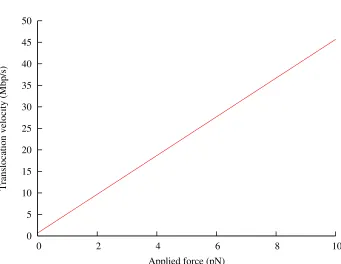
phage-induced channels, the continuum approximation is the best that we have. Figure 2.6 shows the translocation
velocities predicted by this model for forces in the range of 0–10 pN.
The translocation speed at Fconf = 0, 680 kbp/s is fast enough to be consistent with all experiments on phage ejection in vivo: no phage has ever been observed to eject its DNA faster than that. There are
cases, such as T7, in which the DNA is observed to enter the cell much moreslowly; this can be attributed
to mechanisms that slow down the motion of the DNA, such as a constriction region in the channel causing
direct channel-DNA interaction (Kempet al.2004).
The only source we used for the permeability of cell membranes is the study by Delamarcheet al.(1999).
A further study, using real-time fluorescence and light scattering measurements, concluded that plasmolysis
0 5 10 15 20 25 30 35 40 45 50
0 2 4 6 8 10
Translocation velocity (Mbp/s)
[image:37.612.132.473.211.475.2]Applied force (pN)
2005). It is unclear why there is such a huge discrepancy between the two results, but such a highly
perme-able cell membrane would make the forces computed in this paper entirely negligible. The former paper is
more satisfying, both because of its single-cell images that reveal exactly what is happening in the
experi-ment, and because it provides a natural explanation for why bacterial cells must be highly pressurized. It is
also worth mentioning that, according to our calculations, the AqpZ- mutants of Delamarcheet al.(1999)
should not be able to grow as rapidly as the wild-type, unless they have an internal osmotic pressure of at
least1.6pN/nm2= 16atm.
We assumed 0.3 pN/nm2 for the osmotic pressure inside of a cell without much comment, but, as was
discussed, it may be five times higher during rapid growth, presenting a much higher force resisting DNA
entry.
To conclude, we have thoroughly considered the motion of water molecules entering the cytoplasm
through a phage-induced channel. It appears that forces from hydrodynamic drag may be a significant
contributor to the total force on the DNA, and that they are potentially responsible for translocation of the
entire genome. In estimating these forces, it is essential to understand the difference between hydrostatic and
osmotic pressures, which will not be equal in non-equilibrium situations. In any case, there are numerous
unknown quantities in the estimates, and it is hard to draw strong conclusions about the role of hydrodynamic
drag. Experiments to examine these hydrodynamic forces, and non-equilibrium osmotic pressure in general,
Chapter 3
Experiments on the bacteriophage ejection
process
It is the author’s strong belief that for biology, theory and experiment must go together. A good theory
makes predictions for quantities that can be tested experimentally, which is why Chapter 2 makes a series
of specific predictions, without any free parameters. Even when the parameters are unknown, it is important
to make reasonable estimates, so that it is possible to identify theories that make completely unreasonable
predictions. Similarly, it is essential for experimenters to design experiments to give quantitative results that
can be directly compared to theory. In this chapter we describe a series of experiments onλthat complement
the theoretical models. With the model set by Luria and Delbr¨uck in mind, we hope that for some of the cases
agreement between theory and experiment will clarify our understanding of how phages work. Specifically,
we have carried out an experiment (Section 3.1) to test the pressure estimates of Section 2.1; an experiment
(Section 3.2) that measures the velocity of DNA ejection fromλin vitro, for comparison to the estimates
of mobility in Section 2.2; and we have made progress on an experiment to visualize the ejection process
in vivo (Section 3.3) for comparison to models such as the one presented in Section 2.3. In Section 3.4,
we discuss a comparison of our results on the ejection process with measurements on DNA packaging in
phages.
3.1
Experimental measurement of ejection force
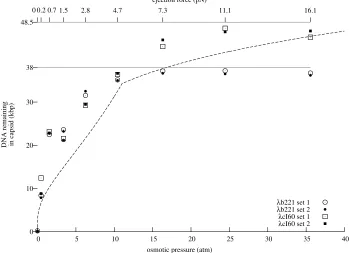
Figure 3.1: Experimental measurement of ejection force. A. LamB binds to phage tails, triggering the ejection of DNA. The ejection reaches an equilibrium when the internal force balances the osmotic force due to PEG. B. DNase I cuts the ejected DNA into small fragments. C. Phages are removed by centrifugation, leaving the ejected fraction of the DNA in solution. See Section C.7 for the details of the procedure.
bring the accuracy to the level where the quantitative theory of Section 2.1 may be tested. Most generally,
the model predicts thatFconf is a function only of the amount of DNA within the capsid; what this means is that the original genome size of the phage should not affectFconf. A fortuitous feature ofλis that there are mutants available with different genome sizes: in this experiment, we usedλcI60, which has a wild-type
genome length of 48.5 kbp, andλb221cI26, with a genome length of approximately 38 kbp (Feisset al.
1977). See Section C.3 for the technique we used to accurately measure the length ofλgenomes.
The experimental procedure is described in detail in Section C.7 and is illustrated in Figure 3.1.