Volume 78
Issue 2
Summer
Article 1
Summer 1987
Stranger Violence: Perspectives, Issues, and
Problems
Marc Riedel
Follow this and additional works at:
https://scholarlycommons.law.northwestern.edu/jclc
Part of the
Criminal Law Commons
,
Criminology Commons
, and the
Criminology and Criminal
Justice Commons
This Symposium is brought to you for free and open access by Northwestern University School of Law Scholarly Commons. It has been accepted for inclusion in Journal of Criminal Law and Criminology by an authorized editor of Northwestern University School of Law Scholarly Commons.
Recommended Citation
0091-4169/87/7802-223
THE JOURNAL OF CRIMINAL LAW & CRIMINOLOGY Vol. 78, No. 2
Copyright 0 1987 by Northwestern University, School of Law Printed in U.S.A.
SYMPOSIUM
STRANGER VIOLENCE: PERSPECTIVES,
ISSUES, AND PROBLEMS*
MARC RIEDEL**
I. INTRODUCTION
Stranger violence represents one of the most frightening forms of criminal victimization. Conklin' and McIntyre2 have argued that the fear of crime is basically a fear of strangers. It is suggested that people fear the unknown person who commits an unpredictable and violent attack on a vulnerable and innocent citizen going about rou-tine daily activities. The perceptions that the attacker is indiscrimi-nate in his selection of the victim and that the victim can do little to avoid attack or protect himself also elicit fear in society. The urban dweller, in particular, confronts what Silberman refers to as a
"star-tling paradox":
Life in metropolitan areas . . . involves a startling paradox: we fear
strangers more than anything else, and yet we live our lives among strangers. Every time we take a walk, ride a subway or bus, shop in a supermarket or department store, enter an office building lobby or el-evator, work in a factory or large office, or attend a ball game or the movies, we are surrounded by strangers. The potential for fear is as immense as it is unavoidable.3
The fear of crime from strangers has important consequences for life in a civil society. People stay behind locked doors and travel by taxi or car rather than public transportation or on foot to avoid contact with strangers. When people go out, they travel in groups
* The author would like to express his appreciation to Thomas C. Castellano,
Center for the Study of Crime, Delinquency, and Corrections, Southern Illinois University, for his helpful comments and suggestions in preparing this paper.
** Associate Professor, Center for the Study of Crime, Delinquency, and Corrections,
Southern Illinois University. Ph.D., University of Pennsylvania, 1972. 1 j. CONKLIN, THE IMPACT OF CRIME (1975).
2 McIntyre, Public Attitudes Toward Crime and Law Enforcement, 374 ANNALS 34 (1967).
3 C. SILBERMAN, CRIMINAL VIOLENCE, CRIMINALJUSTICE 11 (1978).
and avoid returning to their homes at a late hour. They stay away from cultural and educational events if traveling to a certain section of the city at night is required. Such avoidance behavior represents what economists refer to as "opportunity costs." When people stay home, they are not enjoying the educational and cultural advantages of their community. By restricting with whom they will interact, the general level of sociability decreases. Such responses not only un-dermine the trust essential for a civil society, but diminish the qual-ity of life as well.4
Because of its extraordinary fear-provoking nature and negative implications for the quality of urban life, it might be assumed that stranger violence would be well researched; however, such is not the case. The purpose of this Symposium Issue is to stimulate research on the topic by presenting several articles which provide a descrip-tive foundation for the topic and to explore the relationship of stranger violence to other more familiar criminological dimensions. This Article is both introductory and integrative. It is introduc-tory in that it focuses on basic problems such as the incidence and trends in stranger violence, the theoretical status of the topic, and the conceptual issues confronting present and future research. It is integrative in that it weaves some of the major findings and perspec-tives of the Symposium papers into more general considerations of stranger violence.
II. THE INCIDENCE OF STRANGER VIOLENCE
A. STRANGER HOMICIDE
Data on the nationwide incidence and trends in stranger vio-lence are undeveloped. National estimates of the amount of stran-ger violence, excluding homicide, are available from victimization surveys.5 Estimates of the number of stranger homicides are avail-able from the Supplementary Homicide Reports (SHR) of the Uni-form Crime Reporting Program.
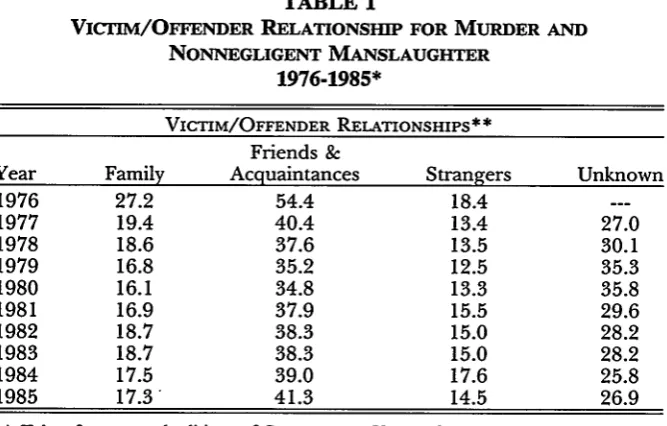
In 1976, the SHR began collecting information on homicide victim/offender relationships. Table 1 shows the distribution of vic-tim/offender relationships in murder and nonnegligent manslaugh-ter from 1976 through 1985.
Table 1 indicates that although murders and non-negligent manslaughters involving strangers decreased from 18.4% in 1976 to
4 J. CONKLIN, supra note 1; McIntyre, supra note 2.
5 BUREAU OF JUSTICE, U.S. DEP'T. OF JUSTICE, VIOLENT CRIME BY STRANGERS AND
PERSPECTIVES, ISSUES, AND PROBLEMS
TABLE 1
VICTIM/OFFENDER RELATIONSHIP FOR MURDER AND
NONNEGLIGENT MANSLAUGHTER 1976-1985*
VICTIM/OFFENDER RELATIONSHIPS**
Friends &
Year Family Acquaintances Strangers Unknown 1976 27.2 54.4 18.4
---1977 19.4 40.4 13.4 27.0 1978 18.6 37.6 13.5 30.1
1979 16.8 35.2 12.5 35.3 1980 16.1 34.8 13.3 35.8 1981 16.9 37.9 15.5 29.6 1982 18.7 38.3 15.0 28.2 1983 18.7 38.3 15.0 28.2 1984 17.5 39.0 17.6 25.8
1985 17.3' 41.3 14.5 26.9
* Taken from annual editions of CRIME IN THE UNITED STATES. ** Due to rounding percentages may not add up to 100.0%6.
13.3% in 1980, they increased to 17.6% in 1984. By 1985, murders involving strangers had again declined to 14.5%.
Murders involving family members decreased from 27.2% to 16.9% from 1975 to 1981, increased to 18.7% in 1982, and de-creased to 17.3% in 1985. Homicides involving friends and ac-quaintances decreased from 54.4% in 1976 to 34.8% in 1980 and increased to 41.3% in 1985. Nationwide, victim/offender relation-ships in which the relationship was unknown increased from 27.0% in 1977 to 35.8% in 1980, but declined to 25.8% in 1984.
Although homicides involving family and friends and acquain-tance homicides reported by the SHR may be valid, the available research suggests that the SHR substantially underreports the inci-dence of stranger murder and nonnegligent manslaughter. Zahn and Riedel examined the extent of this underreporting by compar-ing SHR frequencies to the frequencies of a number of variables recorded by the police departments of seven cities: Philadelphia, Newark, St. Louis, Memphis, Dallas, Oakland, and Ashton.6 Ashton
6 Zahn & Riedel, National Versus Local Data Sources in the Study of Homicide: Do They
Agree?, in 32 MEASUREMENT ISSUES IN CRIMINAL JUSTICE (G. Waldo ed. 1983); Riedel,
Nationwide Homicide Datasets: An Evaluation of UCR and NCHS Data, in MEASURING
CRIME: LARGE-SCALE, LONG-RANGE EFFORTS (D. MacKenzie, P. Baunach, & R. Roberg
eds.)(forthcoming). To measure the amount of agreement, the homicide frequencies reported by the SHR were divided by the frequencies recorded by the cities' police de-partments. If the frequencies of the two data sources agreed completely, the agreement
[image:4.454.63.397.51.264.2]is a pseudonym for a western, non-California city.
Zahn and Riedel examined the amount of agreement between the police department records and the SHR for the variables of sex, race, age of murder victims, and weapon, and they found no consis-tent reporting pattern.7 The victim/offender relationsnip variable,
however, reflected a consistent pattern of underreported stranger murders.8 The city police departments consistently recorded more stranger murders than were reported by the SHR.
The agreement ratios for stranger murders ranged from .071 in Oakland to .968 in Dallas. In other words, the Oakland SHR only reported about 7% of the stranger murders, and the Dallas SHR reported almost 97%. With the exception of Dallas, the agreement ratios were smaller than for either family murders or murders in-volving friends and acquaintances.
While stranger murders were underreported for the year in the seven cities analyzed, Riedel also found that stranger murders were underreported for six years in Chicago.9 Using data made available by the Statistical Analysis Center for the Illinois Criminal Justice In-formation Authority,10 comparisons were made between Chicago Police Department records of stranger murders and the SHR for the years 1976 through 1981. The results generally supported the seven-city analysis: the agreement ratios ranged from .954 in 1978 to .600 in 1980. As with the seven-city analysis, the ratios for the stranger murder category were the smallest of the three vic-tim/offender categories.
ratio was 1.000. If the SHR reported a higher frequency than the police, the ratio was greater than one. If the SHR underreported the frequency relative to that recorded by
the police, the agreement ratio was less than one.
7 Zahn & Riedel, supra note 6. For the total number of cases, the results suggest that
almost all cases of murder and nonnegligent manslaughter were included in the SHR. The difference in the number of cases between the two reporting systems ranged from one in Dallas to nine in Philadelphia. With respect to male victims in the seven cities, for example, the agreement ratios ranged from .947 in Oakland to 1.023 in Newark, thus indicating high agreement. For female victims, there was much less agreement, gener-ally in the direction of overreporting by the SHR. The agreement ratios ranged from .963 in St. Louis to 1.294 in Newark.
In general, there was no consistent reporting pattern. Newark frequently underre-ported in comparison to the SHR, but this was not always the case. There was some tendency for cities to record larger frequencies than the SHR, but this pattern was also not consistent.
8 Riedel, supra note 6.
9 M. Riedel, Stranger Violence: A Theoretical Inquiry (unpublished manuscript).
PERSPECTIVES, ISSUES, AND PROBLEMS
In his original study of this problem, Riedel concluded that the underreporting of stranger murders is a function of the reporting lag between local police departments and the Uniform Crime Re-porting Program."1 Using a computerized data base of all murders in Memphis from 1974 to 1978, Riedel compared the distribution of victim/offender relationships to a similar SHR distribution. The pattern of agreement was similar to that found later in the seven-city and Chicago data.'2 Riedel also found that stranger murders took longer to resolve, i.e., the time between the criminal event and the identification of its perpetrator was longer.'3 Because of this time lag, when the SHR were completed by police departments each month, the victim/offender relationship information was not avail-able and the case was recorded as being of unknown relationship. These records were then forwarded to the Uniform Crime Report-ing Program. If an arrest was made after this reportReport-ing of the of-fense, the victim/offender relationship was recorded in police records. An updated report, however, was not routinely forwarded to the Uniform Crime Reporting Program.
In addition to a reporting lag, the validity of the SHR's classifi-cation of homicides is questionable. In one of the few studies of its type, Loftin compared the homicide circumstances classification for the SHR to a classification generated by examining narrative sum-maries of each of the 196 cases from the files of the Baltimore City Prosecuting Attorney and the Public Information Office of the Balti-more Police Department.'4 The two classifications initially indi-cated a high degree of consistency. The Baltimore SHR classified
14.3% of the homicide circumstances as robbery and Loftin's coders classified 17.3% of the homicide circumstances as robbery.'5 When the cases were grouped and cross-classified, however, forty-two cases were classified as robbery-circumstance in one or both of the studies; only twenty cases were so classified in both studies. If the three categories are considered (robbery, not robbery, and undeter-mined), the two classifications agreed in 93 out of 196 cases, which represents only 47% agreement.16
Loftin concluded that the classification of robbery-related homicides was not very reliable. He suggested three problems with
11 M. Riedel, Stranger Homicides in an American City (November 11-14,1981)(paper
presented at the American Society of Criminology Meetings, Washington, D.C.).
12 See Zahn & Riedel, supra note 6.
13 See M. Riedel, supra note 11.
14 Loftin, The Validity of Robbery-Murder Classifications in Baltimore, 1 VIOLENCE AND
VIc-TIMs 191 (1986).
15 Id. at 195.
16 Id. at 196.
the SHR classification. First, categories used by the SHR are mutu-ally exclusive. This situation forces coders to place cases in only one category when more than one category is appropriate. Second, there are no clear rules for coding cases with ambiguous motives. Third, the SHR coders placed significantly more cases in the unde-termined category than did the coders used by Loftin. The failure to use an appropriate other-than-robbery category may have a major impact on studies of the correlates of robbery murder.1 7
In their Article included in this Symposium Issue, Loftin, Kin-dley, Norris, and Wiersema extended the analysis of classification to an examination of victim/offender relationships.'8 By developing
and testing the utility of a classification based on attributes of the victim and the offender, Loftin and his colleagues used homicide and SHR cases from the earlier study. Forty-three of the Baltimore homicides were classified as stranger homicides by either the SHR or attribute classification, but only nineteen, or 44%, were classified as homicides with stranger involvement by both classification approaches.
This research suggests that the use of the SHR may neither be accurate nor reliable as an indicator of the nationwide incidence and trends in stranger violence.19 Although the problem of comparabil-ity exists, one alternative is to examine recent studies of homicides in different cities in order to gain an indication of the proportion of homicides involving strangers.
Riedel and Zahn collected detailed homicide data from eight American cities for 1978.20 All homicide cases were collected in seven cities, and a 50% systematic sample was used in Chicago. Ta-ble 2 shows the victim/offender frequencies and percentages for the eight cities. Table 2 indicates substantial variation among the eight cities for the three victim/offender relationship categories. For homicides occurring within the family, the range is the smallest: from 11.2% to 21.1% of total homicides. For homicides involving friends and acquaintances, the figures range from 31.4% in Newark to 58.6% in Memphis. Stranger homicides range from 14.3% in Oakland to 29.0% in Philadelphia. For all eight cities, 23.5% of all homicides involved strangers.
17 Id. at 201.
18 Loftin, Kindley, Norris & Wiersema, An Attribute Approach to Relationships Between
Offenders and Victims in Homicides, 78 J. CRIM. L. & CRIMINOLOGY 259 (1987).
19 The total number of homocides, based on Return A, crimes known to the police,
appear to be accurately recorded. See Cantor & Cohen, Comparing Measures of Homicide
Trends: Methodological and Substantive Differences in the Vital Statistics and Uniform Crime Report Time Series (1933-1975), 9 Soc. ScI. RES. 121 (1980).
PERSPECTIVES, ISSUES, AND PROBLEMS
TABLE 2
VICTIM/OFFENDER RELATIONSHIPS AS REPORTED BY
EIGHT CITY POLICE DEPARTMENTS (1978)
Victim/ Philadelphia Newark St. Louis Offender
Relationship f
%
f%
fWithin Family 46 12.7 13 12.8 27 13.0 Friends and 138 38.1 32 31.4 92 44.4 Acquaintances
Strangers 106 29.3 28 27.4 37 17.9 Unknown 72 19.9 29 28.4 51 24.6 Total 362 100.0* 102 100.0 207 100.0 Victim/ Memphis Dallas Oakland
Offender
Relationship f f f
Within Family 16 13.8 44 18.9 11 11.2 Friends and 68 58.6 95 40.8 51 52.0 Acquaintances
Strangers 23 19.8 63 27.0 14 14.3 Unknown 9 7.8 31 13.3 22 22.4 Total 116 100.0 233 100.0 98 100.0 Victim/ Ashton Chicago** Total Cities Offender
Relationship f f f
Within Family 19 21.1 61 14.4 237 14.5 Friends and 38 42.2 206 48.7 720 44.2 Acquaintances
Strangers 21 23.3 92 21.7 384 23.5 Unknown 12 13.3 64 15.1 290 17.8 Total 90 100.0 423 100.0 1,631 100.0
** Based on a 50 percent systematic sample.
* Total percent rounded to 100.0%.
The range of approximately 14% to 29% is consistent with per-centages found in the majority of other recent studies using city po-lice records. An examination of victim/offender relationships in Chicago from 1978 through 1981 indicated that stranger homicides ranged from 22.0% in 1978 to 29.6% in 1981.21 Morgan and
21 M. Riedel, supra note 9.
Kratcoski2 2 selected a 50% sample of homicide cases from Cuyahoga County (Cleveland) for the years 1970 through 1979
(N= 1,655). These homicide cases were compared to data gathered
for the same years on all the non-justifiable homicide cases recorded by the Court of Appeals for the Sixth Circuit in Alabama, a jurisdic-tion which includes the county and the city of Tuscaloosa (N=99). For 1978-1979, stranger homicides constituted 22% of the homi-cides in Cuyahoga County, but constituted 40% of the homihomi-cides in Tuscaloosa County. The percentage from the ninety-nine cases in the city and the county of Tuscaloosa was the only one to fall outside of the 14% to 29% range mentioned above.
In a study of 569 homicides in Dade County (Miami) Wilbanks found that 11
%
of the homicides were classified as involving stran-gers.23 However, if the categories of citizens killing felons and felons killing citizens, both of which involved strangers, were in-cluded, the resulting percentage is 24.9.In their Article on relational distance and stranger homicide in this Symposium Issue, Silverman and Kennedy found that stranger homicides total 12% to 22% of all homicides.2 4 The studies report-ing the lower percentages were published before 1975. In their analysis, Silverman and Kennedy used data tapes of all Canadian homicides from 1961 through 1983. In more recent years, stranger homicide increased to a peak of 29% in 1980 and declined to 18% in 1982 and 1983.
In addition to specifying a range, the percentages of stranger homicides from various studies were ranked, and a median was com-puted. By using the percentages from the eight-city study, data from Chicago police records from 1978-1981, the Morgan and Kratcoski research results, the Wilbanks study, and three of the most recent studies cited by Silverman and Kennedy, it is estimated that the median of stranger homicides in the United States cities surveyed is approximately 22.0%. The Silverman and Kennedy data from 1978 through 1983 shows that the median of stranger homi-cides in Canada is also approximately 22.0%.
The estimates and ranges cited are approximations for three reasons. First, this analysis presumes that police records are a more accurate source of information of stranger related homicide than SHR data. While the problems of classification and underreporting
22 Morgan & Kratcoski, An Analysis of the Victim-Offender Relationship in Homicide Cases, 2
J. POLICE & CRIM. PSYCHOLOGY 52 (1986). 23 W. WILBANKS, MURDER IN MIAMI 35 (1984).
24 Silverman & Kennedy, Relational Distance and Homicide: The Role of the Stranger, 78J.
PERSPECTIVES, ISSUES, AND PROBLEMS
have been discussed with respect to the SHR, there is little informa-tion concerning the reliability of police record classificainforma-tions. It is not known, for example, whether there is agreement among city po-lice departments as to how to classify stranger homicides in popo-lice
records.
Second, the percentages cited may underestimate the true inci-dence of stranger homicides in cities. Because of the longer time and additional resources needed to investigate and solve stranger murders, many such homicides remain classified as of "unknown re-lationship." One of the few efforts examining which homicides are included in the "unknown" category was conducted by Wolfgang.2 5 Of the 588 criminal homicides studied by Wolfgang between 1948 and 1952, thirty-eight, or approximately 6%, were unsolved. Of these thirty-eight homicides, 42% were believed to be motivated by robbery. "Because robbery constituted such a high proportion of the unsolved cases, it is probably safe to assume that most of the victims were strangers to their slayers."' 26 Wolfgang's study sug-gests that stranger homicide rates are conservative because a sub-stantial number are included in the unknown relationship category. Third, estimates of stranger homicide in the cities studied are based on data that are at least four-years old. The most recent United States studies date from 1981 while the most recent data from Canada date from 1983. Although a subsequent section will suggest that stranger homicides are increasing, the most recent data is from 1981. The percentages cited may be an accurate reflection of the incidence of stranger homicides in the United States and in Canada at the time of the research, but, since that time, the propor-tion of homicides involving strangers could have increased, de-creased, or remained the same.
B. OTHER FORMS OF STRANGER VIOLENCE
Although it is difficult to obtain a measure of the nationwide incidence of stranger homicide from the SHR, there is general agreement that homicides are the best reported offense.2 7 For
crimes such as rape, robbery, and assault, the prevalence of under-reporting has served as a stimulus for the development and use of victimization surveys.28
A recent report of the Bureau ofJustice Statistics describes the
25 M. WOLFGANG, PATrERNS IN CRIMINAL HOMICIDE (1958).
26 Id. at 292-93.
27 See R. O'BRIEN, CRIME AND VICTIMIZATION DATA (1985).
incidence and characteristics of violent crime, excluding homicides, for different victim/offender relationships.29 The data was drawn
from the 1982-1984 National Crime Survey and consisted of an av-erage sample of 58,000 households and 123,000 individuals, the lat-ter of whom were inlat-terviewed twice a year. Series crimes, which are
crimes in which there were three or more incidents about which the
victim could not provide separate details, were included in the counts as single incidents.
Three victim/offender relationship categories were used. Crimes committed by relatives included crimes by spouses, ex-spouses, parents, and children which were committed against other relatives. The category of acquaintance included casual acquaint-ances, friends, boyfriends, girlfriends, and other non-related but well-known persons. Strangers were divided into those people com-pletely unknown and those known " 'by sight only." Offenders were known "'by sight only' if the victim never said more than hello to the offender."30 Of the 57% of the rape, robbery, and assault vic-timizations committed by strangers, 46% were committed by of-fenders who were completely unknown to their victim, and 11% were committed by persons known by sight only.3 1
Thirty-one percent of the violent victimizations involved ac-quaintances.32 The categories were: casual acquaintances, 14%; non-related, but well-known persons, 6%; friends/ex-friends, 6%; girlfriends and ex-girlfriends, boyfriends and ex-boyfriends, 4%. Relatives composed 8% of the violent victimizations. In 3% of the victimizations, the relationship could not be ascertained. Robbery was the offense most frequently committed by strangers; 77% of the robbery victimizations were committed by strangers. The percent-ages of stranger involvement for rape (55%), aggravated assault (56%), and simple assault (52%) were very similar.33
Violent victimizations involving acquaintances were higher in simple assault (36%), rape (35%), and aggravated assault (30%) than in robbery (15%). Relatives constituted less than 10% of the victimizations for every violent crime in this study.34
Although strangers were involved in 57% of the violent victim-izations, excluding homicides, in the United States, Sampson found
29 BUREAU OF JUSTICE STATISTICS, U.S. DEPT. OF JUSTICE, VIOLENT CRIME BY
STRAN-GERS AND NONSTRANSTRAN-GERS (1987)(special report).
30 Id. at 1. 31 Id. at 2.
32 Id.
33 Id.
PERSPECTIVES, ISSUES, AND PROBLEMS
that the amount of stranger involvement in Britain was very small.8 5 In his study of the relationships of routine activities to stranger vio-lence theory, Sampson used data from a nationally representative survey of England and Wales. This survey, the British Crime Sur-vey, was conducted in 1982. In the surSur-vey, one respondent per household who was sixteen years or older, was randomly selected and interviewed, resulting in a final sample of 10,905.
Only about 2% of residents of Great Britain reported being assaulted
by a stranger, and less than 1%o were robbed, pick-pocketed, or had
their purse snatched by a stranger. The probability of suffering a seri-ous personal crime by strangers is, therefore, very low.3 6
Stranger homicides tend to be underreported by the police be-cause of the difficulty in finding and arresting such offenders.37 As a result, a valid estimate may be somewhat higher than what has been reported. Estimates of stranger involvement in other forms of vio-lence have the opposite problem, as stranger involvement in rape, robbery, and assault is reported more frequently than nonstranger involvement in those offenses.
In a review of the literature comparing victimization surveys to
UCR data, Gove, Hughes, and Geerken3 8 cite the research by Sko-gan39 that indicates a much higher proportion of assaults take place among relatives, friends, and acquaintances than is reported in vic-timization surveys. Skogan found that police records contain three and one half times more violence than is reported by interview. Similarly, in an LEAA40 study of rapes cited by the authors, 9%o of the rapes in the victimization survey involved nonstrangers while of-ficial statistics indicated that 57% of the rapes involved nonstrangers.
C. CONCLUSIONS
From a review of the available research on the incidence of stranger violence, the following conclusions are warranted. First, the SHR is not a reliable source of information about the nationwide incidence of stranger homicide. Results indicate that there is a re-porting lag in providing the Uniform Crime Rere-porting Program
35 Sampson, Personal Violence by Strangers: An Extension and Test of the Opportunity Model
of Predatory Victimization, 78J. GRIM. L. & CRIMINOLOGY 327 (1987).
36 Id. at 342.
37 M. Riedel, supra note 11.
38 Gove, Hughes & Geerkin, Are Uniform Crime Reports a Valid Indicator of the Index
Crimes? An Affirmative Answer with Minor Qualifications, 23 CRIMINOLOGY 451 (1985).
39 W. SKOGAN, ISSUES IN THE MEASUREMENT OF VICTIMIZATION (1981).
40 LAW ENFORCEMENT ASSISTANCE ADMINISTRATION, EXPANDING THE PERSPECTIVE OF
CRIME DATA: PERFORMANCE IMPLICATIONS FOR POLICY MAKERS (1977).
with updated police records on the incidence of stranger homicides. Additionally, the available research indicates problems with accurate classification of robbery murder. Because national statistics under-report stranger homicides, a more accurate indication of the inci-dence of stranger homicide can be obtained by examining recent city studies of victim/offender relationships.
Second, studies show that stranger homicides in United States cities range from 14% to 29%, with a 22% median. The Canadian study is consistent with the United States results.
Third, recently published victimization survey results indicate that 57% of all rapes, robberies, and assaults involve strangers. Stranger offenders were most frequently involved in robberies (77%) and were responsible for between 52% and 56% of all rapes, aggravated assaults, and simple assaults. By contrast, strangers in Great Britain were involved in approximately 2% of all assaults and less than 1% of all robberies and thefts.
Finally, unlike stranger homicides, other forms of stranger vio-lence appear to be overreported. Research on victimization surveys indicates non-lethal violent offenses involving strangers are more likely to be reported to interviewers than those involving offenders known to the victim.
III. Is STRANGER VIOLENCE INCREASING?
A. STRANGER HOMICIDE
Due to the underreporting of stranger homicides by the SHR, the nationwide incidence of stranger homicide can only be approxi-mated by examining numerous studies of homicides in cities. Ef-forts to ascertain changes in homicide rates are exacerbated by underreporting. One exception, however, was the detailed informa-tion gathered on 12,872 homicides in Chicago from January, 1965
through December, 1981.4 1 Figure 1, constructed by the author
from the dataset of Chicago homicides, shows the changes in vic-tim/offender relationships from 1965 through 1981.
Figure 1 indicates that, as an annual proportion of all homi-cides, homicides involving strangers increased to 28.0% in 1970 from 20.0% in 1965 and then declined to 15.4% in 1977. After 1977, the trend was steadily upward, to a maximum level of 29.6% in 1981.
Conversely, the trends for family and acquaintance homicides remained the same or declined during the seventeen-year period.
PERSPECTIVES, ISSUES, AND PROBLEMS
In 1965 and 1968, family homicides were, respectively, 26.1% and 24.6% of Chicago homicides. By 1981, family homicides had de-creased to 10.3%. Likewise, acquaintance homicides have shown a decline after reaching a peak of 53.3% in 1972. By 1981, acquain-tance homicides constituted 36.9% of all homicides in Chicago.
Figure 1 indicates a large increase in the number of cases in which the type of victim/offender relationship is unknown. In 1965, only 3.8% of the victim/offender relationships were unknown; by 1981, this figure had increased to 23.2%.
A major problem in determining whether stranger homicide is increasing is the difficulty in generalizing the results from city data. With respect to total homicides, Block suggests:
Chicago is not atypical of other large U.S. cities, either in the amount of homicide or in its general pattern over time. Homicide mortality data for total U.S. metropolitan areas show the same rapid increase in the 1960's, a slower increase in the early 1970's, a brief decline, and then another increase. Further, the patterns of change over time in the number of homicides known to the police in two other large north-ern cities, Philadelphia and Detroit, are similar to the pattnorth-ern in Chicago.4 2
In their study of homicides in the Midwest (Cleveland) and the South (Tuscaloosa), Morgan and Kratcoski found that stranger and felony homicides increased from 1970 to 1979, while homicides in-volving spouses, relatives, and acquaintances remained the same or declined during that time period.43 Stranger homicides, according to the Midwest data, increased from 14.4% for the 1970-1971 pe-riod to 26.6% for the 1972-1973 pepe-riod. Stranger homicides de-clined to 20.3% in 1974-1975 and slowly increased to 22.0% by 1978-1979.4 4
Spouse homicides in the Midwest, by contrast, increased from 14.7% in 1970-1971 to 16.4% in 1972-1973. Spouse homicides
42 C. Block, Lethal Violence in Chicago over Seventeen Years: Homicides Known to the Police,
1965-1981, Statistical Analysis Center, Illinois Criminal Justice Information Authority 5
(1985).
43 Morgan & Kratcoski, supra note 22.
44 Id. at 62.
45 Id. The analysis for stranger homicides indicated a clear decade-long trend toward
a greater proportion of stranger homicides (Midwest slope = +.94; South = +.88) and felony homicides (Midwest slope = + 1.28; South = +2.8 1). The authors found a shift in both areas away from spouse homicides (Midwest slope = - 1.27; South = - 1.58). Acquaintance homicides had a slope of +.01 in the Midwest data and a slope of -. 26 in the data from the South. The authors caution that the small number of cases in the data from the South make it difficult to draw definitive conclusions.
46 Munford, Kazer, Feldman & Stivers, Homicide Trends in Atlanta, 14 CRIMINOLOGY
213 (1976) [hereinafter Munford].
47 Id. at 219.
FIGURE 1
[image:15.454.66.402.46.388.2]VICTIM/OFFENDER RELATIONSHIPS IN CHICAGO
(1965-1981)*
Legend
Family
---Acquaintances
---Strangers
Unknown ...
A... ....
...o'
.*..
..
- -S..
*% - ~ -r
-I I I I S I I S ! | S i . . .
65 66 67 68 69 70 71 72 73 74 75 76 77 78 79 80 81
Year
* Source: Unpublished analysis, Illinois CriminalJustice Information Authority, of
da-ta collected by Carolyn Rebecca Block, Richard L. Block and Franklin E. Zimring with the help of the Chicago Police Department.
then decreased to 10.2% of all homicides in 1978-1979.4 5
A study conducted by Munford, Kazer, Feldman, and Stivers on
591 Atlanta homicides shows changes in stranger homicide rates
over time.46 This study analyzed homicides for two time periods:
1961-1962 and 1971-1972. Victim/offender relationships were
di-48 Pokorny, A Comparison of Homicides in Two Cities, 56 J. CRIM. L. CRIMINOLOGY &
POLICE Sci. 479 (1965). In order to make victim/offender relationships comparable across the two Houston and two Philadelphia studies, these relationships were reclassi-fied into "within family," "other known relationships," strangers," and "other or unknown."
49 H. LUNDSGAARDE, MURDER IN SPACE CITY: A CULTURAL ANALYSIS OF HOUSTON
HOMICIDE PATTERNS (1977). The within family homicides increased slightly from 22.9%
in 1958-1961 to 31.0% in 1969; homicides involving other known relationships re-mained approximately the same (51%).
50 Pokorny, supra note 40, at 483.
51 H. LUNDSGAARDE, supra note 49, at 231.
55.
50-
45-
40-
35-
30-
S25-
20- 15-
PERSPECTIVES, ISSUES, AND PROBLEMS
vided into three groups: relatives and acquaintances, strangers, and unknowns. In Atlanta, from 1961 to 1962, stranger homicides rep-resented 1.3% of all homicides. By 1971-1972, this figure had in-creased to 15.0%. While stranger homicides showed an increase, those involving relatives and acquaintances showed a decrease. In 1961-1962, relative and acquaintance homicide accounted for 73.0% of the total; by 1971-1972, Atlanta's percentage decreased to 71.6%. Unlike the Chicago data, the percent of unknown ships declined. In 1961-1962, the percentage of unknown relation-ships was 25.7%; by 1971-1972, this figure had declined to 13.4%.4 7 Another way to determine whether stranger homicides have in-creased is to compare different studies conducted at different times in the same city. Pokorny's48 data on 423 homicide victim/offender relationships in Houston were compared to similar data from Lundesgaarde's4 9 study of 200 homicides in Houston. Pokorny found that, in Houston, stranger homicides comprised 3.3% of all homicides from 1958 through 1961.50 In 1969, Lundesgaarde's re-search indicated that stranger homicides had increased to 17.5%.51 Similarly, Wolfgang's data on 588 homicides in Philadelphia52 were compared to a distribution of victim/offender relationships by Riedel and Zahn.53 Wolfgang found that stranger cases in 1948-1952 constituted 12.4% of all homicides.54 By contrast, in 1978, Riedel and Zahn found that stranger homicides constituted 29.2% of all Philadelphia homicides.5 5
Silverman and Kennedy discuss the following trends in vic-tim/offender relationships in Canadian homicides from 1961 through 1983 in their Article.
The proportion of stranger homicide rose gradually to a rather dra-matic peak in 1980 (29%), followed by an equally dradra-matic decline in 1982 and 1983 (18%). The low year for stranger homicide was 1967 (15%). The average proportion of stranger involvement in homicide over the twenty-two years was 22%.56
Caution must be used in generalizing from the previous limited
52 M. WOLFGANG, supra note 25.
53 M. RIEDEL & M. ZAHN, supra note 20. Within family homicides declined from
23.0% in 1948-1952 to 12.4%o in 1978. Homicides involving other known relationships also declined during this period from 58.2% to 38.4%. In Philadelphia, the percentage of unknown relationships increased from 6.4% to 19.9%.
54 M. Wolfgang, supra note 25.
55 M. RIEDEL & M. ZAHN, supra note 20.
56 Silverman & Kennedy, supra note 24, at 283. ("'Family' homicide remained rela-tively stable, while the proportion of spouse/lover homicide has been in steady decline since the 1960s levelling out in the early 1980s. On the other hand, it is the proportion of friends and acquaintances' has been persistently rising since the beginning of the measurement period.").
evidence to postulating a general increase in stranger homicide. First, the only series of data available for more than a few years is limited to Chicago, Cleveland, and Tuscaloosa.5 7 Second, it is unac-ceptable to posit an increase on the basis of two data points sepa-rated by an interval of time such as was inferred by this author.58 Third, the risk of error increases when the two data points are stud-ies done by different researchers at widely varying times in the same city, such as the comparison of homicide studies in Houston and Philadelphia. Finally, the most recent United States data is from Chicago for the year 1981. Examination of the Silverman and Ken-nedy research in Canada suggests that the proportion of stranger homicides can vary substantially in a short period of time. Stranger homicides decreased from 29% in 1980 to 18% in 1982 and 1983.59 There is no assurance that a similar development did not occur in the United States.
Minimally, no evidence in studies of United States cities sug-gests a decrease in the proportion of homicides involving strangers. Results assembled from seven studies in six cities uniformly suggest an increase. There is, however, no general indication of the amount of the increase or the stability of the increase over time.
With the exception of the Atlanta study,60 the proportion of un-known relationships has increased in the studies reviewed. Given the greater difficulty police have in clearing stranger homicides by the arrest of one or more offenders, the increase in the proportion of unknown relationships may be due to the larger proportion of stranger homicides.
B. OTHER FORMS OF STRANGER VIOLENCE
Between 1982 and 1984, 57% of the rape, robbery, and assault victimizations reported to the National Crime Survey involved stran-gers.61 In an earlier report covering the years 1973-1979, 59% of all violent victimizations, excluding homicide, involved strangers.6 2 Therefore, results from the two National Crime Survey reports sug-gest that stranger involvement in rape, robbery, and assault have generally remained stable.
During the two time periods covered by the National Crime
57 M. RIEDEL, supra note 9; Morgan & Kratcoski, supra note 22. 58 Munford, supra note 46.
59 Silverman & Kennedy, supra note 24, at 283.
60 Munford, supra note 46.
61 BUREAU OF JUSTICE STATISTICS, supra note 29, at 2, table 1.
62 BUREAU OF JUSTICE STATISTICS, U.S. DEPT. OF JUSTICE, VIOLENT CRIME BY
PERSPECTIVES, ISSUES, AND PROBLEMS
Survey reports, the percentage of stranger rapes declined. In the 1973-1979 period, stranger rapes constituted 65% of all violent vic-timizations;63 in 1982-1984, they constituted 55%.64
Robbery, aggravated assault, and simple assault rates changed very little between the two time periods. Stranger robbery victim-izations increased from 76% to 77% from 1973-1979 to 1982-1984; aggravated assault remained the same (56%); and simple assault
de-creased from 53% to 52%.65
Violent stranger victimizations between 1973 and 1979 showed little change. Total violent stranger victimizations decreased from about 20 per 1,000 population in 1973 to approximately 18 per
1,000 population in 1979.66
A related question to the possible increases in stranger crime is whether stranger robberies more often result in homicide. Unfortu-nately, it is difficult to combine victimization and police data to pro-duce a reliable answer. One obstacle mentioned earlier is that stranger homicides tend to be underreported, while other forms of stranger violence are reported more frequently.67
Because a large number of robberies involve strangers, an ex-amination of the ratios of robbery murders to robberies would pro-vide some indirect information about whether stranger involvement in violence has more often resulted in homicide. Cook studied whether robbery violence had increased by using reports of crime known to the police and SHR data from fifty-two of the nation's largest cities in 1968.68 All cities used by Cook had populations in excess of 250,000. In contrast to media accounts which suggest that robberies are becoming more violent, Cook found that "the esti-mated ratio of robbery murders to robberies shows no consistent increase during the period 1968-1983."69 The ratio increased from 1968 through 1973, remained at approximately the same level from 1973 through 1979, and dropped rather sharply after 1979. Although Cook found no evidence that robberies are becoming more violent in general, he suggested that "[p]erhaps a different categorization, for example, focusing on the prior relationships be-tween killer and victim, would exhibit an upward trend during the
63 See supra notes 61-66 and accompanying text.
64 BUREAU OF JUSTICE STATISTICS, supra note 5.
65 See supra notes 61-62.
66 BUREAU OF JUSTICE STATISTICS, supra note 62 at 2, figure 1.
67 See supra notes 38-40 and accompanying text.
68 Cook, Is Robbery Becoming More Violent? An Analysis of Robbery Murder Trends Since
1968, 76J. GRIM. L. & CRIMINOLOGY 480 (1985). 69 Id. at 481.
last decade."70
C. CONCLUSIONS
A seventeen-year series of homicide data from Chicago, a ten-year series from Cleveland and Tuscaloosa, a comparison of two time periods separated by a decade in Atlanta, and comparisons of four studies done at different times in Houston and Philadelphia in-dicate an increase in stranger homicides. This increase in stranger homicides is further supported by the existence of an increase in the number of homicides of unknown relationship. Because stranger homicides are more difficult to clear by arrest, an increase in homi-cides of unknown relationships is partially attributable to an in-crease in stranger homicides. The best that can be said is that there is no evidence that stranger homicides have decreased.
Two national crime surveys conducted at different times sug-gest that other forms of stranger violence have remained stable or declined slightly. While strangers were involved in 59% of the rape, robbery, and assault victimizations in the 1973-1979 period, this percentage decreased to 57% in the 1982-1984 period.7' Although it is difficult to determine whether robberies, rapes, and assaults in-creasingly result in lethal outcomes, Cook's study of the ratios of robbery murders to robberies for the period 1968-1973 suggests that there is no evidence for believing that robberies are becoming more violent.7 2 There has been no research extending this conclu-sion to stranger robbery.
IV. THEORETICAL ISSUES IN THE STUDY OF STRANGER VIOLENCE
A. A PROBLEM OF DEFINITION
An understanding of stranger violence requires knowledge of the cultural, structural, and situational components of social life. Stranger violence is not independent of social influences, as it is nested in and emerges out of the routine social activities of individu-als. In short, stranger violence cannot be understood without some conceptual guidelines as to the meaning of the term "stranger."
Researchers have responded in several ways to the problem of defining "strangers." Some have used victim/offender categories, as if the meanings of the various relationships were self-evident.73 Others have expressly indicated the source of their definitions. For
70 Id. at 487.
71 See supra notes 61-66 and accompanying text.
72 See supra notes 68-70 and accompanying text.
PERSPECTIVES, ISSUES, AND PROBLEMS
example, Munford states that "the victim was killed by a relative or
acquaintance or by a stranger if the record so indicated. ' 74 Homicide studies and victimization surveys commonly define a stranger rela-tionship as one in which there was no prior relarela-tionship between the victim and offender.7 5
Although such survey definitions allow the research inquiry to proceed, it is unlikely that a simple extrapolation will be theoreti-cally fruitful. The difficulty in defining stranger relationships as those in which there is no prior relationship is that they are thereby defined in terms of nonstranger categories. Nonstranger relation-ships, such as family relationrelation-ships, are defined positively (i.e.,husband and wife, sister and brother). Stranger relationships are defined, by contrast, as non-relationships, a situation in which no known previous relationship existed. The theoretical difficulty associated with such a negative definition is similar to the problems encountered with what Parsons has called "residual categories."'76
Every system, including both its theoretical propositions and its main relevant empirical insights, may be visualized as an illuminated spot enveloped by darkness. The logical name for the darkness is, in gen-eral, "residual categories ... ." If, as is almost always the case, not all
the actually observable facts of the field, or those which have been ob-served, fit into sharply, positively defined categories, they tend to be given one or more blanket names which refer to categories negatively defined, that is, of facts known to exist, which are even more or less adequately described, but which are defined theoretically by their fail-ure to fit into the positively defined categories of the system. The only theoretically significant statements that can be made about these facts are negative statements-they are not so and so. But it is not to be inferred that because these statements are negative they are therefore unimportant.7 7
Because stranger homicide and violence are defined residually, they tend to be ignored or confounded with other variables when conceptualizing their role in an empirical inquiry. Sampson has noted that "[o]n the empirical side, previous examination of per-sonal victimization has, for the most part, lumped together crimes by acquaintances and crimes by strangers, even though there are no
Patterns of Criminal Homicide in Chicago, 59 J. CRIM. L. CRIMINOLOGY & POL. ScI. 499
(1968).
74 Munford, supra note 46, at 215 (emphasis in original).
75 For example, see M. WOLFGANG, supra note 25, at 205: "'A stranger' is one with whom no known previous contact existed." BUREAU OF JUSTICE STATISTICS, supra note 29 at 1: "Crimes by strangers refer to those committed by total strangers, in which the assailant was completely unknown to the victim, and to those in which the assailant was known only by sight." Id.
76 T. PARSONS, THE STRUCTURE OF SOCIAL ACTION (2d ed. 1949).
77 Id. at 17-18 (emphasis original).
a priori reason to expect that the patterns of stranger crime are
nec-essarily the same as acquaintance crime."7 8
Among sociologists, Simmel has discussed the need for a posi-tive definition of stranger relationships: "[T]o be a stranger is natu-rally a very positive relation: it is a specific form of interaction.' 79 Attempts at positive theoretical definitions of stranger relationships are also found in Wood's "newcomer,"8 0 Park's "marginal man,"8 1 and Stonequist's elaboration of the "marginal man" concept.8 2
The difficulty with the concepts suggested by Simmel, Wood, and Park is that they share assumptions which do not seem consis-tent with the character of stranger violence. First, implicit in theo-rizing is the assumption that the stranger must come to terms with the norms and values of the group. The importance of group struc-ture and values in determining whether the stranger-newcomer will be accepted is apparent in Wood's writing: "The broad determi-nant throughout is the character of the values about which the group is organized and the degree to which the stranger is adjudged an asset or a liability for the realization of such values, whether they pertain to kinship or to nationality, to expediency or to
congenial-ity."8 3
The stranger arrives after the rules of the interactional game
have been established and the players are chosen. Whether the stranger would be allowed to play in this interactional game, whether he wanted to play, and what role, if any, he or she would play, constitute the focus of the theoretical explanation.
A second assumption, which characterizes the writings of Wood and Park more than that of Simmel, is that it is preferable to be a member of a group rather than to be a stranger. For Park, the con-flict of cultures expresses itself as a divided self: the old self and the
new self.84 As a result, the marginal man is characterized by
"spiri-tual instability, intensified self-consciousness, restlessness, and
mal-aise."85 While the latter conflicts imply a desire to join the host group, the crisis of the marginal man may be lasting.
Given the importance of group values, it is not surprising that Wood sees the newcomer as engaging himself or herself in the
pro-78 Sampson, supra note 35, at 327.
79 G. Simmel, The Stranger, in THE SOCIOLOGY OF GEORG SIMMEL 402 (K. Wolff ed.
1950).
80 M. WOOD, THE STRANGER: A STUDY OF SOCIAL RELATIONSHIPS (1934). 81 Park, Human Migration and the Marginal Man, 33 AM.J. Soc. 881 (1928).
82 E. STONEQUIST, THE MARGINAL MAN (1937).
83 M. WOOD, supra note 80, at 284.
84 Park, supra note 81, at 284.
PERSPECTIVES, ISSUES, AND PROBLEMS
cess of adaptation to the group. The newcomer has a temporary status at the beginning of a lengthy and complex process.
A stranger who has entered a group for the first time is outside the system of relationships which unite the group, and if he is to be in-cluded, these relationships must be extended to him. The ease or the difficulty with which this is done will depend upon the flexibility of the system of relationships, the personal qualities of the interacting indi-viduals, and the presence or absence of extraneous factors which might tend to hasten or retard the process.86
While stranger encounters are viewed by Park and Wood as be-ing fraught with anxiety and apprehensiveness, Simmel describes the stranger as a person with a great deal of freedom and success.8 7 This freedom is structurally dependent on the development of a
money economy.88 It is no accident that the stranger described in
most detail by Simmel is one whose position is important to a money economy: the trader. As Levine has noted, Simmel's stran-gers are highly successful and are "depicted as a successful trader, a judge, and a trusted confidant."'8 9
While the conceptualizations of Simmel, Wood, and Park have been influential in shaping our understanding of strangers, they do not seem to be consistent with the nature of violent stranger counters. Given the violent and exploitative nature of criminal en-counters between strangers, it is not the relationships of the stranger to the group that is important, but the relationship of strangers to each other. When contemporary city dwellers consider the problems of strangers and the violence inflicted by them, they are not concerned with how the stranger might relate to any groups to which they belong. The image of the stranger is one of fear and avoidance, rather than one of acquaintance, acceptance, and understanding.
B. ALTERNATIVE APPROACHES
Drawing on interactionist theory, Lofland has developed a con-cept of stranger relationships which is useful in studying stranger violence.90 Lofland identifies the major theoretical problem as un-derstanding how strangers interact with one another in an urban
86 M. WOOD, supra note 80, at 8.
87 G. SIMMEL, THE PHILOSOPHY OF MONEY (T. Bottomore & D. Frisby trans. 1978).
88 Id.
89 Levine, Simmel at a Distance: On the History and Systematics of the Sociology of the
Stran-ger, 10 Soc. Focus 15, 17 (1977).
90 L. Lofland, A World of Strangers: Order and Action in Urban Public Space
(1973).
environment in which strangers are an omnipresent fact of life.9' How strangers relate to groups or whether the status of a stranger is preferable is irrelevant. Rather, the city, "because of its size, is the locus of a peculiar social situation: the people to be found within its boundaries at any given moment know nothing personally about the vast majority of others with whom they share this space."92 Given the nature of cities, interaction with strangers is a necessity; there-fore, the problem is understanding how such interaction can be con-trolled or minimized.
Lofland suggests that strangers are persons known only by be-ing able to be placed in one or more social categories.
By categoric knowing, I refer to knowledge of another based on infor-mation about his roles or statuses, to use the standard sociological jargon. That is, one knows who the other is only in the sense that one knows he can be placed into some category or categories. One knows that the other is a policeman or a whore or a female or an American Indian or a student or a Frenchman or a king, or some combination thereof.93
Categoric knowing is the mode by which enough is learned so that a person can form and adjust his or her expectations to interact with stranger-others. On the other hand, "personal knowing" involves learning something about the other's biography, however slight. Personal knowing is being able to recognize someone by name, face, or some other means.9 4
Interaction with strangers in a contemporary urban setting also involves a spatial dimension. Lofland suggests that, in contrast to preindustrial cities, activities in modern cities are more spatially seg-regated. Certain sections of modem cities are given over to indus-try, commerce, recreation, and education. With an increase in the importance of specific locations came a change in how strangers were identified. In preindustrial cities, clothes and other modes of appearance identified strangers in terms of social class and occupa-tion.9 5 By contrast, contemporary urban dwellers rely on location.
The modern urbanite, then, in contrast to his preindustrial counter-part, primarily uses location rather than appearance to identify the strange others who surround him. In the preindustrial city, space was chaotic, appearances were ordered. In the modem city, appearances are chaotic, space is ordered. In the preindustrial city, a man was what he wore. In the modem city, a man is where he stands.9 6
91 Id.
92 Id. at 15.
93 Id. at 15.
94 Id. at 16.
95 Id. at 82.
PERSPECTIVES, ISSUES, AND PROBLEMS
In her ethnographic study of danger in an ethnically mixed housing project, Engle Merry confirms many of Lofland's con-cepts.9 7 The Chinese, the Blacks, and the Whites of Dover Square, the name she gives to a hypothetical housing project, characterize strangers categorically. Where ethnic groups live in uneasy proxim-ity with little communication among themselves, the categories are primarily ethnically linked. Strangers are likely to be perceived as dangerous, unpredictable, and difficult to control. Thus, among the Chinese, who interacted with other ethnic groups the least, Blacks and Whites "all look alike" and are perceived as being dangerous and untrustworthy. Whites, according to Engle Merry, are able to identify some members of other ethnic groups who commit crimes in Dover Square. It is, however, Blacks who are most skilled at drawing distinctions among strangers largely because they interact the most with the various ethnic groups.9 8
In their Article, Silverman and Kennedy apply Black's concept of relational distance99 to describe the differing degrees of vic-tim/offender relationships.10 0 Because people vary in the degree to which they participate in one another's lives, such degrees of partici-pation define intimacy or relational distance. 0 1 To operationalize the concept of relational distance, Silverman and Kennedy divided homicide victim/offender relationships into four groups which re-flect different levels of intimacy. The highest level of intimacy was found within the category of spouses/lovers, followed by family members, friends and acquaintances, and strangers.10 2
Another approach consistent with Lofland's emphasis on spatial dimensions was used by LeBeau in his Article.10 3 In addition to in-terpersonal distance between victim and offender, LeBeau ex-amined spatial distances with respect to stranger and serial rapists. LeBeau found that open or unknown (nonapprehended) offenders remain at large because they execute their assaults in a way which provides little information that can lead to their apprehension. They maximize interpersonal distance because they are predomi-nantly strangers to their victims. The open or unknown offender also frequently makes use of the "blitz" approach by immediately applying threat and force to subdue the victim. Furthermore, if the
97 S. MERRY, URBAN DANGER: LIFE IN A NEIGHBORHOOD OF STRANGERS (1981).
98 Id. at 160.
99 D. BLACK, THE BEHAVIOR OF LAW (1976). 100 Silverman & Kennedy, supra note 24.
101 D. BLACK, supra note 99.
102 Silverman & Kennedy, supra note 24.
103 LeBeau, Patterns of Stranger and Serial Rape Offending: Factors Distinguishing
Appre-hended and At-Large Offenders, 78 J. CRIM. L. & CRIMINOLOGY 309 (1987).
open or unknown offenders move their victims, they do so for shorter distances than other single offenders. LeBeau suggests that the former method "tend[s] to minimize geographic distances."'10 4 Finally, rather than relying on the use of a positive definition of stranger violence, Sampson uses the existing empirical definition in the testing of theory.10 5 When the concept is used in the latter fash-ion, it not only acts to refine existing theory, but also contributes to an understanding of stranger violence. Perhaps because stranger vi-olence has been defined residually, that lesson has not always been clear:
Most importantly, there are strong theoretical reasons for distin-guishing stranger victimizations that derive from the lifestyle-routine activity and opportunity theories originated by Hindelang and col-leagues and Cohen and Felson. The explanatory constructs devel-oped, such as routine daily activities, guardianship, target attractiveness, and lifestyle, lead to crucial hypotheses regarding vic-timization by strangers. For example, the theories predict that an in-crease in routine activities away from the household inin-creases contact with strangers, thereby decreasing guardianship and increasing stran-ger victimization risk. On the other hand, family violence and conflict with friends and acquaintances may be simultaneously decreased. Un-fortunately, empirical tests of routine activity theory have, to date, used crime rates and victimization rates that aggregate and confound primary and stranger crimes, precluding further refinement of the op-portunity model.10 6
In analyzing the results of the British Crime Survey, Sampson found that both micro-level and macro-level risk factors were impor-tant in understanding stranger victimization. As hypothesized, lifes-tyle and routine activity variables relate to stranger violence. Males, younger persons, and single or divorced persons have a significantly higher likelihood of being victims of stranger violence than do fe-males, older persons, and married persons.'0 7
Macro-level factors, however, are necessary to fully understand stranger violence. Persons living in areas characterized by high levels of family disruption, a high proportion of single individuals, and large amounts of residential mobility suffer higher than average risks of stranger violence. "Apparently, the anonymity, attenuated guardianship, and lowered surveillance in areas of high residential mobility, unattached singles, and family disruption significantly in-creases stranger victimization risk, regardless of an individual's
lifes-104 Id. at 323.
105 Sampson, supra note 35.
106 Id. at 328-29.
PERSPECTIVES, ISSUES, AND PROBLEMS
tyle and demographic characteristics."''0 8 C. CONCLUSIONS
Because stranger violence emerges out of the broader social context of stranger relationships, it is necessary to consider what is meant by the term "stranger." Previous research has generally de-fined stranger relationships as those in which there is no prior knowledge of the victim. This negative definition, however, has lim-itations. Residual definition of stranger relationships leads to a con-founding of variables and a conceptual tendency to aggregate stranger violence with violence in which the victim and offender are known to each other. Ignoring stranger violence as a distinct cate-gory, as Sampson has indicated,'0 9 also deprives researchers of an opportunity to test and refine appropriate theory.
Conceptualizations of stranger relationships suggested by Sim-mel, Wood, and Park have influenced criminological thinking about the phenomenon." 0 Difficulty arises, however, because these con-ceptualizations focus on the desire and the need for adaptation or assimilation of the stranger to the group.
Instead, conceptualization of stranger relationships useful to a study of stranger violence must focus on the relationship of stran-gers to each other. Lofland has suggested that stranstran-gers are cogni-tively categorized by urban dwellers on the basis of readily observable social categories such as race, age, and sex. Lofland has also suggested that, in contrast to the dwellers of preindustrial cit-ies, contemporary urban dwellers use location to provide clues about the interactional identity of the stranger."'
While there have been efforts to use Lofland's conceptualiza-tion, other writers have provided alternative approaches. Silverman and Kennedy use Black's concept of relational distance,"' 2 and Le-Beau uses spatial as well as interpersonal distance in his study of rape offenders." 1 Although Sampson leaves stranger violence as an
empirical category, he is particularly sensitive to the need to explore the category in order to test and refine the lifestyle and routine ac-tivity theory. He finds that while the latter are important in explain-ing stranger victimization, other macro-level variables which relate
108 Id. at 349.
109 See supra notes 105-06 and accompanying text.
110 See supra notes 79-89 and accompanying text.
I1I See supra notes 90-96 and accompanying text. 112 See supra notes 99-102 and accompanying text.
118 See supra notes 103-04 and accompanying text.