© 2016, IRJET | Impact Factor value: 4.45 | ISO 9001:2008 Certified Journal | Page 163
ADHAAR BASED ONLINE POLLING SYSTEM USING VISUAL
CRYPTOGRAPHY
Mrs. Swati Yogesh Shinde, Prof. Amrit Priyadarshi
PG Scholar,Dept of Computer Engineering Dattakala Faculty of Engineering, Pune, Maharashtra, India
Professor, Dept of Computer Engineering Dattakala Faculty of Engineering, Pune, Maharashtra, India
Abstract-
Trustworthy elections are essential to democracy. The processes of Election is complex and involve many components including voter registration,ballot preparation and distribution, voter
authentication, vote casting, tabulation, result reporting, auditing, and validation. To make the process more secure and reliable, the standard mechanism should be deployed. Online Polling System offers many benefits including low cost & increased voter participation. Remote Voting system considers security & human factors carefully and mainly considers that they provide voters reliable and intuitive indications of the validity of the voting process.This gives rise to the concept of Secure Online polling System Using Extended Visual Cryptography, Such a technique thus would be lucrative for security. It offers many benefits including low cost, increased voter participation and consider human factor carefully.
Keywords
- Visual cryptography, ADHAAR ID, Secretimage, share process, polling
process
I INTRODUCTION
Online polling System Using Extended Visual Cryptography (VC) aims at providing a facility to cast vote for critical and confidential internal corporate decisions. It has the flexibility to allow casting of vote from any remote place, even when key stakeholders of election process are not available at workplace. This is enabled by implementing the features provided by the extended VC. The election is
held in full confidentiality by applying appropriate security measures to allow the voter to vote for any participating candidate only if he logs into the system by entering the correct password which is generated by merging the shares using extended VC scheme. Voter will get the secret password to cast his vote by combining shares using extended VC. Visual Cryptography (VC) is a secret sharing scheme in which an image is converted into shares. No information can be revealed by observing any share (Black & White dotted Image). The information about the original image (Voter Password) will be revealed only after stacking sufficient number of shares. This stacking of shares can be done in decryption process.
II LITERATURE SURVEY
Naor and Shamir [3] proposed a visual cryptographic scheme, i.e. contrast and expansion scheme. The basic model consists of printed page of cipher text that can be sent by mail or faxed and printed transparency serves as a secret key.
Table I Comparison of Existing Cryptographic Schemes
© 2016, IRJET | Impact Factor value: 4.45 | ISO 9001:2008 Certified Journal | Page 164 company for their various internal posts.The system
fascilitate their voter to caste their vote from any remote place.The system makes use of secret sharing scheme in which image is converted into two shares each with dotted black and white dots .The original image(voter password) will be revealed only after stacking two shares. Wholchock and Wustrow [4]described the digital vote by mail (DVBM) system. The system was a pilot project by Washinton, D.C for their overseas absentee voters to allow to caste their ballots using website.Wang, Sang,Dong[5] proposed reversing based cryptographic scheme for binary secret images.The system gives greyscale reversing with minimum pixel expansion and also proposes an optimal contrast greyscale.
III EXISTING SYSTEM
The Current Voting System is critical to our Election Commission of India for conducting Elections and
announcing the results because the money involved in employee remuneration and the complexity of the legal requirements is more. In traditional elections, a voter usually goes to the voting stations. After direct person-person verification with some IDs, the voter is allowed to vote. The voter is then given a ballot which allows a single vote. Once the ballot is used, it cannot be used again. However, this ballot must also be anonymous. The ballot must identify the voter as being permitted to vote, but not reveal their actual identity, and the voter must also be given assurances of this. Traditional polling methods trust a lot of parties during the election. The current methods require an attacker interact directly with the voting process to disrupt it. There is a greater chance of getting caught as there will be physical evidence in the traditional polling.
On the other end, internet is harder to control and manage the security as Network and internet related attacks are more difficult to trace. In the traditional polling, you know who is in the election room. Also with the internet or network related voting, from all around the world you will have attackers, not only by the few people in the room. In a voting system, privacy and security are desired, but are not always simultaneously achievable at a reasonable cost. In online voting systems, verification is very difficult to do accurately, and anonymity is difficult to ensure so to maintain the security over network is important issue.
IV PROPOSED SYSTEM
The basic idea is that the Candidates can poll their votes from anywhere during election time.
Features of proposed system:- 1. Remote access voter 2. High Security 3. Session Management
4. Reduced paper-work and human efforts 5. Centralized Administration
Sr. No.
Author VCS Used
Pixel Expansio n
Image Genrated
Image Sharing
1 Rajendra
& Sheshad ri
(2,2) Maximum Random Single
2 Adi & Shami
(k,n) Maximum Random Multiple
3 Naor & Shamir
(k,n) Maximum Random Multiple
4 Wolchoc
k &Wustro w
(2,2) Minimum Random Single
5 Wang,Sa
ng&Don g
(k,n) Minimum Random Multiple
6 R.Youma
ran
(2,2) Maximum than all above
© 2016, IRJET | Impact Factor value: 4.45 | ISO 9001:2008 Certified Journal | Page 165 That all features can be obtained by implementing the
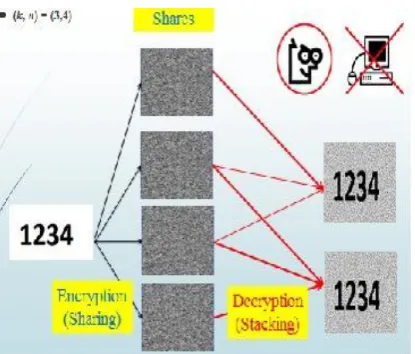
extended visual cryptography.The proposed methodology is implemented using Zk framework. Fig 1, Shows the result of creation and stacking of shares. In the registration phase the most important part is the creation of shares from the secret image where one share is kept with the user and of rest of the share can be kept with the server. For login, the user needs to enter a valid username and password which is provide by OPS system at the time of registration. So it is two layer security. This is implemented through extended visual cryptography using k out of n scheme.
Example:-
Fig. 1-Example of (k.n) cryptographic scheme
A SYSTEM ARCHITECTURE
Login
Voting Admin
c
User Reg And Modification
Candidate Reg And Modification Result
Share Generation
Share 2 Share1
Share 4
cc
Share 3
Stacking
Online Polling System
cc
cc
cc
cc Result
cc
cc Email Handler
Share 3
Share 4
cc
cc
Share1
Share 2
cc cc cc
Fig. 2 System Architecture
B MAIN MODULES
1. Admin
2. Voter Registration 3. Voter modification 4. Candidate registration 5. Candidate modification 6. Share process
7. Email handler 8. Polling process 9. Result
Modules Description:
1. Admin
Admin module controls generation of election, voter registration, voter modification according to user/voter request, candidate registration, candidate modification, election generation process and displaying result.
2. Voter registration
Voter registration module controls registration process of the new user/voter in the supervision of admin.
3. Voter modification
Voter modification module controls the modifications of the already registered user/voter’s information as per the request to the admin.
4. Candidate registration
Candidate registration module controls the registration process of the candidate who is nominated for election.
5. Candidate modification
[image:3.595.37.245.323.500.2]© 2016, IRJET | Impact Factor value: 4.45 | ISO 9001:2008 Certified Journal | Page 166
6. Share process
Share process module controls generation and stacking of the shares.
7. Email handler
Email handler module sends mail containing one of the shares generated in the voting process.
8. Polling process
Polling process module handles polling process.
9. Result
Result module displays result of the election. Result can be displayed only by the admin.
Algorithm:
1.Generate the secret image from user’s unique ADHAAR ID.
2. Convert the secret image into no of shares. (Encryption method).
3. Send one share out of n share to the voter email ID and send rest of the shares to the OPS database system. 4. Authentication can be done using stacking of shares from both side such as download share from voter email ID and rest of the share fetch from OPS database.
5. Comparison between secret image and stacked image will decide if voter is valid or not.
V ADVANTAGES
Visual Cryptography separates a secret image into two parts knows as shares which give no hint about the secret image. The secret image is revealed only whe shares are combined together by superimposition. First advantage is , it is simple to use and no mathematical computations required to reveal the secret image. Secondly, those who don’t posses any knowledge about of cryptography can indirectly gets involved in the process of decryption.
VI CONCLUSION
The propose system is very useful and safe for online polling. This system is web based application so that it can be accessed by any authorized person anywhere in the world through internet. This is two layer security which is useful to avoid the unauthorized users. Online Polling System offers many benefits including low cost & increased voter participation. Remote Voting system considers security & human factors carefully and mainly considers that they provide voters reliable and intuitive indications of the validity of the voting process.OPS is currently not used in India. To simplify job of election officers, to provide fast election process, with minimal cost, reliable and secure process, the remote voting systems are evolved. In traditional voting system there was no strong security mechanism for voter authentication. With traditional voting, voters authenticate themselves by providing identification or an affirmation to a trusted poll worker; a poll site authenticates itself to a voter by being at a well-publicized physical location and having officials representing several different organizations present. Main aim of this methodology is to provide complete privacy to the voter and to make the best integration of the voting system. The core concept of this system is to use strong security mechanism for voter authentication. Visual cryptography encrypts the information in such a way that decryption can be done without using any mathematical computations.
ACKNOWLEDGEMENT
I would like to express my gratitude towards my guide prof. Amrit Priyadashi and H.O.D of computer engg. Department Prof. Sayyed M. M for their support and guidance in my work.
REFERENCES
© 2016, IRJET | Impact Factor value: 4.45 | ISO 9001:2008 Certified Journal | Page 167 [2] Adi Shamir(1979),”How to share a Secret”,
Communication of ACM, pp. 612-613
[3] M. Naor and A. Shamir, Visual Cryptography, Springer,pp. 1-12
[4] Scott Wolchok, Eric Wustrow, Dawn Isabel, and J.Alex Halderman,(2012),”Attacking the Washington, D.C. Internet Voting System”,In Proc.16th Conference on Financial Cryptography &
Data Security,pp. 1-18
[5] Carlo Blundo,University of Salerno,Alfredo De Santis and Douglas R Stinson(1998),”On the Contrast in Visual Cryptography Scheme”,pp. 1-28 [6] R. Youmaran, A.Adler,A.Miri,”An Improved Visual Cryptography Scheme for Secret Hiding”,23rd Biennial Symposium on